The Harry Potter club

harry-potter-club

Every semester a new group of them arrives, fresh-faced, wide-eyed, often clutching owls or wands, quivering with excitement and  ready to be sorted into one of the four houses … no, they’re not at Hogwarts. These are third, fourth, and fifth grade students who signed up to be in the Harry Potter club at our magnet school.

A colleague and I are the founders, the “co-deputy headmistresses” of the club, formed in conjunction with the school’s mission to expand arts and science integrated opportunities for the students. Staff chooses what to offer; students can sign up for anything from cooking classes to a foreign language to astronomy. Since it began, the Harry Potter club has operated at maximum capacity. Once we know students’ names, they receive their own rolled parchment letter of acceptance (as yet not delivered by owl, but we headmistresses are working on that).

My colleague and I expected to have fun – after all, we chose a theme that was fun for us. We expected that the kids would have fun, and they do. From Day One when they are sorted with the help of an online quiz  – we call it the “technological Sorting Hat” and we always end up with an alarming number of Slytherins, prompting discussions about character traits – through sessions of making their own wands, Quidditch pencil brooms, golden snitches, and patronus pictures, the students savor every moment. One of us, a teacher or student volunteer, reads aloud from the books while the club members work on their crafts. As students are sorted, someone reads Harry’s sorting experience to the group; when students make wands, one of us reads the scene where Harry goes to Ollivander’s for his wand. All students chime in right on cue, because they’ve seen the movies and they know: “The wand chooses the wizard.”

What my colleague and I didn’t expect were the far-reaching effects. Parents frequently tell us: “My child is SO excited about being in the Harry Potter club!” We didn’t expect the depth of the discussions students would initiate on their own, regarding various characters and their motivation:

“Professor Snape was really protecting Harry the whole time, not trying to hurt him.”

“That’s because Snape loved Harry’s mother – they knew each other when they were little, before she knew Harry’s father.”

“It was Harry’s mother’s love that protected him – she died to save him, and that’s why Voldemort couldn’t defeat Harry.”

One would have expected students to be drawn most by the magic, the fantastic, or the old good vs. evil theme, but at the ages of eight to ten or eleven, the students talk more about love, the huge, shining thread that winds through the stories and ties them all together.

My colleague and I certainly never anticipated one student’s attending the club from its inception to the day he left for middle school. As the club is in high demand, repeaters are not usually allowed. One of his teachers made the appeal: “He doesn’t like school, but he loves the Harry Potter club. He’s always here on club days. Can he please be in it again?”

His mother said: “It’s all he ever talks about – the Harry Potter club.”

Our young friend turned out to be a jubilant Gryffindor (as is yours truly, for the record). By his third go-round in the club, he was made Head Boy; he coached newcomers on club matters. He occasionally stopped by my room to discuss Potter trivia and other topics of his interest, always smiling. When he graduated from the fifth grade, my colleague and I presented him with a Hogwarts T-shirt. He wore it for the ceremony.

Just before his departure, our veteran member was asked why he loved the club so much. His brow furrowed in thought for a moment before he replied: “It’s this whole story about a boy who loses his parents and everything is hard for him all the time, but he still tries to save everyone. He’s so brave.”

He paused. We listeners wondered, with tears brimming, what sage, profound connection might be coming next. Our Head Boy just shrugged: “And there’s no Star Wars club.”

Ah, perspective.

Reflect: The power of story is limitless. Read a story to someone. Tell yours. It matters.
 

Why I write 2016

writing

I write because it’s the closest thing there is to magic.

From words spring worlds.

Worlds of understanding, perception, knowledge – of humanity and of myself. I write to explore the world without and within, the real and the fantastic, the important and the insignificant, the extraordinary and most certainly the ordinary. Where there are ideas and images, there are words – lanterns for encircling thoughts, illuminating objects and scenes, mystically shining from one mind to another.

I write because the narrative voice in my head is continuously composing, often drowning out other important things.

The power of story compelled me to write when I was six years old, sitting at the living room coffee table with a pack of wide ruled paper and a fat pencil. A few years later, a teacher said, “What vivid descriptions! Keep writing.” Every year thereafter, a teacher strategically appeared to give a refining bit of feedback: “Wonderful writing. Here’s a way you can make it even better … and keep writing!”

I kept writing, even when my dad grumbled, “Why are you wasting so much notebook paper?”

Today, I write with children. I witness their discovery of their own voices, their courage in putting pieces of their souls on a page. I share in the excitement of their creations, in every little triumph over challenge. I work to empower teachers as writers, for the empowerment of student writers, that all might tap into the magic.

And I keep writing.

I write to wrap a cloak of immortality around everything I have loved – what was, what is, what will be.

I write to scatter the ashes of all my yesterdays, to walk in the light of all my tomorrows.

I write to celebrate having lived.

In honor of National Day on Writing, October 20.

Reflect: Why do you write? What have you wanted to write, but haven’t yet? Carve out a pocket of time today and begin. Tomorrow, repeat.


A poem of friendship

Through clouds of gray will softly shine

a gentle silver tear of mine,

leaving lines to slowly trace

an empty soul, a lonely place.

A golden glow you gave to me

to help me through eternity –

light and warmth with which I try

your own sweet rains to somehow dry.

And we two have learned to see

the me in you, the you in me.

A golden ray through a silver drop

create such colors; they cannot stop.

What blazing brilliance we have sown,

this iridescence of our own!

Combine our souls and we will show

our strength lies in our rainbow.

-Written when I was fourteen. The UK’s National Poetry Day brought this early effort back to mind.

Reflect:  What metaphor captures the beauty and power of your dearest friendship? 


Cicada rhythm

cicada-on-post

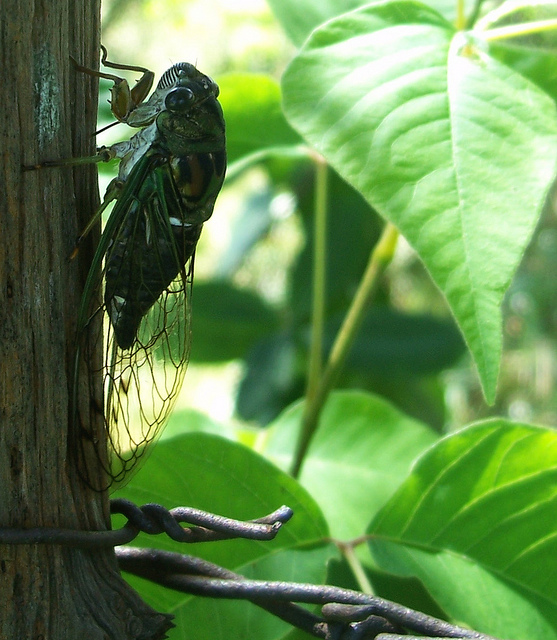
Image: Cicada on a post. Jo Naylor CC BY 

Summer is dying now, taking with it one of the things I love best: The song of cicadas.

If you’ve ever heard cicadas in full throttle, you might not agree with “song” as a fitting description of their cacophonous buzzing. It’s not pretty. The noise can be deafening.

Yet when I hear that first discordant rattle sometime in May, my spirit rises, my own heart sings in response.

The song of cicadas calls to me from long ago, when I was a little city girl spending sultry summers in the country. The song evokes narrow dirt roads keeping an ominous forest from encroaching on rustic homeplaces, tiny cemeteries where baby after baby is buried under white monuments adorned with lambs, and the old church just around the bend. The song is one of ages, the rising and falling of generations, all of us coming and going in our time. It is a song reverberating with tire swings hanging from pecan trees, canals teeming with frogs and turtles, white-tailed deer bounding up from lush ditch banks along fields at dusk. It is the bright song of the sun, of hope, of continuity. It is the dark song of the night, oddly comforting; something out in the blackness is vibrantly alive, maybe keeping watch, while children drift off to sleep. It is the sound of safety, stability, belonging. Calling and calling, the crescendo mirrors the rhythm of life, brimming with promise, echoing eternity. When I hear it, I am a child again, no matter how many summers have come and gone. My home is in the countryside now and it is with a deeper pang each September that I note the song fading out. Every May, as I mark another year of my existence, I listen for the first returning rattle. You’re back! my heart sings. Ah, but we were here all along, they might say, if cicadas had words. There’s a lot of living and loving yet to do. You have today. Carry on.

Reflect: What’s one thing in nature that inspires you? Why?