Life imitates art

img_0527

“Life imitates Art far more than Art imitates Life.” -Oscar Wilde

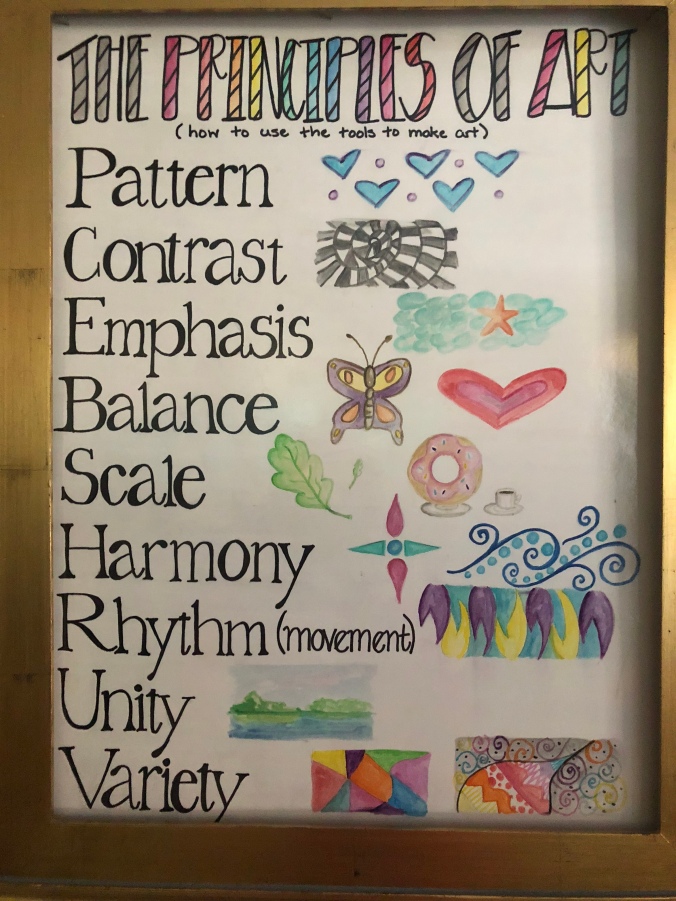
When I saw my colleague’s handmade “Principles of Art” on the wall of the art classroom, I thought: Wait – couldn’t these be principles of life, too?

Inspiration struck; in fact, it dared me to try . . . so, here goes . . . .

How to Use Tools in Life

Pattern

Let us step away from repetition; save it for rhythm. Think instead of a template laid before us, with diagrams and guidelines, a model to be examined before cutting to fit who we are and are becoming, always making the necessary alterations as we go. 

Contrast

—isn’t easy, might be painful, but is necessary, for it makes elements that need to be seen stand out: the good, the bad, the ugly. It also makes better and best possible, for it is in differences that we find beauty, that we reach beyond realms that we know into those we don’t; this is how we grow. 

Emphasis

Find your focus. What’s WORTH emphasizing? Everything cannot have the same intensity or there’s no big picture, no real vision, and meaning is lost. 

Balance

—means stability. Not attempting too much or too little. Too much and we become oppressed, paralyzed, ineffective. Too little, and we become bored, listless, unproductive. Balance is achieved by planning for it, knowing that the work and the break from the work are essential, equivalent, and correlated gifts. 

Scale

—is about relationships. And perspective. It takes courage to see these as they are. Healthy relationships are in proportion. Unhealthy ones are not. A whole must relate to another whole, not to parts. The only person you can adjust is you. Use your power wisely.

Harmony

Finding common ground, honoring inherent sameness, coming to a pleasing agreement or resolution, is finding our place of belonging, one to another.

Rhythm (movement)

—begins with the beating of our hearts. Humanity is meant to to make music, sing, to dance, to run; rhythm is exciting, reminds us we are alive. It is not random. It is structured. It is anticipated. It is a recognizable, repeated pattern necessary for order and flow. It’s all about the right timing.  

Unity

—is about overall clarity and completeness. It occurs only when all individuals, all pieces, are in harmony with one another. Clutter and confusion are gone.

Variety

Ah, the spice of life . . . intricacies, complexities, diversity, the delight of the unexpected . . . all that transforms existence from an interesting experience to one breathtaking adventure. 

Double challenge: Re-read as 1) Tools for writing and again as 2) Tools for teaching.


What delighted you today?

Narnia

Narnia. Mark IrvineCC BY

The sky became bluer and bluer and now there were white clouds hurrying across it from time to time. In the wide glades there were primroses. A light breeze sprang up which scattered drops of moisture from the swaying branches and carried cool, delicious scents against the face of the travellers. The trees began to come fully alive. The larches and birches were covered with green, the laburnums with gold. Soon the beech trees had put forth their delicate, transparent leaves. As the travellers walked under them the light became green. A bee buzzed across their path. 

“This is no thaw,” said the Dwarf, suddenly stopping. This is spring . . .”

—”Aslan is Nearer,” The Lion, the Witch and the Wardrobe, C.S. Lewis

What delighted you today?

That it’s the first day of spring delights me.

The beautiful description of spring coming after a hundred years of winter (but never Christmas) in The Lion, the Witch and the Wardrobe delights me.

That I remember first reading that passage at age ten delights me.

The painting of a child in a green forest clearing, reaching out to pet a deer that may be merely a statue, or might be real, or will become real at the touch of her hand, delights me.

—I’ve decided to notice things that delight me, every day.

As way of stopping to breathe in the daily grind, of pushing back the domineering world, of finding a moment of stillness, even seconds of stillness, to savor something I see, hear, taste, touch, smell—or simply sense within my soul.

Such as:

the three finch eggs in the nest on my front door

birdsong early in the morning

my youngest son asking when I’ll be home so we can go walking

my husband’s laughter

Henry the dog’s ecstasy at any sighting of me

finally writing something down after its wings have beating in my head or heart for ever so long

What delighted you today?

All around us are affirmations, if we open ourselves to receive them. The wondrous exists in close proximity, is even ours for the taking, if we remain aware. As grand as a bald eagle at the roadside, as pure as the light in a child’s eyes, as simple as a stranger passing by with a genuine smile and a “Hello! How are you today?”

What delighted you today?

Might even pay to keep a journal of delight, to read and re-read when most needed, to create a pocket of peace amid the clamor, to strike a spark in the dark.

Every day has its gifts, small and great, that await.

What delighted you today?

—And what delight will you be?

The gift

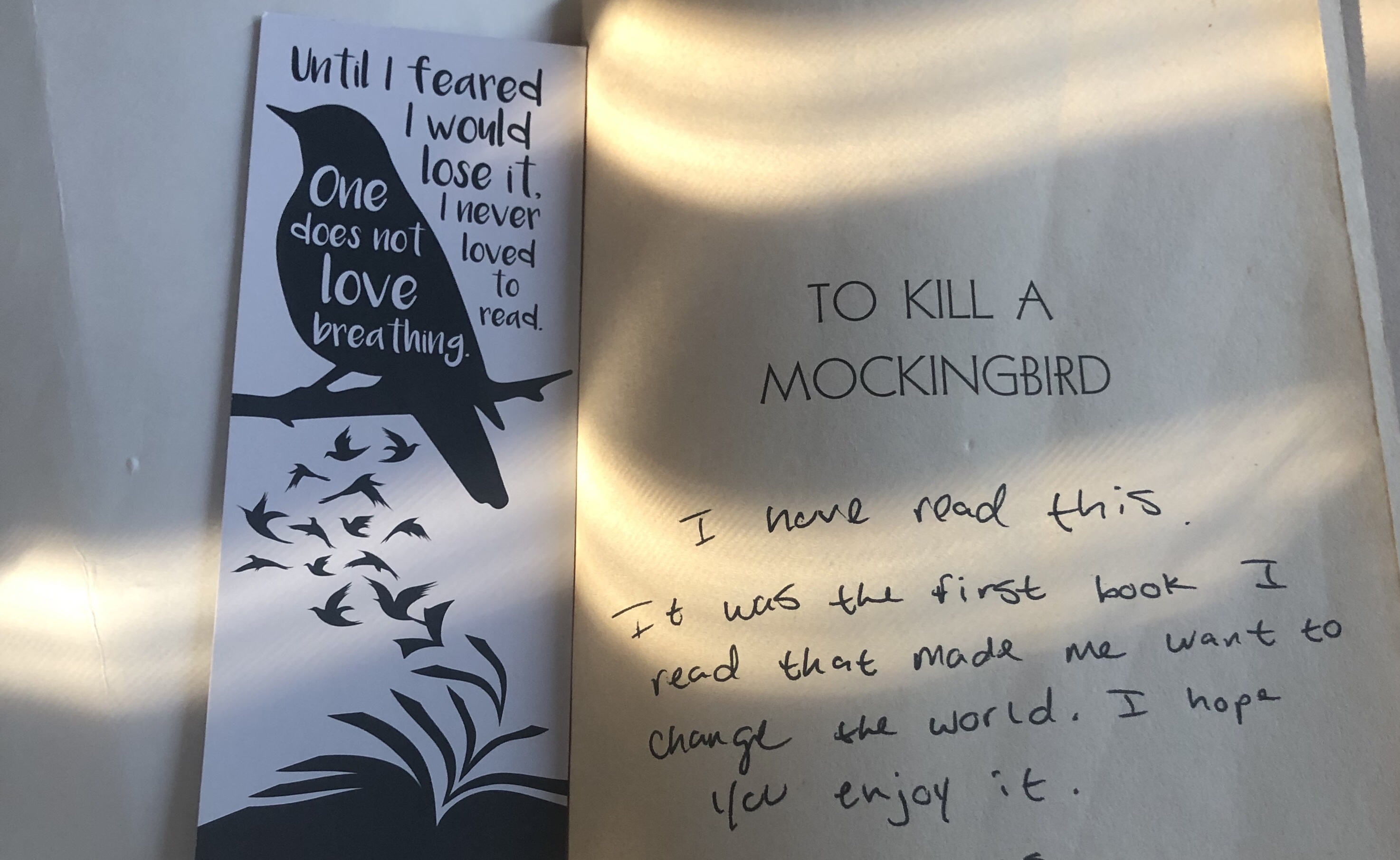
I remember what you wrote but I came to find the book anyway, to read the inscription again.

I hold it in my hands and think about you for a long, long time.

You were the baby who was always smiling, the cheeriest toddler, until I had to launder your blanket. Then you leaned your head against the washer and cried.

You were the little boy in preschool who sat beside classmates on the playground when others overlooked them, excluded them. From the start you noticed the outcast, offered comfort, pulled for the underdog.

You were:

The winner of the Principal’s Leadership Award at the end of your senior year.

The college student who started teaching the men’s Sunday School class at church.

The young man who returned to high school, where your Leadership Award still hangs in the front office, to teach Social Studies. Remember how, when you were setting up your classroom, you cleaned out a cabinet and found your old history exams in that stack of papers?

The teacher who taught your students to dance the Charleston—and who taught your own brother in AP U.S. History (your Dad and I weren’t kidding when we said, “Don’t even THINK about calling us in for parent-teacher conferences”).

The soccer coach who built the program and took the team to the State playoffs for the first and only time. 

An inspiration to so many kids. Their parents still tell your father and me.

I remember it all.

Teachers don’t make a lot of money; you took an extra job at night.

I remember the call. You’d been taken to the hospital. You’d been assaulted. Emergency surgery, jaw wired shut, liquid diet for six weeks. Having to carry wire cutters if you should vomit, or you’d suffocate.

How you chose to visit that young man in prison, forgave him, became his friend.

How you adopted a rescue dog, reached a crossroads in your life, came back home, quit teaching, enrolled in seminary.

Almost immediately followed by your meeting the loveliest young woman and her little girl.

I think about all these things as setting sunlight spills through the blinds onto this book in my hands, illuminating the words you wrote to me that Christmas, years ago:

It is the first book I read that made me want to change the world.

You may not think so, but you’ve been changing the world since the day you first entered it, baby boy. One word, one breath, one heartbeat at time.

I’m quite sure you always will.

Maybe we should have named you Atticus.  

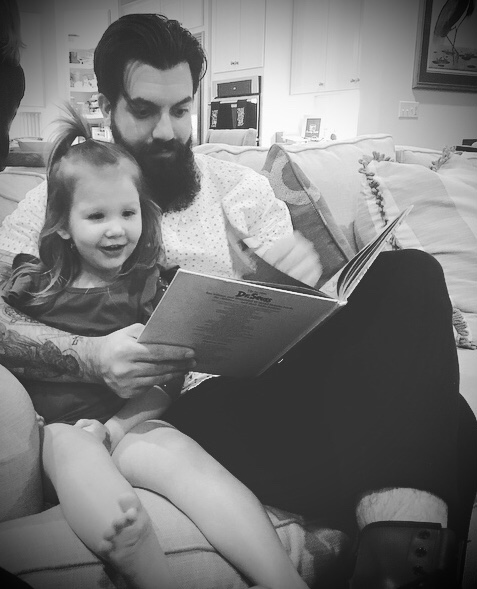
No matter, for things have a way of working out as they’re meant to. I watch you with your new loved ones. I marvel at the gift of it all, the sheer poetry of life writing itself a day at a time, in the most curious of rhythms—like how pages of a book that stirred your heart long ago should come to us, living and breathing, a young mom who loves the same book, and in a little girl named Scout, crawling into your lap for a story.

The star

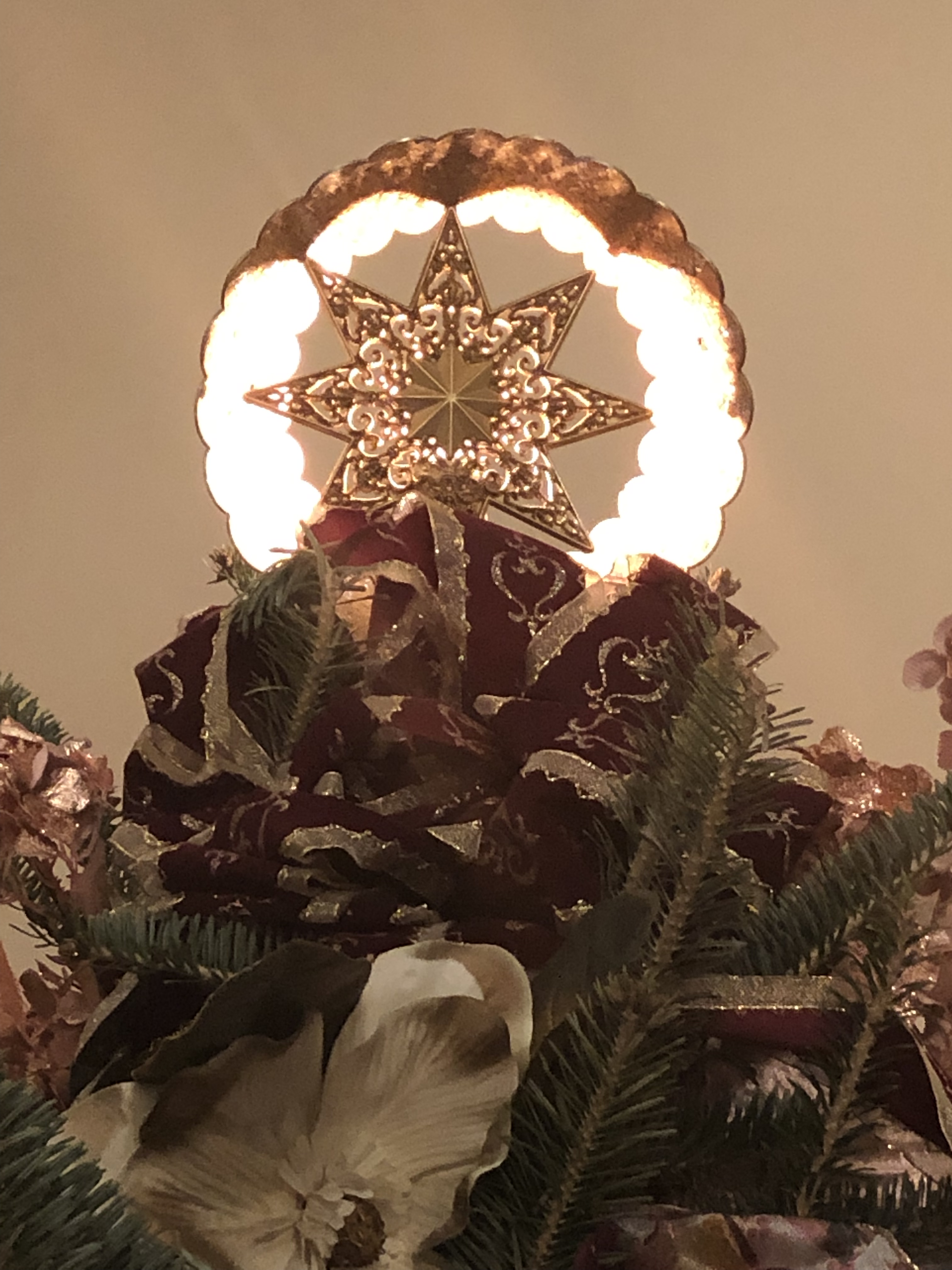
The first Christmas that we were married, my husband and I bought a star tree topper at a drugstore.

That was over thirty years ago.

The star was silver then.

Eventually I sprayed it gold so it would better match ornaments on the tree.

Every year I have to reinforce it with hot glue and duct tape. And every year I say it’s time for this old star to go.

But it still shines.

And I can’t find another tree topper I like better.

It’s older than our children. It’s presided over Christmas for their entire lives.

It’s outlasted the gingerbread ornament that my youngest made in preschool. The sweet ornament crumbled after a decade or so—ashes to ashes, dust to dust, gingerbread to cinnamon and cloves. Spice of life, formless and void, fragrant fragments in my hand when just the Christmas before, it was whole.

The star shone on when other lights went out, one by one. Lights in my life, not those of man-made strings on the tree. This star glowed above me as I decorated, year after passing year, listening to a particularly poignant version of Jesu, Joy of Man’s Desiring that pierced my soul. The haunting chords stirred an almost unbearable sense of loss. Of time, of people, of the inevitability of it all. For a moment, though, under that star, somewhere in the music, in the light, in the season, those who loved me were near again. Not visible, not tangible, yet present, perceptible. Very near.

It stands within its own circle, this star. I think of all that might symbolize. The circle of life. May the circle be unbroken. A wedding band, a halo, a covenant. Wholeness, holiness.

It is fragile.

It is old.

But the star hangs on. It still shines.

With Christmas grace.

September 1st

Morning glory

Morning glory. Toshiyuki IMAICC BY-SA

 In the half-light

the barest fog

wisps about the trees

silhouetted against

a colorless sky.

The stars have gone.

Stillness but not silence

just the faintest thrum

of summer symphony

by insects of the night.

The last long encore.

Cool expectant breath

of the dawn

before day is fully awake

like the rooster nearby

with his rusty, lusty cry.

Circadian rhythm. All is well, is well.

I stand

under the haloed half-moon

drinking in the glory

of life

 even in its transitions.

Even in

farewell, farewell, farewell.

What is literacy?

Museum of the Navy

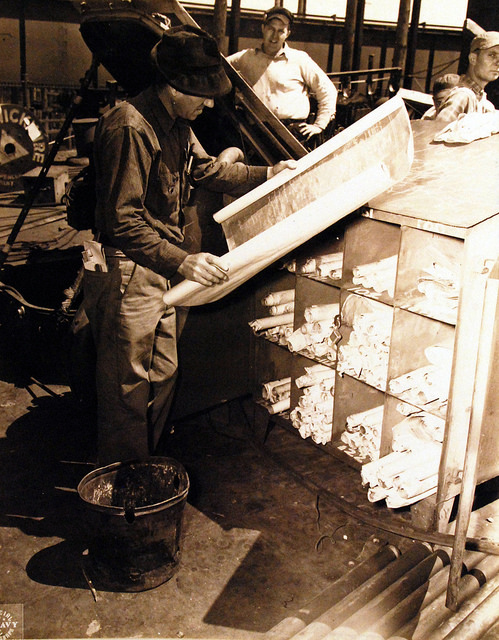
Quarterman shipfitter looks at blueprints, 1943. Museum of the U.S. Navy

“Literacy is the ability to identify, understand, interpret, create, compute, and communicate using visual, audible, and digital materials across disciplines and in any context.

The ability to read, write, and communicate connects people to one another and empowers them to achieve things they never thought possible. Communication and connection are the basis of who we are and how we live together and interact with the world.” 

International Literacy Association, 2018

On the eve of the New School Year, I contemplate my role in the scheme of things. In the face of changes in staff, in curriculum, in differing perspectives on literacy instruction.

I am defined by literacy. I’ve loved reading and writing all my life. My professional work is literacy: As a coach, I collaborate with teacher colleagues across grade levels on how to best teach English Language Arts in ways that meet the needs of all students.

When it comes to defining literacy, I rely on the International Literacy Association, for no two dictionaries, and hardly any two people, seem to have the same idea of it. Some believe it’s just reading and writing. But it’s so much more . . . .

In the ILA definition several things jump out at me, beginning with

the ability to interpret

in any context

I think of my grandfather.

Over a hundred years ago, my grandfather left school to work on his family’s little North Carolina farm. He married during the Great Depression. When tenant farming, sharecropping, and other odd jobs like painting houses weren’t enough for him to “make a go of it,” Granddaddy rode with men from his hometown to Newport News, Virginia, in hopes of landing steady work at the shipyard.

Granddaddy became a shipwright, responsible for helping build the keels of ships, less than a year before Pearl Harbor. When America entered World War II, production continued around the clock with the invention of a new thing: aircraft carriers.

He made his living; he took care of his own. He retired from the shipyard when I was five. He and Grandma moved back home and there I spent my childhood summers.

In the evenings he sat in his recliner while Grandma and I sat on the living room floor. She spread the newspaper out on the carpet, handed me the “funnies” section, and then she read the rest of the paper in a loud, clear voice to Granddaddy—his years around industrial equipment in the Yard had made him hard of hearing.

I eventually asked:

Why do you read the paper to Granddaddy? Why doesn’t he just read it?

He can’t, Dear. 

Why? Is something wrong with his eyes?

No, no. He just never learned to read, not much, really. He quit school in the fourth grade to help on his family’s farm, you see . . . .

I was stunned. This was the first time I’d known of anyone who couldn’t read.

It hurt my heart for him.

But I later learned that he could read intricate blueprints and build to those precise measurements. That’s what he did at the shipyard all those years.

It’s something I can’t do.

 the ability to identify, understand, interpret

using visual

materials across disciplines

and in any context

My grandfather was always a farmer first; he read the days, the seasons, the weather.

He read nature. When he and I came across strange worms gliding over his front sidewalk, he couldn’t identify them but instinctively knew to leave them alone. Decades later I researched them (land planarians) and learned that if he’d tried to crush or chop them up, every piece would have replicated and they would have destroyed the good earthworms that kept his garden so abundant and healthy.

Signs, symbols, meanings, he understood. Not in or from books, but from life. He possessed visual-spatial acuity. Keen intuition. He read the times in which he lived, comprehended that the way of life he and the generations before him had known was passing forever. He reached for better things. He worked hard. He collaborated with a lot of different people. The shipyard management eventually asked him to be a supervisor, and that’s where his courage ran out. It required regular paperwork. He declined the position.

My heart ached again, deeply, on learning that.

The ability to read, write, and communicate connects people to one another

and empowers them to achieve things

they never thought possible.

That belief is behind everything I do with teachers and students.

The greatest man I’ve ever known indirectly taught me, years ago, that reading and writing are the keys to opening doors of possibility and opportunity. He also taught me that literacy is so much more, long before this digital age.

We have to be able to read words and ascertain their meaning, but our survival depends on more. We must be able to read the times, read people, read what we see, what we are creating. And make sense of it. We must interpret. That’s the entire, inherent value of reading and writing in the first place.

We must communicate well with one another, recognizing that each of us possesses different strengths, all of which are valuable to helping each other. Communication is the keel on which all good relationships are built. We must speak, but we must listen more, absorb more, understand more.

Communication and connection are the basis of who we are

and how we live together

and interact with the world.

My grandfather survived—his family survived—because of his clarity of vision and sense of purpose.  He knew he lived through unique times. In his last years he preserved his life experiences for future generations not by penning a memoir but by recording his stories on a set of audiotapes. I don’t think he ever knew just how unique, how extraordinary, he was. In my mind I see him now—thick white hair, plaid shirt, gray pants with a black belt, black shoes, his big, wrinkled, work-worn hands folded in his lap, leaning back in his recliner listening to my grandmother reading. In addition to the nightly newspaper, she read the Bible through to him each year.

And so, on the eve of the New School Year, I contemplate my role in the scheme of things. I think of the constant adaptation of teachers to the times and the changing tides of literacy instruction; of students, each of whom has strengths and gifts that may not be obvious at first. I think of their futures and know that clarity of vision and a sense of purpose are vital to their learning and well-being. To all of our well-being. I think of my grandfather reading complex blueprints and going forth to build something previously unknown in a vastly changing world. I think about life literacy as well as literacy for life. How we live together and interact with the world.

For, in truth, we are building the world.

*******

Here’s the story of Granddaddy and me encountering those unknown worms long ago: First do no harm.
A fine mess

After being away on vacation all last week, my first order of business on returning home was to check on the four baby house finches that hatched in the wreath on my front door. I’d been chronicling their development daily, so I knew many changes would occur in my absence.

Here is what I discovered:

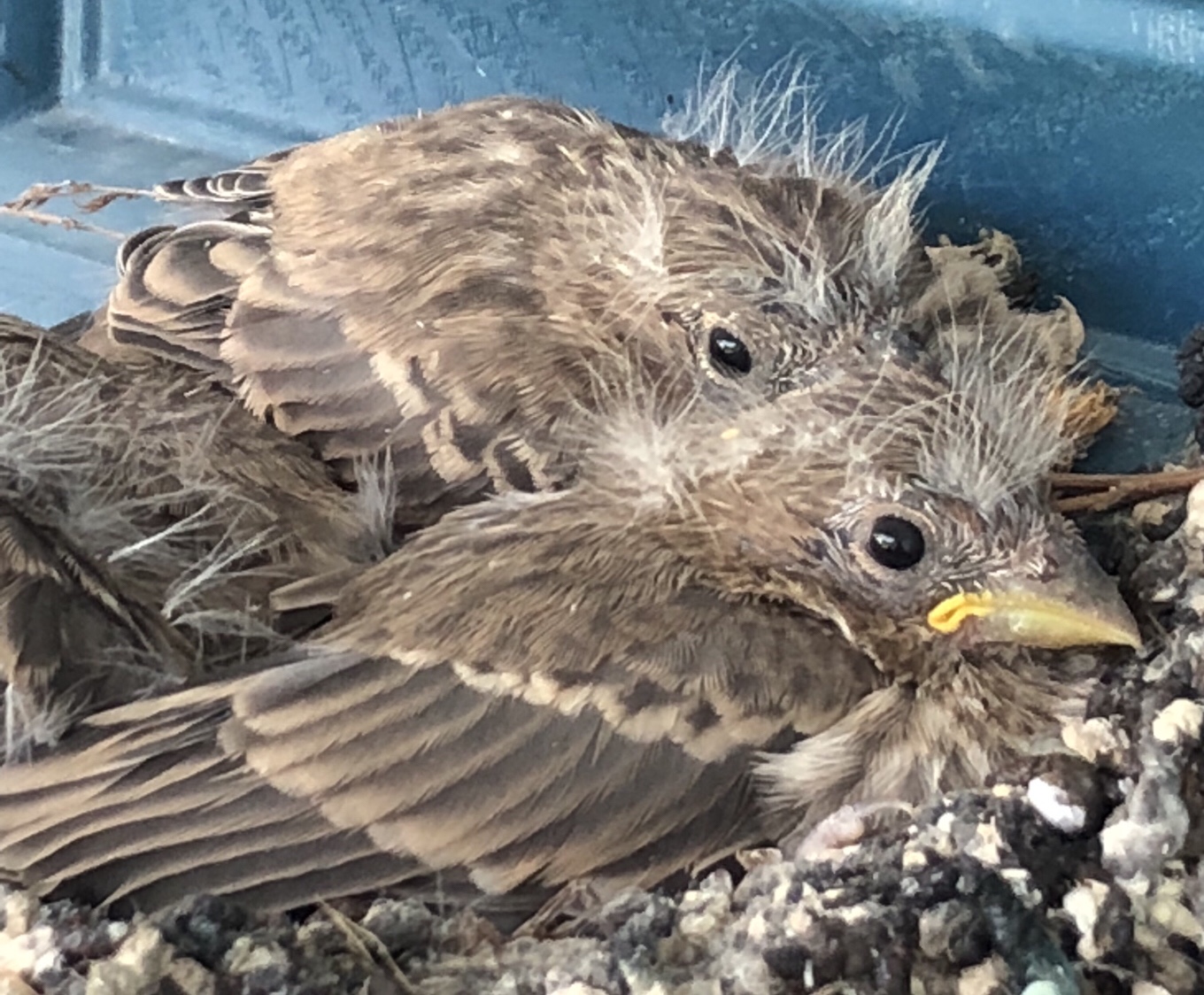
1) The babies are now well-feathered; their skin-head mohawks have become mere wisps upon their downy crowns.

2) Two of the babies can fly. They sailed out of the nest this morning as I approached. The other two stayed put, their bright little eyes regarding me with a mixture of curiosity and apprehension.

3) Their nest is one spectacular conglomeration of droppings.

To be fair, the droppings are only around the rim; the mother collects them there. What a job, building a wall of excrement. Worse than diapers. When I first wrote of the perfect, flower-graced nest, the pale blue eggs, the hatching of the tiny pink nestlings, I concentrated on the beauty and wonder of life. I pointed out that the collective noun for a group of finches is a charm.

And charmed I was.

There is nothing charming about that nest now.

The fledglings themselves, of course, are enchanting. They’ll soon be gone, the circle of life will go on, and all that will remain of these magical moments is a monumental mess.

But that’s the story of life. It’s messy. It can’t be comprised solely of breathtaking beauty and newness; if it were, we could not recognize these moments for what they are. They’d lose their value. Only when contrasted with ugliness, hardships, and pain can we see and cherish the beautiful when it comes. We inevitably deal with messes, some that occur naturally, some created by others, some of our own making. Therein lie all the stories . . .

Which makes me think of writing. This nest is a tangible (although I do not wish to touch it) reminder of these commonalities:

-Life is messy.

-Writing is messy.

-Thinking is messy.

-Teaching is messy.

To do any of these well, we have to be willing to accept and even embrace the messiness. We must certainly persevere through it to arrive at the beautiful. It takes courage, stamina, and a lot of hard work, to write well, to think well, to teach well, to live well.

The strength to do so, I believe, lies in believing that the beautiful will come. It’s all a matter of trust, of faith. And pressing on.

Although I was appalled by the quantity of accumulated—um, bird-doo—around the nest, I was also amazed that two of my four little finches could fly. Last night they couldn’t; today they can. Tomorrow the others might.

This is a message to me about readiness.

Everyone arrives as a writer, a thinker, a teacher, a good practitioner of life, in their own time. Lots of messes will be made along the way. Sorting this out is what grows us. One by one, as children, as adults, as long as we live, we are continually growing the necessary wings to fly beyond where we are. And it’s truly a collective, collaborative growth; we are to nudge each other when needed, but not too hard, too soon. We’re not to hold back, to hold one another back, simply because we cannot see all that lies ahead and for fear of navigating the unknown. Knowledge comes by trying. By experiencing. By taking risks. There’s an implicit difference between throwing caution to the wind and taking a leap of faith, that being potential self-destruction versus healthy maturation. These finches know. As the day wears on, I watch the two fledglings that can fly going back and forth from the eaves to the nest, coaching their other two siblings on how to do it. See see see, I hear them cheeping. A bit at a time, a bit at a time. At any moment, those last two are going to get up on that nasty, messy rim and let go.

In more ways than one . . . .

So you make a mess. So what? So you’re alive and growing.

Tomorrow you stretch your newest feathers and find you can move on.

To where the beautiful awaits.

Charmed


The door to my home is now charmed.

By a family of finches.

I’ve been researching house finches since a pair of them persevered in rebuilding a nest on the wreath adorning my front door, where the mother laid four tiny blue eggs (see last week’s post, Sanctuary). I discovered in my reading that the word for a group of finches is a charm.

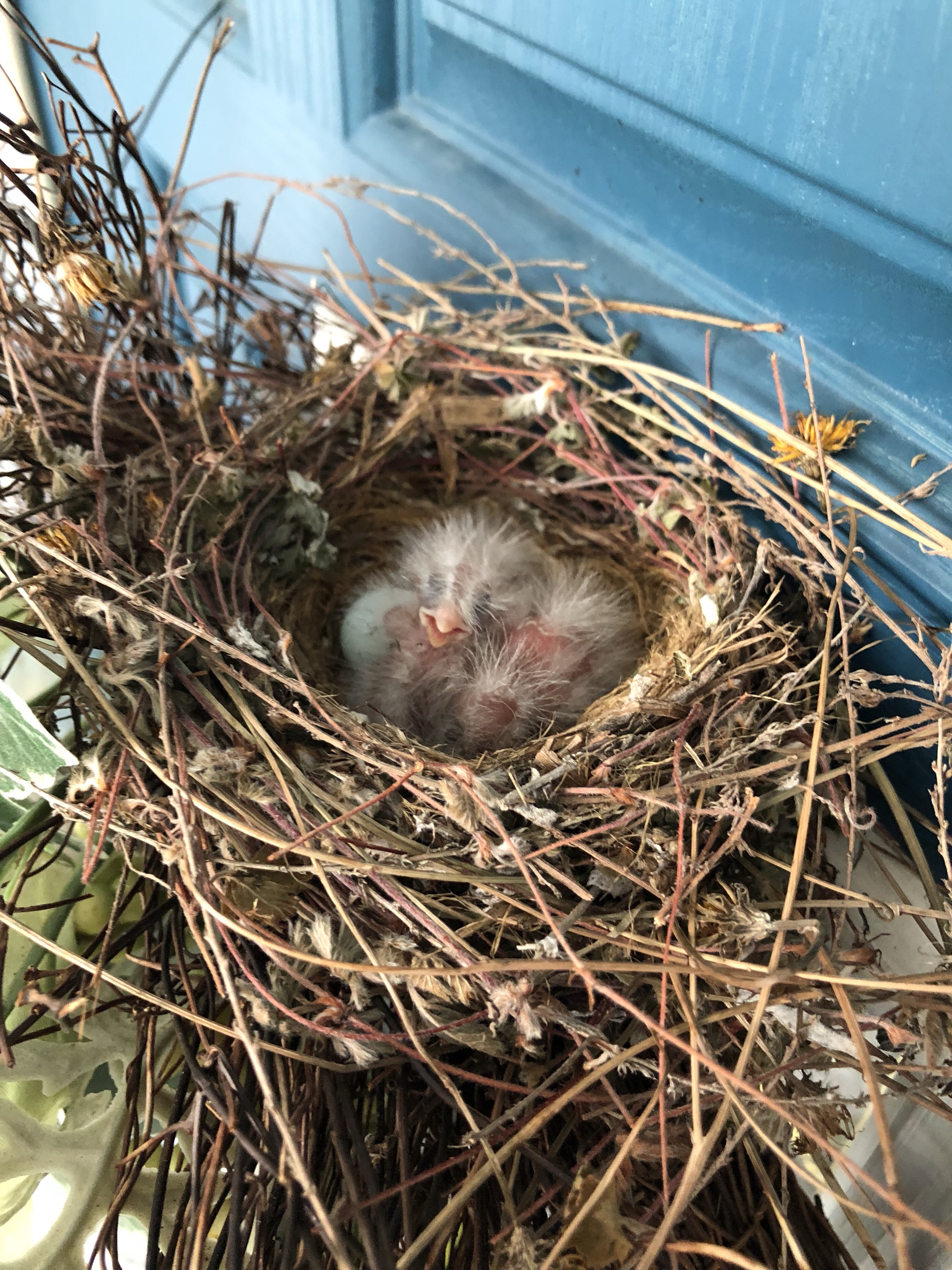
A word of delight, enchantment, magic . . . very much what I feel as I step into my bird sanctuary to check on the babies. The last egg hatched early this morning. The mother removed the eggshells after each hatching so now there’s just four pink things with tufts of gray-white feathers huddling close to one another, so tiny that they’d all fit easily in the palm of my hand with room to spare.

I think: They’re so fragile. Yet so hardy. 

A paradox describing life itself.

With every glimpse of the hatchlings I am filled with the glory of being alive. That they are alive, changing every single moment. That I am alive to see them. My door is their sanctuary; they are my miracle. That this is the ordinary course of things does not make it any less so; we will never have a sense of the miraculous if we cease to look for it.

I wonder what the babies will think of me, this formidable being who briefly appears and disappears by the rim of their dwelling. I do not want them to be afraid. I can offer my bird family nothing but the safety and shelter of my porch roof, but, truth is, the mother and father chose the place and it had nothing to do with me. The mother flies to a nearby pine when she sees me coming, so I limit my visits to once a day for a few seconds. I get my fix of awe and get out of the way.

Honoring the life that came into my sphere.

There are so many directions I might take this post, as a mother, as a teacher, as a literacy coach, as a writer. I will let it rest on the level of human being: Honor the lives that come your way. How you do so is the shape and artistry of your own life. It is what we’re meant to do, every bit as much as the mother finch was meant to design her beautiful, dandelion-laced nest for the lives it now holds.

I am grateful for my tiny charm of finches, profoundly grateful for life itself.

Charmed, indeed, in so many ways.

Incidentally, charm comes from the Latin carmen, meaning “song” and “verse.” The babies are silent right now but in a few days they’ll be peeping, eventually singing. Finches are songbirds. All in all, I cannot think of a better word to collectively describe these little creatures.

Although I intentionally didn’t mention before that the other word for a group of finches is a trembling.

Again so perfect.

Not for describing the finches, however. For describing me as I stand in the quiet of my porch sanctuary viewing the new pink life, holding my breath, a wordless song swelling in my heart, trembling at the minuteness and magnitude of it all.

img_0024

As the last egg was hatching


Help

Help

“Help.” James JohnstoneCC BY

As I entered the darkened cinema auditorium, an attendant handed me a pack of tissues.

Foreshadowing at its best.

The tears come at various points throughout the viewing of Won’t You Be My Neighbor?—the lovingly documented life and work of Fred Rogers.

Mr. Rogers operated from a profound wellspring of love and empathy for children. At the outset of the movie, he’s young, seated at a piano. The film is black-and-white. With his hands on the keys, Mr. Rogers speaks of modulations: “It’s fairly easy to go from, say, a C to an F,” he says, playing each chord. “But to go from an F to an F-sharp,” he models, “you must navigate all sorts of things.” He saw the new medium of communication, television, as a means of helping children navigate the modulations of life. Fears. Changes. Questions. Emotions. A country at war. Hatred. Not understanding. Divorce. Illness. Death.

I watched and listened with the ears of an educator and the heart of a writer. This is my work, too, I thought, only my medium is paper and pencil. 

Then, after having helped generations of children through the modulations of life, came 9/11.

Mr. Rogers, then retired, was asked to help, his voice, his presence, once again a ray of light, this time cutting through incomprehensible darkness. In the documentary, the sorrow is etched on his face. He spoke of being tikkun olam, “repairers of creation.”

With his words I saw the world in all its brokenness, violence, despair . . . and thought, It begins with the world inside us. Repair begins there, within each of us, before we can work on the world without.

I thought of children I’ve known through the years, finding their voices through writing, facing their fears, overcoming them, gaining strength and courage. Children who have suffered loss and grappled with it in their own words. I’ve read the haunting account of a child being tortured in another country and celebrating his new life in the United States. I thought it was fiction until the third-person changed to first near the narrative’s end; the teenager was writing about himself. A second-grader whose mother was remarrying and her fear: “Will my stepfather like me?” A fifth-grader lashing out at her mother in the very first line of her memoir over how many times they’d had to move, and how it hard it was to have any friends.

And with the words that came from within, anger eventually melted to forgiveness, fears pointed toward hope, insecurities gave way to confidence and validation. With the writing, the stories became those of enduring, of overcoming, of celebration.

Repairing within.

I thought about how some educators look at writing only as a means of retelling what you know from what you’ve read, or a standard to be delivered, assessed, and crossed off a list. No time for this “touchy-feely” kind of  thing . . . yet the one thing that best helps children understand themselves, the world around them, and their place in it, is writing. Freedom versus constriction. Discovering potential, seeing possibilities, problem-solving. I’ve said it before, I’ll say it again: Why is the goal “college and career ready?” How about life ready?

For the modulations don’t end in childhood, do they, Grown-Up.

Mr. Rogers spoke of his own childhood and what his mother told him whenever there was a catastrophe, or news of tragedy, on the air; she said “Look for the helpers. There will always be helpers, even if on the sidelines . . . because if you look for the helpers, you’ll know that there’s hope.”

Look for the helpers. Repairers of the world.

Then be the hope.

And . . . write.

Tell me something good

Don't believe everything

Image: John D. Fisher, street photographer. CC BY-SA

When I found this photo of a man reading the newspaper, I noted that his pet pelican has grabbed a corner. I imagined the bird saying to the man, somewhat dryly as it peers at the page, Tell me something good.

It just so happens that a teacher colleague recently wore a shirt to school bearing these same words. Tell me something good.

“Well,” I said to her, “This is something good: Summer’s almost here.”

She laughed. At the time she was was returning her end-of-grade testing materials. “I hope people tell me something good all day.”

I began to think about how different a day could be if people continually heard something good from others.

Vacation’s almost here.

The test is over.

I enjoy working with my colleagues.

I admire your work.

I found twenty dollars in the pocket of a coat I was about to throw out!

Systems and society can make us pretty acclimated to the negative. Deficits, grievances, outrageous behavior, all that’s broken, all that’s not working. Things that beat down rather than build up.

But good stuff’s always happening out there.

All the time, everywhere.

A stranger stopped to change my tire this morning. He was tired, on his way home from working the night shift, but he said that being able to help someone is a blessing. 

I got a well-written thank you note from a young person.

Another Triple Crown winner!

It’s all about hope, really. A reminder that there’s much to keep striving for in the hard grind of life. And that it’s worth it.

Tell me something good.

Please.