Eating life

My friends and I spoke recently of family members in various stages of dementia and failing health.

Our declining ones hallucinate. They see children who aren’t there and can relate what the children are doing: running down the hall, making a mess with cereal, simply standing there in the room. They speak of loved ones long dead, as if they are well and visit regularly. Time is a viscous fluid in the brain of someone nearing the end of life; it is often hard to discern if the person is speaking of events that occurred yesterday, today, or fifty years ago.

Sometimes the visions are unnerving.

My father would visit Grannie, my mother’s mother, in the hospital. He’d help feed her. One day during their conversation, Grannie casually told my father: “I see Earline over there.”

My mother’s sister, who died of cancer years before. She never married and lived at home with Grannie.

Daddy, taken aback, asked, “Where is she?”

Grannie pointed. “Over there against the wall. Under the clock.”

There was a clock, in fact. High on the bare hospital wall.

Daddy said, “But . . . ”

Grannie cut him off. Looked him right in the eye: “I know she’s dead.”

Never one to tolerate fancies, my father asked, “Well, what does she look like?”

Grannie hesistated. Maybe grasping for words. “Kind of grave-y.”

A mere observation, without emotion or alarm. She may as well have been commenting on the weather or the hospital food.

I told this story when the topic came up with my friends, as we commiserated on watching our aged loved ones endure these haunting effects.

“It’s so strange,” said one friend, who has two relatives suffering with dementia. “Neither of them ever liked to eat eggs. Never in their whole lives. Now that’s all they ask for – Can you bring me some scrambled eggs? Run on over to IHOP and get me some eggs.”

I tried to recall if my grandmothers and mother-in-law made this request. But they’d all liked eggs; it wouldn’t have been unusual.

While my friends talked, I kept thinking There’s something to this egg thing.

It’s true that the tastes of dementia patients can change, that they sometimes develop cravings for things they never liked before. The answer could be that simple; eggs are a simple food.

They’re considered brain food. How interesting that a person succumbing to dementia should begin to crave them. Numerous articles on foods good for the brain reference choline, a nutrient found in egg yolks, that helps improve memory, brain cell communication, and even fetal brain development. Eggs are protein, the building block of the brain, the building block of life itself.

This is where I leap from the physical, the scientific, to the metaphysical. All around the world, since ancient times, the egg symbolizes life. In some belief systems, life-energy. An object small enough to hold in your hand, the egg represents the universe, health, nature awakening, new life about to emerge, immortality.

And hope.

They may sense it, they may not, those whose brains are slowly giving way. Perhaps it is the final rallying cry of the brain alone, this impulse to eat eggs, in an effort to hold on, to carry on.

Can you please bring me some eggs? 

Eating health, even as it ebbs away.

Eating hope.

They are eating life.

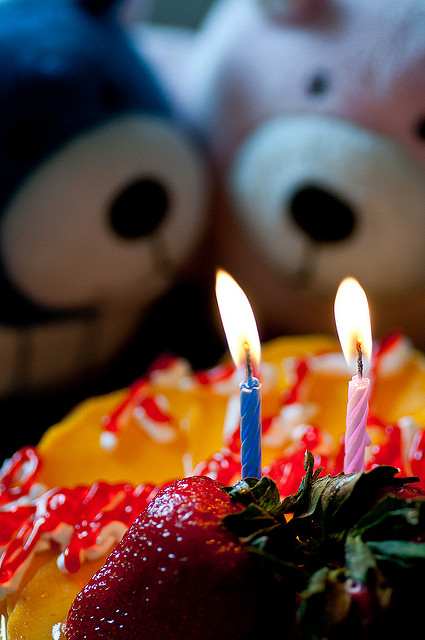
Happy blog birthday

Cake & two candles

Matching candles. Ray_LACCC BY

My blog, Lit Bits and Pieces, is two years old today.

I celebrate with a little recap.

My first post, Seeing past the surface, combines a bit of memoir with teaching struggling readers. When I was a child visiting my grandmother in the summer, she took me crabbing. This activity takes a little more finesse than one realizes . . . as does helping readers make meaning of their reading.

The post with the most views is Deeper than data. It opens with a conversation during a meeting at school, where a child’s reading data is projected and I, as the literacy coach, am expected to make a pronouncement on what all this data means and what to do for the child. I say I can’t answer these things until I listen to that child read first. This post is about seeing the children behind the data points.

The post with the most likes occurred just a few days ago: Blanket. I wrote it when I was too tired to write, and I am still sitting in amazement at the response.

A post frequently mentioned to me, that seems to strike a deep chord in others, is Fresh-cut grass. As long as I live, the fragrance of cut grass will remind me of my father and evoke my childhood.

I can’t say I have a favorite post, really.  It’s akin to saying which of your children is your favorite.  I think a couple of my best are To love that well, a tribute to my mother-in-law’s life on her passing, and What child is this, remembering a former student killed in an accident. I ponder the importance of college and career ready versus life ready. Especially when a life lasts only eleven years.

One of the great joys of writing is turning back time to relive moments too precious to live just once. Here I am as a child with my Granddaddy: Red rubber boots. I walk the old paths with Granddaddy again many times in these posts.

I started this blog for a couple of reasons: to stretch myself as a writer and to walk the walk as a writing teacher and coach. If I’m going to be encouraging students and teachers to write, I’d best be writing myself. And, as Dr. Mary Howard says of her Facebook posts, that they’re her “writing playground,” so this blog is my my own writing playground. I didn’t want it to be all about education; I want to write about whatever comes to my heart and mind at given moments.

Here I simply ponder the meaning behind experiences, images, and ideas. I strive to capture what I find as best I can. If you come away feeling uplifted, then I’ve accomplished what I’ve set out to do.

I celebrate two years of writing Lit Bits and Pieces. I celebrate life.

I celebrate you.

Thank you for reading.

Hearts

Only a minute

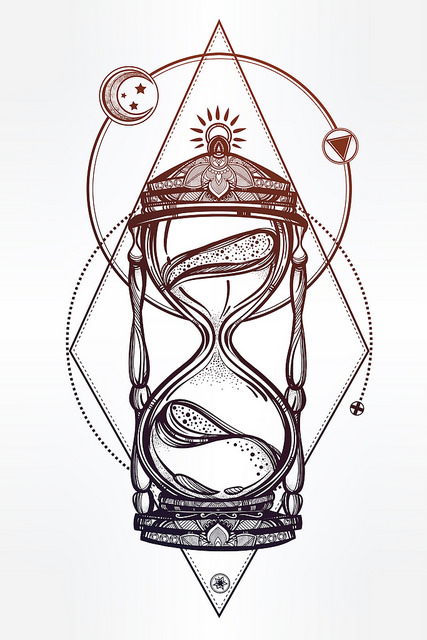
Hourglass

Hand drawn romantic design hourglass. jl71077CC BY

Every so often, this poem comes to mind.

I first heard it years ago, when a young co-worker recited it from memory. Listening to her mellifluous voice, rising and falling in all the right places, I thought, How profound.

I’ve used it with students for interpretation, for inferring, for fluency practice, for the pleasing rhythm.

Mostly I just mull the truth of it, in its utter simplicity.

Especially the last two lines.

I’ve only just a minute,

Only sixty seconds in it.

Forced upon me, can’t refuse it,

Didn’t seek it, didn’t choose it,

But it’s up to me to use it.

I must suffer if I lose it,

Give an account if I abuse it,

Just a tiny little minute,

But eternity is in it.

Attributed to Dr. Benjamin E. Mays

You’ll bring your own interpretations, images, minutes to this.

I think of all the stories that hang in the balance of a minute. In the wavering. In the choosing. There’s always that minute before the accident, before the attack, before the kiss of human or substance, before the choice that cannot be unmade is made. In a minute, lives are created, lives are destroyed. Fortunes gained, fortunes lost. The young, often consumed with this minute, blinded by now, cannot see forward; the old, bearing the weight of all their minutes, look back, see them all too clearly, and sigh.

We do not choose our minutes. We cannot save them or store them. We can only seize them, endure them, waste them, invest them, or pay for them. A choice lies inside each minute, always, even when there seems no choice.

I think of the ripple effect of one minute’s choice, how it never affects just one person but countless others, spanning families, communities, cities, nations, maybe generation after generation. For better, for worse.

I see the news. I read. I hear people’s stories, every day. We live our stories, we make them, every single minute, by our choices, actions, reactions. In some minutes I pause, recalibrate, celebrate, breathe a prayer of gratitude. In other minutes I sink under the anesthesia of why.

Only a minute, come and gone, and we are changed, whether imperceptibly or instantly, forever.

And that line whispers to me, once more. It’s never far away, really.

Just a tiny little minute, but eternity is in it.

Beautiful lady

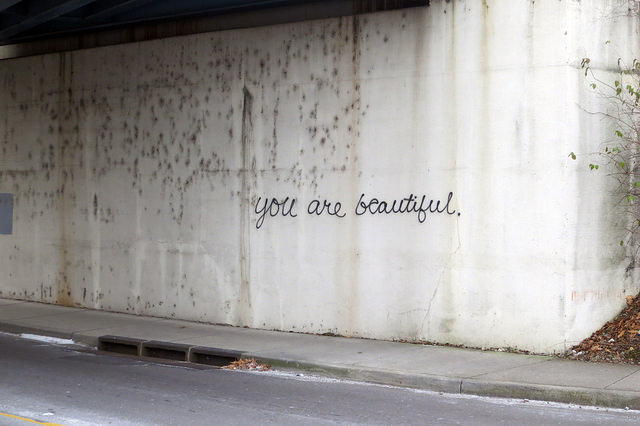
beautiful sign

It took me a while to figure out the tiny, nondescript building in the heart of the rundown side of town. I only noticed what it was when I needed it—there, in the tiny window, a tiny sign:

Dry Cleaning.

My first thought: So that’s what that little place is!

Second thought: Time to take that mountain of cleaning . . . 

Back at home, I grumbled all the way to the car with my armload. Too much of my family’s wardrobe required dry cleaning. Suits, coats, some of my dresses . . . this is ridiculous, this is IT, I am reading every tag in the future and I am NOT buying anything else that has to go to the cleaners. I could buy several more outfits for what this is going to cost!

The tiny parking lot had only three parking places. A pretty tight fit.

Fortunately, two spaces were free.

I got out of my car, gathered my garment mountain unto myself, and somehow maneuvered through a sliding glass door to enter the shop. I made it to the counter where I let it all go—thunk!

Yes, the weight of the clothing was enough to thunk.

Then, as if by magic—I didn’t see exactly where she came from—a young woman materialized.

“Hello!” she said, smiling at me. “Welcome! I am happy to help you today.”

Her Korean face shone like the sun; I actually blinked. I could feel the warmth she radiated.

She clasped her hands. “Oh, you are such a beautiful lady!”

Tears stung my eyes.

Seriously.

I almost wanted to hide.

I had been feeling—acting—anything but beautiful. I am quite sure my face looked like a thundercloud when I walked in.

“Oh my,” I said, feebly. “Um, thank you.”

She beamed.

She catalogued my family’s clothes, said they’d be ready next Tuesday, and she walked me to my car. When I pulled out of the parking lot, she stood there waving good-bye with fervor.

My first thought: Grandma used to do that. Used to wave after the car when I left, even ran out into the old dirt road to keep waving until she couldn’t see me anymore.

Second thought: How can this lady be so exuberant? Is ANYONE really that happy?

But I realized, as I drove away, that I was smiling, too.

Thus began years of visits to this dry cleaning shop.

Always when I walked in, the young woman dropped what she was doing and flew to meet me: “Beautiful Lady!”

I stopped ruing the fact that I had so many clothes needing to be dry cleaned.

I started taking things that needed mending. A hem come undone, a blouse pulling apart, hateful buttons that fell off of coats because they weren’t sewn on properly to begin with. A zipper that broke, needing to be replaced.

She fixed them all.

Once I took a challenging piece to her. A jacket with torn lining.

For the first time, I saw her brow furrow as she examined the tear.

“Is it fixable?” I asked. “If it’s not, that’s okay.”

She held her head up, sticking her chin out just a bit. “I will fix it. Not on the machine. By hand.”

And she did.

When I picked up the jacket, I marveled at the tiny, perfect stitches. They were machine-precision. I looked at her in awe. Sewing, I’d decided long ago, was just about a lost art. My mother and grandmothers sewed; they made clothes for themselves, my sister and me when we were children, and for others. My mother even crafted a slipcover for a sectional sofa. I can barely sew on a button.

And here in my hands was some of the prettiest handiwork I’d ever seen.

“It’s beautiful!” I said.

My dry cleaning lady smiled, good cheer emanating from her entire being: “It must be beautiful for the Beautiful Lady.”

I swallowed, too humbled for words.

Her habit now was to carry my clothes to the car—she absolutely would not allow me to do it—to hang them and to open the driver’s door for me. And there she stood, waving good-bye to me until I was out of sight.

I had taken to rolling the window down and waving back until I was well down the road.

I met her children as they began learning the business. “Look!” she exclaimed on one visit, as soon as I entered.  “Look at this report card!” Her son had received straight As.

“That’s awesome work,” I said to him as he rang me up on the register.

“Thank you,” he said somewhat shyly, handing me my receipt.

“Listen!” said my dry cleaning lady another time. “My boys are taking piano lessons.”

There against the wall by the entrance stood a piano; when did that get delivered to this little shop?  The two boys, in turn, sat and played without any sheet music:

The Entertainer.

Fur Elise.

Moonlight Sonata.

My musician son was with me on some of those visits; he listened, nodded his approval, and was invited to play.

He played his favorite.

Amazing Grace.

My dry cleaning lady and her boys nodded.

“Beautiful music!” she clapped, hopping up and down, when my son was done.

“Your boys also played beautifully,” I told her.

“I am taking lessons, too,” she said, glowing with obvious joy. In that moment, I realized just how much I admired her. Her generosity of heart, her effervescence, her genuine zest. The utter freedom with which she honored life—her own as well as others’.

I didn’t know, still don’t know, her back story, whether she was born in America or came here when she was a child. I never met her husband. She labored long hours in and out of that tiny dry cleaning shop, tireless in her dedication to her work, her family, and her customers. She raised three stellar boys, paid for their piano lessons, got that piano for them to practice as she taught them the dry cleaning business after school, and decided to play herself.

I wonder how long she harbored that dream of playing.

One day I walked in and an old man greeted me. When I inquired where my dry cleaning lady was, he explained with a heavy accent: “I am her father. She is gone to open another shop.”

In another town.

That shop will do well, I thought, thinking of her smile, her magnetic energy.

But a great light and warmth had gone from this shop.

I saw her first name written down once and asked her how to pronounce it. She coached me on it until I said it perfectly. I recalled it this week, and looked it up: It’s derived from the old Chinese “Ming,” meaning bright, brilliant.

It’s too perfect. Dead-on. Life is like that, so seemingly random at times, but always, always moving with purpose, like realizing a nondescript shop is a dry cleaners and oh, maybe I should bring that mountain of cleaning, never expecting to come face to face with the most alive human being, whose ability to make another person feel valued is unparalleled, whose very name means brightness.

I’ve been in the presence of greatness in a tiny shop in the heart of the rundown side of town. I needed to be there, but not for the kind of cleaning and mending I thought I needed. For a different and deeper kind: A lesson in blessing others at the hands of one luminous, amazing, incomparably beautiful lady.

You are beautiful.

If we could all see one another that way, and could say so sincerely, if we honored each others’ lives because we believe it . . . what a different world it would be.


Mastering the monster

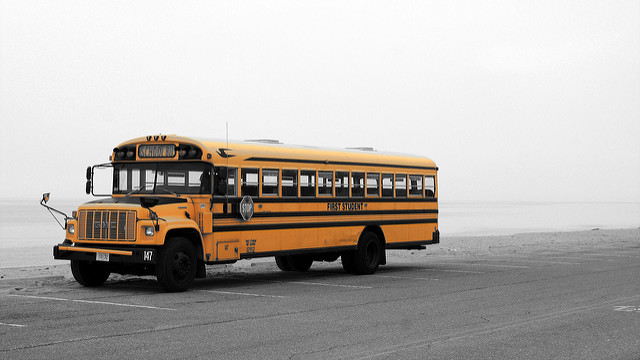
School bus

Bus #147. SebamirumCC BY

Life takes many unexpected twists and turns – a friend of mine says, “Life is one wild ride.” The mysterious is frequently interwoven with the breathtaking, the brightest moments often collide with the darkest, and the greatest desires of our hearts almost always involve epic challenges.

It took me the better part of two decades to finish college, for example.

I married at twenty, quitting college with a year and a half of coursework in general studies and theater arts. My boys were born. My husband completed two degrees needed for his work. I took a variety of jobs, all the while wanting to return to college myself, taking a class or two whenever and wherever I could. Sometimes I dusted off the old textbooks and plays, reread portions, dreamed of going on with my education.

When my younger son started kindergarten, I took a part-time reading remediation position that became full-time, until the program was cut after a couple of years.

“I’d like to keep you on, if you’re willing to take a teaching assistant job in first grade,” my principal told me. “Furthermore, there’s a distance education cohort beginning for paraprofessionals to get teaching degrees. You should pursue this – you’d be an excellent teacher.”

I pondered the prospect. A teacher. At the elementary level? I don’t know. High school English, maybe, but . . .

“It’s a consortium,” the principal went on. “If you’re a full-time teaching assistant, our county qualifies you to attend with financial aid. The books are even covered.”

Here it was, the long-awaited chance to finish school, only it didn’t look exactly like what I imagined.

The principal noted my hesitation. “It’s a perfect opportunity. What are you waiting for?”

Turns out that the program had K-12 reading certification built in.

That was the tipping point.

I love roller coasters. They climb and climb, gaining momentum, then – wooooosh. Hold on tight, as you don’t know what’s coming next – a pretty good metaphor for the wild ride of life. I applied to the program, got in. I loved my classes, my advisor, my instructors, my classmates. Returning to college was exhilarating.

Until.

“Of course, as a full-time teaching assistant in our county,” my principal said, “you’re required to get bus driver licensure.”

WHAT? 

I’m not overly fond of driving in the first place. The idea of maneuvering something as big as a bus, loaded with kids, being the only adult responsible . . .

“I’m not sure I can do it,” I said, going cold and clammy. My stomach lurched like it does after a sudden twist on a coaster, only worse.

The principal smiled. “Yes, you can. Look at it as something that gets you where you want to go.”

That’s what it came down to. If I wanted to finish school, to teach – which I now wanted to do more than anything, the ultimate situational irony – then I would have to face the big yellow monster.

My dad had driven a school bus when he was in high school. So had his sister. Back in their day, students were drivers. Daddy told stories about students tampering with the governor so the buses would go faster – I could envision the buses bumping down the country dirt roads, whipping around the bends in thick clouds of dust, kids bouncing wildly. He told the tales with glee; I listened in horror. While I darkly imagined Daddy’s great amusement on learning that I’d be driving a bus, if he’d lived to see it, this connection to him helped, if only the tiniest bit.

Look at it as something that gets you where you need to go.

I couldn’t let a bus stop me from finishing school or embarking on a whole new career that stretched out before me, glimmering and beckoning like the sea.

I signed up for the training.

The trainer started off with lots of stories, such as a driver once tipping a bus over by trying to avoid a squirrel, which is why we should never swerve if an animal runs in front of the bus.

I put my head down on the desk.

Then there was the first exam: Memorizing all the parts of the bus, how these parts are connected, what these parts do and why, what every light means. This was conducted by walking with the instructor, pointing everything out and giving an oral explanation. A written exam was also given.

I briefly considered failing these exams but my pride wouldn’t let me.

The training culminated in behind-the-wheel practice with the instructor, who asked: “Ever driven a Mercedes before?”

“No sir,” I answered.

He chuckled. “You’re about to now.”

I thought he was joking.

He wasn’t.

The bus I learned to drive on was made by Mercedes-Benz – who knew? It almost drove itself.

I managed to get this monstrous thing, this almost-airplane, through the narrow tree-lined streets of the nearby little old southern town without doing harm to anything until the instructor said: “All right, make a stop. Let these imaginary kids off the bus.”

I made the stop, opened the bus door. The flashing lights came on, the stop sign came out. I even counted imaginary heads.

For the first time, I thought: I’ve got this. It’s not so bad.

Then, as I closed the door to move on, the instructor said, “STOP!”

“What?!” I jumped a little in my seat. I stood on the brake.

“You just ran over a child,” said the instructor.

“I – what? How? I counted all the imaginary heads!”

“You didn’t check your mirrors. Kids can hide close to the bus and you’ll never see them if you don’t check all those mirrors. That’s why they’re there. Kids have been killed that way.”

I returned to work that afternoon in the deepest funk. A teacher assistant colleague greeted me: “Hey, how’d the training go?”

I sighed. “Not great. I ran over an imaginary child.”

My colleague grinned. “How did the imaginary parents take it?”

I laughed in spite of myself.

Still, I put myself on the prayer list at church. Seriously. The youth minister consoled me: “Look, when the time comes, God will give you driving grace.”

He was right.

The first time I had to drive, on my own, with real kids, it wasn’t a magnificent Mercedes bus but an old “cheese box,” as the kids say. I boarded with driving grace in my head and rosary beads in my pocket, given to me by a friend – and I’m not even Catholic.

I – and more importantly, the kids – lived to tell about it.

In fact, my driving the first-graders on their field trip to the movies (a trip of about three miles, consisting of three turns, one of which I took too close with a back wheel going over the curb, causing the bus to sway and the kids to scream), made their writing journals. When the teacher asked them to write about their favorite part of the trip, our entire class wrote various versions of this, with various spellings: “My favorite part of the field trip was when Mrs. Haley drove the bus.” On all the pages I was depicted at the wheel of the big yellow monster, my hair flying in the breeze for some reason, and smiling.

In the eyes of the kids, apparently, I was a great success.

I consider my mastery of the yellow monster my most dubious achievement, closely followed by my passing a college course on golf. No animals ever ran in front of me, all the kids got home, and other than the door handle rolling off one day and causing me to drive back to school with the stop sign out and all the lights flashing so that every car on both sides of the road pulled over, I am happy to report that I only had to drive a handful of times without incident until I finished the teaching degree and moved on, when I no longer had to drive a bus.

It did, indeed, get me where I needed to go.

Those obstacles that stand in the way of what we want, where we want to go – there’s no shortcut, no way over or around them. The only way is through, even when it doesn’t seem feasible, beneficial, or possible.

Whatever it is, whether it looms in front of you, in your past, or inside you, face your monster. Look it in the eye.

Then make up your mind to master it.

Grace be with you.

Making adjustments

Poor Banjo

Poor Banjo!

Banjo is my family’s 18-month-old yellow Lab. If he can be summed up in one word, it’s exuberant. If two words – wildly exuberant. He is a force to be reckoned with, ninety-one pounds of raw energy barreling toward us at top speed in hopes of 1) eating something or 2) having us throw a ball or stick for him to retrieve. Endlessly. Banjo goes into a frenzy if he thinks we’re about to stop throwing said ball or stick, the bodily equivalent of shouting NONONONONOPLEASEPLEASEPLEASEPLEASE!!!! His beautiful gold-green eyes (sky-blue when he was a baby) go pink around the rims; he often leaves us humans coated in a layer of frothy slobber, prompting us to quote Bill Murray’s line to Dan Aykroyd in Ghostbusters: “He slimed me.”

During attempted walks on the leash (key word: attempted – these walks are more like trying to restrain a steam locomotive), Banjo’s mouth foams to the point of looking rabid, unnerving to anyone who might recall a certain story about a big yellow dog exposed to hydrophobia. I mentally push this horrible connection away the instant it comes to mind. Managing Banjo has become something of a Herculean challenge, to say the least. Twice he’s escaped from us, running, barking and foaming, through our neighborhood, causing one woman to run into her house and giving young men chase. I corralled him once myself and got him safely to our fenced backyard. The other time my older son chased him for forty-five minutes, while Banjo had the time of his life ripping through neighbor’s yards and swimming in the pond across the street from our house. In disgust, my son gave up and stormed home, at which point Banjo, sopping with pond water, bounded back up the driveway.

Banjo escaped from the backyard recently, having dislodged two slats of the wooden fence by repeatedly jumping against them with his considerable weight. Looking at the slats, presently secured with bungee cords until we can nail them back properly, my husband said, “If we can’t contain him, we’re not going to be able to keep him.”

My turn to say NONONONONOPLEASEPLEASEPLEASEPLEASE!!!! 

Despite all, I love this wildly exuberant dog. He’s been with us since he was seven weeks old, a ball of yellow fuzz that slept in my lap or on my feet. Banjo’s presence represents hope and survival, his own as well as my husband’s during a dark time;  I wrote about it in The unplanned baby. How can I just give him up? Yes, he’s one giant mess. Sure, he sheds copiously, enough hair to make a whole other dog. Yes, he dug up the pipe leading from the propane tank by the back deck until the stench of gas frightened us all, giving us visions of the whole place blowing at any moment, until we buried the pipe again and built a small wall of cinder blocks around it. Banjo barked at these blocks nonstop, all day, every day, for about a month.

But when he goes into his crate at night, he looks at me with those golden-green eyes and waits patiently for me to reach through and rub him for a minute. When I do, he leans his head against my hand, closes his eyes, and savors every second – the sweetest, most loving of creatures.

If only he would stay this calm more often . . . .

It was inevitable, of course, and past time, really. It had to be done.

We took Banjo to be neutered.

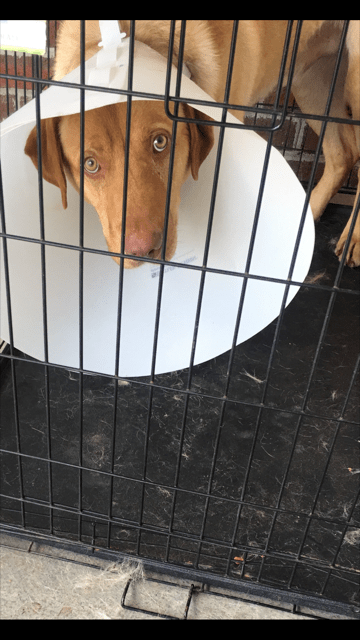
We did not know until we picked him up that he’d be wearing a cone to keep him from interfering with his surgery site until it healed – for seven days.

“There’s no way,” I said, watching Banjo writhing, twisting, and jumping, trying to rid himself of this horrid thing around his head. But after a few minutes, he sat still, with his head hanging down. Subjugated, submissive, maybe even dejected, Banjo seemed to be contemplating this new, unfortunate turn of events.

In the subsequent days, he simply made the necessary adjustments.

He learned that he had to put the entire cone opening over his food and water bowl to eat and drink. I laughed at the sight. He looked like something straight out of science fiction, a vacuum-headed suction creature from another planet. He ran through the backyard, as exuberant as ever, with his cone pointed toward the sky like a morning-glory flower. He wanted to play so badly that, despite the cone, he managed to drag a five-foot pine limb thicker than my arm to me in hopes that I’d throw it for him.

He still waited for me to rub his head when he went into his crate to sleep.

“I am so sorry about all of this, Banjo,” I said, working my hand through the bars and past the cone.

He shifted his head to help me reach him, leaned against my hand, and closed his eyes. So accepting and forgiving.

I rubbed him an extra-long time, tears stinging my own eyes.

My husband and I took the cone off after four days. We couldn’t stand it anymore.

Banjo is healed now, running unfettered again in the backyard each day of this glorious, sunny spring. He never fails to lift my spirits, this big, beautiful, messy boy. He reminds me that setbacks are temporary, that whatever pain and hardships come, there’s something good waiting just on the other side. Accept, make the necessary adjustments, carry on – cheerfully.

Just another of life’s lessons from an exuberant yellow dog that will hopefully be calmer now.

Regardless, here’s the truth about Banjo: He doesn’t belong to me. I belong to him.

Always.

Reflection: What are the necessary adjustments must you make in your own life, currently? Think acceptance, forgiveness, healing, moving beyond. What’s the something better that might be waiting on the other side of the struggle, the pain? Write your truths.


Suncatcher

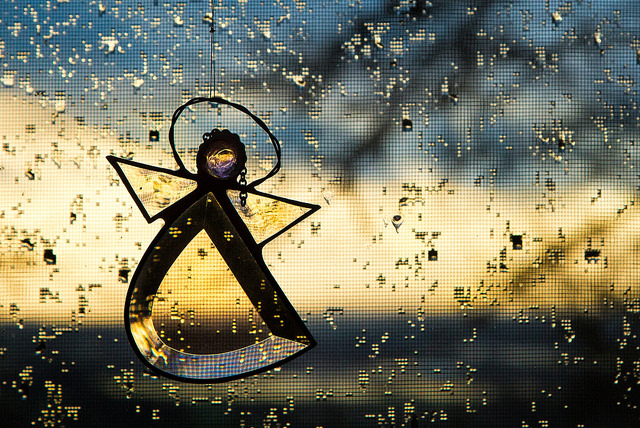
Sun angel

Sun angel. Sheila SundCC BY

 Into each life some rain must fall
But too much is falling in mine
Into each heart some tears must fall
But some day the sun will shine
Some folks can lose the blues in their hearts
But when I think of you another shower starts
Into each life some rain must fall
But too much is falling in mine.

-Allan Roberts

Yesterday morning the sun beckoned from among striated clouds, streaking the sky with silver and gold. Birdsong—it’s a brand-new spring. The scent of fresh-cut grass from the day before lingers, and nothing takes me back to my childhood and my father quicker than that sweet green fragrance.

Even as the sun shone, a soft rain pattered down.

In my heart, in the hearts of my community, too much rain is falling.

Yesterday we buried a young lady who grew up here, was one of us, was an only child and grandchild. She was a college freshman, eighteen, a year younger than my second son, his childhood playmate and lifelong friend. She went to church with us all of her life, sang in the choir, and was beautiful. She caught the light and scattered it like a faceted gemstone quietly scatters tiny, vivid rainbows on objects close by.

Death, when it comes suddenly to someone so young and full of promise, can only be likened to a great ripping apart.

She is ripped away.

The church was full and overflowing an hour before the service. People stood around the walls of the sanctuary, packed the fellowship hall, lined every hallway on both sides throughout; a huge crowd waited outside because there was no more room.

My husband officiated. He was at the hospital the day this child was born. He ended the eulogy with a little twist of Shakespeare: “Good-night, sweet princess; and flights of angels sing thee to thy rest.”

As the crowd walked to the burial site, the sun shone for all it was worth. The clouds were gone; a warm breeze ruffled dresses, suit jackets, hair.

Even so, the rain will fall within us for days and days to come, yet it doesn’t mean that our little suncatcher won’t keep catching and scattering the light in the quiet way she always did. More light than ever is reflected in the myriad drops of rain, like iridescent droplets of diamonds quivering with celebration that she lived, that she was a gift.

She will always be.

slice-of-life_individualEarly Morning Slicer