Prayer poem: Learning rhythms of grace

Last weekend I spoke on Matthew 11:28-30 at a women’s conference. Jesus, under increasing oppostion, extends this invitation to a Galilean crowd oppressed by their religious leadership and Rome:

Come unto me, all ye who are weary and heavy laden, and I will give you rest. Take my yoke upon you, and learn from me, for I am meek and lowly in heart, and you will find rest for your souls. For my yoke is easy and my burden is light.

In The Message, a contemporary rendering of the original languages into that of the modern day, pastor and biblical scholar Eugene Peterson paraphrases Christ’s words: Walk with me and work with me—watch how I do it. Learn the unforced rhythms of grace.

That last line plays in my head like a continous prayer, pushing away the constant challenges of life in this world by sensing and seeing the unforced grace given by God.

And, in turn, to give it.

Learning Unforced Rhythms of Grace

How do I learn them, Lord?
Let me count the ways…

Listening for Your voice
in the cadence of my days

Seeking to still my spirit’s
frenetic beating wings

Perceiving the song
all of Creation sings

Releasing judgment, 
not mine to make

Forgiving and forgiven daily,
a flow of give and take

Bearing pain and scars
accrued in life’s syncopated race

Opening my arms, my heart
to YOU, my resting place

Acknowledging the story
pulsing though others’ veins

Knowing You have the final Word
Your sovereign remedy remains

Desiring patterns of peace
in a prosody of embrace, erase…

Walking in step with Your pierced feet, O Lord
I learn unforced rhythms of grace.

Jesus preaching. ideacreammanuela2.

True or False poem

My friend Denise Krebs hosts VerseLove over on Ethical ELA today with a profound “true/false” list poem based on the work of Dean Young. By all means, read her poem and the prompt.

Here’s what I have, so far…

True or False?

  1. I am much older than I appear.
  2. Green is the color of ordinary time.
  3. Angels can sing.
  4. Stars can sing.
  5. Trees can sing.
  6. Just because it’s myth doesn’t mean it isn’t true.
  7. There’s a reason I use seven asterisks for section breaks.
  8. A seahorse holds the reins of your memory and emotions.
  9. Salt water heals all.
  10. Blood is thicker than water.
  11. Blood cries.
  12. I will live to see another solar eclipse.

*******

Bonus points will be awarded for citing evidence in support your answer for #10.

Tip: Double check #3 before submission.

*******

MDavis.D, CC BY-SA 4.0 https://creativecommons.org/licenses/by-sa/4.0, via Wikimedia Commons

*******

with thanks to Two Writing Teachers for the Tuesday Slice of Life Story sharing

13 ways of looking at a black cat crossing your path…

A list poem, of sorts, inspired by Wallace Stevens “Thirteen Ways of Looking at a Blackbird,” shared this week on Ethical ELA. The Open Write challenge: “To look outside ourselves to the larger world. Craft a poem about it…the larger world is many different things to people, and in many cases, it’s America.”

Everything hinges on interpretation. There are infinite ways of looking.

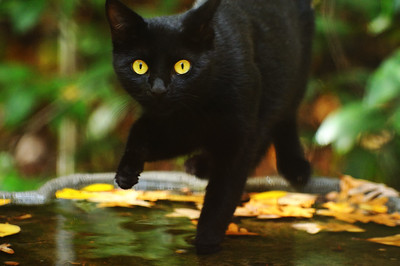
It just so happened that this week marked my return to campus in preparation for student cohorts transitioning back to the building. Driving along the familiar back road for the first time in what seemed like ages, car piled with stuff, brain churning with things to do and how to do them, trapped in a constant state of COVID suspension, in a fog very like the one rising from the ground, smoky swirls lending a seasonal eerie-ness to beguiling red-gold trees against an obscured sky, what to my wondering eyes should appear but the sudden darting of a black cat from the woods just ahead on the right. Neatly across the ditch bank it sailed, mission-like, directly across the road in front of me…

13 Ways of Looking at a Black Cat Crossing Your Path in the Time of COVID-19 While Driving to School to Teach Online Near Halloween of Election Year 2020

I.
Unexpected poetry in motion from the russet woods, long, lithe feline fluidity rippling low along the golden ditch bank, ebony mercury flowing across the gray asphalt, a thing of beauty, a joy forever or at least until…
II.
Still alive. I didn’t hit it.
III.
Spawn of inexplicable, maniacal laughter
(nowhere near the Joaquin Phoenix level)
IV.
The omen of—misfortune? As in—Google crashing?—no Wi-Fi?—more lost instruction?—a forgotten mask? —one more directive on what to do or not to do with data, disinfectant, distance?
V.
Will I even make it to school today?
VI.
Will students (onscreen)?
VII.
Spirit of the season, shape-shifter running to and fro on the Earth, demon on the loose, witch’s familiar, unholy harbinger …
VIII.
This election. Heaven help us.
IX.
Misrepresentation and slaughter of God’s creatures.
X.
Curiosity. Where are you running to, little black cat? From where? From what—or whom? Do people other than scientists know that your fur holds secrets to disease resistance? Can the mystery be unlocked, decoded?
Pandemics of rats and bats.
What if healing sprung from cats.

Poetic justice.
XI.
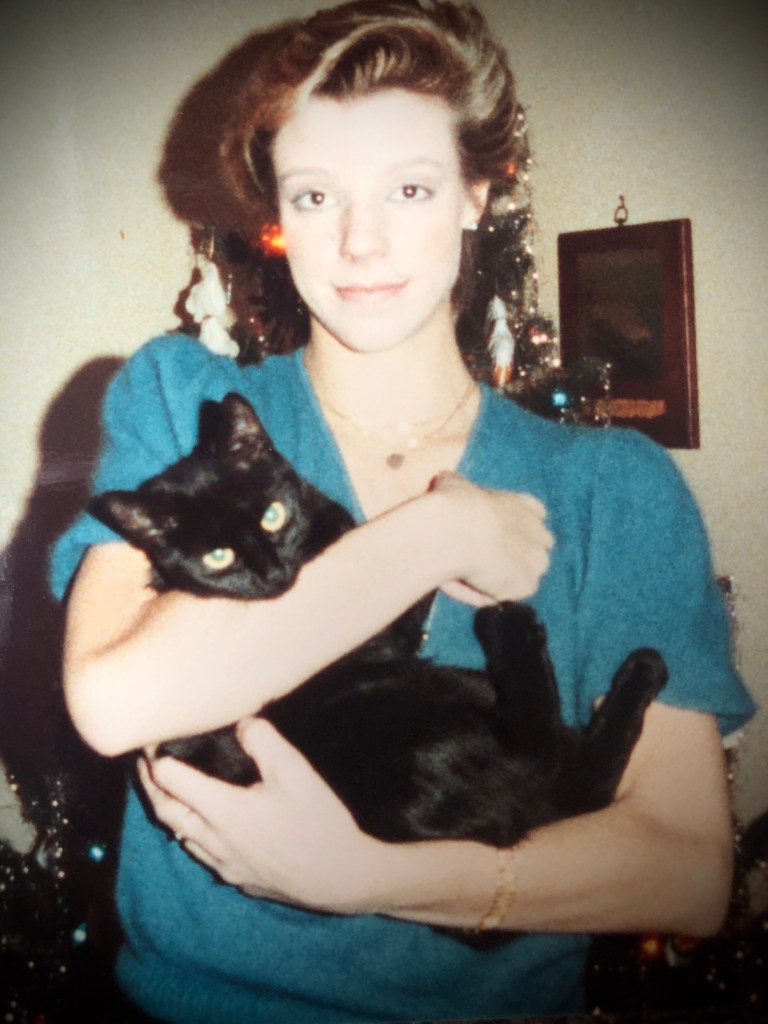
Portal of memory… I had a little black cat, once. She had no tail and no one else wanted her. The last left in a box of kittens a guy at college was giving away. Brought her home, named her after a magic cat who was exceedingly wise, in a book I read as a child. Couldn’t take her with me when I married and moved into an apartment so I gave her to my dad. He bought turkey from the deli, tore it into small bites, and fed her on the countertop.
She wasn’t magical. Just full of ever-purring love.
XII.
The great portender, seeming to be what you are not… all I know is you are poetry in motion. Run on, blithe spirit. Run on, long, lithe spirit-lifter, ebony mercury flowing… how glad I am our paths crossed.
Fear not. We bring one another no harm.
XIV.
I skipped #13. Too unlucky.

*******

Note on IX: For centuries, beginning in medieval times, superstition and associations with evil led to widespread killing of black cats. Many shelters today will not allow black cats to be adopted near Halloween for fear of their being used as decorations and mistreated, tortured, sacrificed, or abandoned. Just one way of looking at those lines.

With thanks to Ethical ELA for inviting many ways of looking and to the fine folks celebrating Poetry Friday, especially Jama Rattigan for hosting the Roundup. Jama’s blog, An Eclectic Feast of Food, Fiction, Folderol and Chewy Culinary Verse is a mind-bogglingly gorgeous work of art. I don’t know how she does it!

Thanks also to Keats, Shelley, Stevens, and Patricia A. McKillip. I haven’t forgotten you, Moriah.

Lead Photo: Ralph Daily. CC-BY

Learning decay wordplay

Today on the Ethical ELA blog, teacher-librarian-poet Linda Mitchell kicks off a five-day Open Write invitation by using lists for composing poetry (read her beautiful “Wishing Well Price List” poem and other inspiring offerings here).

Now, I am a notorious list-maker, so much so that my husband once asked: “What are you writing now?”

To which I replied, absently, while hunched over a scrap of paper: “A list.”

“ANOTHER list? For what?”

I hesitated to confess, but I did, in a decidedly small voice … “A list of lists I have to make.”

So. If I am going to base a poem on one of my myriad lists, I must choose quickly or I’ll never begin.

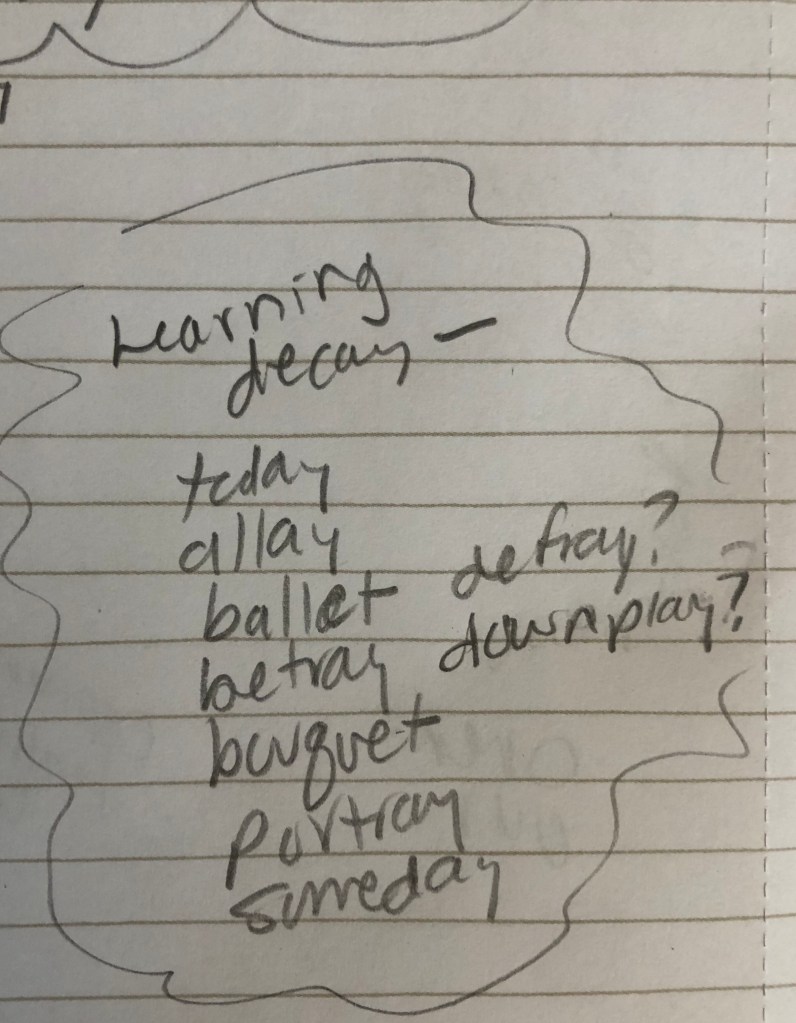
The first thing I turned to in my scrawly notebook idea-keeper was a list of rhyming words based on the phrase “learning decay.” I heard a fellow educator use it recently, expressing concern for children returning to school in the fall after having been out for five months (or longer) due to COVID-19. That idea has been sitting dormant … maybe waiting for just this moment, this prompt, as a lens to lend focus. What can I make of this list? What would help prevent “learning decay” for kids? For ANYONE? For me the answer is always twofold: Read. Write. Always.

One last thing: Kids need to know that writing is more than an assignment and generally hateful chore. They can do it anywhere, anytime, about anything. There are no limits, only endless discoveries. A notebook is a gateway for making sense of the world and discovering what you think and feel … a safe haven, a springboard, a sounding board, a lifeline, a reliquary for housing fragile new ideas, precious fragments of self. It can be on paper. On a screen. It can be a recording. A drawing. Any means of capturing thoughts, impressions, expressions. I use multiple mediums, myself. You’re reading one now. To me, moments spent writing are never wasted; growth is inevitable.

Here’s my rather rapid-fire poem based on “learning decay” and the list of rhyming words in my notebook:


Learning decay?
No, not today.
Strive to allay.
So invite play:
a word ballet,
a thought bouquet.
True soul portray,
not self-betray.
Notebook away,
the cost defray –
Recoup the day.