Snow day GIF documentary

If you work in education—in central North Carolina, anyway— you know that the merest rumor of snowflakes sends people into a frenzy. Mostly because 1) We must go buy bread and water in vast quantities, or at least the necessary ingredients to make big pots of chili; and 2) We want to be home quickly, because we really don’t know how to drive in this stuff.

Just to be safe, systems dismiss early, sometimes before any flakes fall.

Such was the case yesterday. The masses went home to stay glued to weather reports and social media, all the while asking: When will the snow start? How much will we get?

And the question of all questions: WILL SCHOOL BE CANCELED TOMORROW?

So, as a few flakes dropped in various areas, but not in others, as the evening wore on, the waiting intensified.

I amused myself by reading tweets to the school district about when a decision would be made about school closings. Many had GIFS such as these:
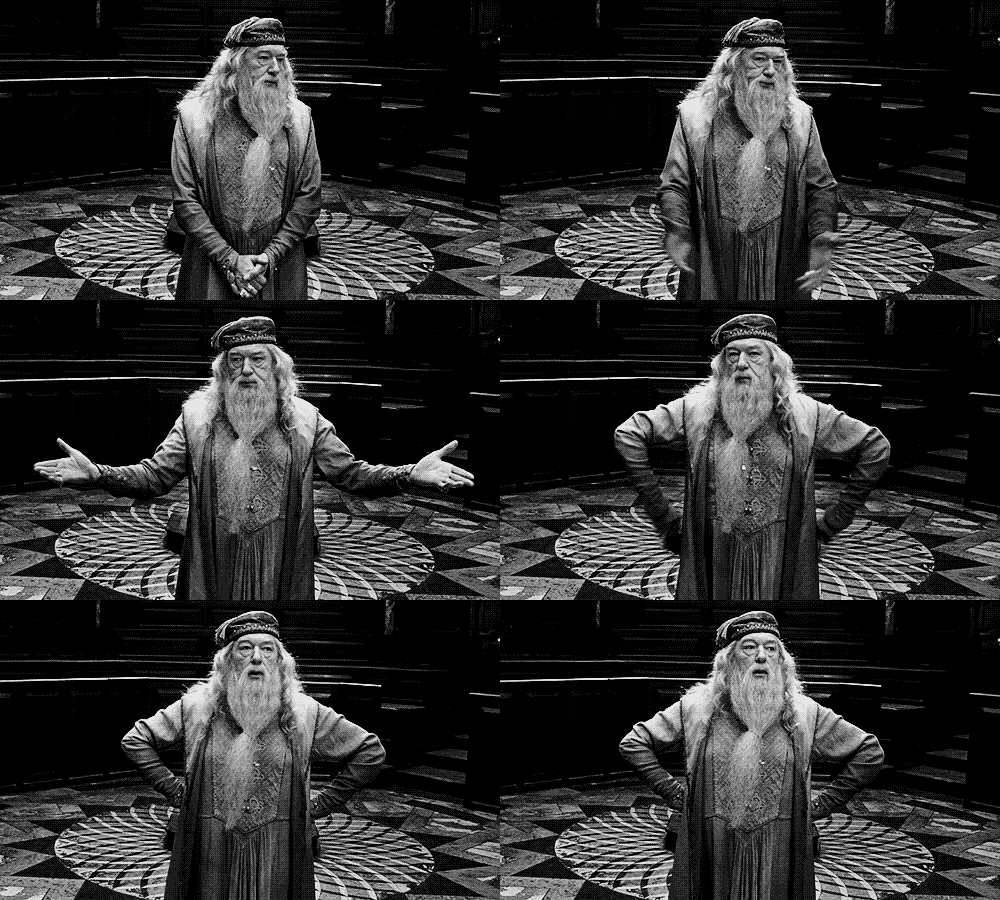
Dumbledore.gif

tenor.gif

Those, by the way, were sent by staff. Not students!

Then the announcement came: There were, in fact, enough snowflakes to cancel school today!

Someone tweeted this as the parent reaction across the district:

John Ritter.gif

Poor parents! And poor John Ritter, for that matter . . . is anyone else out there astonished that this will make fifteen years since he died?

By and large, however, there were hundreds of celebratory tweets from students with variations of GIFs such as this:
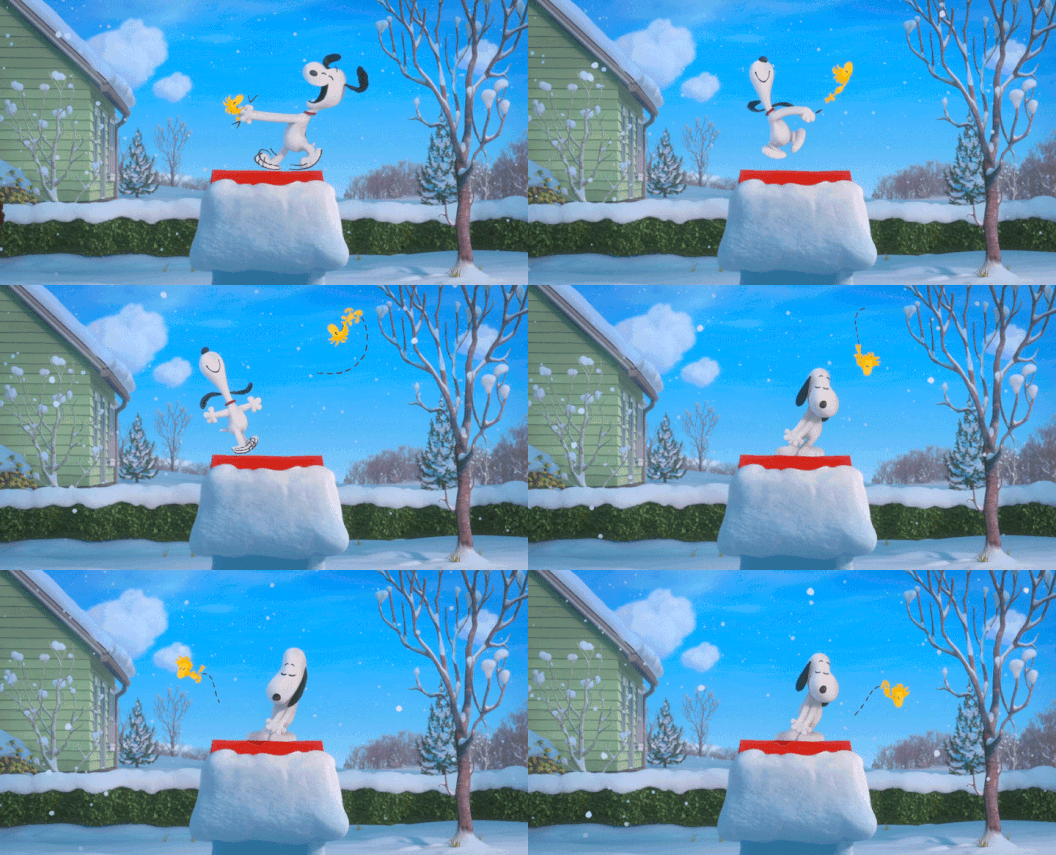
Peanuts

Many of those tweets said something like: “THANK YOU! You saved me and my grades!”

Okay . . . that really begs more investigation as to exactly how one snow day can save a GPA . . . and why grades are the whole emphasis of education . . .

Then there was this cheery admonishment from the school system: “Everyone stay safe! Kids, don’t forget to read!”

Truly warms the cockles of your heart, doesn’t it?

Except for a long thread of student responses like this:

“Don’t expect us to read, though.”

Reading that sentiment was, to me, like being impaled by a jagged icicle. My reaction:
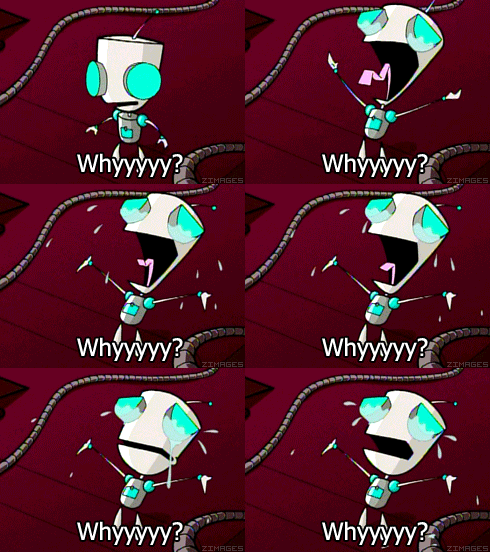
Why.gif

Why do the kids hate reading so much? When they say “reading,” what do they actually mean? After all, they text constantly, they’re a huge presence in social media, and their choices of graphics to communicate feelings are both entertaining and dead-on. Today’s average student is quite literate, digitally.

I think—I shiver as I say this—that the aversion is to reading books. Whether it’s actual books or those on a screen is a moot point. My question is: How have we, educators, failed on such an epic scale to promote a love of reading, to the point that our students, especially those who NEED to read more, view it as such a hateful chore? As long as they feel this way, when will our students ever, hopefully, pick up a book that they simply want to read?

The year is young; there’s no time like the present. Snow days are ideal for thinking of ways to revamp instruction to help the kids get excited about books and develop a love—or at least a very strong like—of reading. Will they all? Truthfully, probably not. But that’s no excuse for not striving for something far better on their behalf:
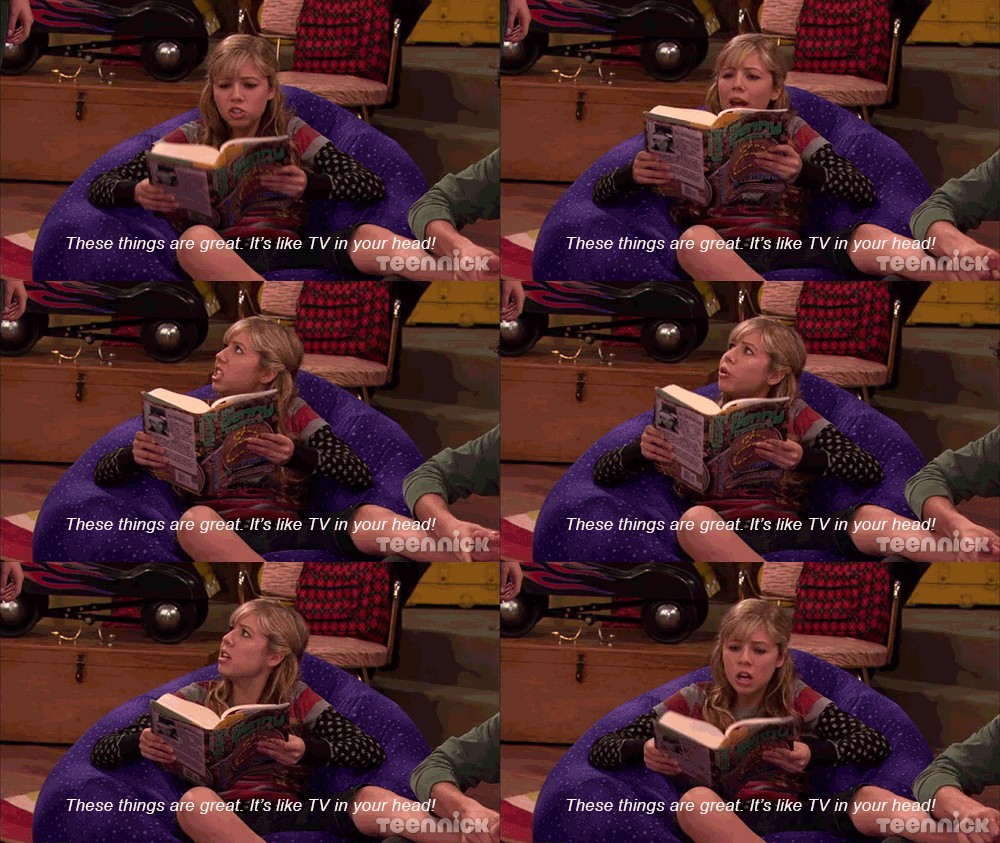
Books are great.gif

Beacon

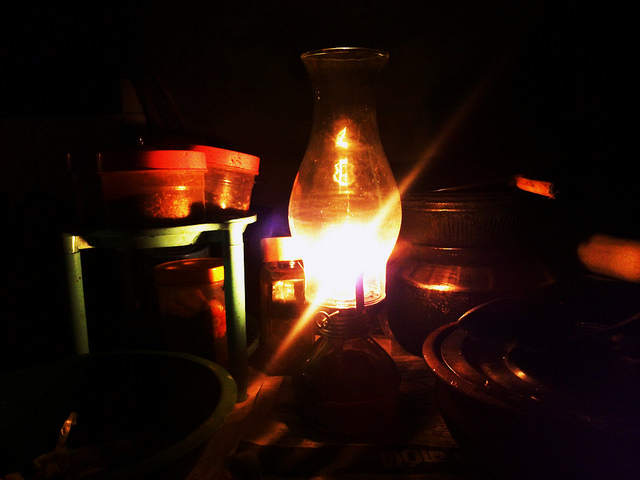
Kerosene lantern

Kerosene lantern. hare 🙂CC BY-SA

In reflecting on my reading and writing life, I am most thankful that my tastes cover a pretty wide spectrum. As a child I devoured everything from Dr. Seuss to Highlights, from cereal boxes to Funk and Wagnalls Medical Encyclopedias (yes, really), from fiction series to biographies, from Reader’s Digest to dictionaries, as I marveled over the many meanings a single word can have. 

None of these were required reading in school.

All of this is what I chose to read, was compelled to read, from an insatiable hunger for the experiences, the ideas, the information, the emotions, the beautiful and the stark way of stringing words together, long before I thought about how hard authors work on hammering those words and phrases into something with just the right impact on readers.

Now, as a writer, my tastes run the gamut as well.

With Lit Bits and Pieces, I am usually reflecting on or exploring meanings of every-day experiences. Creative nonfiction, mostly.

Today I am sharing a short piece of fiction – for, truthfully, fiction is forever beckoning me with a capricious and winsome smile.

This was inspired by a personal challenge, a house I once lived in, and being told a long time ago that when she was a little girl, my maternal grandmother sometimes assisted her midwife mother.

-Enjoy.

Beacon

The captain’s wife was going to die.

Lily and her mother couldn’t save her.

They tried.

Vestal administered tinctures she’d made from leaves and bark as six-year-old Lily rubbed Miss Rebekah’s swollen belly, repeating over and over in her mind like a mantra: Little baby, please get borned . . . your Mama’s trying so hard.

Lily’s arms ached. The odors of sweat, blood, and tincture hung heavy in the close room. Miss Rebekah had chosen the highest, hottest point in the house and she couldn’t be moved now. Lily breathed through her mouth instead of her nose to avoid the metallic taste of blood and salt on her tongue. She kept kneading: Little baby, please, PLEASE get borned . . . .

The hours wore on; the sky darkened and thunder rolled in from the Atlantic.

Storms frightened Lily. Vestal said she mustn’t let it show. “When you live by the ocean, Lily dear, storms are always violent. Become accustomed to it. This is where thunderstorms are born, child.”

The wind moaned like a ghost under the eaves; rain slapped against the windowpanes. Lightning burst and sizzled a split second before the thunderclap shook the house. Lily jumped but she didn’t cry out. She sat trembling while Vestal calmly lit the kerosene lamp on the dresser.

Rebekah, sinking deeper in the feather bed, whispered, “Miss Vestal, would you move that lamp over to the window, please, so Captain Turner can find his way home.”

Captain Turner was at sea. Lily knew he wasn’t due back any time soon. Even if he was, he’d never see this lamp through the storm.

Vestal hesitated.

“Please.” Miss Rebekah’s whisper was barely audible, more air than voice.

Vestal carried the lamp to the sill of the window overlooking the widow’s walk. Beyond her mother’s silhouette, Lily could see the surf illuminated by lightning, billowing, foaming, crashing. Lily thought about the women at the marketplace who dressed only in black, murmuring to one another that this Carolina coast was treacherous even without storms.

Women who had watched for ships that never returned.

Rebekah groaned. Vestal flew back to her. The groan was so deep and prolonged that Lily’s courage finally collapsed. She cowered with her hands over her ears while Rebekah, just nineteen, married less than a year, made one last, valiant push before her life ebbed away. Lily knew it was all over when Miss Rebekah lay silent, her pinched face turned slightly toward the window where the lamplight flickered, then stood still.

Vestal gasped: “Lily!”

Lily scrambled to the foot of the bed. There in her mother’s hands was a tiny, motionless body. In all the births she’d witnessed, Lily had never seen anything like this.

The baby had no face.

“Oh, Mama, what’s wrong with it?”

“She’s a caulbearer! All my life I’ve heard of this! Cauls bring good luck, Lily, and healing powers. Whoever owns one will never drown. We must save it for her Papa.”

Lily watched as Vestal gently peeled the membrane, intact, from the baby’s face. Sweet-smelling fluid trickled from beneath the caul. When the veil lifted and she faced the world at last, the baby shuddered, reddened, flailed at the air; she drew a rasping, croup-like breath, then gave a mighty squall, startling Lily.

Vestal beamed.

Almost instantly, there was another sound: heavy boots pounding up the wooden stairs. Captain Turner burst into the chamber, rivulets of rain and seawater running from his hat and cloak, so out of breath he couldn’t speak. He simply sank to his knees on the floor in the circle of light cast by Rebekah’s lamp.

Lily was little, but she believed in miracles, believed that she was witnessing how many, right now? She eyed that lamp, glowing so serenely through the gloom. She knelt by the struggling captain. With a tentative hand, she dared to pat his arm:

“Welcome home, Captain. Everyone’s made safe harbor now. I think maybe you should call this baby Stormy, sir.”

As if in agreement, the flame in the lamp flared and danced.

******

Note: My original version of “Beacon” ended up placing in a flash fiction competition sponsored by Women on Writing – just one of the ways I’ve tried to push and challenge myself as a writer. Here’s their pretty fun response: The Muffin/Women on Writing Interview.

Lit happens

Lit happens

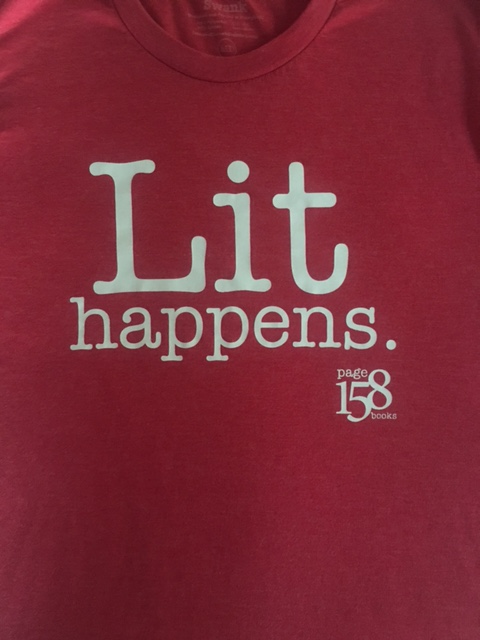
I saw the T-shirt on display behind the register of my local indie bookstore, as I succumbed, yet again, to rampant bibliophilia.

Lit happens. 

Had to have it.

Oh yes, there was one in my size, in blue. The store owner smiled as she added it to my total. “I can order it in red for you, too. I tell people the color stands for being well-read.”

Irresistible.

As I returned to the store to pick up the red Lit happens T-shirt, I thought about literary people being well-read. Bibliophiles. Bookworms. I thought about the shirt my aunt made for me decades ago, with iron-on letters spelling Bookworm: “Because you always have your nose in a book,” she’d grinned.

I turned the the idea of lit happens around in my mind, from being well-read to learning how to read: Literacy happens.

How?

How does literacy really happen?

Research immediately tried to crowd my head, for a big part of my bibliophilia is professional. My shelves at school and at home are lined, overflowing, in fact, with books on growing readers and writers – how to teach, assess, reinforce. Every bit of it is powerful.

But I pushed the research back for a little breathing room, to think about my own path to literacy. How did I become literate?

It’s anything but strategic or elaborate.

Sure, my grandmother read to me from the time I can remember – the same books, over and over, until I could anticipate and recite the words before she read them aloud. I didn’t ever think of my parents as readers – they were big TV watchers – but I do have a memory of my mother reading “Sleeping Beauty” aloud to me, deliberately changing the name to “Beeping Sleauty.”

“No no no!” I am laughing hard. “Her name is SLEEPING BEAUTY.”

“Oh, that’s right,” says my mother, turning the page. “Let’s see if the prince uses his sword to cut through the thorns to find Beeping Sleauty.”

The sound of the transposed name is hilarious; I dissolve with laughter. My mother begins giggling, which means we will be laughing for a while – her cackling is utterly infectious.

It was wordplay, not word work – not intentional, just being silly.

So much fun.

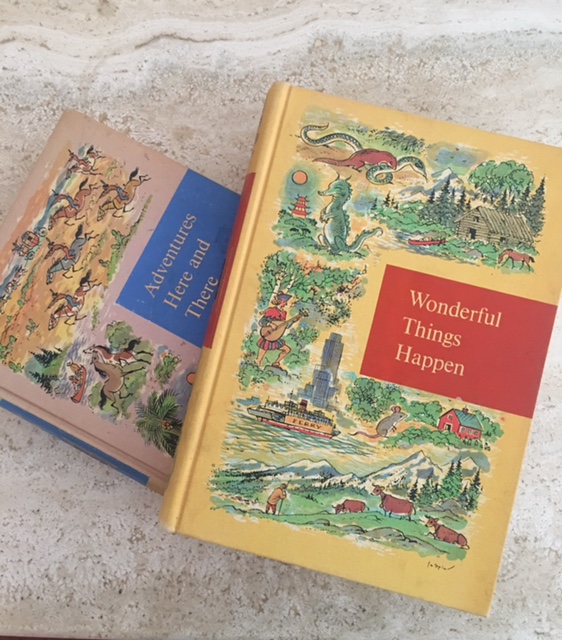
My parents had one bookshelf in the living room, containing a set of encyclopedias, (including, oddly, medical encyclopedias, maybe thrown in with the purchase of the standard set), old dictionaries, high school yearbooks, an avocado green Living Bible, and a set of children’s literature anthologies, Through Golden Windows, by Grolier. The book titles: Mostly Magic, Fun and Fantasy, Wonderful Things Happen, Adventures Here and There, Good Times Together, Children Everywhere, Stories of Early America, American Backgrounds, Wide, Wonderful World, Man and His World. 

These anthologies contained a multitude of classic stories and authors; I read some of them over and over while eating my breakfast cereal until the covers were grimy with use, particularly Mostly Magic. In these books I first encountered Medio Pollito, the little half-chick, Little One-Eye, Little Two-Eyes, and Little Three-Eyes, Tom Sawyer, Laura Ingalls Wilder, Daniel Boone, Robin Hood, and so much more.

An excerpt from the dedication page of Through Golden Windows:

What can books give to a child that is growing up in today’s curiously complicated world? Many things, we believe, although the evidence is not altogether conclusive. Facts and information, of course, about almost everything; understanding of himself and others; confidence and security; fun and laughter; friends and friendships; escape from reality at times – all these are the possible results if the right book is used with the right child in the right way.

But suppose the right book is not available? … Or suppose parents and teachers do not know the right book? Many, by their own admission, do not know children’s books well. Must the child’s values in reading be left to chance, while he struggles with everyday problems, or grows up without feeling the full rapture of a good book?

That was written in the “curiously complicated world” of 1958. Well before I was born. Thirty years before the World Wide Web. Before much of the educational research lining my shelves was begun.

What strikes me are the words “grows up without feeling the full rapture of a good book.”

That, I believe, is where the path to literacy lies, in getting that first taste of rapture from a book. The right book mentioned by the Grolier editor in 1958 isn’t a “just-right” book referenced in reading education today, one that is leveled, that a child can read without too much difficulty. The right book could actually be a magazine or blog or site. The right book always was, and always will be, one in which the reader immerses so that the word “reading” doesn’t even seem to fit the process of pursuit, the wanting more, the needing to know, the absorption of the ideas and images, the stepping out of self.

Note that I didn’t mention school in my early path to literacy – for the bulk of the literate life occurs outside of school. Many of my friends and teaching colleagues say that they didn’t enjoy reading until they were grown. That’s an awfully long wait for the full rapture.

When the words become more than words, when they become the window, the gateway, to all that lies beyond what one can immediately see, arousing a driving desire to get through and drink it all in – that’s the rapture.

Lit happening.

Through Golden Windows

Tripping the write fantastic

Fantasy

Fill your life with love. Dianne LacourciereCC BY-SA

Without this playing with fantasy no creative work has ever yet come to birth. The debt we owe to the play of the imagination is incalculable. – Carl Jung

Her teacher sent her to me, to confer about her writing.

Not because the student is struggling.

The student, a fifth-grader, had written twenty pages of complex plot and extraordinary dialogue that revealed character personality and motivation.

“It’s amazing,” explained my colleague. “Out of the blue, she’s just taken off. I thought you could give her some pointers – her story is really good.”

The student, delighted at the prospect, immediately sent her work to me via Google Docs. Here are things I am thinking about, her message stated. She’d made notes about characters, problems with the story line, where she wanted to go with certain parts.

For a moment I felt transported to the future, as if I were an agent or editor receiving book ideas from an established author.

I read the work, praising the strength of the writing on sticky notes: Powerful, believable dialogue! and Excellent descriptive detail – I can “see” this scene vividly.

I looked for a couple of major areas to improve – only a couple – and they had nothing to to with spelling, format, or conventions at this point. The pressing thing at the moment was keeping those rich ideas flowing and clarifying this young writer’s meaning in some spots.

The child, beaming, comes to confer with me at the appointed time.

I sit beside her at my table:

“Ok, I have to know what inspired you. Clearly anyone who writes this much and this well – this dialogue is better than what I’ve seen some adults write! – is very inspired.”

Giggles ensue. “Well, it started with the fantasy writing unit in class. I got this idea of a girl who went back in time to the days of slavery. I am bad at history” – more giggles – “but that time period interests me, especially since my teacher read Chains to the class. That book made me want to go back in time and rescue some of those people, so that is what my main character will do. And she will meet her great-great-great grandmother.”

“That,” I say reverently, “is a story a lot of people might like to read.”

She goes on to share additional ideas that she got from other books like Serafina and the Black Cloak. 

As she speaks, I mentally toast the power of the read-aloud and student-selected texts.

To the student, I say: “Let’s go over what you’ve done here.”

I explain that switching narrators and times is using multiple story lines – “very advanced,” I tell her.

She grins.

I show her places where she lost me: “This is called a plot hole. You know what’s in your head and what you mean to say, but you jumped too fast and lost your reader.”

She nods. “Yes, I see that now.” We discuss ways she might want to fix it.

Off she goes.

That night, the Google Doc returns with revisions and questions.

Today she appears in my room, announcing: “I rewrote the entire first chapter. I felt that readers needed to know a little more about my main character’s life and her family in order to get the rest of the story.”

“Ah,” I reply, “exposition and backstory. That will help your readers.”

We look at the changes together.

“What we have to watch now is your pacing. Don’t spend too long on the beginning or you’ll lose readers – they want to know where this is going, so you want to speed up the less important parts and slow down at the more important ones.”

“And watch for plot holes,” she laughs.

“Indeed,” I smile.

Her ideas come fast and furious, and before we know it, time is up. As she turns to leave, she asks: “When is the next time we can meet?”

My turn to laugh. “Ask your teacher.”

At the end of the day, I return to my room to find a folded paper on my table – a schedule for when she can confer with me every day through the rest of the year.

I think of J.K. Rowling, who said that the idea of a boy wizard fell into her head on a train ride, when she had nothing to write on.

I think of C.S. Lewis, how an image of a faun carrying Christmas presents in the snow popped into his mind.

I think of Suzanne Collins, who grew up on her father’s stories about the effects of war.

I think of my young writer’s inspiration, and how fantasy and fairy tales help us work through the problems of the real world.

I recall telling my young writer: “Stick with it. You will be a famous author one day. I’ll come to your book signings.”

Giggling, she’d replied: “And you will be my famous helper.”

I look at the little conferring schedule in her handwriting, and smile.

We are tripping the write fantastic, she and I.


slice-of-life_individual


My book bag

Bookbag

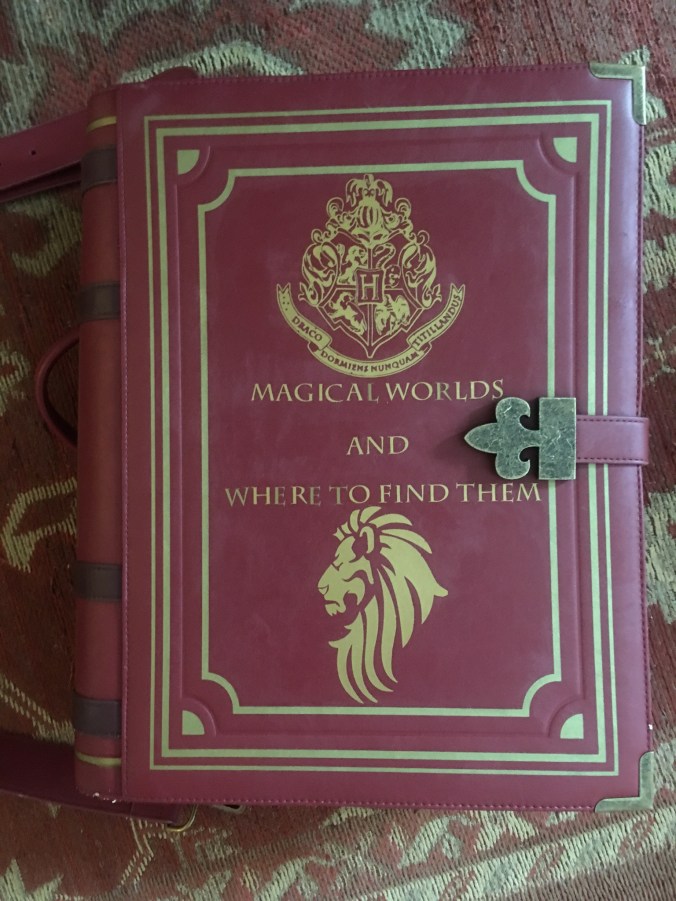
Everywhere I go, my customized book bag is a topic of conversation.

First of all, it’s literally a BOOK bag, sending the message “I’m a reader.”

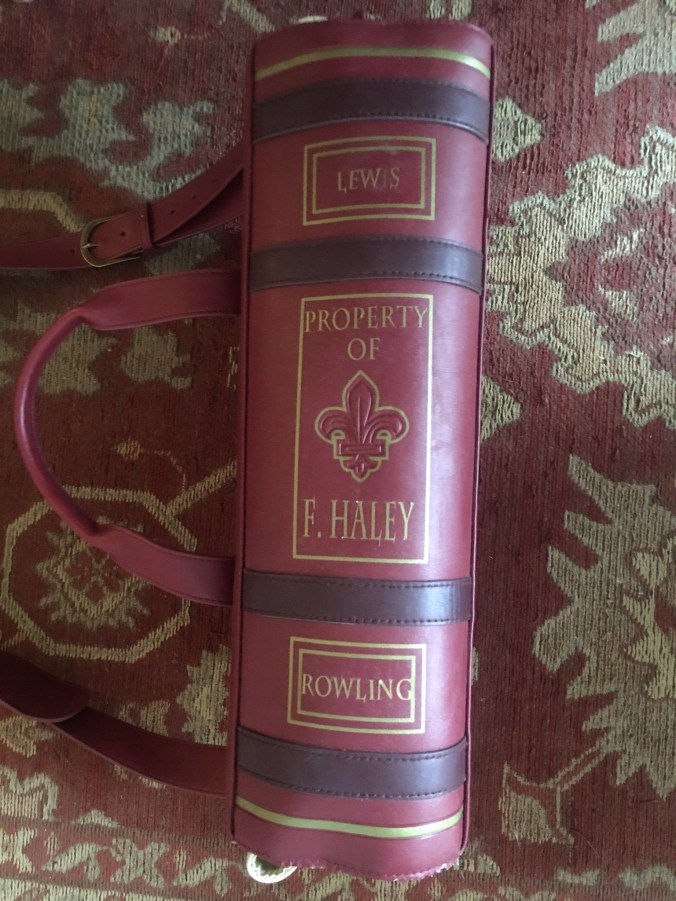
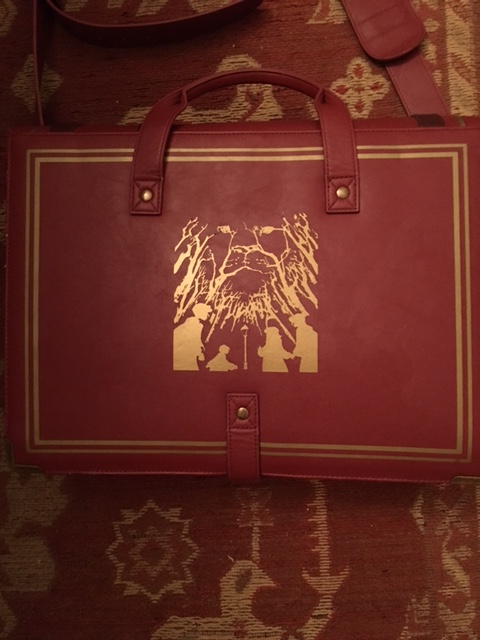
Then people realize what the “book” is about. A play on Fantastic Beasts and Where to Find Them, my book bag bears the title “Magical Worlds and Where to Find Them.”

Opening a book, for me, is akin to Newt Scamander opening his suitcase – we step in and walk through magically expanded worlds. Whatever the book, it’s a passport to the minds and souls of other people, where I find myself reflected not always as a writer or thinker but as a fellow human being on the common, complex journey of life.

That’s the message I want to send to my young students, who are frequently in raptures over my book bag: Read. Expand your world, your mind.

My book bag actually sends more than one message:

Bookbag spine

It’s an homage to my favorite fantasy writers and the worlds they created, old and new.

Much is written and debated, perhaps, on the importance of reading fantasy. Here’s a favorite quote on the subject:

The problem with people who are afraid of imagination, of fantasy, is that their world becomes so narrow that I don’t see how they can imagine beyond what their senses can verify. We know from science that there are entire worlds that our senses can’t verify. 
-Katherine Paterson

The magic is a draw, certainly – in regard to Lewis’ Chronicles of Narnia, who wouldn’t want to experience singing stars and merfolk, a centaur, talking animals? Who wouldn’t want a chance to feel the tingle of the box of dust from the lost island of Atlantis and ride on the back of a huge owl? Truth is, the bigger, deeper exploration is not the mysteries of the magical world but the real workings of the human heart – we read fantasy to escape our world, to live in another for a time, and all the while we’re looking into a mirror. This is where our thinking truly broadens – in understanding self, then in pushing the parameters of possibility.

Dr. Seuss said:

Fantasy is a necessary ingredient in living, it’s a way of looking at life through the wrong end of a telescope, and that enables you to laugh at life’s realities.  

The lines between the fantasy stories we love best and the world we live in are much blurrier than we realize. It’s where the impossible and possible merge – who’s to say where all the boundaries really are?

Which is fun, sometimes even comforting, to think about.

So everywhere I go, I carry a little fantasy, a little magic, with me.

Via my book bag – a messenger bag, indeed.

Bookbag back

slice-of-life_individual

Deeper than data

Moonrise

Moonrise. magnoidCC BY-SA

Papers are spread across the conference room table. The projector shines a graph – a student’s reading assessment history – on a screen. Discussions center on interpreting the erratic data points on a trend line in relation to the aim line toward a goal, the rate of improvement, and whether or not this student is a retention candidate.

A colleague turns to me: “What do you think? You’re the literacy person.”

I consider the numbers, the color-coded risk categories, where this child falls in all of it.

“I don’t know,” I reply. “I haven’t heard this child read.”

Silence. Eyes are on me.

“I need to know what exactly this child is doing during reading, how the child approaches it, feels about it, what the actual strengths and weaknesses are. Until I do, I cannot say what I think. Data is information but it doesn’t tell the whole story, only little pieces at specific points in time. I have to listen to the child.”

I leave the meeting to do just that.

The child is eager to read and turns out to be highly accurate, reading slowly and deliberately; the time that it takes this child to finish reading is why a high risk is indicated on some measures. In fact, the child can read and fully comprehend text above grade level expectation. The only enemy is time, and that’s only an issue in assessing. The desire to read, the ability to self-monitor, and an obvious work ethic so early in life will take this child far.

I think of Brené Brown, professor-author, who says: “I am a storyteller. I’m a qualitative researcher. I collect stories; that’s what I do. And maybe stories are just data with a soul.”

Data is the dust jacket; behind it there’s a story, and in the center of the story is a little soul.

It takes another soul to reach it.

I listen to another child reading with great flow and prosody, to discover that this young reader isn’t making meaning beyond the surface of the text – and struggles a bit even to retell what’s explicitly there. This child, whose data looks near-ideal, “in the green,” is of far greater concern. Supports need to be put in place immediately or this child will fall through the cracks.

On paper – on the dust jacket – this child looks just fine.

A few months ago, as I was printing data reports in the computer lab, I saw a young man walking with a class down the hallway. Subs are getting younger and younger, I thought, gathering my papers and returning to my room to begin analyzing them. Two colleagues joined me at my table.

The young man came into my room, smiling. “Mrs. Haley, do you remember me?”

I look at him. A little face, frowning over a book, springs into my mind. “Yes, I do! Goodness, you’ve grown up!” Mentally, I am counting off years – Good grief, how long have I been doing this?

Turns out he’s not a sub, he’s a high school volunteer. I breathe a little easier about the passage of time. He was one of my first intervention students at this school.

“I am planning to go to college to teach,” he says with a grin. I marvel at his poise. He exudes young professionalism.

“Really? What do you want to teach?”

“Reading. In fifth grade. I think I can help the kids love it. I really didn’t love it until I was in high school and suddenly I couldn’t read enough – I read all the time.”

I am awed. “That’s amazing! I am so glad to know. The kids need you. What a great role model you’ll be.”

One of the colleagues at my table asks: “Was there a particular teacher who inspired you?”

His face – once so little and serious, nearly scowling as he sat at this very table – lights up with a beatific smile.

“Yes. Mrs. Haley.”

My colleagues’ eyes tear up. I cannot even blink, cannot quite process this.

“But – you said you really didn’t enjoy reading until high school,” I manage.

“It took a while,” he laughs. “Reading was hard for me when I was little. I didn’t think I’d ever be good at it. You were the one that gave me the confidence, the one who said I could do it. I kept trying.”

Behind the data is a story. Behind the story is a little soul. A precious one.

Sometimes we never know how the story unfolds once the children go on. We only play a part for a little while, but how priceless is that tiny window.

If data were the whole story, I wouldn’t be a teacher, wouldn’t be writing this now. My parents didn’t go to college; one didn’t finish high school. The odds were against me. But my parents bought books and magazines, my grandmother read to me long before I went to school, and teachers challenged me all along to strive for more.

Another meeting, another table strewn with papers. I stand up. “I have to go now. It’s time for me to read with a student.”

This student and I read every day, if we can. He struggles with vocabulary but his primary issue is lack of confidence – he doesn’t want his peers to hear him.

I am running late. When I find him, he tries to hide a smile.

“I thought you forgot,” he says, as we settle at the table.

“I was in a meeting,” I explain. “I had to leave it.”

Pure astonishment is on his face. “You left a meeting? To read with me?”

“Well, yes. Your reading is important. Let’s get going.”

He looks at me, wide-eyed. “I can’t believe someone would do that.”

“You’re more important than the meeting,” I say.

He smiles in spite of himself.

And he reads.

I listen.


Lighting the way

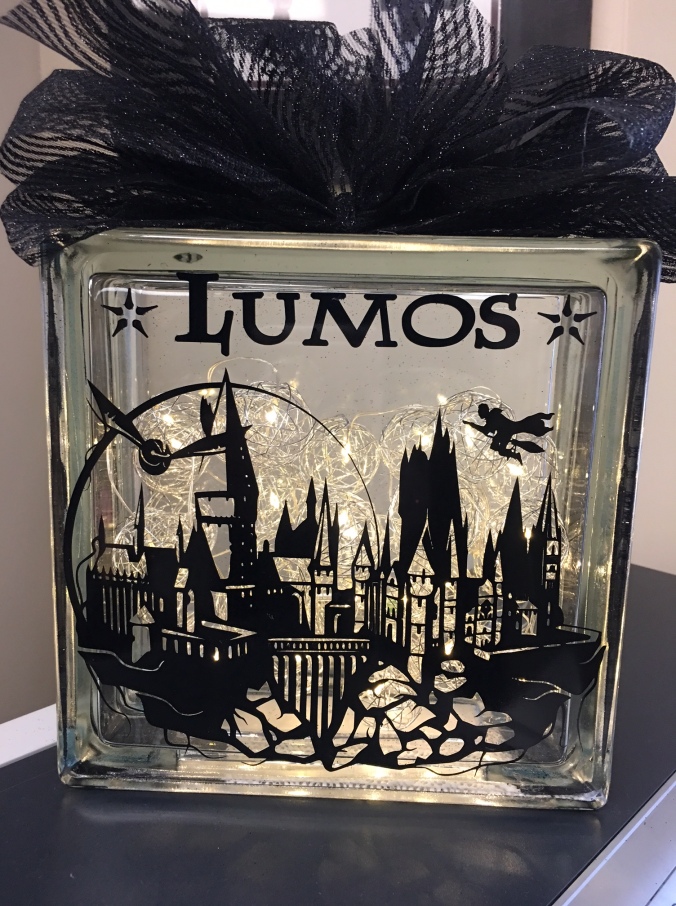
Lumos

Yesterday a fifth-grader caught me in the hallway:

“Mrs. Haley, do you have a copy of Harry Potter and the Chamber of Secrets in your room?”

 “I have two copies. Ask your teacher if you can walk with me to get one.”

He did. As we walked, I said, “The Chamber of Secrets is a great book. I enjoyed it more than The Sorcerer’s Stone.”

“Yeah, I haven’t read Chamber of Secrets. I saw the movie and my favorite part is when Harry gets the cloak of invisibility and finds that mirror where he sees his family.”

“Ah, the Mirror of Erised … I just read that aloud to two classes at another school last week while they were studying fantasy.”

In that chapter, Harry receives the cloak of invisibility at Christmas with an anonymous note explaining that it had belonged to his father; he is admonished to “use it well.” He sneaks around Hogwarts, hidden by the cloak, and ends up in a remote, off-limits part of the building in what appears to be a storage room. He finds a large, ornate mirror. Erised backwards is desire – looking in the Mirror of Erised shows a person the deepest desires of his or her heart. Harry’s family is dead; he desperately wishes he could have known them. He is transfixed by their images in the mirror – they wave at him, and his mother wipes away her tears as she smiles at Harry.

I think, as I rummage through my basket of Potter books, Fascinating how it’s the humanity that draws us, more than the magic. 

“Here you, go,” I say to the student. “The Chamber of Secrets.”

His face lights up when I place it in his hands. “Thanks, Mrs. Haley!”

“Read it well,” I call after him, as he walks away, flipping pages.

I look around my room, my own chamber decorated with Potter memorabilia that draws children from across grade levels. They love to drop by to show me their owl collections, to ask if I’ve read The Cursed Child, to share anything Harry Potter that they’ve recently acquired. The Harry Potter club meets here twice a month, students from third through fifth grades, and we talk so much more about what motivates the characters than the magic they employ.

My Lumos glass box gleams in the corner by the doorway. I think of all the times that teachers might wish we had magic wands to show us everything the kids need, to fix all that needs fixing. I recall J.K. Rowling’s quote from her 2008 Harvard speech, now connected to her Lumos charity on behalf of children:

“We do not need magic to transform the world. We carry all the power we need inside ourselves already.”

It’s apparent whenever I read with the kids, whenever the Potter club meets and someone has an epiphany about a character, whenever I walk into a classroom to write with students and teachers. The essence of teaching, of reading, of writing more than anything else, is the connection of human minds and hearts. It’s all part of same story, the triumph of the human spirit. Teach it, read it, write it well – tap into all you’ve known, all you’ve loved, all you’re wrestling with, and watch their faces.

It’s all inside you. Light the way.

slice-of-life_individualEarly Morning Slicer


Open a book and dance

dance-metaphor

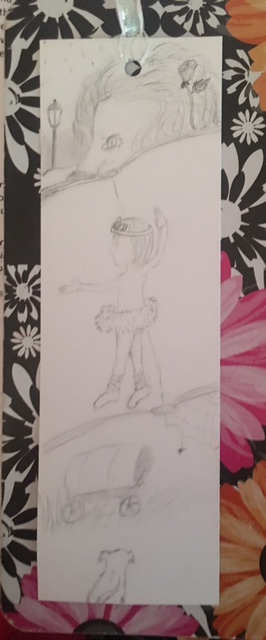
During a recent study of Who’s Doing the Work? How to Say Less So Readers Can Do More (Burkins and Yaris, 2016), the facilitator encouraged participants to jot notes or sketch on blank bookmarks as reflections of our learning.

Throughout the book, the authors use dance lessons as a metaphor for how learning to read works. As aspiring dancers watch proficient ones with a desire to emulate them, to navigating increasingly challenging choreography, so young readers develop skills along with a desire to read for the sake of it. My chapter was “Independent Reading: Learning to Love to Read,” in which independent reading is compared to a dance recital. Students have practiced and the teacher watches from the wings, not interfering when there are missteps, but “noting ways to fine-tune the their next performance.” The line that struck me most: “Most important, teachers let students read, allowing them the glorious luxury of falling in love with books.”

That got me thinking about my early reading life and the hand that teachers played in it.

In fourth grade, my teacher began the year by reading Charlotte’s Web to the class. Naturally we wept at the death of Charlotte (don’t we all, still?). I was so captivated by the story that I bought a copy at the book fair, to reread it to my heart’s content. This teacher knew what she was doing: she ended the year by reading Old Yeller aloud to outright sobbing from the class. I had to read the book again on my own, to grapple further with Travis’s extraordinary courage and the horror of the decision he had to make after that old yellow dog had saved his life. Old Yeller was outdone only by my own discovery of Where the Red Fern Grows in the school library – I cried every day for weeks after that one. I remain eternally grateful to Mrs. Cooley for hooking me with the power of story.

My fifth-grade teacher suggested that I read the Little House series. I loved Laura so much that I sometimes wore my long brown hair in braids and had my mother make sunbonnets for me (to wear at home, not to school). Laura was real. She wasn’t perfect and she knew it; I admired her backbone and the way she faced challenges. I also loved going back in time, reveling in Laura’s descriptions of the natural world and everyday life long ago. There’s such poignancy in the line “Now is now. It can never be a long time ago” (Little House in the Big Woods). As a child I pondered that line, knowing the story took place over a hundred years in the past – then realized that, in the pages of a book, time is preserved, all that happened is still unfolding, those who are gone still live. In the pages of an engrossing book, at least, now is now. How wise my teacher was, guiding me to books that would make reading part of my everyday life.

I was given lots of opportunity to explore books in the sixth grade. That year I was scouring the school library shelves for titles I hadn’t already read when I encountered an especially intriguing one: The Lion, the Witch and the Wardrobe.  “Sounds interesting,” I thought, taking it from the shelf, never suspecting what a defining life moment this would be. When I opened the cover, the magic poured out and pulled me in; I devoured every one of the Narnia Chronicles with an insatiable hunger. I loved them for the beauty of the setting, for their Britishness, for the author’s gift of turning a phrase and his humor, and most of all, for the hope they contain. I was encouraged to reenact scenes from the book for my classmates: I roped a friend into portraying Jadis while I dressed up as Aslan, complete with mane and tail. It’s the old good vs. evil theme, resurfacing many times throughout one’s academic and life experiences.

The influence and insight of my  of my teachers, along with the freedoms they gave me, had much to do with the reader I am, with person I am, today. They provided me the “glorious luxury of falling in love with books” – as you can see in the bookmark above, my tribute to them. I was never much of a real dancer, but metaphorically speaking – as a reader – I dance each day with wild abandon and absolute joy.

Reflect: Who helped you fall in love with reading? Write about this experience – and if these people are still living, write to thank them for their great gift to you. If you teach: How can you better provide “the glorious luxury of falling in love with books” for your students?

Haunting forevermore

Ah, distinctly I remember it was in … June, 2013.

My older son and I, teachers inspired by a love of The Great Gatsby,  celebrated the arrival of summer vacation by driving from North Carolina to Rockville, Maryland, where we visited the grave of F. Scott Fitzgerald. Having accomplished this mission before nine o’clock in the morning, my son asked: “What do you want to do now?”

“You know,” I grinned, “Baltimore is only forty-five minutes away. Poe is buried there.”

Thus was our Dead Writers Tour born. Off to Baltimore we went.

In contrast to a midnight dreary, the morning sun was blinding at the Westminster Hall and Burying Ground. The old Gothic-Revival church, the gate, the trees, the headstones, all cast the blackest, sharp-edged shadows, as if intentionally evoking the last lines of  “The Raven”:

And the lamp-light o’er him streaming throws his shadow on the floor;

And my soul from out that shadow that lies floating on the floor

Shall be lifted – nevermore!

And there, to the immediate right of the entrance, was the author’s grave under a large, shadowy monument bearing a plaque with his likeness. One wilting yellow rose and a couple of little rocks rested on the base.

Poe is buried with his wife, who was also his cousin, aged thirteen when he married her and twenty-four when she died, and her mother, his aunt.

“This isn’t the original grave,” my son pointed out. “Poe was first buried somewhere behind the church. He was moved here to to the front later.”

“That figures,” I said. “The man was unsettled for most of his life. He couldn’t even be settled in death.”

Just then a black bird flew by to land on another headstone, where it sat watching us from the stark shadows.

“Is that a raven?” I whispered.

Quoth my son, wide-eyed: “Geez, Mom!”

“No, it can’t be,” I assured him. “Ravens are bigger than that … I think. Let’s go find the first grave.”

This cemetery is old, dating from the late 1700s. The pathway from the entrance to the back is narrow,  leading past massive domed slabs somewhat reminiscent of Quonset huts. Years and weather have left black streaks running down the sides of these burial slabs to form odd swirls and patterns. Ghostly patterns, painted by nature’s fingers.

“Check out this stain,” I said, pausing. “Does it look like a skull to you?”

“Oh, wow – it does!”

Rounding the corner of the church, we came upon a marble table with thick legs and a top so sunken in the middle that it seemed impossible for such a heavy substance. A plaque informed us that this “gravity-defying” monument was mentioned in a Ripley’s Believe It or Not! article. A Revolutionary War veteran is buried beneath this oddity.

From there, my son and I could see Poe’s original grave, as the crowned headstone is embossed with a raven. On nearing the cenotaph – the empty tomb – the words arching above the bird become visible: “Quoth the Raven – Nevermore.” The stone informs visitors that Poe rested in this spot from 1849 to 1875.

“Do you remember reading about the mysterious person who showed up every year on Poe’s birthday, wearing a cloak or something, to leave roses at the grave?” I asked my son, a trivia expert extraordinaire.

“Oh, right – the Poe Toaster. He wore a hat and white scarf. He left cognac, too.”

“At this marker or the other?” I wondered.

“This one, I think. He came for decades, until just a couple of years ago. No one ever figured out who the Toaster was.”

“That’s hard to believe, in this day and age.”

“What’s really strange is that just before Poe died, he was found in the streets of Baltimore, out of his mind, wearing someone else’s clothes, and no one ever knew why.”

“It’s haunting, but mostly sad,” I pondered aloud. “Something straight out of his own work.”

We turned to leave, walking past a line of eroding tombs and vaults on the far side of the little cemetery. Some stone vaults had iron closures that appeared damaged. My fanciful imagination took flight: Had someone tampered with the doors, trying to get in – or out?

I shuddered despite the brightness of the day, recalling something my grandmother told me when I was a child afraid of the tiny graveyard across from her house in the country: Never fear the dead. Fear the living.

“I don’t think I’d want to be here at night,” I said to my son.

We simultaneously picked up our pace toward the exit.

“Nor would I.”

Back at Poe’s final resting place by the gate, my thoughts turned to his poetry, the glorious rhythm of “The Raven,” which drew me as a child the first time I heard Vincent Price reading it on TV. The poem wields mesmerizing, unique power. It is meant to be read aloud. Once when I was working to help third graders comprehend a text they were reading, we encountered the word raven.

“What’s a raven?” they wanted to know.

“It’s a bird – a black bird,” I told them. “There’s a famous poem about a raven.”

“Read it to us!” demanded the kids.

After a quick Internet search, I read the opening stanzas.

The children listened, spellbound. When I stopped, one of them sighed:

“Oh, Mrs. Haley – that sounds just like music.”

It does, indeed.

Ever after, the kids greeted me with “Hi, Mrs. Haley! Once upon a midnight dreary, while I pondered, weak and weary!”

Having paid my respects at last to Edgar Allan Poe, I walked back through the gate, just as the church’s bells began striking eleven – as if the word master himself was sending a message:

Keeping time, time, time,

As he knells, knells, knells,

In a happy Runic rhyme,

To the rolling of the the bells —

Of the bells, bells, bells —

To the tolling of the bells,

Of the bells, bells, bells, bells,

Bells, bells, bells–

To the moaning and groaning of the bells.

It couldn’t be coincidence – could it?

Today is the 167th anniversary of Poe’s death.

Reflect: What written works sing in your head, call to you, haunt you? Why?


So we beat on

fitzgerald-grave

In the summer of 2013, my older son and I embarked on what we now call The Dead Writers Tour. The Great Gatsby film, newly released, was creating a resurgence of interest in the novel and F. Scott Fitzgerald himself. My son had just completed his second year teaching high school social studies, his favorite portion of which is the Jazz Age; he had even begun coordinating his history lessons with the English classes’ reading of Gatsby and teaching his students how to dance the Charleston.

Perhaps it was our shared loved of literature and writing, or the joy of the whole summer lying before us, teachers on the loose, that beckoned us like the green light beckoned Jay Gatsby. Perhaps the movie was the impetus for adventure, capturing the zeitgeist and ending, as the novel does,  with my son’s favorite literary quote:

So we beat on, boats against the current, borne back ceaselessly into the past.

Fitting, indeed, for a young history teacher who was born by a bay (albeit one in Virginia, not New York).

“You know, Mom,” said my son, as we left the cinema, “That quote is on Fitzgerald’s grave.”

“Is it, now,” I mused. “As much as you love it, you ought to go take a picture and put it up in your classroom.”

The light in his eyes was instantaneous. Out came the phone to research the grave’s location: Rockville, Maryland. How far is that from home in North Carolina? A quick check in Apple Maps: Right at four hours.

“That’s a day trip,” I said. “I’ll come with you. It will be our summer celebration kick-off.”

So, on a mid-June morning, we left long before daylight. We ate breakfast while it was still dark, chattering about our teaching accomplishments that year and our dreams about writing, lamenting the constraints of time in the daily grind of making a living. The hours passed quickly, despite the epic traffic snafu of D.C. Once on the other side, however, we sailed right into Rockville.

The cemetery is at a Catholic church in the midst of bustling city streets. After navigating such noise and chaos, I was not expecting utter silence on entering the graveyard. It was like a cosmic mute button was suddenly pressed, or that I had passed through a portal from one world to another. The city receded at once; all I could hear was a faint shivering of tree leaves overhead in the breeze, oddly cool for June, and the occasional flap of little American flags, remnants of Memorial Day, at the graves of veterans.

How incredibly peaceful, I thought.

“There it is,” whispered my son, pointing.

Fitzgerald was easy to find; his grave was the most adorned. As we approached, a brown rabbit hopped out of our path to a more remote patch of sun-dappled grass where it could nibble, undisturbed. At at the foot of his grave a flag commemorated Fitzgerald’s World War I service. On the headstone, the author’s full name signifies an even deeper connection to the flag: his famous cousin wrote the lyrics to the “Star-Spangled Banner.” I reveled in having my own first name in common with these writers and Fitzgerald’s daughter, buried nearby. A pot of daisies had been placed by the headstone, a nod to the love of Jay Gatsby’s life. Most interesting of all is that Fitzgerald’s wife, Zelda, who was at least part of the inspiration for the character of Daisy, is buried with him in the same grave.

Any student of F. Scott Fitzgerald knows his struggles, that he was always teetering on the brink of financial ruin, that he and Zelda lived a frenzied life, that both of their deaths were sudden and tragic, him with a heart attack in his forties and her a few years after, in a fire at the mental hospital where she was a patient. Fitzgerald never knew The Great Gatsby would become the beloved American icon that it is.

We stood there in the stillness, my son and I, drinking in the sight, lost in our own thoughts. After a bit, we took the pictures.

One or the other of us sighed. I am not sure which.

“What do you want to do now?” asked my son.

I looked up at the sky. The day was golden, still young; we had time, perhaps, for another adventure.

“You know,” I grinned, “Baltimore is only forty-five minutes farther. Poe is buried there.”

My son chuckled. He took one last look at the final Gatsby lines etched on the weathered granite slab. “All right, Mom. Let’s go.”

So we beat on.

Reflect: What literary works or quotes strike a deep chord in you? Why?

-Happy Birthday this week, F. Scott Fitzgerald.