Sun-kissed summer: Spiritual Journey

And so it comes to pass, at long last, that I return to the site of my sun-kissed childhood summers.

My ancestral homeplace in eastern North Carolina. Literally the land of my fathers: My dad, my grandparents, my great-parents, my great-greats were all born within a small radius of a tiny town and crossroads that were old long before my appearance on this Earth.

Thus began my fascination with Time.

In the bend of a dirt road stood my grandparents’ home, where my father grew up. My youngest aunt was born here in the same room where her father, my Granddaddy, would die fifty-three years later at 92. He wanted to die at home. He did, peacefully and “full of days,” as the Scriptures say of Abraham, Isaac, and Job: After this lived Job an hundred and forty years, and saw his sons, and his sons’ sons, even four generations. So Job died, being old and full of days (Job 42:16-17).

Likewise, my grandparents saw four generations. They lived to see my children. Incidentally, Granddaddy had a brother named Job who died in the 1920s (he drowned, if I recall correctly; this is a coastal area).

So it was that I grew up on stories of the old days and ways, a little city girl mesmerized by my deep country roots. In my time the once-thriving community was already history; nature was reclaiming the unpainted houses, one by one. Some were still visible through the woods (an early memory: a cypress shingle roof in the treetops, if you looked just right) and others were in various stages of falling down with yards still mowed by descendants.

On this return journey a few weeks ago, I discovered that my grandmother’s homeplace from the early 1900s is being swallowed by the forest:
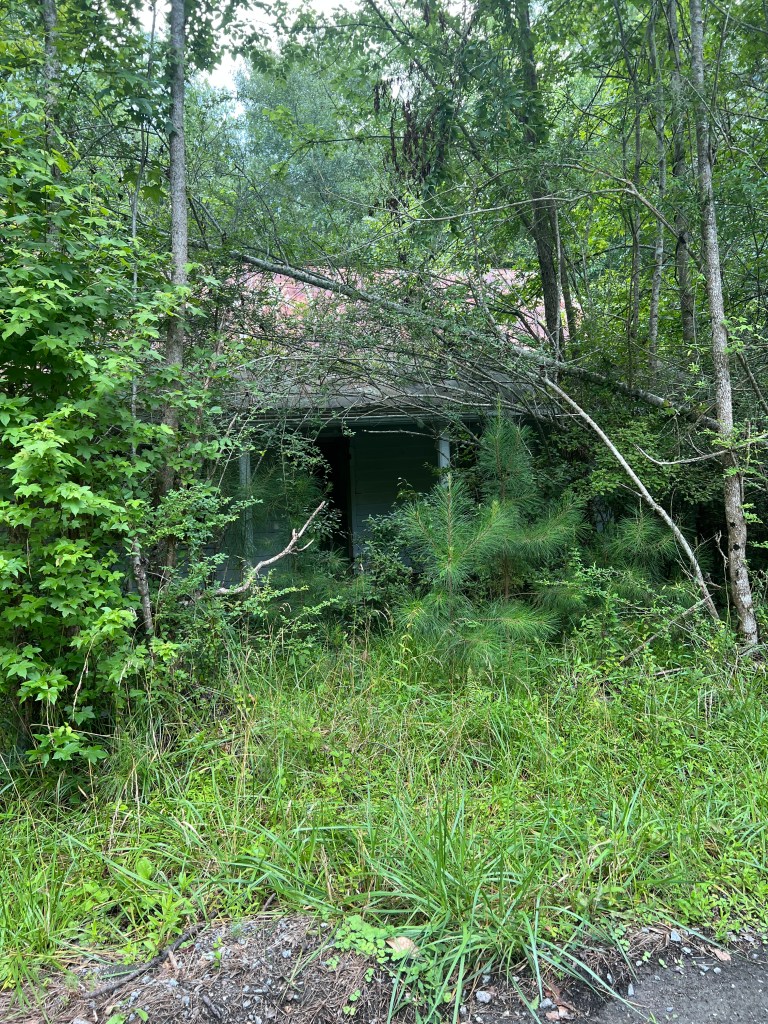
A terrible jolt, as I can remember it having a hedge, a lawn, a porch swing, a screen door. I remember the layout inside and my great-uncle living there, tending to a patch of sunflowers.

And I knew, prior to this journey, that my grandparents’ house, which stood on the corner a little farther on, is gone.

This story is a little different, however. Instead of the forest reaching its veiny green fingers to reclaim its own, a young couple has built a home right in the middle of what was once my grandfather’s garden. I can’t help thinking how Grandma would marvel at the beauty of this new house and its lovely landscaping.

All that remains here from the enchanted summers of my childhood half a century ago (and from time before me) is the pumphouse, one of Grandma’s crepe myrtles (now wistfully draped in Spanish moss, which never used to be in these parts), and the sidewalk that once led to the front porch of Granddaddy and Grandma’s home:
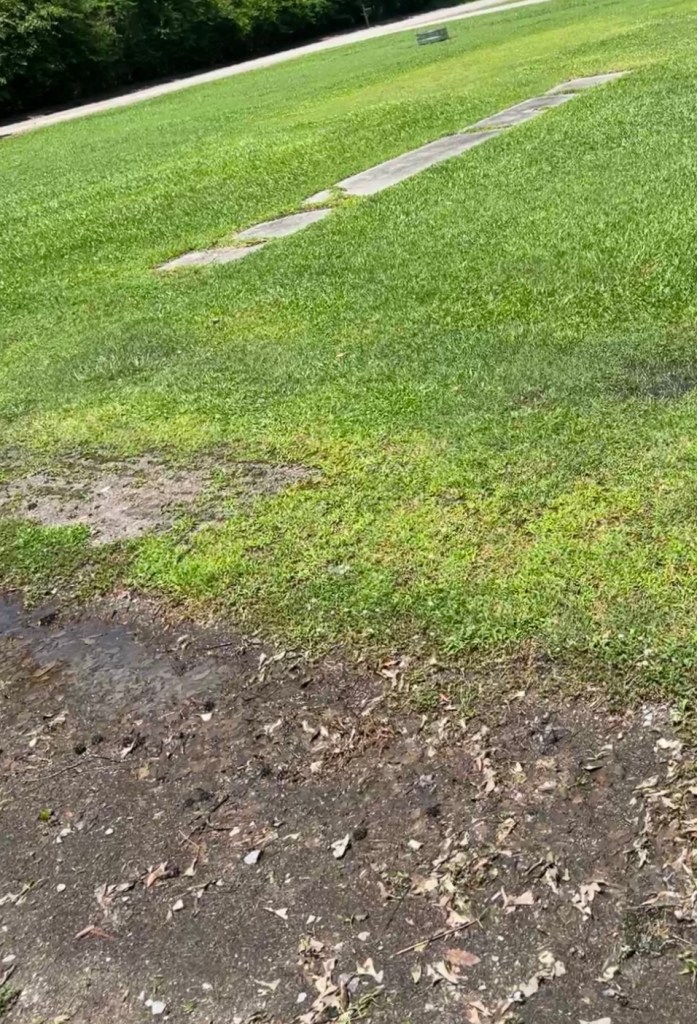
As a teenager I wrote a song about a sidewalk. Haven’t thought about it in ages:

Where does this lonely sidewalk lead?
You think by now I’d know
Footsteps into yesterday
That’s where I want to go…

I had no idea, then, that only the sidewalk would remain in this place I loved so well, where I used to play outside in the sweltering bug-infested heat, where Grandma would sit at her piano in the evenings to have me sing old hymns with her as Granddaddy listened from his recliner, where I felt loved and wanted and sheltered and that I belonged…

The old dirt road remains, too, of course.
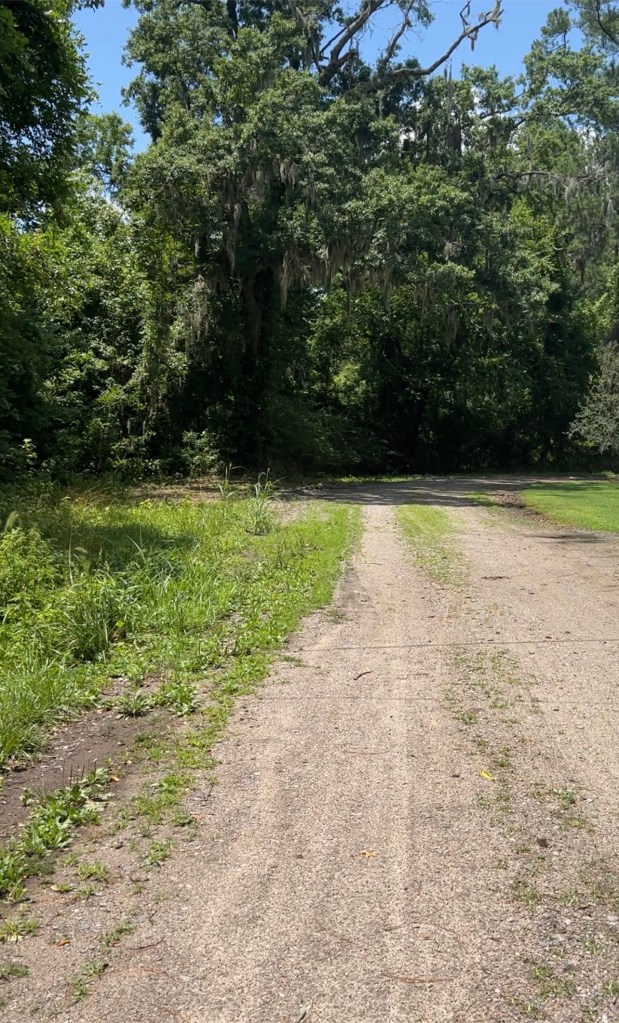
There was another dirt road branching off of it here in the shadows to the left; it once led, Grandma said, to a two-story antebellum house with a double balcony. I could hear admiration for that house in her voice. In my childhood the road was just two tracks through grass and thickets. The path faded more and more with every passing summer. Now you would never know it had ever been anything but woods.

From this vantage point, my grandparents’ yard is on the right, and to the immediate left is an old family cemetery. Not my family’s, although I walked it often with Grandma over the years. When I was a child, I was afraid ghosts would come out here at night. Grandma assured me they would not. She offered this dubious comfort: No need to fear the dead. Fear the living.

When I wondered at the graves of so many babies, she said people just didn’t know what to do for them when they were sick.

It’s clear how much the children were loved and mourned. This tiny cemetery remains painstakingly tended and strangely outside of time:
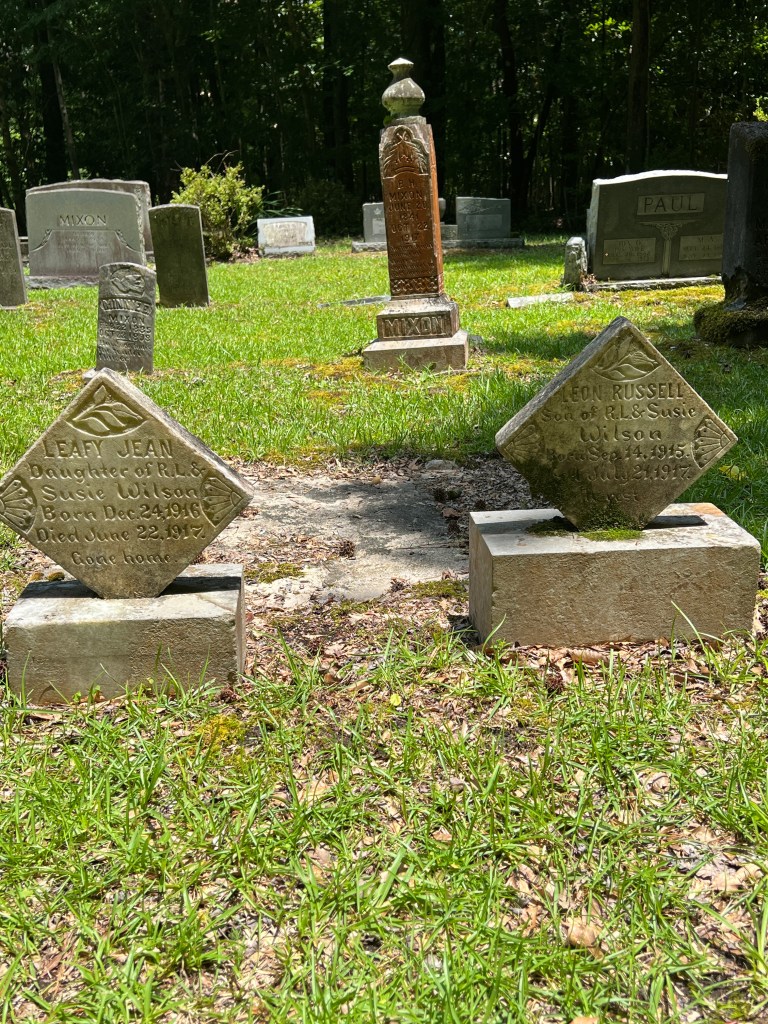
Hello again, baby Leafy Jean and big brother Leon Russell.

These siblings died a month apart in 1917. Grandma was born three months after Leon, almost a year to the day before Leafy, in the soon-to-be obscured homeplace just around the bend of the road.
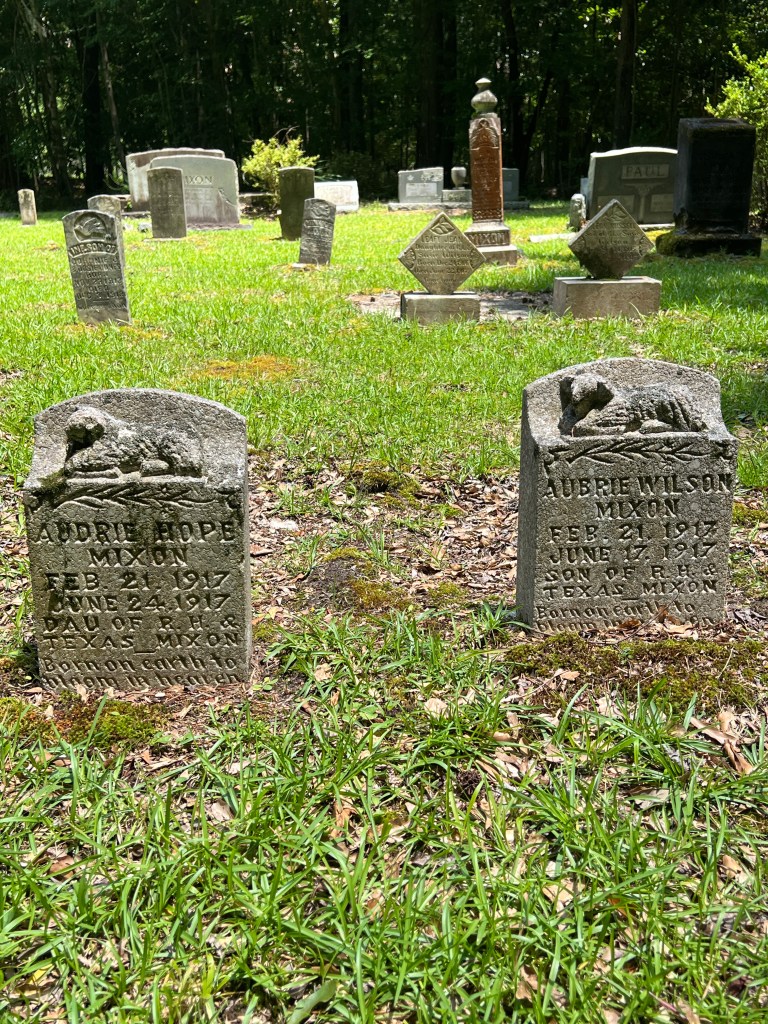
Four-month-old twins Audrie and Aubrie died a week apart during that same summer.

The greater wonder, in its way, are the children who survived disease and mothers who died giving birth to them, which almost happened to Grandma: her mother delivered a stillborn baby three months before she was born. My grandmother was a twin. Grandma journaled this because I asked her to; in her writings, she says several women in the community who recently had babies helped nurse her while my great-grandmother was so ill that she “almost didn’t make it.”

—Why am I just now realizing that Grandma’s lost twin would have come around the same time as Leon Russell? Could his mother have been one of the women who preserved my newborn grandmother’s hungry life? if so …imagine saving someone else’s child and losing your own…

So many mysteries in this place. I’ve always felt the pull.

Over fifty years after I first walked this cemetery with my grandmother, I’m awed by the good condition of the headstones. I halfway expected them to be eroding into illegibility — after all, these people’s earthly homes have long since crumbled. No greater mystery than Time…

I cannot linger here, ruminating, for there’s another place to visit. Really just a good walk “around the horn” to the church, a journey I’ve made many times.
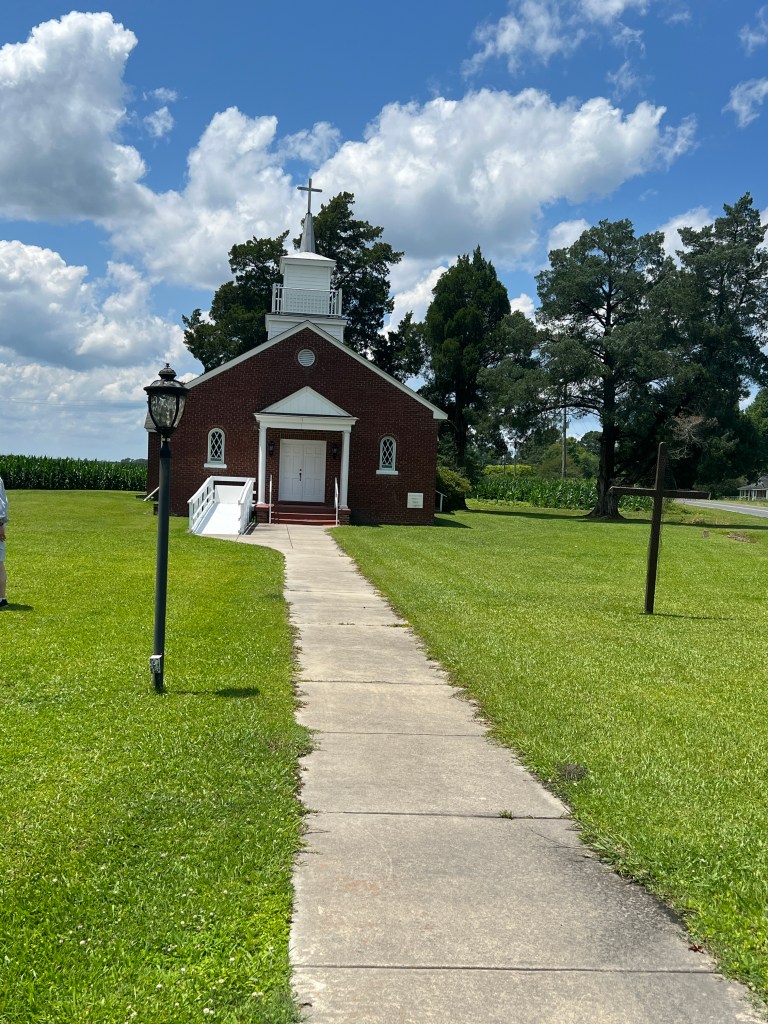
This was once the heart of the bustling farm community. The church was built on land given by my grandmother’s predecessors. Her father, mother, brothers, and other family are buried to the right of this crossroads.

Granddaddy and Grandma are buried in the churchyard, to the left.
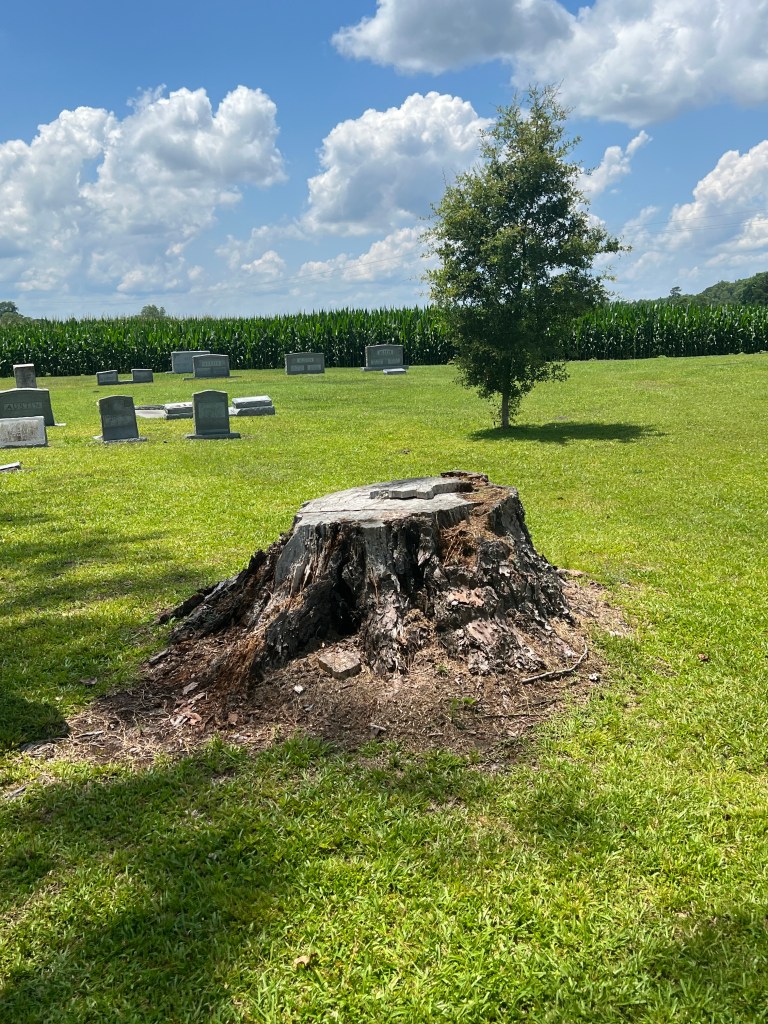
Such a beautiful little resting place, presently bordered by a lush cornfield. An old live oak felled by a hurricane in recent years has been replaced by a new one nearby.

Grandma would be so pleased to see how well-tended everything is.

There’s even a new footbridge over the ditch at the churchyard, for easy access to the little community center across the road. This building stands where Grandma’s three-room grade school used to, she said in her journal.

Here’s where old and new converge most for me, where Time is most relevant and paradoxically elusive. The spirit of this place is old; my own memories are growing old.
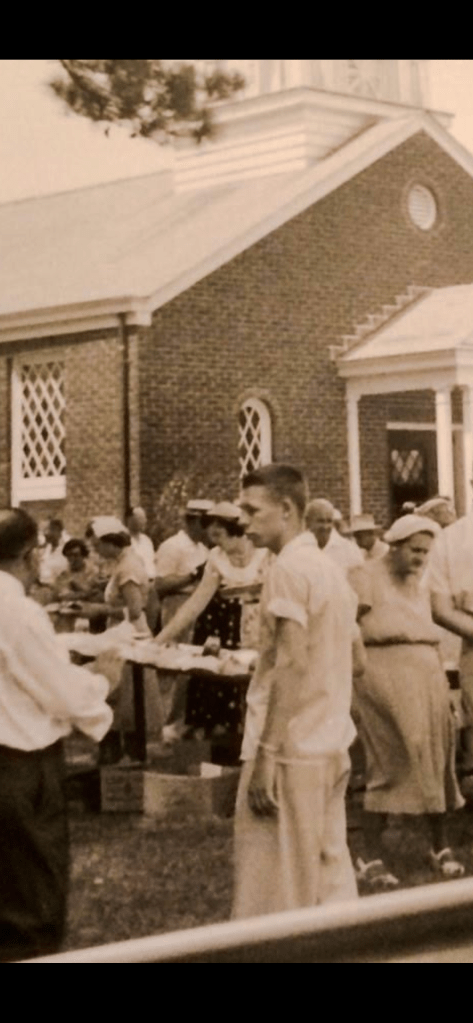
My father as a teenager, in the churchyard

I am the keeper of memories older than mine.

But I came for the new.

I brought my granddaughter, you see.

All along the journey, I told her stories. Of the old days, the old ways.

I brought her to dig for fossils at the Museum in town (which is where the phosphate mining company sends its rejects now, instead of scattering treasures on the old dirt roads).
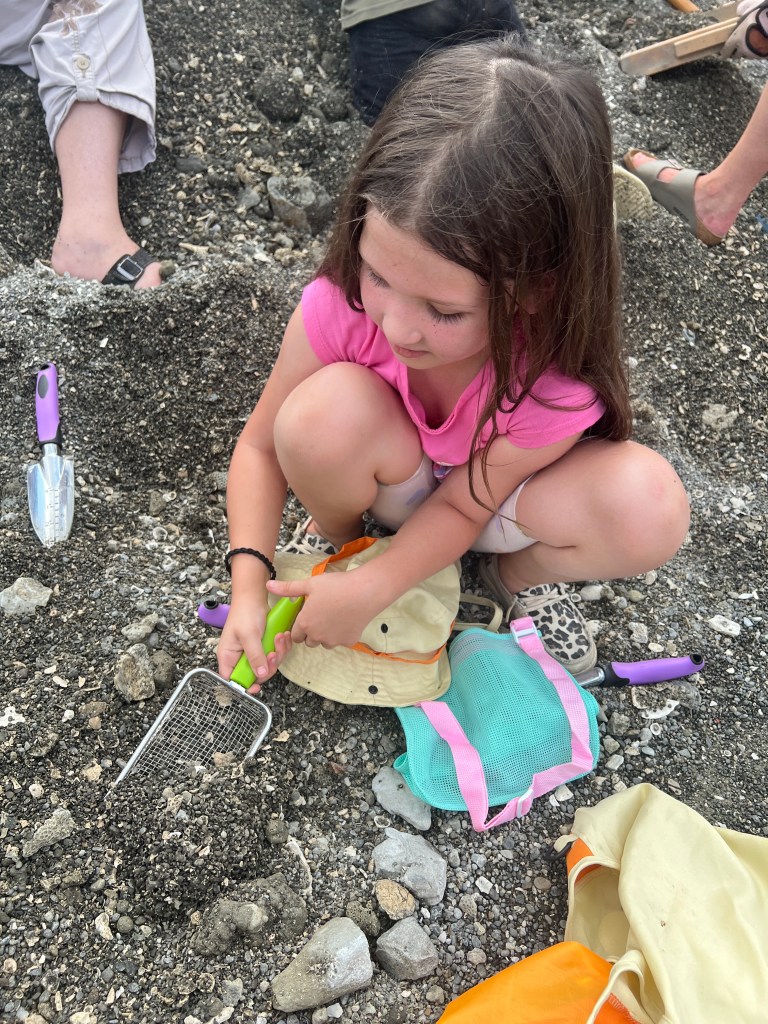
We found a bit of coral skeleton, shark’s teeth, and some bony things I’ve yet to identify:
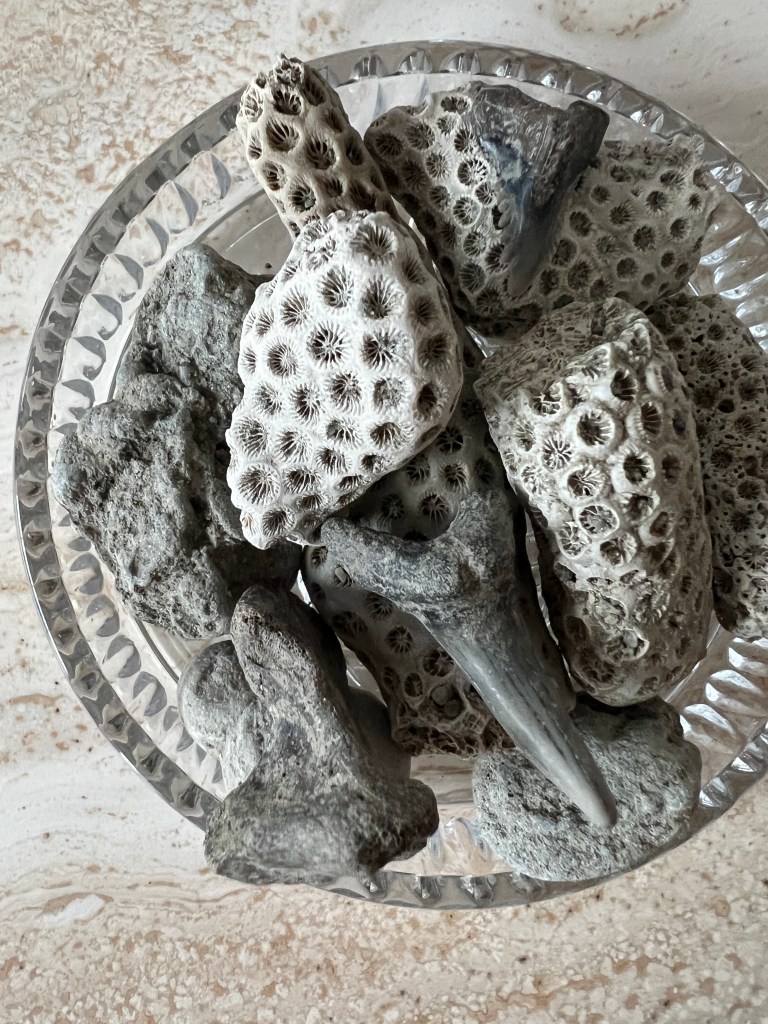
Making new memories from the old… even from the ancient, from time before recorded time.

As we were leaving, I discovered that the old library in this old, old town looks the same as it did five decades ago when Grandma drove me to pick out books to read at her house in the summer. I halfway expected to see her coming out with the armful she had to help me carry…
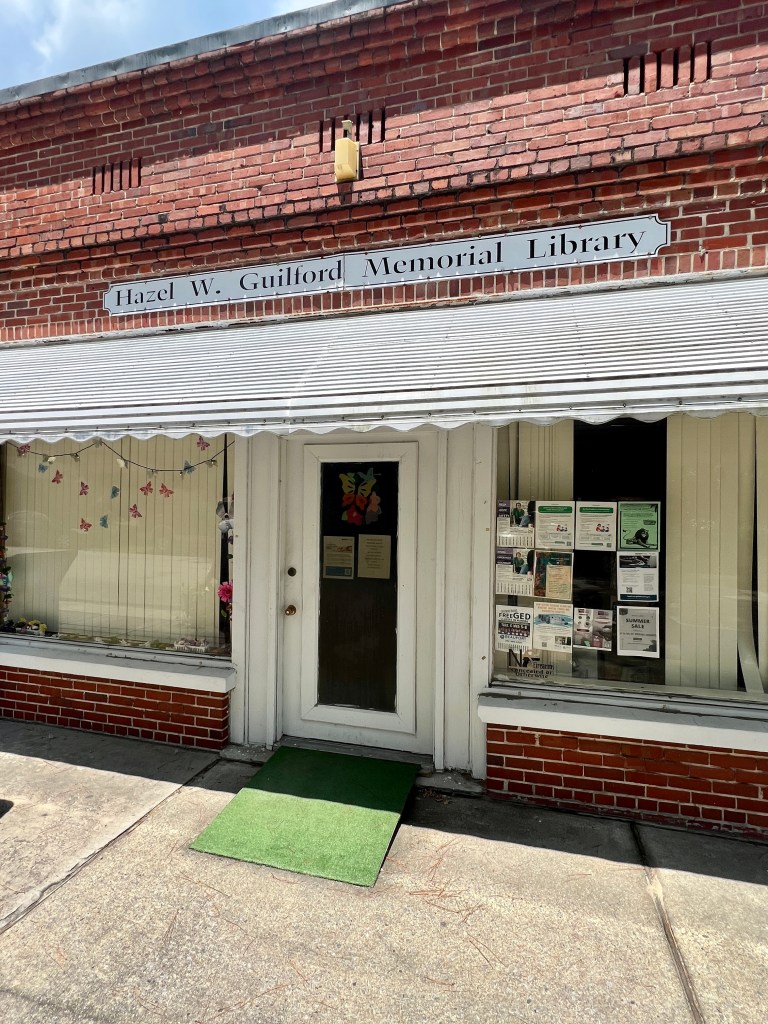
And I think this is used to be, or is at least near, the butcher shop where Daddy worked as a teenager.

There’s so much more to be said about memory, legacy, endurance, overcoming, and family… about the whole spiritual journey of life. The greatest gift my grandparents gave me, beyond their unconditional love and their stories, is that of faith lived out. I learned long ago that eventually there comes a homecoming so bright, so glorious, that all the former shadows are forgotten.

I expect I’ll recognize my little corner of Heaven, having had such a foretaste here.

Until that time, I carry on in the footsteps before me, praying I walk even half as well.

My now, my tomorrows

From Everlasting to Everlasting: A Prayer of Moses

Lord, you have been our dwelling place
    in all generations.

Before the mountains were brought forth,
    or ever you had formed the earth and the world,
    from everlasting to everlasting you are God.

You return man to dust
    and say, “Return, O children of man!”
For a thousand years in your sight
    are but as yesterday when it is past,

    or as a watch in the night

Let your work be shown to your servants,
    and your glorious power to their children.

Let the favor of the Lord our God be upon us,
    and establish the work of our hands upon us;
    yes, establish the work of our hands!

Psalm 90: 1-4;16-17

*******

with thanks to my Spiritual Journey friends who write on the first Thursday of each month
and to host Carol Varsalona who posted this reflection and question for July:

Pause and praise God for His wondrous gifts! 
What are you rejoicing over this summer?

/

Core memories poem

On Day Two of National Poetry Month, Emily Yamasaki offers this invitation for VerseLove at Ethical ELA: “There are some details that we hold in our hearts and minds, never to be forgotten. Whether it was carved into our memory in joy or distress, they are always there. Join me in giving those core memories a space to live openly today.”

This is the kind of thing that can keep me writing for hours, days, years… I kept it simple, using the first things that rose to the surface, sticking somewhat close to Emily’s models.

random core memories

the cadence of my grandmother’s voice, reading
fat pencils in kindergarten
the smell of struck kitchen matches
bacon grease kept in a canister by the stove
having to throw myself against the stubborn front door
     of my childhood home, to get it open
ironing my father’s uniforms
the smell of his shoe polish
the vaporizer sputtering in my room at night
the rattling crescendo, decrescendo of cicadas
saying it’s going to be all right without knowing how
finding sharks’ teeth in the new gravel of an old country road
lines from dialogues in my 7th grade French textbook
soft-petal satin of new baby skin
that one wonky piano key (is it D or E?)
the mustiness of my grandparents’ tiny old church
the weight of the study Bible in my hands
seeing you for the first time, across the crowded room
the cadence of our granddaughter’s voice, reading

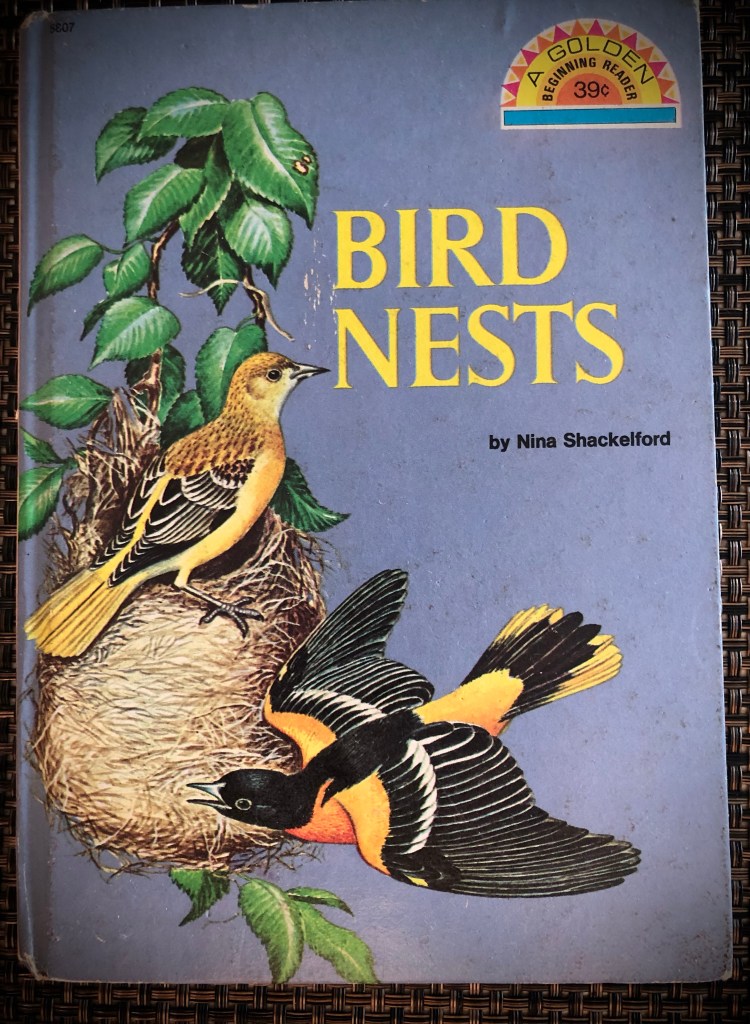
A book my grandmother read to me, that I read with my granddaughter now.
Is it any wonder that I find birds and nests so alluring?
Early memories hold such latent power.

Dust motes

Dust motes

Dust. ZoiKorakiCC BY

Last week I had the pleasure of co-facilitating my district’s third annual Teacher Summer Writing Institute. K-12 teachers were invited to deepen their sense of identity as writers, hone their craft, and experiment with form. Guest author Matt de la Peña led us through a series of writing explorations on Day One.

Here’s how it went for me as de la Peña used this exchange from “Steady Hands at Seattle General,” a short story by Denis Johnson, as a springboard for capturing images: 

“What about your past?”
“What about it?”
“When you look back, what do you see?”
“Wrecked cars.”

What might those two words mean, de la Peña muses aloud for the benefit of participants. 

“Wrecked cars?” Might they be literal or figurative? 

He goes on: Choose two words to create an image describing your past—when you look back, what do you see? 

At first I wrote ‘Christmas trees’. When I look back, I see them. From my grandmother’s all-silver, 1960s tabletop tree to my real Fraser fir decked in Victorian decor. Christmas trees mean another year is ending. That life and perspectives change continuously. To me they symbolize more than tradition. They mark time. Eras. Celebrations. Losses. Our children grow up; grown-ups from our own childhood pass away . . . between chapters of the unfolding story of life stands a tree.

When I look back, I see it all.

Suddenly I don’t want to use those words, Christmas trees.

In that instant, two other words materialize: 

Dust motes. 

I do not know why.

Except that I can clearly see the image of my childhood living room, a shaft of light between the drawn curtains of the picture window, the dust floating there, tiny specks of gold— 

He’s speaking, de la Peña. Asking if any of us would share our two words.

After a moment, I volunteer. 

“Dust motes?” he questions.  “I’ve not heard this before. I’m curious—why?”

Well,” I say, thinking as I speak, “it’s the image that came to mind, a shaft of light with dust specks floating in it . . . maybe because as a child I spent much time to myself, reading, in the stillness, in silences . . . when I look back, that’s what I see. Dust motes being partly your own skin. Shed cells. Pieces of yourself floating in that light . . . “

His expression is unfathomable. 

He says: “That’s fascinating and eerie. It lends itself to something really creepy . . .”

I consider this a compliment. 

De la Peña shares a model, “What Jimmy Remembers” from Jimmy & Rita by Kim Addonizio (2012):

Girls in white stockings and checkered wool jumpers, round white collars, red bows at their throats. Birds in Saint Christopher’s schoolyard—hundreds of them, black, spread out across the lawn in late afternoon. The brick wall of the steel mill on Dye Street he could see from the living room window, his father in there working, his mother in a shiny black dress coming in at dawn after singing in some nightclub, waking him for school. Shivering and dressing over the heating vent in the front hall. Dark-blue blazer and black shoes. A puppy that died of distemper, put in a shopping bag and into a can in Bushler’s Alley. Cotton candy on the boardwalk in Seaside Heights, the barkers calling Hey bub, Hey sonny, Buster, Skip, You. . .The black hearse carrying his father through the snow, a semicircle of metal folding chairs. The green faces in avocado leaves smiling down at him. God in the clouds. Who art in Heaven. His mother, ghost now: wearing a stolen mink, flipping a cigarette from a deck of Lucky’s. His father moving toward her with a match, cupping his palms around the flame.

—All images, fragments, this bit of microfiction.

“Now, using your two words as a title, take a few minutes to write what you remember from your past, but here’s the challenge: Don’t mention those two words in your scene,” says de la Peña. “Don’t worry about proper sentences. Just write . . . “

My pencil is already scratching away against the notebook paper: 

Hand-me-down corduroy Levi’s in baby blue, green, tan, cream. Ashtrays overflowing. Trips in aging Fords to buy discounted boxes of Salem menthols. Complimentary bubblegum cigarettes. A screen of smoke in the air mingled with chicken grease. Ivory Liquid suds in the sink, stiff, dry, stained with spaghetti sauce. Bathroom wall by the tub caving in where a soap dish used to be. The biting scent of Pine-Sol as it’s poured in the toilets, rolling white like smoke, clouding the water like creamer in coffee. Vaporizer in my bedroom, rattling, sputtering. The hallway, broom leaning against the wall, a gathered pile of gray lint.  Bullet in the living room rug, in the floor, if you know where to look. Books. Books. Books. Silences. Shafts of light through the picture window, beckoning from beyond. The wrought-iron lamppost by the concrete steps leading to and from the front door, the heavy, decadent fragrance of my mother’s gardenias in various stages of living and dying on the bushes there. Church carillon chiming, loud and clear, from several blocks away: Let me hide myself in Thee. The pungent whiff of crab from the factory, if the wind is just right. Salt. Salt. On my baked potato, tin foil too hot to touch, on my popcorn, on the wind. The answer, my friend, is blowin’ in the wind. All we are is dust in the wind. Words and words in my head and my heart, pouring onto stacks of pages that are always able to hold it all, and which never judge, which just absorb, and save.

There you have it. Dust motes. What I see when I look back, at least in part.

With apologies to Matt de la Peña, for while I didn’t use “motes” anywhere in my remembering, there was just no getting around “dust.” 

But also with deepest thanks to him for creating the conditions for this writing to occur.

Which is what good writing teachers do.

Live in the moment

I love to write memoir. I usually write it in present tense, as if the event is occurring.

Such as:

The nurse wheels me out of x-rays. I am trying so hard to not cry from pain and fear when I see him standing there in the exam room. He has something in his hands . . .

My Baby Ann doll. Smudged face, short white hair in cowlicks now, from lying so long in the toy box.

Despite my pain, I’m suddenly irritated: I can’t believe he brought Baby Ann! I don’t play with her anymore. Not since I was eight, last year. I want to say Daddy, I am too old for dolls now, don’t you know?

But I look at his face, I see the worry, because of me, because of my arm that the doctor is getting ready to pull and pull, to set the bones . . . and something inside me twists, gives way. I start to cry for Daddy because he’s trying to help me and doesn’t know how. I cry for me, for the pain about to intensify at the doctor’s hands and I don’t know how much.

I even cry for Baby Ann and her smudges and cowlicks.

When I write like this, I am there. It is happening. I see the exam room. I remember my red shirt with ruffled sleeves, ruined by plaster of Paris so that I could never wear it again. I see my father’s face contort, turn grayish-green, when I scream during the torturous pulling of my broken left arm to set it. I see that old doll, so vividly, in Daddy’s hands.

As I write it, see it, relive it, I think, How beautiful, Daddy.

I didn’t think any such thing at the time. Nor did he.

Which brings me to now and the idea of recognizing moments as they occur.

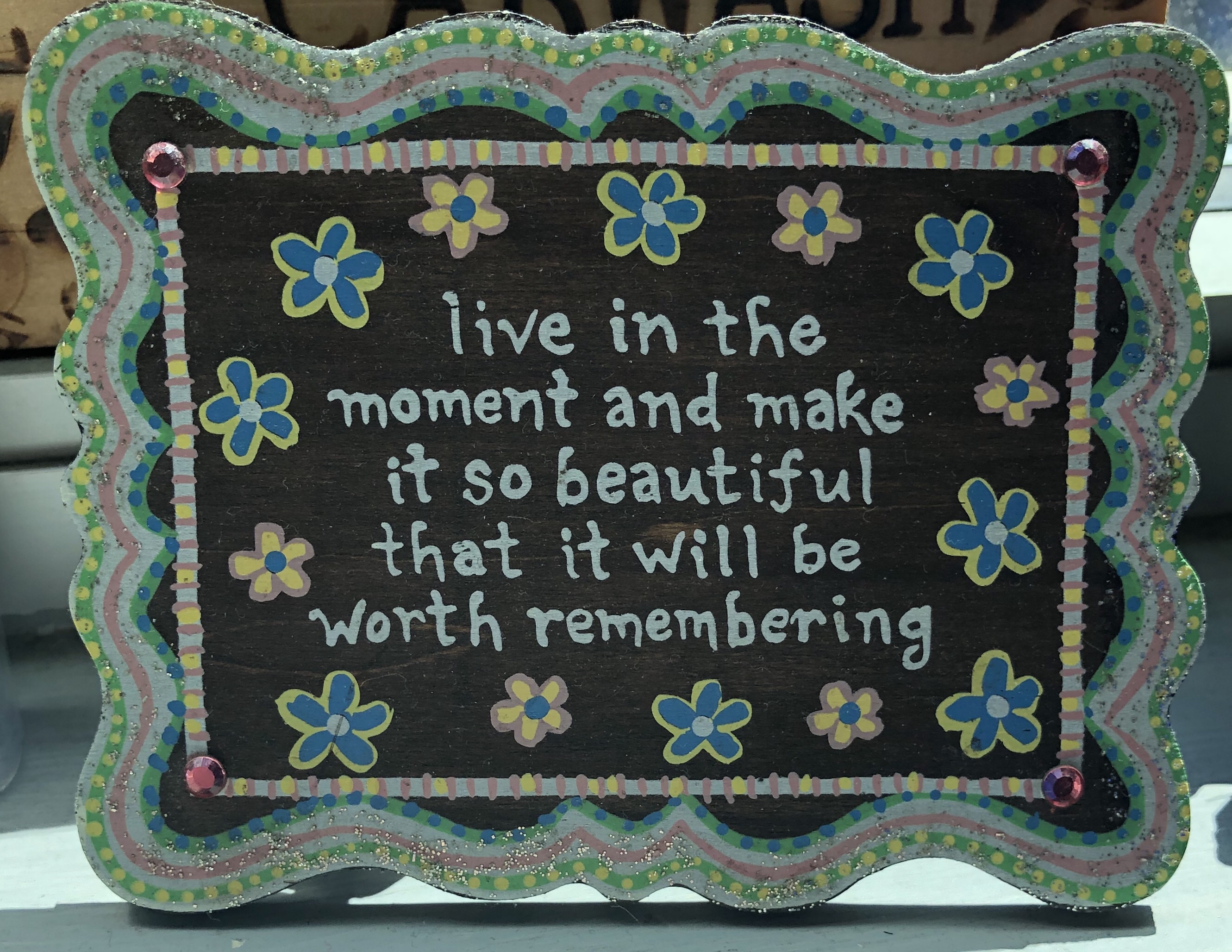
I saw the sign at the top of this post in a shop today. When you’re in the throes of a daily writing challenge, you learn to look everywhere for ideas. I took a picture of the sign as soon as I saw it.

I knew, in that moment, I’d write about it. Somehow.

Because that statement about living in the moment and making it so beautiful that it’s worth remembering speaks on two levels. Worth remembering in order to write about, of course. And being fully present for the people in your life. It is a call to be mindful, to savor every moment together. Moments typically aren’t as beautiful alone. Certainly not in being together and feeling alone (read “UNPLUG,” if you wish).

Memories will live, yes.

But what makes them so beautiful is how we live our now. Be present now. Make time now.

For we don’t know how many minutes we have.

-Do we, Daddy.

Relics

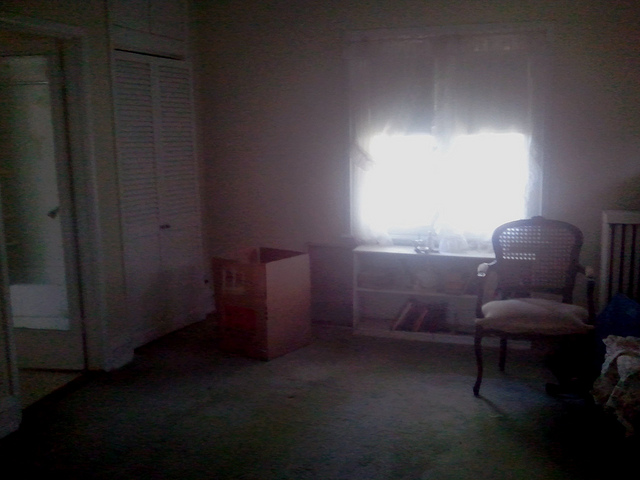
Mom's empty room

Mom’s empty room. The_DoodlerCC BY_SA

So many stories 

in every room

in every thing.

A lifetime packed

tight in every closet

in every drawer

for even in the time

of abundance 

the memory of deprivation

remained.

A lifetime of love

recorded in cards and letters

all saved 

even poems 

I don’t remember writing.

The photos of my children

so carefully preserved

growing up all over again

here in my hands.

Their father captured 

as a  little boy

in black and white

long ago.

His own father in uniform

smiling, alive

his olive-green dress hats

sealed in a bag 

on a shelf 

deep in her closet.

The ghost of holidays past

pulled from the attic 

with childhood toys

long forgotten.

Tarnished silver in the kitchen

and a fine layer of dust

on the crystal. 

Cookies in a jar

grown stale 

maybe in hopes of

grandchildren coming.

Things with no explanation

only wonder 

as to what they are

and what they’re for. 

So many stories

in rooms once beautiful

in every thing crammed

holding on, holding on

in the hidden places.

A lifetime packed

with living

and loving.

Decades of

acquiring

prospering

overcoming

remembering

all dismantled 

and disposed of

in the space of

a single afternoon.