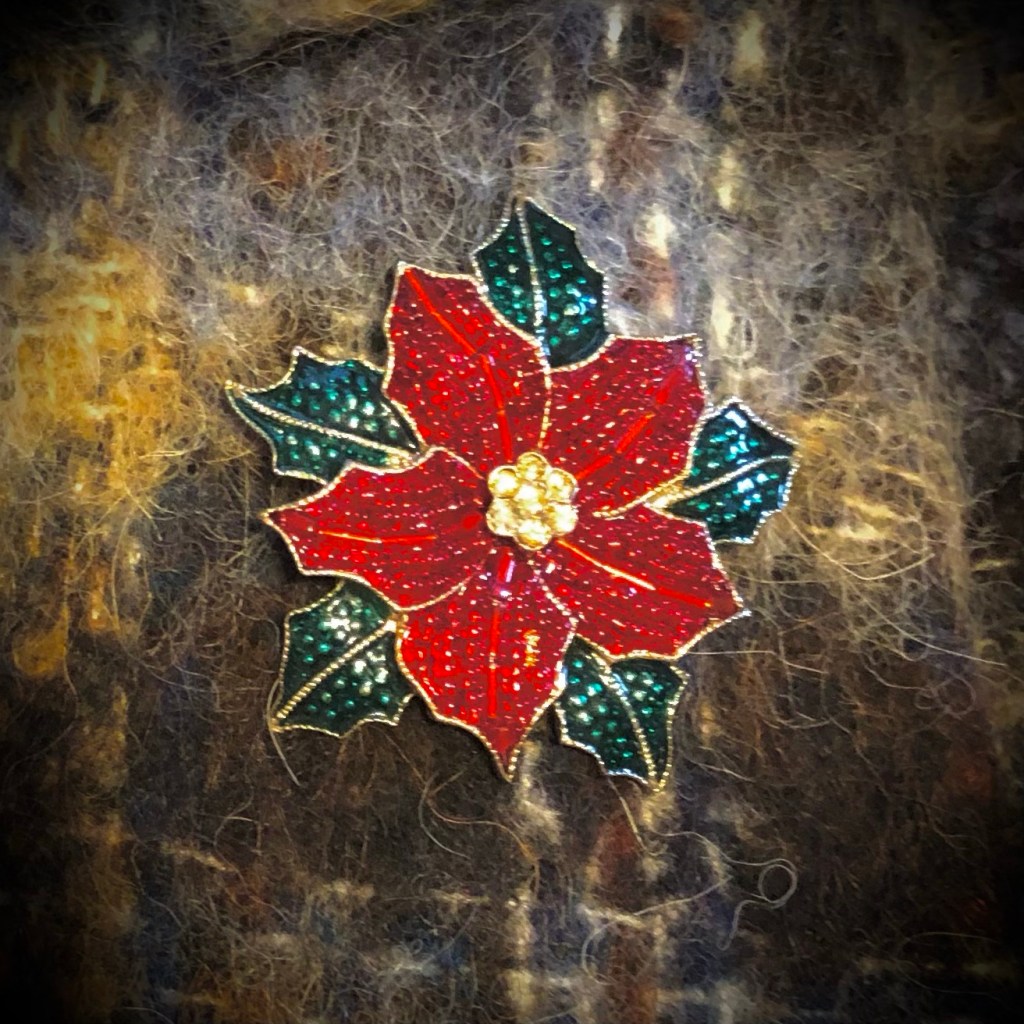
Every December I open the small cardboard box, remove the pin, and place it on my winter dress coat.
This is the fifteenth year.
The box is now timeworn but the little poinsettia still sparkles like it did the day I bought it. There it was, right by the checkout counter where I purchased black hose to wear to my grandmother’s funeral.
Not one poinsettia pin.
Three of them, just alike.
I bought them all.
I packed them for the journey to my grandparents’ hometown. The setting of so many idyllic childhood summers, so many holiday and birthday gatherings.
It happened to be her ninety-first birthday when the family gathered at the funeral home on that cold winter’s night.
She was born the day after Christmas. Used to chuckle about not having anything to look forward to the rest of the year, with her wedding anniversary, Christmas, and birthday all in December. But she loved the season more than anyone I’ve ever known. Sending and receiving cards. Baking. Cooking, cooking, cooking. Glass ornaments and colorful lights on the tree. Gifts in festive paper, old-fashioned hard candy in the candy dish. Collecting angel figurines and bells across the years. The aged, sepia-toned Nativity scene atop the piano. Going to church. Carols. Snowfall. Candles in the windowsills, shining in the night. Little children with wonderstruck expressions. She loved it all. She exuded holiday joy.
It was her season.
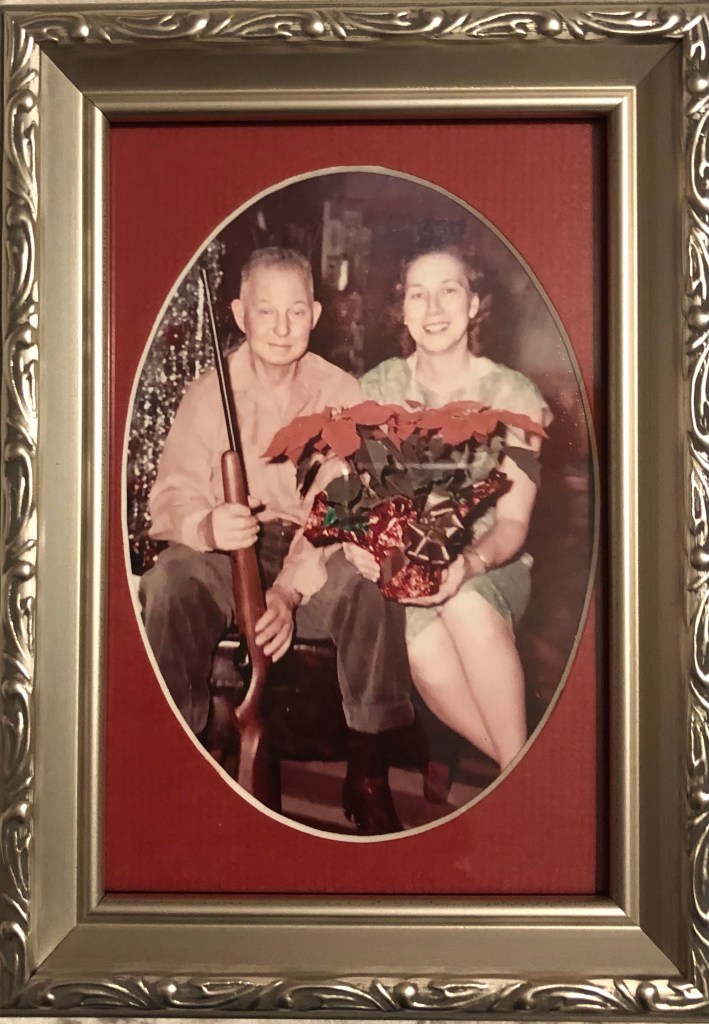
One of my favorite old photos was taken at Christmas when I was a baby: Granddaddy holds a new shotgun. Grandma holds a poinsettia. It’s their first Christmas as grandparents. Her face is radiant.
I would give her a poinsettia every Christmas in her later years. She would exclaim over each one: Oh, it’s just beautiful!
It had to be red, like her season. Like her name. Ruby. Deep red, precious. Bright as the cardinals that also enchanted her.
I knew she would leave at Christmastime. Seemed written in the stars.
And she did. The day before Christmas Eve.
The holiday was a blur. Arrangements were made. The visitation set for the twenty-sixth because there wasn’t time before Christmas Day.
I would speak at her service the following day. I would read Proverbs 31: Who can find a virtuous woman? for her price is far above rubies…
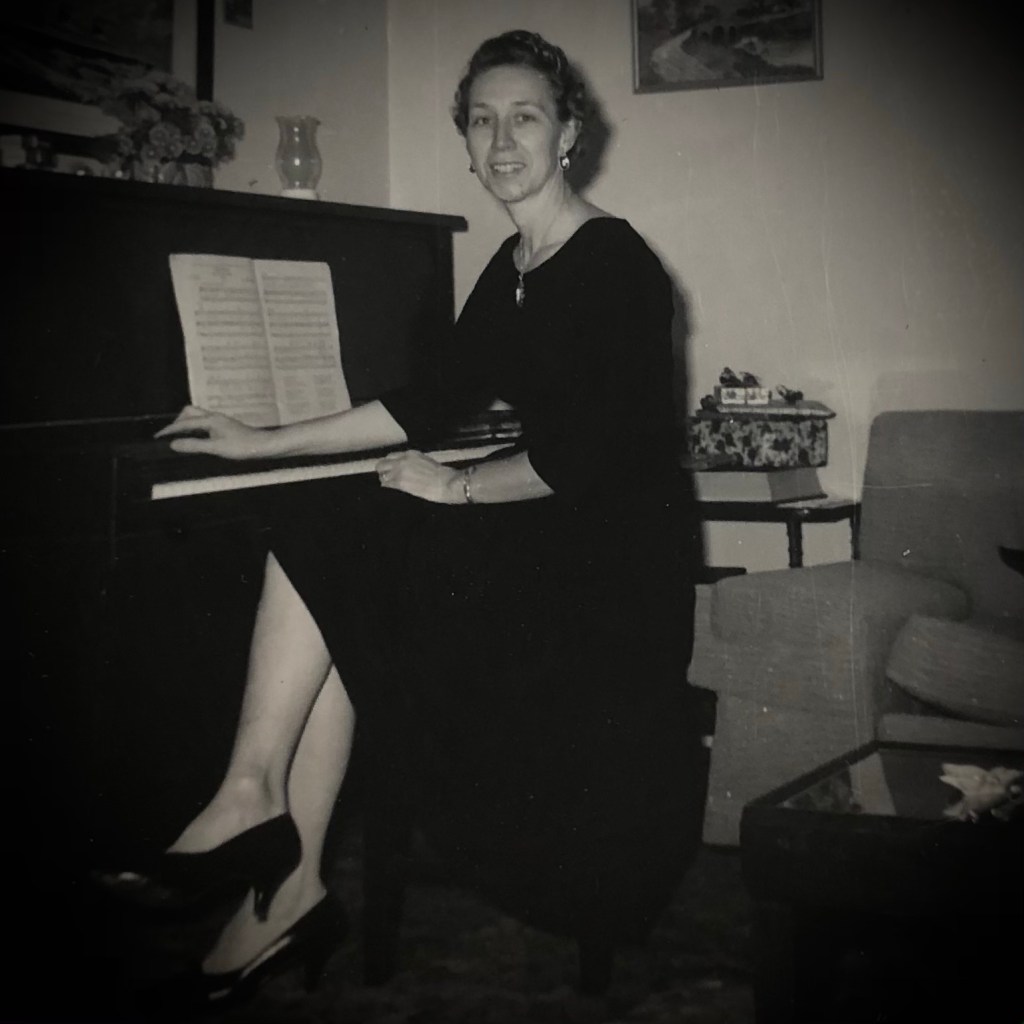
I would ask that her favorite Christmas song be played. Silent night, holy night, all is calm, all is bright…the first song she taught me how to play on her chord organ, when I was around four or five. Her hands guided my fingers along the keys.
I would find the tiny old church of my happy childhood summers laden with red poinsettias. Christmas remnants. I would recall someone giving her a silk poinsettia after she went into the nursing home, and how she lovingly watered it…dementia erasing pieces of the mind, of memory, leaving fragments intact.
I arrived early for the visitation. There was something I needed to do.
Three poinsettia pins, just alike.
I wore one on my coat. I gave one to her last living child, my aunt, who met me at the casket. And I leaned in to pin the third one on the lapel of her suit.
She would be buried with her last poinsettia.
Merry Christmas and happy birthday, Grandma. Sleep in heavenly peace.
December comes again, and again I wear my pin. She is near. In the songs, in the lights, in the color, in the spirit, in the story. As undiminished as brilliant cardinals against the wintertime world.
All dressed for church waiting for our ride because Mama doesn’t drive —never got her license: I get too nervous, she says—
so we wait while she watches through the picture window where I see our reflection: Mama, little sister, and me against the empty street beyond
after a while she says you might as well change we have been forgotten
her voice is strange and when I look up there are tears sliding down her cheeks.
–excerpt, “Picture Window.” Draft poem, F. Haley
On the first Thursday of each month, a group of us teacher-writer-blogger-believers post spiritual journey reflections. Today Chris Margocs hosts our gathering on her blog, Horizon 51. We are writing around the theme of “waiting, with a side of hope.”
Earlier this year I wrote those lines above, remembering the scene from long ago. My mother had asked another church member to please stop by and pick us up. We waited, and waited…until my mother understood the ride wasn’t coming. And cried.
I might have been six or seven. I wasn’t too upset about changing my clothes (likely a dress made by my mother) and not going to church. But I was sorry for my mother’s sadness. I couldn’t understand being forgotten.
My childhood pastor once preached on Isaiah 49:15: Can a woman forget her sucking child, that she should have no compassion on the son of her womb? Even these may forget, yet I will not forget you.
I couldn’t understand that either, at the time: How can a mother forget her child? It seemed impossible, inconceivable…
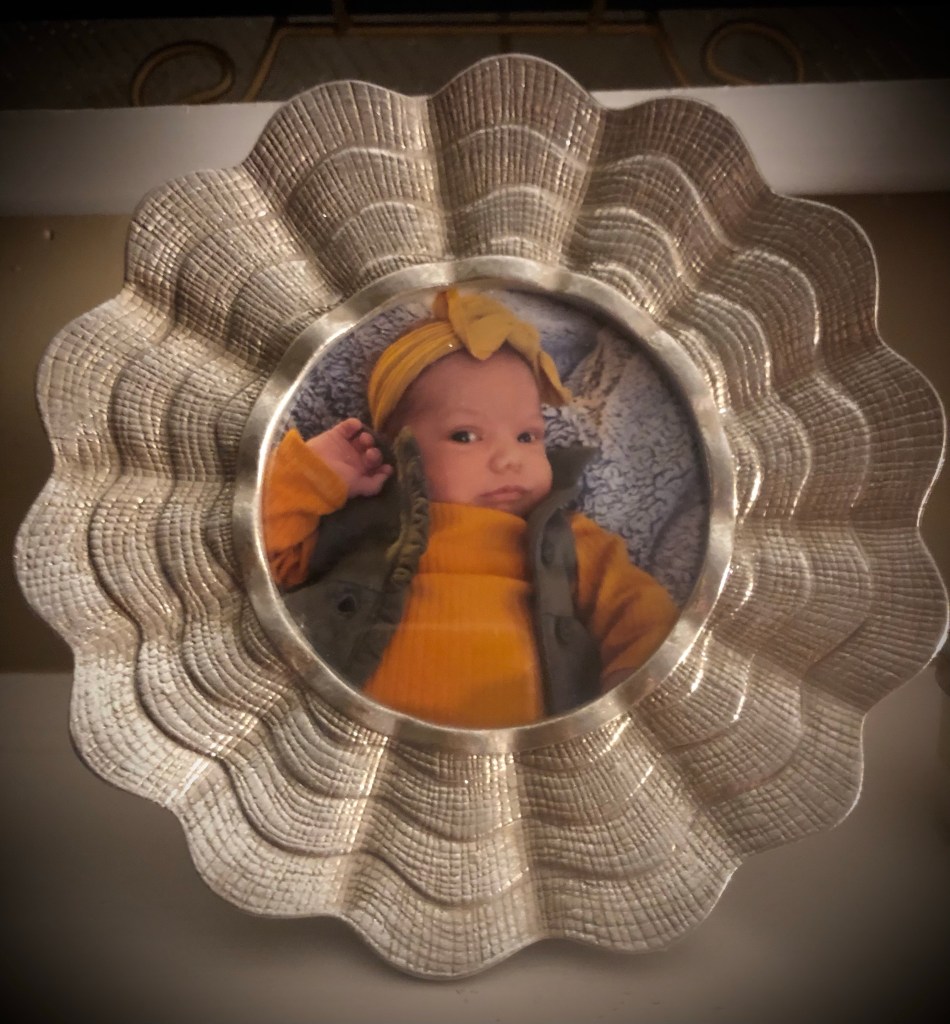
Decades later, as a mother and grandmother myself, I decorate for Christmas with exceeding great joy because of the new baby in our family. As I plan and wrap and make preparations, humming along to holiday music, I can’t imagine ever forgetting my sons, my little granddaughters. I would cease to be me if I did. They’re such joys. Layer upon layer of richness and fullness on all of my days. But mothers can forget. They do forget. There are mental health issues. Addictions. Illnesses. Diseases. Destroyed relationships. A number of things can separate a child from a mother’s love and from her memory.
The Apostle Paul wrote: For I am sure that neither death nor life, nor angels nor rulers, nor things present nor things to come, nor powers, nor height nor depth, nor anything else in all creation, will be able to separate us from the love of God in Christ Jesus our Lord (Romans 8:38-39).
How this links to God’s promise in Isaiah: I will not forget you.
Christmas is a reminder of exactly that.
We are not forgotten; we are not alone. The prophet Isaiah, again: Therefore the Lord himself will give you a sign. Behold, the virgin shall conceive and bear a son, and shall call his name Immanuel (7:14).The Gospel of Matthew repeats this prophecy as fulfillment in the first chapter detailing the genealogy and birth of Christ: Behold, a virgin shall be with child, and shall bring forth a son, and they shall call his name Emmanuel, which being interpreted is, God with us (1:23).
Words that resonate. God with us. Every day, all the time. How long a wait it was—around eight centuries—from Isaiah’s prophecy to the coming of Christ.
A long, long wait…but we were not forgotten.
That church member from long ago apologized profusely to my mother for failing to pick us up that day. My mother, I presume, graciously forgave. Whenever the weather was nice, we walked to church, my mother, my little sister, and me. I couldn’t know then that my childhood pastor would ordain my future husband to the pastorate one day. I just walked along, hoping Mama would take us to Hardee’s for lunch afterward. The Looney Tunes glasses we collected from those after-church excursions remain in my cabinet to this day, much as memories rest on the shelves of my mind. They are a treasure. I do not want to forget.
My childhood pastor would eventually tell me that when the church’s bus ministry began, my mother was the first person to sign up. No more waiting for rides that might not show. God provided the vehicle to get us where we needed to go.
He always does. In the fullness of time.
Even now, I hear the distant chiming of those church bells of years long gone:
Savior, Savior hear my humble cry while on others Thou are calling do not pass me by.
He hears. He is here. He remembers.
So do I, Mama.
one of my favorite Christmas cards
*******
with thanks to Chris and all my dear Spiritual Journey friends
a blessed Advent to all – the first candle lit on the Advent wreath this week symbolizes hope
I once read of a young woman preparing her kitchen for Passover. Amid the traditional cleaning and purging, she had a sense of taking her place in the long line of women who had done so before her, throughout history. As if the rituals of tradition invoked their presence, for within the actions lie inextricable, unbroken threads of purpose, holiness, praise, gratitude…
On the eve of Thanksgiving, I have a similar sensation. Driving to the grocery store, armed with a list of ingredients for foods that my children have requested (deviled eggs and carrot cake chief among them), I am enchanted by autumn’s alchemy. Late afternoon sun gilds the trees along the roadside. The blending of red, orange, bronze, some trees already bare, preparing for winter…for a moment, for mere seconds, I imagine there are figures running through these flickering sunlit woods. If I could look long enough, or just right, I might catch glimpses of people as they were in times past, maybe even my childhood self. Burnished memories still living, beckoning…snapshot scenes of Thanksgivings, with card tables set up for the children. Heads bowed in prayer. My grandfather’s humble blessing, his knobbled, work-worn hands. Grandma’s deviled eggs and potato salad, Mama’s carrot cake (the hit of every holiday gathering), Grannie’s rum pound cake…lifting that big old Tupperware lid, the first whiff nearly knocking me down, but the moist golden richness after…incomparable. I find myself yearning for a slice of it now.
In the process of cleaning and preparing for the holidays I reorganized a closet. I found a box of Grandma’s things. Letters and cards given to her over the years, her green-bronze jewelry box containing her clip-on “earbobs”. Old photos. Books and trinkets I’d given her. Her diaries, dating back to when I was twelve. Programs from my school plays. Her funeral program. And I think about how life is the story of love, sacrifice, survival. How she and Grannie did much with little, raising children during the Great Depression. How they held faith and family above all else…how they do not feel far from me, even now, as I write these words. My own granddaughter, their great-great granddaughter, will be four weeks old on Thanksgiving Day. I have a profound sense of taking my place in a hallowed line of legacy and love. With abiding gratitude. And joy, shining like the immutable sun on the autumn trees, in the ongoing story of survival. The turning of pages, new chapters, in a gilt-bound book…
Here’s to all the blessings that were, are, and are still to come.
Late June afternoon on the porch. A long-settling stillness, the day’s brilliance deepening to amber, shadows slanting across lawns and pavement, a cool pre-dusk breeze riffling trees and wind chimes, carrying the sound of a child calling in the distance. It’s not a child; it’s a little goat from a neighbor’s pen, hidden in a patch of woods. Bleating for its supper, I suspect. Startlingly humanlike voice. A neither-here-nor-there sound, disembodied, suspended in the air like time itself, clinging to these green and gold moments, unwilling to let go…
“Mom, let’s go for a walk,” says my youngest son (aka Cadillac Man).
I grab my shoes.
Walking beside me along our neighborhood street, my boy speaks, as he always does, of music. Songs he is learning, one he wants me to practice with him (it has to be simple for me. He can sing any part he likes in any key he likes; he can play anything he wants on the piano or guitar). I say I’ll try. He speaks of his new job at the funeral home; we reflect on the recent death of a beloved friend who’s the same age I am. Fresh-grated sadness, still surreal.
As we talk I note that no neighbors are out and about this afternoon. We seem quite alone. At one house, pool towels draped over the front railing billow in the breeze. American flags on front porch flagpoles ripple and flap with crisp smacks. A couple of cicadas rattle from high in the trees that frame backyards. Our long shadows stretch out on the pavement before us, where flecks of quartz wink; when my boy and I turn at the road’s end, the shadows disappear.
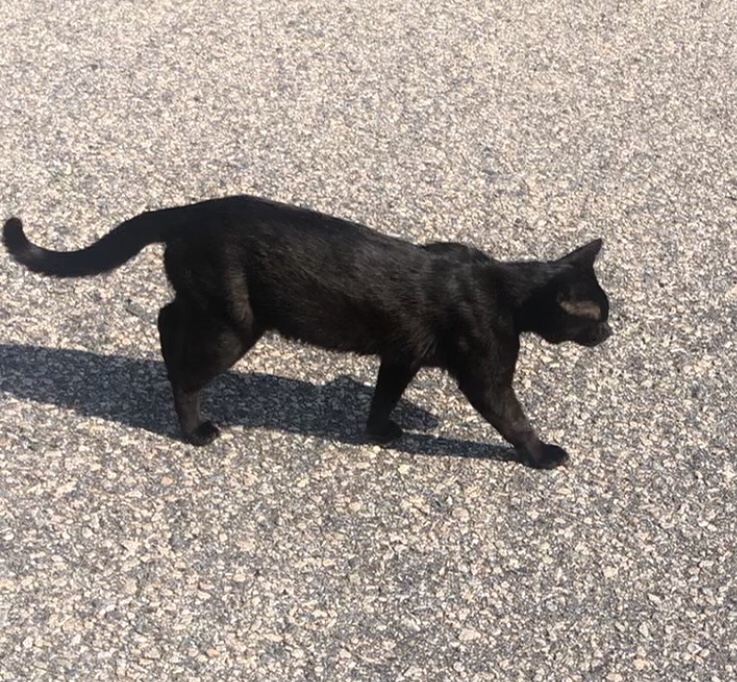
We pass a row of cypresses where there’s sudden movement in the grass. A black shape materializes, runs after us, crosses right in front of us…
Good thing we aren’t superstitious.
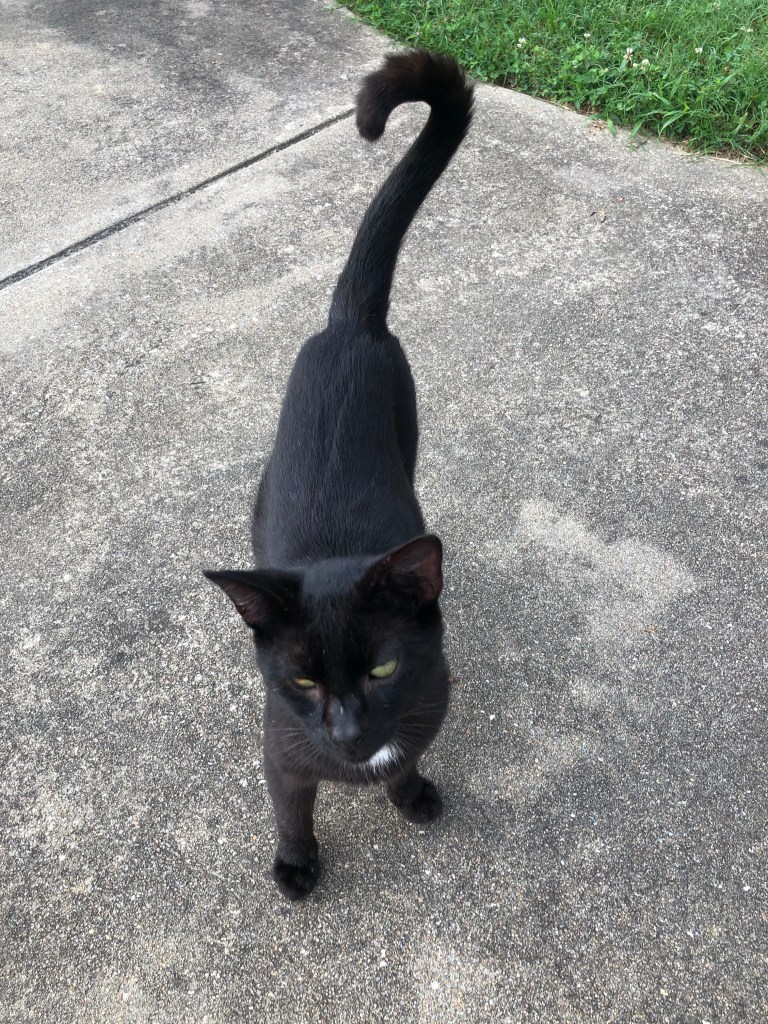
A young black cat, meowing.
“Awww,” says Cadillac Man, as it rubs against his legs. “What a sweet little cat.”
It comes over to me, rubs against my legs, purring madly.
We are devout dog-people. I can’t have a cat. I’m allergic. I learned this at age five or six when my family took in a stray Siamese (Mr. Cat, we called him) that took refuge on the stoop of my childhood home during a storm. Swollen eyes and asthma didn’t stop me, however, from bringing home a black kitten nobody else wanted when I was in college…
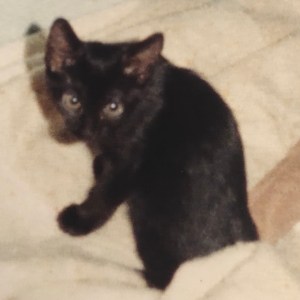
“It looks so much like my cat Moriah,” I tell my son. The name came from a magical cat in The Forgotten Beasts of Eld, a book I read when I was about twelve.
Cadillac Man bends down, picks up the creature. “I would keep it if you could breathe.” The little cat nestles against him. Animals love my boy. They seem to sense his gentle spirit.
After a moment, the cat twists to get down. Cadillac Man releases it.
“It looks kind of thin. I wonder if it’s hungry…” Do moms always think about this first? Is this our deepest default, this hard-wired compulsion to feed all little living things, to keep them living?
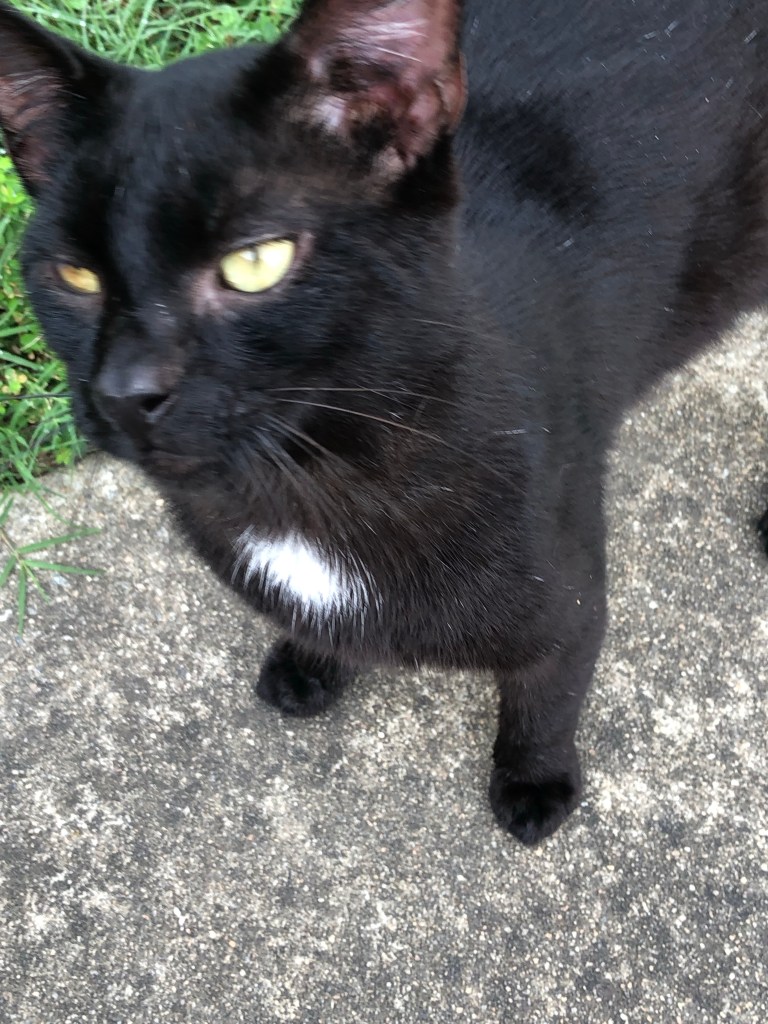
The cat sits looking up at us with big, unblinking, green-yellow eyes. Meow.
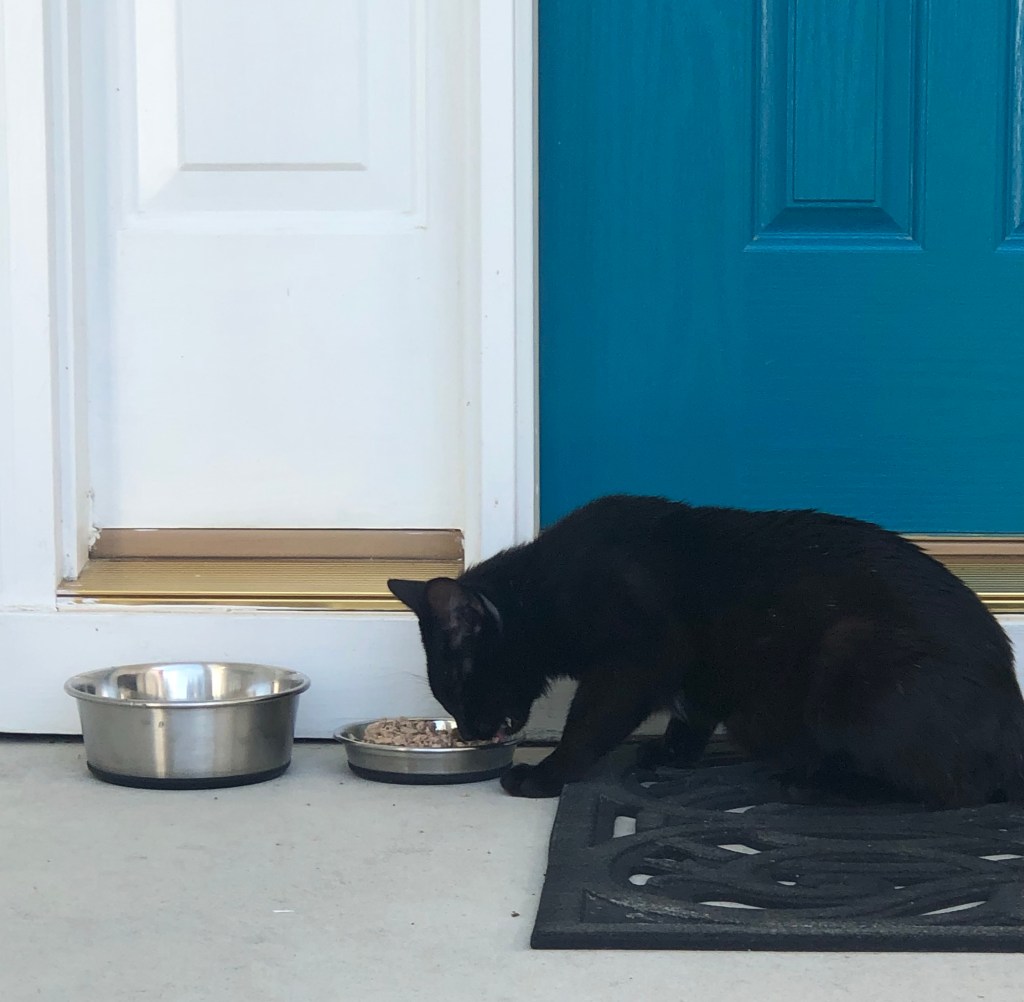
And it trots right beside us, like a good dog would, back to our driveway where I feed it some of Dennis the dachshund’s steak-flavored food in an old dish.
“I hope it stays,” says Cadillac Man. “It can be an outside cat.”
I examine the cat as it eats. “It has all its claws.”
“We should name it,” says Cadillac Man.
“Look how rusty its fur is in the sunlight,” I observe. “Black cats aren’t exactly black. It’s a genetic mutation of the tabby pattern. See the faint rings in its tail, there at the tip? So much like Moriah, only she was smaller and didn’t have a tail…” another mutation. She was the last kitten left in the Free Kittens box on campus the day I found her and took her home. Shelters say black cats are the hardest to find homes for; no idea on stats of cats with stumps for tails…
“We aren’t naming it Moriah, Mom.”
“Of course not. She was one of a kind and besides, this one’s a boy.”
Cadillac Man is silent for a moment. The cat has nearly finished his steak dinner. “Well, you know it has to be a musician’s name…”
This is what he does. Since childhood he’s named pet fish after bass singers; his dachshund, after drummer Dennis Wilson of The Beach Boys.
I can see what’s coming: “Brian, I suppose?”
Cadillac Man smiles. “Not quite. I christen this cat Douglas.
Brian Wilson’s middle name. I was close.
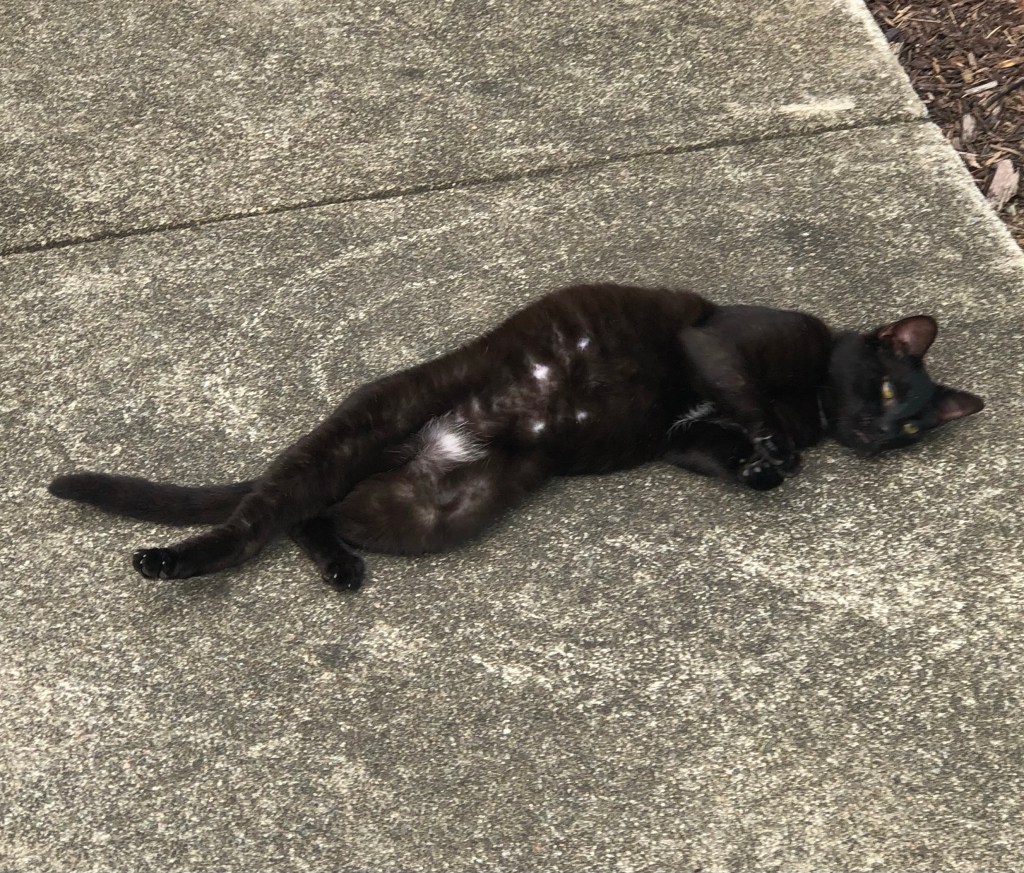
After licking the bowl clean, Douglas follows us up the sidewalk, cutting in front of Cadillac Man to roll over just like Dennis the dachshund does for a belly rub.
“Awww,” says my boy, rubbing the proffered belly. “Listen—he’s purring like a truck!”
Indeed he is.
It’s getting late. We need to go in to wash up and have our own supper, so we stroke Douglas one last time. I make sure to wash my hands well, with extra soap.
We peek out of the windows from time to time. Douglas is lying on the porch, and then he’s gone.
But not really.
He’s curled up under the rocking chair, sound asleep.
When he wakes, I take one of Dennis’ soft blankets out and put it in his chosen sleeping spot. Douglas sits on it at once.
“There,” I tell him. “Now you know that if you need a safe, comfortable place to sleep, you have one. If you’re hungry, I’ll feed you whenever you come around. I’ll leave water out for you. It’s summer, see…”
Douglas purrs as if he understands…and maybe he does, for the next morning he comes to polish off a whole bowl full of food, and he’s waiting in the driveway to greet us on Wednesday night when we return from prayer meeting.
And then he vanishes.
A day passes, and another, and another. No Douglas.
It storms. Thunder, lightning. Rain gushing from the gutters.
I hope he’s all right, wherever he is. If he belongs to someone, I hope he’s back home and happy. We ought to have named him Macavity, the Mystery Cat.
I shake out his blanket, fold it, replace it. I toss yesterday’s water from his new dish and refill it with fresh.
I think of Mr. Cat. Of Moriah. So long ago.
I wonder if it’s absurd to keep leaving fresh water out for a cat that may never return.
But I do it anyway, because I told Douglas I would.
I also told Cadillac Man we could have named him Question Quigley (from Harry Potter) for that tail
The best shot I could get of his face; Douglas kept trying to rub against me while I attempted to take his picture
Asking for a belly rub
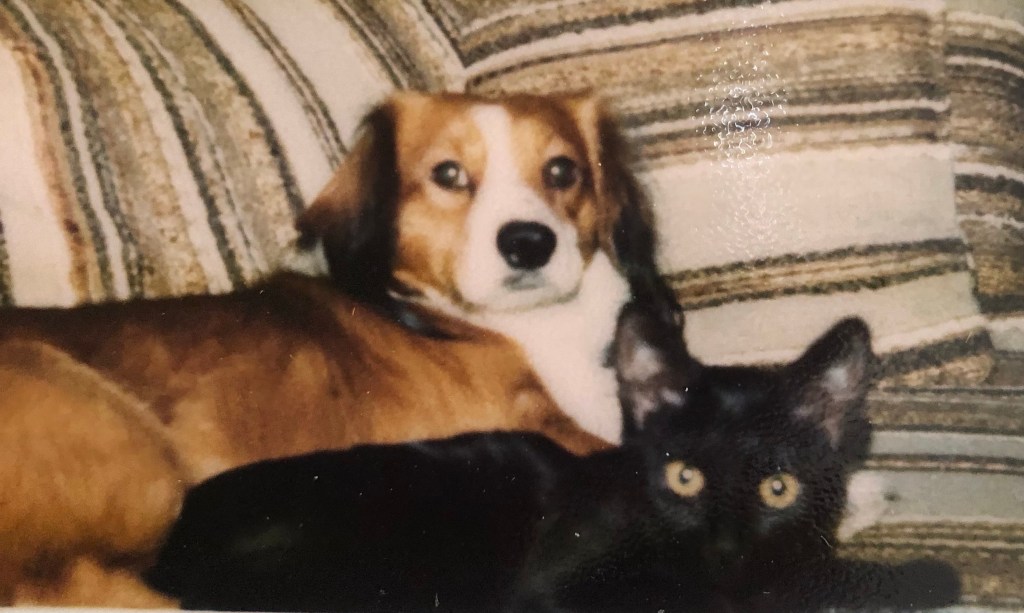
For comparison: my cat Moriah, almost forty years ago, with my childhood dog, Bagel
—OH, and P.S. Guess who came for dinner last night?
National Poetry Month has ended, and I miss it. While I may not be posting every day for a while, I continue to write.
The last prompt on Ethical ELA’s #VerseLove was on fear. Articulating it, facing it…perhaps conquering it.
This got me thinking how facing a thing for what it really is = the first step in conquering. There’s a lot of extreme anxiety in the world today. A lot of hatred. Sometimes we just don’t see things for what they are…including our own thoughts.
And so this poem was born.
Courage, peace, and wellness to you, Friends.Whatever it is…you can overcome.
My Fear Haiku
I once read a book where people’s eyes turned inward. They died from seeing
what’s inside their minds. I trembled to take a look at what lurks in mine.
Now I remember what Granddaddy once told me regarding black snakes:
don’t ever kill them. See, black snakes eat rats and mice; they’re good. We need them.
I think fear’s like that snaking along, with purpose something quite useful
so I never try to kill it. Let it consume the uglier parts
of my thoughts, and go its way leaving me with a clean peace and a better mind
so that all I fear, in the end, is forgetting memories of love.
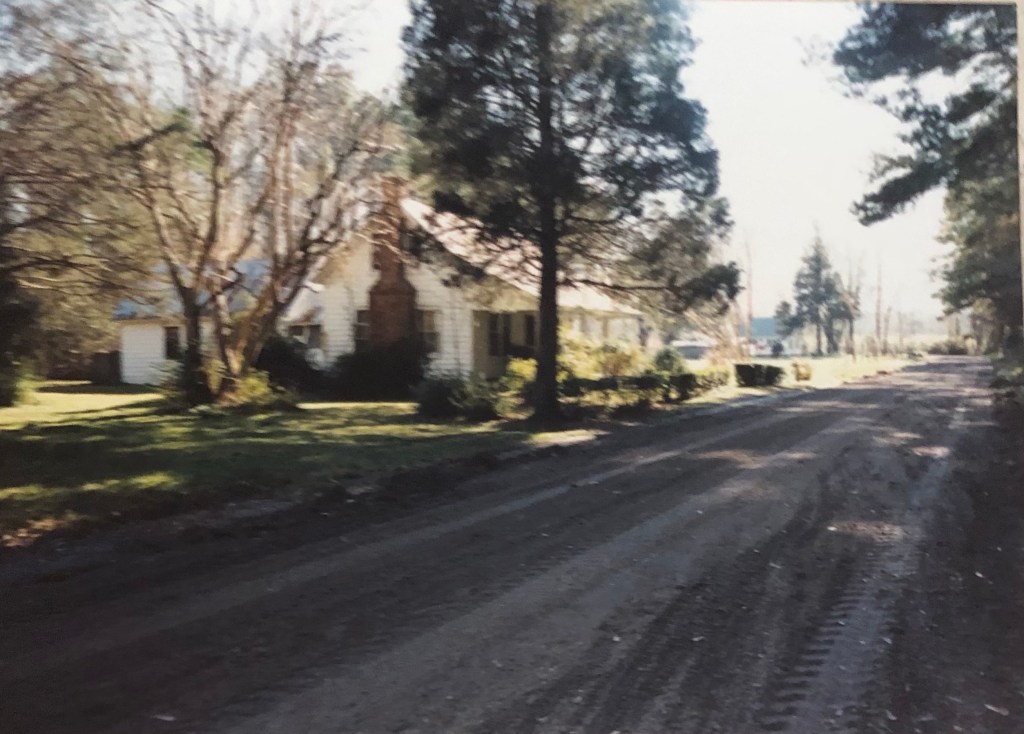
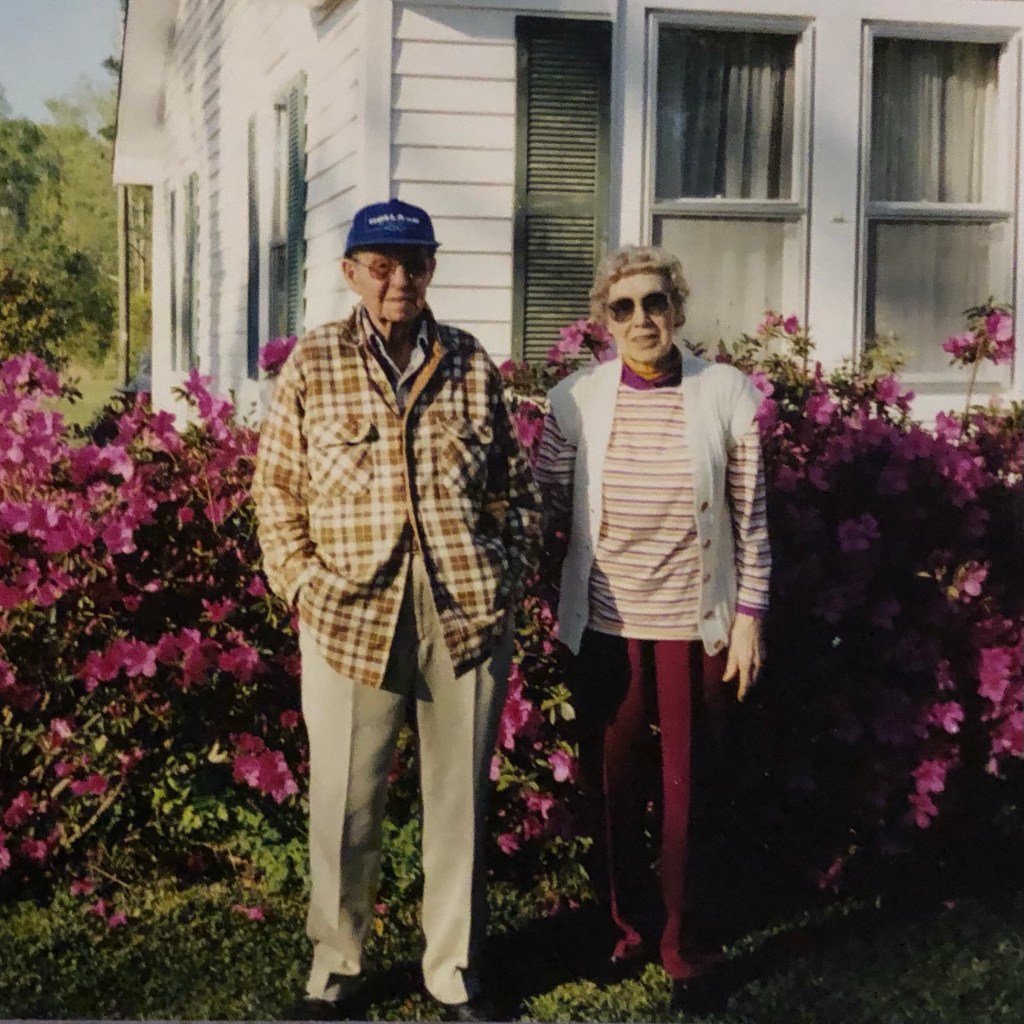
Path of peace. The view after turning off the highway to visit my grandparents. The house is my grandmother’s homeplace, where she and her eight siblings were born in the early 1900s. Just ahead, around the bend on the left, stood my grandparents’ home where my dad and his sisters grew up in the 1940s-50s, and where I spent many childhood summers.
with thanks to Katie at #verselove on Ethical ELA yesterday. She inspired poets to look around the room for an object of great personal significance, followed by a brainstorming process for finding the object’s own voice and characteristics: “Now that you have stilled this object in order to distill it in a piece of art, it’s time to bring it to life. Listen to it, and once you are ready, consider: If it were a character…and say something back.”
when the harmonies rang and people sang songs by shape note
now more of a reliquary
with touch-memory of her hands on your beloved keys
they don’t forget
somewhere in that high-backed mahogany cracked prized-possession frame
amid your hammers and strings and octavian dreams
surely you must hold her dust alongside mine skin cells of the child I was
relics of bygone days side by side just as we used to be on your bench, of a summer night in pale lamplight
singing of the sweet by and by when we shall meet on that beautiful shore
in the meantime despite your need for tuning and your wonky key
her great-grandson stirs the slumbering chords again the dust the strings the house the blood in our veins pounding out the glory of the old, old story
blood does not forget
she’d be overjoyed with my boy
as you must surely be
as you whisper to me
in high-backed mahogany cracked corners where silence aches
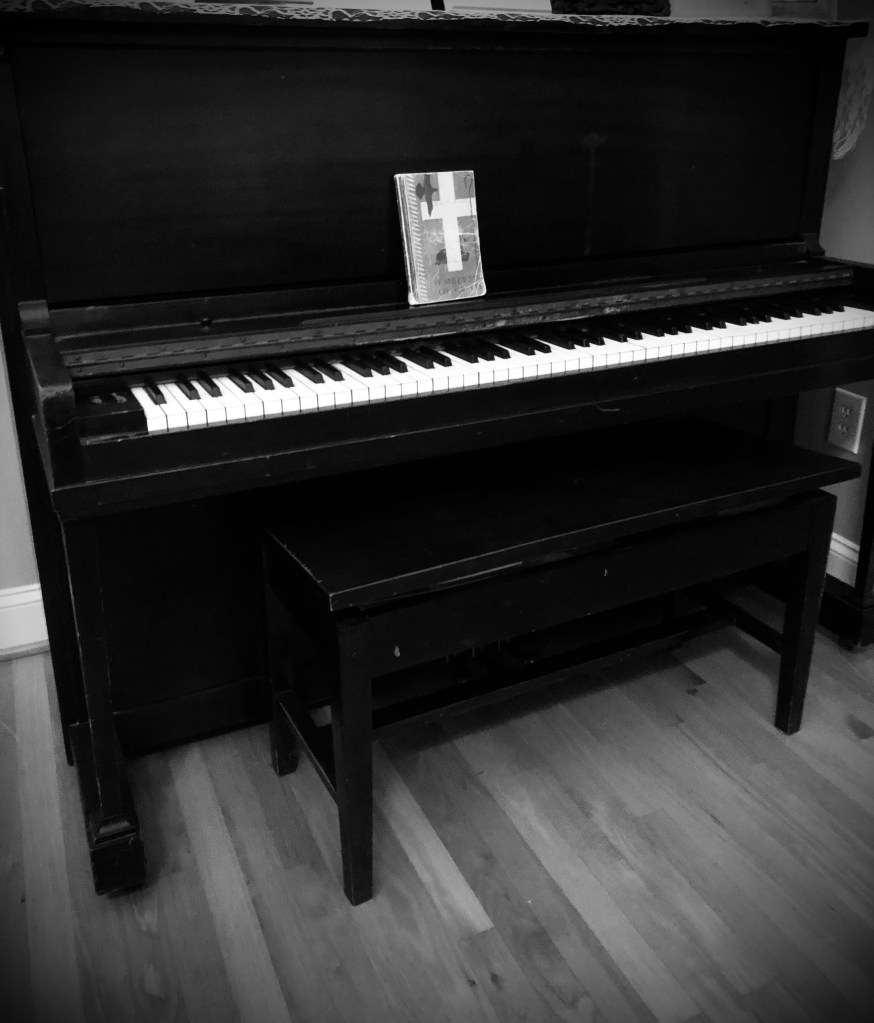
The piano dates to pre-WWII days, possibly the 1920s. My grandfather bought it secondhand for my grandmother. I spent many hours beside her on the bench as she played and sang alto to my soprano. In her last years she moved in with my aunt and finally the nursing home. She gave the piano to me: “It’s my most-prized possession, you know.” I never learned how to play but my my youngest son grew up loving old gospel songs. He’s a magnificent pianist who graduated from college with a music ministry degree; not a day passes that I don’t think of how elated she’d beto know this.
with thanks to Araceli, Deanna, and Michelle at #verselove on Ethical ELA today, for the invitation to write about someone who’s influenced your life, incorporating sensory details. My first inclination is to write of my grandparents – as I often do – but today, my aunt came to mind. I expect she’d be so surprised.
I am.
This one’s for her.
On Day Twenty-Two of National Poetry Month
A Poem for Earnie
I didn’t expect to write of you today but here I am, remembering of all things, the tape recorder your ready, set, go! the click of your finger pressing play and singing for all we were worth, you, my little sister and me: Wherever you go, wherever you may wander in your life Surely you know I always want to be there… one of us flubbing the words all of us cracking up you saying, I’ll rewind let’s try it again
I think of your laughter wild, free, contagious your raucous humor trailing you like an ermine robe rich, resplendent, priceless cloaking loneliness I may not have perceived
The only one of my mother’s sisters never to marry or have children which didn’t keep you from giving advice pressing Mama’s buttons like no one else on Earth yet she went and named her youngest daughter after you
Then there were the wigs on the featureless disembodied heads sitting on your dresser you could pick whatever 1970s hair you wanted each day how cool was that?
I can’t recall a thing you ever cooked only that you loved eating Mama said you were picky you didn’t look it Mama said that’s why you weren’t married so picky that you didn’t get got
I wondered why you never really left home living with Grannie most of your life you’d break away for an apartment once or twice but would always go back like you needed to be within the borders of her shadow
Perhaps it will surprise you that I recall the ceramics class you took and the Pepto Bismol pink statuette of Hotei, the Laughing Buddha god of happiness and contentment that you made for me his hands thrown high to the heavens Rub his big belly for good luck each day, you said and I could hear the pleasure in your voice only much later did I flip him over to find your inscription of love on the bottom of his pedestal
Funny how the dress you wore to my wedding was Pepto Bismol pink I am glad I asked you to be my wedding director at Mama’s prodding I remember the books you ran out to buy to do the job well for me
Of course there’s Jenny… a love of your life Siamese as picky as yourself who’d curl in my lap purring That’s rare, you’d say
Jenny who lived twelve years who died in the fire when you woke in the middle of the night choking on the smoke phone in your bedroom hot to the touch calling 9-1-1 for the first time because it was a brand-new thing I don’t know how you roused Grannie and Papa G in the other room nor how any of you climbed out of the windows onto the roof into the freezing midnight air and safety as the firemen arrived but you did it
in my mind, Mama’s voice: It took three firemen to hold her from going back in for Jenny. They found her the next day under Earnie’s window.
I hear your anguished sobs even now in those wee hours when you arrived at our house to stay reeking of smoke so that the fur coat you wore would have to be destroyed
I remember the clothes you bought for my first baby in bright, beautiful colors, expensive so lovingly chosen
You didn’t live to see my youngest never knew of his gift for music how you’d have loved it I can see you right now, tape recorder in hand
As the disease took your lungs and reached its insidious fingers into your brain I recall the peculiar shine in your hollowed eyes against the yellowing of your face
when you asked: Are you still writing? Have you published anything yet?
Yes and no, Earnie. I am still writing, yes. Long, long after we laid you to rest in your pink dress (Grannie had your nails painted to match) and this isn’t really published but it’s for you I didn’t expect to be writing of you today or singing Olivia Newton-John all of a sudden after all these years, but here I am and here you are, wherever I may wander in my life snatches of song, rolling laughter here in my morning here in my night.
with thanks to Abigail, Betsy, and Soshi for the invitation to write on this topic for #verselove at Ethical ELA today (who’s not longing for summer right now?!).
Here’s why summer has such a special pull for me.
For Day Nineteen of National Poetry Month
Summer Second
Sunny afternoon blue sky bit of breeze faint sound of a radio from a neighbor’s yard I can’t discern the song it just sends me into reverie for a second conjuring hot sand under my bare feet Coppertone in my nose salt on my tongue If everybody had an ocean across the USA then everybody’d be surfin’ like Californ-i-ay… snatches of conversation cresting and dipping on the breeze mighty waves of memory crashing on the shore my father’s big black sandals flip-flopping to the old navy-blue Ford the battered brown Samsonite suitcase in his hand the ride is so long so long the city gives way to pastures, meadows horses fields that go on and on, forever plowed furrows running like long crazy legs to keep up with the Ford as we zoom past until at last the lonesome highway comes to a fork on the left, the tiny church where my ancestors sleep under stones we veer to the right turning onto the dirt road my heart beats faster Daddy drives slower stirring clouds of dust and I am already grabbing the door handle as Granddaddy’s lush garden comes into view with just a glimpse of Grandma’s white angel birdbath circled by orange marigolds through the laundry lazily flapping on the clothesline and there they are, walking across the green, green grass and I am out of the Ford before it’s hardly stopped and in their arms in the blinding sun as the forest stands tall all around with its cool dark mysteries where the rattling cicadas crescendo vibrating on and on and on through my soul I can’t discern the song it just carries me through eternity in this one bright second
with thanks to Dr. Stefani Boutelier on Ethical ELA’s #VerseLove today. She writes of the way a title can change the interpretation of a poem, or how it might add layers of metaphor: “I invite you to write a poem where the title helps identify its content, theme, or purpose. The topic and form are up to you–the focus today is on the title.”
I will share my poem’s title at the end.
For Day Fifteen of National Poetry Month
The stories of time before my time I lived them through your telling felt them through your pounding heart breathed them with your young lungs until I wanted to run coughing from the reek of smoke the acrid taste of ash and I think of how you spent your years giving yourself to others despite the ghosts that surely clung as smoke clings to clothing and as I enter the doorway I can hardly breathe for the cloying scent of flowers and there you are on the table ready and waiting in your little box conveniently resting in a little white tote I dare not trust the handles I just wrap my arms around you and carry you against my heart like I did my babies only there’s no car seat needed now
still, I must keep you safe in your new lightness so I strap the seatbelt across us both pondering the measure of a man larger than life so reduced
but I’ve got you, I’ve got you cradled close see now, I’m driving you home sun and shadows flickering over us like old newsreels of liberation
******
Title: What Remains
Dedicated to my father-in-law, a World War II veteran.
Next-to-the last day of March. Early morning. Still dark. Chilly.
I sit at my laptop, sipping coffee, catching up on my Slice of Life blog comments. The neighborhood rooster across the street crows for all he’s worth.
My husband comes into the kitchen: “Is she up yet?” he whispers.
He means our granddaughter. She spent the night. We stayed up way late watching Frozen II (again). We watched her dancing to the ending credits soundtrack, performing her own astoundingly artistic interpretation, cheeks pink, blue eyes glowing…followed by punchy laughter before the crashing.
“Not yet,” I whisper back. He retreats to his study to work on sermons.
Shortly, though, she here she comes, a gift of the dawn, Aurora’s child, barefoot in a blue flannel gown, cloaked in long, disheveled hair, ethereal smile of joy illuminating the semi-dark kitchen. Favorite lines of a Billy Collins poem come to life:
But tomorrow dawn will come the way I picture her,
barefoot and disheveled, standing outside my window in one of the fragile cotton dresses of the poor. She will look in at me with her thin arms extended, offering a handful of birdsong and a small cup of light.
My radiant dawn-child climbs into my lap. I let her read my post about Dennis the dachshund and his toy moose. At five, she reads with exactly the right inflection in exactly the right places, decoding beyootiful without batting an eye.
“That rascally Dennis!” She laughs aloud.
My husband returns, his own face alight at sight of her. “There she is!” he exclaims. “I’ve been waiting for you, Sugar Magnolia.”
He sings the opening line of the Grateful Dead song:
Sugar Magnolia blossom’s blooming…
Just so happens that our granddaughter’s middle name is Magnolia. A nod to her Louisiana heritage. A native tree here in North Carolina, too.
I think how, less than two years ago, my husband wasdead, until EMS and CPR brought him back. I think of all he’d have missed…
What matters is that we’re here together now, today, in this moment. The Grateful Alive.
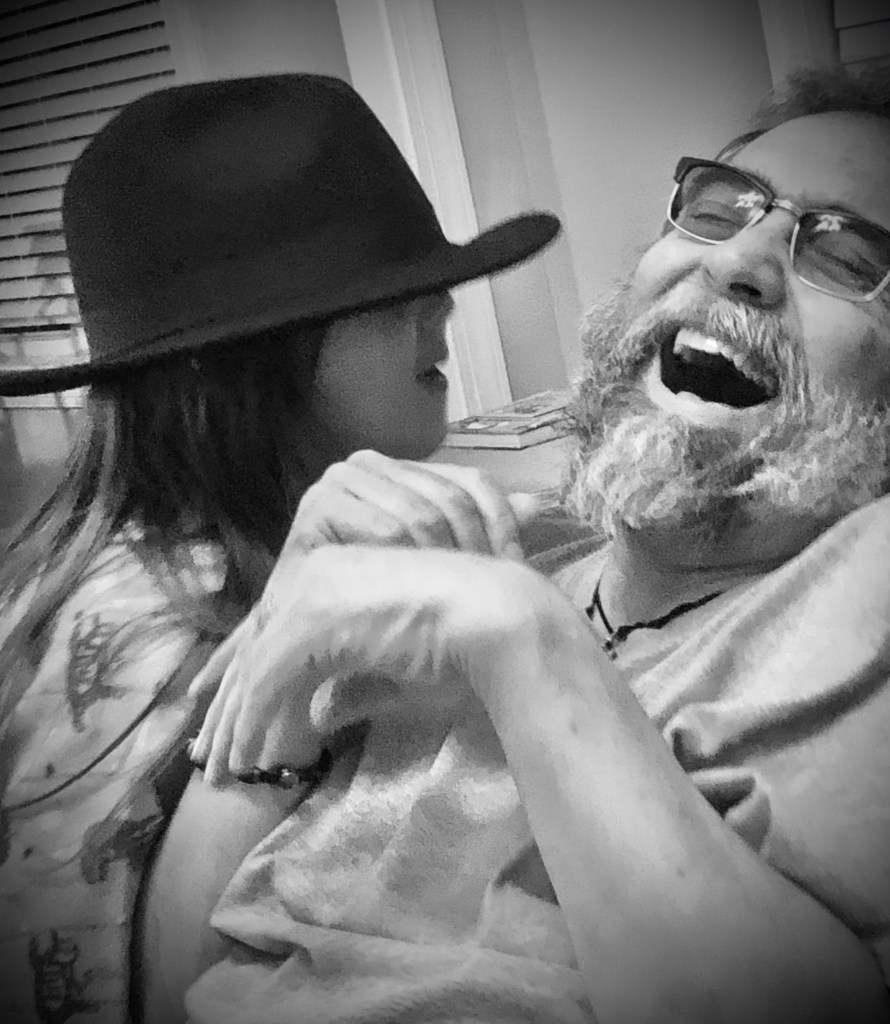
Sugar Magnolia, in one of Grandpa’s hats
When we are dressed for the day, she asks: “Can I pick out your earrings? And your necklace?”
“Certainly.”
She picks the magnolia. She and my son gave it to me for my birthday last year.
She hands me the necklace, watches me clasp it, smiles with satisfaction.
She will look in at me with her thin arms extended, offering a handful of birdsong and a small cup of light…
Just beyond the bedroom door, from the windows in the foyer, birdsong.
The finches.
I waited for them all of March, in vain. Then, here at the very end, within the space of these last twenty-four hours, a nearly-complete nest rests on my front door wreath. More on this tomorrow, when I write with the Spiritual Journey gathering on the first Thursday in April…for now all that needs to be said is that the finches always come to my door, every year except this last one. They vanished without warning, without a trace, during COVID-19. Now they’re back, making their home in the wreath.
The magnolia wreath.
Front door wreath and nest-in-progress
Magnolias, magnolias, everywhere…
They are tougher than they look. The oldest flowering plants on Earth. A symbol of love, longevity, perseverance, endurance.
It’s that word that captures me: Endurance.
It is the end of March.
We’ve endured the COVID pandemic for a whole year.
We’ve endured the reinvention of life as we knew it, school as we knew it, teaching as we knew it.
My family has endured distance, isolation, individual private battles…and we all get our second round of vaccinations over these next two days.
My husband has endured. He is alive.
My granddaughter has endured. She is the light of our days.
The finches have endured. They have returned to resume nesting.
This is my last post for the Slice of Life Story Challenge; for thirty-one consecutive days, I’ve endured. My writing has endured.
I wrote a lot of memoir in the Challenge, for memories endure. I wrote of a walled garden and roots and the need to get out of the comfort zone; I did that with some of my writing. I think now of my magnolia metaphor and look back at its deep roots in my childhood. Southern heritage. My grandmothers, steel magnolias (although they wouldn’t have thought it of themselves). Women who endured wars, deprivation, unspeakable losses. The stand over the landscape of my life like the old magnolia trees near their homes, their churches. They were the encompassing, protective shadows against the burning sun and sweltering heat, the solid coolness of the earth under my feet, where lie the curious, fuzzy seedpods of my existence, my remembering, my gratitude, my faith. From these branches waft the eternal fragrance of sacrificial love and forgiveness; nothing on God’s Earth smells as sweet.
One final curious image—it persists, so I have to figure out if and how it will fit here: When I was very small, I spent a lot of time with Grandma, Daddy’s mother. She and Granddaddy lived nearby in city apartments until he retired and they moved back home to the country when I was six. In this scene, I am around four, I think:
I am waiting in the hall for Grandma. She’s turning the lights out; we are getting ready to go. She calls my name from another room. I call back: “I am here.” My voice keeps bouncing, off the walls, off the stairs going down, down, down, into the darkness; we have to go through it before we can get to the door and the sidewalks and the sunlight outside.
“Grandma!” I cry. More bouncing voice, hollow, strange.
She’s there in an instant. “What’s the matter?”
“What is that sound?”
“Oh, honey, that’s just your echo.”
She calls out, “Hello”…her voice bounces, just like mine.
“Echoooo…” I call. Echooo-ooo-ooo, says the shadow of my voice, rolling down the stairwell.
And I am no longer scared, because now I know.
What does this have to do with magnolias?
Only that we are on our way to the park, where she would offer me bread to feed the ducks, which would come to eat from my hands, from my little extended arms…and where the magnolias still grow in abundance. The memory is a cup of light I carry with me, just as the echo of her voice remains, just as I find myself echoing her, for we are always echoes of the ones we love most. As blood circulates in our veins, so do remembered light and beloved voices, long past shadows and silence. These are things that endure.
Grandma’s homeplace was named for the dawn, by the way. She’s literally Aurora’s child.
But tomorrow dawn will come the way I picture her…
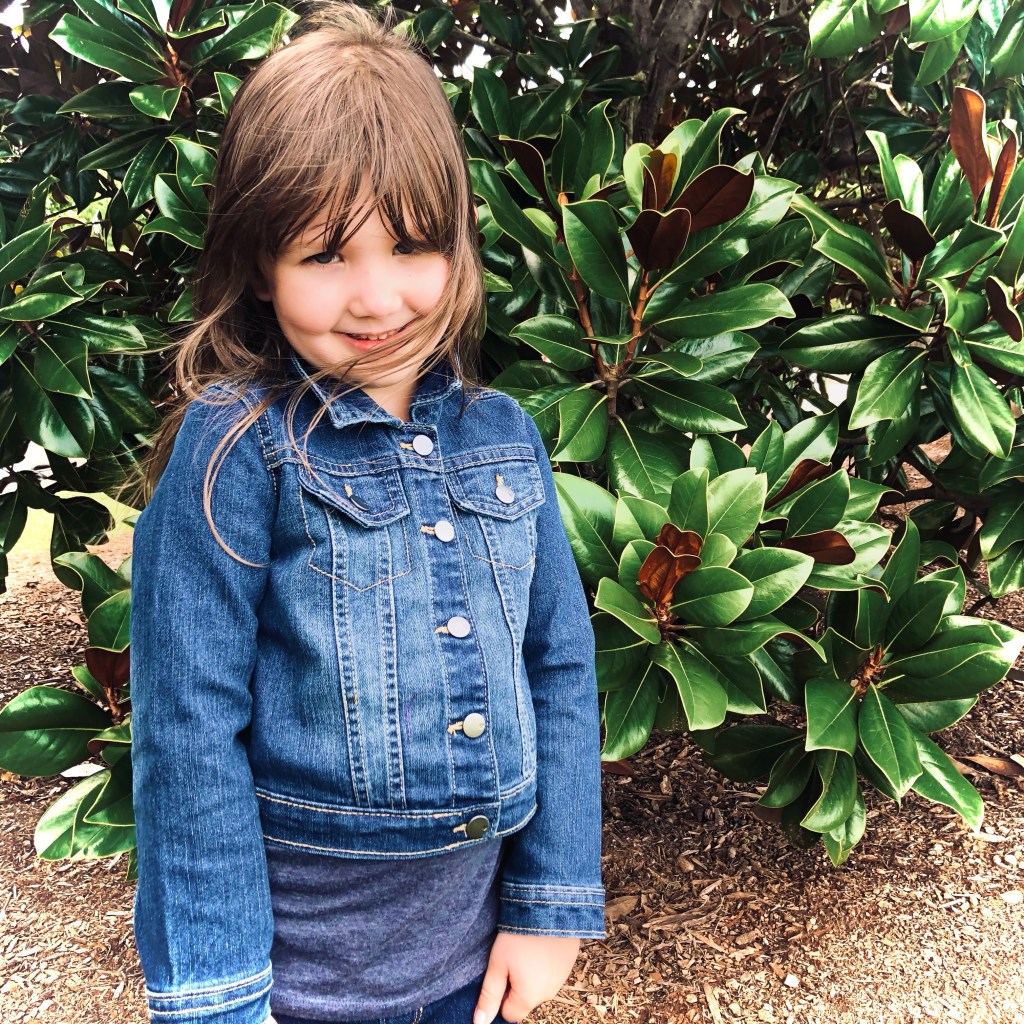
“Stand right there, honey. Let me get your picture by that tree,” I tell my granddaughter, on our first trip to the park.
It’s a different park. A different tree.
But still, and always, a magnolia.
Our Sugar Magnolia, by “her” tree.
*******
With abiding gratitude to the community at Two Writing Teachers during the annual Slice of Life Story Challenge, which concludes today. It was a joy to write alongside you every day in the month of March. Thank you for every cup of light you offered; I will savor the echo of your voicesfor many days to come.






 lit bits and pieces