An incongruity

These are
the collective nouns
for hummingbirds:
a charm
a glittering
a shimmer
a tune
a bouquet
a hover

Call them what you may
they are not at all charmed
by each other

They are
tenacious
pugnacious
audacious

This I have learned
by observing
a half-dozen tiny Amazons
battling over the feeder
sometimes striking each other
so hard
that one smacks, thunk,
against the window

I am also learning
their colorful language:
warning cheeps
and indignant squeaks
over who gets the sugar-water
even questioning chirps
from the safety of the
pink crape myrtle branches
whenever I remove the feeder
for cleaning and a refill
(I am bringing it right back,
I say aloud
to a subsequent
skeptical silence)

Right back to the nectar
they come
with renewed vigor
peeping
chirping
quarreling
never singing
only once in a while
by some temporary truce
feeding side by side

I might call them
an incongruity

Although, in a way,
they are a bouquet
of diva style:
I can now recognize
the one with black spots
from her neckline
all the way down her pale belly
and the bigger one
with a pristine ivory belly
whose back shimmers
brighter green
and my favorite of all
the smallest one
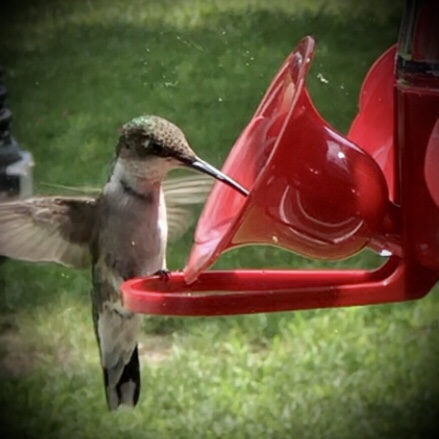
with just a touch of red
glittering at her throat
—a tiny lady wearing
a precious ruby pendant

When I opened the blinds
this morning
there she was,
Little Ruby, hovering,
looking in at me for a split second
of mutual awe
before she darted away

which, hummers being
what they may,
makes for me a
charmed
glittering
shimmering
day
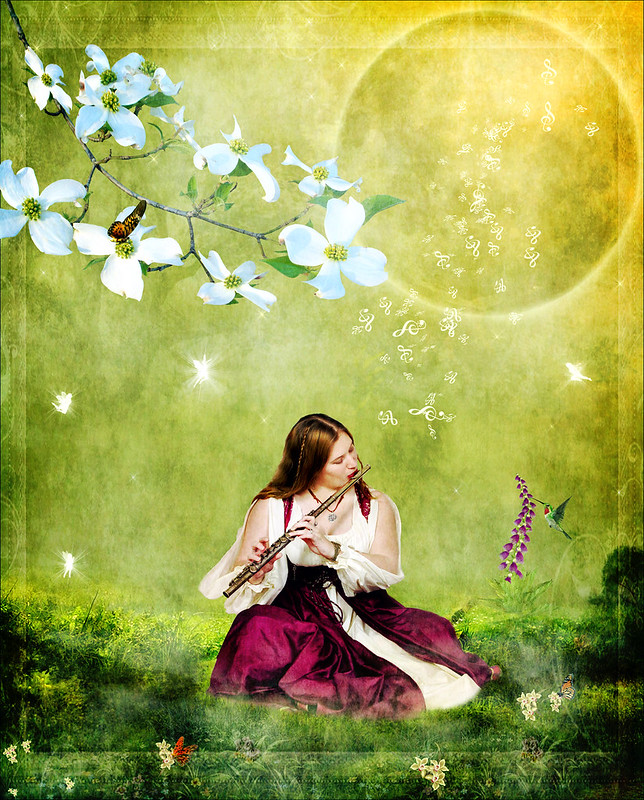
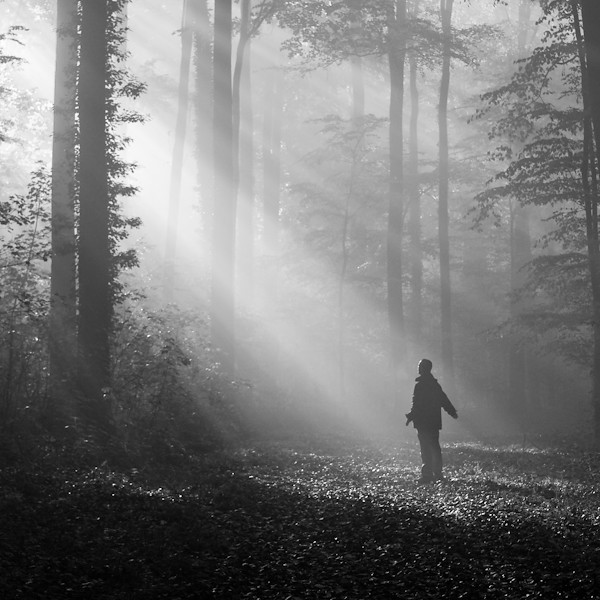
Forest Music.~Brenda-Starr~.CC BY-NC-ND 2.0.


The last one?

Amid the August frenzy
of female hummingbirds
battling at my feeders
one male sneaks in for a moment
and I haven’t seen him since.

There are more and more hummers at my feeders now. All females. I’ve been watching for males, suspecting they’ve already migrated. Late last week, lo and behold: A straggler? A south-bound traveler on a refueling rest stop? He may be the last male I see this season.

Godspeed, little one.

Tongue of hummingbird

“At a feeder, a hummingbird extrudes and withdraws its tongue thirteen times a second. Hummingbirds do not sip nectar; they lap it. The tongue is forked, like a snake’s, with absorbent fringes along the edge of each fork…The tongue is so long that, when retracted, it extends back to the rear of the skull and then curls around to lie on top of the skull.”

—Sy Montgomery, The Hummingbirds’ Gift: Wonder, Beauty, and Renewal on Wings

Tongue of hummingbird outside my window.

The only way I can get such a photo is by videoing and going back, frame by frame, to select a still shot.

Utterly mesmerizing, these tiny creatures and the way they are designed. They have the largest brain and heart of any bird in relation to its size, plus a skullful of tongue.

—Wild.

Curious connection

gogyoshi: a Japanese poem with a title and five lines

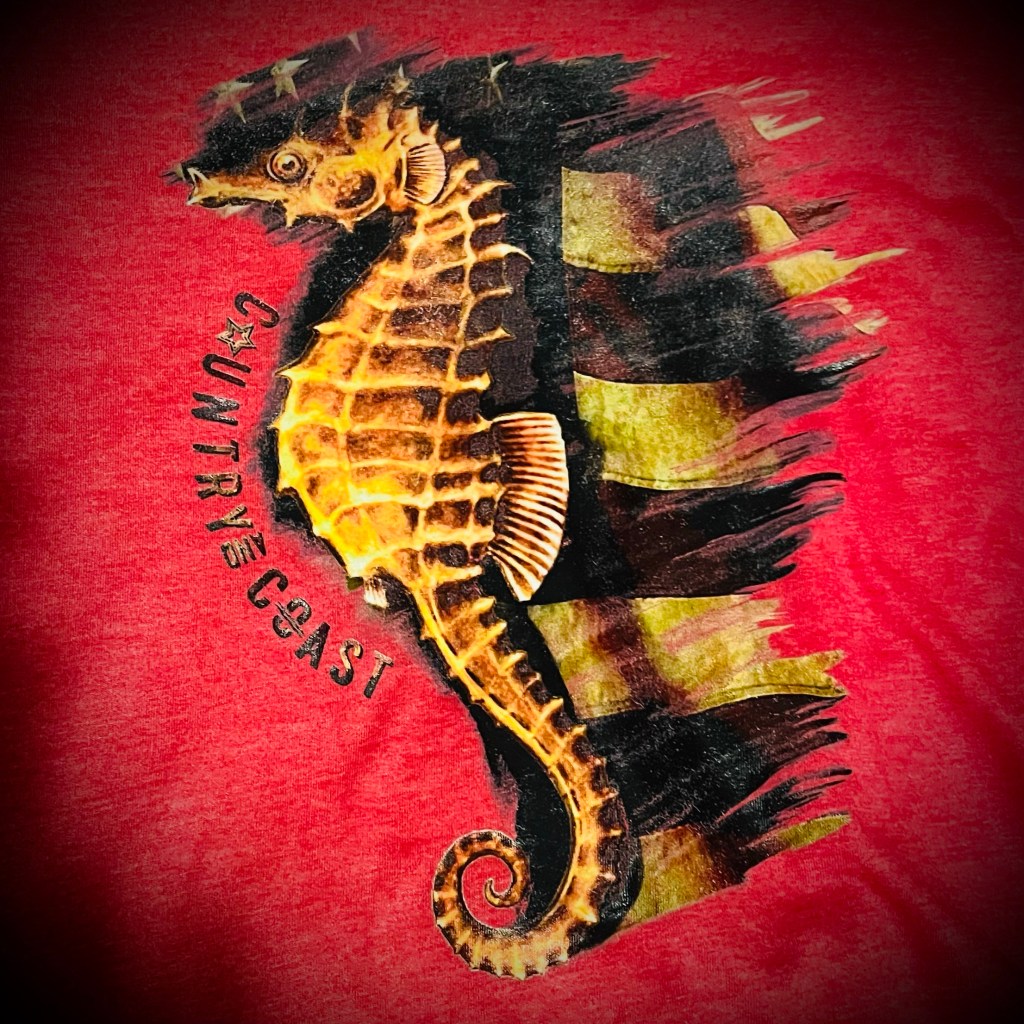
The Curious Connection of Seahorses and Hummingbirds
(Two of My Favorite Creatures)

One is the slowest creature in the sea
the other, the most agile in the air.
One armor-plated, one gorgeously plumed;
what could they possibly have in common?
Fins and wings beating at the same speed.

Light reading

A friend who knows my affinity for the natural world gave me The Book of Hope: A Survival Guide for Trying Times. It’s written as a conversation between Jane Goodall and her interviewer, Douglas Abrams. When I say it’s part of my current “light reading” I don’t mean easy (although it is) or frivolous (for it is not).

I mean light as in candleglow dancing on the walls of a dark room.

I’ve not gotten far yet but here are some lines that draw me in the first couple of chapters—flickerings of my own credo:

Hope is a survival trait.

The naturalist looks for the wonder of nature – she listens to the voice of nature and learns from it as she tries to understand it.

Hope does not deny all the difficulty and all the danger that exists, but is not stopped by them. There’s a lot of darkness, but our actions create the light.

And this from an Inuit elder, on confronting and healing our grief, which can manifest itself in the body as physical pain: Make space for grief…find awe and joy in every day.

—these, I believe. They are often the very reason why I write.

Recipe for Survival

Hold onto hope, and it will hold you
Open the ears, eyes, arms of your spirit
Perceive the call of awe, all around
Embrace it. Let the healing begin.

Tiny king

The Tiny King Comes to Sip His Nectar

He visits a little more each day
watching me through the window, wary
not knowing I hold my breath
at sight of him, flash of living jewel-fire
out of nowhere, here, and gone

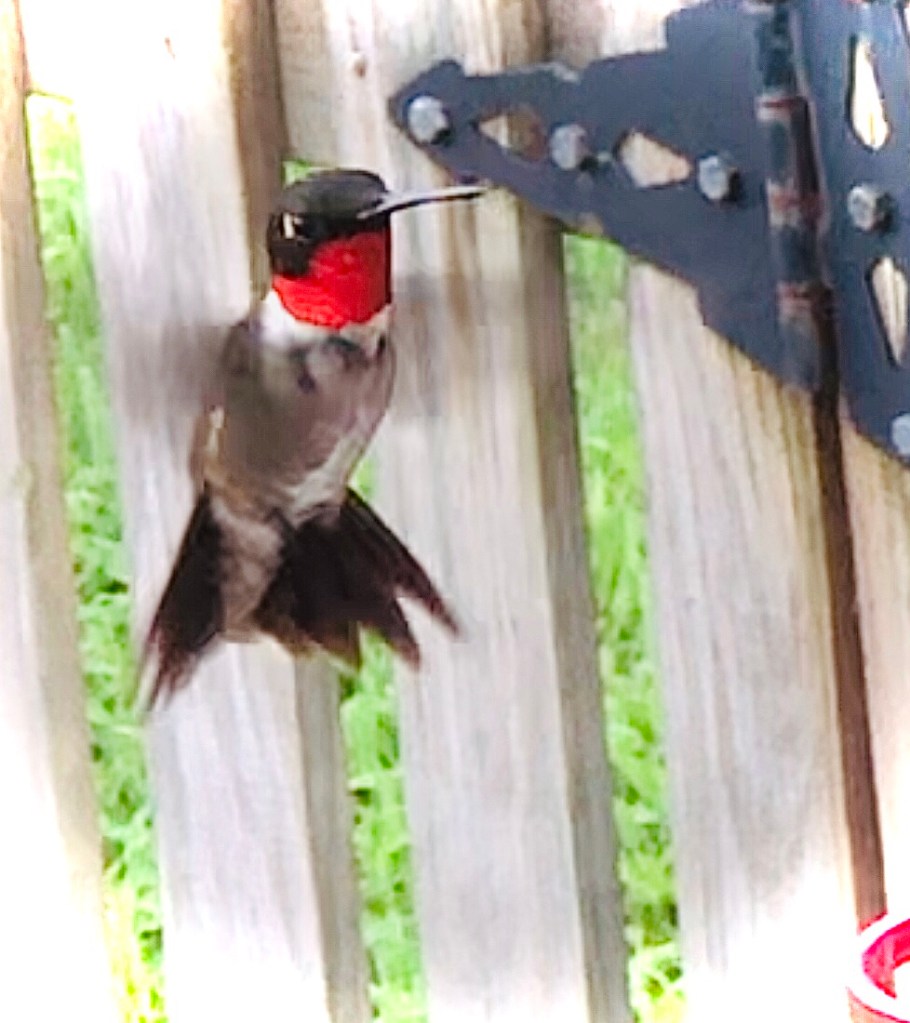
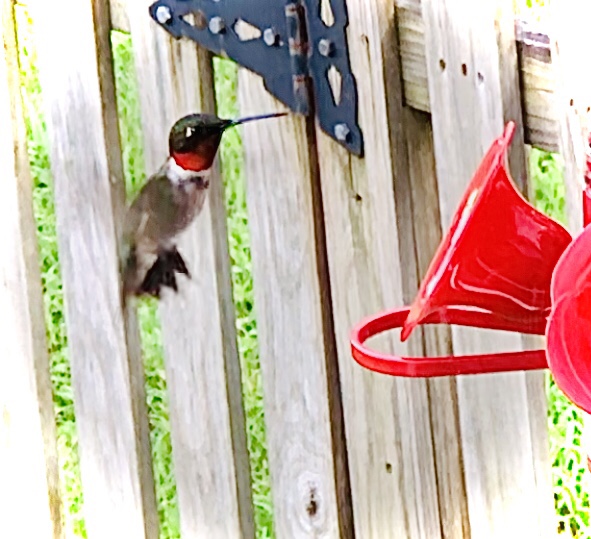
My male ruby-throated hummingbird
—took days of stealth to get these shots.
The females come more frequently.


Rubies are the stone of kings; in chess, the king can move in any direction. In mythology, nectar is the drink of the gods. Fitting symbolism for this little creature so gloriously arrayed, so endowed with otherworldly powers. He’s outside my window looking in at this very moment, the morning sun shining on his fiery throat—the brightest color I’ve ever seen in nature. Utterly breathtaking. He’s laid claim to the window feeder since I put another one out in the yard. Tiny king of a tiny kingdom, reigning and defending from a twig-throne on high, among pink blossoms in the crape myrtlewhich just so happens to represent royalty.

Of the ages

It is said that
the Information Age
is ending
giving way to
the Experience Age
loosely defined
as moving from
accumulation
(our digital output
is greater
than our capacity
to store it
anyway)
to immersion
in the story:
‘Live every moment
of your life
to the fullest,
with as much
sensory detail
as possible!’

(a shift
reminiscent of
the writing rule
‘show, don’t tell’
although in truth
it takes both
to bring a story
to life
and in thinking
of narratives
I pause to consider
this thing called
the unreliable narrator)

then, this week,
I stumbled across
this phrase:
We live in the age of rage

I contemplate the why of it
as my brain follows threads
inextricably, impossibly knotted
through a psychological tapestry
of distortion
information here
experience there
narrative everywhere
(as I once heard a father
tell his child:
It’s your lie.
Tell it like you want to.)

people do tell it
and sell it
and buy it
like they want to

often, it seems,
without an eye
turned toward the age
to come
being too blinded
by continual bombardment
in the now

the Experience Age
I wonder if it might be
more aptly called
the Age of Escape
fleeting as it is

these are the things
I think about
when I sit to write
in the stillness
of early morning
before the sunrise
before the stirring of the birds
nature’s continuity
offering sacred respite
from the Age of Rage
where the broken road
inevitably sends one
teetering on the edge
if not over into
the abyss
of despair

Hope. Martin Gommel. CC BY-NC-ND 2.0

Tiny warriors

Not one but two hummingbirds
visit the new feeder now
as if the first brought a friend
to a cool new place for a drink

This is not the case

It’s a competition
a quarrel, a chase
each determined

to drive the other away
each little but fierce

Methinks I will call them
Helena and Hermia

(no sign of any males;
perhaps they’re in the woods
asleep)

What I’d say to these tiny warriors
if I could make them understand
is that there’s plenty to go around


but humans
(what fools we mortals be)

who should understand
have yet to learn
about living peaceably
about there always being enough

if only…

I sigh as I ponder
the solitary existence
of hummingbirds

and the mad beating
of their wings


“And though she be but little, she is fierce…”

Toadally true story

While working outside around the house, I paid no attention to the little brown rock in the driveway.

Until it hopped.

On closer inspection: Not a rock. A tiny, rust-colored toad, pretending to be a rock.

Reminded me, for just a fraction, of story characters who magically transform themselves into creatures or objects to avoid detection from enemies…

I leaned in while trying to maintain a respectful, non-threatening distance.

“You’re doing a magnificent job of it,” I told the toad.

Of what? its tiny taciturn face seemed to ask.

“Of pretending to be a rock,” I said.

It sighed (I think).

What gave me away?

“Well, rocks don’t hop.”

Its expression: pure disdain.

“Toads don’t talk, either,” it said, as it turned and hopped away across the hot pavement.

Okay…so this story may not be toadally true…

The toad. Less than one inch long. Stone-faced, isn’t it. Can’t decide if I’d call it Rusty or Rocky. Or perhaps just Fowler, as it appears to be a Fowler’s toad, with poisonous warts…fun fact: apparently ALL toads are poisonous. Not highly toxic to humans through touch, only if ingested (gulp). Think of those I caught as a child and brought home in my metal Peanuts lunchbox amongst the crusts of my PB&J (toadally true. Honest). Would make for fun fiction writing with students when they study animal defense mechanisms: The Revenge of the Toads…

*******

with thanks to Two Writing Teachers for the weekly Slice of Life Story Challenge
and, of course, to the toad

A tree for a tree

This week I read that you can tell how long it’s been since a field has been reclaimed by forest. If the forest has a lot of pines, maybe twenty years. If there are more hardwoods than pines, maybe forty years.

We own a tiny of patch woods behind our house. Beyond that is a field (not ours). Once upon a time, this was all field, and long before that, all forest.

I cannot recall what these trees looked like when our house was new, twenty years ago. I can see we have quite a few hardwoods now in our tiny bit of forest.

This week one of our pines toppled in a wind gust preceding a thunderstorm. The trunk’s resting partly on the fence (which is holding up, surprisingly). On the other side, the treetop is a shattered, mangled mess. My plant identifier app tells me it’s a loblolly pine with Crown Gall caused by bacterial infection. It must have been slowly starving for water or nutrients. The extent of its brokenness there on the grass makes me wonder how much the tree suffered and if others of its species tried to help or not (trees do this for one another).

At any rate, it’s gone. A fat sand-colored dove lands on the fence to survey the damage also. Maybe it is simply paying respects.

There is nothing I can do. The fallen tree will have to be cleaned up. I imagine the confusion of rabbits, the next time they come out to nibble clover and find this mess. I turn to go back to the house, whereupon I discover a curiously bright and fresh plant quite to itself where the pinestraw ends and grass begins.

Sweetgum. A baby hardwood. Encroaching toward the middle of the yard.

I look at back at the grown sweetgums waving their starry leaves from among the cedars and pines. I imagine the mother tossing her seeds as far she could (not very far, only a few feet; maybe birds or animals helped but the wind apparently didn’t, not much).

Still. Cannot help thinking about that reading I’ve just been doing…as in, this cheery neon-green baby being a strategic move in the decades-long hardwood takeover and that sick pine, an occupational casualty.

I wonder what the trees tell one another, what old secrets live deep in the understory.

I wonder what the dove knows, and the wind, as it blows.

Something of belonging and primeval balance, surely.