Courage (part two)

The surgery took longer than expected, but the surgeon came to the waiting room at last.

“It went well,” he said. “Your husband’s eye is removed and the implant is in place, covered by membrane and attached to the muscles as it should be, if he were to get a prosthesis.”

He paused.

If it went well, why is he pausing? Something’s not right.

He continued: “I had to remove a lot of extra tissue, as it was dark and there’s no way for me to tell if it’s just natural pigment, or bruising, or melanoma.”

I was shaking. “What does this mean?”

“I took all of the dark tissue but he may never be able to wear a prosthesis, as there may not be enough support for it,” said the surgeon, gently.

I nodded. How are we going to tell him?

“Pathology will send the eye to Wills Institute in Philadelphia – they’re the best. They’ll analyze the tumor, whether or not any cells have spread . . . .”

 I closed my eyes as he spoke, not having considered this possibility.

I recalled the oncologist’s words when we consulted him: By the time it’s found, it’s usually metastasized. Radiation and chemotherapy are ineffective. It’s nasty.

That doctor had treated five patients with ocular melanoma in the last two decades.

All five had died.

Please, God. Please let those cells not have spread.

And then I went to recovery to hold my husband’s hand.

He squeezed mine, hard.

Half his head was bandaged. When an eye is surgically removed (enucleated), that side of a person’s face bruises badly. A conformer, a clear plastic piece like a huge contact lens, is put under the eyelid to hold its shape during healing so a prosthesis will fit.

The pain is intense for the first few days.

When the bandage had to be removed the first time for the application of antibacterial ointment, my husband said, “Get me a mirror.”

I handed it to him.

“Dear God,” he said, looking at his reflection.

It was the only time he cried.

After that, he never complained, not once – all of his energy went into healing.

The first night back home, when he went to bed, my husband said, “I see a light.”

“There isn’t a light,” I said. “I just turned it off.”

“I see it with my . . . what used to be my eye,” he said. “A bright light at the floor. Then it sort of swept up to the ceiling.”

I thought about amputees who still feel rings on fingers that are gone, or sensations in legs that are not there anymore. Phantom pain.

“I think it’s a phantom light,” I told my husband.

 He saw it for a few nights, this ghost light, the optic nerve trying to adapt to not seeing anymore. And then it stopped.

The bruising absorbed in a week or so and the eye – what do you call an eye that’s not an eye? A non-eye? – didn’t look as alarming as one would imagine. Just a pale orb, sort of like sclera without an iris. Not frightening at all, nothing like a hallowgast from Miss Peregrine.  Just different.

And every day we wondered about that pathology report.

Three long weeks went by before the surgeon called:

“No rogue cells in the tissue around the eye! The timing couldn’t have been better – the tumor was in the early stages.”

We threw our arms around each other; we could get on with living.

It wasn’t all that easy.

At first my husband wore a black eye patch to shield the removed eye. Everywhere we went, little kids called out, “Look, a pirate!” My husband just laughed and waved at them. An eye patch, however, is quite convex. It bumped against the lens of his glasses, which he had to wear all the time now for his remaining eye, as it was becoming strained.

He tried adhesive bandages designed for eyes next. Our grown sons said, “Dad, the eye patch looks better than those Band-Aids. A lot better.”

My husband sighed. He decided to try wearing a contact lens in the real eye, doing away with glasses so he could go back to the eye patch, which worried all his doctors:

“You only have one eye now – you can’t afford an abscess or corneal infection,” they told him.

He tried it anyway – and learned that in order to put a contact in, you really need two eyes to see what you’re doing.

At last he resorted to tinted lenses and gave up on coverings altogether.

He had trouble with depth perception, driving after dark, merging onto the highway. He was startled by people approaching him on his left side, because he couldn’t see them coming.

He bumped into things, hard enough to leave bruises.

He had trouble reading, which worried him more than anything else – he’s a minister, and reading is the foundation of his life’s work. He got a magnifying glass to be able to study his Bible.

He became restless, quiet.

At an appointment for his strained eye, the neurological ophthalmologist asked: “Why haven’t you gotten a prosthesis?”

“The surgeon said with all the tissue he removed, there may not be enough support for it,” answered my husband.

“Hmmm,” said the ophthalmologist. “How long has it been since your surgery?”

“A year.”

“I think you should investigate it. Here’s the name of the ocularist. He’s only about an hour away.”

We called, and learned that the ocularist sets appointments in the morning. If the patient is a candidate for a prosthesis, he makes it in his office that day and the patient leaves wearing it.

My husband hung up the phone, his face alight with hope.

“What if . . . ” I struggled, “what if you’re not a candidate?”

“Then I tried, and that’s all I can do.”

I worried the whole trip about how the idea buoyed his spirits, fearing that we’d be sent away, and how would that affect him?

Our younger son drove us. The three of us sat in the office together as the ocularist examined my husband.

“Oh, that was a lovely surgery,” he said. “Lovely. Great movement of the implant. Let’s get to work.”

“Do you mean,” I hardly dared to confirm, “that he will be able to wear a prosthesis, after all?”

“Sure – not a problem.”

I sat there watching as the mold was made of my husband’s non-eye, then as the resin was poured into it to create the prosthesis, thinking, This is like a cross between a medieval apothecary and Lemony Snicket. It might have been downright gothic, except that the room was sunny and cozy, being part of a house converted to an office.

The last step of the process was painting the prosthesis. We watched this man, this artist extraordinaire, open his set of paints and create his little masterpiece. He held the prosthesis up to my husband’s eye for comparison: “You have a lot of ocher in your iris. I have to add more.”

Back to dabbing paint he went.

As long as I live, I do not expect to see anything like it again – it was nothing short of a miracle when the ocularist placed the prosthesis over the implant, and my husband looked at me with two big, beautiful brown eyes.

My mouth fell open.

So did my husband’s, when the ocularist handed him the mirror.

We arrived at 8:00 that morning.

We left at 3:00 that afternoon, with the new eye.

On the porch of the office as we were leaving, in the bright the afternoon sun, my husband said, “Tell me how it looks.”

A perfect match – one would not know which was the real eye.

“It’s unbelievable,” I said. “Amazing.”

“It looks great, Dad,” said our son.

“I feel like myself again,” said my husband. A grin spread across his face.

“I just wonder how long it will be before someone asks if I can see out of it,” and he dissolved with laughter.

That was just three weeks ago.

He hasn’t stopped smiling since.

*******

(Note:  Just before the surgery, when we didn’t know what would happen next, we made the seemingly insane decision to adopt a seven-week-old Lab puppy who needed a home. If you are interested in the puppy’s story in relation to this experience, here’s a previous post: The unplanned baby.

slice-of-life_individualEarly Morning Slicer

Follow the light

Hermit crab

Hermit crab. Jessica DiamondCC BY-SA

Daddy has a story to tell this morning:

“Last night, a sound woke me up.  I got out of bed and listened.  A steady clinking was coming from the bathroom. I thought: What in the devil could be making that noise in the bathroom? I went and looked around – didn’t see anything. I bent down to look at the pipe under the sink. Nothing. The noise was much closer, though, almost right in my ear . . . I turned my head and there on the sink leg was that hermit crab, crawling up. His shell was hitting against the metal leg – that was the clinking.”

I look in the glass bowl where my pet crab Shermie lives. He’s completely inside his black-and-white shell now, obviously sleeping off his late-night adventure. 

“He got out of his bowl and went that far? Why would he do that, Daddy?”

 “I guess he was following the light.”

The bowl is in the living room. I look at the hallway. The bathroom is at the end, around the corner on the right. That’s an awfully long way for a little crab. I imagine him crawling along the hardwood floor past the bedrooms in the dark. It’s a good thing none of us got up and stepped on him. 

Shermie’s stalk eyes peek out of his shell and I wish I could ask him: Why were you trying so hard to get to the light?

Maybe it wasn’t the light. A quick skim of the Internet reveals that hermit crabs are nocturnal creatures which often climb out of cages at night, when they would normally be in search of food and water; in the wild, they do this in droves, traveling for miles. When a pet hermit crab escapes – apparently quite a few do – the experts say to check the bathroom, as the crab might be seeking the humidity of its natural habitat.

In the days before the Internet, however, we didn’t know all of this.

For years I thought of that tiny creature and the Herculean task of climbing out of a wide, smooth glass bowl – how, I do not know to this day – to make his way, alone, through the dark toward the only light in the house.

And I would think: If Shermie could figure out where the light is, then so can I. There’s a light to follow out of this darkness, somewhere. I’ll find it. I’ll climb out.

slice-of-life_individual Early Morning Slicer


But I’m not a teacher

Encourage

He’d saved his own money to buy me a Christmas present. He told his dad he wanted to go to the bookstore, so his dad took him.

He bought me a picture instead of a book and watched with great pride as the clerk wrapped it.

“I got it for my mom,” he told the clerk.

“Oh, she’ll love it!”

He clasped it to his heart all the way home.

He burst into the house, calling, “Mom! Mom! I got you a present!”

His dad said, “Son, just put it under the tree. It’s for Christmas.”

“I want to give it to her now!”

“All right,” I said,  sitting down on the couch. My little boy scrambled up beside me. “I’ll go ahead and open it, if that’s what you want.”

He watched my every move as I unwrapped the paper and pulled out the matted picture bearing the quote: A teacher in wisdom and kindness helps children learn to do exactly what they thought could not be done.

I didn’t know what to say for a moment.

“It’s beautiful, honey,” I said, hugging him. “Thank you so much.”

“Do you love it, Mom?”

“I do … but I’m not a teacher.”

My son surveyed me with huge dark eyes that seemed far older than his six years: “Oh yes you are, Mom.”

At the time, I wasn’t even a college graduate. Teaching wasn’t on my radar. Thirteen years, a degree, and another baby later, I actually became a teacher. In all of those education courses that required me to describe my educational philosophy, I wrote: A teacher is an encourager, recalling that solemn little face, those big eyes, the absolute conviction shining in them. Children, sometimes, are the greatest of sages, the most profound of prophets.

Three more years, and the boy graduated college himself with a degree in history. “What am I going to do for a job?” he asked one afternoon, a slight hint of anxiety in his voice.

“Teach,” I answered, smiling.

He didn’t smile back. “But I’m not a teacher.”

“Oh yes you are, Son.”

Before the summer ended, he had a job teaching social studies at his old high school. When he went to set up his classroom, he cleaned out the cabinets and found old tests – including his own.

He also became a soccer coach, taking his team to the championships and winning regional Coach of the Year this past season.

We didn’t seek teaching; it found us. We’ve done exactly what we thought could not be done – we do it every day, all over again.

And every day is new, if not easy; every day offers wisdom, beckons kindness, invites us to believe in others, in ourselves, every moment a chance to create, to reinvent, to overcome. It can be done.

Encourage one another.

slice-of-life_individualEarly Morning Slicer


Spectacle

Glass doors

Untitled. SupportPDXCC BY

“Bye, Mrs. Haley!”

“Thank you, Mrs. Haley!”

The fifth-graders hugged me as they left summer enrichment camp. Their parents, present for camp graduation, made a point to speak to me, too:

“Thanks so much for this experience. My son loved it  – he wants it to last all summer!”

“My girl wants to come back next year!”

I laughed, shaking hands with the gracious parents, all the while basking in an inner glow: I did it! I successfully organized and taught this thing!

Just then, I spotted a student’s notebook left on the floor.

Oh, no! She’s going to need this  – the whole point of compiling it is to have a resource in sixth grade!

I glanced through the glass lobby doors. My student was with her mom, getting into a blue Honda. I snatched the notebook up from the floor. If I hurried, I could catch them before they pulled away.

I sprinted for all I was worth across the crowded lobby and – BAM!

For a nanosecond, I wasn’t sure what had happened. That sound was immense. Then I realized: I was the sound.

I found myself lying on the cold stone of the lobby floor.

There were loud gasps, maybe even a small scream.

“Mrs. Haley!”

That’s when I knew: I had run full blast into the closed glass door.

In a lobby full of parents and kids.

I sat up. Deep, throbbing pain spread across the bones of my face. I quickly ran my tongue over my teeth – were they knocked out?

No, they were intact.

Get up! said my brain. Before anybody comes over here.

Squaring my shoulders, I popped up from the floor, grabbed the notebook I’d dropped, OPENED the glass door, and scurried through to the blue Honda.

My student and her mom looked at me dubiously as I approached the driver’s side. The mom slid the window down.

“Um, your daughter forgot her notebook,” I said, holding my nose with one hand. Blood  seeped through my fingers. I extended the notebook with the other hand.

“Uh – thanks,” said the mom, taking it from me.

“Hey, Mrs. Haley, your nose is bleeding!” said my student, craning over in the front seat for a better look.

“Yes, I know,” I answered, “but it’s fine. Enjoy the rest of your summer!”

I slunk back into the building where people stood, gaping. Giggles rippled through them. Without making eye contact, I marched past them into the bathroom to survey the damage.

I didn’t look too mutilated. The nosebleed was already slowing.

The bathroom door opened and one of my colleagues came in.

“Are you okay?” she asked.

“I think so,” I said. I leaned closer to the mirror. “Oh, no – look! My nose is turning black already!” How bad will the bruising be? Will I have two black eyes?

“Let me see,” said my colleague. She came up close to scrutinize my nose. She touched it gently.

I winced.

A grin spread over her face.

“That’s ink from the newspapers you were holding!” She doubled up with laughter.

This is just great. Assured that my nose was going to be fine, I had no choice but to return to the lobby after I washed away the ink and the blood.

Most of the folks had cleared, thankfully. Only my colleagues remained; they’d propped open the offending glass door. “You need to see what you did to the door,” one of them told me.

I went to check it out, wondering if I’d somehow managed to hurt the door more than it had hurt me.

And there on the clear glass before me was a perfect mask of my face, thanks to the foundation I wore. An oval with two eye-holes, a complete set of lips in faint lipstick, even the little vertical lines in my lips, all captured there on impact better than any artist could have painted.

As I stared in horror at this specter of my visage, one of my colleagues called, “Here’s looking at you, kid.”

They all howled while I frantically wiped my phantom make-up mask from the glass.

“One thing’s for sure,” one of them said, wiping her eyes, “no one will ever forget this camp graduation!”

Indeed. The success of the camp itself is not a topic of conversation anymore, but as for me – I’m legendary.

slice-of-life_individual


Dogged determination

nikolaus

Nikolaus


What comes to mind when you hear the word perseverance? Perhaps it’s The Little Engine That Could. Or Jim Valvano.

I think of Nikolaus.

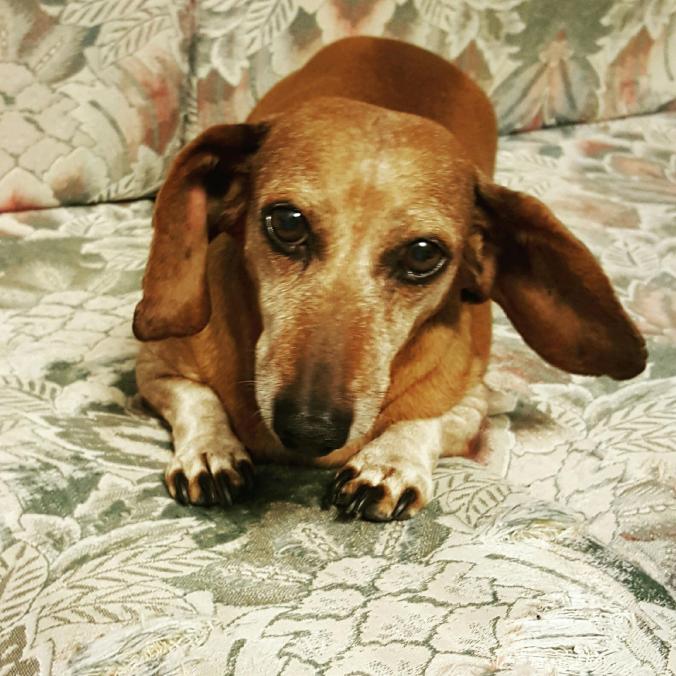
He’s a dachshund, and if you’ve ever owned one or read E.B. White, you know that the breed tends to be stubborn—as my eastern North Carolinian father would say, “hard-headed.”

Nik came to us when he was three months old. My boys, ages twelve and four, had been begging for a miniature dachshund after they puppy-sat one for friends on vacation. They knew exactly what they wanted: A little chocolate female. So when another friend called to say that her elderly mother had this very creature but could not take care of it, and if we wanted this puppy, we could have it, my boys were elated.

On the much-anticipated day of arrival, we opened the crate door and out strutted Nik. He was tiny, weighing maybe five pounds.

Within sixty seconds, these things developed:

“Mom, she’s not chocolate,” the older son observed. The puppy’s glossy coat was deep red, nearly crimson.

“Mom, she’s peeing on the carpet!” squealed the younger son. A remarkably large puddle, I might add, for a bladder so small.

“And she’s a boy,” I noted, running for the paper towels.

Just sixty seconds to an inkling that This Might Not Be What We Imagined.

Nik looked at us lovingly, wagging his tail.

He was, I decided in the weeks and months that followed, completely untrainable. He could not control his bladder. He wet the carpet, sofa, beds, everything. He would not “go” when we took him outside. Crate training did not work at all; he eliminated in the crate immediately upon entering. Exasperated, I asked the vet: “Why isn’t this working? I read that dogs don’t like to mess up their dens.”

The vet shrugged. “With some dogs, it’s just a behavioral issue.”

Great, I thought. We have a disturbed dog. It did not occur to me until much later that he’d been crated a lot as a puppy because his elderly owner could not keep up with the demands of caring for him. He cried loudly the whole time he was in the crate. Nik, I learned, never wanted to be confined.

The futile attempt to housebreak him reached its zenith a year after we moved into a new house.

“Boys, I don’t know what else to do. I’ve tried everything. I can’t housebreak Nik. He hates his crate, I’m going to work full-time, and he can’t just mess up everything. Maybe it’s time for him to go to a new home.”

The younger son began to sob. “No! We can’t give him away. He’s ours. We’re his family.”

My husband, not Nik’s biggest fan by a long shot, melted: “Shh, don’t cry, son. We won’t give Nik away.”

I glared at him.

“Nik can stay in my room when we’re all out,” offered the older son. “I’ll clean up if he has an accident.”

I thought of the new carpet and sighed. “All right, then. This means everyone is going to have to look after him. EVERYONE.”

The strange thing is that Nik seemed to know about this, because, from that time forward, he was instantly, miraculously housebroken. Whenever he needed to go, he went to the back door and waited to be let out. Just like that. After two years of abject failure.

The boys taught this untrainable dog to “sit pretty” for a treat, which meant that at every meal Nik was by one of our chairs, holding his pose like a groundhog in hopes that we’d give him a bite to eat. I taught him to roll over, so if sitting pretty didn’t work, he’d roll over to get his treat. That’s his entire repertoire: Two tricks.

Nik follows me everywhere in utter devotion, and when he was younger he’d jump into my chair to wedge himself between me and the chair back when I was writing. He is wary of my husband—they are competitors for my attention—but as soon as my husband leaves the room, Nik flies over to curl up in my lap, as if claiming me.

The boys say, “He loves you the best.”

Nik’s intense gaze seems to say the very same thing. He watches my every move.

A couple of years ago, we thought we were about to lose him.

My husband and I heard him fall on the landing of the stairs leading to the upstairs bedroom, dubbed “Nik’s lair,” as Nik was long accustomed to staying there during the day when the family was out. He’d also go up whenever he was tired or ready to go to bed for the night. By this time the older son was grown and gone, and the room belonged to the younger one, who was not home at the moment. On hearing Nik fall, my husband and I rushed to find him crumpled but conscious on the landing.

My husband began to cry.

“Stop it! You, of all people, crying about Nik! Don’t tell me you’re attached to him after all!”

“It’s the boys,” sobbed my husband. “Having to tell them that Nik . . . that he might . . .”

I picked Nik up as carefully as I would a newborn baby. “Let me wrap him in a blanket. You’re driving us to the vet. Stop crying.”

The trouble was two kinked-up vertebrae; the vet pointed them out. He dispensed medication and sent us home.

I made a pallet for Nik in the living room and covered him with the blanket. For two days, Nik didn’t walk. The younger son slept  on the couch to be near him at night. Nik didn’t eat or “go” when we took him outside. He just looked at us with big eyes and never made a sound. When he’s not crated, Nik hardly ever makes any noise.

In the wee hours of the third morning, I woke up and decided to check on Nik. My son was sound asleep on the couch. Nik’s blanket was still tucked on his pallet, but he was nowhere to be seen. He wasn’t on the couch with my son. I started searching, increasingly alarmed as minutes passed with no sign of Nik. He’s crawled off away from us to die. That’s what animals do. He wasn’t in the kitchen, under the chair where he likes to take his treats.

I woke my son: “Where’s Nik?”

“He’s not on his pallet?” asked my groggy teenager.

“No! I can’t find him anywhere!”

I woke my husband: “Nik has disappeared!”

“How is that possible?” He and my son looked again in all the places I’d just looked.

Then I thought, No—surely not—I don’t know how he could . . . 

The upstairs bedroom. That’s where he’d want to be, if . . . .

My heart pounding, dread deepening with every step, I climbed the stairs and opened the bedroom door.

I turned on the light.

No Nik. Normally he’d have jumped on my son’s bed and gone to sleep.

But he couldn’t jump now, not with his back . . . very carefully, I lifted the dust ruffle.

A tail thumped in greeting, and two eyes looked out at me as if to say, I just came up to bed like I always do. 

I cannot envision how he did it, how he dragged himself from his pallet all the way up the stairs to his favorite, safe place. After three days of not being able to walk at all. Knowing he could not jump, he contented himself with sleeping under the bed instead of on top of it.

I do not cry easily, but I did then.

He recuperated, and it happened again a month ago. This time Nik could not walk for a week and a half. The vet—a different one now—called to see how he was faring.

“He’s not any better,” I said into the phone. “No change. He wags his tail at us, but he can’t move.”

“It may be time to think about the quality of life,” the vet said, gently.

We tried to talk about it, the boys, their dad, and I.

“But he knows us still,” I said. “He doesn’t seem to be suffering, except for not being able to walk.”

“Yeah, it’s not like he’s in a coma,” said the younger son.

“If you make that decision, I want to be there,” said the older son, who’d come by on his way home from work. He rubbed Nik’s head.

Nik looked at us lovingly.

Another day passed, and another. He still did not walk.

My younger son and I took turns bringing Nik’s food and water to him. Nik ate and drank. Good signs. I carried him out several times a day; he obediently did what he needed to do, lying in the grass. I carried him back inside, put him in his beloved new dog bed, and covered him with a blanket.

More days passed.

Then one day when I carried him out, I felt his back legs press against my side. When I put him down, he stood. By himself, for a few seconds, on his old white paws, looking at me lovingly from his little white face, before his legs gave out and he flopped down.

Each day after he could stand for a bit longer at a time.

He is fifteen now, turning sixteen in January.  He runs from room to room again like he did when he was a puppy, still begging for treats although he can’t sit pretty anymore or even see his treats as well as he once did, but he gobbles them just like always.

And every night, one of us carries him upstairs to his favorite, safe place to sleep.

Reflect: Who—or what—represents perseverance to you?  Why? What have you learned from this person or situation, and what have you learned about yourself?