Late June afternoon on the porch. A long-settling stillness, the day’s brilliance deepening to amber, shadows slanting across lawns and pavement, a cool pre-dusk breeze riffling trees and wind chimes, carrying the sound of a child calling in the distance. It’s not a child; it’s a little goat from a neighbor’s pen, hidden in a patch of woods. Bleating for its supper, I suspect. Startlingly humanlike voice. A neither-here-nor-there sound, disembodied, suspended in the air like time itself, clinging to these green and gold moments, unwilling to let go…
“Mom, let’s go for a walk,” says my youngest son (aka Cadillac Man).
I grab my shoes.
Walking beside me along our neighborhood street, my boy speaks, as he always does, of music. Songs he is learning, one he wants me to practice with him (it has to be simple for me. He can sing any part he likes in any key he likes; he can play anything he wants on the piano or guitar). I say I’ll try. He speaks of his new job at the funeral home; we reflect on the recent death of a beloved friend who’s the same age I am. Fresh-grated sadness, still surreal.
As we talk I note that no neighbors are out and about this afternoon. We seem quite alone. At one house, pool towels draped over the front railing billow in the breeze. American flags on front porch flagpoles ripple and flap with crisp smacks. A couple of cicadas rattle from high in the trees that frame backyards. Our long shadows stretch out on the pavement before us, where flecks of quartz wink; when my boy and I turn at the road’s end, the shadows disappear.
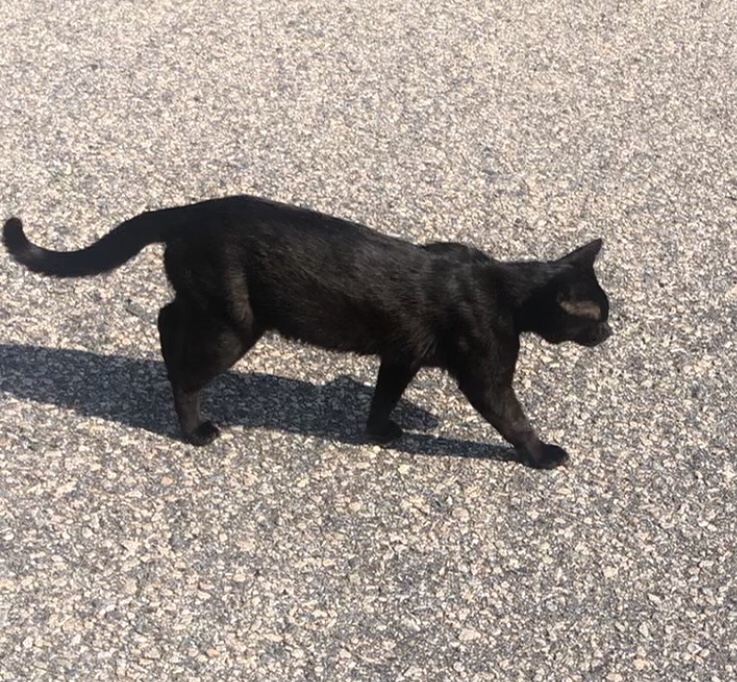
We pass a row of cypresses where there’s sudden movement in the grass. A black shape materializes, runs after us, crosses right in front of us…
Good thing we aren’t superstitious.
A young black cat, meowing.
“Awww,” says Cadillac Man, as it rubs against his legs. “What a sweet little cat.”
It comes over to me, rubs against my legs, purring madly.
We are devout dog-people. I can’t have a cat. I’m allergic. I learned this at age five or six when my family took in a stray Siamese (Mr. Cat, we called him) that took refuge on the stoop of my childhood home during a storm. Swollen eyes and asthma didn’t stop me, however, from bringing home a black kitten nobody else wanted when I was in college…
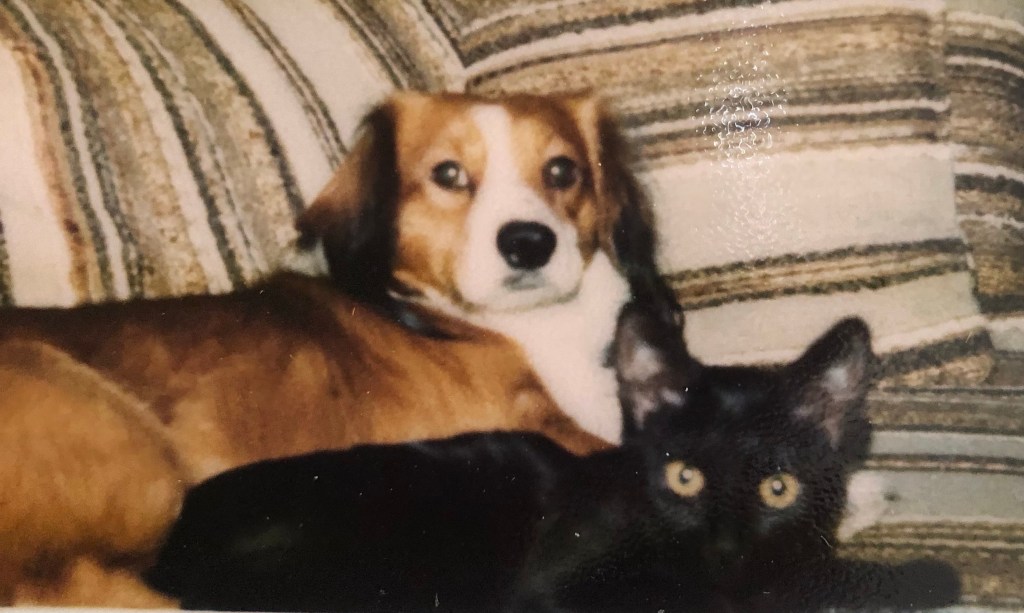
“It looks so much like my cat Moriah,” I tell my son. The name came from a magical cat in The Forgotten Beasts of Eld, a book I read when I was about twelve.
Cadillac Man bends down, picks up the creature. “I would keep it if you could breathe.” The little cat nestles against him. Animals love my boy. They seem to sense his gentle spirit.
After a moment, the cat twists to get down. Cadillac Man releases it.
“It looks kind of thin. I wonder if it’s hungry…” Do moms always think about this first? Is this our deepest default, this hard-wired compulsion to feed all little living things, to keep them living?
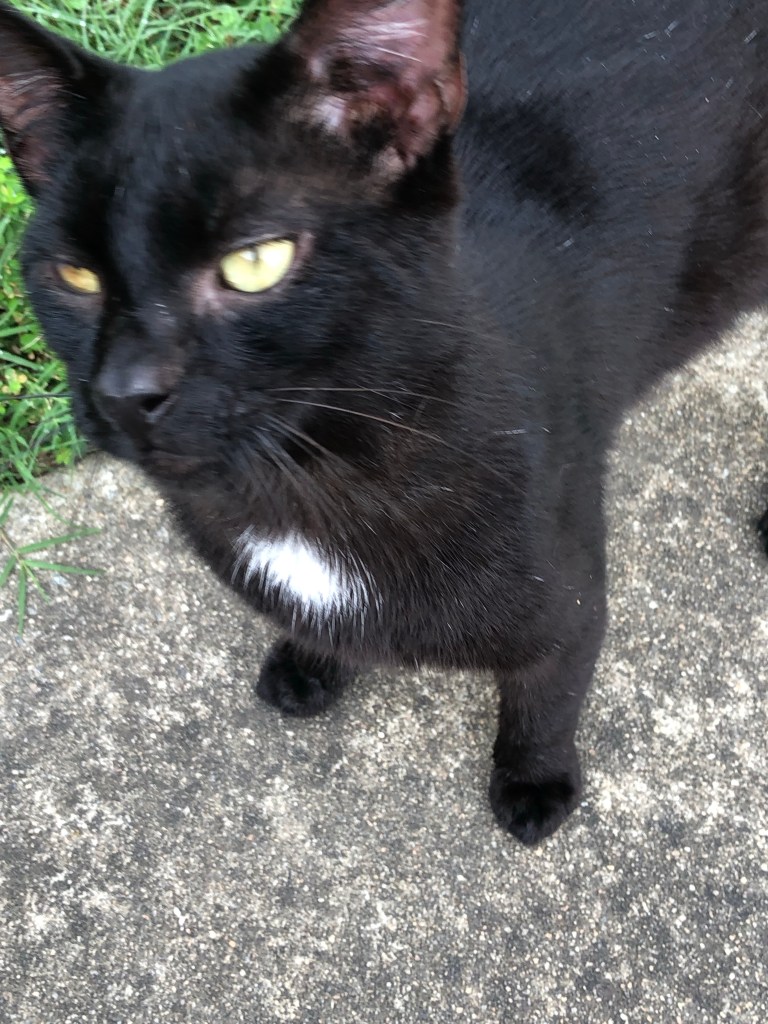
The cat sits looking up at us with big, unblinking, green-yellow eyes. Meow.
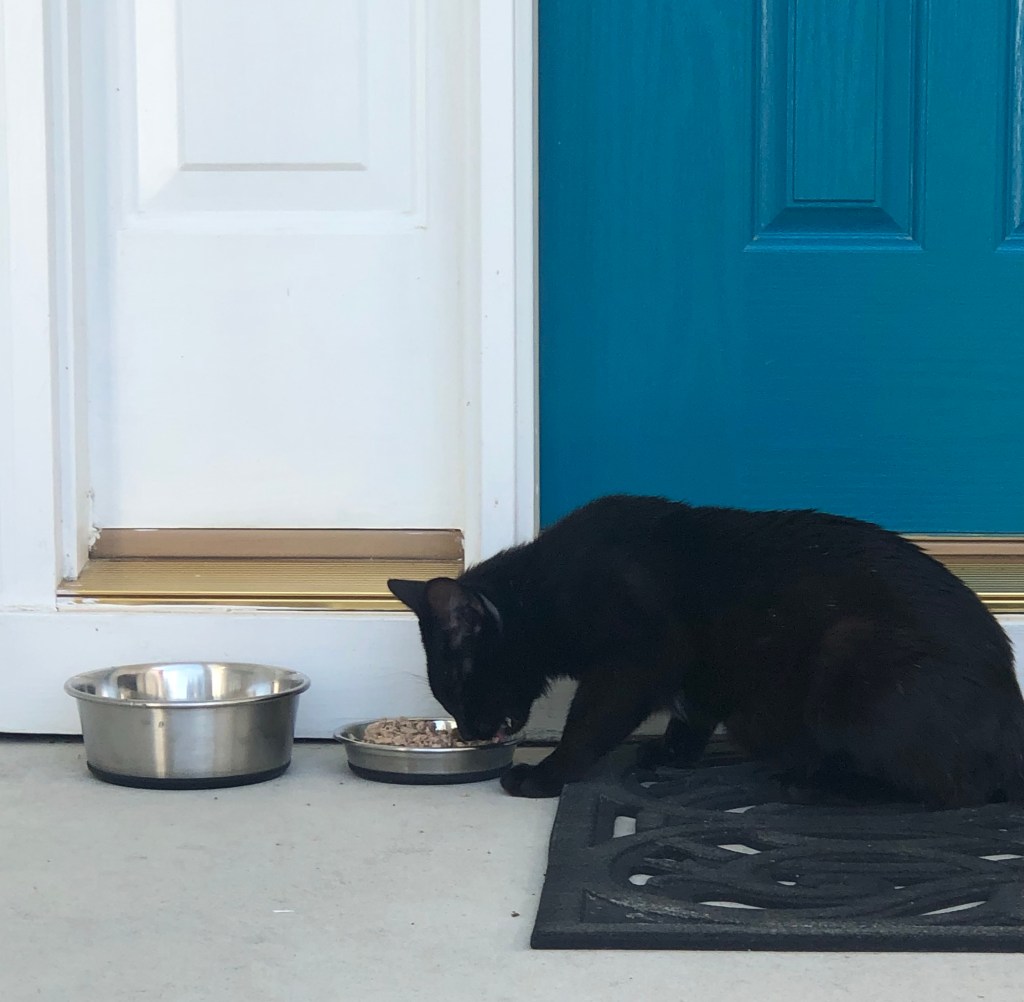
And it trots right beside us, like a good dog would, back to our driveway where I feed it some of Dennis the dachshund’s steak-flavored food in an old dish.
“I hope it stays,” says Cadillac Man. “It can be an outside cat.”
I examine the cat as it eats. “It has all its claws.”
“We should name it,” says Cadillac Man.
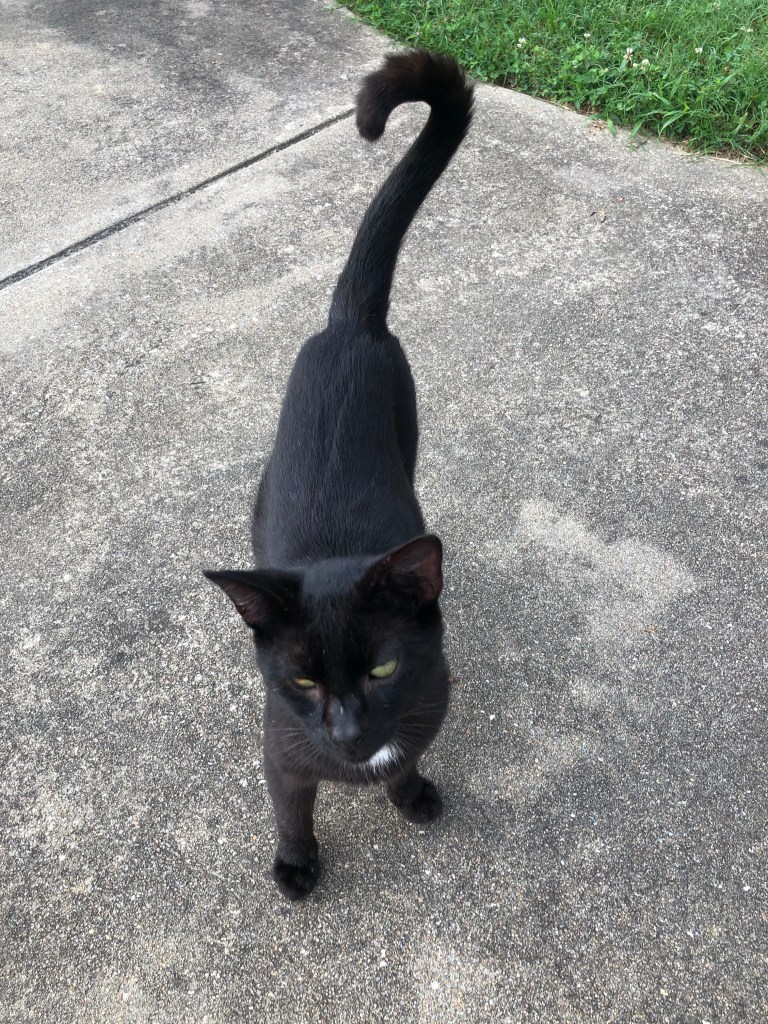
“Look how rusty its fur is in the sunlight,” I observe. “Black cats aren’t exactly black. It’s a genetic mutation of the tabby pattern. See the faint rings in its tail, there at the tip? So much like Moriah, only she was smaller and didn’t have a tail…” another mutation. She was the last kitten left in the Free Kittens box on campus the day I found her and took her home. Shelters say black cats are the hardest to find homes for; no idea on stats of cats with stumps for tails…
“We aren’t naming it Moriah, Mom.”
“Of course not. She was one of a kind and besides, this one’s a boy.”
Cadillac Man is silent for a moment. The cat has nearly finished his steak dinner. “Well, you know it has to be a musician’s name…”
This is what he does. Since childhood he’s named pet fish after bass singers; his dachshund, after drummer Dennis Wilson of The Beach Boys.
I can see what’s coming: “Brian, I suppose?”
Cadillac Man smiles. “Not quite. I christen this cat Douglas.
Brian Wilson’s middle name. I was close.
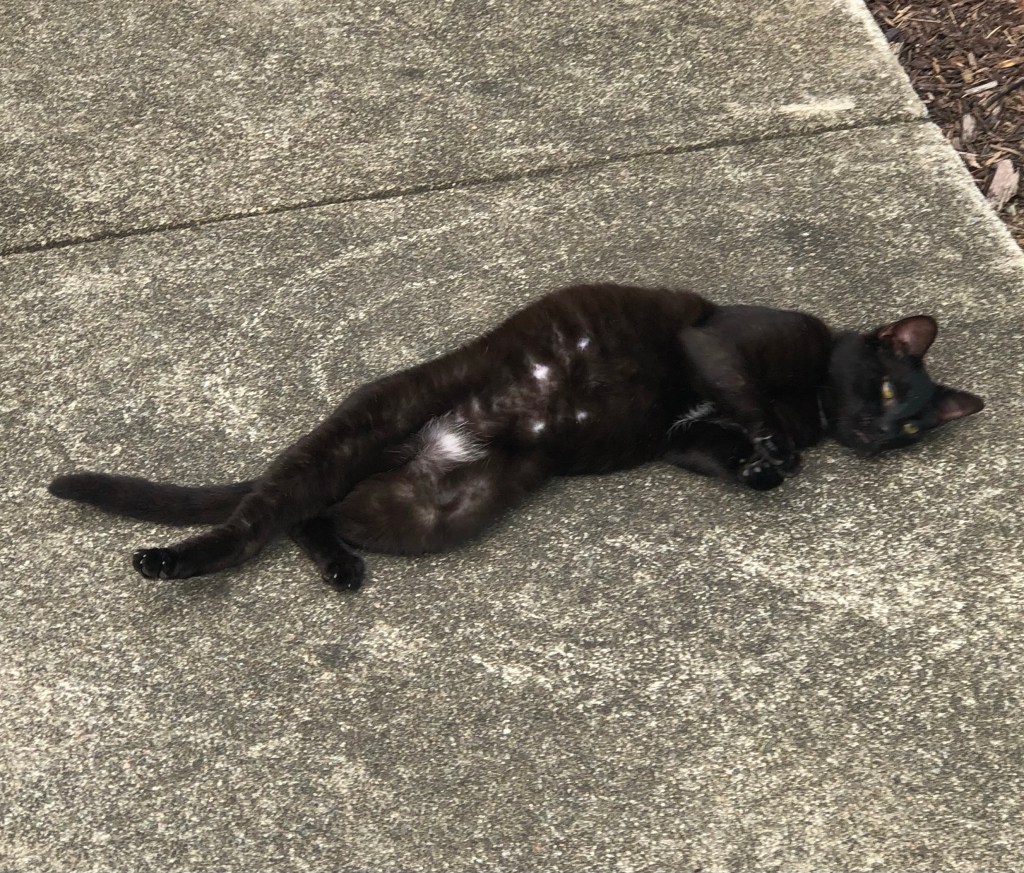
After licking the bowl clean, Douglas follows us up the sidewalk, cutting in front of Cadillac Man to roll over just like Dennis the dachshund does for a belly rub.
“Awww,” says my boy, rubbing the proffered belly. “Listen—he’s purring like a truck!”
Indeed he is.
It’s getting late. We need to go in to wash up and have our own supper, so we stroke Douglas one last time. I make sure to wash my hands well, with extra soap.
We peek out of the windows from time to time. Douglas is lying on the porch, and then he’s gone.
But not really.
He’s curled up under the rocking chair, sound asleep.
When he wakes, I take one of Dennis’ soft blankets out and put it in his chosen sleeping spot. Douglas sits on it at once.
“There,” I tell him. “Now you know that if you need a safe, comfortable place to sleep, you have one. If you’re hungry, I’ll feed you whenever you come around. I’ll leave water out for you. It’s summer, see…”
Douglas purrs as if he understands…and maybe he does, for the next morning he comes to polish off a whole bowl full of food, and he’s waiting in the driveway to greet us on Wednesday night when we return from prayer meeting.
And then he vanishes.
A day passes, and another, and another. No Douglas.
It storms. Thunder, lightning. Rain gushing from the gutters.
I hope he’s all right, wherever he is. If he belongs to someone, I hope he’s back home and happy. We ought to have named him Macavity, the Mystery Cat.
I shake out his blanket, fold it, replace it. I toss yesterday’s water from his new dish and refill it with fresh.
I think of Mr. Cat. Of Moriah. So long ago.
I wonder if it’s absurd to keep leaving fresh water out for a cat that may never return.
But I do it anyway, because I told Douglas I would.
I also told Cadillac Man we could have named him Question Quigley (from Harry Potter) for that tail
The best shot I could get of his face; Douglas kept trying to rub against me while I attempted to take his picture
Asking for a belly rub
For comparison: my cat Moriah, almost forty years ago, with my childhood dog, Bagel
—OH, and P.S. Guess who came for dinner last night?
Memories, like little shadows, return, too.
*******
And so it is that black cats are my favorite, despite their long-maligned history (another reason I feel concerned for Douglas). I wrote another take on them if you’re so inclined: 13 Ways of Looking at a Black Cat Crossing Your Path in the Time of COVID-19 While Driving to School to Teach Online Near Halloween of Election Year 2020.
–with special thanks to the Slice of Life community at Two Writing Teachers.
We are our stories.

 lit bits and pieces