He just keeps turning up everywhere I go.
It started with the painting on the otherwise unremarkable side of a building in an uptown shopping mall last summer. An unexpected portal:
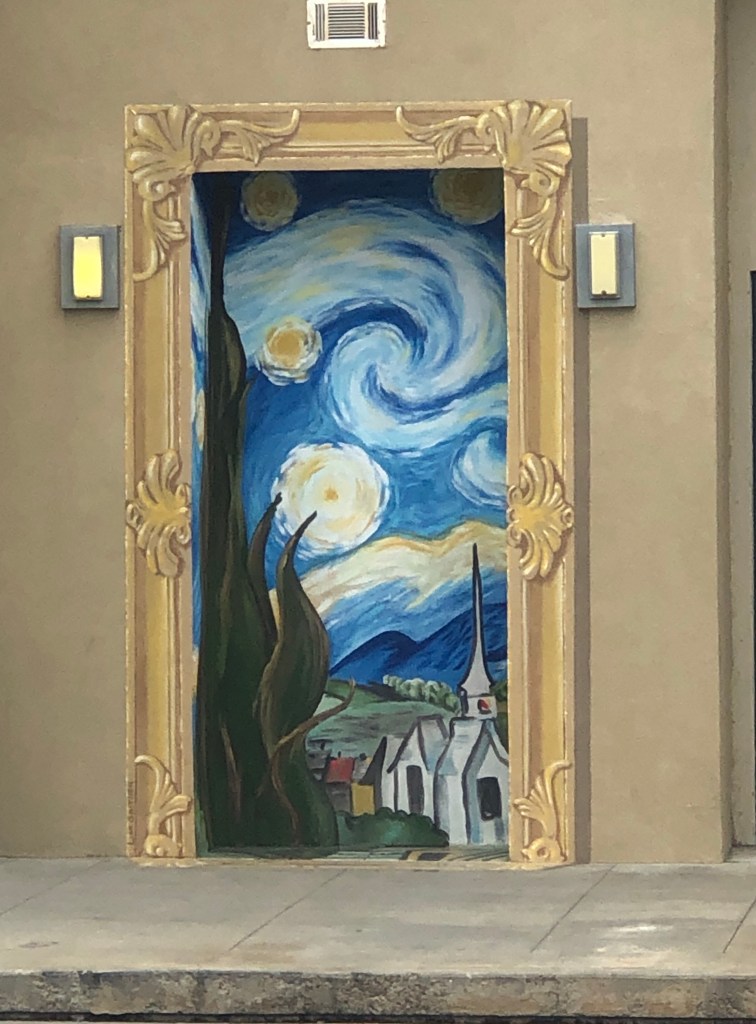
Got me thinking a lot about imagination, passages, transitions, transcendence, overcoming…and faith. See how prominent the church is. And maybe a touch of magic—who has not encountered mysterious doors leading from one world to another in fantasy novels?
The Starry Night beckoned, took me in, adopted me. It became a personal motif during the COVID pandemic. Consider these definitions of motif:
a usually recurring salient thematic element (as in the arts); especially : a dominant idea or central theme. —Merriam-Webster
a symbolic image or idea that appears frequently in a story. —literaryterms.com
My version: A “salient” (noticeable, as in you can’t miss it) symbol that keeps recurring, that has significant meaning to a narrative. Which is, in this case, my life. For I began taking note of how often van Gogh’s famous painting appeared in my daily existence, and what it could mean. Perhaps it is those deep blues, or those stars, or the peaceful village, or the presence of the church, or all of the above, that impart a sense of calm, benevolence, and well-being to me in the time of crisis. Maybe much as the artist felt when he painted it.
I have The Starry Night on a mask. A sort of literal and figurative protection. I used its imagery in a poem I wrote about awe, the word that adopted me when I turned the pages of my planner from 2020 to 2021 and found it in a quote there on January 1st. Awe and well-being are also deeply linked. When I wrote the poem I was thinking of all those blues in the painting and how blue is the rarest color in nature. Like forgiveness. Hence my closing lines: “The color of forgiveness/in the blue hour.” Those lines were born of awe just after The Starry Night resurfaced yet again in a startling way; one day I will be able to explain, but the time is not yet ripe for that story. Let us leave it at love, for love and forgiveness do not exist apart from one another.
And so we come to February.
Where this quote appears in the pages of my planner:

He just keeps turning up everywhere I go.
I marvel at those words and their truth for an artist, a student, a teacher, a writer.
Furthermore, we learn life by doing it.
One more thing…
I recently stumbled across van Gogh’s paintings of shoes. I wasn’t aware that this was a favorite subject for him. The story is that he would buy old shoes from flea markets and wear them through mud until they were interesting enough to paint.
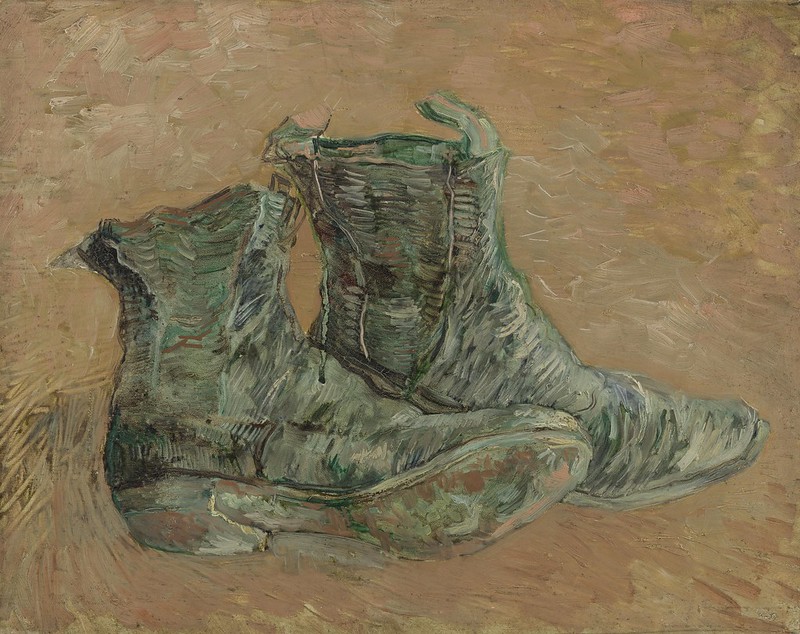
I have to wonder about the symbolism. Shoes are necessary protection in daily life. A motif with many meanings in many cultures. A fashion obsession and status symbol in some. Deep spiritual connotations in others; shoes are often mentioned in the Bible, especially removing them as an act of reverence and faith. I wonder if van Gogh thought while he painted about the places these shoes had been, the people who wore them, what their life-journeys were like. What stories the shoes might tell, maybe just metaphorically, humbly, in their layers of dust and mud from long, hard travels on this Earth.
Lots to ponder with van Gogh and his shoes.
As I travel through life in my own.
He really does keep turning up, everywhere I go.

My shoes.
I’ve found these to be the most comfortable since breaking my foot, a year ago today.
Lots more to explore there, on brokenness and healing.
How perfect is it that they are Vans. Wherever I may Gogh.
*******
written for the Tuesday Slice of Life Story Challenge with Two Writing Teachers.
Our stories often remind us of where we’ve been, where we are going, and who we are.
Writing them leads to surprising discoveries.
Sometimes those within ourselves.
Sometimes awe, at what lies beyond.

 lit bits and pieces