Dear Boy

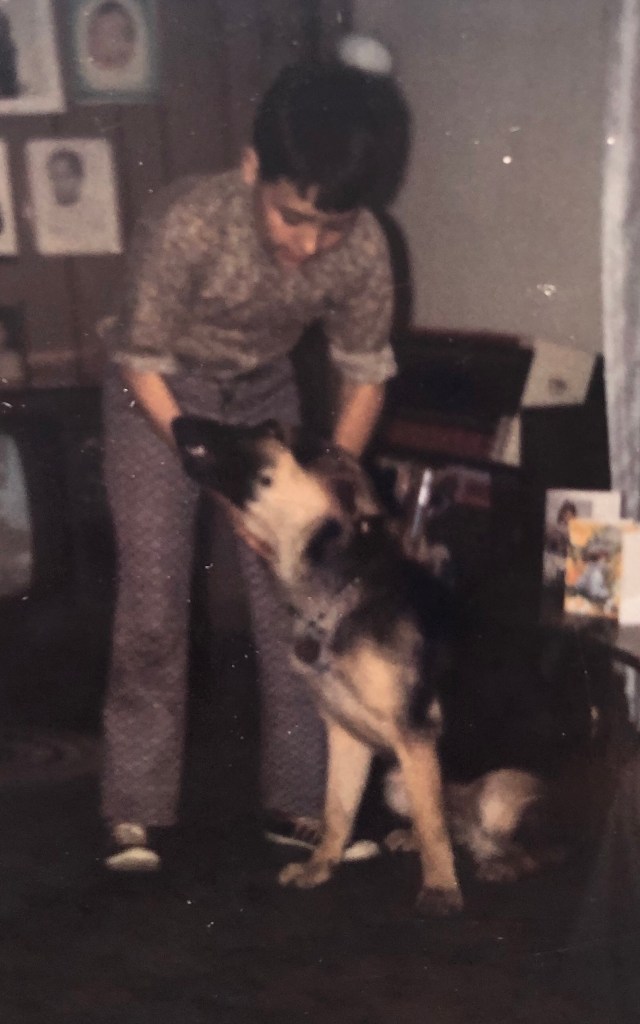
A good dog is one of life’s greatest gifts. Today’s post is dedicated to Rin, my husband’s childhood pet.

Dear Boy,

It is late. I am thinking about you sleeping upstairs. I wish I could get up there like I used to; I feel I should be near you tonight.

But I content myself with knowing that you are here and safe.

I think about the first time I saw you.

There you came with your mom and dad, looking at all my brothers and sisters at the place where we were born. As soon as I saw you, I knew: That is my Boy. That is my Boy. I ran straight to you, your arms went around me, and that was the moment we began. How excited you were to give me my name. Rin Tin Tin, you said. He was famous and you look just like him!

I was just happy because you were happy.

Do you remember taking me to classes? I do. How proud I was to learn what you wanted, to make you so pleased with me.

I’d do anything for you, my Boy. I hope you know.

I remember that bad time when I was still a very young dog and you were so sad. When your dad left for work and never came back. I knew you were hurting and afraid; that’s why I stayed so close. I gave you all the comfort I knew how, the warmth of my body, the occasional lick for reassurance. I watched you while you slept in case you woke and needed me.

You’re my everything, Boy. You always were.

Remember how you’d throw a stick for me to fetch, over and over and over, because I never got tired of it? How I miss that! I will still fetch for you, Boy, if you would only let me. That’s why I keep finding sticks and bringing them to you even though I understand you don’t want me to run. I know I am slow and yes, it hurts my old hip—but it is what we do. It is what we always did. So much fun, so much joy. If I could have fit your basketball in my mouth all those hours and days and weeks and years you were out on the backyard court, I’d have played that with you, too. But it was enough for me just to run beside you.

Perhaps tonight I will dream of those days, when we ran and ran and you got tired but I never did. I am tired now. I want you to know that whatever comes, Boy, I would do it all again. Every bit of it.

You’re my life, Boy. I love you so.

Now I lay me down to sleep. I’ll wait for you in the morning.

Goodnight, Boy.

Rin

*******

On the morning after the Boy and I got married, his mother found Rin unresponsive. He’d had a stroke. He died later that day at the vet’s office.

He was thirteen.

I’ve always believed you knew that you finished your job, Rin. You saw the Boy safely off to his adult life on the last day of your own. Thank you, Rin Tin Tin, good and faithful servant, for giving him your all.

The Boy loves you still.

Spittin’ image

Memoir is probably my favorite kind of writing.

It’s like small moments on steroids. When I write myself back into childhood, scenes, conversations, little forgotten details are pumped full of meaning, for I have the advantage of understanding so much more than I did then . . .

This event occurred when I was seven or eight. As I write, I think of how we don’t know all that children are experiencing or how they’re trying to navigate life. Families don’t make perfect portraits. There are so many reasons why.

We are our stories.

With that in mind I’ve opted to change family names here. It gives me the final shot of courage needed to share “Spittin’ Image.”

*******

We are going to visit my grandfather.

Not my Daddy’s daddy, my Sunday-afternoons-in-the park Granddaddy who bought me red rubber boots when I started school because all my kindergarten friends had them and I wanted them, too.  We are going to see my Mama’s daddy.  I don’t know him very well. He came to visit us once, sat in our living room chair with his hand stuck out so that when I ran by, not paying attention, not being careful, his cigarette burned me.

Mama says he lives in a hospital.

I don’t know why anyone would live in a hospital. I don’t want to go see him, don’t know why we have to go.

My mother gets snappy: “He’s your granddaddy—you’re going!”

My aunts are taking us because Mama doesn’t drive. She doesn’t know how.

“Last time I seen Daddy, he was looking better,” says Aunt Bobbie, who’s driving us in her maroon Ford LTD, a Marlboro sticking out from the first two fingers of her right hand on the steering wheel. I see her mouth in the rear-view mirror. There are little pucker lines around her lips. “I believe he’s eating good. Acted happy to see me, too.”

Aunt Imogene—Genie, I call her—is riding shotgun in front of me. She takes a long drag on her own cigarette. I slide over so I can see the thick white smoke pouring out of her mouth and how it all goes right up her nose, like a waterfall in reverse. It’s neat to watch. About ten minutes pass before she speaks; Genie never does anything fast.

“Waaaay-yelllll…” says Genie, stretching the word well into four or five syllables, “at least we know he’s taken care of at the Home.”

Beside me in the backseat, Mama puts a Salem Menthol in her mouth and flicks her lighter, inhales. She doesn’t do fancy stuff with her smoke. She is quiet.

She is often quiet.

The ride takes forever. Finally Aunt Bobbie says, “We’re here,” and we pull into a parking place bordered by pine trees.

Mama drops the butt to the ground and grinds it into the gravelly dirt with her sandal. This is my grandfather’s Home, I guess, but Mama told me it was a hospital, so I’m confused. When we go in there are many small rooms but no bright lights, no doctors in lab coats, no nurses wearing white dresses and little caps. There’s a lot of wood paneling. The Home makes me think of a really big cabin but the people here don’t look like campers. Some are in wheelchairs, some are standing. Some are in pajamas. Not all of them are old. They stare at us as we go by and I don’t like the feel of their eyes.

Aunt Bobbie leads the way, down a hall, around a corner. I peek in one room and see a man with long white hair lying in bed with his mouth open, but he’s not asleep.

I want to run out of here.

Genie says, “Waaaay-yelll, hey, Daddy.”

He’s sitting in an armchair in a little living room area, holding a lit cigarette in the first two fingers of his right hand. All of his fingers have yellow stains. His nails are brown and long, and the ashes on that cigarette are the longest I’ve ever seen; why don’t they fall?      

Genie hugs him. Aunt Bobbie hugs him. He says “Hey” to them in a high, raspy voice. He doesn’t have much hair. His face is long, kind of yellowish, kind of gray, with brown spots. His clothes have spots, too, except that they’re actually small holes. From dropping cigarettes. Or ashes.

Mama is hanging back but Aunt Bobbie pulls her over.

“Daddy, look who come to see you. Beverly Ann.”

“Hey Daddy,” says my mother, bending to hug him, then stepping back. “How are you doing?”

My grandfather looks at her, his daughter, my mother, and I can tell he doesn’t know her.

Next thing I know, she’s yanking on my arm.

“I brought your granddaughter to visit.” She tugs. “Come on, give your granddaddy a hug.”

I do not want to.  I don’t move. I just look at him.

Genie pokes me from behind.

“Go and see him,” say my aunts. “He’s your granddaddy.”

I already see him and he sees me. For a minute I look into his eyes—they are big, green like moss—and the emptiness there makes me think of a hole in the ground that has no bottom. Or the time Daddy was holding me when he opened the medicine cabinet and its mirror reflected into the mirror over the sink. Mirror, mirror, on the wall . . . it became a mirror, mirror, mirror hall, reflected mirrors going on and on and on, growing tinier and tinier, like a never-ending nothingness. I’m frightened of my grandfather’s eyes, frightened that he’s looking at me with them, that something about them makes me think of my mother.

Then they light up. He knows me! He holds out his hand—not the one with the cigarette, I have my eye on that one—and calls to me:

“Beverly Aaaannn…” he says, drawling like Genie does.

“No, Daddy,” says Aunt Bobbie, “this is Beverly Ann’s daughter. That,” she points to Mama, “is Beverly Ann.”

He keeps right on staring at me.

He doesn’t get it. He thinks I am my mother. When she was little.

I hug him because I have to, because the sisters, his daughters, are making me. His skin is cool and frog-like. When I pull away, he’s still looking at me.

 Am I supposed to love him? I don’t know him. And he doesn’t know me.

We don’t stay long. As soon as we’re outside, Genie bums a light off Mama, who’s shakily firing up another Salem. Genie sucks deep, does her dragon-smoke thing, nods at me.

“I’ve said it a thousand tiiiiiimes, you are your Mama’s child, that’s for sure. Spittin’ image.”

“Ain’t she though?” agrees Aunt Bobbie.

I walk beside Mama. The aunts move ahead of us. Hoping they won’t hear, I whisper: “Why did he think I’m you, Mama?”

“His mind’s not right. Never has been,” she says, taking a drag, looking off in the distance at nothing in particular. “I really wasn’t around him much. I was a little girl when he left home.”

“Why did he leave?”

She turns her eyes on me. Dark brown eyes, like mine, and for a second they have that bottomless look. She’s slow to answer but not in the way that Genie is slow to do things. She takes another long drag.

“Grannie sent him away because he tried to hurt her.”

“Were you sad?”

“No.” Then, softly: “I was scared of him.”

Aunt Bobbie cranks the maroon LTD; Genie is getting in the front passenger side. Mama looks back at the Home and I wonder what she’s thinking. As I reach for the door, I catch my reflection in the backseat window. I glimpse the pines and the cloudless blue sky behind me. Crows fly overhead, cawing loudly. Yes, I do look a lot like my Mama. Even I can see that.

I feel shaky, too. I lean in to look closely at my own eyes, hoping to God I never find them so empty.
Little girl blowing bubbles

Ever wish you could keep a small child safe and innocent forever? It’s a wish as ethereal as bubbles in the wind, drifting away like childhood itself. I took this photo last summer. It’s taken this long to figure out how to convey what I felt.

Little girl

blowing bubbles

in the sun

free of troubles

How they drift

on the breeze

turning, turning

as they please

Colors shimmer

ever bright

just a moment

in the light

Wave your wand

my temporary

iridescent

bubble fairy

All too soon

time shall pass

bubbles pop

in the grass

How I wish

things could stay

idyllic as

this summer day.

My new name

All the world’s a stage,
And all the men and women merely players;
They have their exits and their entrances;
And one man in his time plays many parts

—Shakespeare, As You Like It

Life’s transitions tend to sneak up on us.

For example, when it dawned on my oldest son that high school wouldn’t last forever and beyond it was college plus this thing called The Rest of Your Life, involving responsibility and duty, he looked at me with big brown eyes full of gloom: “I don’t want to grow up.”

Alas. It happens.

But he found his way. Last fall he simultaneously started the pastorate, married, and became the dad of a beautiful four-year-old girl. That’s a lot of transitions in one fell swoop, and he’s embracing them all. He’s thriving.

One man in his time plays many parts . . .

All of a sudden, his father and I have reached the grandparent stage of life. While it’s the loveliest transition, I can’t keep from thinking, with a pang, How did I become this old? Truth is, there’s exactly the same age difference between my grandmother and me as there is between me and my new granddaughter. It shouldn’t seem so astonishing.

The hardest transition isn’t mine, however. It’s my granddaughter’s. She loves to come over, loves to climb in my lap with a book as much as I loved climbing into my Grandma’s with one. All of this is glorious fun. No, the hard part is what to call me. She’s used to saying Miss Fran:

“Miss Fran, I’m hungry!”

“Oooo, Miss Fran, I like your nails. Can you paint mine?”

“Can we have a popcorn party and watch Frozen again, Miss Fran?”

“Let’s go outside and blow bubbles, Miss Fran!”

She likes telling everyone that I am her grandmother now. She even likes pretending to be me. My son said that after I broke my foot she went clomping around their house with one rain boot on, saying “I’m Miss Fran!” Yikes.

This transition away from Miss Fran has proved challenging. But she’s working on it.

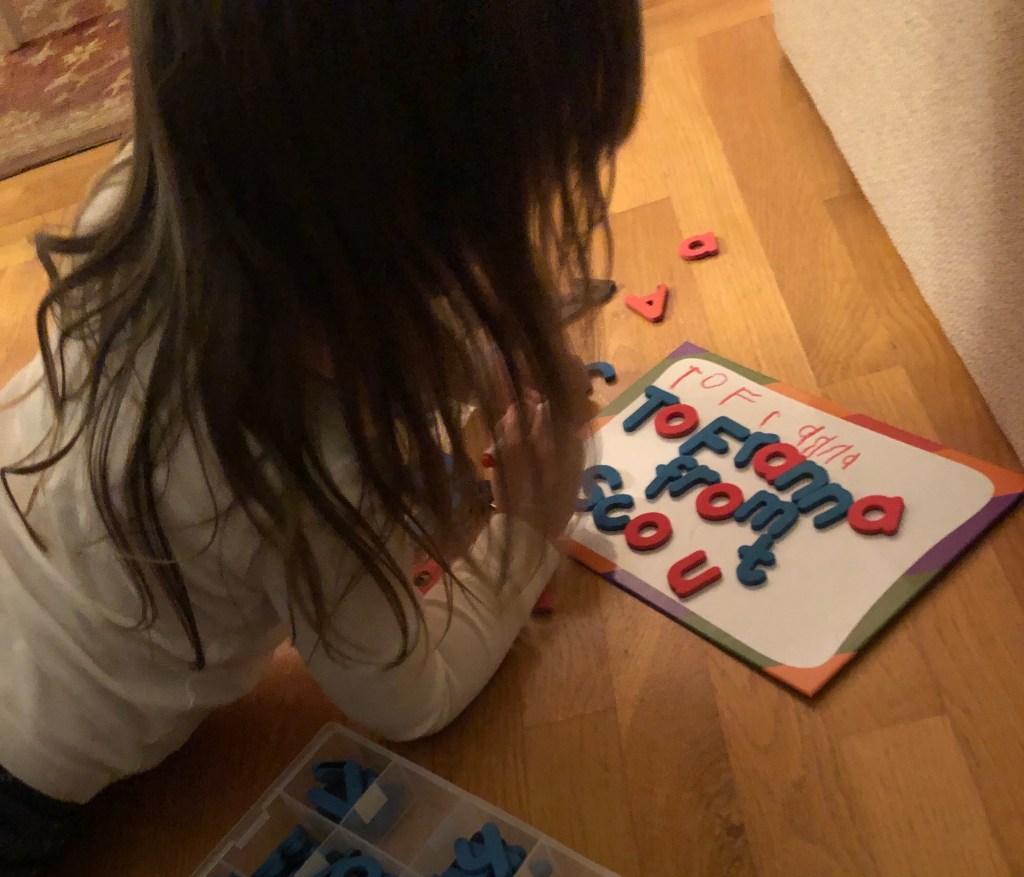
The other night she asked me to spell words for her with magnets on a whiteboard. I did, without realizing that she intended to copy them with a marker.

Here she is, writing with utmost care. A message to me.

With my new name, for the new role I get to play in her life:

Franna.

Life just gets grander.

I asked her if she wanted to spell “Franna” with one ‘n’ or two. She chose two.

Dear Writing

As a participant in the annual Slice of Life Story Challenge with Two Writing Teachers, I will be posting each day for the month of March.

What better way to start than by expressing my love for writing? Or, to be exact, by expressing my love TO writing for the profound impact it’s had on my life.

Inspired in part by Kobe Bryant’s retirement love letter, “Dear Basketball.”

*******

Dear Writing,

It occurs to me that I’ve never told you how much you mean to me.

It is time, for you mean more now than ever before.

I remember when you first materialized. I was, what, about six years old? I wonder now whether I discovered you or you discovered me, sitting there at the coffee table in the living room, wide-ruled paper in front of me and a fat pencil in my hand. All I know is that it began with story. A pull, a beckoning, a desire to get what was swirling inside me onto pages. By some great alchemy, my blocky letters, erratic spelling, rudimentary sentences ceased to be merely themselves; combined, they became something distinctly Other.

And there you were. Almost a living, breathing presence.

I didn’t know then that you’d come to stay. That as I grew, you would grow with me. That you would, in fact, grow me, always pulling me to more. To think more, explore more, discover more, strive more, play more. To be more.

Do you remember the diary Grandma gave me for Christmas when I was ten or eleven? Trimmed in pink, little girl on the front, with a brass lock and tiny key. Do you remember this entry: “I wrote a story that I hope will be published”? Whatever happened to that diary—? To that story? They’re lost in time. No matter. I can see that page in my mind to this day; is it you that keeps this memory alive?

People began to notice our relationship early on, didn’t they. Teachers who said it was a good thing, who gave tips on how we could be stronger. Friends and family who told me to stick with you: Please keep writing. I owe them all for how they shaped you and me.

Where would I have been without you in my teenage years? In the early days of my marriage? Those were the poetry years, the journal years, when you let me glimpse the beautiful inside the uncertain, when you compelled me to pour out my heart. You were bigger than my anguish, my anger, my fear. You channeled it all, absorbed it all. Ever how circuitous the path, how violent the storm, how steep the mountain, how dark the night, how deep the pain, you were there, leading me to safety, to calm. Even now, I reach for you and you are there. Like the ocean, you bring forth unexpected treasures. And healing. When my emotions and energy are spent, washed clean away, you reveal over and over one thing that always remains: Hope.

For there’s always more to the story, to the ones that I create, to the ones that I live. I think that’s one of the most important lessons you’ve taught me: This chapter of life is ending, but a new one is about to begin. Embrace it. It’s one of your most extraordinary powers. As amazing as your ability to mine my memory. With you I am any age I ever was. I sit on my grandfather’s lap once more; he walks with me, holds my hand. I hear his voice. I am in Grandma’s kitchen while steam fogs the windows, in her arms as she rocks me and sings: Jesus loves me, this I know . . . I see my father’s blue eyes, hear my mother’s laughter and the whir of her sewing machine late into the night. With you my children are still little, my husband is young, black-haired, healthy, whole, and out on the court shooting hoops. And every dog I ever loved comes bounding back to me in absolute joy, all my shortcomings forgiven.

With you, I relive it all. The parts I am proud of and the parts I’m not; the moments I cherish and the ones I survived. With you, they all become a celebration of living, of learning.

I learned long ago that I can harness your power to attack but you showed me that it doesn’t bring me peace; you taught me, instead, to defend. Not as a warrior with drawn sword but as a careful guardian of my own mind and heart. Not by destroying, but by edifying. You enable me to walk in another’s shoes and see through another’s eyes, to understand that fighting doesn’t move the hearts of others, but story does.

There’s something of the divine about you as well. Marvel of marvels, how a spark in the human brain becomes a thought and a thought becomes substance because of you. Like something from nothing. Ex nihilo. It’s how God created, speaking the world into existence. With words. Without limits. Anything is possible. Believe. To me there’s a sacredness behind the human spirit’s desperate craving to create, to express, to be heard . . .

Which brings me back to being six years old, at the table, pencil in my hand.

And you will outlive me. You are my record, what I leave behind.

Let it be the best of me.

Know that you’re an inextricable part of who I am, one of my life’s greatest gifts. Meant to be given. And so I give you away.

I am grateful beyond words.

I love you.

Fran

A poem written at age sixteen