The song

Grandma's organ

I love Granddaddy’s and Grandma’s apartment. The walls are knotty pine and the floors are made of a different wood; they shine under Grandma’s braided rugs.  There’s a booth curving around a table in one corner. It makes me think of the ice cream shop where we sometimes go for milkshakes. This booth is where Granddaddy, Grandma and I eat supper. Sometimes we have jelly doughnuts or apple turnovers for dessert; Grandma is very fond of apple turnovers and so I am I. There’s an odd, glass-less window between the bedroom and the “front room,” as Grandma calls it. I call it the living room. Grandma has curtains on this weird window and I can remember, dimly, my aunt holding me in her arms on one side as Grandma pulled the curtains apart on the other, crying “PEEK-A-BOO!” We all dissolved with laughter. A fancy ashtray with a curved handle that’s either a ram or a goat – some horned, leaping  animal – stands on a tall, thin pedestal beside my grandfather’s worn leather recliner, but no one ever smokes here.

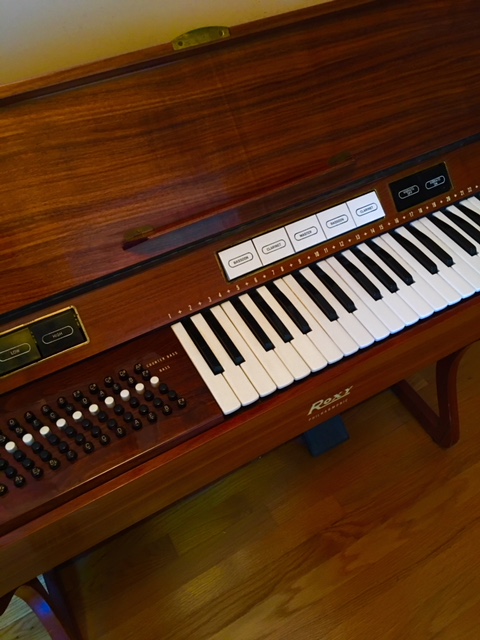
Many wonders exist in this cozy place, but one of the prettiest is Grandma’s organ.

It’s made of polished wood, with curved legs. It stands gracefully against the front room wall, under shelves of family mementos and photographs.

Grandma knows how to play it. She has a piano down home in the country, but it was too big to bring to the apartment. When Granddaddy went to work at the shipyard during the War, my grandmother had to leave her piano behind. So, he bought her this organ one Christmas. 

He knew how much she loved to play.

One afternoon she says, “I will teach you.”

I am nervous and excited at the same time – I have never touched this organ.

Grandma opens the top. She lowers the little stand that holds a book. She has a booklet of hymns and one of Christmas songs; she places the Christmas book on the stand.

“Watch and listen,” she says, her blue eyes soft and bright. “This is my favorite.”

She plays “Silent Night.”

She sings, and I know the song. I sing some of the words with her:

Sleep in heavenly peace, sleep in heavenly peace.

“Now it’s your turn,” she says.”See these numbers? That’s what you play with your right hand. These circles with letters are the chords – you play the buttons with your left hand.”

She takes my hands in her own. 

5,6,5,3 – Si – i -lent night

5,6,5,3 – ho – o -ly night

She puts my fingers on the right keys, pressing the white “C” major button until we switch – gracious! – to “G” and “F.”

I am very slow – it seems a lot to do at one time.

But Grandma guides me, and soon I have played a song.

A whole song.

“Now try it on your own,” she says.

I labor. My keys and my chords are not exactly in sync, but I play. I am playing the song by myself!

Grandma sings behind me. Her voice carries me on.

She hugs me when I finish; I smell her Avon Cachet cream, light and clean.

Her eyes glisten with tears, but she’s smiling.

It was the first of many lessons I’d learn from my grandmother. In those days before I started school, I thought the white major buttons sounded like a wedding; all the minor and diminished buttons sounded like something in haunted houses.

Pretty much the theme music of life – celebrations and dark, mysterious moments. Sometimes I would play the buttons by themselves, listening to the happiness and strangeness of the chords.

I made my own stories out of these sounds.

I realized, decades later, the legacy my grandmother left me: There was always a song of hope and faith in the heart to carry me through the darkest times. That being a wife and mother often meant sacrifice. She was the quintessential teacher, without being formally trained – my foray into the music she loved followed the perfect I do, we do, you do pattern.  She guided my fingers on the keys, my feet on the path, my heart on the things that matter most.

Above all, she believed in me.

There’s no greater gift to a child.

When I was in the sixth grade, I was invited to attend a summer program for gifted students in writing, drama, and photography.

My father couldn’t afford the fee.

Grandma paid it. “Children need to have a chance to do things that matter to them,” she said, with a startling ferocity.

Much later I learned that she wanted to take piano lessons when she was in her early teens and that her family couldn’t afford them during the Depression. A young minister’s wife, however, taught my grandmother how to play.

In everything I do, she’s still there behind me, singing, urging me on, never far away. She is gone, yet she isn’t; her song sings in my soul, in time with the beating of my heart. I am who I am because of her.

Today my youngest son – a college student and music minister – plays her piano and sings the old songs. Her organ stands in my foyer – the first thing that people see when they come to my home.

Her legacy lives, from generation to generation.

I often think how thrilled she’d be to hear my boy’s beautiful playing and singing. “Oh, how my Grandma would love to hear this,” I tell him.

Even as I say the words, I know she knows.
Anchored

Seahorse

Seahorse. Brandon LeonCC BY-SA

The seahorse was the motif of my summer.

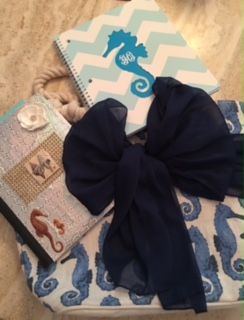
He turned up everywhere – on my new beach bags, on a bracelet from a friend, on a spiral notebook given to me, in a pile of decorations for writing journals at a summer institute.

Seahorses galore.

This sudden proliferation was odd, too odd to be random. Loving symbolism, interpretation, and looking things up in general, I researched seahorses, curious about what mysterious meaning or significant message they portend for my life at the moment.

I already knew, of course, that the males bear the young, which is the reason I am mostly using the pronoun he, in honor of the seahorse dads.  I really couldn’t make much of a connection to this appealing characteristic, however. I am the only female in a household of males (including three dogs and two guinea pigs), none of whom are about to become a gestational vehicle.

In the metaphorical realm, seahorses apparently represent a great number of things: patience, persistence, inventiveness, creativity, whimsy – all enchanting. I celebrate and welcome all of these things.

I learned that the scientific name for the seahorse, hippocampus, is the same word for the part of the human brain thought to be the center of emotion and memory.

Speaking as a writer – utterly fascinating.

Seahorses can also symbolize stubbornness (my father’s word was “hardheaded”). Speaking as a human – ouch. Ahem.  I prefer to call it “determination” or “perseverance,” but we’ll keep moving along here.

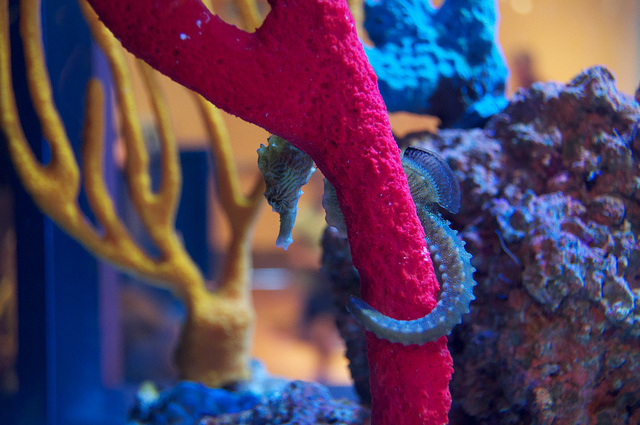
The thing that strikes me most about the seahorse is that it’s a poor swimmer – one species being the slowest-recorded swimmer in the animal kingdom – and that its tail is invaluable to its survival. National Geographic puts it this way: Seahorses are rather inept swimmers and can easily die of exhaustion when caught in storm-roiled seas . . . they anchor themselves with their prehensile tails to sea grasses and corals.

Ah. A ray of light shines here in the murky depths of symbolism.

The seahorse began appearing, and appeared most often, in things connected with my work as an educator – on a tote bag with a book order, on my notebook and journal.

Education today – might that be the storm-roiled sea, full of conflicting ideologies and solutions that sometimes beget more problems, just for starters? It’s not that educators are inept (“poor swimmers”) but that the ever-changing currents in our ecosystem are vast and powerful, so to shrink one’s spirit and drain one’s energy just trying to keep up, to stay afloat.

Seahorses can die of exhaustion if they aren’t anchored.

I think about how often the word anchor appears in the educational realm – anchor text, anchor standard – signifying the foundation of something upon which other things will be built, or that subsequent learning will connect back to.

But I don’t think that’s why the little seahorse loomed so large of late. In my mind I see him, small and shadowy against a backdrop of coral and waving sea grass, anchored by his tail, swaying peacefully despite the surging sea. I think of teachers and the demands they face. I think of students, who, above all, are too easily caught in a virtual riptide.

What’s the anchor here?

We are.

We anchor one another. Teacher to teacher. Whatever’s raging around us, we support each other, we help each other along. Ultimately, we form the solid thing, the reef, where students can anchor themselves, where their best interests are tantamount to our own, where they are sheltered, nurtured, and given outlets for inventiveness, creativity, whimsy, even in the most uncertain, troublous times.

Hang on, hang together, and believe.

Says the seahorse not just to the educational world – but to humanity.

Seahorse motif

Of candy, ice, & equity

Candy throwing

The throwing candy tradition. Lars PloughmannCC BY-SA

And then the whining schoolboy, with his satchel

And shining morning face, creeping like snail

Unwillingly to school.

-Shakespeare, As You Like It

Reading these lines for the first time as a college student, I smiled in recognition of Shakespeare’s schoolboy. In less than twenty words, The Bard encapsulated the drudgery of the school experience and the subsequent aversion of countless children since the dawn of education itself. I thought of my young self’s occasional feigned stomachaches and the heaviness of my own feet on the pavement en route to school. I doubt I had a “shining morning face” – especially since my mother sometimes grabbed a used dishcloth to wipe it while I recoiled from the sourness.

As an educator living over four centuries after Shakespeare nailed this image, I sigh. Two thoughts weigh in my mind: Why school is still drudgery for so many, and how the rich get richer.

In Shakespeare’s time, of course, only the boys of wealthy families went to school; girls in these families were tutored at home. If parents had money, their kids got the education, the wealth of knowledge, to be the next leaders and shapers of society. While all children in America today have access to education, they aren’t all at the same place when they begin school. We know this. I heard it said best at at a district Title I meeting years ago by the keynote speaker, an esteemed professor from a nearby university: “The problem is systemic. Systems are designed as if all children are standing on the same starting line” – he showed a slide bearing a line with little dots along it, even a few ahead of it – “when the truth is that many are starting from far behind.” He clicked, and little dots appeared at varying distances below the “starting line.” Many alarmingly below.

I looked at those dots below that line. I knew some of those children, how terribly much ground they had to cover just to be at the beginning place, while their classmates surged onward, clearing bars being raised ever higher. I knew the truth of the professor’s words. I nodded as he went on to challenge curriculum and practices, admiring his boldness. Although he didn’t name it, he was essentially pointing out the Matthew Effect in reading – those who had already acquired foundational literacy skills versus those who hadn’t, that “the rich get richer, the poor get poorer.” Thereby hangs the achievement gap, that bane of many a teacher’s, school’s, and district’s existence.

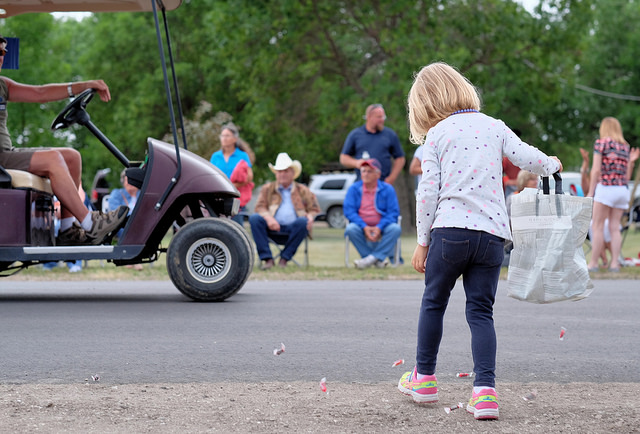
It’s like a homecoming parade. Everyone turns out to cheer for the football team as the marching band sets the pace, followed by fire trucks blaring loud enough to wake the dead (side note – recall that chilling scene in Mr. Holland’s Opus?).  At my sons’ high school parades, I stood, hands shielding my ears, as people on the floats tossed handfuls of candy to the children lining the roadside. I watched the children who were closest, the ones who were strongest or most agile, scramble out to grab the candy as it fell. The ones farther back couldn’t get there in time. Over and over the scene repeated, unless a parent or a larger sibling got out there with the kids who couldn’t reach the candy. 

The parade rolls on, the beat keeps going, there are smiles and celebrations all around, but all things are not really equitable.

The chidren creep unwillingly to school often because access to the learning is not designed for them, in the ways that they learn, but for their stronger, more agile classmates. Or because it’s boring. Or because the teacher, with a sense of desperation borne of increasing expectations and evaluations, is tossing the lessons, the standards, in a catch-as-catch-can attempt. Some kids get it, some don’t. What about the child who’s already had plenty of this “candy” and is ready for something more? 

Drudgery, indeed – for everyone. To the point that teachers might creep unwillingly to school. Or leave the profession.

In recalling the professor’s words about “systemic issues”: Systemic change is slow. Glacial, I once heard it described, implying millimeters at a time. Agonizingly slow. But the truth is that glaciers actually flow – they mold themselves to the land and even shape the land, reforming it, as they go. 

Where does the momentum begin?

On the first day of my college math education course, the instructor eyed me carefully.

“You look scared to be here,” she observed.

“Math’s never been my thing,” I replied, with an attempted smile. Deep in my memory lay the words of my geometry teacher, who had attended the high school play in which I performed a lively comic relief role: I didn’t think you had it in you. My performance in her class had been poor; I couldn’t “catch the candy” and eventually transferred out before I flunked it.

My instructor pursed her lips. I swear I saw a twinkle in her eye.

She ended up pulling me into a group to present on the course and the college at a local event – we had shirts made with the words “Cutie Pi.”

The teacher – to this day, one of my favorites – turned my dread of the content into an experience, into something unexpectedly fun. She acknowledged and eliminated my barriers. Met me where I was and propelled me forward. 

One of her greatest statements: “The parents of the kids you’ll teach are not hiding their best kids at home. They’re sending you the best that they have.”

They don’t all start at the same place, nor will they all achieve at the same rate, but they can and will achieve. Systems compare students to one another; teachers must see each child’s strengths and weaknesses. Systems do not move children; teachers do.  Teachers, not the curriculum, are the architects and engineers of student learning, creatively building bridges between the child and the standards, finding the entry points and scaffolding.  Bit by precious bit, the ponderous glacier keeps moving because teachers are the gravity, the one absolute, magnetic force, whenever they make the sweet stuff – the love of learning, the desire for it – the real goal, with every child getting a true taste of it. 


Cactus malpractice

Cactus

Kelly’s cactus. GinnyCC BY-SA

I want a puppy, but his answer is always “NO.”

Tweety, my yellow parakeet, has died after six years of squawking, escaping his cage, and flinging seed hulls everywhere.

“No more birds, either,” says my father, in a tone that I dare not challenge.

I am bereft. I want something to take care of. Some small living thing that belongs to me.

I’m getting too old to catch caterpillars (the forest tent caterpillars, to be exact, which have amazing, detailed patterns with brilliant blue stripes and are not very hairy) and keep them in used margarine containers until they turn into little brown moths. Far too old to catch toads after school and bring them home in my metal Charlie Brown lunch box, which I was quickly forbidden to do.

I sigh. 

On a trip to Woolco, something catches my eye. It’s enchantingly tiny and it won’t make a mess or escape in the house.

So I ask: “Daddy, can I have a cactus?”

He looks at me oddly, as if he’s trying to decide whether or not I am being a smart aleck.

“Sure,” he says. 

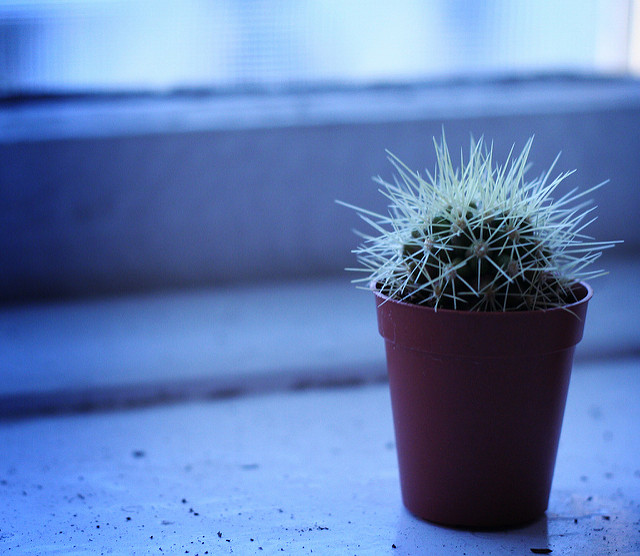
The cactus costs 89 cents, the same as a 45 rpm record. It’s spherical, about the circumference of a quarter, about the height of a quarter standing on its edge. 

“Isn’t it the cutest thing?” I ask my Dad.

He raises his eyebrows. “Well, it’s certainly easy to take care of.”

For a couple of week, the cactus sits on my dresser, until I start worrying that it’s not growing. I know cacti don’t need a lot of water – maybe it needs more light, more heat. Cacti grow in the desert, after all.

Hmmm. How can I help it?

I know! The mirror in the bathroom is in a large frame. I can climb on the sink and put the cactus on the top of it, right up there under the light. 

Sure enough, it fits perfectly, just inches away from the bulb.

After a few days, I climb up and check on my cactus. It’s grown taller! I give it a few drops of water and return it to its makeshift sun.

And then I forget about it for weeks.

When I finally remembered the cactus and scrambled back on top of the sink to retrieve it, I found only a little brown crisp in the tiny pot.

Burnt slam up, as my grandfather might say.

I stood there gazing at the destruction in my hands, feeling a pang of horror mixed with shame – Am I the only person, ever, to kill a cactus? 

I meant well. I wanted the cactus to grow, to thrive, to have what it needed.

I just failed to check on it more than once to see if my plan worked, or to determine if it was even a good plan in the first place.

And the cactus couldn’t say Hey, this is too much light and heat, not enough water – I do still need that, you know. 

It just quietly withered away.

The word that comes to mind is mindfulness.

A mighty and crucial thing, indeed.

***

Note: There were hermit crabs and, yes, puppies in my near future. 

They fared far better.

Committing assumicide

Through the window

Through the window sepia. Jo NaylorCC BY

Your assumptions are your windows on the world. Scrub them off every once in a while, or the light won’t come in.
Isaac Asimov

This quote brings a little girl to mind.

She shows up in my classroom early for her reading intervention group. I am hunkered over my laptop fighting with a SMART Board activity I’ve created on word families.

“Hello,” I say, without looking up, frowning at my screen and the uncooperative technology. “Come have a seat. The others will be here in a few minutes.”

She sits right next to me, a small warmth at my elbow. “What are you doing?”

I sigh. “Trying to fix this activity for your group to play – it will be fun. Something’s not right, though. I’m trying to figure it out.”

She watches while I attempt to cut a word from one side to paste on the other. Unsuccessfully.

Even as I fight the program, I wonder what she is thinking.

She struggles terribly in all academic areas, an ESL student with processing issues beyond the language barrier. She is soon to be tested for disabilities.

“What is that line in the middle?” she asks.

“It’s a dual screen – two screens instead of one.”

“Oh. You are trying to move this word to here?” She points from one side of the screen to the other.

“Yes. I don’t know what I’m doing wrong,” I say in exasperation. I glance at the clock – I should have caught this problem sooner! “I’m going to have to quit now – I’m out of time. Your group will have to do something else instead.”

Without removing her eyes from the laptop, my student reaches over, clicks on the obstinate word, then drags and drops it on the other side.

“There,” she says, matter-of-factly.

I stare at her. “How did you know that? Have you seen a SMART Notebook before?”

She shrugs, laughing at my expression. “No. Just a try.”

The group was able to play the interactive word game. That day my little girl was a much more willing participant, with considerably more confidence.

The outcome could have been quite different. In my frustration, it would have been easy to answer her questions with Oh, never mind. It’s too hard. I could have thought, There’s not much need of my explaining. You won’t understand.

Had I done so, I would never have known that she had this ability, that she could “see” what to do with the new software when I couldn’t.

I would have committed assumicide.

It happens every day.

Teachers assume that students who struggle in academic areas struggle in all things – and thereby limit the students further. Although the thought may never be verbalized, it lurks in the mind: They can’t do that . . . so surely they can’t do this . . . .

A friend of my family was born with cerebral palsy. His father was an avid golfer who decided early on that he would treat his son as if he didn’t have the disability. As soon as the boy was big enough, his father started teaching him the game.

I have often wondered how many eyebrows were raised at the time: What is that man doing? His child can barely walk or dress himself – why in the world would he teach him something requiring as much precision as golf? That boy will never be able to hit the ball! I wondered if some people may have been angry over the injustice.

If so, they eventually learned that they’d committed egregious assumicide.

The boy grew up living and breathing golf. He remains a local expert on the game with a room full of trophies won in multiple tournaments, long after his father had passed away.

Yes, that’s right – a room full of trophies in a precise game like golf, when the two halves of his body don’t work together for him to climb stairs and his hands shake when holding a cup so that it can only be partially filled, lest he spill the contents.

When I needed a fast P.E. credit one summer to complete my teaching degree, the only thing available, to my great chagrin, was golf – and this extraordinary man coached me through it. I have page after page of his painstakingly handwritten notes and drawings on “the fundamentals of golf.”

When I was growing up, my parents had the In the Wind album with Peter, Paul and Mary singing Bob Dylan’s “Blowin’ in the Wind.” As a child, I loved the three-part harmony and haunting lyrics:

How many times can a man turn his head

And pretend that he just doesn’t see? 

Maybe it’s not always a matter of not seeing, but seeing wrongly – seeing the deficits, not the potential.

For the teacher, what isn’t working too often overshadows what might. Sometimes we see but don’t act because we don’t know what to do, or because we believe our efforts won’t matter. We assume we are defeated before we begin. Sometimes our focus just isn’t where it needs to be when worry, exhaustion, fear, discomfort, directives, even the need for self-preservation and validation, occlude our vision. Sometimes it’s hard, in the throes of teaching – and of living – to stop and breathe, to listen, to see, to let go when we’re so focused on whatever it is we are trying to make happen. Accordingly, we close more doors than we open – for ourselves as well as for others.

We assume, and something dies.

I decided at the end of eleventh grade that I wanted to go to college. Higher education wasn’t talked about at my home, wasn’t encouraged. The general expectation is that I would keep taking courses like business typing (which I bombed, miserably) to become a secretary.

I needed to take several college prep courses in twelfth grade even to apply for college, and the college prep English teacher wouldn’t let me in his class.

He had the reputation for being the hardest teacher in the school. He reluctantly met with me, frowning over my transcripts. “You haven’t taken the prerequisites for this class or demonstrated that you can handle this caliber of work,” he commented, handing the transcripts back.

“Y-yes, sir, I know,” I answered, trembling. “I hadn’t planned to go to college until now.”

He eyed me over the rim of his glasses. Piercing blue, absolutely no-nonsense eyes.

“Tell me why I should let you into my class.”

“I’ll work hard. I can do it,” I said.

He sort of snorted. “A lot of students before you thought they could do it, too, and transferred out of my class, even when they had prepared for it.”

“Please.” It was all I knew to say.

He shook his head. “I am doing this against my better judgment,” he grumbled, and signed my special permission form.

That year I encountered the great poets, studied sonnets, wrote so much about the spider in Robert Frost’s “Design” that my teacher noted at the end of my interpretation: Exhaustive analysis! I memorized and recited – in Middle English – the first thirty-four lines of Chaucer’s Prologue to the Canterbury Tales. I hung on my teacher’s every word about London during the time of the Black Death; his descriptions were so vivid that the images remain clear in my mind to this day. For my final paper I wrote about the function of King Claudius in Hamlet – and when our teacher announced that four students tied for the highest score on the paper, I was one of the four.

He returned my paper on the last day with this comment: “For someone who had to have a special conference to get in this class, you have done remarkably well. You have surpassed expectations.”

All of which leads me to believe that the First Commandment of teaching should be Thou shalt not commit assumicide.

Perhaps it may even need to be the First Commandment of humanity.

slice-of-life_individual

O. Henry

O. Henry grave 

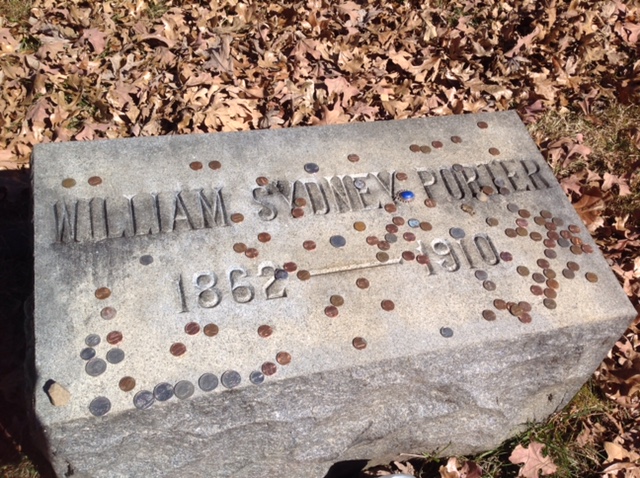
Fall comes early in Asheville, North Carolina. The air is chilly when I get out of the car at the cemetery to visit the grave. I think of winter coming, of Christmas, of this writer’s most famous work. I take a picture, marveling at the coins spread over the gravestone. As I turn to go, a frigid wind gusts, scuttling leaves over the ground and across the driveway.

Leaves . . . I remember that story.

O. Henry’s headstone is covered in coins, mostly pennies, which usually add up to $1.87 –  the amount of money that Jim and Della had at Christmastime in his famous short story, “The Gift of the Magi.” This shortage of money is why Jim sold his gold pocket watch to buy combs for Della’s beautiful hair, and why Della cut and sold her hair to buy a platinum fob chain for Jim’s prized watch. Their sacrificial love for one another has made the story an enduring classic.

There is another story of O. Henry’s that I love almost as well.

I remembered it as I planned to write “Oh, Henry,” yesterday’s post about my son’s dog. I should write about O. Henry next, I smiled to myself. A little word play with the titles. How enticing.

That’s when I thought about the fallen leaves blowing over the writer’s grave.

I scrounged up my old paperback copy of O. Henry’s short stories and reread “The Last Leaf.”

In this tale, two young artists live in a three-story Greenwich Village building. One of them becomes sick with pneumonia. She watches the leaves dropping from an ivy vine against the wall just outside of her window, convinced that she will die when the last leaf falls. To her astonishment, the last leaf hangs on through high wind and rain. To make a short story shorter, the leaf remains because an old artist in the building crawled up a ladder in the dark of a raw November night and painted it on the wall with the vine. The girl begins to recover and the old man, Behrman, dies of the pneumonia he catches from being out in the weather while painting that night.

The old artist had always wanted to paint a masterpiece and never pulled it off – but the last lines of the story have the roommate telling the recovering girl about the leaf: “Didn’t you wonder why it never fluttered when the wind blew? Ah, darling, it’s Berhman’s masterpiece – he painted it there the night the last leaf fell.”

Self-sacrificial love at work again – but there’s more to it.

That leaf symbolized hope, sparking the desire to strive, to overcome. The old artist’s small gesture inspired the young artist to keep living.

This leaves me thinking, in the course of our days as teachers, as writers: Are we not the artists who paint the pictures of possibility, of hope, in the minds of others? Do we spark in others a desire to strive, to reach for what’s beyond their grasp, or to hang on only long enough until this, too, shall pass?

Our masterpieces may never be world-famous; they may be as simple as knowing the right word, the right idea, the right vision, the right story, and sharing it when it is most needed. Inspiration leaps from one heart to another, creating something to hang onto, outlasting high winds and rain. We may never see the full effect of our work, but that’s all right.

We paint the leaves where we can.

I close my old paperback book.

O. Henry, I am so thankful you were here.


slice-of-life_individualEarly Morning Slicer


The coaching tree

Coaching Tree Lg

Early in the school year, my instructional coaching colleagues and I attended district training where participants were tasked with creating an image to explain the coaching process.

My group thought for a moment.

“You know, coaching is an organic thing,” I said. “Or at least it should be. We all know it takes time to develop relationships and trust. It’s about honing practices, sure, but this is a growth process for us as well as for our teachers. We grow together to reach goals.”

A colleague said, “Yes! I’m seeing a tree, branching out . . . .”

In a few minutes we’d sketched the tree. We began to label it, recognizing coaching elements that correlated to parts of the tree. The more we worked, the faster the ideas came.

Relationships are key in coaching, the foundation, but certain things must feed the relationships before the process can begin. These roots are trust, the human connection, listening, collegiality, safety, empathy, and support. Coaches must meet teachers where they are and be willing to plug in with what teachers want to accomplish – it’s not as much about seeing the work as it is seeing a fellow human being. The vision develops from there, and needs to be a shared one.

The trunk of the tree symbolizes this togetherness with inspiration from Shel Silverstein’s The Giving Tree. Near the bottom of our tree, we placed a little heart: Coach + You. The heart of coaching is just that – having a heart for each other.

A solid, thriving coaching relationship branches out into nearly endless possibilities, aspirations, and directions, such as goals, the 4 Cs (communication, creativity, critical thinking, collaboration), encouragement, self-modifying learners, reflection, growth mindset and learner agency.

My coaching colleagues and I stood looking at our work, feeling pretty happy with our Coaching Tree.

“We need to put the sun in,” said a colleague. “The sun is the climate, of course – a warm climate conducive to coaching is necessary for the process to work. That’s where administration comes in.”

We put the sun in.

At this point, something struck me – “Trees bear fruit! What is the ultimate goal of coaching, the payoff? What’s the fruit of our labor?”

We created a basket then, and labeled it The fruit of our combined efforts. It holds apples: Love of learning, data, increased student achievement, teacher fulfillment, students graduating college or career ready. 

As teachers are fulfilled and productive, we desire to branch out into new areas. The growth continues. As students achieve, as they go on with their lives, some will go into the teaching field and the cycle begins anew.

At the close of the training, small groups presented their work to the whole assembly of coaches. The other groups had designed diagrams, cycles, or flow charts, all of which artistically, appropriately encapsulated the continuous reflective coaching cycle of support.

My group was the only one to present the coaching process as a living thing, something organic.

We were startled by the enthusiastic applause from our fellow coaches.

Upon returning to school, my colleagues and I recreated the Coaching Tree in the teachers’ lounge. It stands there to encourage, invite, celebrate, and maybe inspire or spark hope when we all need it, a visual reminder that our work is not in vain, that we’re in this together, to help each other along, and the sky is the limit.

slice-of-life_individualEarly Morning Slicer

Six-word memoir

Words pour in

“What do you love best? How can you use the things you love to represent you, to describe who you are, in just six words?”

I pause to let the fifth graders think.

“One thing that I love,” I continue, “is the sound of cicadas. Have you heard that sound?”

Hands shoot up. I nod to a girl who replies: “Those bugs that buzz really loud.”

“Yes. Every spring I look forward to hearing the cicadas again – they will buzz all summer long. They remind me of summers spent with my grandparents. The sound was deafening in the thick woods around their home. Hearing cicadas now makes me feel happy and safe, no matter what else is going on. It’s one of the things I love best. So I might try to write my six-word memoir about the sound of cicadas.”

With pencil on paper, using the document camera, I write:

Nature sings to me. I listen.

I see heads nodding.

“I might keep working these six words to see if I can make them represent me better. I might decide to work on another idea. Today you will make a list of things that you love – maybe things you love to do, or favorite objects, or even dreams you have of things you want to do or be – and think about how each thing represents you. Then we will work on capturing and hammering out those descriptions in just six words.”

Off they go around the room, to brainstorm.

I brainstorm, too. What else can I write? What’s another example I can give them?

Well, as far back as I can remember, I loved reading and writing – it’s who I am. It’s what I do. It’s why I’m in this very room this very minute, teaching it.

I think about it all night, and am ready for the next lesson.

“So, ladies and gentlemen, yesterday we brainstormed ideas for writing our six-word memoirs. We thought of things we love and how they might represent us. I thought of something else to represent me. Let me ask you: What do you think represents me? Think about what I do and what you know about me.”

A boy waves his hand: “I know! Harry Potter!”

The class giggles and a few say, “Yessss!”

I laugh. “Excellent. But think bigger than Harry Potter, if possible! Think about who I am and what I do.”

A quiet girl’s hand sneaks up. “You teach reading and writing.”

“There you go. I’ve loved reading and writing all my life. I think this idea might be a great choice for a six-word memoir. It really describes who I am. I have to think now about how to capture this idea in six words.”

With pencil, paper, and the document camera, I write:

I read, I write, I am.

Heads nod – and an image materializes in my mind just then.

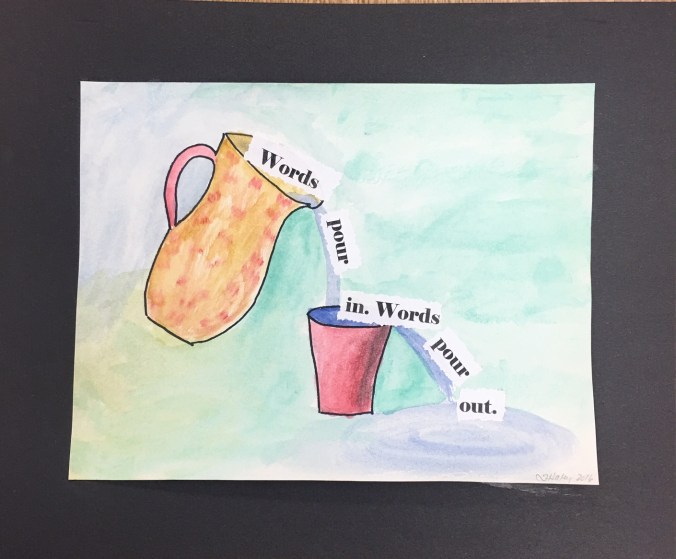
A pitcher, a glass, water pouring . . . .

“I just got an idea of how to make this better!”

I write:

Words pour in. Words pour out.

The children study these words.

“What do you think this means, ladies and gentlemen?”

A boy says, “First you wrote I read, I write, I am and you said you could make it better so I think you mean that if words pour in, you’re reading, and if words pour out, you’re writing.”

Across the room, faces light up.

I smile. “Well done. For a few minutes, share your ideas with your partner and talk about possible ways to begin writing your six-word memoir. Then we’ll all write.”

I listen as the ideas flow in and out, with a hum as vibrant as that of cicadas.

(If you’re interested in reading an earlier Slice on the sound of cicadas: Cicada rhythm)

slice-of-life_individualEarly Morning Slicer

But I’m not a teacher

Encourage

He’d saved his own money to buy me a Christmas present. He told his dad he wanted to go to the bookstore, so his dad took him.

He bought me a picture instead of a book and watched with great pride as the clerk wrapped it.

“I got it for my mom,” he told the clerk.

“Oh, she’ll love it!”

He clasped it to his heart all the way home.

He burst into the house, calling, “Mom! Mom! I got you a present!”

His dad said, “Son, just put it under the tree. It’s for Christmas.”

“I want to give it to her now!”

“All right,” I said,  sitting down on the couch. My little boy scrambled up beside me. “I’ll go ahead and open it, if that’s what you want.”

He watched my every move as I unwrapped the paper and pulled out the matted picture bearing the quote: A teacher in wisdom and kindness helps children learn to do exactly what they thought could not be done.

I didn’t know what to say for a moment.

“It’s beautiful, honey,” I said, hugging him. “Thank you so much.”

“Do you love it, Mom?”

“I do … but I’m not a teacher.”

My son surveyed me with huge dark eyes that seemed far older than his six years: “Oh yes you are, Mom.”

At the time, I wasn’t even a college graduate. Teaching wasn’t on my radar. Thirteen years, a degree, and another baby later, I actually became a teacher. In all of those education courses that required me to describe my educational philosophy, I wrote: A teacher is an encourager, recalling that solemn little face, those big eyes, the absolute conviction shining in them. Children, sometimes, are the greatest of sages, the most profound of prophets.

Three more years, and the boy graduated college himself with a degree in history. “What am I going to do for a job?” he asked one afternoon, a slight hint of anxiety in his voice.

“Teach,” I answered, smiling.

He didn’t smile back. “But I’m not a teacher.”

“Oh yes you are, Son.”

Before the summer ended, he had a job teaching social studies at his old high school. When he went to set up his classroom, he cleaned out the cabinets and found old tests – including his own.

He also became a soccer coach, taking his team to the championships and winning regional Coach of the Year this past season.

We didn’t seek teaching; it found us. We’ve done exactly what we thought could not be done – we do it every day, all over again.

And every day is new, if not easy; every day offers wisdom, beckons kindness, invites us to believe in others, in ourselves, every moment a chance to create, to reinvent, to overcome. It can be done.

Encourage one another.

slice-of-life_individualEarly Morning Slicer


Lighting the way

Lumos

Yesterday a fifth-grader caught me in the hallway:

“Mrs. Haley, do you have a copy of Harry Potter and the Chamber of Secrets in your room?”

 “I have two copies. Ask your teacher if you can walk with me to get one.”

He did. As we walked, I said, “The Chamber of Secrets is a great book. I enjoyed it more than The Sorcerer’s Stone.”

“Yeah, I haven’t read Chamber of Secrets. I saw the movie and my favorite part is when Harry gets the cloak of invisibility and finds that mirror where he sees his family.”

“Ah, the Mirror of Erised … I just read that aloud to two classes at another school last week while they were studying fantasy.”

In that chapter, Harry receives the cloak of invisibility at Christmas with an anonymous note explaining that it had belonged to his father; he is admonished to “use it well.” He sneaks around Hogwarts, hidden by the cloak, and ends up in a remote, off-limits part of the building in what appears to be a storage room. He finds a large, ornate mirror. Erised backwards is desire – looking in the Mirror of Erised shows a person the deepest desires of his or her heart. Harry’s family is dead; he desperately wishes he could have known them. He is transfixed by their images in the mirror – they wave at him, and his mother wipes away her tears as she smiles at Harry.

I think, as I rummage through my basket of Potter books, Fascinating how it’s the humanity that draws us, more than the magic. 

“Here you, go,” I say to the student. “The Chamber of Secrets.”

His face lights up when I place it in his hands. “Thanks, Mrs. Haley!”

“Read it well,” I call after him, as he walks away, flipping pages.

I look around my room, my own chamber decorated with Potter memorabilia that draws children from across grade levels. They love to drop by to show me their owl collections, to ask if I’ve read The Cursed Child, to share anything Harry Potter that they’ve recently acquired. The Harry Potter club meets here twice a month, students from third through fifth grades, and we talk so much more about what motivates the characters than the magic they employ.

My Lumos glass box gleams in the corner by the doorway. I think of all the times that teachers might wish we had magic wands to show us everything the kids need, to fix all that needs fixing. I recall J.K. Rowling’s quote from her 2008 Harvard speech, now connected to her Lumos charity on behalf of children:

“We do not need magic to transform the world. We carry all the power we need inside ourselves already.”

It’s apparent whenever I read with the kids, whenever the Potter club meets and someone has an epiphany about a character, whenever I walk into a classroom to write with students and teachers. The essence of teaching, of reading, of writing more than anything else, is the connection of human minds and hearts. It’s all part of same story, the triumph of the human spirit. Teach it, read it, write it well – tap into all you’ve known, all you’ve loved, all you’re wrestling with, and watch their faces.

It’s all inside you. Light the way.

slice-of-life_individualEarly Morning Slicer