Finding a safe harbor poem

National Poetry Month continues, and while I have been writing a poem each day in April, I have not posted them all here on the blog.

Today I return to post about “safe harbors.”

Yesterday for VerseLove at Ethical ELA, poet Padma Venkatraman offered this prompt along with her own beautiful work as an example: “Think about a place that feels like a safe harbor to you – and bring that space alive in a poem.”

Ah. I knew exactly what to write about…

Haven

I should convert
one of the boys’
old bedrooms
to a study
where I can write
with fewer
interruptions

but here
at the kitchen table
is my place

here
there are windows
all around

I open the blinds
while it is yet dark

inviting the light
before its return

bringing with it, birds
rippling with song
praise for the morning
and the new day

these colorful
feathered visitors
peer in my windows
from time to time
like curious, bright-eyed
Muses

—yes, I am here
—yes, I see you, too

and sometimes
when my husband
turns on the TV
in the living room
I grow weary
of the news
and sports

but when
he goes away
he leaves music playing
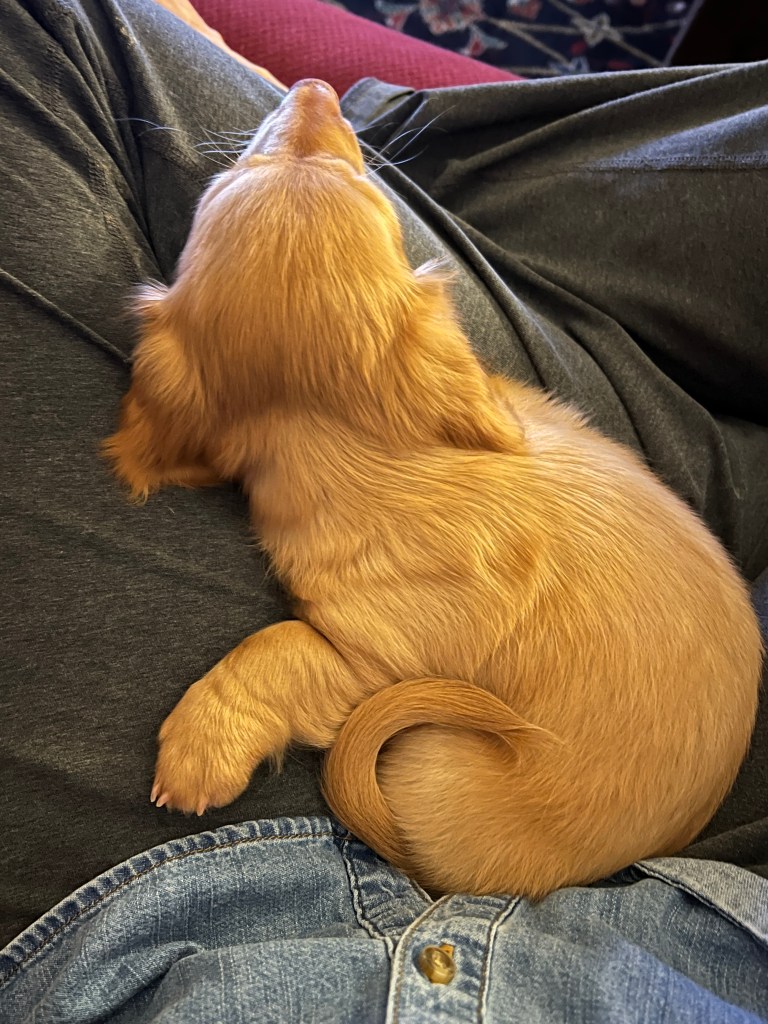
for the puppy

playing under my chair
little ball of golden fluff
having dragged every toy
he owns
to my feet

where he whimpers
just now
to be held

and so I pick him up

he curls in my lap
while I write
to the background song
a’rippling:

If my words did glow
with the gold of sunshine…

yeah, the Grateful Dead…

here in my place
my beloved space

I write

ever grateful, alive.

******

Lyrics: “Ripple,” Robert Hunter/Jerome Garcia, 1970.

My Jesse

with thanks also to Two Writing Teachers for the Tuesday Slice of Life Story Challenge

Spring verse

On the second day of National Poetry Month, Leilya Pitre hosts VerseLove at Ethical ELA. She offers this poetic prompt:

A tricube consists of three stanzas, each with three lines, and each line having three syllables—quick, rhythmic, and focused. It’s easy to remember as 3:3:3.

Begin by answering the question: What does spring mean to you?

I think I have an answer…

Spring’s Message

Morning sky
streaked rose-gold:
heaven’s yawn

Birdsong praise
rising on
wings of dawn

Green-robed earth
resurrects—
loss is gone

True or False poem

My friend Denise Krebs hosts VerseLove over on Ethical ELA today with a profound “true/false” list poem based on the work of Dean Young. By all means, read her poem and the prompt.

Here’s what I have, so far…

True or False?

  1. I am much older than I appear.
  2. Green is the color of ordinary time.
  3. Angels can sing.
  4. Stars can sing.
  5. Trees can sing.
  6. Just because it’s myth doesn’t mean it isn’t true.
  7. There’s a reason I use seven asterisks for section breaks.
  8. A seahorse holds the reins of your memory and emotions.
  9. Salt water heals all.
  10. Blood is thicker than water.
  11. Blood cries.
  12. I will live to see another solar eclipse.

*******

Bonus points will be awarded for citing evidence in support your answer for #10.

Tip: Double check #3 before submission.

*******

MDavis.D, CC BY-SA 4.0 https://creativecommons.org/licenses/by-sa/4.0, via Wikimedia Commons

*******

with thanks to Two Writing Teachers for the Tuesday Slice of Life Story sharing

Alphabeticals poem

For VerseLove today on Ethical ELA, host Jennifer Guyor Jowett extends this invitation to participants: Pick any letter from the alphabet. Think about its shape, its function, how else it might be heard or understood. Play with variations. See what might be discovered. 

Welp… I find I’ve gotta go with this.

Ode to F

Let’s face it:

F is not the most alluring
letter of the alphabet.

It indicates failure.

It stands for an expletive.

Technically, it’s fricative,
a sound made by forcing
air through a narrow channel,
in this case, by placing the
teeth on the lower lip

looking rather like
trepidation

or, rather,
fearfulness.

Seems a humble
(if not humiliated)
letter
not to mention
nearly impossible
for a young child
to write
in its capital cursive form:
France, for example,
looks like Trance.

But
let’s face it:

F happens to be
a banner letter.
Case in point:
when a small child
has to turn her
first name initial
into an object
for a class assignment
and the girl beside her
is drawing E as
the gorgeous wing
of a bird in flight
the F girl’s got nothing
until she finally thinks
of a flagpole.

A universal
symbol of
freedom

and where would we be
without that?

It stands nobly
there in JFK and RFK

not to mention
twice ceaselessly
in F. Scott Fitzgerald.

A banner letter,
indeed

woven into the very
fabric of our existence…
how could we function
without

Fibonacci sequence
flora and fauna
forests
fish
family

or finches?

Or FRIDAY
or friends?

Or fearlessness.

Or faith.

Stand tall
and proud, 
oh F,
waving your
two little fronds
in the wind
forever.

Fly on.

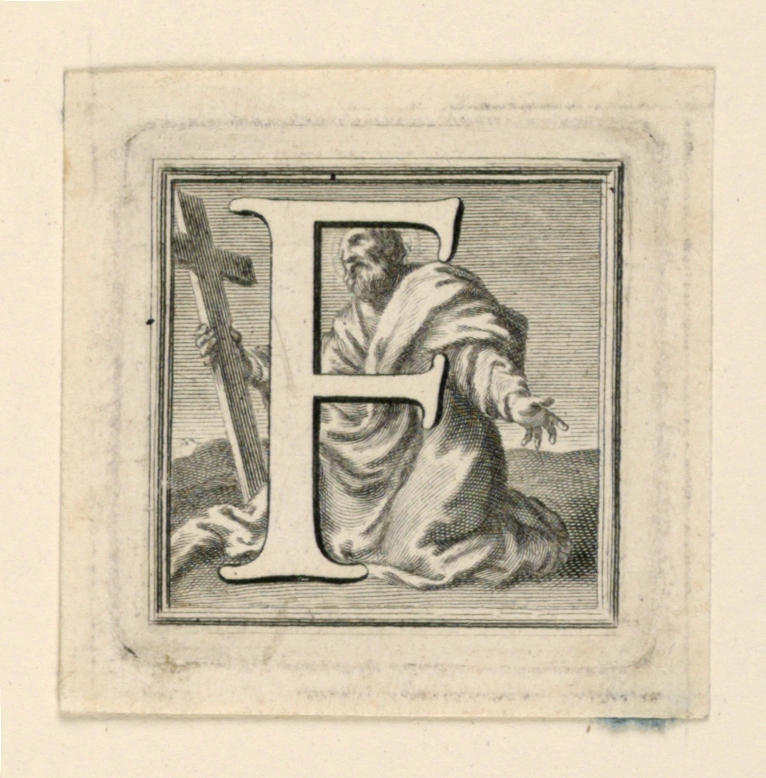
Decorated Capital Letter F“.Jakob Frey, Swiss, active Italy, 1681 – 1752. CC0 1.0.
Public domain, Smithsonian.

Inspirational place poem

For VerseLove on Ethical ELA today, host Wendy Everard invited participants to “Take some time to rabbit hole online.  Discover some places that were inspirational to your favorite author or poet.  You can write about a place you’ve visited or one that you’ve discovered today, through some research.”

Ah. See if you know this place and, more importantly, the person that inspires me.

Remember the Signs

Sometimes
there is
a magic
that
chases you
from one
world
to another

such as when
you visit
a Tex-Mex restaurant
in North Carolina

dedicated to Elvis

and as
the hostess
leads your party
to your table
you happen
to notice

high on the wall
above all the 
hodgepodge
framed photos
that aren’t even 
of Elvis at all
but instead are 
of food 
and dogs 
and cars
(the ceiling
is a mass
of actual
gleaming chrome
hubcaps)

…that high
on the wall
above these
eccentric displays
is a wooden sign

and that
is when
you know
you know
you know
magic is 
afoot

the air begins
tingling with it

and if
you can somehow
explore this wall
without being noticed
by anyone else

you might
very probably
find, if conditions
are right,

a hidden door…

It is here,
somewhere,
I am sure.

Someday,
so help me, 
I shall find it

I shall get in

to find myself
I suspect

in the Rabbit Room
of an Oxford pub
where a group of men
light their pipes and order
another beer as they
debate the manuscript
on magic chasing you
from one world
to another

by mysteriously
connected rooms
and secret portals…

inside the Tex-Mex
Elvis restaurant
I stand staring
at this sign
(later,
I will have trouble
remembering
if I actually
saw it)

knowing magic
is afoot

—it’s more than
a pretty strong
inkling…

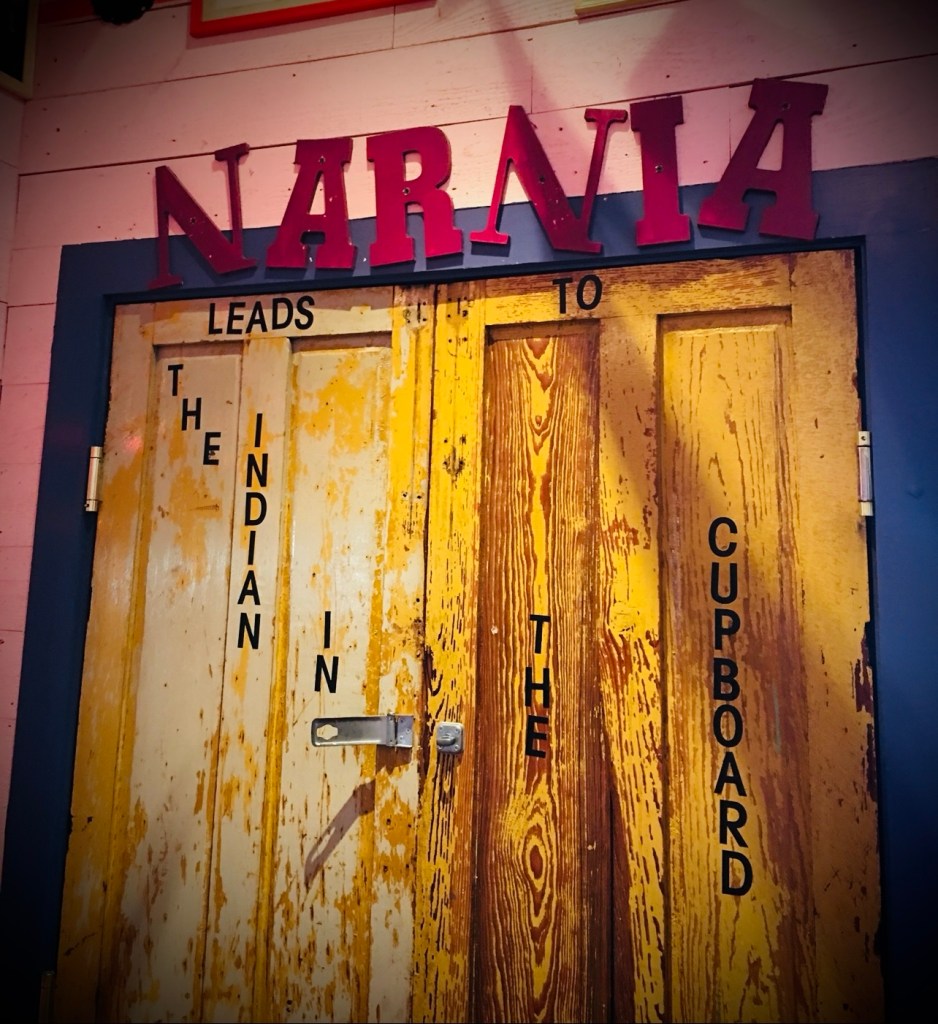
A photo of the actual sign — and door—! on the wall inside the Tex-Mex Elvis restaurant in NC.

*******

*REVEAL* in case you did not know:

The Rabbit Room was a private lounge in the back of the Oxford, England pub, The Eagle and the Child (nicknamed The Bird and the Baby), where C.S. Lewis, J.R.R. Tolkien, and others (“The Inklings”) met regularly to share their working drafts. My poem’s title, the tingling magic, the door leading to another world are all Narnia/Lewis references. Even “I shall get in” is taken from Lewis, whom I’ve loved since age ten. The manuscript being debated in the poem is The Lion, the Witch, and the Wardrobe – Tolkien didn’t like it and basically told Lewis it would never work. While writing the poem I actually forgot what the sign (“NARNIA”) looked like in my local Tex-Mex-Elvis restaurant; I recalled it as an obscure reference to that magical world. I had to scroll around for the photo I took, to remember…but even my forgetting the sign ties directly into the plot of one of The Chronicles of Narnia books (The Silver Chair).

The sign’s presence in this odd place is definitely magical to me…one day…I shall get in…

Hashtag and magic box poems

April is National Poetry Month, and over at Ethical ELA, VerseLove is well underway.

My friend Kim Johnson kicked off the daily poetry writing yesterday by inviting participants to introduce themselves via hashtag poems. Kim shared the process:

Write your name vertically down the left side of a page.  You can use your first name, nickname, or full name – your choice! 

Place a hashtag in front of each letter of your name.

Jot a list of your hobbies, your passions, and any other aspects that you might use to introduce yourself to someone getting to know you.  You can scroll through photos, Facebook posts, or past poems to help you think of some ideas. 

Finally, use the letters to make a hashtag acrostic to introduce yourself to your #VerseLove family! You can #smashyourwordstogether or #space them apart. 

My hashtag poem (I used my favorite variation of my name, what my granddaughters call me):

#HeyY’all #ThisIsMe

#finchologist
#rise&write
#aweseeker
#naturereveler
#nowletmelookthatup
#anothercupofcoffeeplease

Today, Bryan Ripley Crandall hosts VerseLove with a “Magic Box” poem – the directions are somewhat extensive, but very intriguing; check them out here.

My Magic Box poem:

The Golden Rim

I discovered the jewels
right here at home
       whispering rules, awaiting accruals
like longing, lingering talismans
to put in my pockets, protection from fools

I shall not suffer them, removing my saffron socks
barefootedly heading for another world
where winter is fading
       adventure, a’waiting
already, I savor the welcoming salt

I wished, and the grail materialized
in my hand, like a poem
       capturing the wellspring of my heart
       hoping for rhythms of grace
with these words etched around the golden rim:
Write Me

Oh, this spiral shell of Time, wobbling on crustaceous legs!
It’s sweet as honey and bitter as medicine in tentative turn
luring me to press myself
between the musty pages
with my new ink, riding the roaring waves of the past
in the bubbling clean foam of Now.

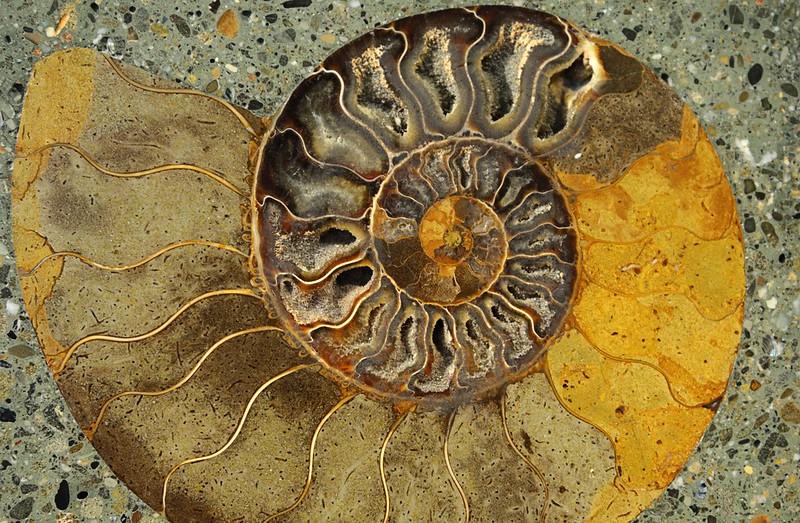
Fossil nautilus.HitchsterCC BY 2.0.

Speaking of Now…what will you write?

******

with thanks to Kim and Bryan at Ethical ELA
along with those sharing for Slice of Life Tuesday at Two Writing Teachers

Poetry: keeping the channel open

For VerseLove on Ethical ELA this week, host Margaret Simon shared this quote from dancer Martha Graham (on The Marginalian):

“There is a vitality, a life force, an energy, a quickening that is translated through you into action, and because there is only one of you in all of time, this expression is unique. And if you block it, it will never exist through any other medium and it will be lost. The world will not have it. It is not your business to determine how good it is nor how valuable nor how it compares with other expressions. It is your business to keep it yours clearly and directly, to keep the channel open. You do not even have to believe in yourself or your work. You have to keep yourself open and aware of the urges that motivate you. Keep the channel open.”

Margaret invited poet-participants to free-write for ten minutes and “just flow.” She shared a poem she composed in her Notes app while walking, along with this encouragement to keep going: “Mary Oliver says ‘You do not have to be good’ in her poem ‘Wild Geese’…accept what comes and be open to it. We all have an energy inside us waiting to be released in some creative way… Forget the rules today and flow, flow, flow.”

In keeping the channel open…here is where my mind went first.

Gifts from the Limbic Sea

Before it is quite morning
the otherworld of dreams
begins to recede
the hippocampus
swimming in its own sea
of memory
is unable to hold onto
the waving grasses
ever how beautiful
or important these
may be 

Try, I tell my twin seahorses
before I am quite awake
I would tighten
the ethereal reins
but I know I am
only dreaming

my hands cannot grasp
anything solid
images dissolve into foam
all I can feel
is a gentle current
ebbing away

or maybe 
that strange and bright
otherworld remains
and I am what transitions
from there to here
borne away on 
mystical tides 
back to reality

and so I rise 
in the darkness
before it is quite morning
to find my journal

and write
before the hippocampus
shakes off 
the remaining residue

it’s not much
this grasping
but I do it
because
these last particles
of dream-dust
preserved on the page
mean something

and they 
are mine

Hippocampus coronal sections. DanielsabinaszCC BY-SA 4.0

‘Hippocampus’ by The Black Apple. Halogen GalleryCC BY-SA 2.0

Found story-poem

On Ethical ELA this week, host Dave Wooley invited VerseLove participants to compose blackout poems: “Find a piece of writing that you want to use as a source, grab a black sharpie and start redacting. The words that are left will be your poem.”

Basically, a blackout is a found poem, with chosen words and phrases remaining in original order. Examples can be found here: How-To Blackout Poetry.

Great! I thought. This will be easy.

It was not.

The problem: First thing that came to mind was a new poem that completely awes me…

Amy Nemecek, The Language of the Birds, 2022.

I started blacking out lines and stopped, because a thing happened.

I just couldn’t reduce this stunning poem. It felt like…desecration.

Instead, I lifted a few words out that especially sang to me. They brought with them their own images, forming something new and other.

Thus was my “found-story haiku” born (not sure if that’s even a thing… I guess it is now):

History of Ideas

from firelight, a spark
illumination flaring
then dying in dust

from the river, song
improvisational joy
free and beckoning

from the silhouette
of trees against starlit sky
infinite longing

from the heart crying
against its impermanence
a reliquary

from calloused fingers
a hieroglyph on a wall
before papyrus

from the weightless bones
a shell of structure is formed
the embryo stirs

out of the static
spark, song, longing are harnessed
the fragile thing lives

For the record: I finished blacking to reveal the words I pulled, although this in itself is not a blackout poem.

It is my seed-bed of ideas.

Science poem: Existential Dance

For Monday’s VerseLove on Ethical ELA, host Brittany Saulnier extended this invitation: “Today, write a poem inspired by science and perhaps, whimsy…The challenge is to ensure the reader can simultaneously glimpse the scientific concept you were inspired by and a universal truth.”

As always, my thoughts turn to nature. It is always teaching; are we heeding its lessons? Nature’s messages don’t come on words but from its own rhythms and coding. I write much of birds. It is said that they are they last living dinosaurs. Maybe even now they are the impetus, in their always-inspirational way, for my digging deep to see what I might find…

Existential Dance

sea and earth
earth and sea
complicated
choreography

streams of movement
building higher
freeform deposits
wetter, drier

life rising, falling
layer on layer
it’s all timing, timing,
the dragon-slayer

everything alive
to remain, must eat
until nothing remains
but remains under feet 

strata with volumes 
lined on a shelf
stories kept secret
unto itself

sea and earth
earth and sea
consolidated
choreography

streams of movement
releasing the store
freeform deposits
washing ashore

when miners come
millennia later
scratching their heads
no translator

for what they’re seeing
drawn from the earth
looking for phosphate
to be stunned by girth

of ancient teeth
from a creature long gone
scientific name:

Megalodon

(meaning “big tooth”)
—what great irony
this turns out to be
last laugh of earth and sea

monster-shark teeth
unearthed in a way
with a side effect:
workers’ tooth decay

everything alive
to remain, must eat
until nothing remains
but remnants…of teeth

sea and earth
earth and sea
conspiratorial
choreography

Carcharocles Megalodon Tooth. 5.4 inches long, 4.4 inches wide.
Excavated from Lee Creek Mine, Aurora, North Carolina, USA.
Public domain.

My grandparents lived on the outskirts of tiny Aurora, North Carolina, home to the largest phosphate mining and chemical plant in the world (miningtechnology.com archive). In the 1970s, prior to the establishment of the Aurora Fossil Museum, “rejects” or unwanted gravel material from mines were scattered on the many dirt roads around the area. As a child I walked in these rejects along the old dirt road by my grandparents’ home, finding bits of coral skeleton, shark’s teeth, possibly some Megalodon teeth, and fossilized eardrums and vertebrae of log-extinct creatures. Now visitors can dig through this material in the fossil pits at the Museum, which will host its annual Fossil Festival May 26-29.

The April 2023 edition of Our State Magazine contains an article by Katie Schanze about Aurora and its fossils: the area “produces the most prolific fossil record of Miocene (2.3 million to 5.3 million years ago) and Pliocene (5.3 million to 2.6 million years ago) marine life on the Atlantic coast.”

It was by chance that I stumbled across references elsewhere stating that one of the detrimental effects of phosphate mining is tooth decay from prolonged exposure to fumes of chemicals used in the process. What irony, I thought, tooth decay caused by mining something used as fertilizer to grow food, while simultaneously finding preserved teeth of one of the mightiest sea predators ever to have lived…which likely went extinct due to loss of food.

*******

with thanks to Brittany Saulnier for the poetic inspiration on Ethical ELA
and to Two Writing Teachers for the Tuesday Slice of Life Story Challenge
and Our State: Celebrating North Carolina, Vol. 90, No. 11
Haibun poem: Breath

On the first day of National Poetry Month, Glenda Funk kicks off VerseLove at Ethical ELA with haibun poetry writing:

“Haibun originated in Japan and combines prose and haiku. Haibun can feature many genre forms, including narrative, biography, diary, essay, prose poem, travel journal, etc. The prose section comes first and is followed by the haiku, which an article on Poets.org describes as ‘a whispery and insightful postscript’

Compose a poem juxtaposing ideas about rest with the haibun form…I’ve noticed the economy of words in the haibun and believe this is achieved by omitting as many being verbs (and dare I say adjectives) as possible.”

I have never written haibun before.

I do not know why the image of the child struggling to breathe in the night came to mind, but she did.

More on that after the verse…

Breath

Night takes the stage like a magician bent on harm, draping the child in her bed with a velvet cape intended to suffocate. Ghost-hands press theme music from her lungs, just pipes and whistles, an accordion straining, straining to get enough air in and out. Carnival music distortion, chorusing with the machine at the bedside rattling and spewing steam. It doesn’t help. The child craves release. Air. Sleep. PleasePlease…she wriggles against the ghost-hands, piling her pillows, drawing her knees to her chest underneath her, not knowing this is how she slept as a baby. Not knowing she’s a victim of in-betweenness, planted in a time before widespread use of inhalers and eras beyond physicians prescribing the remedy (for adults, anyway) of smoking jimsonweed. Nightshade. The magician’s sleight of hand, again. In the fog-filled room, moisture trickling down the walls, she’s akin to the bald cypress in the bog, relying on knees to —stabilize? —to breathe? She does not know that even trees rest at night (measure the droop of their branches; see it restored at morning). Like trees repatriating nutrients before winter, turning their fragile leaves loose, she knows she has one hope for staving off ruination. Her knees. In this pocket, the ghost-hands lose their grip; the magician is undone. The velvet cape slips away. 

Sleep repairs the brain
but there would be no breathing
at all, without trees

#Repost @_sunkissed_gal_ ・・・
The trees are our lungs, the rivers our circulation, the air our breath, and the earth our body. — Deepak Chopra.
Sterling College. CC BY 2.0.

—I was the child, suffering with asthma.