Blanket

I am more tired than I realized.

I wake up early every day, around 3:30. Not intentionally; I just do. Instead of lying awake or drowsing for another couple of hours, I get up and write. It’s the perfect time, before my menfolk and canines begin to stir.

My early mornings are a logical reason to be tired.

And spring break is still a week away. The last mile is always the hardest . . . .

And I am twenty-five days into a thirty-one day writing streak, the Slice of Life Story Challenge, which requires an extreme level of thought-immersion and attention to the minutiae around me (everything is a writable moment). My receptors must be wide-open all the time. This, however, is a good kind of tired. Even though I am mentally composing while I’m sleeping.

And I am fighting an allergy or a cold; I feel it lurking around my edges. My boys, when they were small, used to say, “I am catching up to a cold.”

And it’s been a long winter. There may be a few snowflakes tonight. Spring hasn’t fully sprung. There’s still a lot of darkness.

And my family marks a year of losing loved ones, young and old, sudden and by inches with dementia. My husband, his sister, and I need to finish cleaning out their mother’s house.

The dogs, knowing I’m the mom of everything, trail my every step. Henry wriggles like a worm, with an insatiable need for pats, for attention, and even poor old Nikolaus, his eyes like clear marbles full of misty clouds, is still able to scamper behind me in hopes of a treat.

And so, I’m tired.

Yesterday, being Saturday, I did something I almost never do:

I finished my post and went back to bed.

My husband, who’s now been up for a short while, reading in the study, comes looking. “Oh, you’re back in bed?”

“Just for a little while,” I say.

“Okay.” He closes the door.

I pull the blankets up to my chin. So cozy. I drowse. I hear bits of blog posts echoing in my brain.

The door opens. Older son. Henry’s so-called “dad.”

“Are you sick, Mom?”

“No. Just resting.”

“Oh, okay.” He goes to fix his breakfast. He loves a big breakfast. His brother won’t eat until lunchtime.

Snuffling outside the door. Henry. He usually begins to grumble-half-whine to come in and snuggle to me, or to sleep on my bed if I am getting ready for work. Today he must sense something. He goes away. Unusual.

Distant clanking in the kitchen. Muffled voices. Footsteps in the hallway.

The door opens. Younger son, Cadillac Man.

“Mom?”

“Yes?”

“Are you okay?”

“Yes. Just resting.”

“Okay. Lowees.” This is how he first said ‘I love you’ when he was a baby. Lowees. It immediately became part of the family lexicon. We all say it to each other. His father reminds me again and again that Cadillac Baby said it to him first.

“Lowees,” I say.

I can’t stay here long. None of them will be able to take it. There’s too much to do, anyway. There are places to be.

But I pull the covers partway over my head, sinking into the warmth, the softness, savoring the moment, grateful for the web of words knitting itself from random scraps in my mind, for the abiding blanket of love wrapped over and around my life.

Heroes

img_4479

They’re heroes. All of them.

From across the state of North Carolina, they gathered in the capital city. Fighting crowds and full parking decks, between a St. Patrick’s Day parade, a street festival with an Irish band, a pub crawl, and educators arriving for the North Carolina Reading Association conference, the children made it to the Young Authors Project celebration.

These young people, from kindergarten through twelfth grade, and some of their teachers, were previously recognized by their local reading associations for writing on the theme “Show Your Strength.” Finalists went on to be judged by a panel for the state, and yesterday the North Carolina Reading Association awarded winners a book of their published entries and a medal.

Prior to the ceremony, such figures as Batman, Wonder Woman, and the X-Men swept through the audience, greeting the children, congratulating them, posing for pictures with them.

Project Superhero, Inc. and Causeplay Carolinas team up at the NCRA Young Authors Project celebration. Photo: Twitter, @superheroorg 03/17/2018.

Note the word POWER on the photo-op backdrop . . .

I thought immediately of the power in writing.

I watched as the children were called, county by county, to receive their awards on stage, their faces glowing. I’ve read their stories, how they showed their strength by sticking with tasks they thought they couldn’t accomplish, reaching desired goals, drawing inspiration from others, overcoming bullies, conquering their greatest fears, coping with illness, the loss of pets, of family members. How they got through, even when they didn’t think they could.

It takes courage to be a writer, courage to be a child.

There they stood, heroes, all.

Celebrating each other, celebrating their stories.

Celebrating perseverance. Celebrating courage. Celebrating hope.

Celebrating life.

img_4482

Get words

Imagine what is over there

Imagine what is over there. Kenneth BarkerCC BY

Last night I met with a small group of teacher-writer-colleagues from my district.

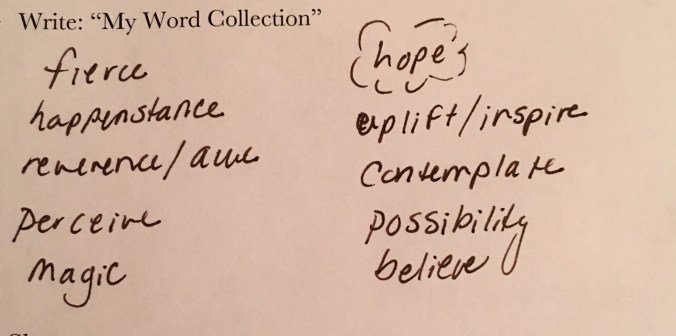
We started our discussion by writing words that resonate with us.

-Quickly.

Mine are:

fierce    happenstance   reverence   awe   perceive  magic  hope   uplift   inspire               contemplate   possibility   believe

I don’t know why this was hard or why some of these words came to me (happenstance? Go figure. Must just be the sound of it. What other reason could there be?).

Then we had to pick the word that was most significant to us.

Mine is

      hope

for in every aspect of my life, I am hopeful. If I could impart one thing to others, it would be hope.

Hope is vital to the human spirit.

My colleagues and I talked about our work with students, other teachers, and our own writing. Where we’ve been, where we are now, where we want to go.

       uplift

               inspire

Going home, the lively discussion and energy circles round my mind. Something in there is trying to find a landing place.

                         contemplate

The “something” is tied somehow to student reactions . . . the ooooohhhh moment that’s such music to a teacher’s ears . . . like when a student connects a thing he/she loves to a book, or to writing . . . this week in fourth grade, it was me asking Why is opinion writing important? with a student responding You write about what you feel deep in your heart and another student saying Like music. I can write about why I love music. I want to write songs and me saying, Well, maybe you need to write your opinion piece AS a song.

—beat—

OOOOHHHH

       reverence

                             awe

And then I think, fierce is an odd word for me to pick yet it was the first one that came to mind. Why is that?

Fierce love like mother for child, fierce dedication to excellence, fierce desire for learning.  Maybe that’s why.

The something circling in my mind is materializing. I think it’s another word . . .

                                                    perceive

Not that word.

The word is—well, awfully simple:

Get.

Get?

Yes, get.

Get what?

Get them reading

Get them writing

Get them talking

Then get out of the way.

Oh, I get it.

My colleagues and I talked about that.

And

Get out of the box.

Because that’s where all the

          magic

happens.

We don’t make it happen.

They do

but only after we tear down the walls

of windowless boxes

so that they can see the glimmering horizon beckoning

and be free to

imagine

what is over there.

                       possibility

And that they can

get excited

get through

get there

if they only

      believe

And that comes only from the stirring the ocean within

Not by sea-spray on the wind without

never never by

                           happenstance

To dream, to write, perchance to connect

Connection

“Connection” by Dylan O’Donnell

Henry is sound asleep on the sofa, his head on two throw pillows, snoring like a middle-aged man.

He is my family’s  endearing, shamelessly-babied Lab-Pit mix. Three years old and in his mind, he owns this sofa. It exists solely for him.

We don’t tell him otherwise.

Within moments, Henry’s breathing changes. His smoky gray body shakes; his white paws twitch. He whimpers at a higher pitch than he ever does when he’s awake.

“He’s dreaming,” we humans say to each other.

That whimper. It sounds puppy-like. Afraid. Vulnerable. Nothing like the rumbling from deep within his chest when Henry “talks” to us (translating to “Hello, I want something, so drop what you’re doing, pronto, to do my bidding”).

Which leads me to wonder: What is he dreaming about?

He is a rescue dog, found wandering the streets. He was timid for a long time before attaining his current level of confidence (and world domination).

Is he reliving a scene from his early life? Was he mistreated? Abandoned? Did something frighten him badly when he was a puppy?

Do dogs really dream like humans do?

The answer, according to Live Science, is yes: “Dogs likely dream about waking activities much like humans do.”

I am the one chasing a rabbit here: Captivated by the article,  I keep on reading beyond dogs to rats to flies—yes, says a cognitive scientist, even flies may dream in some form.

Sounds like something straight out of fantasy . . .

You may visit the site to read about the rats and flies yourself, if you like, but here are the article’s big clinchers for me: That sleep “adds something” to the process of learning and remembering, that sleep is “a sort of categorizing of the day’s activities” and a chance for the brain “to explore in a consequence-free environment”:

The idea is that, in sleep, the brain is trying to find shortcuts or connections between  things that you may have experienced but you just hadn’t put them together.

Cognitive scientist Matthew Wilson, “What Do Dogs Dream About?” Live Science

Categorizing of the day’s activities . . . yes, this often happens to me as I fall asleep. Reliving moments, subconsciously archiving them in specific mental folders for future retrieval as needed. A subliminal attempt at order and organization—how I appreciate that. The brain is an indescribable marvel, the ultimate computer. I envision lines arcing this way and that along a grid, an image of our brains actively searching, reaching, connecting and grouping things, while we rest.

My uncle once told me he could sleep on a problem and before he woke, the solution would materialize in his mind. Some mornings, in the transition between sleeping and waking, I can “see” the day’s events before me, and a detail or an approach will offer itself in a way I hadn’t thought of before. This has a name: liminal dreaming. 

But as I am awake, here is where I very consciously, intentionally, connect some psychological dots.

As Henry lay dreaming, prompting me to wonder about his background and the stuff of his dreams, I happened to be reading Ruth Ayres’ new book, Enticing Hard-To-Reach Writers. It is a must-read for educators, whether one teaches writing or not. Ayres has a lot to say, from firsthand experience, about the brains of children who’ve suffered extreme trauma and neglect. She also has a lot to say about the power of writing, of story, to heal and to save . . . I cannot help thinking now of the thirteen Turpin children in the news and the discovery of  their “hundreds of journals” which officials speculate may have helped them survive the unimaginable at the hands of their parents. If this is true, we’ll soon know.

But as for my dog, his dream, a website, the book in my hands . . . they all converge on the work of the brain:

When I write, I realize new ideas. I make connections. I figure out what I need to do next. When I write about what’s happening . . . something significant happens: I begin to see things from a new perspective. This is how learning happens. This is how growth happens. 

-Ruth Ayres, “Writing Always Gives More Than It Takes,” Enticing Hard-To-Reach Writers

To sleep, to dream, to subconsciously categorize, make connections, problem-solve . . .

To wake, to write, to consciously realize ideas, make connections, problem-solve . . .

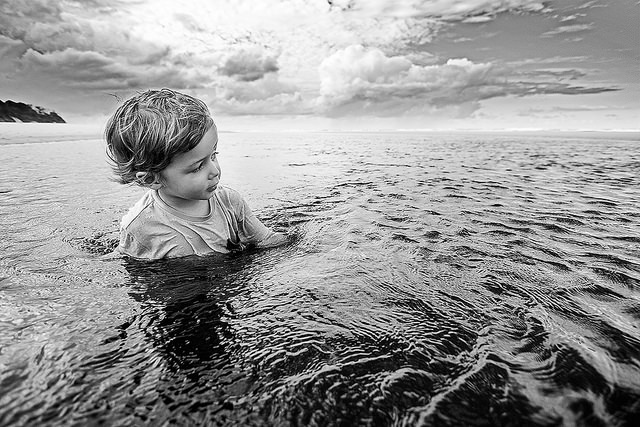
Revisit the child in the photo at the top of this post. He’s immersed in water, a symbol of life, an expression of contemplation on his little face. He’s absorbing the experience. The world is big. Sometimes alarming. Not always fair. When he lies down to sleep, what dreams may come? Will they haunt or heal? Hold him back, or help him overcome? He is at the mercy of his dreams. As are we all.

But to wake, to write, is to immerse in thought, to gain unexpected perspective, to remain open to questions, to answers, to possibility, to wonder, to hope.  Dreams, in all their mystery, come and go at random; their meanings and value often elude us. When we write—an equally mysterious process—we actually take hold of meaning. We continually unfold it, one layer of thought leading to another, branching off in directions previously unseen. To write is to go both deep and wide, to actively broaden the scope of one’s own world, to expand one’s sphere of interest, to explore what’s within to better relate to what’s without  . . . to connect.

I mark the page in my book and reach over to rub my quivering dog.

“Shh, shh, Henry. It’s okay. I’m here.”

At the touch of my hand he eases. He lifts his head, regards me with bleary eyes. His tail thumps. He readjusts, curling himself into a tighter ball there on his sofa.

He sighs.

The sound of satisfaction, of being connected, of being safe.

To the children

writing in notebook

Writing. VassilisCC BY-SA

Dear Children,

I am thankful for you.

For your uniqueness, for your existence, for the lens through which only you can see the world.

I am thankful for your courage, your stories.

That you feel free enough to write about what you know, what you’ve lived, endured, and overcome in your young lives.

That you have the strength to share your early taste of loss—of pets, of parents, of siblings, of homes.

That you escaped abusive homes for ones where you could thrive.

That you left another country for mine—for ours.

That you learned from watching the failures and mistakes of others close to you.

That you learned to forgive others and even yourself.

That you learned to persevere, that you accomplished what you set your mind to because you kept trying.

That you faced your fears and came safely through.

I am thankful for what you teach me each day about listening, seeing, discerning, wondering.

I am thankful for the reminder that curiosity and questioning are natural, that creating something from whatever happens to be lying nearby is a hallmark of the human soul.

I am thankful for the beauty you bring to the world.

I thank you for daring to pour your hearts onto the page, for laboring at it, and for your truth.

I thank you for the unparalleled honor of reading your words, for the moments of laughing with you, crying with you, and standing in awe of you. For the privilege of helping you capture your ideas and communicate them clearly, of seeing you realize the power of your own voices. Of simply being on the receiving end of the important messages you have within you.

If I have inspired any of you, know that I am inspired a hundredfold in return.

Keep writing, Children, and I will do the same, for we owe it to ourselves and to each other—we need to read our stories as much as we need to write them.

I carry you and your stories, your abiding images, with me always.

Always believe in yourself, for I believe in you. In who you are now, in who you will become.

With love and profound gratitude,

your writing teacher

*******

Inspired by students I’ve taught and others whose work I’ve read.

Thanksgiving challenge: To whom are you deeply grateful, and why? Write this person a letter expressing your gratitude. If  your person is still living, read your letter aloud to them face to face or by phone. If your person is no longer living, read it aloud in a place that’s meaningful to you. Celebrate what this person has added to your life. Celebrate the power of writing and the transformative power of gratitude. 

slice-of-life_individual

Making the magic

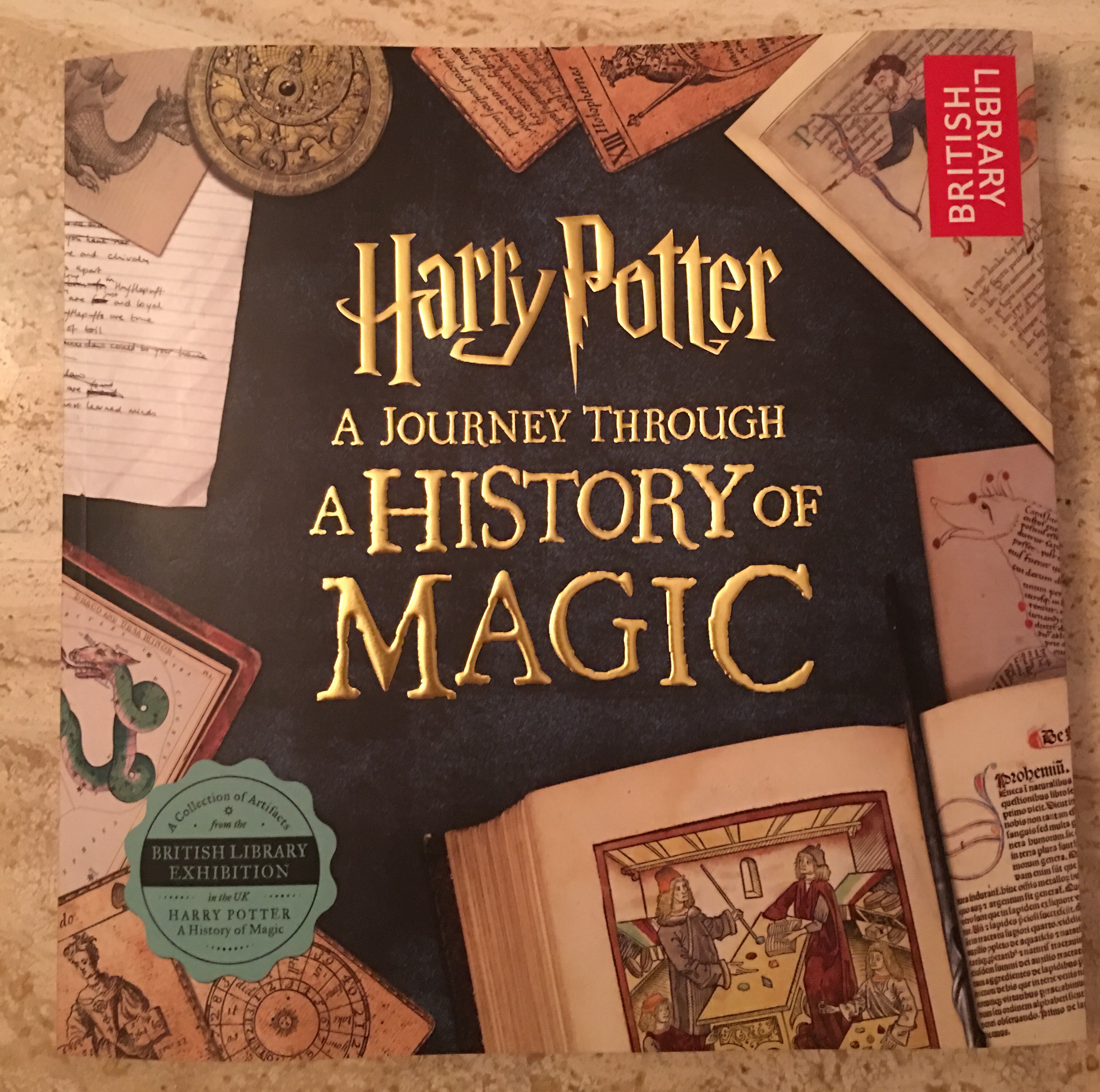
The thing I love most about the newly-released Harry Potter: A Journey Through a History of Magic isn’t the astonishing wealth of research, the fascinating museum artifacts, or the breathtaking artistry of Jim Kay.  It’s not the topic of magic, explored through the ages.

It’s the writing process documented throughout the book.

From handwritten drafts in composition notebooks to typed manuscripts marked with ongoing revisions, this photographic journey of J.K. Rowling’s creation of the series is a treasure trove for writers and teachers of writing. The message is clear: Making the magic is a lot of hard work.


Rowling’s draft of Harry Potter and the Deathly Hallows in Harry Potter: A Journey Through a History of Magic.

Rowling shares how her ideas began, how they grew, and how immersion in the process caused more ideas to develop:

When I’m planning I often have multiple ideas popping up at the same time, so I’m attempting to catch the best ones as they fly by and preserve them on paper. My notebooks are full of arrows and triple asterisks instructing me to move forward four pages, past the ideas I jotted down 20 minutes ago, to continue the thread of the story (113).

Catching ideas “as they fly by.” I am reminded of Elizabeth Gilbert’s words in Big Magic: Creative Living Beyond Fear, recounting what poet Ruth Stone shared with her:

When she was a child growing up on  a farm in rural Virginia, she would be out working in the fields when she would sometimes hear a poem coming toward her—hear it rushing across the landscape at her, like a galloping horse. . . she would “run like hell” toward the house, hoping to get to a piece of paper and a pencil fast enough to catch it. That way, when the poem reached her and passed through her, she would be able to grab it and take dictation, letting the words pour forth onto the page. Sometimes, however, she was too slow, and she couldn’t get to the pencil and paper in time. At those instances, she could feel the poem rushing right through her body and out the other side. It would be in her for a moment, seeking a response, and then it would be gone before she could grasp it . . . But sometimes, she would nearly miss the poem, but not quite. She would just barely catch it, she explained, “by the tail.” Like grabbing a tiger. Then she would almost physically pull the poem back into her with one hand, even as she was taking dictation with the other. In these instances, the poem would appear on the page from the last word to the first—backward, but otherwise intact (65).

It’s one of the reasons why I say writing is the closest thing to magic that there is.

Note that Rowling and Stone were both working as the ideas flew. Physical activity stimulates thought, gets the creative juices flowing, sets the welcome mat out for the ideas, opens oneself as the conduit. The ideas don’t come if you merely sit and wait for them. Get busy. Start writing or walking (the preferred activity of E.B. White and C.S. Lewis).  Just do.

And have those notebooks nearby—be ready to capture the ideas as soon as they start flying.

The real alchemy begins as soon as the ideas are on the page. There’s an art and a science to transforming raw, base material into something of value, in purifying and perfecting the work. We know these as revision and editing. Rowling’s drafts are priceless examples of the writing process to share with would-be writers. Even Ron, Hermione, and Harry would attest to the fact that making magic does not come easy—it’s the result of continuous practice, of constantly honing the craft.

Speaking of which: It just so happens that I was in a bookstore cafe on a Saturday afternoon, collaborating with colleagues on a district presentation about the writing process and growing writers, when guest services announced:

“Listen up, Harry Potter fans! You’ll want to come by and get a copy of A Journey Through a History of Magic, released just yesterday. . .”

My colleagues looked at me knowingly. Of course I went straight for the counter, never suspecting that a powerful tool was about to land in my hands.

Just another illustration of being immersed in work when the magic comes seeking.

Why I Write 2017

The Light is On

The Light is on. Susanne NilssonCC BY-SA

Write the things which thou hast seen and the things which are, and the things which shall be hereafter.

Revelation 1:19

I write to celebrate the strange adventure of life.

I write to relive moments too precious to forget.

I write to light the way for the children, so that they will find their own writing paths.

I write to clear the clutter in my mind, to ease the ache in my soul – and to encourage others to do the same.

I write to set my imagination free, to create worlds, to discover what happens there.

I write because characters pop into my head and need a place to be.

I write because mental images materialize, insisting that they have meanings, and that their meanings matter.

I write because I am a warrior. I will defend what I believe.

I write because I believe writing is a transcendent, transformative force.

I write to celebrate having loved and been loved

because love and words never die.

I write because words are in my life’s blood, always flowing, arranging, rearranging, singing a story

that really has

no end.

*******

 Another celebration: This is the 100th post on Lit Bits and Pieces.

Abiding images

Last week I spent several days on Ocracoke Island, North Carolina, studying writing with teaching colleagues from across the state.  This extraordinary opportunity was provided to us by the North Carolina Center for the Advancement of Teaching – heartfelt thanks to you, NCCAT, for your support of teachers, and for inspiration at a time when it is needed more than ever.

Ocracoke is, in the words of our faculty advisor, who’s native to the island, “a windy, sandy, watery place.” It’s also tiny and breathtakingly beautiful. One of our assignments was to capture abiding images from this idyllic locale in our writer’s notebooks.

Abiding images are symbols with deep personal meaning to us, often recurring, according to dream analysts. Abiding images are part of us, shaping our lives the way the wind and the water continuously shape this island. To poets and writers, abiding images come from a wellspring inside us – stories, dreams, conscious and unconscious memories – each as unique to us as our own fingerprints.

Our task was to walk in this brine-tinged breeze, under the moody sky, without speaking to one another. We were to walk alone, searching for the images that speak to us.

I prefer to think of it as being called by the images that wish to speak to us.

The long beach grass rippled like hair against the ground; the sea, shimmering and calm on the Pamlico Sound side, flowed ceaselessly from left to right like words across a page. Come, was the inherent, compelling invitation. Come. Listen to me. I have stories to tell.

I filled seven pages with abiding images and took pictures of a few.

There were the pink wildflowers, startlingly bright against the beach grass. Marsh pinks, they’re called. Sabatia stellaris. Our advisor said for anything to survive on the island, it must be hardy, yet here were these delicate flowers with perfect yellow stars in the center, as if painstakingly hand-painted by an artist. Incongruous. Surprising. Hopeful, somehow, for these flowers carry the mark of the heavens in their upturned faces.

I came across some shells by a small hole in the sand, out of which grew a thin, solitary blade of grass. No other grass stood anywhere near this one long, lonely strand, this one hair from this one follicle. There are secrets in the sand, the advisor told us. So much more goes on in it and below it than we really know. 

This curious wisp of grass shivers, nods.

I walk farther and discover the ivory-yellow skeleton of . . . something. I don’t have a frame of reference for it, other than knowing it’s a bone, something once alive. It worries me. I want to know what creature it was and why it’s here in such pristine condition, with no other marks in the sand near it in this isolated spot. How long has it been dead?

I learn later that it’s the skull – just the skull, although it’s the size of a chicken – of a red drum. North Carolina’s state fish.

I still don’t know why it was lying there all by itself.

The last of my abiding images is at the marina in front of the NCCAT building, which used to be the old U.S. Coast Guard lifesaving station. As I turn to go back inside, I encounter a rusted handle quite suddenly in the sand near the marina’s edge. It’s sticking upright, clearly attached to something buried there, and it’s obviously been around a long time. What’s THIS secret hidden in the sand? I don’t tug on the handle, although I want to; I imagine pulling it and a door coming forth from the sand to reveal an opening with stairs leading down to . . . anywhere. A bunker, a secret gathering place, another world, another time. Oh, the stories this strange handle evokes!

Perhaps I will write one of them yet.

For now, the images abide in my notebook and in my mind; they shape me, even as I shape my thoughts about them. I carry them with me while I leave a piece of my heart, perhaps a piece of my soul, behind with them.

We belong to one another. That’s what I think as the sun goes down over the Sound, as I hear boats over in the marina rocking as if they are waking from a long sleep, coming back to life.

We abide.


Sunset Pamlico Sound

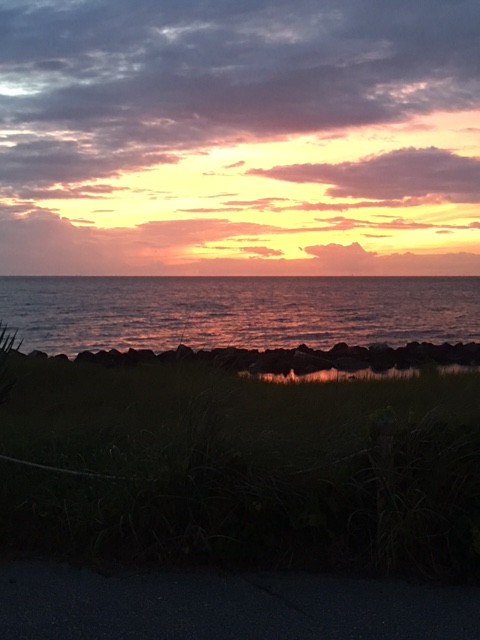
Sunset on the Pamlico Sound.

In reading and in writing, our instructors told us, “Setting is everything. It drives the story, drives the characters’ actions.” 

The hallway

Hallway

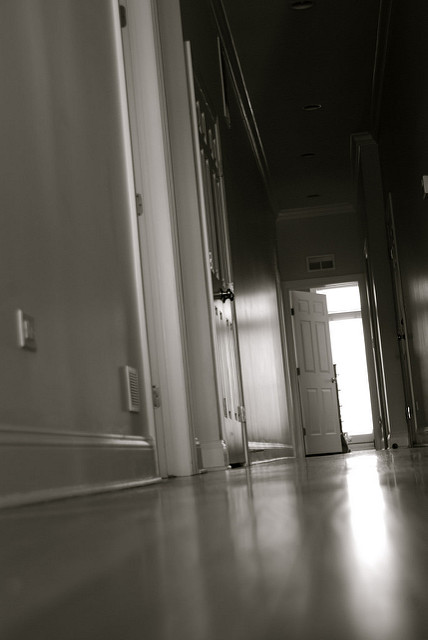
Hallway. DSC_003. ColinCC-BY

A large part of my job involves helping teachers and students grow as writers. I often define writing workshop as an artist’s studio, a place with time to fall in love with the craft of writing.

As I consider my own writing experiences, the image of a hallway forms in my mind. I am actually in this hallway. I can see numerous doors, one of which stands partially open, and through it I can see a window, and beyond that, trees, bright in the golden light of afternoon, probably in late spring or early summer. The branches sway in a breeze, making the leaves dance and beckon, but there is no sound, not from this vantage point. I would have to go through the door and open the window, probably, to hear the rustling, the insects, the birds, to feel the sun’s warmth and taste the laziness of a free afternoon – if, in fact, the afternoon is lazy and free, as it seems to be from where I stand.

Other doors are closed, and knowing that I can open any of my choosing sends a compelling shiver through me – each door leads to a different place, experience, and story. They are all mine to explore, at my leisure. I will never know what’s behind the doors unless I go and open them. Some lead to the past – when I walk through, I can see my family, some of whom are gone now but alive and remarkably young in this place.  They don’t seem to mind at all when I come – in fact, they seem to welcome my visit the same as they always did. If I go farther, I see old friends, classmates, even people I didn’t know well but who are somehow connected to an idea, a moment in time when I learned something or realized that something mattered. My childhood dogs bounce up at the makeshift gate between the kitchen and the living room in their typical greeting; I smell cigarette smoke, the old Kirby vacuum cleaner, the old worn rug; fried chicken also lingers in the air. But I do not want to stay and wander like a ghost here in my childhood home. I can come back another time, anytime I like.

Behind other doors are chairs where I rocked my babies. Here I sit with their soft warmth in my arms, their fuzzy heads nestled against my neck. I feel them breathing, slow, easy, contented in their slumber. I can stay here a while and just be, just rocking, holding one boy for a long time and then the other. I can see them when they are a little older, one always chipper and friendly, the other absorbed in his own thoughts, spending hours lining up his Hot Wheels or taking things apart to put them back together. They are safe and well in this place, so I will leave them here, after I kiss their satin-soft cheeks once more and tell them that I will always love them.

Other doors, I suspect, lead to worlds that I can still create, both real and imagined. I can only see so far in the future; only some things are certain and I will alternately face them and embrace them as they come. I could linger far too long in the imagined worlds, just to see what will happen, to discover the secrets and the magic, knowing all is of it is at my command.

I am surprised by the door that opens straight into the natural world. I have discovered this about myself, that the workings of nature have a strong pull for me. Some of the discoveries are breathtaking, like the iridescence of a dragonfly’s body, the precise blue and orange painted pattern down a caterpillar’s back, the powerfully sweet fragrance of a gardenia, of honeysuckle, and the tiny war-plane drone of a hummingbird’s wings. Others discoveries are not nearly as pleasant – a horseshoe crab decaying on the beach, a tobacco worm (a non-native North Carolina neighbor recoils in horror – “Is that a dragon?“) crawling on my porch rail, a scar on the wood trim by the roof where lightning struck the house. Not pleasant, but fascinating all the same. I had no idea until I started writing that nature spoke so much to me – just now, as I capture these words, the sun bursts forth from behind the clouds beyond my bay window, shining on the laptop and my hands as I type, like a validation, an invocation.

Other doors lead to mysterious places like cemeteries, where time is irrelevant. I don’t know these people, but I look at the stones, the names, the dates; I read the poems on the older, eroding ones, and I want to know: Who were you? What were you like? What was your life like, what did you love, and how did you die? What’s your story?

The most curious thing of all about this silent hallway is that whichever door I open, in whatever order, wherever I go and however far or for however long, I find myself there. Myself as I was, as I am, as I will be.

I give myself a nod.

And I write.


Tripping the write fantastic

Fantasy

Fill your life with love. Dianne LacourciereCC BY-SA

Without this playing with fantasy no creative work has ever yet come to birth. The debt we owe to the play of the imagination is incalculable. – Carl Jung

Her teacher sent her to me, to confer about her writing.

Not because the student is struggling.

The student, a fifth-grader, had written twenty pages of complex plot and extraordinary dialogue that revealed character personality and motivation.

“It’s amazing,” explained my colleague. “Out of the blue, she’s just taken off. I thought you could give her some pointers – her story is really good.”

The student, delighted at the prospect, immediately sent her work to me via Google Docs. Here are things I am thinking about, her message stated. She’d made notes about characters, problems with the story line, where she wanted to go with certain parts.

For a moment I felt transported to the future, as if I were an agent or editor receiving book ideas from an established author.

I read the work, praising the strength of the writing on sticky notes: Powerful, believable dialogue! and Excellent descriptive detail – I can “see” this scene vividly.

I looked for a couple of major areas to improve – only a couple – and they had nothing to to with spelling, format, or conventions at this point. The pressing thing at the moment was keeping those rich ideas flowing and clarifying this young writer’s meaning in some spots.

The child, beaming, comes to confer with me at the appointed time.

I sit beside her at my table:

“Ok, I have to know what inspired you. Clearly anyone who writes this much and this well – this dialogue is better than what I’ve seen some adults write! – is very inspired.”

Giggles ensue. “Well, it started with the fantasy writing unit in class. I got this idea of a girl who went back in time to the days of slavery. I am bad at history” – more giggles – “but that time period interests me, especially since my teacher read Chains to the class. That book made me want to go back in time and rescue some of those people, so that is what my main character will do. And she will meet her great-great-great grandmother.”

“That,” I say reverently, “is a story a lot of people might like to read.”

She goes on to share additional ideas that she got from other books like Serafina and the Black Cloak. 

As she speaks, I mentally toast the power of the read-aloud and student-selected texts.

To the student, I say: “Let’s go over what you’ve done here.”

I explain that switching narrators and times is using multiple story lines – “very advanced,” I tell her.

She grins.

I show her places where she lost me: “This is called a plot hole. You know what’s in your head and what you mean to say, but you jumped too fast and lost your reader.”

She nods. “Yes, I see that now.” We discuss ways she might want to fix it.

Off she goes.

That night, the Google Doc returns with revisions and questions.

Today she appears in my room, announcing: “I rewrote the entire first chapter. I felt that readers needed to know a little more about my main character’s life and her family in order to get the rest of the story.”

“Ah,” I reply, “exposition and backstory. That will help your readers.”

We look at the changes together.

“What we have to watch now is your pacing. Don’t spend too long on the beginning or you’ll lose readers – they want to know where this is going, so you want to speed up the less important parts and slow down at the more important ones.”

“And watch for plot holes,” she laughs.

“Indeed,” I smile.

Her ideas come fast and furious, and before we know it, time is up. As she turns to leave, she asks: “When is the next time we can meet?”

My turn to laugh. “Ask your teacher.”

At the end of the day, I return to my room to find a folded paper on my table – a schedule for when she can confer with me every day through the rest of the year.

I think of J.K. Rowling, who said that the idea of a boy wizard fell into her head on a train ride, when she had nothing to write on.

I think of C.S. Lewis, how an image of a faun carrying Christmas presents in the snow popped into his mind.

I think of Suzanne Collins, who grew up on her father’s stories about the effects of war.

I think of my young writer’s inspiration, and how fantasy and fairy tales help us work through the problems of the real world.

I recall telling my young writer: “Stick with it. You will be a famous author one day. I’ll come to your book signings.”

Giggling, she’d replied: “And you will be my famous helper.”

I look at the little conferring schedule in her handwriting, and smile.

We are tripping the write fantastic, she and I.


slice-of-life_individual