My Patronus

As a headmistress and co-founder of my school’s Harry Potter Club, I was recently admonished to take the Pottermore Patronus quiz, as all other Patronus quizzes are essentially heresy. I approached the task with a bit of trepidation, having heard of people attaining aardvarks and the like.

For the non-Potterite: The Patronus charm produces a silvery animal guardian, usually representative of the individual casting it.

Being a fantasy fan since childhood, and considering my headmistress role, it was necessary: I plunged into the virtual dark forest to seek my symbolic protector. On the site, ghostly words appear in groups of three amongst the trees; the seeker chooses one and is moved onto the next set. At one point in this quest, when I paused too long, the words evaporated with a reprimand: “You are too slow. This game requires quick reflexes.” Silently chiding myself for overthinking simple word choices, certain that this blunder would land me with an armadillo or caterpillar, I picked up my pace. At last, in the ominous forest, a silvery shape materialized.

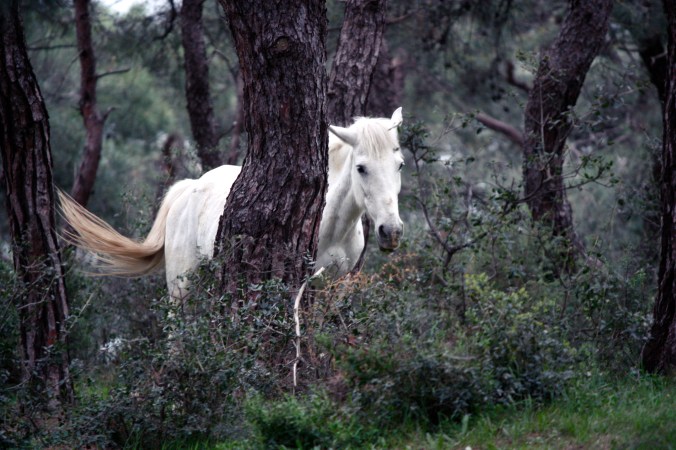
A white mare.

Beautiful and powerful, my white mare galloped through the forest, luminous against the darkness. Enchanting.

My next quest, naturally, was looking up the symbolism.

From various sites, the synthesis is that a white horse represents wisdom, power, loyalty, heroism, nobility, victory – encouraging, yes, but also inversely raising an intrinsic, lofty bar: am I worthy of the white mare? Do I deserve her? Never mind the fact that I gained her by playing a game with an end product based solely on word choices, not short answers or soul-searching responses. The writer in me delves deep into the metaphorical.

I already knew that white horses can symbolize death or the end of the world. They are considered psychopomps, creatures that guide human spirits on their journey from Earth to the afterlife.

As I pondered these connections, my Patronus suddenly conjured up road trips with my father and sister. Three hours is an eternity to young children cooped in a car, so to pass the time, Daddy taught us a game he played as a child:

“When we go by any horses, if they’re on your side of the street, you get a point for each horse. If you have a white horse on your side, it’s worth ten points, because you don’t see many of those.”

My sister and I instantly glued our faces to our respective windows, for we’d been by these random pastures before. We’d often seen horses grazing, strolling, sometimes galloping. I was sure – I just knew – I’d get a white horse. Maybe more than one!

“The thing is,” Daddy continued, “if we pass a graveyard, and it’s on your side of the street, you lose all your horses.”

So we played the game. My sister and I gained horses with glee, then lost them with loud groans, without realizing that one of us would win on the journey to the destination and the other would win on the return trip.

Daddy drove on in peace, smiling to himself.

How many horses I won and lost, I’m not sure, nor do I recall how many were white, only that they were there by the wayside on a long, tiresome journey. Those white horses are obscured by time now, very dim, but still real, ever more priceless, in my misty memory.

Enchanting, indeed, that one should reappear as my guardian after so many years, and that I should have gained it in a game venue that didn’t exist when I was a child.

Daddy, I think, would be pleased. Perhaps he is, from his place on the other side.

Reflect: What creature might symbolize you, and why? I’ve often played a game with students, challenging them to think of an animal that begins with the first letter of their first names (I’ve always chosen fawn in these scenarios – perhaps I should change it to foal?). No two can be the same, so each student ends up with a unique animal and has to think of ways the animal might represent them or their lives. Think – and write. 


Shine

born-to-shine


This is the cover of my mentor text notebook, housing the writing I’ve done with and for children across grade levels.

I believe that every child is a writer, because every child has a story. Every child has feelings and ideas. The writing teacher simply shows how to tap into these feelings and ideas, to give voice to them, to organize them, so that the mind and heart of the writer impacts readers.

Writing is about the human experience: We are all born to shine.

We shine through our fears, our losses.

We shine beyond the choices we make and the choices of others, beyond the things done to us and the things we have done.

We shine no less in our failures than in our successes; in fact, in learning and pressing on, we shine the brighter.

We shine in knowing what to hold onto and what to let go.

We shine when we harness anger before it burns away all that’s of value within us.

We shine by leaving footprints of hope for others to follow, for the human heart runs empty on despair.

We are ALL born to shine. Whether or not we do is up to us.

Reflect:  In the book The Forgotten Beasts of Eld by Patricia A. McKillip, 1974, a mysterious creature had the power to turn people’s eyes around to see inside their minds; they died from what they saw there. Writer, know thyself. Look deep within. You will be surprised by what you discover – the beautiful and the not. Write – and shine.


Why I write 2016

writing

I write because it’s the closest thing there is to magic.

From words spring worlds.

Worlds of understanding, perception, knowledge – of humanity and of myself. I write to explore the world without and within, the real and the fantastic, the important and the insignificant, the extraordinary and most certainly the ordinary. Where there are ideas and images, there are words – lanterns for encircling thoughts, illuminating objects and scenes, mystically shining from one mind to another.

I write because the narrative voice in my head is continuously composing, often drowning out other important things.

The power of story compelled me to write when I was six years old, sitting at the living room coffee table with a pack of wide ruled paper and a fat pencil. A few years later, a teacher said, “What vivid descriptions! Keep writing.” Every year thereafter, a teacher strategically appeared to give a refining bit of feedback: “Wonderful writing. Here’s a way you can make it even better … and keep writing!”

I kept writing, even when my dad grumbled, “Why are you wasting so much notebook paper?”

Today, I write with children. I witness their discovery of their own voices, their courage in putting pieces of their souls on a page. I share in the excitement of their creations, in every little triumph over challenge. I work to empower teachers as writers, for the empowerment of student writers, that all might tap into the magic.

And I keep writing.

I write to wrap a cloak of immortality around everything I have loved – what was, what is, what will be.

I write to scatter the ashes of all my yesterdays, to walk in the light of all my tomorrows.

I write to celebrate having lived.

In honor of National Day on Writing, October 20.

Reflect: Why do you write? What have you wanted to write, but haven’t yet? Carve out a pocket of time today and begin. Tomorrow, repeat.


A poem of friendship

Through clouds of gray will softly shine

a gentle silver tear of mine,

leaving lines to slowly trace

an empty soul, a lonely place.

A golden glow you gave to me

to help me through eternity –

light and warmth with which I try

your own sweet rains to somehow dry.

And we two have learned to see

the me in you, the you in me.

A golden ray through a silver drop

create such colors; they cannot stop.

What blazing brilliance we have sown,

this iridescence of our own!

Combine our souls and we will show

our strength lies in our rainbow.

-Written when I was fourteen. The UK’s National Poetry Day brought this early effort back to mind.

Reflect:  What metaphor captures the beauty and power of your dearest friendship?