A word for 2019

A friend gave me a treasure box of gifts for Christmas.

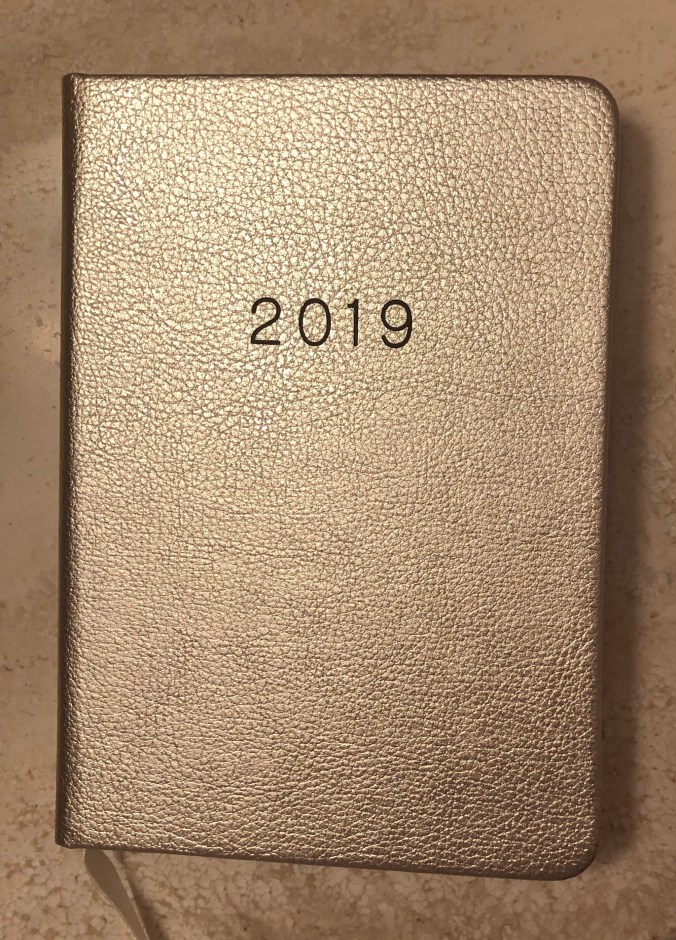
One of the items in it was this gilded 2019 planner.

I already have a (rather large) daily planner for mapping out my workdays—I write in pencil because, as I accommodate the teachers I support, the course of each day shifts constantly, and I make lots of notes. Part of living the coachly life. I’ve learned to embrace it.

So I look at this beautiful planner and think: How shall I use it?

I could give it away, except that don’t want to, it was given to me with love, and I have come to understand that things come to us for a reason. There’s a purpose for this little planner.

I look at it, shimmery and new, just like the year itself, lying before me.

Beckoning, almost.

I will use it for something personal, then.

Maybe for my writing. To map out a timeline, to hold myself accountable for completing things. Or perhaps as a bit of a notebook, recording new thoughts and ideas before they get away, before I have the chance to play with them and flesh them out. I could capture images until I have time to explore why they struck me and what they mean. I frequently use the notes app in my phone for this but the planner has more “space” for movement, for expression. Not to mention sketching. I could carry it with me, keep it by my bedside.

Or I might even be able to use the planner as a sort of manuscript style sheet. For I’ve lots of things that need to be written, rewritten, or simply finished.

However I slice it, then, the planner invites me to plan.

And to write.

And there’s my word for 2019.

It’s something I already do, that already defines me, so it seems superfluous, but it’s the word, the action, that calls to me most. With the greatest sense of urgency, tinged with excitement.

—WRITE.

Here’s to your own unique adventure as the golden cover of 2019 opens.

Take it, live it, to the next level.

Treasures await.

And one of them is your story.

A different Nativity story

They loved decorating for Christmas, my in-laws.

My mother-in-law had bows and garland running all through the house. Candles in each windowsill and against the panes, wreaths hanging from long ribbon.

My father-in-law took care of the outside. He made a lot of what he displayed—a wooden Santa and sleigh, snowmen. Every year he added a bit more.

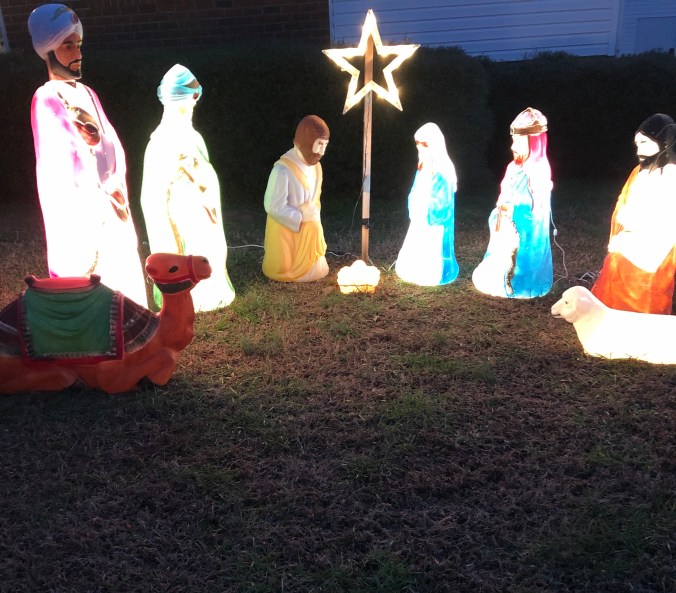
In the backyard, which is what people saw first as they entered the neighborhood, stood the Nativity scene. Large, colorful, lighted figures. My father-in-law made a wooden stable to shelter Joseph, Mary, and the Baby. He covered the roof with straw and rigged a star to stand over it.

One year, when my children were small, vandals climbed the backyard fence on Christmas Eve. They knocked the Nativity figures down, coated them with black spray paint, and stole the Baby Jesus. He was nowhere to be found when my distraught in-laws discovered the desecration on Christmas morning.

My father-in-law painstakingly removed all of the spray paint—I can see him in my mind, bending to his task, working gently to avoid doing further damage, until the figures were clean.

My mother-in-law, however, was afraid to display the scene again:

“Whoever did this came over the fence, awfully close to the house. I don’t want to invite them back.”

She asked her son, my pastor husband, if he wanted the Nativity. After all, he and I lived in the country, in a parsonage right beside our church. Seemed a fitting home for a Nativity scene—albeit one without a Baby Jesus.

So we took it.

And put it up in the parsonage yard the next Christmas.

Our youngest son, a preschooler, was fascinated by the scene. He’d put on his coat and go out into the yard to stare at it for as long as we’d let him.

One day, he asked: “Why doesn’t Baby Jesus light up?”

We’d supplied a little wooden manger and a doll in swaddling cloths (i.e., a tightly-wrapped blanket). We simply told our boy that someone had taken the Jesus that lit up; we didn’t know who had done it or why, so we had to use this one.

He accepted that. Furthermore, his fascination rested on Joseph anyway. For a year or two, he referred to the entire Nativity scene as “The Joseph.”

He loved it so much that once people at church heard about it, they began giving him all kinds of small Nativity scenes. He put every one of them up in his room. I told my husband: “It’s beginning to look like a Palestinian South of the Border in there.”

Our boy became interested in the Wise Men next. He identified them by their clothing: the Blue Wise Man, the Green Wise Man, and the Pink Wise Man. He learned that they carried gold, frankincense, and myrrh. Of those, myrrh captured his imagination most. I think it was the sound of it.

A few times I caught him out in the yard with a blanket around him, kneeling at the manger.

When I asked what he was doing, he replied, solemnly, “I’m the fourth Wise Man.”

I crept away to a respectable distance, marveling at his devotion.

Wondering.

Many Christmases have come and gone. My in-laws are no longer here. “Ma-Ma” died at the end of November last year.

But my son, age twenty-one and a music minister now, still sets out that very same Nativity on the day after Thanksgiving. When the wind gusts enough to blow the figures down, he’s soon outside, standing them back up. The wooden stable fell apart long ago, but “Pa-Pa’s” star remains.

Oh, and we now have a Baby Jesus that lights up.

See, when our makeshift, non-lighted manger and doll got too weathered to use after a few seasons, our elementary-age son improvised with a stuffed dog that our real dogs had played with. It was dirty and torn. He placed right on the ground in front of Joseph and Mary.

I shuddered, thinking, Is it disrespectful to have such a thing depicting Jesus?

Then I realized . . . isn’t it actually more symbolic? To have a Jesus that’s torn, battered, and stained?

I used this as an analogy in a Sunday School lesson.

That Christmas Eve, church members who had a Nativity scene just like ours came in the night to leave their Baby Jesus in the back of my husband’s truck. On it was a note to our little son, wishing him a Merry Christmas.

And that is what Christmas is all about, is it not.

Redemption.

Pa-Pa removing the paint. The people sacrificially replacing what was taken long ago.

Restoring what seems to be hopelessly beyond repair.

My son pauses by the window. The old Nativity is still standing there in our yard, lighting up this dark Christmas Eve night, as I write. My son goes up the stairs to his room, where he’ll work on his music for a while longer.

And I hear the strains of song, faintly:

With the dawn of redeeming grace . . . .
The star

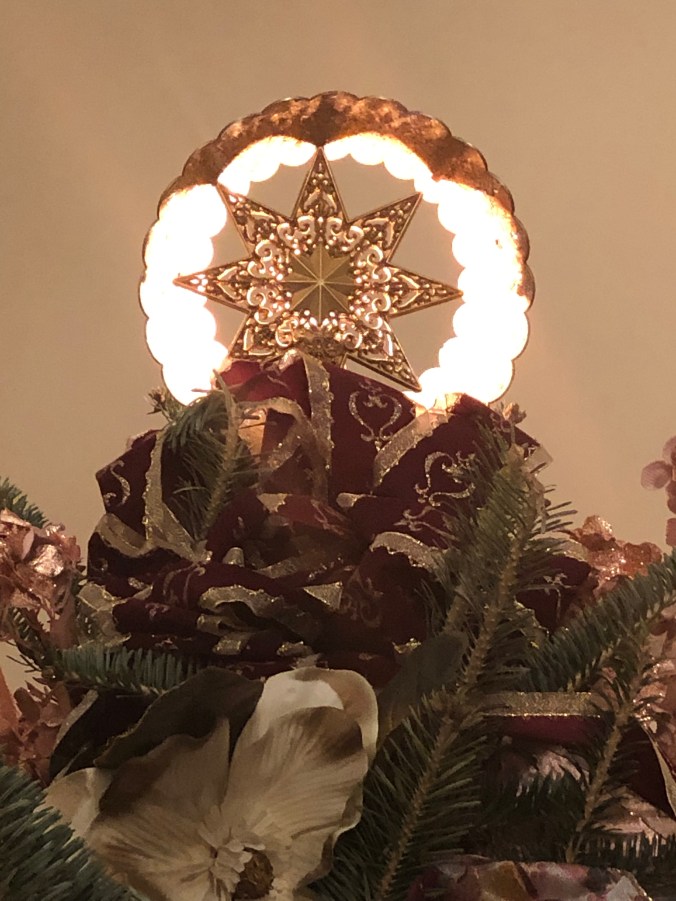
The first Christmas that we were married, my husband and I bought a star tree topper at a drugstore.

That was over thirty years ago.

The star was silver then.

Eventually I sprayed it gold so it would better match ornaments on the tree.

Every year I have to reinforce it with hot glue and duct tape. And every year I say it’s time for this old star to go.

But it still shines.

And I can’t find another tree topper I like better.

It’s older than our children. It’s presided over Christmas for their entire lives.

It’s outlasted the gingerbread ornament that my youngest made in preschool. The sweet ornament crumbled after a decade or so—ashes to ashes, dust to dust, gingerbread to cinnamon and cloves. Spice of life, formless and void, fragrant fragments in my hand when just the Christmas before, it was whole.

The star shone on when other lights went out, one by one. Lights in my life, not those of man-made strings on the tree. This star glowed above me as I decorated, year after passing year, listening to a particularly poignant version of Jesu, Joy of Man’s Desiring that pierced my soul. The haunting chords stirred an almost unbearable sense of loss. Of time, of people, of the inevitability of it all. For a moment, though, under that star, somewhere in the music, in the light, in the season, those who loved me were near again. Not visible, not tangible, yet present, perceptible. Very near.

It stands within its own circle, this star. I think of all that might symbolize. The circle of life. May the circle be unbroken. A wedding band, a halo, a covenant. Wholeness, holiness.

It is fragile.

It is old.

But the star hangs on. It still shines.

With Christmas grace.

Atmosphere

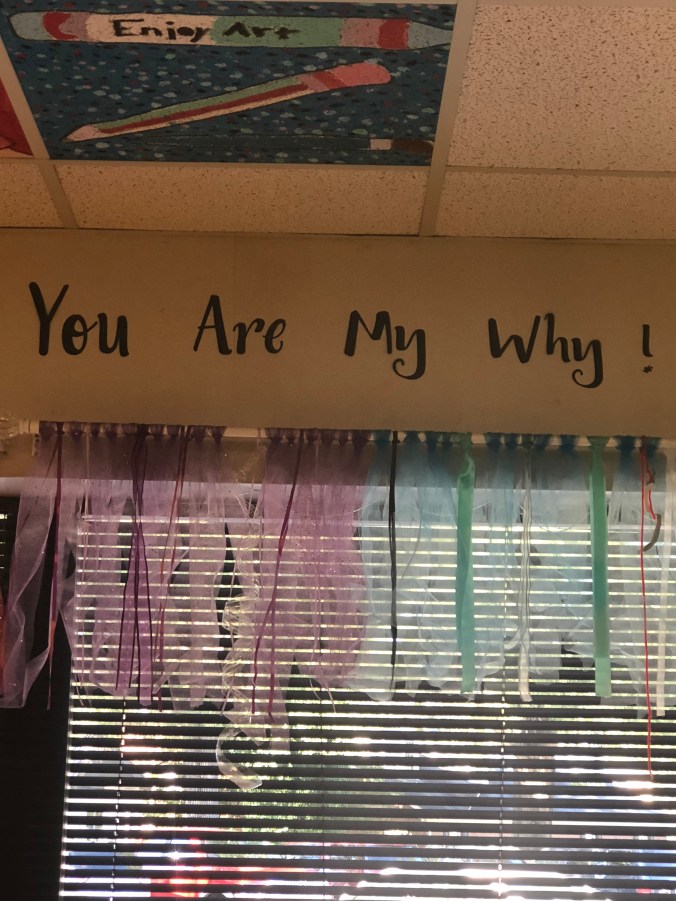
By the worktables in the art room at my school is a window, and above that window is a message from the art teacher to her students:

You are my why!

The words draw your eyes as soon as you walk into the room. They convey more than a greeting; they impart a sense of importance, of being wanted, of being cared about. They are a word-hug of welcome, of belonging, of mattering.

I think about how little is in teachers’ control these days, how the art of teaching is increasingly straightjacketed, hijacked. Expectations on top of expectations, a precariously unwieldy, wobbling mountain, stones heaped one by one, Greek thlipsis until a person’s spirit is crushed rather than one’s actual body. I see, hear, and feel this incremental adding of weight in every day interactions with colleagues. Opening lines from the old Christmas movie It’s a Wonderful Life come to mind, when the angels, appearing as stars in the cosmos, are talking:

FRANKLIN: A man down on Earth needs our help.

CLARENCE: Splendid! Is he sick?

FRANKLIN: No, worse. He’s discouraged.

—Truth.

A gallery of teacher faces appears in my mind.

Then I see these words on the wall and I think, that’s the breathing room. 

The beginning of atmosphere.

Before learning, before discovering, before creating, before engagement, empowerment, objectives or standards, before all the materials and tools are ever distributed, there’s atmosphere. 

It’s both bigger and smaller than the what of climate and the how of culture. Atmosphere in a classroom still lies wholly within the power of the teacher. It starts as small as the heartbeat of the teacher that keeps showing up to say You are my why.

The heartbeat, the breath, that keeps the entire organism alive.

Today


Bubble in reeds

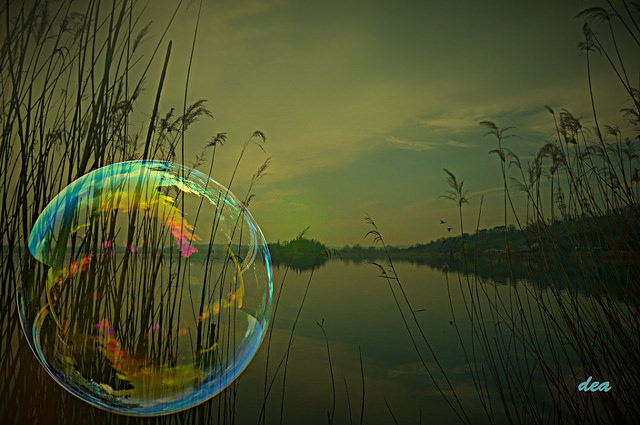
Today … a bubble in the reeds. Claudia DeaCC BY

Today held some rare things.

A teacher said, “Come sit with me while I do my reading groups. I don’t learn by watching but by doing.  Just be there with me and jump in when you see a way I can make them better.”

A third-grader read me his rough draft about experiencing an eclipse, relating his understanding of the science behind it, yet conveying real fear at watching the sun go dark. I sat, listening, in awe of his inspiration, his words.

Another third-grader read her narrative draft to me. How she helps her grandmother to dress and brush her teeth, but not wanting to, wanting instead to go outside and play or watch TV . . . . I sat blinking back tears as she spoke her truths recorded there on the page. She has no idea how powerful this is. How powerful she is. And she’s eight.

I walked down an empty hallway and suddenly heard song—a student coming up the stairs, walking back to class, singing to herself in a vibrato that almost sounded trained. I turned around to see her moving her arms and hands in time with the words. Sign language. I didn’t know she could sing. Or sign.

Had I somehow fallen into a parallel universe, a facet of paradise, maybe, where beauty is multiplied exponentially? Somewhere over the rainbow?

But no, these were only moments in a regular day. Wondrous bubbles against the usual backdrop. Shining, ethereal, iridescent.

And all I really did was show up and listen.

Craftsmanship

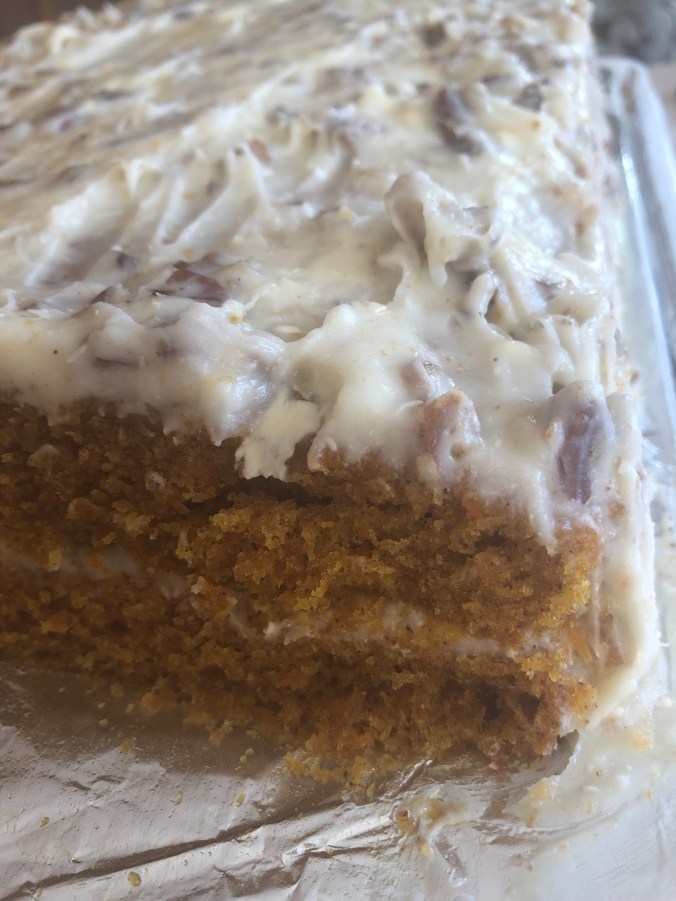
When I was growing up, the dessert everyone wanted at holiday gatherings was my mother’s carrot cake.

I used to sit at the table watching her make it, hoping for scrapings of the batter bowl or to sneak a fingerful of icing. The process took forever. Finally the two layer pans went into the oven, and as the cake baked, the fragrance of cinnamon filled the house—an indescribably delicious smell.

Now I make the cake. Over time I’ve come to think mine is almost—almost—as good as hers.

But as much as I love the cake and want to make it, and as much as it stirs the ghost of my childhood self on holidays past, I find myself sighing and almost reluctant as I prepare for it.

Making this cake is a lot of work.

I make it the way my mother did. Peeling the carrots, grating them on the finest side of the grater so that they become a smooth orange pulp, for no carrot bits should be discernible in the cake batter. I know people who use processors or even baby food carrots, and that may work for them . . . but this is where I appreciate the craftsmanship of my mother’s cake.

That word has been in my mind since a recent meeting when facilitators asked fellow educators a guiding question: “What makes high-quality work?” The answers were plentiful: originality or authenticity, clarity of expression or thought, meeting or exceeding a standard or learning goal . . . and craftsmanship.

It takes time to produce something high-quality. There aren’t shortcuts. I think about writing (because I always think about writing). As with making mother’s carrot cake, writing well is a lot of work, hard work. Refining, refining, grating those danged carrots to a pulp so that they’re not even evident in the outcome, yet they’re the foundation of it. Words worked and reworked and restrung until they finally blend into a seamless, cohesive whole. Without hunks of stuff that trips up readers. To become skilled at anything is to work and work and keep working, all the while knowing how these parts and pieces should come together and that in the end, the effort pays off. Craftsmanship means a serious investment of time, effort, and patience.

There’s an aesthetic feature to craftsmanship. The artist labors long for the effect and beauty of the work. The aesthetics of my mother’s carrot cake are its exceptional flavors and textures, the sensory experience of eating it, for on the surface it looks pretty humble. In middle school I had a French teacher native to Greece (another story for another day, trust me) who told the class that Greek desserts look very plain but are incredibly rich and sweet; when she first came to America and saw our wedding cakes, she couldn’t even imagine what such gorgeous things would taste like. “Then I tried one,” she said, wrinkling her nose. “Bah! Like cardboard!” Aesthetics can be somewhat subjective, then, allowing for personal preference, but I can say this after having read hundreds of student papers across grade levels: When I find one of high quality, from the first sentence all the way through, it “sings.” It stands out. Not perfect, but flowing, clear, and beautiful. I know time and effort have gone into it, and that the author cared about the work.

And this, I believe, lies at the heart of craftsmanship. Caring. With every carrot I grate, I think about how my family will enjoy this cake, the same way I always have. Their enjoyment, more than my own, keeps me at the task. I even make the frosting like my mother did, blending cream cheese, Blue Bonnet margarine, and powdered sugar. That’s tedious, too. Like with writing, I get tired of it all long before I’m through. But I keep at it, not just to be done, but to do as well as I can, because it’s not only for me. It’s something deeply meaningful to me that I am sharing; I need for it to be as good as I can make it. The only concession I allow myself with the cake is buying chopped pecans for the frosting. When I was a child, I helped my mother crack, shell, and chop the pecans. They came from Granddaddy’s pecan tree.

But that tree is gone, as are so many people I loved long ago. The holidays come round and round again with their particular darkness—less and less daylight, the shadows of memory—but there’s a strength gained in expending strength on behalf of others. Caring means giving. Love means sacrifice. There’s a holiness in such work, a healing . . .

My son walks through the kitchen, puts his empty plate in the sink. He sighs. “That is the best cake.”

—Every carrot worth it.


Not another hand turkey

Last week ended with a professional development session. One of those “compliance” types for which it’s hard to muster enthusiasm. I’ve led professional development under some tough circumstances—like, for an entire staff on the last day before winter break, when snowflakes began billowing on the other side of the window—so I know how hard it can be. I attempt to make whatever PD I do as inspirational and practical as I can for teachers (in the case of the snowfall, it was “Bye! Vacation starts now!”).

But this time, I was an attendee. The whole week had been out of whack between the holiday on Monday and my battling a minor illness. I was happy to see the end arrive despite some trepidation about this PD session.

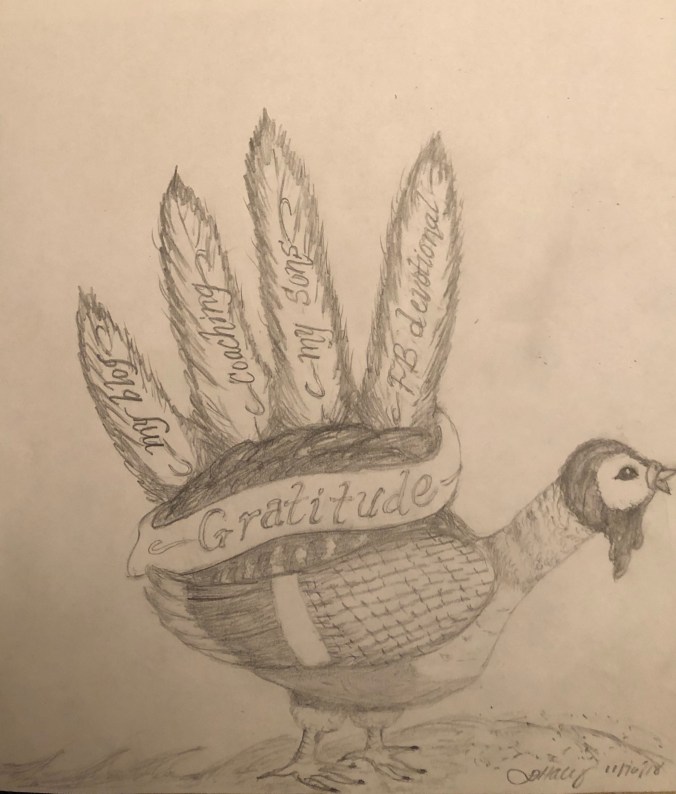
Especially when we participants were asked to draw hand turkeys.

For real? I sighed. Is this in any way productive? 

I couldn’t recall the last time I did this. In my early elementary years, surely.  I tried to remember helping my own children trace their little hands in autumns past.

But I complied. I penciled the outline of my hand onto white paper.

We attendees were then told to write “something we’re proud of” on each of the four so-called tail feathers. These things could be personal, professional, or both.

Well, this was kinda different. The four things came to me pretty quickly:

My blog. It was born as a way of making myself write regularly, evidence of “walking the walk” as a teacher-writer. I can’t stand before colleagues and profess my love of writing or testify to its impact if I’m not doing it on a regular basis. That’s how the blog started; it soon became a keeping-place of memories and reflections, a patchwork quilt of my life now and long ago. Not to mention that it threw the doors wide open for meeting other teacher-writer and reader friends who’ve enriched my days immeasurably. That I’ve sustained it for nearly three years feels like a true achievement.

Coaching. My daily work. I collaborate with K-5 teachers on English Language Arts instruction.There’s a different ebb and flow to it each year.  The work can be like riding a train and watching the landscape zip by at an alarming rate. It’s sometimes like trying to irrigate monotonous, barren deserts. There’s a lot of new expectations of my teaching colleagues this year, new curriculum, newly-tweaked standards (again). With new and greater demands on top of all the old ones, it’s easy for a teacher to feel constrained, paralyzed. Every time I can help simplify, problem-solve, or streamline the work of classroom teachers, I feel like the “flow” gets better for them and for their students. We ALL grow.

My sons. I am so proud of who they are and where they are in life. Both of them are working on seminary degrees, one in music, the other in graduate divinity studies. One knew his path from early childhood, the other took the long way round, but both have chosen paths of service. On this note, my heart becomes too full for words. . . .

The Facebook devotional.  I don’t have a Facebook account (preferring Twitter) but my husband does. He’s had it for years and has never written a post. Last week, out of the blue, he said: “I need your help.” He’s a pastor. For three decades now he’s tirelessly served churches and communities. He’s married people, buried them, held their hands during their darkest times, laughed and rejoiced with them in the better ones. And ministry is changing; social media is a way to reach out . . . so, enter me.  Would I help him craft a short devotional post each day? It’s a small thing, really, but if the words help someone, or give them hope . . . then to me it’s a way of giving back. See, November marks three years since my husband was diagnosed with ocular melanoma. He lost his eye, but he’s alive. He’s here. Cancer-free. Every day is a celebration. There’s always, always, always something to be thankful for . . . yes, I’ll help him share it each day.

I suppose the professional development presenters may have wondered why I kept working on my hand turkey throughout the entire session. They may have thought I’d tuned them out. I hadn’t. I was listening. What they had to say was actually quite helpful. I processed it all as I added more and more detail to my turkey—let’s hope the facilitators thought I was sketchnoting. One thing just kept leading to another until I realized that the words on the tail feathers represented more than things I was simply proud of. This is the work of my hands, I mused, as I wrote and drew with one hand inside the outline of the other. Each thing I’ve listed is an opportunity, a piece of life’s work given to me.

—Gifts. 

Pride wasn’t the appropriate sentiment. Not even close.

I draped my turkey in a banner bearing the word “Gratitude.”

Isn’t that where the personal and professional roads should converge, anyway? Or the point of origin from which they radiate?

It is for me.

It is from this crossroads of gratitude that I wish you professional and personal joy, in all the work of your hands.

Happy Thanksgiving.

Metaphor

For metaphorMorning glory. Jason BolderoCC BY

Following a poetry unit in fourth grade, the teacher invited me to collaborate on arts-integrated assessments. We set it up by having students choose 1) Poetry concepts they learned and 2) The vehicle for conveying their understanding, one of the multiple intelligences: arts smart, math smart, music smart, body smart, self smart, people smart, word smart, science/nature smart, and one extra that we added, tech smart.

Students could collaborate if they’d selected the same “smart.” They were free to think and design as long as the activity or product defined or represented the selected elements of poetry – imagery, personification, alliteration, simile, etc. Some students chose to make games and puzzles (math smart) with their poetry concepts. Some went straight for Chromebooks. Some preferred sketching and drawing (later in this process one student who struggles with academics will show me how she intentionally incorporated perspective and 3D elements in her art smart visual representation of imagery). A team of body smart students began choreographing a dance to define three concepts. One student wanted to write a song. 

So much excitement, so much brilliance, yet no one picked “metaphor”— the word sat all alone on the chart where students placed their names beside the poetry elements that they wanted to demonstrate.

And no one chose “word smart” as the mode. They had, however, written their own poems during the unit.

I pointed out that word smart is naturally interwoven with music smart in writing a song, and with body smart in the chants accompanying the dance. Words play their part in slideshows, in the puzzles and games, and in all the conversation the kids were having about how to best represent the concepts in these ways.  

As for metaphor . . . the students grinned. With lots of teeth. “You said you’d give us a model.”

Ah. So I did. Is that why no one picked “metaphor” and “word smart”? Was this a conspiracy?  A throwing down the gauntlet?

I smiled inside myself. I would have chosen metaphor anyway (I think). And what better “word smart” way to convey its meaning than through poetry?

When I returned, rough draft poem in hand, I posed a question: “First, I need to make sure you know for yourselves what metaphor is. How would you define it?”

Their responses:

“An image that stands for something else.”

It helps paint a picture in the reader’s mind.”

You can’t say ‘like’ or ‘as’ because that’s simile. You have to say something IS something else.”

A comparison.”

Wordplay.”

Really, guys? And none of you picked metaphor? Seriously?” I asked in mock exasperation.

Giggles. They sit gathered round my chair, on the rug at my feet, these young sages waiting for me to read.

What is metaphor?

Metaphor is the sun behind the clouds

the heavens reaching long, shining fingers

down to the earth of our minds.

Metaphor is the moon on the ocean of knowledge

bits of silver smiles shining on a dark surface

that’s always moving, moving, moving.

When I say that home is the velvety warmth of my dog

and the laughter of my family around the dinner table

that’s metaphor.

What is metaphor for?

Well, meta means beyond.

Metaphor is understanding

in a deeper way.

Without metaphor

imagery is a just a strange skeleton

without flesh and color

something we don’t recognize.

Metaphor is what we know

helping us to see better.

Metaphor is new glasses.

Metaphor is the cloak

thrown over the invisible

to make it appear

and have shape

and make sense.

Without metaphor

poetry would shrivel

and maybe die.

Metaphor waters the poet-tree

and keeps it alive.

That’s meta.

That’s what it’s for.

Metaphor.

In one motion their hands went up to flutter or “sparkle” in silent applause; I had a fleeting sense of being in a beatnik coffee house, minus the sound of finger snaps. Of course these artists, mathematicians, scientists, all, will be chomping to give me specific feedback with the rubric that I helped them create. They’ll do it thoroughly and gleefully, rest assured.

Such a jewel-encrusted, double-edged sword, teaching.

Thank you, Brian Wilson

img_0617

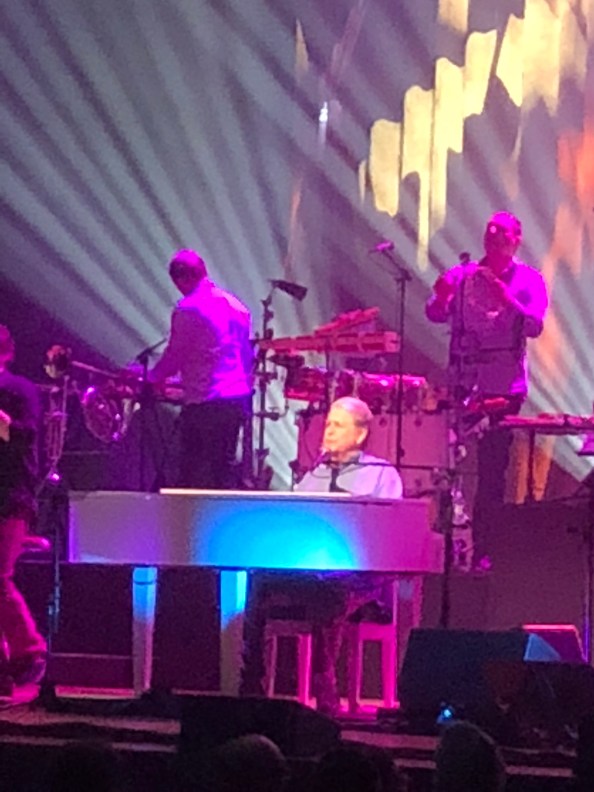
Brian Wilson sings his favorite song from Pet Sounds, “God Only Knows.” 11/02/2018. Richmond, VA.

If setting is everything, then tonight is mystical.

To begin with, the November evening is balmy. Few people in the crowd gathering on the sidewalk are wearing jackets. There’s quiet anticipation in the air, in the murmur of voices. It’s supposed to be raining but the sky above the city is dry, shimmering like a thick swath of navy blue velvet.

The sense of wonder deepens upon entering the auditorium. I’ve never been inside the Carpenter Theater in Richmond before and am unprepared for the splendor of it. Gilded walls, pillars wrapped in vines, balconies adorned with Roman statues, backlit alcoves with busts—it’s like stepping out of a time machine into Old World fantasyland. Overhead, white clouds frame the stage front against the dark auditorium sky —ceiling, I mean—where dozens of man-made stars sparkle an ethereal welcome.

The writer in me searches for words:

breathtaking 

otherworldly

adventure

expectancy

Apropos, I think, for our temporary raison d’etre: My family is here for the Brian Wilson Pet Sounds concert.

Primarily because the younger of my two sons (Cadillac Man), at twenty-one, avows Brian as the artist he most admires. He strives to emulate him in his own music. He studies how Brian deconstructed songs and what he did with vocals and chord progressions, complex, innovative stuff fifty-two years ago when Pet Sounds was released and still the stuff of legend, of music history. My son researches the Beach Boys and tells me things I never knew about their origins, talents, trials, and tragedies. He identifies with Brian on multiple levels—they both have a penchant for Cadillacs, both of their fathers lost their left eyes—but mostly my son relates to Brian’s musical thought and language. Cadillac Man confesses that he couldn’t concentrate on what his first grade teacher was saying in class years ago because “Sloop John B” was playing in his own head. This explains a few things about his childhood academics  . . . nevertheless, that this incident occurred nearly four decades after the release of Pet Sounds speaks to the timelessness of Brian’s work.

So we’re here to see an icon tonight. A glimpse of the extraordinary.

For me it’s not just the music, although I’ve always loved it, too.

It’s the story.

A boy deaf in one ear, teaching his younger brothers the harmonies he heard in his head, singing together in their bedroom at night. An athlete who once wrote in a high school essay: “I don’t want to settle with a mediocre life, but make a name for myself in my life’s work, which I hope will be music. The satisfaction of a place in this world seems well worth a sincere effort to me” (I Am Brian Wilson: A Memoir, 2016).

A name for himself, a place in this world, and a life that’s anything but mediocre . . .  I think about these things as the crowd greets him with a standing ovation. Brian is helped onstage, having had back surgery earlier this year. He wears a brace on one leg. His escorts seat him at a white piano, center stage, where his silvery hair glows in the spotlight.

I look at him and think about time. How quickly life passes. I think about the strange, sad, haunting truth of great gifts so often coming with equally great physical or mental afflictions attached, as if that’s part of the deal. We all have our demons. The ones that chase us, the ones that we chase. Brian’s battles are well-known. The most wondrous thing to me this night is that he’s still here, despite all, the only one of the Wilson brothers to reach old age, a survivor of so much. Still performing, sharing his profound gift.

He speaks just a little throughout the show. I wonder how he feels, what he thinks. At seventy-six, does he enjoy touring now? He wasn’t able to for years when he was young. Does anxiety still threaten to crush him? Is he in much physical pain?

If the answers are yes, then he’s mastered these demons. For the sake of the music, for others.

Brian sings his brother Carl’s solo in “God Only Knows” as stage lights come to rest on him like splintered sunbeams. God rays. I recall the clip of his speech for the Beach Boys’ Rock and Roll Hall Fame induction, in which he said that “music is God’s voice” and that he only ever wanted to create joyful music to make people happy.

He does just that, even now. At the end of the concert, this orderly, respectful crowd—comprised of multiple generations—is on its feet dancing to the old favorite songs. It’s a celebration of life, love, being young—whether now or long ago—and the creative power of humanity overcoming the terrible weight of being human. I think of these things as the audience thunders its applause, as Brian’s escorts return for him, as he’s carefully ushered away.

I wonder what it costs him, these moments of joy for other people. And marvel that he still has it in him to give.

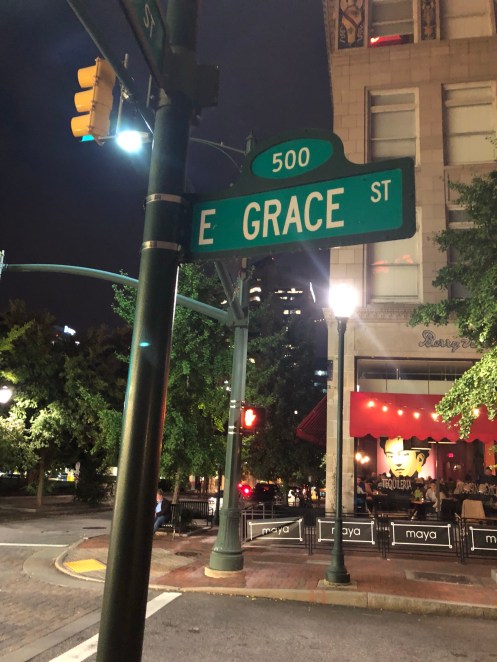
I leave the theater mentally wishing Brian peace in the days and years remaining to him and to his loved ones. I hope he can keep doing this for as long as he wants. I ponder the curious nature of gifts and how they’re so clearly bestowed on certain mortals. Maybe the Roman auditorium put me in mind of the Muses. There’s a word for the strength to overcome, to relentlessly pursue and attain the beautiful, despite unfathomable suffering, the Herculean feat of living. I can’t quite think of what it is. Overhead, the real stars glitter at random through an indiscernible cloud cover. The night is soft, quiet. And then—there it is. The word. I am not sure what Brian would say, but to me, the street sign says it all:

*******

I must also mention the timeless charisma of Al Jardine in this performance. He carried much of it while seeming to enjoy every moment. As did Blondie Chaplin, with absolute showmanship. All in all, the instrumentalists and vocalists paid exemplary homage to the music, which sounded unbelievably rich and true performed live. 


After

On a mission through the school’s main hall

a casual glance through the glass wall

fresh mulch, a sea of woody brown

a few dead leaves scattered round

—Fall.

It registers after I pass

something else beyond the glass

something crumpled on the woody bed

a conspicuous spot of red.

I turn around. 

A bird, lying on the ground

flat on its back

speckled white and black

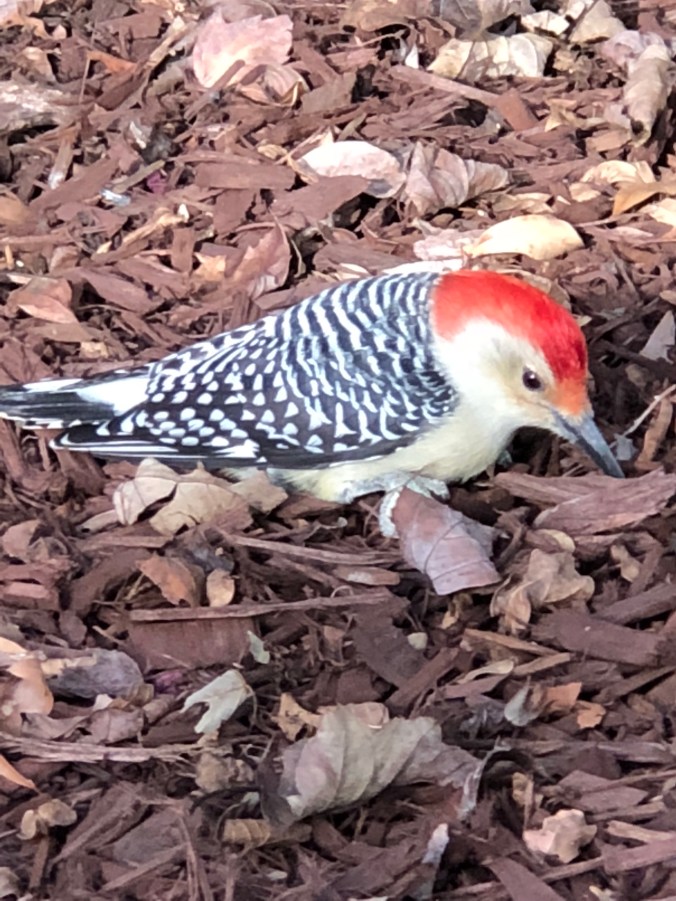
white claws curled, scarlet head.

Little woodpecker. Dead.

Flew into the glass wall, it’s clear

from the way it’s lying here.

A broken neck, I think

but then, then—I see it blink.

What comfort can I give?

Is it even going to live?

I mustn’t touch it, must let it be

I won’t have it die for fear of me.

The hall’s deserted, what to do

people are waiting for me, too

—I’ll hurry. I can never atone

for letting it die alone.

On my hasty return, a wondrous sight

the woodpecker, sitting upright

scarcely moving, still dazed.

I am amazed.

It opens one eye, tests its beak

assessing the damage wreaked

turns that stunning head

of breathtaking red.

I silently celebrate

as I watch and pray and wait

for that one eye remaining shut

to be all right, to open, to see—but

the instant it does, without warning

with a flurry of wings, off in the morning

he goes. I didn’t see him fall

from my side of this glass wall.

I’m just here, rejoicing, for his open eyes

his reclaimed strength, his reclaimed skies.

My heart goes with him, as he flies

—I saw him rise.

Just before he took flight again. A woodpecker happens to symbolize communication, opportunity, and awareness. How grateful I am to have seen him, to have witnessed his overcoming.