Dear Goat

Dear Goat In The Pasture At The End Of The Street Where I Make a Right Turn On My Way to Work Each Morning:

I just want to say thank you for lifting my spirits on weekday mornings as I drive by your pasture. You cannot know that I look for you and your herdmates, or how the sight of you fills me with inexplicable peace. Perhaps it’s the idyllic setting, the pastoral scene with its inherent restfulness. Maybe it’s the continuity. Your pasture remains as it always has, while all around us fields are being bulldozed and sculpted for the coming of houses. The trees farther down this road are being timbered this very moment… I wonder: Had birds already nested in them? Were there any little eggs that are now lost? It’s possible; this is March. Isn’t tampering with birds’s nests and eggs a crime? I digress. I cannot help it, watching the trees come down even though I know the new houses to be erected will be homes where people will build their lives and live their stories, where children will grow up… meanwhile, on the other side of the world, a man is busily destroying people’s homes, sending them fleeing from danger like animals trying to outrun a raging forest fire, in search of a different place to survive…

Yesterday as I came through here I heard a bird calling and wondered if its tree is gone. Will the big, beautiful,snowy-feathered hawks soon be gone, too? I haven’t seen one for weeks now. I keep watching. And in all the years I’ve lived here, I’ve never seen skunks until last week when I saw two dead in the road and my son saw a third. We didn’t smell them, thankfully. Makes me wonder about them never seeing the end coming…

I don’t know why I should be telling you all of this, dear Brown Goat in your green pasture so often dappled with new morning light when I drive by. All I really meant to say is thank you. I see you grazing in the grass and a tiny bit of balance returns to the universe. Your placid nature spills into mine. You somehow impart the right and needed mood for the day…

I am grateful for you.

Sincerely,

An Admirer

P.S. I would deliver this letter to you in person but I suspect you would only eat it… I’ve had to eat my words before and it’s not a particularly pleasant experience… trust me.

*******

with thanks to Two Writing Teachers for the Slice of Life Story Challenge every day in the month of March.

Carry on

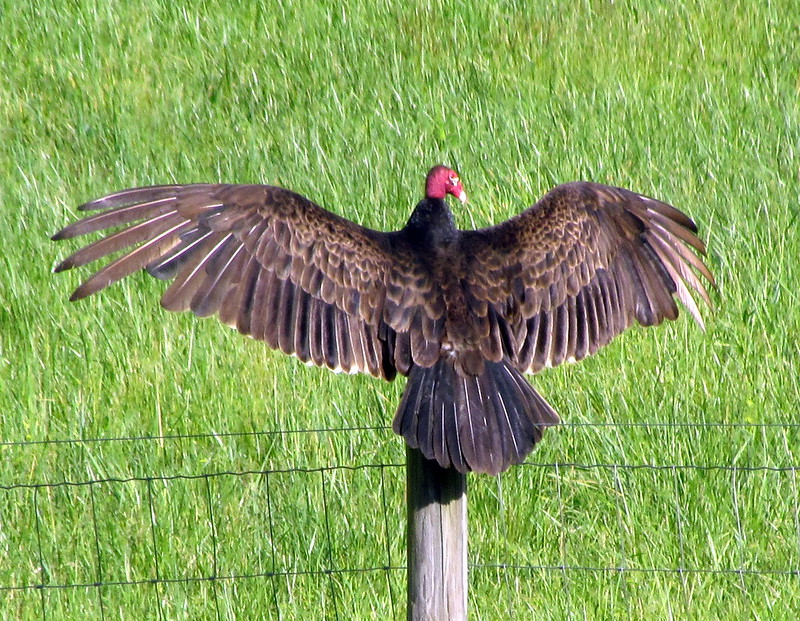
The bird at the roadside sat
day after day after day
by the body of his lifetime mate
after she passed away

The naturalist saw him there
day after day after day
’til finally with some rotting meat
she lured the bird away

You must carry on, old boy
carry on carry on carry on
a marvel, how you honor your mate
when she’s carrion carrion carrion

Dedicated to the local buzzard who mourned his dead partner by the roadside. Until this story reached me, I didn’t know that turkey buzzards mate for life. I’ve since learned that they lack vocal organs…they cannot call or sing or cry. They can only grunt and hiss as they go about the humble work of cleaning up carcasses…but not, apparently, those of their mates.

Photo: 11 Turkey Buzzard Pittsboro NC 9425bobistraveling. CC BY 2.0.

*******

with thanks to Two Writing Teachers for the Slice of Life Story Challenge every day in the month of March. This is my sixth year participating.

Shot of strength

On this final, frosty February morn, I wasn’t sure I had stamina enough to endure the day. For a short month, February can be so long. Teachers know.

I bundle up. I get in the car. I sigh. Could I manage to take half a day? Is it worth it? Probably not. A moment at a time, a moment at a time…

I drive. The empty fields seem sugarcoated with ice. I look for hawks. I am always looking for hawks. I don’t know why they lift my spirits so. They just do.

No hawks. No plump little goats in the goat pen by the stop sign, either. But something different in the glassy pond…

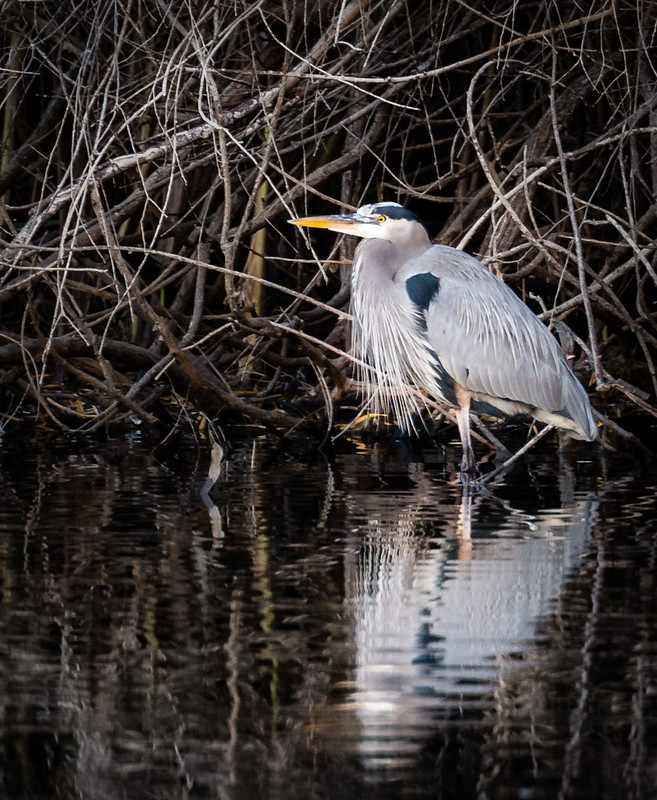
A great blue heron.

Symbol of self-determination, paragon of peace, harbinger of spring. Stoic, tall, unflinching. Stunning.

Just the shot of strength needed for the day.

Photo: Great Blue Heron at Sunset. Maxinux40k. CC BY-NC-SA

I stopped to take a picture of my beautiful heron but it’s not clear enough to post. I have to content myself with sharing this one instead; mine looked so like this.

Mystery creature

Pleasant evening drive
after a taxing workday
heading to supper

ahead, in the road,
a little creature trotting
like some kind of cat

I said, What IS that?
I can’t tell, said my husband
so sphinx-like, it was

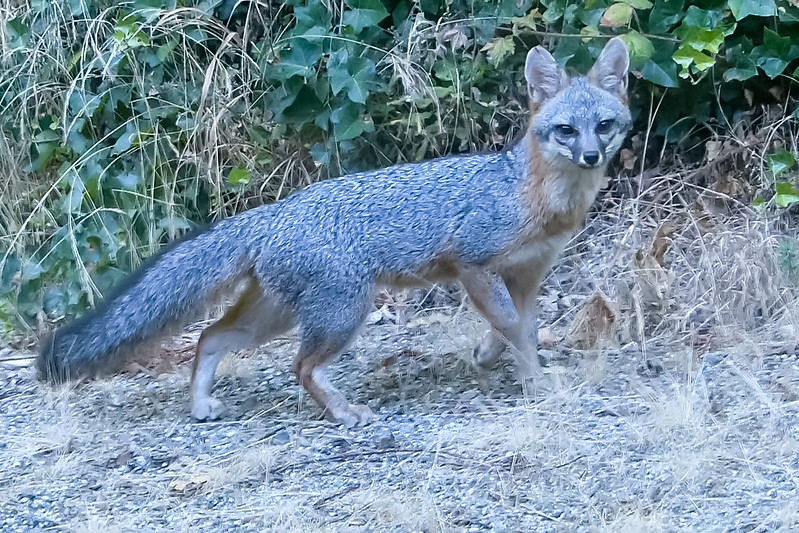
long, low, and silver
big pointy ears, feline grace
canine whiskered face

—oh! we cried, a fox!—
as it vanished, phantom-like,
in the shrouding woods.

We’d have known it right away, had it been red. We see those occasionally. Gray foxes are actually native to the area, however; the red fox didn’t appear in this part of the country until the 1800s. I cannot recall having seen a gray fox before. It was small and lovely, with a grizzled silver coat so prized by hunters. These are the only foxes that can climb trees.

I wonder where our enigmatic gray fox was going on its jaunt along the woodland road just before dusk…and how many more of its kind are about, in the secret places…

Photo: Gray FoxKeith Wescourt. CC BY-NC-SA 2.0

Bookends of winter days

Winter mornings
dawn in gray monochrome
before the sun bursts on the scene
like a passionate artist
with its gilded palette

Driving to work
in this gray in-betweenness
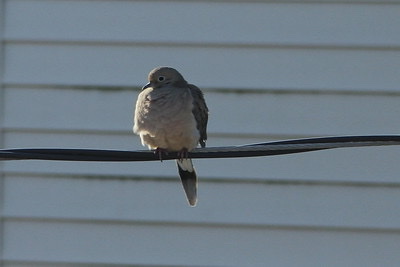
I note the doves
always sitting on the power lines
like heralds
their plump bodies
of soft sandy colors
framed by the oyster sky

reminding me:
look for the peace this day
live as peacefully as possible
this day

Then, in the strange way
of life
as I drive home
weary and worn
the golden part of the day
nearly spent
what should I see
on other power lines?

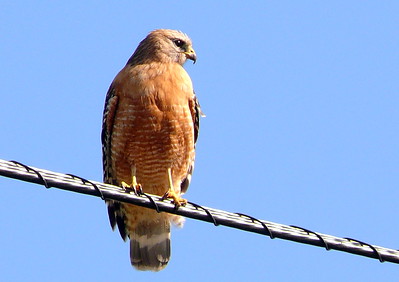
Hawks
big and breathtaking
still as statues
painted in shades of rust

They might remind some people
of raw bloodthirstiness
or predatory fierceness
but their beauty
fills me with such awe
that it’s all I can do
to keep my eyes on the road
driving home

as I think about how my winter days
are bookended by birds
and how there’s something
inherently sacred
and profoundly satisfying
in that.


DoveJim, the Photographer. CC BY 2.0

Red-Shouldered Hawkgoingslo. CC BY 2.0

(One of these days, when I can stop the car safely, I am going to get my own photos of my hawks…)

*******
with thanks to Ruth at SOS-Sharing Our Stories: Magic in a Blog
for today’s inspiration to write:
“You are invited to linger in your winter memories, reach deep and pick a golden moment to share.”

Dirt road

On Ethical ELA’s Open Write today, Kim Johnson invites teacher-poets to compose poetry from paint chip colors. She happened to have “Dirt Road” in her own list.

As soon as I saw that name, it was over. I would have to take Dirt Road. Its pull is too strong for me, calling me back to a place I write about often.

So today I write a memoir poem, although I did incorporate a few paint chip names along the dirt road: Oyster Shell, Turtle Green, Pink Blossoms, Dreamy Memory, Forever Fairytale, Summer Sunflower.

Maybe tomorrow I’ll try whole new paint chip poem away from Dirt Road.

This is where the name led me today.

Dirt Road

I watch the highway
and my heart beats fast
when I see it coming
just around the bend

old dirt road

off to the right
threading through the trees
past Miss Etta’s tiny turtle-green
screened-porch house
where she dips snuff

past the homeplace
standing like a dreamy memory
white paint faded to tired oyster shell
sunlight gleaming
on the tin roof

Grandma was born here

past the tangle of sunflowers
planted by her brother
who still lives here alone
something is different about him
I don’t know what
it’s in his long face
he never says much
but he did give me some quarters
once

just beyond the sunflowers
Granddaddy’s garden
looks like something
an artist painted
in watercolor greens
in perfect rows
he grows collards 
and little round peppers for his vinegar
squash, cantaloupe, snap beans, 
Silver Queen corn, crowder peas,
and butterbeans, 
speckled pink and white
when I help shell them
from their furry green pods

then the grape arbor he built
laden with scuppernong vines
big leaves waving Hey
big brown-gold grapes
won’t be ready yet
and they aren’t even pretty
but to me
they taste like Heaven itself

then the row of crape myrtles at the curve
bright pink blossoms nodding their heads
sometimes shedding, rolling on and on
smooth forked trunks
where I like to climb and sit
and make up songs
thinking in forever fairytale

the house
bright white
black shutters

and I can’t think now
about the tire swing 
hanging there in the pecan tree 
studded with woodpecker holes
or the tiny cemetery with its ghosts
across the old dirt road

because Grandaddy and Grandma
are coming across the yard
straw hats shielding faces
lit with smiles
bright as the summer sunflowers
ever turning toward the sun

Daddy pulls off 
the old dirt road
into the yard

we’re here
we’re here

I am out of the car 
before it stops
running toward
open arms

and I never
want to leave.

My grandparents and my oldest boy on the old dirt road, a long time ago

*******

with thanks to Kim Johnson, Ethical ELA, and Two Writing Teachers for the weekly Slice of Life Story Challenge. Writing is but half the magic. Sharing is the other half.

Shedding

Let me preface this post with a restated confession: I am not exactly a fan of snakes.

But they, like all of nature, have lessons to teach, if one is willing to learn.

I hope to always be teachable, so…

Early in the summer I found a snakeskin in my garage. Just a little one, but still.

A few weeks later, I found another.

This morning, I found a couple more.

So.

Snakes seem to have been vacationing in my garage. Let us think on that momentarily versus thinking that they’ve taken up permanent residence there.

Here is why I say this: The skins, I’m pretty sure, belong to smooth earth snakes. I’ve seen a couple over the past year or so, which is saying something: These are nonvenomous, shy, fossorial snakes that don’t like to be seen. The first one I saw was dead, lying across my sidewalk after a rainstorm. Pale gray body. I thought it was a worm until I saw the tell-tale scales. The second one was stretched out in my flowerbed mulch, black tongue flickering in and out “smelling” the air, trying to determine what I was. That’s it for my lifetime earth snake sightings. Two. They are uncommon, tiny creatures…just the size of these silvery skins left behind.

So they live in the ground around my home, harmless little things, going about their business of eating earthworms and itty bitty snails or whatever.

And coming into my garage to moult.

Which is nevertheless discomfiting. For me, anyway. Not for the bashful snakes.

I don’t especially want one to come all the way inside and hang out or anything.

But they do have me thinking (among many things) about shedding one’s skin. Metaphorically, that is. As in, what sorts of things I wrap around myself and cling to when I could be letting go and growing. Mindsets, habits, beliefs, assumptions, what have you. Which things actually nourish me, and which actually constrain me? Which are beneficial, and which are harmful? What do I need to shed and leave behind, to better move forward?

I suppose this thinking occurs because summer is waning. I return to work next week not knowing what the year ahead will look like, other than back to masked here in my district. I think about the possibility of a full return to virtual learning. It is more than a great many teachers can take. Yet… we got through last year. The children got through. There were good things in spite of the trials; there were surprises. Many from the children and most concerning ourselves. School of 2020-2021 took a toll on everyone. We had to shed quite a bit of familiarity and comfort to get things done. But we did it. We grew.

I don’t wish for a repeat any more than I wish for snakes to be summering in my garage. I cannot ignore the timing of COVID rearing its more-venomous-than-ever head again when we thought it was on its way out, just when we are on our way back into the schools. I now have a granddaughter starting kindergarten. Her little sister will be born this fall. There’s always a lot at stake when it comes to children—in the words of Herbert Hoover (ever how unpopular a president he was in his day): “Children are our most valuable resource.” There’s nothing more precious. They represent our tomorrows; they are the culmination of our yesterdays. We have to shed the fear of failing them. Not assuming the worst, or that “we can’t,” but doing daily, as only that given day dictates, what must be done for their care and nurture as well as for our own. We have to be… well, “as wise as serpents.” When it comes to plans, we have to hold on loosely, ever how painfully contrary it is to our nature.

This summer I had plans for household repairs and updates. That was before the dryer quit working. Followed by the air conditioning during the hottest week of the year (of course). Followed by turning on the water one morning and nothing coming out of the faucet; the pump died.

I did repairs, all right. Just not the ones I planned.

But I got through. I now have a new dryer and water pump. The AC unit didn’t have to be replaced, thank heaven. All is working well. Throughout this whole process I thought about adapting. I dried clothes out in the hot sun. I remembered how my grandparents never owned a dryer. I thought about that one window air conditioner they had (late in their lives) against a sweltering Carolina summer and no AC at all in the old Ford Galaxy 500; I once left a stack of 45 RPM records on its back deck under the windshield. They melted. They warped and ruffled like clam shells. I’ve never had to pump or draw water in my life, but I had plenty of bottled water and didn’t have to miss my morning coffee while waiting on the new pump.

So I attempt to bring the lesson of shed snakeskin to a point here: In the discomfort is growth. Newness lies ahead; it approaches incrementally as we scratch away at the constraints and setbacks of now. Endurance is possible. We certainly know this. Sometimes the thing that needs shedding most is our perspective…

Meanwhile, I go back to cleaning out my garage, another thing I hadn’t planned to do right now, but the snakeskins sparked it. Time to purge what needs to go and put up a shelf to keep everything else off the floor. I am working on it. Hot, tiresome, dusty work, but I can see my progress.

And it feels good.

Thanks to the snakes.

******

thanks also to the Two Writing Teachers community, where writing our way through is a way of life…courage and strength to all.

Sidewalk angels

Asheville, North Carolina.

First vacation in two years, owing to my husband’s cardiac surgeries and the pandemic. He wants to see the mountains. They remind him of his childhood. They’re in his blood, like rivers and bays are in mine.

We’re not campers, though. We stay in town.

Late arrival, chilly summer rain, deserted city streets. Apparently everything closes early on a Sunday night. Downtown is eerily vacant, as if we’ve landed in a time warp or the Twilight Zone. Where have all the people gone? We walk in the desolation, huddled under our umbrellas.

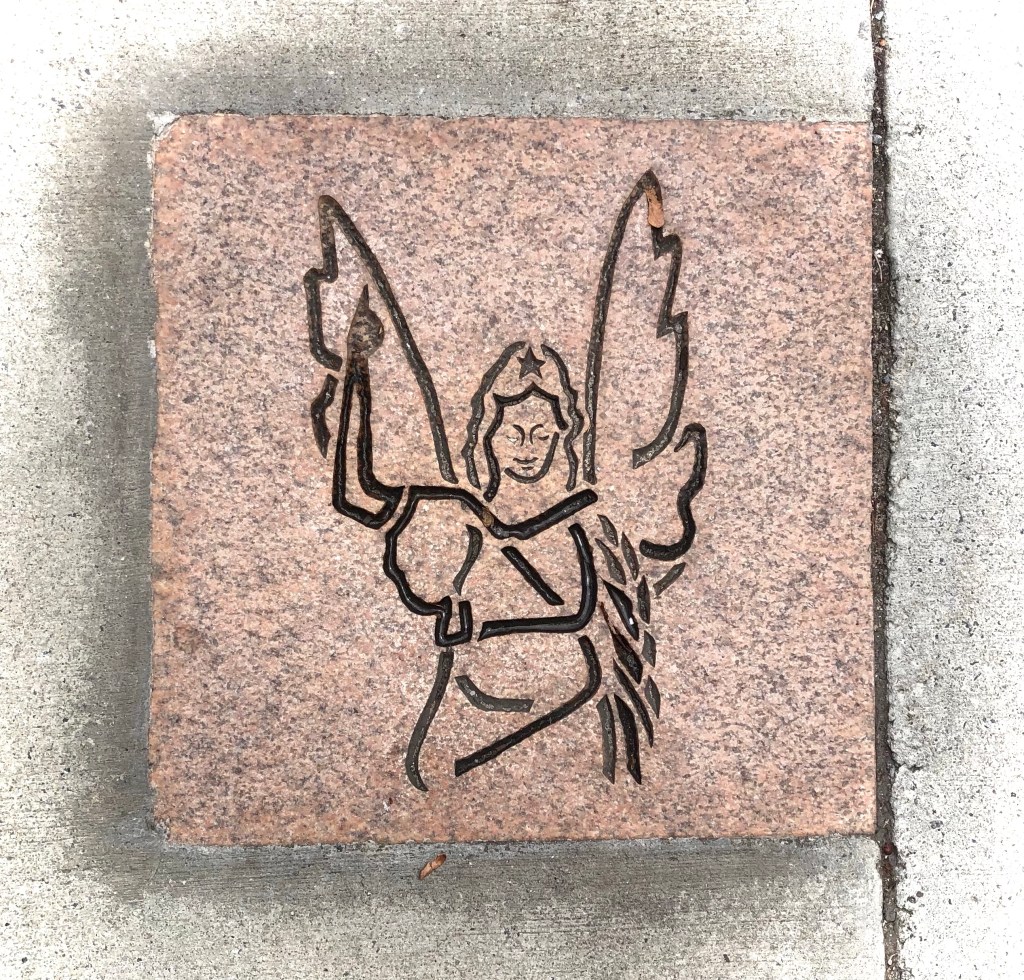
On the sidewalks, random pink granite squares bear strange designs of some secret code: a feather, a horseshoe…

“Did you see that angel?” I ask my husband. I think I recall seeing this here before, on a previous visit.

“No. Where?”

“Back there, on the sidewalk. An angel pointing up, with a star on its head. We just passed it. I’m sure it has something to do with Thomas Wolfe. You know, ‘Look Homeward, Angel’…”

“Oh yeah, I bet it does.”

The rain slacks off. We round a corner to discover people dining under a café awning. A stocky, stubble-faced man lurches along the sidewalk from the opposite direction; his countenance lights up when he sees my husband: “Kris Kristofferson! Jerry Garcia! Can I get your autograph?” He fairly ripples with his own merriment.

Aside from the mountain panorama, this may well be the highlight of the trip for my hoary-curled, gray-bearded husband. Never mind that he’s a Baptist preacher. He’s a lifelong fan of these artists. He laughs: “My autograph won’t get you very far, brother.”

As we press on, trying to determine if any other restaurants are open, I glimpse blanketed bodies nestled in recessed shop doorways. The homeless, sheltered from the weather, settling in for the night ahead. Disparity, like cold mountain rain in midsummer, seeps all the way to my bones. I shiver.

They are still cocooned there the next morning when my husband and I hunt for coffee and bookstores, navigating around other vacationers who are now out and about, pushing their dogs in strollers. One lady on the sidewalk has risen and is sitting by her rolled blankets with a small basket by her side and a little black dog in her lap. Over the course of the next two days, as we try to decipher the odd hours of stores and restaurants (we discover that some are closed on Mondays, others on Tuesdays and Wednesdays, and that some don’t open even when their signs said they will; how apropos is the ‘Stay weird, Asheville’ slogan?) —we see this petite lady several times. She remains there on the sidewalk by the same shop while other people of the street come and go, apparently checking in with one another. She is of indeterminate age. Slight wrinkles, blondish hair pinned up. Blue eyes. The little black dog stays right with her, cuddled close, never making a peep, watching the world walk by. I note that they get visitors. Some bring food. As my husband and I wait for the walk signal to cross the street, a young man from the Ben & Jerry’s shop comes out with a tiny cup of ice cream for the dog. I wonder how often he does this, how many other shopkeepers share in this caring…

I wonder how long this lady has been here, what her story is, if she has any family, if she’s ever stayed at a shelter. Not all shelters are safer than being on the street, especially with COVID. I find myself trying to imagine her daily life, her subsistence, the haunting freedom of living on the street; in the lyrics of Kristofferson: “Freedom is just another word for nothing left to lose.” She doesn’t appear to ask anyone for anything although she has a red plastic container sitting out for donations. I begin to worry about someone taking it from her…

On our last day, as my husband and I approach, she greets us: “Good morning.” She smiles. I know she’s recognized us as having passed this way before. It’s a familiar, familial tone. Full of warmth, the way a mother speaks to her waking children.

We respond in unison: “Good morning!”

“Your little dog is precious,” I say. “And so good.”

“Thank you.” Her voice is raspy but pleasant. “She’s a girl.”

“Such a sweet girl! What’s her name?”

“Raspberry.”

My husband and I learn the woman’s name, too. We chat with her for a moment. My husband takes some cash from his wallet and puts it in the red tub where the woman has an inconspicuous cardboard sign with the words ‘Thank you and God bless youG. and Raspberry’ written in red marker, accompanied by a small drawing of a cross.

We say our goodbyes. The image of Raspberry’s moist dark eyes stays with me as my husband and I walk our last through this beautiful city of Look Homeward, Angel: The Story of a Buried Life. Wolfe set the novel in a fictionalized version of Asheville, his hometown, to explore the “strange and bitter magic of life.

G. and Raspberry remain on my mind as we head homeward through the majestic blue-shadowed mountains. What is homeward if you have no home? Which way do you look then?

I have infinite questions, but this I know: there’s more than one sidewalk angel in Asheville.

*******

It is estimated that over half a million people in the United States experience homelessness. This includes those in shelters, transitional housing, and hotels and motels paid for by charities or government programs as well as those who sleep in cars, parks, camps, and places not meant for human habitation. While many misconceptions persist, among the the primary causes are lack of affordable housing, poverty, disabilities, and domestic violence.

The pink granite squares with designs in Asheville’s sidewalks are part of the Urban Trail, comprised of thirty different stations with sculptures representing historical periods. The Trail tells the story of the city’s past. The angel represents The Times of Thomas Wolfe, 1900-1938.

Right now, as the sun rises in my part of North Carolina, it’s raining again; I wonder how G. and Raspberry are faring this morning.

with special thanks to Two Writing Teachers for providing a venue for sharing Slices of Life.

Apothecary of the soul

Today, the first Thursday of the month, my Spiritual Journey gathering writes around the theme of “Nurturing Our Summer Souls.” Deepest thanks to my friend, teacher-poet-artist Carol Varsalona, for hosting.

Summer itself is about journeys, is it not

In my previous post, A walk back in time, I told of a long-awaited trip to the Country Doctor Museum in the small town of Bailey, NC. I expected to learn about rural physicians and their practices in the 19th to early 20th centuries. I didn’t expect to be mesmerized by the first exhibit, a reproduction apothecary shop replete with show globes (which became the official symbol for pharmacies), exquisite leech jars, real live leeches, rows of dried herbs and powders displayed in large glass jars bearing labels of names so poetic and compelling I itched to look them all up right there on the spot, and black pills made in the shape of tiny coffins because they contain a measure of poisons like mercury, so an illiterate population would be mindful not to overdose.

I certainly wasn’t expecting the large painting on the wall behind the counter…

Apothecary of the soul painting, circa 1700-1750. Artist unknown.
Image: Joyner Library, East Carolina University.

It dominated the wall—the whole room.

“These ‘apothecary of the soul’ paintings are rare,” the docent told our tiny tour group of four, one other couple plus my husband and I. “Most come from Germany. You can see here that Christ is the apothecary. He’s holding the scales, weighing his Crucifixion against the weight of a man’s soul… behind them, jars are labeled with the virtues…we’ve had visitors who are fluent in German and they tell us that this is an old form of the language, much of it is complicated to translate…”

I can make out two Bible references, though. Here’s the King James translation:

Matthew 11:28:

Come unto me, all ye that labour and are heavy laden, and I will give you rest.

Isaiah 55:1:

Ho, every one that thirsteth, come ye to the waters, and he that hath no money; come ye, buy, and eat; yea, come, buy wine and milk without money and without price.

My tour group moved on too soon. I couldn’t linger to study the work at length, to grasp more of its symbolism, so I’ve since visited the Museum’s website for more information. There I learned that an apothecary may have commissioned the painting. Apothecaries wanted to draw people to their shops; they sought to be alluring, to the point of extravagance (hence the elaborate show globe towers and gilded leech jars). But imagine the effect on the ordinary townsperson, in need of help, relief, comfort, entering the shop to find Christ adorning the wall. If customers weren’t able to read the verses (from Luther’s 1545 translation of the Bible, I wonder?), they could see that Christ’s right hand holds the scales and that his sacrifice outweighs the man’s sins, represented by a horned beast. The man holds a banner reading My sins are heavy and overwhelming and grieve me from the heart.* Christ’s left hand rests on what appears to be crosswort, a plant often used to treat wounds, headaches, and other ailments, possibly representing a cure-all from the hands of the Great Physician (or Apothecary) himself: the dispensation of spiritual healing as well as physical, “without money and without price.”

I left the shop thinking about the level of trust one must have in the apothecary, and feeling as if I’d been on a pilgrimage versus a museum tour. This happened to be my first journey of summer, which has come at last, bright and beckoning, as the world strives to heal from the COVID-19 pandemic…

Here is to rest, ongoing spiritual journeys, and nurturing the soul.

*******

*Source: Apothecary of the Soul video, ECU Digital Collections, via the Country Doctor Museum website (see Learning). The Museum belongs to the Medical Foundation of East Carolina University, under the management of the Laupus Health Sciences Library.

Other Apothecary of the Soul paintings can be found online; they contain much of the same symbolism.

A walk back in time

After many years of mentioning it, my husband and I finally visited the Country Doctor Museum. Off the beaten path in a nearby town, the museum consists of three small buildings, one of which is a combination of two actual 19th century doctors’ offices. The museum began as a memorial to rural physicians, expanding over time to include the nursing profession, home remedies, and the apothecary. It now houses an impressive collection of artifacts from the 18th to early 20th centuries.

I expected to learn things. I didn’t know, for example, that this is the oldest museum in the United States dedicated to the history of rural healthcare, or that it’s been taken over by my alma mater, East Carolina University. The docent said: “That saved us during COVID. We had the funding to reopen. Many private-funded museums could not.”

I mourned the loss of museums that had to close for good as we crossed the threshold of the apothecary… where an otherworldly, unanticipated, delicious strangeness awaited on that side of the portal…

A mammoth cabinet of gleaming cherry wood with ornate scrollwork, sunbursts, and Victorian spindles runs the length of the left wall. On its shelves, behind glass doors, stand hundreds of large jars bearing white labels and names of their contents—assorted dried herbs, powders, and liquids—in large black script: Crocus, Cloves, Mace, Valeria, Aq. Rosa., Pond’s Ext., Sol. Benedict Quantitative, Lotio Pilocart Morrow, Pepsengia. Some labels look new; others appear to be timeworn, the lettering nearly illegible. The docent speaks in a low, unmodulated voice about paregoric, opium, mercury, and poisons that were often part of remedies mixed by the apothecary, dispensed to a largely illiterate population which couldn’t read labels. In order to prevent overdose, some of the pills were fashioned into tiny black coffins.

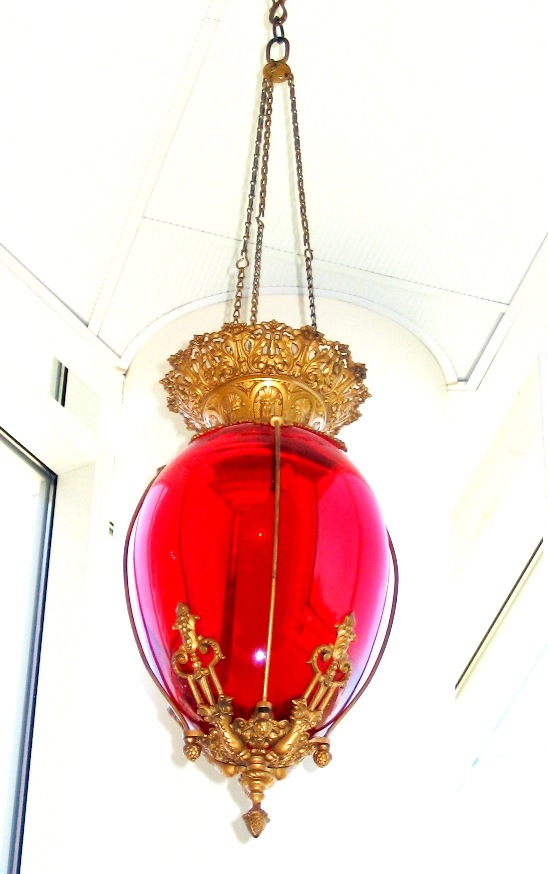
As I look at these coffin-pills, trying to imagine ingesting such a thing, the docent points to the show globes in the cabinet. Tall, decanter-like vessels of different-colored liquids—green, yellow, blue, red—stacked upon each other in rounded triple towers. They seem art deco or like something from the 1960s. “Show globes are an official symbol, like the striped pole is to the barber,” says the docent. “People entering a town would know this is where to find the apothecary. The show globes were displayed in the shop’s front window, and every color had a meaning. The apothecary kept a recipe for mixing dye in water and a guide for when to display certain colors. Red, for example, would warn travelers that there’s widespread sickness in this town, an epidemic…”

I turn to see a large, single-tier show globe with antique bronze trim sitting alone on a pedestal behind me. Full to the brim with bright red, transparent liquid.

Of course, I think. The docent is wearing a mask. I wonder if the all the museum guides came by cover of night in March of 2020 to mix this red solution. And if it will remain red until COVID-19 makes its full departure.

Hanging show globes were sometimes mounted in the apothecary’s shop window.

The docent is now speaking of bloodletting and leeches.

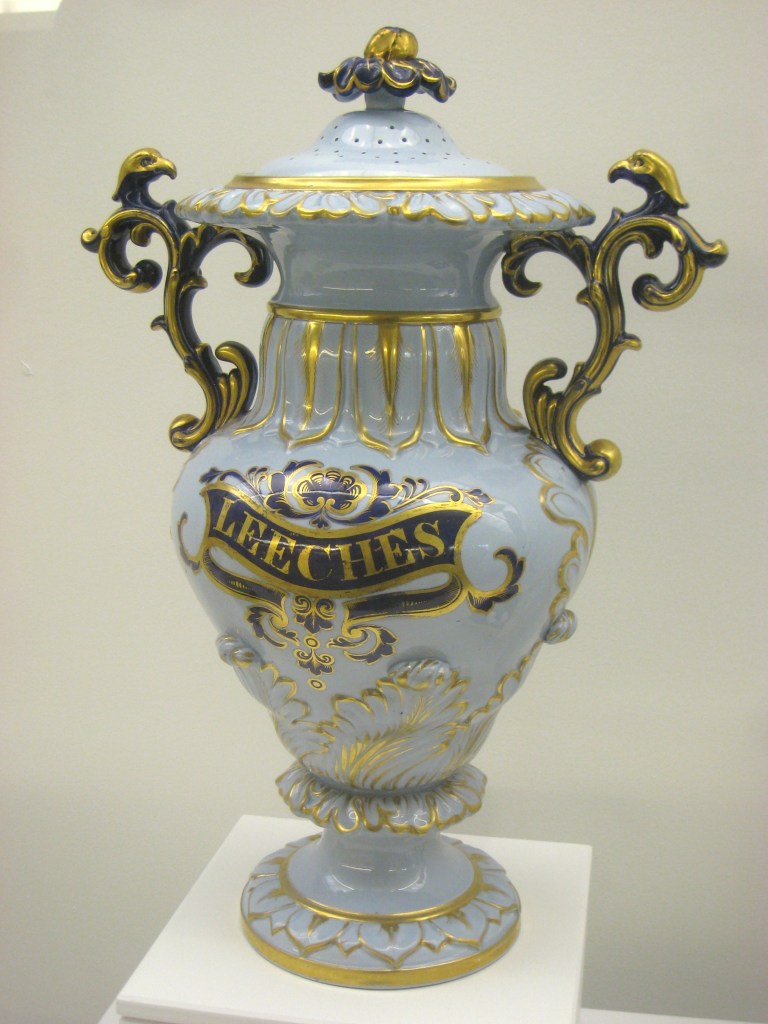
There are, in fact, live leeches on display. They’re floating contentedly in a clear glass bowl of water beside a large vase decorated with a delicate floral pattern…along with the word LEECHES in utterly incongruous, glorious gilt adorning a black banner.

The museum’s leech jar is very similar to this, only with a sweet pattern of tiny pink flowers and vines.

“The apothecary kept leeches in leech jars such as this…” the docent is saying. “It was advertising. The fancier the jar, the better the quality, people believed…”

I’m awed by the jar, that it was designed solely to hold worms. Albeit important ones… and I read once, somewhere, that leeches are amazing escape artists: A more recent druggist had a leech that chewed through a modest gauze lid covering; he found the escapee several days later, lounging on the turntable of his record player.

The docent continues: “Leeches are still in use today. We had a plastic surgeon visit once. He told us of reattaching someone’s ear and using a leech there to increase the blood flow for healing…leeches are often used when fingers are reattached…you don’t feel the leech, of course…”

We are about to move into the next room where there’s a real human skull and kits of amputation tools from the Civil War era, but I want to linger here, I have a thousand questions about the tinctures and remedies and practicesand I want to study the magnificent 1700s era painting on the right wall, above the counter where the apothecary would make pills by mixing powders and dough, rolling and cutting with a pill-roller. The artwork depicts Christ as an apothecary, with elaborate calligraphy in old German. It presides over the whole room.

But time does not wait; it moves on and so must I… prying myself away from the painting and jars and show globes, I content myself with the knowledge that a healing-herb garden waits at the end of the tour. I hurry into the next room just to make the intriguing discovery that I am now standing in the office of a Victorian doctor whose not-very-common surname is my own maiden name.

What a peculiar sense of belonging…and, I think, beginning, of something I’ve yet to name.

*******

I plan to write more about the painting on Thursday.

You can visit the Country Doctor Museum online to learn more and to view many fascinating artifacts.