Do you remember how it stormed on that long-ago morning and your mother cried because it was raining on your wedding day?
I do.
Do you remember that the ceremony was over in ten minutes (my aunt looked at her watch)?
I do.
Do you remember how hot it was during the eternal photographing (especially having to wear a black tux with tails in August) and how much you hated that part?
I do.
Do you remember my going-away outfit that my mother made from sky-blue cotton and how I wore a big straw hat with a big white bow and that just before we said our good-byes she took off her double-strand pearlescent beads and put them around my neck?
I do.
Do you remember as we drove away from family and home and childhood toward all our new tomorrows that the rain had stopped and the sun had come out and the clouds pillared up from the horizon before us like backlit rosettes on wedding cake and you said it was all in celebration of our just being married?
I do.
I remember it all nearly four decades two sons and two granddaughters later. Even the clouds in their radiant array seem to remember today. While marriage is sometimes more blister than bliss I can tell you this: I lift my eyes to the eternal skies with a heart full of wonder and gratitude that ours has grown deeper and richer each day since we vowed I do.
The cover of our wedding album: “God has created your spirits with wings to fly in the spacious firmament of Love and Freedom.” —Kahlil Gibran
Excerpt from our wedding album, in a space commemorating the first anniversary. I wrote, at age twenty-one: “We can’t believe it’s been a year since we’ve been married, but it’s been a happy one and a good one and God has indeed blessed us well – may He bless us for many years to come and let our marriage grow deeper and richer each day.”
You have been in the world for twenty-five years exactly 9131 days and I am grateful for every single one
So teach us to number our days that we may get a heart of wisdom. Psalm 90:12
For this child I prayed, and the Lord has granted me my petition that I made to him. Therefore I have lent him to the Lord. As long as he lives, he is lent to the Lord. 1 Samuel 1:27-28
Last day at the beach I wake far too early but I make the coffee anyway and take a cup to the top deck
I sit in the chair facing east drinking in the deepness of solitude the blessedness of silence
Earth stirs a little and sighs like a baby in its sleep
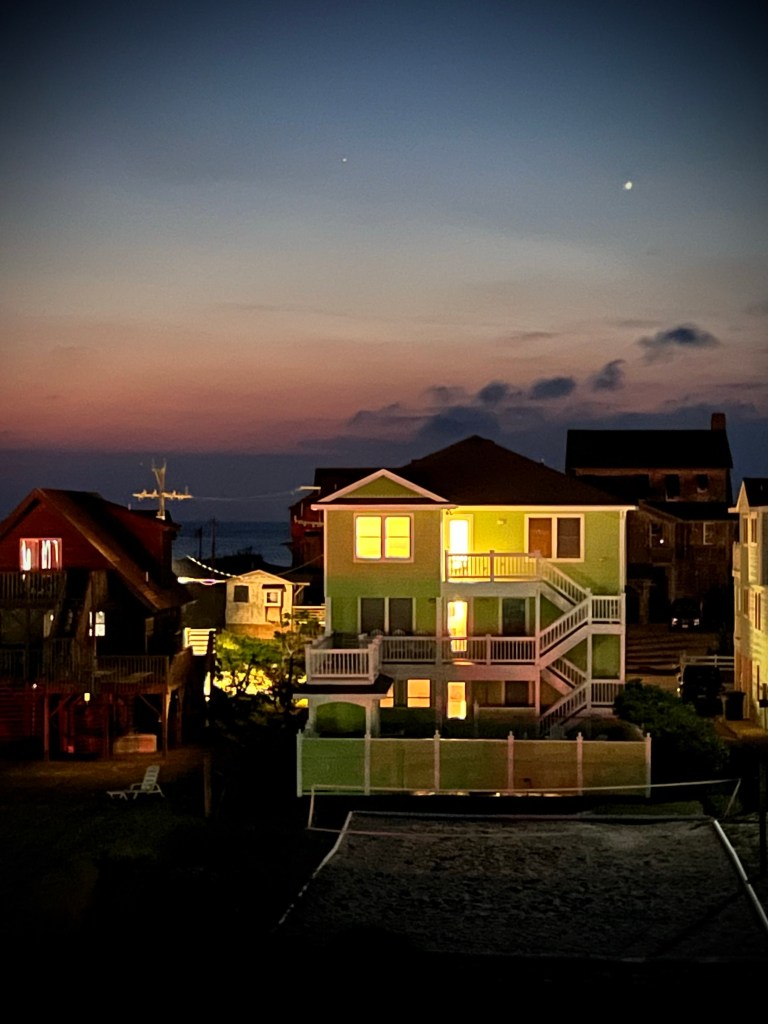
Just ahead, high over the sea Venus glitters and winks
I am the bright and morning star I know you are
My waiting soul cannot think of anything else it wants or needs as black silhouettes of pelicans fly soundlessly by against the sky pinkening with light
Sunrise signifying the end of night
My view this morning: Venus over the Atlanticjust before sunrise
Pelicans, while not in this particular shot, are plentiful here. As the sky grew lighter they appeared in silhouette, gliding gracefully against it. The pelican is an ancient symbol for Christ, often depicted in Christian art.
Revelation 22, the last chapter of the Bible, references the River and Tree of Life, the healing of the nations, the end of night, and the return of Christ with the words “I am Alpha and Omega, the beginning and the end, the first and the last…I am the root and offspring of David, and the bright and morning star” (13; 16).
The best I can do is to describe this morning scene. The sense of peace, so often fleeting or not to be found when Earth is wide awake and churning, was honestly too deep for words. I shall hold these moments in my mind for returning to when my soul needs more nurturing, long past summer.
—with thanks to Carol Varsalona for the theme and for hosting the Spiritual Journey writers on this first Thursday in August.
“The sea does not reward those who are too anxious, too greedy, or too impatient. To dig for treasures shows not only impatience and, greed, but lack of faith. Patience, patience, patience, is what the sea teaches. Patience and faith. One should lie empty, open, choiceless as a beach—waiting for a gift from the sea.”
—Anne Morrow Lindbergh, Gift From the Sea
Lindbergh’s words come back to me as I contemplate the frenzy of living and the pull of making the most of every moment, especially on vacation (how often do we say we need a vacation after returning from our vacation?). Life is not always a matter of doing, of endlessly digging for treasure…but carving out time just to be and to see what treasures may come. For they will. And we will be far less likely to miss them.
with thanks to Chris Margocs for the “Be still” invitation and to Margaret Simon for the “Presence” offering on behalf of our Spiritual Journey writer’s group on this first Thursday in July
Back in March of 2020, four days into COVID-19 lockdown, I wrote a post entitled Be still. It was based on Psalm 46:10, a verse with special significance to me since I was about thirteen, when a youth group leader gave me a little decorative plaque bearing the first line: Be still and know that I am God. The plaque hung on the wall of my bedroom throughout my tumultuous teenage years until I married and left home at twenty. I had no inkling, then, that my young husband would go into the ministry two years later or that we would eventually have two sons, the older of whom would become a pastor and the younger, a music minister and worship leader.
Throughout the decades I’ve received numerous gifts which have borne those words: Be still and know that I am God. The verse keeps returning to me. A few weeks ago my Sunday School co-teacher brought a handful of cards printed with Bible verses, held them out to the class facedown, and had each of us draw one. I drew Psalm 46:10. Be still and know that I am God.
I could write a lot about those eight words, having to do with trusting God in times of trouble and God’s unfailing faithfulness. Overcoming fear and despair. Carving out time away from the demands, vitriol, and horrors of the world. Finding peace in the rhythms of nature surrounding my home in the countryside (I have written a lot about that, actually).
But those eight words are only the opening line.
“Be still and know that I am God. I will be exalted among the nations, I will be exalted in the earth!” —Psalm 46:10 (ESV)
The verse is a call to be in awe of the power of God, to be a people who carry forth the message of godly peace to the world, by which wars will cease (v. 9), and by which God will be exalted. It is a declarative, definitive statement. On the part of God: It shall be. On the part of humanity: Be awed.
Awe has been my guiding word for the past two years. It is likely to remain so as long as I live. In the context of inherent awe and Psalm 46:10, words of the song “Above All” by Michael J. Smith come to mind:
Above all powers, above all kings Above all nature and all created things Above all wisdom and all the ways of man You were here before the world began
Above all kingdoms, above all thrones Above all wonders the world has ever known Above all wealth and treasures of the Earth There’s no way to measure what You’re worth…
Be still and know…God is above all.
My theologian son is studying the work of Eugene Peterson (1932-2018), minister, author, poet, and Professor of Spiritual Theology, Regent College, Vancouver. We have recently been discussing The Message: The Bible in Contemporary Language, Peterson’s idiomatic paraphrase of Scriptures, apparently written out of frustration with people not reading their Bibles.
Here’s Peterson’s paraphrase of Psalm 46:10:
“Step out of the traffic! Take a long, loving look at me, your High God, above politics, above everything.”
I cannot think of a more timely message.
I return now to the original Be still post I wrote on March 17, 2020, during the early days of the pandemic. We thought school would be closed for two weeks. We had no idea of all that lay ahead. Extended isolation. Loss. Rampant fear. Exacerbated discord. Death, violence, rage, destruction. War. Rising inflation.
Consider the verses immediately preceding Psalm 46:10, from the ESV translation:
The nations rage, the kingdoms totter; he utters his voice, the earth melts. The Lord of Hosts is with us; the God of Jacob is our fortress. Selah (6-7).
And then we are told Be still and know that I am God.
Who is above all.
I thought about linking Smith’s song here. Psalm 46 is, after all, a hymn.
I am linking another song instead, one of my longtime favorites for its plaintive beauty and quiet, meditative message—a little rest stop for the soul on the arduous spiritual journey through life in this world that God, incomprehensibly, still loves.
Upon arriving at church to teach a lesson on the work of the Holy Spirit what should greet me but the wafting fragrance of cinnamon coffee brewing serenely
so good and perfect restoring my soul
even though the world is no less broken
it is no less loved
for God so loved
as I read the Scripture sipping my cinnamon infusion what should appear on the windowsill but a little bird looking through the glass at our class
a swallow who’s built her nest under the eaves
Even the sparrow has found a home, and the swallow a nest for herself, where she may have her young— a place near your altar, Lord Almighty, my King and my God
I find there is nothing that drives away dark thoughts as much as Sunday morning, especially when it follows a night of strange and troubled dreams after a week of increasing tensions at work in a school year that seems never-ending. As I wake, pondering the attrition of humanity in general with a hymn-line playing in my head, Change and decay in all around I see, unable to tell if I am feeling heartsick, soul-sick, or just plain sick, the Sunday stillness settles my spirit. My stomach, on the other hand, needs more time…not sure if I will make it to church or not. A riotous melody from the front porch works like a tonic: a finch fantasia. The mohawk-headed babies that hatched in my door wreath should have flown on by now. I am glad they linger. I need these bright notes. I wish I could interpret them and know exactly what the finches are saying to one another… if they were not here, the silence would be so loud. There is a time for silence and it is not now. It is not the same as stillness. Sunday brings stillness, the finch song brings stillness, the wall clock with whirring crystals brings stillness. I am craving prolonged stillness, I am so tired, but I make myself go.
And if I had not done so, I would have missed it.
Backing out of the garage, closing the door, turning down the driveway… there.
Across the street, lying on the grass in front of a tangled green thicket, a large white cat, so still it seemed an alabaster statue. It didn’t move as I approached. It gazed at me as if it belonged in that very spot (I have never seen it before).
Sphinx-like. Pristine. Regal. Otherworldly. Breathtaking. I think I whispered the word Amazing.
I could have stayed and stared, I think, forever.
But, without movement of any kind, the white cat reminded me that stillness isn’t an untroubling; it is, instead, a submerging, away from surface-level fear, a shaking off, a resting place, a deep abiding.
Which paradoxically involves moving on.
I feel certain it winked at me as I did so.
Curiosity drove me to look it up: Pure white cats are rare, 5% or less of the population. It didn’t seem to mind my taking its picture.
*******
special thanks to Two Writing Teachers for the weekly Slice of Life Story Challenge
Inspired by and dedicated to Margaret Simon, who shared the photo and who’s mourning the loss of her father.
Photo: Kim Douillard
Half remains afterward it is enough tangible beauty even in mourning throes to sense the infinite flows of life undulating beyond what the eye can see or hand can hold where the spirit abides whole, unbroken
May. Newness. Longer days, more sunlight. Blossom-laden trees perfume the air, geese with goslings glide across glassy ponds. Along the backroads and byways, the fields have been plowed; John Deere tractors roll over the naked earth, freshly dotted with neat rows of little green plants.
I think of sowing and the harvest to come.
My illustrious daily planner seems to be a cross between almanac and oracle these days. It offers this quote:
Small seeds of gratitude will produce a harvest of hope.
I love it for its own merit, emphasizing gratitude, which I know to be as transformative a force as love, forgiveness, and possibly awe. I envision tiny seeds of gratitude planted in the furrows of the heart, eventually producing a harvest of hope to be stacked and stored for when it is most needed in the future.
And I remember Joseph.
Unlike the chief cupbearer in Genesis 40, who “did not remember Joseph, but forgot him,” after Joseph interpreted his dream, correctly and prophetically. At the time they were in prison with the chief baker, who would be hanged by Pharaoh (yet another accurate dream interpretation by Joseph). To this point, Joseph had endured quite a bit. His mother died just after having his baby brother. His older brothers detested him for being their father’s favorite and for being “this dreamer” (37:19)… perhaps Joseph shouldn’t have told them of his dreams in which they, and their father, Jacob, all bowed to him. His brothers discussed killing him until Reuben, the oldest, intervened. They threw Joseph in a pit instead and sold him as a slave. Joseph is purchased by Potiphar, the captain of the guard of Pharaoh. Joseph serves Potiphar with great efficacy and integrity, so much so that Potiphar “left all he had in Joseph’s charge, and because of him he had no concern about anything but the food he ate” (38:6). Until Potiphar’s wife tried repeatedly to seduce him, that is, becoming so aggressive that Joseph wriggled out of his garment to get away from her… a garment she used to make the accusations which landed him in jail for thirteen years. (Note: This is the second garment that causes trouble for Joseph; the coat of many colors given to him long before by his father didn’t set so well with those brothers. Imagine their initial self-righteousness while tearing it, dipping it in goat’s blood, and presenting it to their father as evidence that Joseph was attacked and killed by wild animals…which, of course, they’d live to regret).
And Joseph is forgotten in prison until Pharaoh has a troubling dream and the restored cupbearer finally remembers him.
Here’s the thing: It was God’s plan all along for Joseph to stand before Pharaoh and interpret his dreams of coming famine, that Pharaoh should be so impressed he’d set Joseph up as prime minister of Egypt, that Joseph should execute his proposed plan for planting and harvesting:
During theseven plentiful years the earth produced abundantly, and he gathered up all the food of these seven years, which occurred in the land of Egypt, and put food in the cities. He put in every city the food from the fields around it. And Joseph stored up grain in great abundance, like the sand of the sea, until he ceased to measure it, for it could not be measured. -Genesis 41:47-49
It is this divine plan of action that eventually saves Joseph’s brothers when they come seeking food in Egypt.
Joseph weeps a lot through several chapters. When his brothers realize who he is, they bow before him (every dream having come true) in fear and trembling… and Joseph chooses reconciliation over retribution. His father is still alive; he brings the whole family to Egypt to survive the famine. The brothers again fear his wrath on the death of their father, but Joseph’s words ring with gratitude to God: “You meant evil against me, but God meant it for good, that many people should be kept alive…” (50:20). And so the Twelve Tribes of Israel were preserved.
Seeds of gratitude, shall we say, protect against spiritual famine, yielding hope to be relied upon in times when faith is tested, as Joseph’s was. He never wavered; this is why I love him. He’s one of my favorite Biblical figures, exhibiting integrity and faith in abundance.
In the midst of our trials, God is at work. In times of bleakness, verdant lushness awaits.
Begin with seeds of gratitude… and expect a harvest of unimaginable abundance.
with thanks to my Spiritual Journey friends who write on the first Thursday of each month, and to Susan Koehler for hosting todayon a theme of “abundance.”






 lit bits and pieces