Vagabond

a memoir poem

Driving along 
a deserted road
in a deluge
in the dark
my hands gripping 
the steering wheel
for dear life

I see him
in the headlights
there, ahead
on the right

standing, bent,
in the sheeting rain
thumb held out

—how can I
not stop?

Rain beats
the car roof
like a drum
as he flings open
the door and
slides into the
passenger seat.

“Thanks,” he says.

He’s wearing 
layers of clothes

a sodden cap
over straw-like hair

sporting
a scraggly beard.

“Sure,” I say.
“Where are you going?”

He looks at me
for a peculiar moment:
“The better question is
where are YOU going?”

His eyes
(maybe it’s just my 
overactive imagination)
are silvery
in the darkness.

“H-h-home,” I stammer.

“Then I’ll ride as far
as you’re able to
take me,”
says the stranger.
“How old are you,
anyway?”

What does it matter?
“Eighteen,” I say.

“You mean
that you have lived
to be eighteen
and no one
has told you
not to pick up
strangers?”

I blink.

“It’s raining…it’s
such a bad night…”
I start

but as I speak
I can hear
Grandma’s voice
reading a favorite 
book to me
when I was small
(Never Talk to Strangers!)
and what 
she always says
at our parting:
Take care of your
precious self…

he finishes:
“It could be
an even worse night.
You don’t know
what some people
might do.
There are a lot
mean people
in the world.
It isn’t safe
for you to
stop alone
like this.
If you let me off at
the next intersection,
it will be enough.”

I blink.

I drive on
to the next 
intersection,
a well-lit place
where he opens
the door:

“Thanks for
the ride.
But don’t 
pick up 
any more
strangers,”
he admonishes.

The lights change
a horn blares
I’m only dimly aware
for watching
open-mouthed
as the vagabond
absconds
into the
rain-cloaked
night.

I blink.

Now I see him
now I don’t

as I take
the last turn
for home.

Lonely Highway. Colby Stopa.  CC BY 2.0.

*******

with thanks to Katrina Morrison for the invitation to write a “Seeing the stranger” poem on Day Four of the Ethical ELA OpenWrite

and to Two Writing Teachers for the monthlong Slice of Life Story Challenge

and to the vagabond hitchhiker
whose advice I have heeded
ever since


Taking stock: my pile of good things

*******

With thanks to Stef Boutelier for the “pile-poem” form and Canva template on Day Two of Ethical ELA’s Open Write.

Thanks also to Two Writing Teachers for the monthlong Slice of Life Story Challenge.

Life IS a challenge. The greatest. For writing inspiration, Stef quotes author Rainbow Rowell:

So, what if, instead of thinking about solving our whole life, you just think about adding additional good things. One at a time. Just let your pile of good things grow. 

What might your “pile of good things” be?

Sleep experiment poem

This is not what you think.

The poem you’re about to read is not about a sleep experiment.

It is an experiment in writing a poem about sleep, using Artificial Intelligence (AI).

On Day One of Ethical ELA’s OpenWrite, host Stef Boutelier invited participants to try AI for creating or modifying a poem, stating that “AI is here to stay. We might as well learn alongside and make sure our humanity isn’t disposed of too quickly.”

She shared these sites with the directive to “explore ways you might use, learn, or negate AI within the lens of poetry”:

So, as a test of AI vs. human creativity, I used the poem generator to write a villanelle.

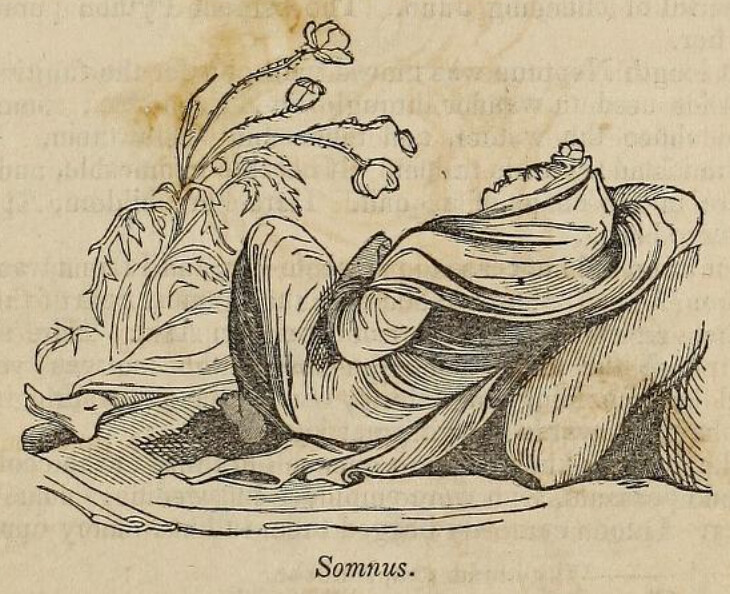
My topic was sleep (I am coveting it in the throes of getting over a lengthy cold, going into week three) and as I was prompted to choose two characters, who better than Somnus and his son Morpheus, gods of sleep?

Confession: I did alter a few of the rhyming words but that is all…

Without further ado, the experiment results:

Somnus’s Torment: The Villanelle of the Sleep

Somnus couldn’t stop thinking about the sleep
It was just so elusive and desired
But he could never forget the sheep

That morning, Somnus was shocked by the upkeep
He found himself feeling rather wired
Somnus couldn’t stop thinking about the sleep

Later, he realized that the sleep was deep
He thought the situation had become rather uninspired
But he could never forget the sheep

Morpheus tried to distract him with a leap.
Said his mind had become too misfired
Somnus couldn’t stop thinking about the sleep

Somnus took action like a veep
The sleep was becoming required
But he could never forget the sheep

Somnus’s demise was cheap
His mind became dangerously tired
Somnus couldn’t stop thinking about the sleep
But he could never forget the sheep

And there you have it.

Give me “Do not go gentle into that good night” any day.

This is not to say that AI can’t inspire or help with learning form and composition. In fact, its greatest offering might be a lesson in the power of revision.

And while it can actually generate some alarmingly wonderful things, I don’t think AI can ever out-poet the human mind.

I shall have to write my own villanelle now…but I won’t be using AI.

Has it ever seen or heard the birds? Has it ever smelled cut grass or felt the heartbeat of a living creature? Can it experience anything?

No.

Here’s to using the senses and the soul to capture the experience of being alive. Is this not the whole purpose of writing?

Meanwhile, sleep is still calling me…

*******

with thanks to Stef Boutelier on Ethical ELA
and to Two Writing Teachers for the monthlong Slice of Life Story Challenge

Ode to menthol

In the season
of sickness,
of a rattling
in the chest
that lingers
and lingers
and lingers
I seek
your healing power
O my elixir

none other will do
as well as you

your name
is not always recorded
on cryptic inscriptions

but I know
it’s you

nothing else
has that
distinctive
burn

Alas, you have become
such an elusive elixir

I search high and low
(on the shelves)
just to find
you’ve vanished

leaving no trace

it befits you,
vaporous thing
that you are

I cannot entertain
the notion
of orange
or honey
—fie!

These cannot
open passages
like you.

I wonder
what on Earth
I shall do

but wait…

memory stirs
like ghosts
like tendrils
like vapors, yes…

my own father
pouring your
precious substance
into a little silver tray
and plugging in
the vaporizer

there I was
suffering child
surrounded
by a steamy cloud
tinged with your
cool fragrance

sputtering
sizzling
on through the
long, long night

(you’re no cure-all
for childhood asthma, btw
but I’m not dealing
with that
anymore)

and speaking
of clouds…

back there
in the shroud
of Time
where sits
my father
and
my mother
puffing
puffing
puffing
on Salem cigarettes
there, the
telltale green carton
indicates your presence

I can still smell you
on the foil
of those packs
and in the
smoke ribbons
curling in the air
(aside: salem means
peaceful
complete
safe
perfect)

—what a cool operator
you are,
alternately healing
and stealing
breath

but then…

far back
so far back
I find you
at your purest,
perhaps

sick child
that I was
struggling
to breathe
(yeah, it’s a theme)

my grandfather
going to
his medicine cabinet
for a little
cobalt-blue tub
my grandmother
unscrewing the
aqua lid
and with one finger
slathering a good dollop
under my nose

(which now
no one is
ever
ever
ever
supposed to do
although clearly
I am alive)

and it is this memory
these moments
that are salve to my soul.
balm to my spirit

and so I come
to find you
like a miracle
in my own
medicine cabinet

whereupon I slather
my own self
up good

relishing your
mint-oil fire

your vapors
like a blanket
of love
enveloping me

breathing
breathing
Yea, with
a little
more ease

until this
lingering
lingering
rattle

evaporates
at last…

O, my elixir.


Fun facts: Vick’s VapoRub was invented in 1894 in the North Carolina county next to where I live now. It was originally called Vick’s Magic Croup Salve. From the NC Department of Natural and Cultural Resources: “The salve in the blue jar is made of menthol, camphor, oil of eucalyptus and several other oils, blended in a base of petroleum jelly.” The creator invented it to cure his son of severe croup…which it did. Spanish flu killed the inventor in 1919 but, paradoxically, that pandemic drastically increased demand for his product. Oh…and guess who worked at the inventor’s drugstore as a teenager? O. Henry.

My ode, however is to menthol, not just Vick’s, seeing as I had to include my parents’ Salem menthols in the mix. I was an asthmatic child, my first attack occurring at age three months. As I grew, I often begged to stay with my grandparents when I was sick; they slathered me with this old remedy, hence my great affinity for VapoRub. Accordingly, my grandparents are ever-present in the healing power of that clean menthol burn…nowadays I am not troubled with asthma but when I feel a cold coming on, or, as in the present moment, trying to shake the rattling cough after a cold, Vick’s DayQuil with VapoCool is my go-to. It works, to which widely empty shelves attest. I finally had some delivered by Instacart (had to show ID, of course) so I can continue burning the rattle out of my chest…it’s the best thing I know of, outside of a certain homemade “recipe” made by one of my old-time church members from the country…not exactly sure what was in THAT jar, but it would’ve surely burned this stuff out long before now… that, however, is another story for another day.

Here’s to the healing power of menthol.

*******

with thanks to Two Writing Teachers for the monthlong Slice of Life Story Challenge
and to Kim Johnson,

whose series on Epsom salts convinced me that I really, really should write about menthol
(which, yes, can occasionally be dangerous, so use with care)

Nestlings

And so it came to pass

that the little blue eggs

in the perfect wee nest

atop the grapevine wreath

hanging on my front door

while it is yet winter

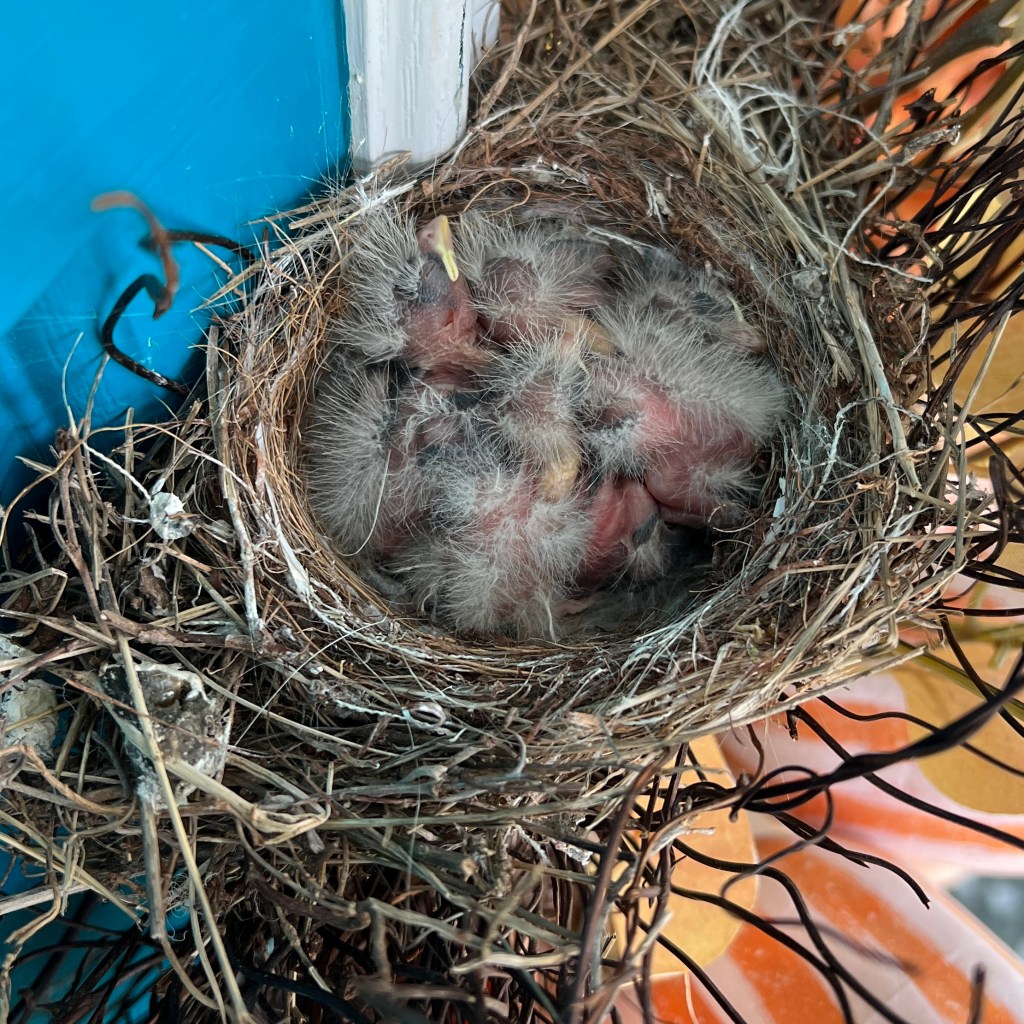
hatched.

My early brood of house finch nestlings, a day or two old.
It’s possible some were hatching during Sunday’s snow.

*******

with thanks to Two Writing Teachers for the monthlong Slice of Life Story Challenge

March snow

haiku story

gray Sunday morning
in spite of springing forward
it begins to snow

first time all winter
big white flakes now descending
on riotous blooms

purple-pink redbuds
bright yellow forsythia
pollen-laden pines

suspend certainty
while birds rush in, unafraid
of crystallized grass

momentarily
melting away in soft earth
—seems a sheer delight

to countless robins
hopping with newfound vigor
and the cardinal

on a blood-red blaze
toward the bare crape myrtle
where his mate awaits

and dark-eyed juncos
living up to their nickname
ground-flitting snowbirds

while papa house finch
forages in the clover
on the old dog’s grave

for seeds he’ll carry
to mama finch on the nest
incubating eggs

bluebird on the gate
ruffles his blue-flame feathers
in exultation

two crows come and go
strangely silent, for they know
the benediction

Carolina wren
hidden somewhere in the pines
sings Holy Holy

the earth’s aflutter
with myriad wings and things
returning blessing

in spite of the snow
life springs forward, brightening
gray Sunday morning

2020-0417_CentreCoPA_WestMain_Eastern Bluebird in the snow -01. amOBX. CC BY-NC 2.0.

*******

with thanks to Two Writing Teachers for the monthlong Slice of Life Story Challenge


Eavesdropping

a pantoum

Under the eaves
a porch
on the porch
a chosen door

a porch
sanctuary
a chosen door
from the other side, I hear

sanctuary:
father finch feeding nesting mother
from the other side, I hear
a song of love

father finch feeding nesting mother
on the porch
a song of love
under the eaves

Short clip of my house finches, which return every spring to nest in my door wreath (the finches don’t know that I purposely put out the twiggy grapevine wreaths they like best). Crank the volume to hear their beautiful voices. You might even catch a glimpse of wings as the father flies off to fetch more food for the mother. He will feed her until their little blue eggs hatch and then they’ll both feed their babies. In listening, it’s easy to understand how “charm” became the collective noun for finches and why they are said to symbolize joy.

House finches have an interesting history. From the Audubon Field Guide:

“Adaptable, colorful, and cheery-voiced, House Finches are common from coast to coast today, familiar visitors to backyard feeders. Native to the Southwest, they are recent arrivals in the East. New York pet shop owners, who had been selling the finches illegally, released their birds in 1940 to escape prosecution; the finches survived, and began to colonize the New York suburbs. By 50 years later they had advanced halfway across the continent, meeting their western kin on the Great Plains.”

also this, from the House Finch Overview, Cornell Lab of Ornithology:

“House Finches feed their nestlings exclusively plant foods, a fairly rare occurrence in the bird world.”

These are things I have learned. I continue to learn the lessons of the finches as they fill my home and heart to overflowing with a rare, almost-otherworldly joy.

House Finch mosaic. wolfpix. CC BY-ND 2.0.

*******

with thanks to Two Writing Teachers for the monthlong Slice of Life Story Writing Challenge

Doggerel

noun

  1. comic verse composed in irregular rhythm.
    “doggerel verses”
    • verse or words that are badly written or expressed.
      “the last stanza deteriorates into doggerel”

Example:

Time for a nap
time to recharge
if only for a bit
on a teeny-tiny pillow
that ain’t a good fit

this is what comes
of living large

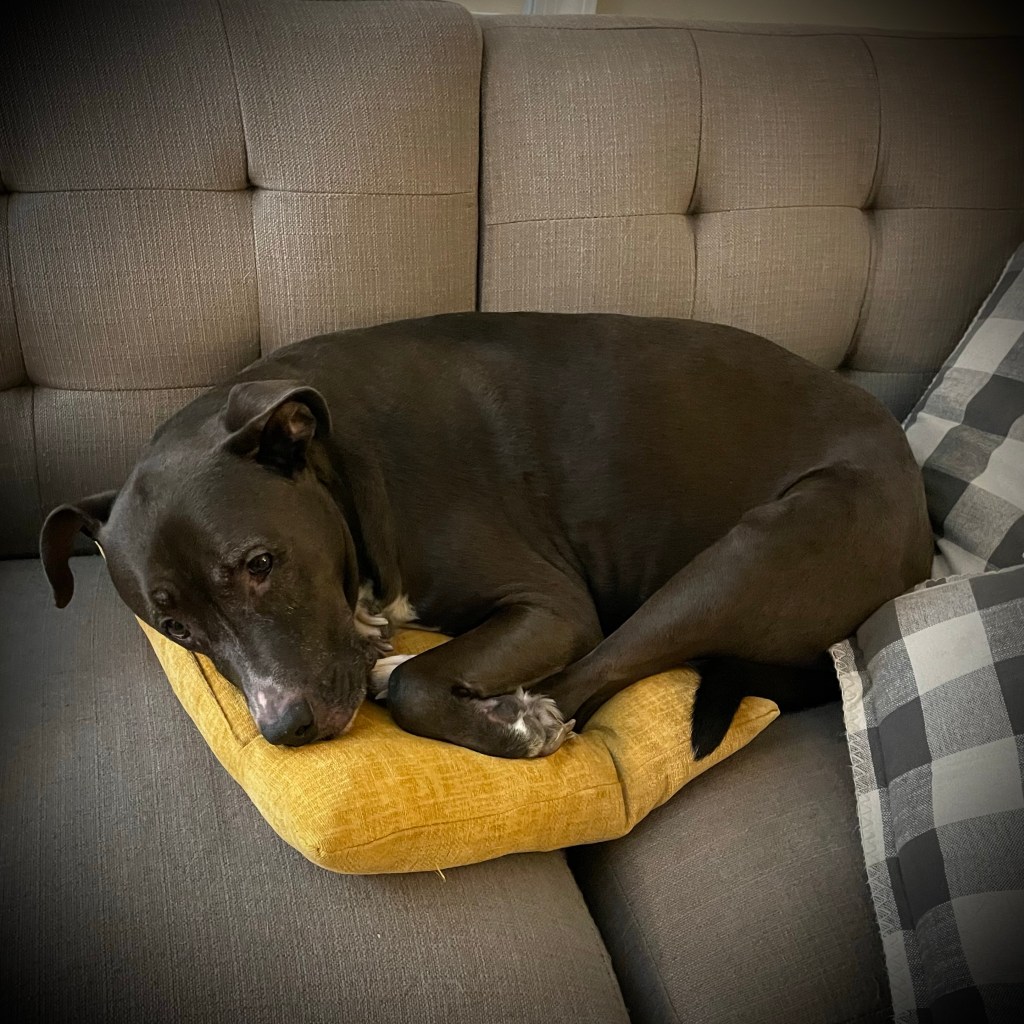
My son’s dog, Henry. Well-spoiled.
A master of making himself look “pitemous,” as you can see.

*******

with thanks to Two Writing Teachers for the monthlong Slice of Life Story Challenge
and to you, Dear Reader, for enduring this bit
of doggerel.

A president, a poem

Today on Ethical ELA’s Open Write, Stacey Joy invites participants to lift a line of poetry and use it in creating a Golden Shovel poem.

I was thinking about it being President’s Day, so I went in search of poems written by our presidents. This led me to Jimmy Carter, the first U.S. President to publish a book of poetry in his lifetime. He is our longest-living president; at age 98, he has just entered hospice care. I have lifted a line from his verse.

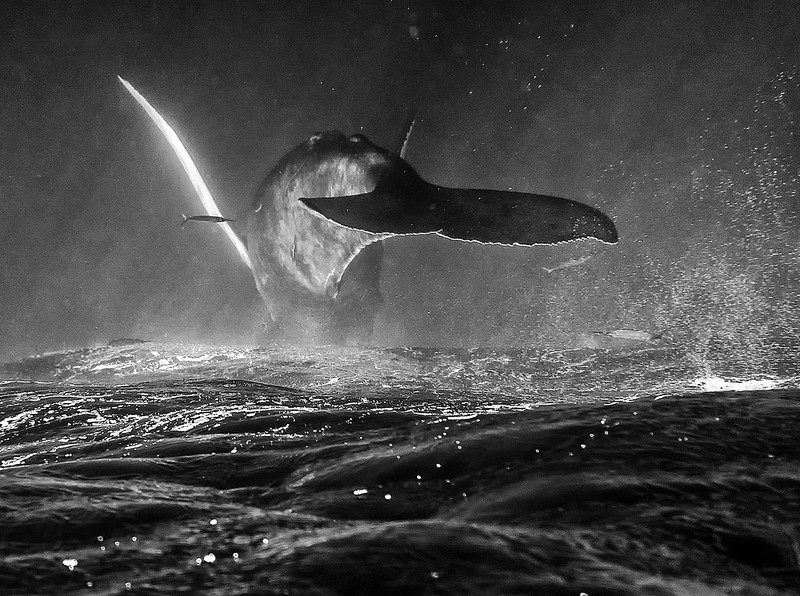
“To hear the same whale’s song” – Jimmy Carter, “Life on a Killer Submarine,” Always a Reckoning and Other Poems

Homeward Hymn

when my life draws to
its close I imagine the last thing I hear
will be cicadas rattling high in the
green oaks as I pass, fervently calling, calling the way, same
lost and found returning sound of whale’s 
pulsating destination song

If Whales Could Fly. Christopher.Michel. CC BY 2.0.

I can’t be the only one poem

Today on Ethical ELA’s Open Write, Britt Decker shares a beloved C.S. Lewis quote: “Friendship is born at that moment when one person says to another, ‘What! You too? I thought I was the only one.’” She invites participants to share “quirky, unusual, uncommon things you do, believe, or say and turn the list into a poem… starting with the line ‘I can’t be the only one who’…”

To begin with: I have loved Lewis since I was ten years old and first landed in Narnia. I have a shelf of his books. When I read Britt’s words about Lewis, I echoed his own: “What! You, too?”

And so I keep that as my title…

What! You, Too?

I can’t be the only one who

would rather write than speak

drinks more black coffee than water

puts pepper on popcorn

is enchanted by abandoned houses
in various stages of falling down

left my Christmas tree up
until February this year
simply because it was beautiful
and looking at it
made me happy

barely dips in social media anymore

follows murder cases daily
for the latest developments

loves my Grandma name (Franna)
better than my actual given name

looks for hawks and herons
on my drive to work

grieves over the blue heron
not having been at a certain pond
in weeks
(please be all right)

savors the harsh rattling
of cicadas in summer
(heartsong
in the background orchestration
of my life)

senses the presence of my father
in the fragrance
of fresh-mown grass

thinks best and sees solutions
in the dark morning hours
before I’m fully awake

journals my dreams, to be awed
by the constant presence of birds
and the recurrence of
vivid green

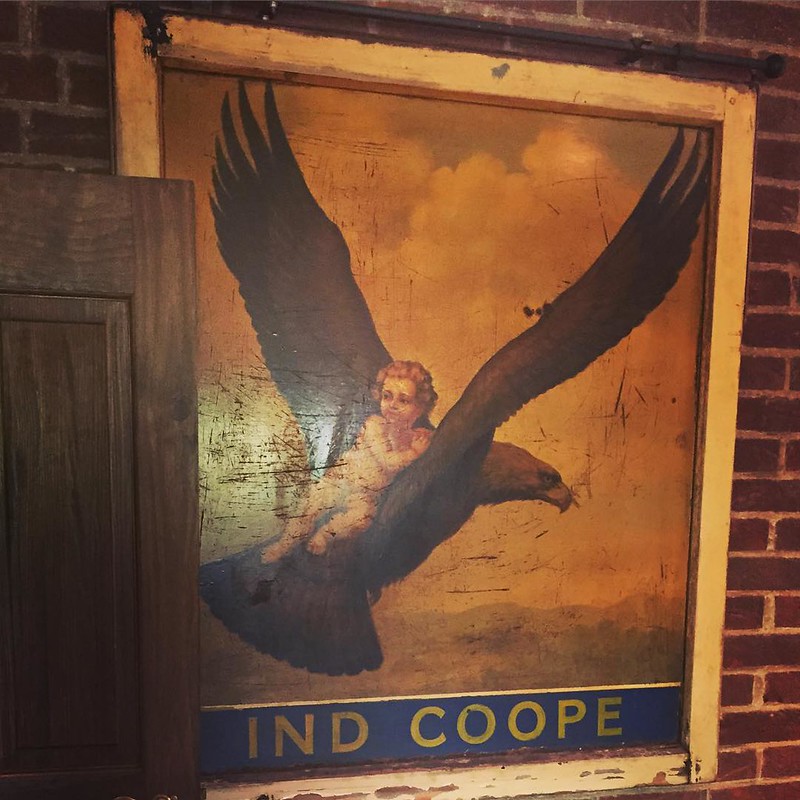
The original sign from The Eagle and Child (at CS Lewis’ home, The Kilns). #TXinUK. david_norman. CC BY-NC-SA 2.0.