Around the bend

white-peacock

Rezervatia de zimbrii Dragos Voda. Cristian Bortes. CC-BY 2.0 

I live in the country.

Long before daybreak, a rooster crows for all he’s worth, a passionate, guttural cry signifying that the dark night is ending.

My kitchen bay window faces east, catching the first glimmers of pink in the sky.

A short drive on the winding road by my home carries me past weathered stables and tobacco barns, abandoned unpainted houses from a bygone era, and fields where farmers still make their living.

There’s a horse or two in the pastures, innumerable goats, and the occasional delightful donkey, silvery-gray and calm. I have learned that donkeys keep coyotes away – how extraordinary.

One day, along a bend in the road, beside an old gate overgrown with brambles, a peacock strutted, the morning light electrifying the brilliant blue of his body. I slowed down, wishing I could see the long green train of his feathers fan out, but the peacock was skittish and went back through the gate via some hidden hole. Surely he should not have been out by the road, although the sight of him made me grateful to be alive. From then on, I looked for him.

Until the day I rounded that same curve and there, in the middle of the road, stood a white peacock.

I could not believe my eyes – I never knew such a thing existed.

But there he was, gleaming like some divine messenger, standing right on the double yellow lines. I slowed to a stop. He looked at me through the windshield; I hardly dared to breathe. He took his time heading back to the lush bank by the brambly gate, as if he owned this road, maybe this entire world, his long white tail feathers dragging behind him like a bridal train or a king’s ermine robe.

I watched him go, oblivious of everything around me except the sheer splendor of his presence.

I have learned, then, that every day is new, that there are unexpected wonders waiting just around the bend. In the middle of the familiar and mundane might be something rare, glorious, breathtaking.

Be watching.

slice-of-life_individual


Born musician

piano-window

Piano & window. Alan Mayers. CC BY-SA

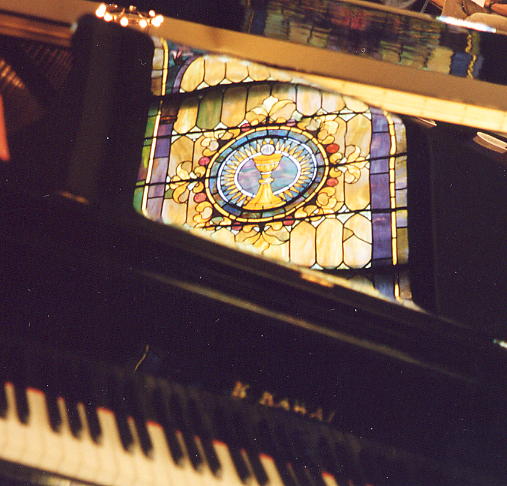
Years ago, a woman – tired, seven months pregnant – sat in the front row of a church. The morning sun shone through the stained glass windows, casting jewel-tone light on the baby grand piano, a soothing sight to the weary woman whose busy child was churning her insides. The pianist took a seat and began to play the prelude.

The baby stopped moving. He or she didn’t move again until the prelude ended. After the final notes, the child resumed the high activity.

The baby hears the music, thought the mother, marveling. It was the first of many times she would notice the unborn child’s response.

Around age three, the boy frequently hummed a tune to himself. His mother recognized it: “Amazing Grace.” When he was four, the child started playing cassette tapes of gospel music that had belonged to his great-grandfather. After his fifth birthday, his mother stood in the doorway of his bedroom, watching the boy making tally marks with a dry erase marker on a whiteboard easel.

“What are you doing?” she finally asked.

“I’m counting the syllables,” her boy replied, with a serious expression on his little face. He continued his business, listening to the tape, steadily making marks.

It’s the beats, the mother thought. He’s counting the beats.

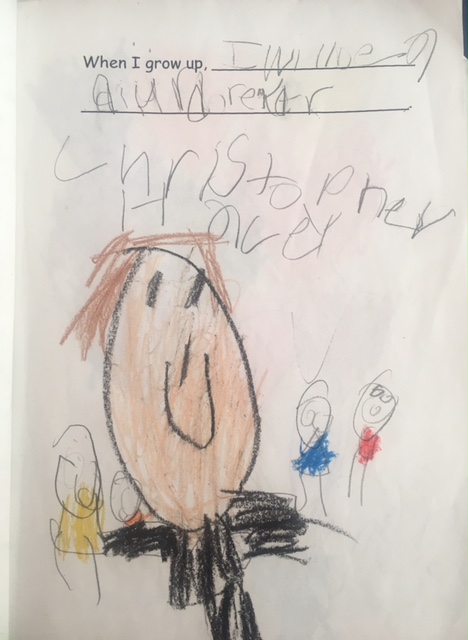
When he brought home his “All About Me” book on finishing kindergarten, his parents smiled at this page:

when-i-grow-up

“When I grow up, I will be a qiur drekctr (choir director).”

When he was seven, watching him tinker occasionally on his great-grandmother’s upright piano in the living room,  his mother said, “You love music so much – why don’t you take piano lessons?”

The boy shrugged, something of a disappointment to his mother, who expected he’d be excited. She took him to lessons anyway.

He wouldn’t practice. The lessons were abandoned before long.

His mother was sad.

In middle school, the boy decided to play alto sax in band. He began tinkering with the piano a little more. Then one day, when he was fourteen, he said, “Hey, Mom, listen to this.” And he played a medley of Christmas songs on the piano – both hands, all the parts – as if he’d been doing so all of his life.

His mother stood marveling, knowing, tears in her eyes.

The boy played the medley on the baby grand piano for the prelude at church on Christmas Day, to the astonishment of the congregation.

He played alto and bari sax for marching band throughout high school; he developed a love for jazz. Few of his friends knew he could play the piano as well. None knew he could sing. One of his teachers did, however. She sought him out when she couldn’t find sheet music for a song she planned to perform at Senior Awards Day.

“This is a version of ‘Perfect’ by Pink – do you think you can play it?” she asked the boy.

“I think so,” replied the boy.

He had two days to prepare.

The result:

One week after graduation, he was hired as the director of music programs at a church, fulfilling his childhood desire of being a choir director.

The rest of the story remains to be written, as it is still unfolding.

I am excited to see where the music takes you throughout your life, Son. Keep learning and reaching.

Much love –

Your infinitely proud mom.

Reflect: Few of us know what we are meant to do so early in life. It’s never too late to find out. What are your dreams, the things that bring you the most fulfillment? Pursue them! What are your gifts? Use them to benefit others. Encourage them to do the same.


Dogged determination

nikolaus

Nikolaus


What comes to mind when you hear the word perseverance? Perhaps it’s The Little Engine That Could. Or Jim Valvano.

I think of Nikolaus.

He’s a dachshund, and if you’ve ever owned one or read E.B. White, you know that the breed tends to be stubborn—as my eastern North Carolinian father would say, “hard-headed.”

Nik came to us when he was three months old. My boys, ages twelve and four, had been begging for a miniature dachshund after they puppy-sat one for friends on vacation. They knew exactly what they wanted: A little chocolate female. So when another friend called to say that her elderly mother had this very creature but could not take care of it, and if we wanted this puppy, we could have it, my boys were elated.

On the much-anticipated day of arrival, we opened the crate door and out strutted Nik. He was tiny, weighing maybe five pounds.

Within sixty seconds, these things developed:

“Mom, she’s not chocolate,” the older son observed. The puppy’s glossy coat was deep red, nearly crimson.

“Mom, she’s peeing on the carpet!” squealed the younger son. A remarkably large puddle, I might add, for a bladder so small.

“And she’s a boy,” I noted, running for the paper towels.

Just sixty seconds to an inkling that This Might Not Be What We Imagined.

Nik looked at us lovingly, wagging his tail.

He was, I decided in the weeks and months that followed, completely untrainable. He could not control his bladder. He wet the carpet, sofa, beds, everything. He would not “go” when we took him outside. Crate training did not work at all; he eliminated in the crate immediately upon entering. Exasperated, I asked the vet: “Why isn’t this working? I read that dogs don’t like to mess up their dens.”

The vet shrugged. “With some dogs, it’s just a behavioral issue.”

Great, I thought. We have a disturbed dog. It did not occur to me until much later that he’d been crated a lot as a puppy because his elderly owner could not keep up with the demands of caring for him. He cried loudly the whole time he was in the crate. Nik, I learned, never wanted to be confined.

The futile attempt to housebreak him reached its zenith a year after we moved into a new house.

“Boys, I don’t know what else to do. I’ve tried everything. I can’t housebreak Nik. He hates his crate, I’m going to work full-time, and he can’t just mess up everything. Maybe it’s time for him to go to a new home.”

The younger son began to sob. “No! We can’t give him away. He’s ours. We’re his family.”

My husband, not Nik’s biggest fan by a long shot, melted: “Shh, don’t cry, son. We won’t give Nik away.”

I glared at him.

“Nik can stay in my room when we’re all out,” offered the older son. “I’ll clean up if he has an accident.”

I thought of the new carpet and sighed. “All right, then. This means everyone is going to have to look after him. EVERYONE.”

The strange thing is that Nik seemed to know about this, because, from that time forward, he was instantly, miraculously housebroken. Whenever he needed to go, he went to the back door and waited to be let out. Just like that. After two years of abject failure.

The boys taught this untrainable dog to “sit pretty” for a treat, which meant that at every meal Nik was by one of our chairs, holding his pose like a groundhog in hopes that we’d give him a bite to eat. I taught him to roll over, so if sitting pretty didn’t work, he’d roll over to get his treat. That’s his entire repertoire: Two tricks.

Nik follows me everywhere in utter devotion, and when he was younger he’d jump into my chair to wedge himself between me and the chair back when I was writing. He is wary of my husband—they are competitors for my attention—but as soon as my husband leaves the room, Nik flies over to curl up in my lap, as if claiming me.

The boys say, “He loves you the best.”

Nik’s intense gaze seems to say the very same thing. He watches my every move.

A couple of years ago, we thought we were about to lose him.

My husband and I heard him fall on the landing of the stairs leading to the upstairs bedroom, dubbed “Nik’s lair,” as Nik was long accustomed to staying there during the day when the family was out. He’d also go up whenever he was tired or ready to go to bed for the night. By this time the older son was grown and gone, and the room belonged to the younger one, who was not home at the moment. On hearing Nik fall, my husband and I rushed to find him crumpled but conscious on the landing.

My husband began to cry.

“Stop it! You, of all people, crying about Nik! Don’t tell me you’re attached to him after all!”

“It’s the boys,” sobbed my husband. “Having to tell them that Nik . . . that he might . . .”

I picked Nik up as carefully as I would a newborn baby. “Let me wrap him in a blanket. You’re driving us to the vet. Stop crying.”

The trouble was two kinked-up vertebrae; the vet pointed them out. He dispensed medication and sent us home.

I made a pallet for Nik in the living room and covered him with the blanket. For two days, Nik didn’t walk. The younger son slept  on the couch to be near him at night. Nik didn’t eat or “go” when we took him outside. He just looked at us with big eyes and never made a sound. When he’s not crated, Nik hardly ever makes any noise.

In the wee hours of the third morning, I woke up and decided to check on Nik. My son was sound asleep on the couch. Nik’s blanket was still tucked on his pallet, but he was nowhere to be seen. He wasn’t on the couch with my son. I started searching, increasingly alarmed as minutes passed with no sign of Nik. He’s crawled off away from us to die. That’s what animals do. He wasn’t in the kitchen, under the chair where he likes to take his treats.

I woke my son: “Where’s Nik?”

“He’s not on his pallet?” asked my groggy teenager.

“No! I can’t find him anywhere!”

I woke my husband: “Nik has disappeared!”

“How is that possible?” He and my son looked again in all the places I’d just looked.

Then I thought, No—surely not—I don’t know how he could . . . 

The upstairs bedroom. That’s where he’d want to be, if . . . .

My heart pounding, dread deepening with every step, I climbed the stairs and opened the bedroom door.

I turned on the light.

No Nik. Normally he’d have jumped on my son’s bed and gone to sleep.

But he couldn’t jump now, not with his back . . . very carefully, I lifted the dust ruffle.

A tail thumped in greeting, and two eyes looked out at me as if to say, I just came up to bed like I always do. 

I cannot envision how he did it, how he dragged himself from his pallet all the way up the stairs to his favorite, safe place. After three days of not being able to walk at all. Knowing he could not jump, he contented himself with sleeping under the bed instead of on top of it.

I do not cry easily, but I did then.

He recuperated, and it happened again a month ago. This time Nik could not walk for a week and a half. The vet—a different one now—called to see how he was faring.

“He’s not any better,” I said into the phone. “No change. He wags his tail at us, but he can’t move.”

“It may be time to think about the quality of life,” the vet said, gently.

We tried to talk about it, the boys, their dad, and I.

“But he knows us still,” I said. “He doesn’t seem to be suffering, except for not being able to walk.”

“Yeah, it’s not like he’s in a coma,” said the younger son.

“If you make that decision, I want to be there,” said the older son, who’d come by on his way home from work. He rubbed Nik’s head.

Nik looked at us lovingly.

Another day passed, and another. He still did not walk.

My younger son and I took turns bringing Nik’s food and water to him. Nik ate and drank. Good signs. I carried him out several times a day; he obediently did what he needed to do, lying in the grass. I carried him back inside, put him in his beloved new dog bed, and covered him with a blanket.

More days passed.

Then one day when I carried him out, I felt his back legs press against my side. When I put him down, he stood. By himself, for a few seconds, on his old white paws, looking at me lovingly from his little white face, before his legs gave out and he flopped down.

Each day after he could stand for a bit longer at a time.

He is fifteen now, turning sixteen in January.  He runs from room to room again like he did when he was a puppy, still begging for treats although he can’t sit pretty anymore or even see his treats as well as he once did, but he gobbles them just like always.

And every night, one of us carries him upstairs to his favorite, safe place to sleep.

Reflect: Who—or what—represents perseverance to you?  Why? What have you learned from this person or situation, and what have you learned about yourself?


Haunting forevermore

Ah, distinctly I remember it was in … June, 2013.

My older son and I, teachers inspired by a love of The Great Gatsby,  celebrated the arrival of summer vacation by driving from North Carolina to Rockville, Maryland, where we visited the grave of F. Scott Fitzgerald. Having accomplished this mission before nine o’clock in the morning, my son asked: “What do you want to do now?”

“You know,” I grinned, “Baltimore is only forty-five minutes away. Poe is buried there.”

Thus was our Dead Writers Tour born. Off to Baltimore we went.

In contrast to a midnight dreary, the morning sun was blinding at the Westminster Hall and Burying Ground. The old Gothic-Revival church, the gate, the trees, the headstones, all cast the blackest, sharp-edged shadows, as if intentionally evoking the last lines of  “The Raven”:

And the lamp-light o’er him streaming throws his shadow on the floor;

And my soul from out that shadow that lies floating on the floor

Shall be lifted – nevermore!

And there, to the immediate right of the entrance, was the author’s grave under a large, shadowy monument bearing a plaque with his likeness. One wilting yellow rose and a couple of little rocks rested on the base.

Poe is buried with his wife, who was also his cousin, aged thirteen when he married her and twenty-four when she died, and her mother, his aunt.

“This isn’t the original grave,” my son pointed out. “Poe was first buried somewhere behind the church. He was moved here to to the front later.”

“That figures,” I said. “The man was unsettled for most of his life. He couldn’t even be settled in death.”

Just then a black bird flew by to land on another headstone, where it sat watching us from the stark shadows.

“Is that a raven?” I whispered.

Quoth my son, wide-eyed: “Geez, Mom!”

“No, it can’t be,” I assured him. “Ravens are bigger than that … I think. Let’s go find the first grave.”

This cemetery is old, dating from the late 1700s. The pathway from the entrance to the back is narrow,  leading past massive domed slabs somewhat reminiscent of Quonset huts. Years and weather have left black streaks running down the sides of these burial slabs to form odd swirls and patterns. Ghostly patterns, painted by nature’s fingers.

“Check out this stain,” I said, pausing. “Does it look like a skull to you?”

“Oh, wow – it does!”

Rounding the corner of the church, we came upon a marble table with thick legs and a top so sunken in the middle that it seemed impossible for such a heavy substance. A plaque informed us that this “gravity-defying” monument was mentioned in a Ripley’s Believe It or Not! article. A Revolutionary War veteran is buried beneath this oddity.

From there, my son and I could see Poe’s original grave, as the crowned headstone is embossed with a raven. On nearing the cenotaph – the empty tomb – the words arching above the bird become visible: “Quoth the Raven – Nevermore.” The stone informs visitors that Poe rested in this spot from 1849 to 1875.

“Do you remember reading about the mysterious person who showed up every year on Poe’s birthday, wearing a cloak or something, to leave roses at the grave?” I asked my son, a trivia expert extraordinaire.

“Oh, right – the Poe Toaster. He wore a hat and white scarf. He left cognac, too.”

“At this marker or the other?” I wondered.

“This one, I think. He came for decades, until just a couple of years ago. No one ever figured out who the Toaster was.”

“That’s hard to believe, in this day and age.”

“What’s really strange is that just before Poe died, he was found in the streets of Baltimore, out of his mind, wearing someone else’s clothes, and no one ever knew why.”

“It’s haunting, but mostly sad,” I pondered aloud. “Something straight out of his own work.”

We turned to leave, walking past a line of eroding tombs and vaults on the far side of the little cemetery. Some stone vaults had iron closures that appeared damaged. My fanciful imagination took flight: Had someone tampered with the doors, trying to get in – or out?

I shuddered despite the brightness of the day, recalling something my grandmother told me when I was a child afraid of the tiny graveyard across from her house in the country: Never fear the dead. Fear the living.

“I don’t think I’d want to be here at night,” I said to my son.

We simultaneously picked up our pace toward the exit.

“Nor would I.”

Back at Poe’s final resting place by the gate, my thoughts turned to his poetry, the glorious rhythm of “The Raven,” which drew me as a child the first time I heard Vincent Price reading it on TV. The poem wields mesmerizing, unique power. It is meant to be read aloud. Once when I was working to help third graders comprehend a text they were reading, we encountered the word raven.

“What’s a raven?” they wanted to know.

“It’s a bird – a black bird,” I told them. “There’s a famous poem about a raven.”

“Read it to us!” demanded the kids.

After a quick Internet search, I read the opening stanzas.

The children listened, spellbound. When I stopped, one of them sighed:

“Oh, Mrs. Haley – that sounds just like music.”

It does, indeed.

Ever after, the kids greeted me with “Hi, Mrs. Haley! Once upon a midnight dreary, while I pondered, weak and weary!”

Having paid my respects at last to Edgar Allan Poe, I walked back through the gate, just as the church’s bells began striking eleven – as if the word master himself was sending a message:

Keeping time, time, time,

As he knells, knells, knells,

In a happy Runic rhyme,

To the rolling of the the bells —

Of the bells, bells, bells —

To the tolling of the bells,

Of the bells, bells, bells, bells,

Bells, bells, bells–

To the moaning and groaning of the bells.

It couldn’t be coincidence – could it?

Today is the 167th anniversary of Poe’s death.

Reflect: What written works sing in your head, call to you, haunt you? Why?


What lies within


scuppernongs

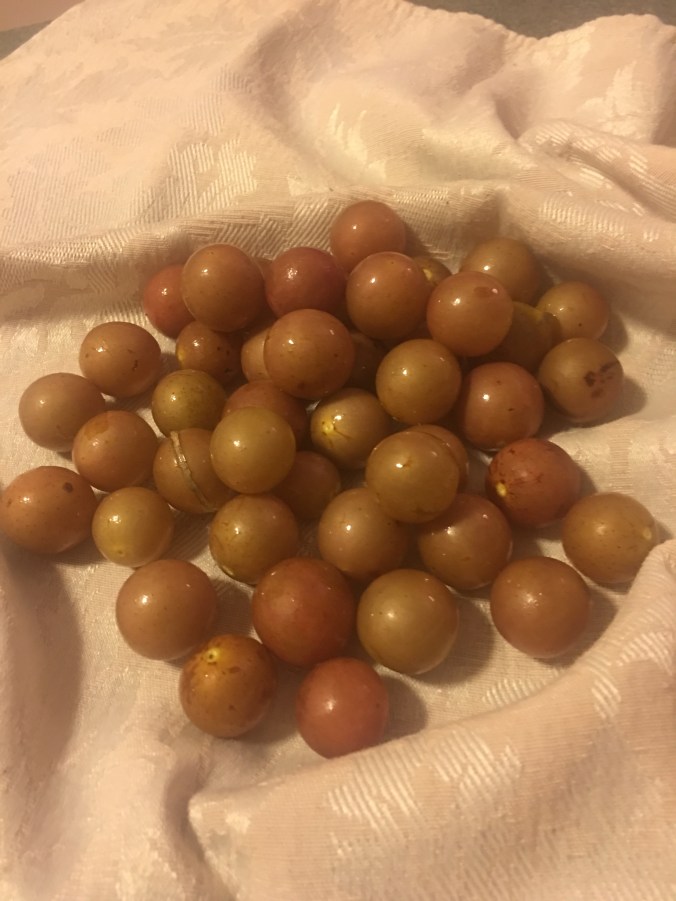
They aren’t beautiful, scuppernong grapes. Their unassuming greenish-bronze skins are flecked as if with age spots. Hardly inviting.

If you have never tasted one, you have not fully lived.

Yes, the seeds are a nuisance, difficult to manage in polite company, as one must spit them somewhere.

But put one in your mouth, gently split its remarkably thick skin open with your teeth … oh! The burst of richness is almost breathtaking. Embryonic wine, a touch of dying summer, a whisper of sweet things to come, something of all Christmases and bit of Heaven is encased in that homely little orb. No other taste on Earth compares. When I first studied mythology, I wondered if ambrosia, the food of the gods, was actually scuppernongs.

I first encountered scuppernongs as a young child. I can see the vines towering over my head, the flickering sunshine and shadow of wide leaves, the poles my grandfather erected, his straw hat, the plaid pattern of his sleeve as his big wrinkled hand reached up to pick the grapes for me. No words; just richness. Just joy.

A lot of things are like scuppernongs – unappealing on the outside, messy and more work than seems necessary. Teaching is like that. Writing is like that. Living is like that. Get beyond that first impression; it’s misleading. Press on to the heart of it. What you find there will take your breath away.

Reflect: When has the appearance of a thing, an experience, deceived you? What surprise was waiting for you within?


Cicada rhythm

cicada-on-post

Image: Cicada on a post. Jo Naylor CC BY 

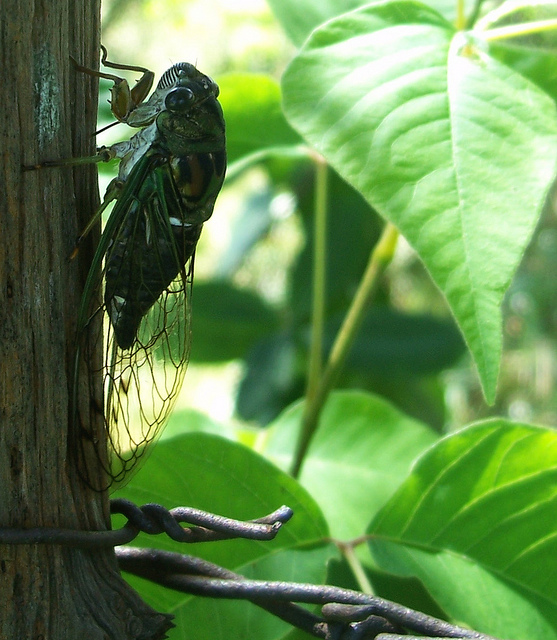
Summer is dying now, taking with it one of the things I love best: The song of cicadas.

If you’ve ever heard cicadas in full throttle, you might not agree with “song” as a fitting description of their cacophonous buzzing. It’s not pretty. The noise can be deafening.

Yet when I hear that first discordant rattle sometime in May, my spirit rises, my own heart sings in response.

The song of cicadas calls to me from long ago, when I was a little city girl spending sultry summers in the country. The song evokes narrow dirt roads keeping an ominous forest from encroaching on rustic homeplaces, tiny cemeteries where baby after baby is buried under white monuments adorned with lambs, and the old church just around the bend. The song is one of ages, the rising and falling of generations, all of us coming and going in our time. It is a song reverberating with tire swings hanging from pecan trees, canals teeming with frogs and turtles, white-tailed deer bounding up from lush ditch banks along fields at dusk. It is the bright song of the sun, of hope, of continuity. It is the dark song of the night, oddly comforting; something out in the blackness is vibrantly alive, maybe keeping watch, while children drift off to sleep. It is the sound of safety, stability, belonging. Calling and calling, the crescendo mirrors the rhythm of life, brimming with promise, echoing eternity. When I hear it, I am a child again, no matter how many summers have come and gone. My home is in the countryside now and it is with a deeper pang each September that I note the song fading out. Every May, as I mark another year of my existence, I listen for the first returning rattle. You’re back! my heart sings. Ah, but we were here all along, they might say, if cicadas had words. There’s a lot of living and loving yet to do. You have today. Carry on.

Reflect: What’s one thing in nature that inspires you? Why?


Thinking fast

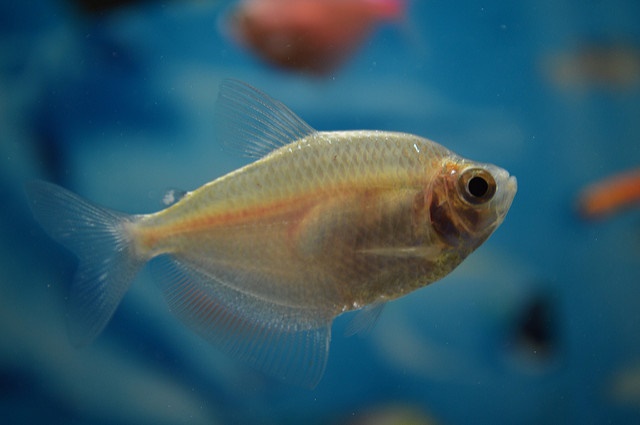
Fish

Image: 甘 泉 CC BY

A carnival came to town when my older son was three. The highlight of this event, you might surmise, was our elephant ride. If you ever plan to ride a real, albeit relatively small elephant, here are some tips: Be prepared to rock precariously from side to side. Hold on with your knees. Wear jeans, because elephants have unexpected long black hairs that stick straight up to pierce your legs. I felt quite exotic, but, alas, it was not the pachyderm that made the boy’s day.  He was completely captivated by the silver goldfish he won all by himself, playing ring toss.

On the way home, envisioning an inadvertent water bomb disaster involving the plastic baggie and the sidewalk, my husband said, “Son, let me carry the fish for you.”

Our boy, who was walking an inch  or so taller, puffed his little chest out. “I won’t drop it!”

“So, what are you going to name your fish?” I asked, trying not to hover.

“Flipper!” Oh, the power of television syndication. The boy held the bag up to his face, beaming. “Hey, Flipper!”

Transferring Flipper from the bag to a large jar was tantamount to a birth: “Be careful! Don’t let him fall!” Our boy watched with big eyes, nearly holding his breath, as I poured his prized possession into a new living space.

We placed the jar on the living room mantel. I explained: “Fish are not supposed to be carried around. They need a safe place. Flipper will be fine here and you can look at him all you want to.”

The boy seemed content with this arrangement. “All right.”

For the next day or two, he could be found in the living room at random moments, staring up at his fish. I listened from the hallway: “Hey, Flipper! Are you hungry? Do you like swimming in your jar? This is your new home!”

Then: “I love you, Flipper.”

Flipper was the first thing he looked for in the mornings and after his naps. He was taking a long nap later in the week when his dad and I had to leave for a dinner meeting. I prepped the babysitter: “He will want to check on Flipper when he wakes up. The boy loves that fish.”

The babysitter chuckled. “That’s so cute!”

The dinner meeting ran longer than expected. Knowing our son would be in bed for the night, my husband and I entered the house quietly. The babysitter met us at the door, wringing her hands:

“Let me just tell you that as soon as you left, I went to see that fish. He didn’t look so great. I tapped on the jar to see if he would move, but no. A floater. Totally dead. I thought ‘What am I going to do? I gotta get him out of here before the boy notices!’ So I flushed him. I figured I’d think of something to say later. Then your son woke up. He said he needed to use the bathroom so I took him. Just as he was finishing the last few drops, he points at the toilet and goes: ‘Is that Flipper in there?’ Heaven help me! I didn’t know the fish hadn’t gone down! I had to think fast. I said, ‘Wow, look at that! You just peed a fish!'”

Exactly what we told the boy about the absence of Flipper and his jar on the mantel is lost in time; all we remember now is the ingenious save – of the moment, if not of the poor fish.

Reflect: When has thinking fast served you well? When have you switched gears in the middle of something to rescue the moment?


Breakfast Island

island

Image:  studio tdes CC BY

Somewhere in Maryland’s scenic Severn River is a tiny island that belongs to me.

Not that I have a deed to it, or that the island was even the giver’s to give, but those are minor details.

The transaction came about when I was around seven years old, during a family gathering. My aunt and uncle, avid boaters, decided to treat everyone to breakfast on the beach. In the chilly gray dawn, a bunch of us piled into my uncle’s motorboat and sped across the Severn. Unbeknownst to me at the time, this majestic river connects with the Chesapeake Bay; the U.S. Naval Academy stands at the convergence. I only knew I was cold and hungry. I shivered in the breeze, thinking that going to the beach for breakfast was just about the most exciting thing ever.

The beach turned out to be an island right in the middle of the river. If Huck Finn had seen it, he would have called it a towhead, a mere islet with a thicket of brush in the middle. As the grown-ups busied themselves with building a small fire, I walked the whole sandy circumference in a couple of minutes, marveling at the island’s diminutive size.

“What is this place?” I asked my uncle, who was crouching by the fire with a skillet full of sausage links.

“Just an island where people sometimes stop off,” my uncle answered, as the sausages began to sizzle.

The sun was bright now, the Severn very blue against the island’s golden sand. A few white sails appeared in the distance.

“What’s the island’s name?” I wondered aloud.

“It doesn’t have one,” replied my uncle.

“Why not?”

“I guess it’s too small for a name.”

How disturbing, that such a pretty place did not have a name.

“Why don’t the owners want it to have a name?”

“Nobody really owns this island,” my uncle said, carefully turning the sausages. Thin blue smoke drifted up from the skillet.

“What! How come nobody owns it? ”

“It’s just here, hon. It isn’t like the big islands, where people live. That’s a good thing, because anyone who wants to can stop and visit, like we’re doing now.”

An inexplicable sorrow welled up in me. It wasn’t fair that no one cared enough about this little island to want it or give it a name. It hurt my heart.

My uncle squinted at me. “What’s the matter?”

“It should belong to somebody.”

“Ok, then, why not you?”

“WHAT?!”

“It now belongs to you.”

“For real?”

“You’re the owner of this island. Congratulations.”

Pride surged through me – I owned this island, the prettiest place in the world! I loved it. Somehow I felt it was mutual, that the island loved me back, was happy that I was there, that we were meant to be. Then a fleeting fear struck me:

“Do I need to pay for it?”

My uncle howled with laughter. “Goodness! Well, since there is no other owner, it’s free.”

The sausages were done; someone filled another skillet with apples and cinnamon. I never knew apples could be fried. Their aroma filled the air like incense from an altar, sweet, pleasing, mouth-watering. For the rest of that morning I basked in the glory of possessing my own island,  soaking up the sun and asking for more apples, until they were gone. I never wanted to leave.

I have never returned. I do not know if the island still exists, or if time and weather have dissolved it, the way that relationships eventually dissolved. What I know is that for that one halcyon morning, I was the richest person on Earth; I owned an island, and it was free.

Reflect: In what ways can you take a child beyond the realm of “the usual” to experience something rich and unusual? How can you creatively instill a sense of ownership?