2021: A year of awe

Some people call it one word. Others call it one little word, abbreviated OLW. Either way it’s the tradition of choosing a focus word for a new year. Maybe even a new word for each month. Make of it what you will, how you will, the chosen word serves as a tool for reflection, a lens for living, a frame for your days.

At the outset of 2021, I wasn’t in the frame of mind to choose a defining word unless it was survival or endurance or possibly perseverance, none of which were inspiring or lyrical (shouldn’t your OLW strike deep chords in your spirit?). After 2020, I was tired. We were tired, all of us. It was a year that seemed liked ten. The world as we knew it changed overnight. Quarantine, separation, isolation, closed businesses, bare shelves at the stores, working from home, doing school online. Plans disrupted. Staggering losses of so many kinds. Grief. Rage. Despair. Navigating the unknown every single day. The COVID-troubled world kept turning but we almost didn’t recognize it or ourselves anymore…literally, behind the masks.

We hoped. We clung to our screens. We cherished every glimmer of light in the long, dark night of the soul. How long? we wondered. How long?

On the brink of 2021, as I wearily turned the page in my academic planner, I said something like this to myself: Forget the one little word thing. I don’t have the energy to think around it or write around it. What difference does it really make, anyway. After all, my word for 2020 was reclamation. I wrote in January, before the onslaught of COVID-19 in March, when everything shut down that Friday 13th for what we thought would be only two weeks: Moving forward becomes an act of will, a revised determination to do what you can, what’s most important, for that given day. Recovering ground, inch by precious inch.

Note to self: Be careful what you wish for…

But then, then, turning that page… I discovered this quote, in tiny font, sitting on January 1, 2021, in my planner: Experiencing awe (the feeling of being in the presence of something bigger than you) can improve your physical health and make you feel more altruistic. Intentionally create awe this month by spending time in nature, meditating, volunteering, etc.

I knew, then.

Whatever might come in 2021, I must look for awe. I must keep the door open for it. Anticipate it. Invite it.

There’s a psychology, a science, to awe. A savoring of life, an ineffable hope, a spark of joy, an inhaled breath of wonder at the wonders all around, a reverence. It can make you feel more altruistic…desiring to benefit others at your own expense…can the world not use more of this?

I sat in awe of this revelation…and that is the story of awe choosing itself as my word for this year, now in its final days.

It’s everywhere, awe.

In fragile periwinkle flowers poking through the January snow, in the piercing cry of a red-tailed hawk, in the flight of an eagle near enough for me to see its white head. In the resilience of children learning from home and in their happy dogs who attended class with them. In my own dog, who slept in my lap during those long hours online. In colleagues who stopped resisting new learning in the hardest of times and began embracing it…and each other. In children learning to read despite all, in one student pointing to a new word, “trombone” (without a picture), and telling me I don’t know how to say it, but it’s a musical instrument. In resuming church services and eventually singing hymns again. In the return of the little finches which have built a nest on my front door wreath every year except for 2020. In the gift of new life…in the announcement that my son and his wife were expecting a baby in the fall. In the long summer of anticipating, in finally making it to the ocean again, in seeing how seabirds stood on the shore, protecting one of their own that was missing a foot. In passing three white horses in a grassy meadow on morning drives to school, reminding me of a game my father taught me to play on long journeys when I was a child (I have a lot of thirty-point days now, Daddy). In teaching poetry again, in seeing the kids’ faces light up with their own writing discoveries. I wrote a lot of poetry in 2021; much of it centered on awe.

I have so much more to write. I am awed by what my sons have accomplished this year, one as a minister, the other as a funeral assistant and musician. I am awed by other people who say your boys have blessed me.

Baby girl Micah arrived at the end of October. Her big sister’s wish, come true.
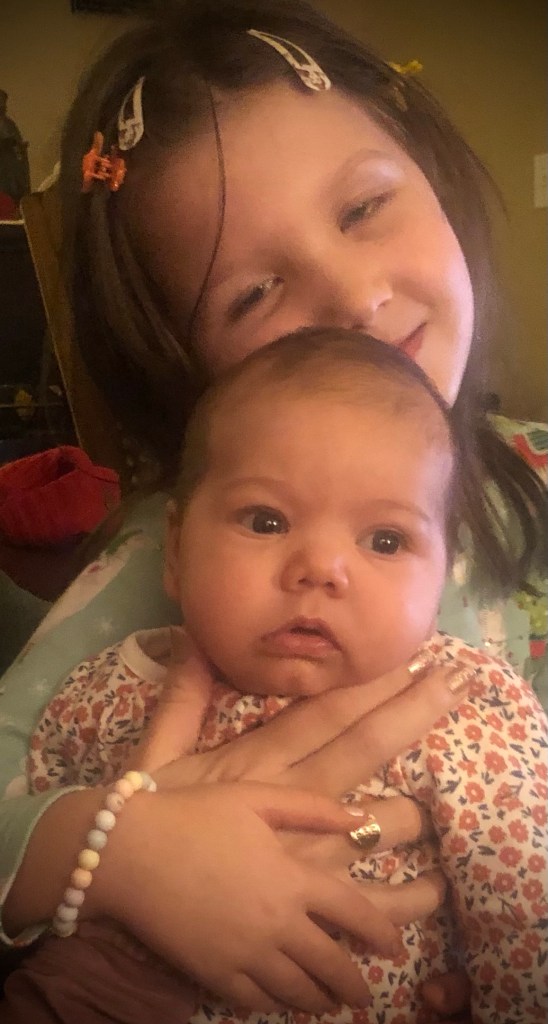
Christmas Eve at my house, 2021

Awe abounds. It waits to be found. Just like the little present placed in my stack on Christmas Eve during our family gathering.

That’s especially for you, Franna, said my daughter-in-law.

I opened it.

Micah’s tiny handprint, in white plaster.

Awe.

And tears. Too overcome for words.

My daughter-in-law didn’t know the story. One day I will tell Micah about the handprint I made for my grandmother so long ago, how it hung on her bedroom wall for over thirty years…

Awe. Awe. Awe. Life in its abundance, making full circles. Light to be found, even in the darkest season. The treasure of having each other. Love, blessing, wonder, the gift of life itself, all from the hand of Almighty God.

I see no reason whatsoever for changing to a new word in 2022.
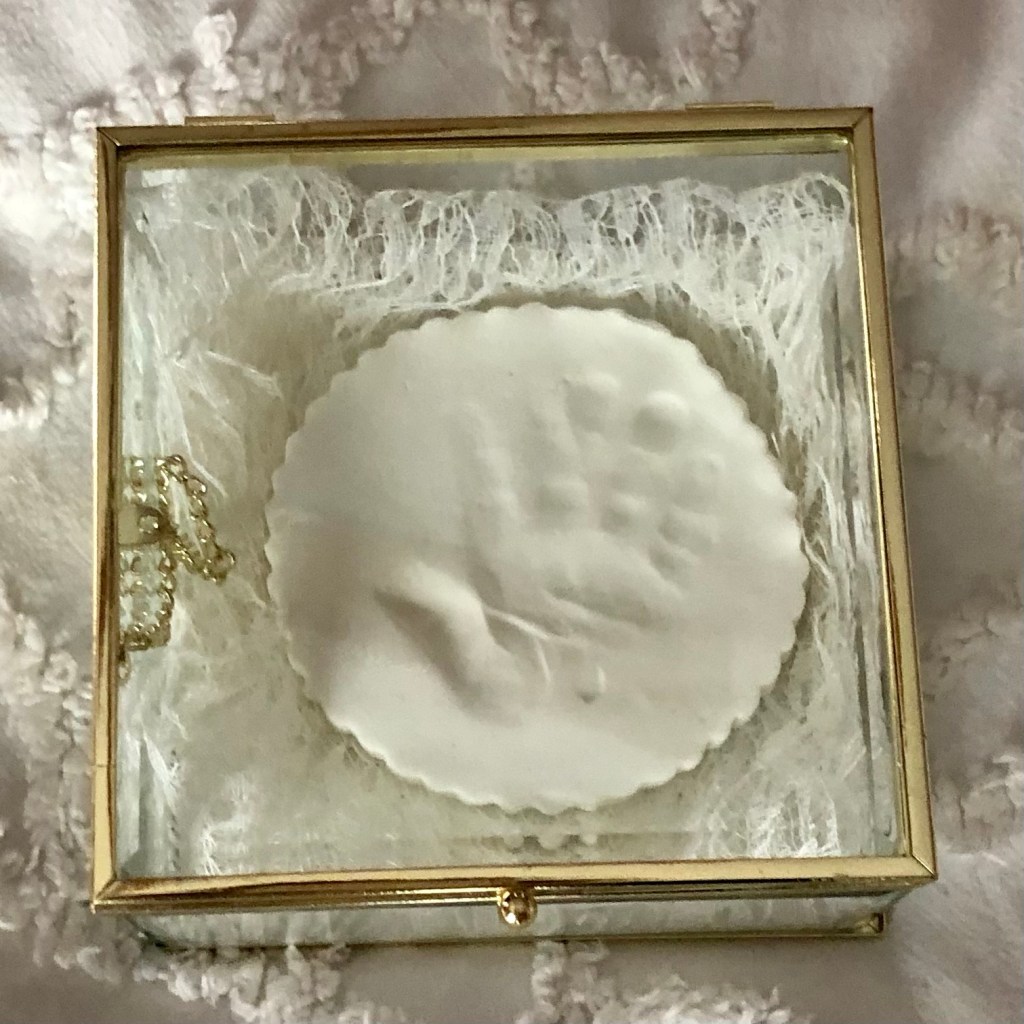
Wishing awe to you all – each new day with its waiting treasures

*******

with much love and gratitude to the Two Writing Teachers for the weekly Slice of Life Story Challenge. There is sustaining power in writing. There is more in a writing community.

Why I write, 2021

The Children’s Eyes (When They Are Writing)

The children’s eyes
are windows to the skies
sun-bright,
moon and star-studded night,
reflected wonderlight.

The children’s eyes
are toy-wagon wheels
absorbing, bearing, hauling
so much more than playthings.

The children’s eyes
are gates in a small walled garden
which widen when they realize
the stunning flora growing within
—cultivate it, Children.

For in my own walled garden
of memory
lush greenery still grows
not concealing
but revealing
what I now know
to be healing.

All I’ve lived and seen
eventually spills forth
in story or verse
above and through and over
the old stone wall

for even in the moonless,
star-obscured,
darkest night,
there is always
a ribbon 
of light. 

This, Children,
is why I write.

Speaking of things I’ve seen…artwork on a concrete wall in Asheville, NC.
The garden struck me as metaphor for writing, growing there in the brain.

*******

with thanks to Andy Schoenborn for the “eyes” and life experience poetry prompt on Ethical ELA this morning, to Two Writing Teachers for sustaining a community where teachers of writing flourish, and to the National Council of Teachers of English for designating October 20th as National Day on Writing.

and in honor of all the children who inspire me, every time I’ve come to your classrooms to teach writing.

Dear student…

That email you sent.
Almost didn’t open it.
Seemed like random spam.

Thank God I did, though:
I hope you remember me…
the little girl who

halfway wrote a book
‘bout five or six years ago…

-How could I forget?

Never finished it
but now I’m writing this one…
-You are still writing!

You can’t know the gift
it was, assisting your craft
as it developed

the pure joy I took
from the spark in your child-eyes 
born of storylove

-that’s YOUR gift, you know.
Your storytelling power.
It’s grown stronger, still.

And your plans, to be
a therapist. A healer.
An author. Oh, child

you have no idea
what your words have done today.
I read them again

and again, amazed
by your remembering me.
I compose my thoughts

to respond to you,
most of all to say that you’re
unforgettable.

*******

I wasn’t this child’s regular teacher but the school’s literacy coach, supporting writing workshop across grade levels at the time. Her fourth-grade teacher asked if I could make time to work with her as she had fallen in love with the craft and wanted to write historical fiction. We carved out the time; we made it happen. I blogged about it in 2017: Tripping the write fantastic. That teacher invited the student back a couple of years later to share her writing with a new crop of fourth graders. I blogged about that, too: Still tripping the write fantastic.

In the recent surprise email that sparked the poem I posted today, the student also wrote: “Every now and then I’ll read what you wrote about me on Lit Bits and Pieces, and it always makes me smile and feel inspired.”

That, Dear Student, makes ME smile and feel inspired. ❤ Can’t wait to see where your writing takes you!

Thanks to Two Writing Teachers for the weekly Slice of Life Story Challenge…for teachers must write to teach writers.

Thanks also to Allison Berryhill who hosted an Open Write on Ethical ELA with prompting “a poem to a student.”

Photo: “Steal Like An Artist – ‘Write the book you want to read’.” Austin Kleon. CC BY-NC-ND 2.0

Culinary adventure

“Cooking is an art, but all art requires knowing something about the techniques and materials.”

—Nathan Myrhvold, former Microsoft CTO and author of Modernist Cuisine

At a restaurant during our recent vacation, my health-conscious husband ordered a black bean burger. I don’t recall him ever eating one before. For the better part of his life, he’s been a hearty meat eater. The man loves food…his reaction upon tasting this vegetarian concoction: “AMAZING! I can’t believe how good it is!”

Then, with a subtle batting of his eyes: “I wish you could make these.”

—Was that a throwing down of the gauntlet, at my very feet?

Call it inspiration, determination, seeking to please, or self-challenge, whatever: I decided on the spot. I would do this.

I’ve never made black bean burgers before.

As a rule, I don’t like veggie burgers. They’re mushy. The whole idea of a burger is, you know, substance.

And so I do my research. I find a recipe entitled “The Best Black Bean Burgers I’ve Ever Had.” Seems a reasonably good starting point (why settle for less than the best?).

It doesn’t seem too complicated, really. While I organize and prep the ingredients, however, doubts seep in…if this tastes awful or falls apart, maybe we’ll go get Mexican…

I learn a couple of things in this new undertaking. It’s essential to get as much moisture as possible out of the beans. The drier they are, the better the texture, so the recipe says. Not only do they need to be drained, rinsed, and patted dry, they need to go in the oven on a baking sheet for a few minutes. I discover that cumin, smoked paprika, chili powder, and Worcestershire blended with the dried beans create a surprisingly grilled taste.

One big concern: Will the burgers hold together after baking? Sometimes my regular hamburgers don’t. Not enough bread crumbs, maybe? How did my Grannie ever make those phenomenal, flavorful burgers of my childhood? She could have sold them and made a mint. I’ve never been able to duplicate them. The scent of Worcestershire stirs the memory with a wave of intense longing…

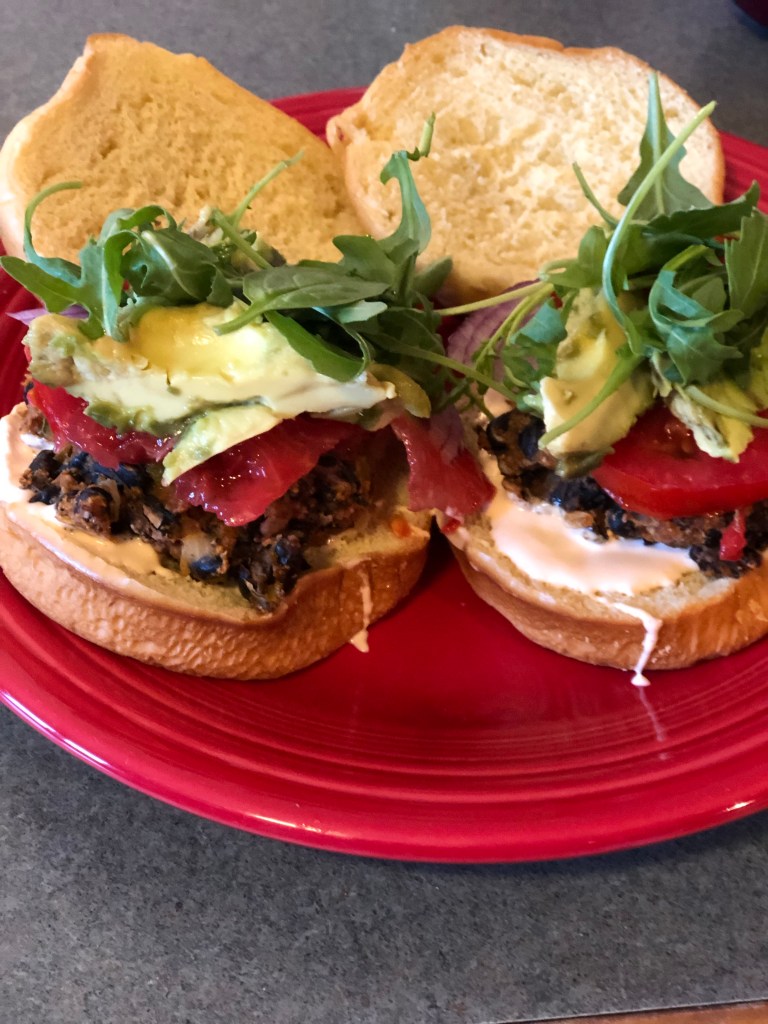
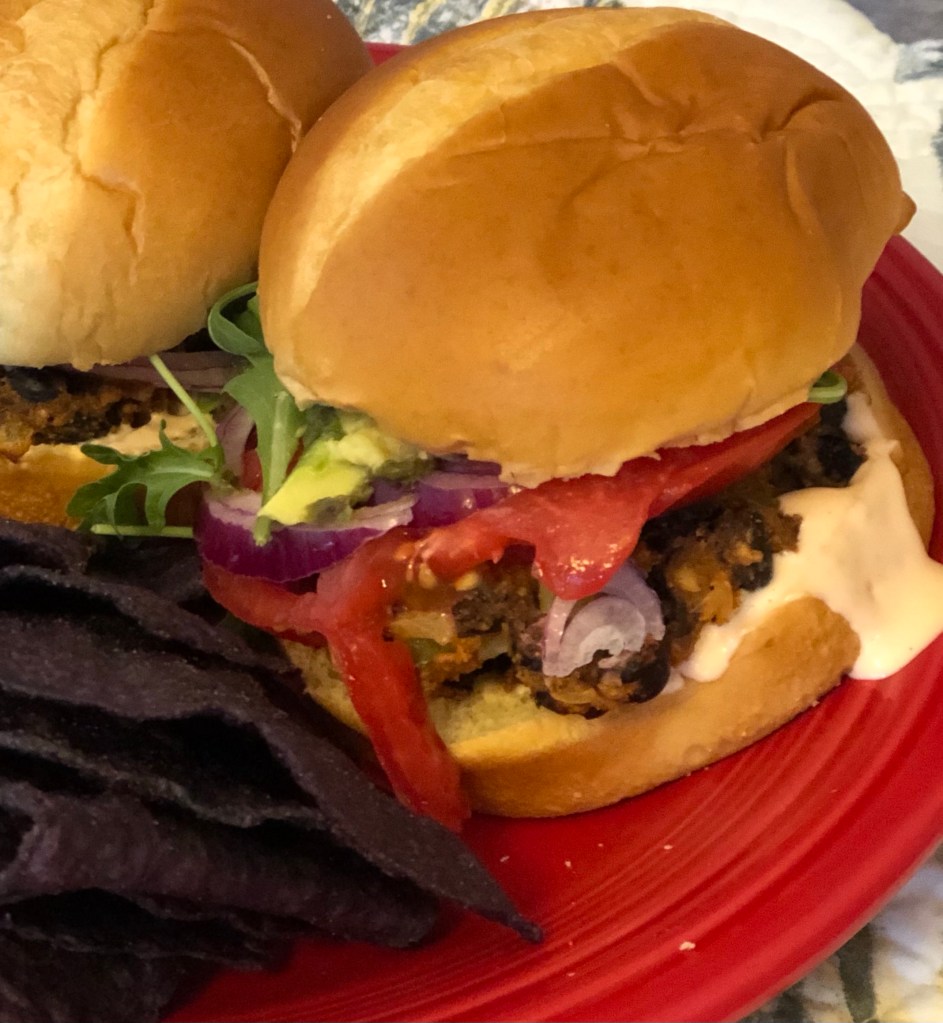
Furthermore, I’ve decided not merely to make these black bean burgers, but to recreate the one my husband thought was so amazing. I’ve looked up the restaurant menu for the toppings: avocado, tomato, arugula, red onion, spicy mayonnaise.

— What IS spicy mayonnaise?

More Googling. Mayo mixed with hot sauce, apparently.

“Hey,” I say to my husband, who’s washing his hands after cheerfully helping to shape the patties for baking, “pick the hot sauce you want to go in this ‘spicy mayonnaise.'”

He has a whole collection of hot sauces.

He picks Texas Pete.

All righty then.

And, if nothing else turns out…we do have gorgeous homegrown tomatoes that have been given to us. They are another reason I love summer, these tomatoes. I think, as I slice into their luscious redness: We could just have cheese and tomato sandwiches in case of disaster…

My husband has also chosen Brioche buns: “The bread at the restaurant was really, really soft.”

We take the burgers out of the oven and—wonder of wonders!—they hold together when we lift them off the pan.

I put them on the buns, layer on the toppings. They’re pretty, but the final test awaits…

My husband takes a bite.

He closes his eyes.

“This is the BEST. THING. I. HAVE. EVER. HAD.”

High praise from my former give-me-steak-and-fries guy.

He eats every blessed crumb for the next three meals.

—Mission accomplished.

The black beans combined with finely chopped onion and green pepper create good texture, much like a tender hamburger.

Pretty proud of my culinary work.

*******

As an educator I could make many analogies between this experience and teaching or writing. We see effective or impactful things that we wish to duplicate. Things we’ve not tried before. It’s daunting. Risk of failure is involved. So is risk of succeeding, if you will. There’s an art and science to writing and teaching, just as with cooking. Myhrvold’s quote on knowledge of techniques and materials at the top of this post struck me as foundational; this is the beginning of process. Knowledge combined with a spirit open to experiment can yield surprising results and discoveries; what you experience and create will not be exactly like your model nor a complete replication what others have done before you. It shouldn’t be. You are making something your own. The work reflects the uniqueness of the artist.

Wishing sustained strength and inspiration to all my fellow teachers preparing to return to school with the residual effects of 2020 still lingering. Here’s to aiming for the best. And to our own learning.

with thanks to Two Writing Teachers and the Slice of Life writing community, ever a safe, nourishing place for creative strivings and growth.

Pencil wizard

Once upon a time, I said that writing is the closest thing there is to magic.

Here is why.

Magic is not, well, magic. It is a lot of work (or why would Hogwarts exist? Just saying).

Writing is a lot of work.

Work (a lot of it) makes the magic happen.

Here is a true story of magic moments at the end of this dystopian school year (know that I am suppressing the urge to compare virtual learning to disapparating, i.e., teleporting from place to place, or essentially vanishing). After end-of-grade testing—I said dystopian, right? What does the State expect this data to look like?—a fourth-grade teacher sent me a note:

One of my students has been writing a story in his free time. He wants to read it to the class. He knows it needs some work and I am wondering if you have any time to help him? He’s not usually motivated to write…

I made time. I would shift heaven and earth for this.

He came to my room wearing a giant grin, clutching his pencil and notebook. I recognized the cover—it’s a notebook our district distributes to teachers. His teacher must have given it to him especially for his story, for in grades 2-5, our district doesn’t use writing workshop any more (and that, Dear Readers, is a whole ‘nother tragedy for the telling on another day).

“Come in, come in!” I said. “Have a seat here beside me and read me your story.”

Without giving too much away (for the story is his): It’s a fantasy, a battle between humans and wizards, the protagonist a young wizard with power to make living things grow. The student read it all aloud and then we went back to make some changes for clarity and flow, with my asking:

“What exactly do you mean here, when…”

“What is it you are trying to tell the reader? What do you want readers to think or feel here?”

“Think of an action to add here, so readers or your audience can better see what’s happening in their minds, like we do when we watch a movie. What are you seeing here in your own mind? That’s what you need to get across.”

“What’s a better word choice here, to make the meaning clear?”

While the boy thought and elaborated aloud, I began typing the story. As I read the lines back to him, his face glowed: “Perfect! That’s amazing!”

“That is the power of revision,” I told him. “When you start writing, it’s all about getting your ideas down. When you go back to make the meaning clear, by adding these kinds of details and taking out what you don’t need, that’s where all the magic happens.”

“We’ve made a lot of changes,” the boy observed, “but it’s SO much better.”

And yet the story remained the story he wanted to write.

We’d changed city to town, people to townspeople. He made the stylistic choice to capitalize Humans. We’d added transitional phrases to keep the readers from falling out of the story. We added gestures for the young wizard when he makes vines grow (“I need to see how the wizard does this,” I explained). The student vetoed my suggestion to go ahead and incorporate “earthbending power” (a phrase borrowed from video games): “I am not ready to tell readers yet about earthbending power,” he stated. —Such a tone of authority!

“All right then! You’re the author. Save it for when the time is right in the story. Just make a note here to add earthbending power later.”

And then the word tome… “Is tome the word you want here, where you say the wizard found a tome in the laundry?”

“Yes. It’s a big book of spells.”

I blinked. “Indeed! That’s impressive. Just make sure your readers know what you mean here, that they can see and understand what you mean by tome.” It became an ancient tome of spells, hidden in a robe in the laundry, that the young wizard began to read “without realizing the power he now carried”—those are the student’s own words, not mine.

And thus I spent the last days of school this year watching the love of writing take root and flourish in the heart of a child…magical, indeed, in a year where so much felt anything but, even in some of my own writing of late.

As I write this morning, sunlight streaming in my window like all the glories of summer on the cusp, I recall my final words to this child as he carried his typed version away in a bright yellow folder: “Keep writing!”

In my mind’s narrative, I add: Young word-wizard, with earthbending power.

For that is the magic of writing.

May he cultivate it all of his life.

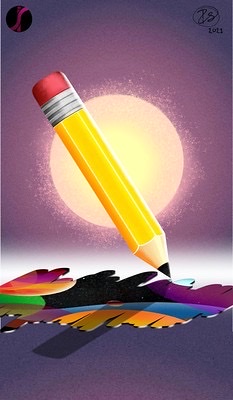
Imagine. Indy Sidhu. CC BY

–with my thanks always to Two Writing Teachers, a community dedicated to the craft, power, and love of writing, for all Humans.

The light

Every morning
at about this time
if I’m not yet out of bed
a curious, pulsating light
enters the room

I would like to think
it’s a Muse, arriving
from celestial regions
bearing new and fragile ideas
for the taking and keeping

or that it’s some other
ethereal visitor
out there beyond
my window
illuminating
the darkness
and if so,
I want to know
why

but no,
it’s only a neighbor
on his morning jog
right on time,
between four and five o’clock
wearing a mining hat
that casts a bright beam
before him as he runs

I think, there’s a metaphor in that
a meditation, a prayer
before I rise
to face the day
in this present darkness:
Let there be a light
on my head
a means of truly seeing
all that I will encounter

not in the inadequacy of
my own shadow, falling before me
no, let it fall behind me
indiscernible in the dark

and so I watch this soft light
bobbing along my walls
permeating my closed blinds
painting pictures real and imagined
in my mind
while the Muse
(who never really leaves)
prods with a finger
or maybe it’s more of a pulling
or a whispering
or all of these

and I sigh,
throwing back the warm covers
rising to write
while it is yet night

a light
to set the day
off
and running

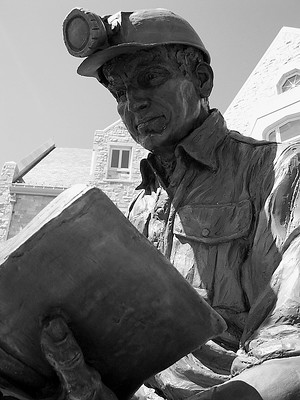
Statue, “Quest for Knowledge,” Washington & Jefferson College, depicting a coal miner on lunch break. Photo by “Kathy,” CC-BY.
My neighbor wears a hat akin to this on his predawn jogs.


A bit of legacy poem

For Day Twenty-Six of National Poetry Month

Testament 

I cannot measure
how much time remains
in the hourglass
of my days

sand grains
steadily trickling
more than half
already gone

yet still refining
polishing
my existence

with words

let them be
the worry-stone
worn smooth
slid into the pockets
of those I encounter
a cool indented
presence of calm
for the holding

let them be a beckoning
a turning inward
toward crystals
forming in the geode void
the amelioration
of hollow places

let them be
like the curious folk remedy
of my childhood
jars of strange white peach rings
with heart-colored centers
floating in witch hazel
(which has nothing to do
with magic; the etymology of the name is
pliable)
cure for bruises and
what ails you

let my words be
a gauge for life-giving rain
collected
yet flowing on
and on
a good measure
pressed and shaken
poured out

a testament of love
for the new life

coming

Habit acrostic

with thanks to Ruth Ayres at SOS – Sharing Our Stories: Magic in a Blog, for reiterating this truth: “Habit is essential for writers. If we develop a habit that allows us to enter into writing, then we will write more often.” She encourages the “magic” community to pay attention to the routines that make blog writing happen.

I am a morning writer. I love the rich, dark silence of the sleeping world around me, the freedom to hear my own uncluttered thoughts, the anticipation of gifts from the burgeoning day. I love the neighbor’s rooster, how his loud crowing wafts through the stillness; there are a few roosters in this neighborhood and sometimes they echo each other in a chorus of wild, rustic, joyful aliveness. It is a song of my soul. For a second, I have a sense of my young grandfather a hundred years ago, preparing for his farm chores, walking the fertile land he cultivated and loved all of his life, as darkness turns to light.

And so I write.

An acrostic, for Day Sixteen of National Poetry Month

Hallowed
Are these moments
Before the dawn
Immersed in words
The breathings of my being

If you are looking to write more or to develop a blogging habit, consider joining the vibrant community
at SOS – Sharing Our Stories: Magic in a Blog.

Digging for awe: Golden shovel poems

I recently wrote a post for the CCIRA Professional Development Blog on the sometimes spirit-crushing work of literacy education. I will not list all of the contributing factors here; I will just say that there are many, especially during this long year of COVID-19. Prior to to writing the post, when asked what teachers are facing in regard to literacy and what is most needed, I responded: “A great lot of pressure at present. We have to able to relax some and find joy in our work.”

As I wrote, and as is usually the case, the path became clearer: Make room for awe.

That is my guiding “one little word” (OLW) for the year, see. And maybe for the rest of my life…

Yesterday I spoke with a colleague who will continue teaching virtually until the year ends in June, for students whose parents have chosen this option. She spoke of awe in regard to the Google Classroom chat feature: “So many more kids share their thoughts this way, more I’ve ever seen in person. I’m in awe of how much they have to say and how they encourage each other. We use the chat all the time now.”

This means students are writing more, which makes my heart sing. If ever there is a conduit for awe, it is writing.

Example: Have you noticed how many people—many students—have suddenly been enraptured by poetry after hearing Amanda Gorman? Who credits her childhood teachers and her school for valuing this kind of expressive, artistic, move-the-mountains writing?

I’ve been lamenting the loss of meaningful writing in elementary schools in my corner of the world, just when it it’s most needed—the writing workshop model having fallen out of favor in the last few years for an embedded, formulaic approach around a topic at a time. That is another whole story; suffice it to say that I am in awe of teachers and students finding their way back to writing that matters.

All of which brings me to Golden Shovel poems. It’s a form I’ve been playing with for about a year. It holds great appeal on a number of levels, practical, creative, metaphorical…the idea of mining for the nuggets of gold, the diamonds that lie within, often so unexpected, yet so important.

A teacher might give the Golden Shovel to students to dig something more out of whatever books they’re reading, songs they’re singing, famous speeches they’re studying, even a line a classmate has written—anything, really. Not necessarily as a response to the work itself, but latching onto any line that strikes them with its beauty, or pierces their hearts with its poignance, or stirs their souls with its power, to create something new and personally meaningful from it. Make room for awe…

Try digging with the Golden Shovel yourself. Take a line from a poem or a favorite book, speech, or song that has special appeal to you and transform it into something of your own. Each word in that line becomes the ending word of a line of your own poem (or the beginning word, if you prefer). Your poem may reflect an aspect from the original work. It may not. A Golden Shovel poem can mean whatever you wish; it’s just inspired by the line you use to create it.

I chose this line from Gorman’s Inauguration Day poem, “The Hill We Climb”: Even as we grieved, we grew.

Days roll on, even to odd, odd to even,

tossed dice, never quite landing, as

we wonder how that’s possible. Don’t we.

In the spinning we still loved as we grieved

and we’ll go on, won’t we, 

even as we did when odds against us grew.

And this one, from the book Wintering: The Power of Rest and Retreat in Difficult Times, by Katherine May: We do not fade so easily from this life.

Now, who are we

and what should we do,

here where the sun shines not

and Earth’s colors fade.

Even so

consider how easily

we glide from

that room to this,

enduring, rather than living, life

And so I pass the Golden Shovel.

Here’s to the awe of your own discoveries.

Happy digging.

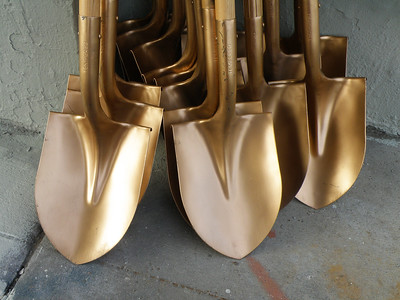
Photo: Golden shovels. Alachua County. CC-BY

*******

The annual Slice of Life Story Challenge with Two Writing Teachers is underway, 
meaning that I am posting every day in the month of March. 

This marks my fifth consecutive year.

Writing

With special thanks to Dr. Kim Johnson who hosted Ethical ELA’s Open Write last week with the invitation to compose “Your Life’s Table of Contents” poems. There is no formula, just lots of freedom; Kim said: “I started thinking about how I might write a table of contents organizing the poems I have written over these past few years, in verse…Imagine you are creating a collection of your own work, and try your hand at an organizing poem to be a table of contents or any other feature of a book.“

My poem is based on a timeline of my writing history, starting at age 6.

My Life’s Writing Anthology

Bible story plagiarized
in blocky big letters
on lined newsprint paper

All About Me
carefully rendered detail
teacher-praised

Myth of Shoeani
on the origin
of shoes

Dr. Heartbeat, Dr. Heartbeat
a play composed
around four words
heart
lion
clock
—I forget the fourth

The Poetry Years
of rainbows
friendships
love
loss
even a baby dragon
rhythms of my soul
attempting to understand
itself

A short story
a mystery
a secret
a little girl
kept safe

All-nighter
research paper
on the function of 
King Claudius
in Hamlet
—still tied two of my best friends
for the highest marks in class

Oral tradition
of grandparents
put to paper
for the first time

Novel ideas
captured in notebooks
beginning to live
even if 
they haven’t breathed
in a while

Critical research
on children’s fantasy lit
taking the last of my strength
and the humanities prize

Short stories
hammered out
within word counts
for competitions

Mentor texts
for students
and teachers
learning how to write
and to love
memoir
essay
story
fantasy
poetry

The blog:
the archive
the scrapbook
of my writing life
my love letter
to words
and the world

*******

The annual Slice of Life Story Challenge with Two Writing Teachers is underway, meaning that I am posting every day in the month of March. This marks my fifth consecutive year and I’m experimenting with an abecedarian approach: On Day 23, I am writing around a word beginning with letter w. How could it NOT be “writing”?