Mystical morning

Ocracoke surprise

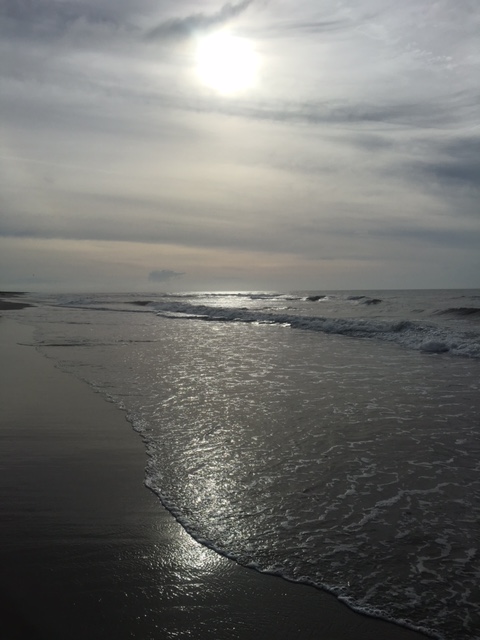
The island dawn is one of nebulous grayness, the sun an oblique white disc shrouded in veils of clouds. Painted from a palette of pearl, silver, and slate, the sand, the sea, the sky are starkly monochromatic, like an old black-and-white-movie. The temperature is indeterminate, neither hot nor cold. The morning is not uninviting nor inviting; it simply is.

As I make my way past softly rolling dunes of long grass shivering and undulating in the wind, I think only of the ocean, the opportunity to savor its splendor in relative isolation, away from commercialism. I expect to see a die-hard beachcomber or two; surely this a shell-collector’s paradise.

I do not expect the tree.

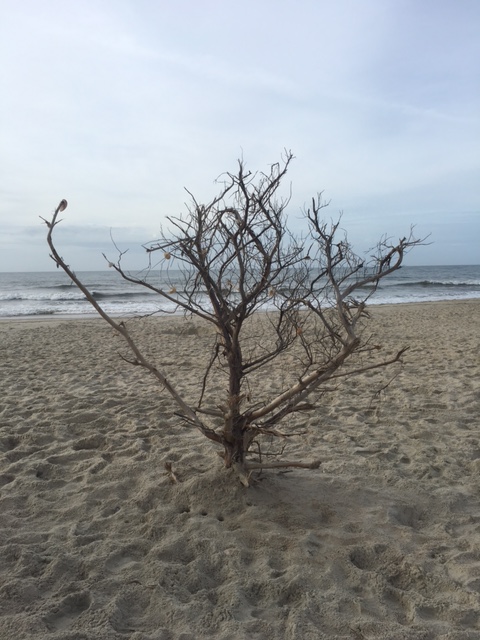
There it is, up ahead in the sand, directly in front of the path where dunes give way to the shore, with the shimmering, empty Atlantic for a backdrop.

How curious. I’ve not seen a tree smack in the middle of a beach before.

Are there others? I scan the shoreline, as far as I can see, on the left and the right.

No.

This is the only tree.

Did it grow here, somehow? I investigate. I suspect not, as the sand is built up around the tree’s base, although I can’t discern human handprints. Or footprints. I don’t even know what kind of tree this is, although I saw numerous others like it lying in the Pamlico Sound on the Hatteras side of the ferry ride to Ocracoke. I should have asked the crew what kind of trees these are and why they lie so far out in the water. 

Driftwood, then. 

It stands here on the vacant beach with its thin, snaky branches twisting skyward. Shells dangle from some of the vine-like tips, reminiscent of castanets on fingers. Or earrings.

I am enchanted. I’ve a sense of standing in no-man’s land, except that someone has clearly been here. Maybe someones, plural. Mystery people were inspired to plant this bit of driftwood and to decorate it with what was near at hand. 

The tree is dead. Shells, for all their intricate beauty, are but skeletons. I marvel at the human heart, its great desire for creativity and play. At the ability of the inner artist to see that random pieces of things no longer living, broken things, can come together in such an unexpected way. Whimsy in the wind. The beach tree stands as a mystical reminder that all is not lost, that all has value, that there’s beauty beyond the brokenness if we are willing to rearrange the pieces. The extraordinary lies not beyond the ordinary, but within it. Not beyond us, but within us, within our very grasp, if we just reach.

The ocean sparkles despite the obscured sun, like the twinkling of an eye when someone’s just about to smile.
Ocracoke morning

Note: The title is a deliberate play on that of a previous post about my son’s trip to Iceland – both attempts at capturing the essence of place: Mythical morn.

slice-of-life_individual

Soul-ache

Only time for a quick hug

Only Have Time for a Quick Hug. JackieCC BY

I recently learned of the UK’s Empathy Museum, which began in 2015. Their mission: To help us look at the world through other people’s eyes. To walk in their shoes.

Literally.

Part of the exhibit, “A Mile in My Shoes,” is an actual collection of shoes worn by a Syrian refugee, a war veteran, a neurosurgeon, and many others. A person can don the shoes and walk in them while listening to a recording of the original shoe-owner’s story.

Another project of the Museum is the Human Library – instead of checking out a book, you can borrow a human for a conversation. “A Living Book,” says the site.

The keys to empathy are story and dialogue. Experiencing what others have experienced.

The Museum was founded by – can you guess? – a writer.

A thousand things flood my mind as I read about the Museum. Although I know it well, the power of story to impact and transform the mind and the heart is driven home again, anew. To live for a moment inside of others, to see through their eyes, to feel the stab of their pain, their fear, their sorrow, their longing, their joy (for joy, too, is a stab; read C.S. Lewis and William Wordsworth) is to bleed away part of ourselves on their behalf. Empathy is a simultaneous forgetting and remembering of our own soul-aches, while standing in someone else’s shoes.

Shoes remain, as stories remain. People do not. I have long been haunted by the image of shoes lying around the wrecked stern of Titanic when it was discovered. Author Charles Pellegrino writes that it took months for scientists to realize that these pairs of shoes, still intact after seventy-three years on the ocean floor, were uniformly spaced about eighteen inches apart, with shoelaces still tied. There’s no other trace of the people at all – not even teeth. Only the shoes remain to mark where the bodies came to rest. Scientists are at a loss to explain exactly how leather and shoelaces endure when no other clothing or skeletal remains are to be found, yet the shoes are there, the final witnesses, the last word in the story of their wearers. (And one more secret of the utterly mysterious ocean).

It is also worth noting how the hardcore scientists, successful in their famous mission to find her, wept over the Titanic.

Empathy.

Soul-ache.

For the suffering of others.

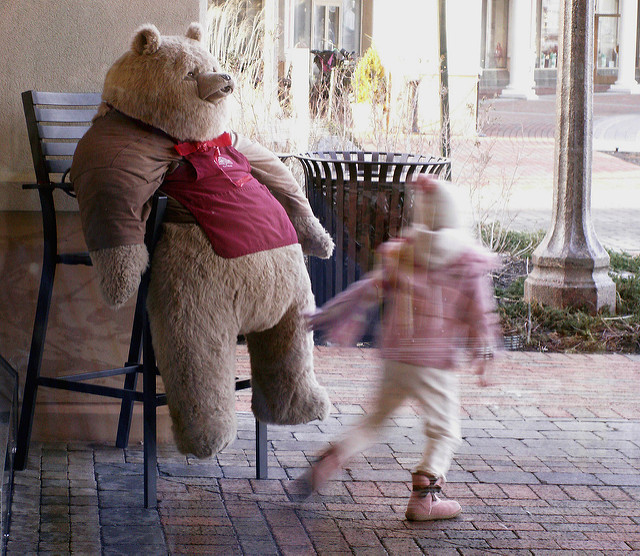
It’s also important to note that the word origin of empathy is rooted in passion as well as in suffering, hence the photo at the top of this post. The little girl runs to hug the stuffed bear in a burst of feeling, then runs away too quickly for the camera. Her image is blurred, ghost-like; a reminder that life is fleeting. She will not be a child for long. She may or may not ever be in this place again to see this bear, but in this moment, she is spurred to action.

That’s what empathy does – the short walk in someone else’s shoes strikes our souls so that we come away changed, wanting to make changes. We are all islands in a common sea, wrote Anne Morrow Lindbergh, twenty years after the kidnapping and murder of her baby boy. The common sea – the human experience, with all of its sufferings, its horrors, its joys, its beauty. See – really see – the people around you. Hear them. Feel their soul-aches, even as you feel your own. That’s empathy. Read it, write it, speak it – and by all means, teach it. A little soul-ache goes a long way in making the world more livable.

For all of us.

Note: The idea of soul-ache came to me while reading Mary Oliver’s poem “Wild Geese.”


Twilight’s gleaming

Twilight Zone

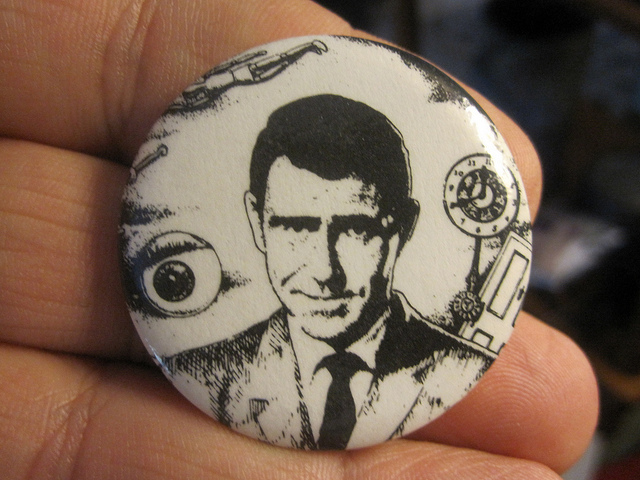
Rod Serling – Twilight Zone Button. Tony AlterCC BY

“It is a dimension as vast as space and as timeless as infinity. It is the middle ground between light and shadow, between science and superstition, and it lies between the pit of man’s fears and the summit of his knowledge. This is the dimension of imagination. It is an area which we call the Twilight Zone.” 

– Season One opening narration, The Twilight Zone television series (1959-1964)

What’s your Fourth of July tradition, fellow Americans?

For my family, it’s watching The Twilight Zone marathon on Syfy.

I have to ask myself: Why do I love this series? Why is it so addictive? After all, special effects have advanced light-years since these shows were filmed; some of the outer space/alien/futuristic costumes and settings are primitive, even laughable. Rod Serling, garbed in dress jacket and skinny tie, strolls out of inconspicuous places – other rooms in houses, offices, or even the woods – to comment on the rising action and the characters,  occasionally smoking a cigarette in true ’60s vogue.

Part of the fun is seeing famous people when they were heartrendingly young, when their stars were still on the rise: Carol Burnett, Telly Savalas, Elizabeth Montgomery, William Shatner (THE Captain Kirk, before the inception of Star Trek). There’s Burgess Meredith, the best of the best character actors, Mickey Rooney beautifully playing an angry drunk. The furniture and props in many episodes, some fashionably chic, some commonplace, are now vintage, nostalgic slices of a bygone era. Something must also be said for the show’s camera work, the strategic zooms, the compelling close-ups. In truth, between some captivating characterizations and the cinematography, there’s a great bit of artistry in The Twlight Zone.

But all that’s just part of it. What really draws the viewer, ultimately, is the story.

The Twilight Zone breaks the dimensions of time and space, to be sure – it takes us away from Earth, brings us to an Earth we don’t recognize, allows us to step into the past and sometimes into a future that isn’t future anymore (I just saw a calendar on the wall of a restaurant in  one futuristic episode: 1974. Geez.). Statues come to life;  a warm, vibrant grandmother is really a custom robot; dolls talk, wreaking havoc and destruction. People down on their luck find good fortune; people lose fortunes; people are at the mercy of forces greater than themselves; people possess supernatural powers that are often abused or taken advantage of by others.

The most haunting thing about The Twilight Zone isn’t the supernatural, however. It’s the journey within, the recognition of the worst parts of ourselves. Selfishness and greed are common themes, with catastrophic consequences – not that the Zone is didactic. In the spirit of the best short stories, with O. Henry-esque twists at the end, The Twilight Zone follows the dark convolutions of the human psyche. Endings are intriguing, but not always happy.

My favorite episode is “A Stop at Willoughby.” A man is locked into a job he hates by a demanding, socialite wife; a hardcore boss berates him for his ineptitude and lack of drive. He’s miserable; he can’t please anyone, least of all himself. On the train commute between home and work, he falls asleep and dreams of a stop that isn’t on the line – a back-in-time place, where women carry parasols and children go fishing and men ride penny-farthing bicycles (the ones with the huge front wheel). The vision of this place, Willoughby, is so real and inviting that the man thinks about getting off there in his dream.  He wakes to the ongoing pressures of his life, but yearns more and more for the slower, contented pace of Willoughby. His wife mocks him for wanting to be Huckleberry Finn, then turns her back on him just as he caves from the pressures at work. On the train, he dreams of Willoughby once more, and this time he gets off, where the townspeople greet him cheerfully by name, as if they’ve always known him, as if he belongs there.

The story doesn’t quite end here; there’s a final scene with a big final twist, but I would be the ultimate spoiler if I told it here. The episode – all the episodes – are meant to be experiences for the viewer. Here’s part of the closing narration: “Willoughby? Whatever it is, it comes with sunlight and serenity and is part of The Twilight Zone.”

Perhaps that’s the pull of the Zone – that beyond the darkness, horror, oppression, bad choices, fears, the worst of humanity, there lies something better, that’s worth the pain of overcoming. Where morbid fascinations, bystander mentalities, selfish desires and regrets melt away. A place of healing, of peace, of freedom – where the best of humanity thrives, has a voice that’s heard. It’s not a place to be merely maintained, but is always being actively created.

What does that sound like to you? What would a Magic 8-Ball say?

Utopia? Very doubtful.

America? Most likely.

The Twilight Zone? Yes definitely.

So celebrate.

Cherish. Savor. Digest. Mull.

Not just food, but your tradition, your story. Yours as well as others’.

And see beyond.


Turtle meditation

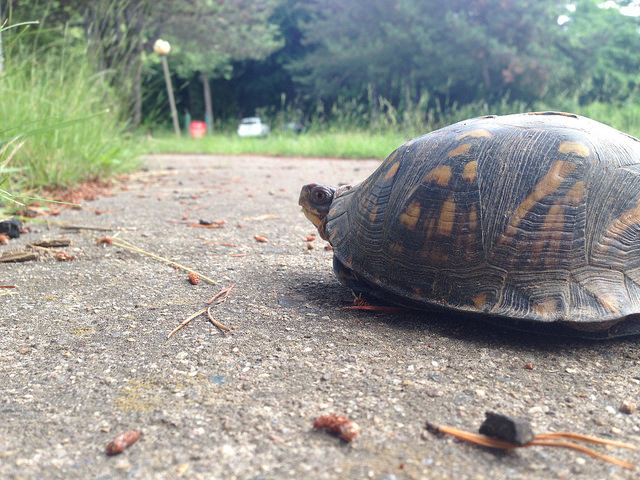
It’s almost summer here in rural North Carolina, which means two things: tobacco is lush in the fields, and turtles are busily crossing the roads.

Which also means that turtles are frequently run over by inattentive drivers.

There by the roadside, these wounded creatures die. Sometimes they leave a trail of blood on the pavement where they dragged themselves to the other side. Any roadkill is disturbing to see, but something about the inner pinkness of the turtle showing through the broken shell pieces troubles me immensely.

Maybe it’s because the shell, perfectly designed to protect the turtle, failed to do so.

But turtle shells are not meant to withstand the weight of a vehicle.

The pinkness represents vulnerability to me; I automatically begin thinking of other vulnerabilities due to failures of structures meant to protect or to edify.

Brokenness occurs on many levels in societies. Governments fail to protect the people, businesses fail to protect employees, family members fail to protect one another.

As an educator, an instructional coach, I see how expectations grow greater all the time and how the weight rests heaviest on teachers. I worry about the cracks, the brokenness, the damage – for, you see, the children are the most vulnerable part, the part we cannot afford to lose.

Any alleviation of this weight, any solution to such brokenness, lies first with the drivers.

Whomever and wherever you are.

Pay attention.

Reflect: Lucy Maud Montgomery wrote: “All things great are wound up with all things little.” Consider the brokenness around you. Repairs and healing will not be complete in a day. Where’s a small place you can begin, in a small but positive way? Positive results only come from positive words, ideas, and actions – and awareness. 

slice-of-life_individual

Fintervention 

​Last week our black goldfish, Kicker, indicated a desperate need for help.

It was pretty obvious. One day he was floating at the top of the tank, unable to swim. Still very much alive, he seemed trapped at the surface of the water. After a day or two of this, I wondered what, if anything, could be done.

I researched the condition: Swim bladder disorder. Kicker has all the symptoms.

I applied the recommended solution: Feeding him cooked, skinned green peas (I wonder who discovered this and how?).

Problems ensued. Most of the green pea chunks that I tried to feed Kicker either came apart or sank too quickly, before he could get to them; although Kicker can move, it’s limited. He has great trouble maneuvering and navigating. I watched with increasing concern – how long can a tiny, ailing fish last in this suspended state?

I did more research. One site recommended putting the green pea chunks on a toothpick.

Voila!

As you can see in the video clip, it worked.

Each day I am able to make sure Kicker eats his peas. He sees me coming and excitedly tries to meet me, paddling himself backwards, sideways, upside down, whatever way he can, to get his sustenance.

Kicker’s still kicking, but he’s not well yet.

Another layer of intervention is needed, apparently.

I can’t help but think of all the children who struggle with reading.

Very quickly, their needs become obvious – these readers cannot keep pace or go deep like their classmates. The reasons are varied and must be explored; a diagnosis must be made, an approach must be developed. Research-based strategies that worked for others can be employed, but time is of the essence – is it working or isn’t it? Is the child making progress or not? How long can a child float at the surface in such a suspended state before the condition worsens? What are the long-term ramifications? What else can be tried for the sake of the child, whose future is at stake?

To not do anything is to . . . well, in Kicker’s case, it’s to watch him die.

When I first started teaching, a well-respected teacher told me, “You can’t save them all.”

Those remain some of the most chilling words I’ve ever heard.

What if that was my child?

Would I not do everything in my power, seeking the advice of others, hunting down books on interventions and overturning every virtual stone in cyberspace, to find answers? Would I not TRY?

As I write, Kicker watches me from his tank. He’s waiting for me, for whatever help I can give him. When I go to him, he will meet me and do the best that he can. I will try another research-based strategy today, as I don’t know when his window of time will close.

We owe the children no less.


If you’d like to read Part One of Kicker’s saga: Flipover

slice-of-life_individual


Flipover

Error
This video doesn’t exist


This is Kicker, a goldfish given to my soccer coach son by one of his teams.

Kicker is not well, as you can see. In fact, we thought Kicker had kicked the bucket, but then we noticed a little fin and mouth movement.

After watching the tiny creature floating helplessly on its side for a morning, I wondered: Can this be fixed? Can poor Kicker be helped?

An Internet search on “floating goldfish” reveals that goldfish are susceptible to a disease called swim bladder disorder or flipover, frequently caused by overeating. The swim bladder is what gives the fish its buoyancy; it cannot function properly if other organs are swollen and pressing on it. This essentially paralyzes the fish.

Kicker has been flipped like this for three days. My thought now: How much longer can this little fish last?

And, being an educator and a writer, I cannot keep from seeing deeper meanings, metaphors, analogies.

I’ve often said that teachers are becoming paralyzed with regulations – too much, too many, suppressing the natural artistry and creativity that comprise great teaching. Expectations are needed, certainly, but when so many are placed on schools, on teachers – on students – what happens to freedom of movement and growth? How many teachers feel like Kicker, floating helplessly near the surface, unable to do anything about it?

In turn, how many students feel that way?

Is there a remedy?

For Kicker, there may be.

Green peas.

Yes, really. My search tells me that feeding cooked, skinned green peas to a fish affected with swim bladder disorder often alleviates the condition. The experts say not to feed the fish for three days after the onset and then to try the peas.

I gave it a shot. It’s very hard, by the way, to get food in the mouth of a fish that can’t swim. But Kicker fluttered his fins and opened his mouth, clearly trying his best.

Kicker seems to be a little livelier this morning – he’s always greeted us, wagging his whole body just like a dog, whenever we approach the tank. Today he’s twisting a bit more, fluttering his fins and tail excitedly. He even gyrated himself all the way over, a complete 360. He’s still not very mobile or upright yet – but I see better movement, and I am hopeful.

Back to teachers, to students: What’s the remedy to glutted systems?

Certainly not adding more. Green peas won’t cut it here – if only they could! – but perhaps they hold a metaphorical answer. Perhaps the answer lies in boiling away, skinning back, getting to the inside part, the valuable part, the part that matters most. Education is not something to be done to children any more than professional development should be done to teachers; growth and learning come from a place of inspiration, desiring to know more and having authentic opportunities to explore, to ask “How can we make this happen?” or the greatest learning question of all time: “What if …?” It all comes from tapping what’s within, not from exterior layers upon layers, causing figurative flipover.

Goals and standards are necessary. They can be met, exceeded, in fact, with inspiration, creativity, and freedom – these lie at the heart of educational wellness.

Our survival depends on it.


If you’d like to read Part Two of Kicker’s saga: Fintervention

slice-of-life_individual


Song of invisibility

I sit straight up in bed. “Oh dear.”

My husband jumps: “What’s wrong?”

My brain can’t form thoughts yet. I was dreaming about . . . something. Whatever it was has already melted away.

He repeats: “What’s wrong?”

“I don’t know. I am – startled.”

My husband sighs, turns over, goes back to sleep.

I can’t. I lie there with my heart pounding.

I’ll write for a while, I decide.

The predawn house is dark but for a nightlight in the hallway. I creep around, wraith-like, to avoid waking the three sleeping dogs. Heading toward the kitchen, I hear it, loud and clear, as if it’s on the front porch, trying to find a way in:

Whip-poor-will, whip-poor-will, whip-poor-will . . . .

My favorite onomatopoetic sound in all the world. I’ve not heard a whippoorwill that close to the house before.

Is that what woke me? 

And then I start thinking about symbolism, so while my coffee brews, I look up whippoorwills on the laptop. Chilling stuff. Harbingers of death, disasters, impending trouble. Being visited by a talking Raven might be more desirable.

Whip-poor-will, whip-poor-will, whip-poor-will . . . .

Okay, it’s a captivating sound, more enchanting than haunting, I think, pouring cream in my coffee. I’ve loved the call of the whippoorwill since I first heard it, the summer after I moved to rural North Carolina. It dominates a warm country night, an energetic, compelling song rather than a plaintive one. It makes me want to stand still and listen for a long, long time. I continue my online reading, how the whippoorwill is referenced over and over in story, song, and poetry. Folks, it’s really a mating call. That bird isn’t going to be lonely for long.  

And then I read: A group of whip-poor-wills are called a “seek” or “invisibility” of whip-poor-wills.

My imagination takes flight. Those are magical words.

“Seek” implies “seeker,” someone on a quest, not to mention Quidditch. Few words have greater magical connections than “invisibility” – it’s a coveted power. Granted, in this context invisibility and seek define a homely, nocturnal bird that is rarely seen and which is simply  seeking a mate with its fervent night song, but still . . . could there be something more?

I’d awakened with a sense of imminent danger, bolting upright in bed. Oh dear, I’d said, just as I crossed the line between sleeping and waking (this a hypnopompic state; I looked it up just now).  While I cannot remember a dream-creature – or any shadow-people, for the true paranormal enthusiasts out there – attempting to do me harm, I do wake sometimes because of a dry, rubby cough, thanks to the flu earlier this year and my latent asthma. I wonder if irregular breathing is the root of this.

What an unromantic notion.

Whatever the reason:  Suppose the whippoorwill arrived at my house not as a portent of doom but as a protector, a preventive force. What if it knew to sing its song – because, let’s face it, that song is all about life and reproduction, not death – to wake me at the very moment before disaster struck? Exactly what, then, did it seek to drive away or undo – and why? What did my evaporated dream have to do with it?

Whip-poor-will, whip-poor-will, whip-poor-will . . . .

Ah, here are better words to describe the call: Ethereal. Otherworldly. 

A little bit of magic in the still of the night from the seek, the invisibility – although I always hear only one.

I sip my coffee, smiling at my flight of fancy.

Although it could be something more . . . .

slice-of-life_individual

Tripping the write fantastic

Fantasy

Fill your life with love. Dianne LacourciereCC BY-SA

Without this playing with fantasy no creative work has ever yet come to birth. The debt we owe to the play of the imagination is incalculable. – Carl Jung

Her teacher sent her to me, to confer about her writing.

Not because the student is struggling.

The student, a fifth-grader, had written twenty pages of complex plot and extraordinary dialogue that revealed character personality and motivation.

“It’s amazing,” explained my colleague. “Out of the blue, she’s just taken off. I thought you could give her some pointers – her story is really good.”

The student, delighted at the prospect, immediately sent her work to me via Google Docs. Here are things I am thinking about, her message stated. She’d made notes about characters, problems with the story line, where she wanted to go with certain parts.

For a moment I felt transported to the future, as if I were an agent or editor receiving book ideas from an established author.

I read the work, praising the strength of the writing on sticky notes: Powerful, believable dialogue! and Excellent descriptive detail – I can “see” this scene vividly.

I looked for a couple of major areas to improve – only a couple – and they had nothing to to with spelling, format, or conventions at this point. The pressing thing at the moment was keeping those rich ideas flowing and clarifying this young writer’s meaning in some spots.

The child, beaming, comes to confer with me at the appointed time.

I sit beside her at my table:

“Ok, I have to know what inspired you. Clearly anyone who writes this much and this well – this dialogue is better than what I’ve seen some adults write! – is very inspired.”

Giggles ensue. “Well, it started with the fantasy writing unit in class. I got this idea of a girl who went back in time to the days of slavery. I am bad at history” – more giggles – “but that time period interests me, especially since my teacher read Chains to the class. That book made me want to go back in time and rescue some of those people, so that is what my main character will do. And she will meet her great-great-great grandmother.”

“That,” I say reverently, “is a story a lot of people might like to read.”

She goes on to share additional ideas that she got from other books like Serafina and the Black Cloak. 

As she speaks, I mentally toast the power of the read-aloud and student-selected texts.

To the student, I say: “Let’s go over what you’ve done here.”

I explain that switching narrators and times is using multiple story lines – “very advanced,” I tell her.

She grins.

I show her places where she lost me: “This is called a plot hole. You know what’s in your head and what you mean to say, but you jumped too fast and lost your reader.”

She nods. “Yes, I see that now.” We discuss ways she might want to fix it.

Off she goes.

That night, the Google Doc returns with revisions and questions.

Today she appears in my room, announcing: “I rewrote the entire first chapter. I felt that readers needed to know a little more about my main character’s life and her family in order to get the rest of the story.”

“Ah,” I reply, “exposition and backstory. That will help your readers.”

We look at the changes together.

“What we have to watch now is your pacing. Don’t spend too long on the beginning or you’ll lose readers – they want to know where this is going, so you want to speed up the less important parts and slow down at the more important ones.”

“And watch for plot holes,” she laughs.

“Indeed,” I smile.

Her ideas come fast and furious, and before we know it, time is up. As she turns to leave, she asks: “When is the next time we can meet?”

My turn to laugh. “Ask your teacher.”

At the end of the day, I return to my room to find a folded paper on my table – a schedule for when she can confer with me every day through the rest of the year.

I think of J.K. Rowling, who said that the idea of a boy wizard fell into her head on a train ride, when she had nothing to write on.

I think of C.S. Lewis, how an image of a faun carrying Christmas presents in the snow popped into his mind.

I think of Suzanne Collins, who grew up on her father’s stories about the effects of war.

I think of my young writer’s inspiration, and how fantasy and fairy tales help us work through the problems of the real world.

I recall telling my young writer: “Stick with it. You will be a famous author one day. I’ll come to your book signings.”

Giggling, she’d replied: “And you will be my famous helper.”

I look at the little conferring schedule in her handwriting, and smile.

We are tripping the write fantastic, she and I.


slice-of-life_individual


The brain and story


Ghosts in hall

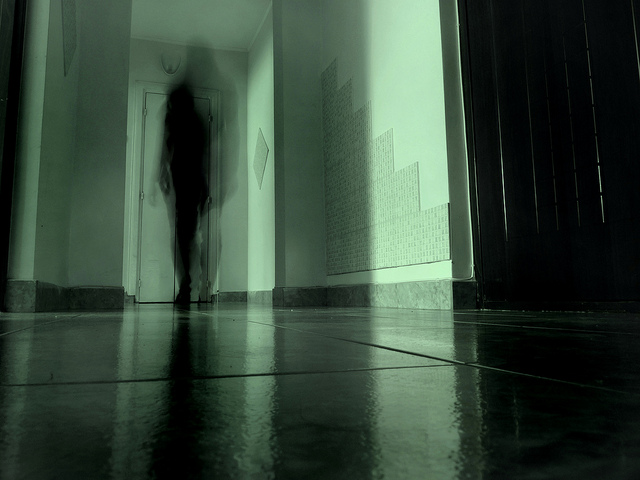
Ghosts in the hall. Rachel TitirigaCC BY

My mother-in-law had a stroke one week ago today.

At ninety-one, she came through emergency surgery astoundingly well. In ICU, she was happy to see her children and grandchildren, called them all by name, told everyone how shocked she was that she’d had a stroke. As I greeted her, she held out her hand to me and said, “Hey, you’ve got a birthday this weekend.”

“Yes, ma’am,” I replied, in wonder.

“I haven’t forgotten,” she said, holding tight to my hand.

In the hospital and rehab, she has remained lucid, talking about books, authors, politics, and traveling she wants to do.

So when she occasionally asks, “Hey, little boy, what are you doing over there?” when no little boy is present, or “Who’s that standing behind you?” when no one is, the family gets anxious.

The physician explained: “It’s her brain at work – partly because of the area affected by the stroke and partly due to her declining vision. When she doesn’t immediately understand what she sees or what’s happening, her brain supplies the story, to make sense of it.”

I hung on every word, thinking: The power of story is profound. It’s more than reading or writing. It’s who we are, how we are wired. 

Both Scientific American and Big Think explain: “The human mind is a story processor, not a logic processor.” Our ability to solve problems, the scientists say, is tied to our understanding of story: “Perhaps story patterns can be considered another higher layer of language.”

Fascinating, isn’t it, that story is where science and the humanities meet.

Story is the essence of being human. It’s how we make sense of the world and our place in it. Story is how we attempt to understand who we are, and how we stretch the boundaries of possibility and our humanity, by imagining more: “What if . . . .”

As an educator, the visit with my mother-in-law could not have been a more striking reminder that story is critical to student learning and growth. It’s not so much the types of texts that students read, but their interpretations, their stories, about the texts that matter – and that for students truly to be critical thinkers and problem-solvers, they must go beyond synthesizing and responding to what others have written. They must look within and generate their own stories. To not do so is to hamper human nature, to not meet an intrinsically human need – and to starve the human brain.

slice-of-life_individual


The value of value

Rose & shadow

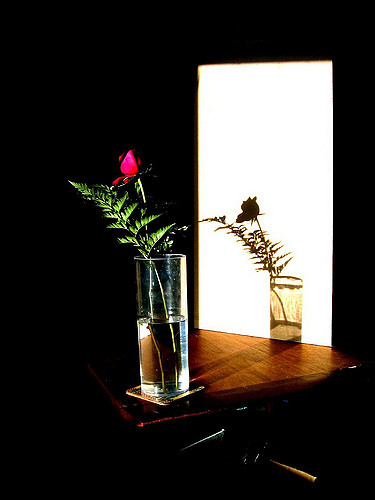
Rose and shadow. ankakayCC BY

We have a new principal at our school.

On his office wall is a certificate presented to him by his previous school: “Most likely to make you feel appreciated and valued.”

That word, valued, set my thoughts firing like electrical arcs in a dozen directions.

The first thing that came to mind, strangely, was an image of light and shadow. From an artist’s perspective, in artist terminology, value is the shading that gives depth to a two-dimensional object, almost magically transforming it visually to three dimensions. Values make an image pop, bring it to life.

A fascinating concept for a leader of a school, or any leader, isn’t it – to be an artist of sorts, to harness the light and the shadows of the given entity, to have a vision, to go beyond the surface and bring depth, meaning, and make it work. Artistically speaking, that’s the value of value.

Another image was immediately conjured – the vast machinery of systems. Have you ever had the sensation of being a tiny cog rotating in a mind-boggling conglomeration of structures that do not fit well or operate properly together, with old, vintage pieces welded precariously to shiny new ones, like something out of steampunk? As the cogs we cannot even see the full extent of the machinery looming far beyond us; we can only feel the unwieldy vibrations as it lumbers on. That’s often how education feels today. In truth, it’s not the structures that hold things together and keep everything running – it’s the cogs, the teachers. Teachers are the most crucial pieces – and the end product isn’t the perfectly standardized student. The students aren’t end products at all – don’t we want them to keep growing, learning, discovering, contributing, as long as they live? That’s something no machinery can produce.

Which gets back to value.

To value something means to hold it in high regard, to recognize its worth and usefulness. We value things that are important and beneficial to us.

My thoughts branch out into a hierarchy of what-ifs:

What if systems valued schools more than data? What if they scaled back and simplified rather than adding on?

What if principals communicated their value of teachers through their actions instead of words?

What if teachers made all students feel valued – and valued their differences? And taught students to do the same?

What if everyone realized that these are matters of the human heart and spirit?

I can see the light and shadows separating already, magically transforming things, creating a depth that’s been needed for so long.

slice-of-life_individual