The unplanned baby

Banjo 8 weeks

Banjo, 8 weeks old

He was born on a Sunday in early November, during the first freeze. For some reason, his mother didn’t seek shelter. She delivered nine puppies out in the open on that bitter night; before they were discovered, five of them died.

Getting a puppy was not even a thought when my husband and I stayed with his sister on her Virginia farm near the turn of the year. Our minds were consumed by the purpose of our trip: consulting with a surgeon on my husband’s rare form of eye disease. Following the appointment, burdened with the confirmation that my husband would soon lose his eye, my sister-in-law drove us by the old hay barn where her son was working:

“Let me know if you hear of anyone who wants a puppy. They’re pure Labs but this litter was unplanned, the second this year. I just want them to go to good homes.”

I was halfway paying attention from the back seat of the Suburban when she rolled the window down and called out: “Go get the big one.”

My nephew slipped into the barn. He returned momentarily with a fuzzy yellow ball, walked around to the passenger side, and placed it in my husband’s arms.

Two sky-blue, baby eyes looked round at me from a face that seemed a hundred years old.

He came home with us, of course, this unplanned baby that cried at the top of his surprisingly powerful lungs the entire three-hour journey back to North Carolina. We’re insane, I thought. We have a surgery to contend with and the surgeon said recuperation would be rough. We don’t even know what the long-term prognosis will be. There’s no puppy stuff at home, he’s going to shed like crazy, a big dog in the house, there’s the whole ordeal of housebreaking, we already HAVE a dog, that’s really enough, dear Lord, listen to this crying, we will never sleep another night…

Our college student/musician son was waiting at the door when we pulled up. He nestled the puppy against his heart and named him Banjo, not after the instrument, but the video game he loved as a child, Banjo Kazooie.  Baby Banjo slept in the bed with him and, incredibly, never made a peep that night or any night thereafter.

It was our darkest winter. Through snow, ice storms, surgery to remove my husband’s eye and his painful recovery, Banjo was the bright spot, an endearing and comical diversion, exactly what we needed. He radiated life, healing, and joy; he drove the bleakness away. His very presence represented survival. Turns out that instead of coming at the worst possible time, the unplanned baby came at the best time of all.

In The Voyage of the Dawn Treader by C.S. Lewis, the characters sail into a darkness where nightmares come true, with no obvious means of escape. Just as the nightmares begin, Lucy whispers, “Aslan, Aslan, if ever you loved us at all, send us help now.” An albatross appears in the darkness, circles Lucy, and whispers to her in Aslan’s voice: “Courage, dear heart.” Within minutes, the darkness begins to lift; the characters find their way out.

For the record, Banjo looked so like a lion cub that we briefly thought about renaming him Aslan, until we decided that it would be utterly impossible ever to reprimand a creature with that name.

Reflect: When has your life or work been interrupted by something unplanned? Where in that experience might there be an unexpected gift? What chances are you willing to take to find it?

If you’d like to read more about Banjo: Making adjustments.

*******

Update: A condensed version of “The Unplanned Baby” is published in the 2017-2018 North Carolina Reading Association’s Young Authors Project anthology, on the theme of “Show Your Strength!”

Seeing past the surface

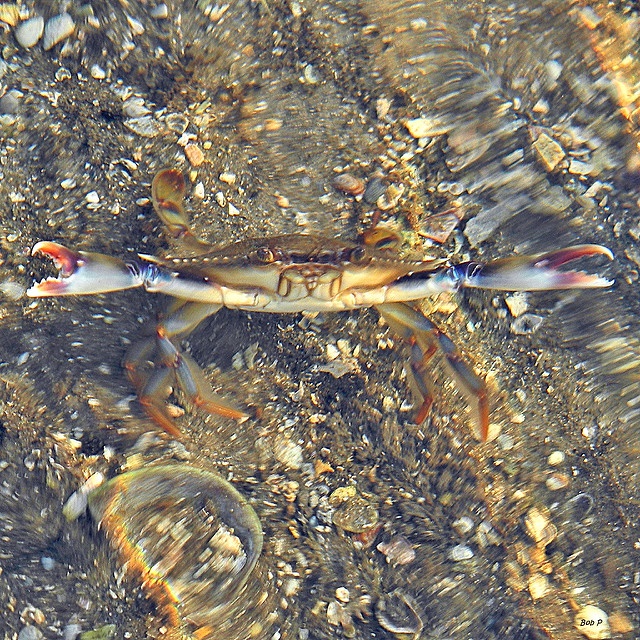
Blue crab

Blue crab (Callinectes sapidus). Image: Bob Peterson CC BY

One summer long ago, my grandmother took me crabbing at South Creek, a tributary of the Pamlico River. We knelt on the weather-beaten pier, tied a long string of twine to a raw chicken neck, and lowered the bait into the murky green depths. Grandma anchored the loose end of twine to a rusty nail jutting out from a piling.

“Now we wait,” she said. “But keep your hand on the string so you can feel when a crab starts nibbling.”

Being a novice, I was sure I felt a crab nibbling right away. I pulled up the length of twine ever so slowly, only to see the fleshy chicken neck. I released the twine. The bait plummeted out of sight again. Within minutes, I was positive I felt nibbles. Reeling in my string, I found only the bait once more.

Grandma chuckled. “You have to be patient. Give the crabs time.”

“I thought I felt nibbles,” I said in my own defense.

“You feel the bait drifting. You’ll know when it’s a crab.”

I waited, my mind wandering. The day was bright; Grandma’s sunhat cast a ruffled shadow on the gray boards, warm and splintery.

Next thing I knew, there were erratic tugs on my line.

“Easy,” said Grandma, sensing my excitement. “Pull slow and easy or you’ll lose it. Pull so the crab doesn’t realize you’re pulling.”

Bit by bit, I inched the twine up through the water to find not one but two – two! – blue crabs picking at opposite ends of the chicken neck. Holding my breath, I pulled until the crabs were just below the surface of the water. I dared not move as Grandma scooped them up with the dip net.

As the crabs scuttled inside a galvanized tub, I tossed the slightly-gnawed chicken neck back into the water, observing: “It would be a lot easier if we could just see to the bottom. Then we would know when we have a crab.”

“Well, isn’t that the fun of it?” asked Grandma. “Not being able to see what’s there, but pulling until you can?”

Decades later, I sat listening to a group of fourth grade intervention students rereading a script.

“You’ve all come a long way with your fluency, recognizing words automatically without needing to self-correct. I can hear some great expression,” I commended them. “I have one question: What is this scene really about?”

As students tossed out random answers, images of a weather-beaten pier, twine, and raw chicken necks came to mind. “Wait, you guys. You’re all skimming along the surface, just seeing the words. There’s a deeper meaning you’re not seeing; it goes past the words into the ideas behind them.” I told them of my long-ago crabbing days, how I knew the crabs were there, hidden from my view, and how I had to watch, feel, and finally pull them to the surface. “Reading is like that,” I told the kids. “There is more than what you see at first. To infer, you have to take your time, go back, and try to feel what’s not actually said before you can grasp the meaning. Some words give you more clues than others, but a deeper understanding is always there. Sometimes you have to wait, think, and work to pull the meaning out.”

Until that moment, I hadn’t imagined crabbing as a metaphor for reading comprehension, or, for that matter, teaching. The students often come to us with their backgrounds, experiences, struggles, and gifts hidden from us at first. The depths can be murky, indeed; how easy teaching would be if we could automatically see everything that each child needs to be successful. The best way to start is by throwing out the greatest “twine” we have: the love of learning. Keep your hand on the string, Grandma said. You’ll know. Pull easy so you won’t lose them. Be patient. 

To me, the true joy of teaching is first hooking students with a love of learning, then watching myriad treasures rise from those depths, especially when students start pulling on their own.

Reflect: Where can you strive to see past the surface of experiences and relationships to something deeper, of value? What unique exploration can you share with a child?