Little girl blowing bubbles

Ever wish you could keep a small child safe and innocent forever? It’s a wish as ethereal as bubbles in the wind, drifting away like childhood itself. I took this photo last summer. It’s taken this long to figure out how to convey what I felt.

Little girl

blowing bubbles

in the sun

free of troubles

How they drift

on the breeze

turning, turning

as they please

Colors shimmer

ever bright

just a moment

in the light

Wave your wand

my temporary

iridescent

bubble fairy

All too soon

time shall pass

bubbles pop

in the grass

How I wish

things could stay

idyllic as

this summer day.

My new name

All the world’s a stage,
And all the men and women merely players;
They have their exits and their entrances;
And one man in his time plays many parts

—Shakespeare, As You Like It

Life’s transitions tend to sneak up on us.

For example, when it dawned on my oldest son that high school wouldn’t last forever and beyond it was college plus this thing called The Rest of Your Life, involving responsibility and duty, he looked at me with big brown eyes full of gloom: “I don’t want to grow up.”

Alas. It happens.

But he found his way. Last fall he simultaneously started the pastorate, married, and became the dad of a beautiful four-year-old girl. That’s a lot of transitions in one fell swoop, and he’s embracing them all. He’s thriving.

One man in his time plays many parts . . .

All of a sudden, his father and I have reached the grandparent stage of life. While it’s the loveliest transition, I can’t keep from thinking, with a pang, How did I become this old? Truth is, there’s exactly the same age difference between my grandmother and me as there is between me and my new granddaughter. It shouldn’t seem so astonishing.

The hardest transition isn’t mine, however. It’s my granddaughter’s. She loves to come over, loves to climb in my lap with a book as much as I loved climbing into my Grandma’s with one. All of this is glorious fun. No, the hard part is what to call me. She’s used to saying Miss Fran:

“Miss Fran, I’m hungry!”

“Oooo, Miss Fran, I like your nails. Can you paint mine?”

“Can we have a popcorn party and watch Frozen again, Miss Fran?”

“Let’s go outside and blow bubbles, Miss Fran!”

She likes telling everyone that I am her grandmother now. She even likes pretending to be me. My son said that after I broke my foot she went clomping around their house with one rain boot on, saying “I’m Miss Fran!” Yikes.

This transition away from Miss Fran has proved challenging. But she’s working on it.

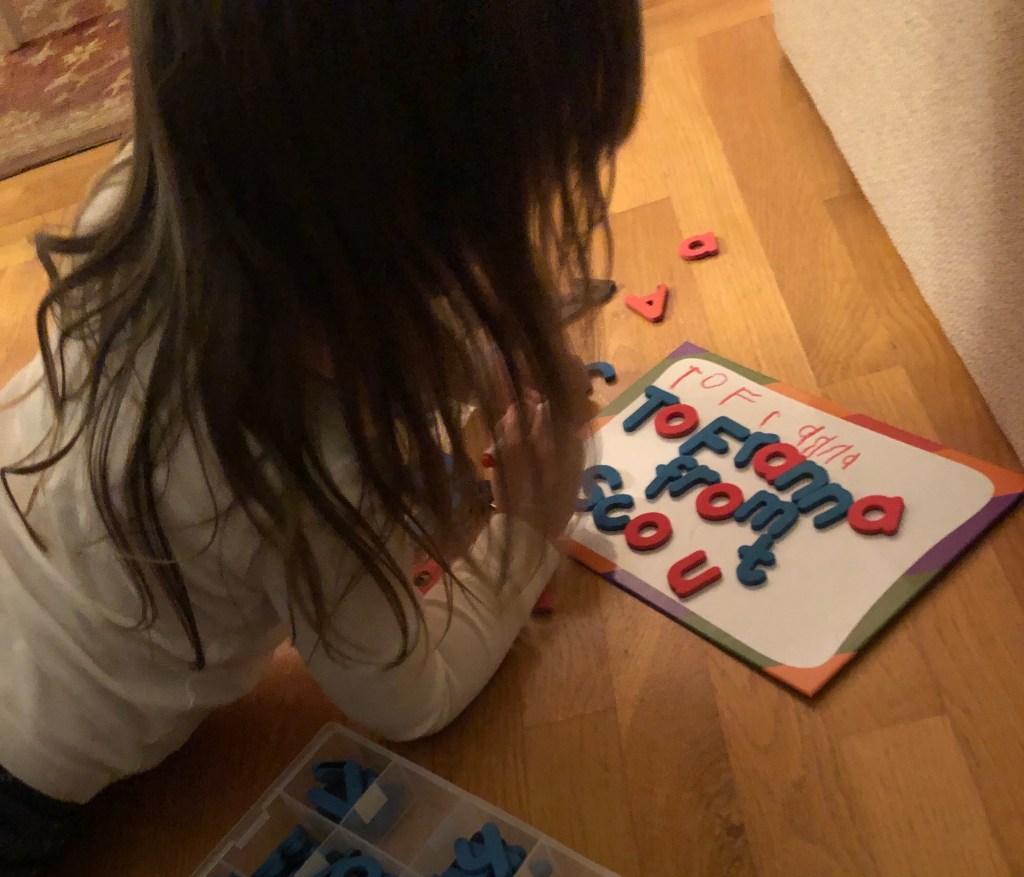
The other night she asked me to spell words for her with magnets on a whiteboard. I did, without realizing that she intended to copy them with a marker.

Here she is, writing with utmost care. A message to me.

With my new name, for the new role I get to play in her life:

Franna.

Life just gets grander.

I asked her if she wanted to spell “Franna” with one ‘n’ or two. She chose two.

A matter of heart

Better is the end of a thing than its beginning, and the patient in spirit is better than the proud in spirit.

-Ecclesiastes 7:8

Last week didn’t start so well.

On Sunday, I broke a bone in my foot while simply walking (and falling, somehow) down the garage steps.

I’d already taken Monday off to attend my brother-in-law’s funeral but spent it on my couch instead with my newly-damaged foot elevated, commiserating with my husband, whose leg has developed a discolored, painful bulge—the leg from which veins were removed for his bypass surgery last fall. It’s not a clot, and that’s all we know until his appointment this week.

“I never would have believed that I wouldn’t be able to attend my own brother’s service,” he sighed. It’s a seven-hour round trip; neither of us was up to it.

I surveyed our legs, propped on the same stool. His left, my right. Mirror-images of each other. Except for my orthopedic boot.

I sighed, too, the entire left side of my body sore from overcompensating for the right. “I know. This is like being eighty years old or something.” Which is decades away…

Our college-student son, passing through the living room, quipped in his deadpan way: “Well, at least you’ll know what to expect when you are eighty.”

So. That was Monday.

On Tuesday I returned to work. It happened to be the 100th day of school, meaning that most kindergarten and first grade students (and many of their teachers) came dressed as old people. White hair, glasses, wrinkles sketched with eyeliner, canes galore.

For a split second, I mused: Who wants to live to be a hundred?

But the kids were adorable, their teachers were having fun, and God knows we all need to have more fun at school. Too much of it isn’t.

That is where my mind was when a little “old” person wandered up to me in the lobby where I rested on a bench between the arrival of buses, my morning duty.

A kindergartner. Big, mournful eyes moving from my boot to my face: “Are you all right?”

“Oh yes! I am fine,” I said, touched by the obvious concern in that small voice.

“What happened to your foot?

“Well, I broke a bone in it.”

“Does it hurt?”

“No, really, it doesn’t. The boot is a cushion for it, see, and it doesn’t hurt at all right now.”

A flicker of relief across the little, made-up old face. The tiny pseudo-centenarian went on her way.

That was Tuesday.

And Wednesday, and Thursday, and Friday. Everywhere I went, the kids wanted to know: What did you do to your foot?

I shared the X-ray with some of them, saw the fascination in their eyes.

Some didn’t ask anything. They came up to me just to say I hope you will be okay. I hope you feel better.

As I labored up and down the staircases, one careful step at a time—the elevator at school is BROKEN—I thought a lot about the curiosity and compassion of children, how natural these things are for them, how comfortable children are with asking and expressing. If we can preserve, nurture, stir curiosity and compassion through all of their formative years … what a different culture, what a different world, it would be. Possibly our greatest work.

The week ended much better than how it began. Not because of satisfying still more curiosity about my broken foot with ongoing questions, or the taste of true human compassion at its purest. Not because I made it through the first week of recovery, although that was a glad milestone. No. Friday was a day of festivities, of celebration, all shining from the children’s faces.

“Happy Valentime’s Day, Mrs. Haley!” called the little ones when they passed me in line in the hallways, inviting me to their classrooms to share their candy, their cupcakes, their joy.

Valentimes. The mispronunciation seems almost poetic. As in, these times are made for Valentines. Definitely for love.

Oh my, thank you, I’ll come see your goodies but you keep them; they were given to you.

You yourselves are gifts enough to me, children.

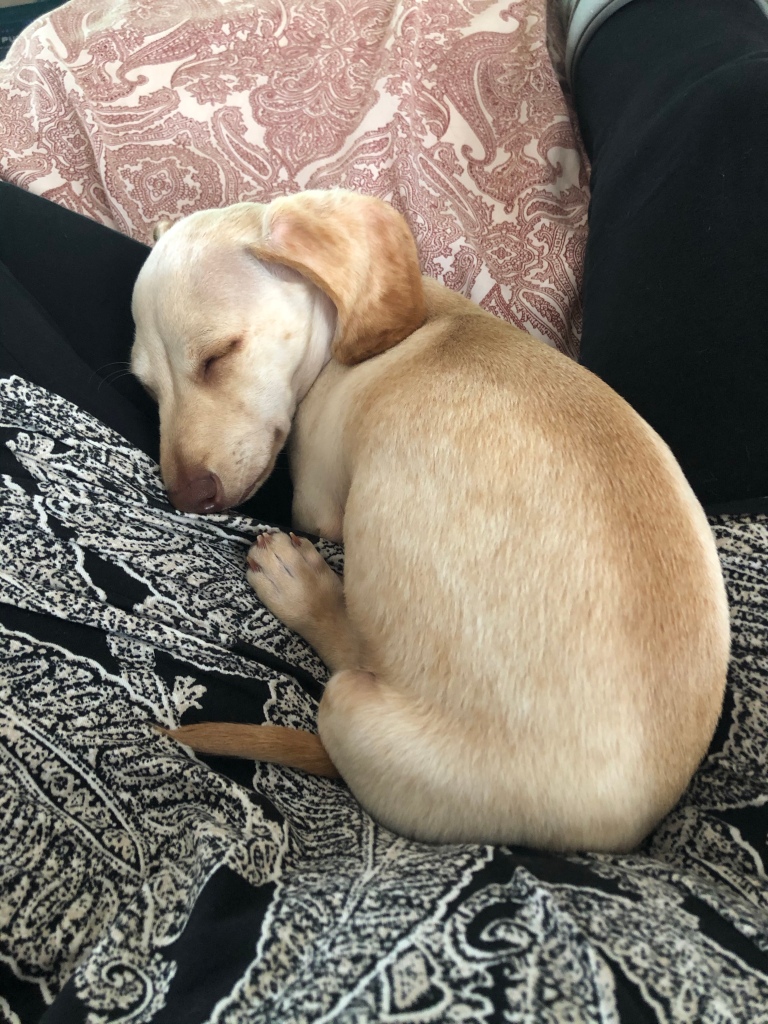
You as well as puppy therapy. ❤️

Dennis the dachshund takes turns between my lap and my husband’s while we prop our legs.

Of the earth

Midway through lunch, the din in the cafeteria is too much. The new boy brings his tray to where I’m standing:

Can I sit here at this table?”

It’s an empty table, save for my phone, closed laptop, electronic entry key, all the things I carried with me because I didn’t have time to put them in my room before this daily duty.

I consider his brown eyes, looking up at me. Pleading.

I consider his boisterous classmates and the seat he left behind.

“Are you moving yourself here because you feel it’s a safer place for you to be right now?” I ask.

He nods.

“All right. That seems like a good choice.”

His face breaks into a grin. He sits.

And the questions start: What kind of phone is that? Do you have a dog? Do you like Doritos? What kind do you like best? What’s your favorite color? Where are you from? How old are you, twenty-nine? Forty? Older?

How old are YOU? Eight? Did you move over just here to ask me all these questions?

He just smiles and takes a swig of his strawberry milk.

Then:

“Mrs. Haley, what’s your favorite snake?”

“What? My favorite SNAKE, did you say? Yikes—I don’t …”

Of course I am about to say I don’t like any snake whatsoever, but something in his expression stops me. “Um, do you like snakes?”

He nods. “I like pythons.”

Heavens. I refrain from telling him about a man I saw on the news this week. He happened to find a boa constrictor in his couch and had no idea how it got there or from whence it came.

He’s watching my face. A keen observer, this child. He’s waiting for my response.

I could say I like green snakes, but I don’t. I could say I like black snakes because my granddaddy said they eat rats and mice, so don’t ever kill a black snake. I think about the copperheads Granddaddy killed on the dirt road where his barefoot grandchildren ran in the summertime. I think about the coiled baby water moccasin I found in front of the kitchen cabinets when my first son was just three, and I how I was about to pick it up, thinking it was an odd piece of rope . . . until I almost touched it. And saw its eyes. Or that time I was cleaning the attic and discovered a complete shed snakeskin; I nearly knocked a whole new exit in my ceiling, trying to scramble out of there . . .

I DO NOT LIKE SNAKES.

But this boy with the strawberry mustache is waiting. His eyes are shining.

And then I recall a little creature lying across my sidewalk a couple of weeks ago. So little that I thought it to be a large worm at first; it was the same pale tan. I noted a faint pattern of scales on it. Could it be a snake? I looked it up. It was. “Smooth earth snake.” They are shy; they live mostly in the dirt around trees and bushes. I’d just had all the old bushes around my house pulled up. Apparently this little fossorial serpent was disturbed, or even damaged, as the equipment pulled away deep, tangled roots. For whatever reason, it crawled out in the open only to die there on the sidewalk. Who knows, maybe it was just trying to get to safety.

—Poor little snake. The only one I’ve ever mourned.

I look at the boy. He’s new here. He’s been uprooted.

Perhaps he did come to this table for safety, after all.

Even as I begin to speak, I think of earth and geosmin, the organic element in soil that humans can smell to something like the trillionth degree (we can detect one tablespoon in three Olympic-size swimming pools) and why that should be, unless it’s because we were meant to live close to the earth, that we came from the earth, and to the earth we will return. A curious kinship with that little snake. With all living things.

“My favorite snake is the earth snake. It’s very small. Have you heard of it?”

He wants to see a picture, so I do a search on my phone just as it’s time for classes to clean up and go outside for recess. To run, to play, to breathe the fresh air, to enjoy being children . . . how well I remember.

The silence in the cafeteria now is too much.

Photo: Smooth Earthsnake. Cygnus921. CC-BY

Writing your own story

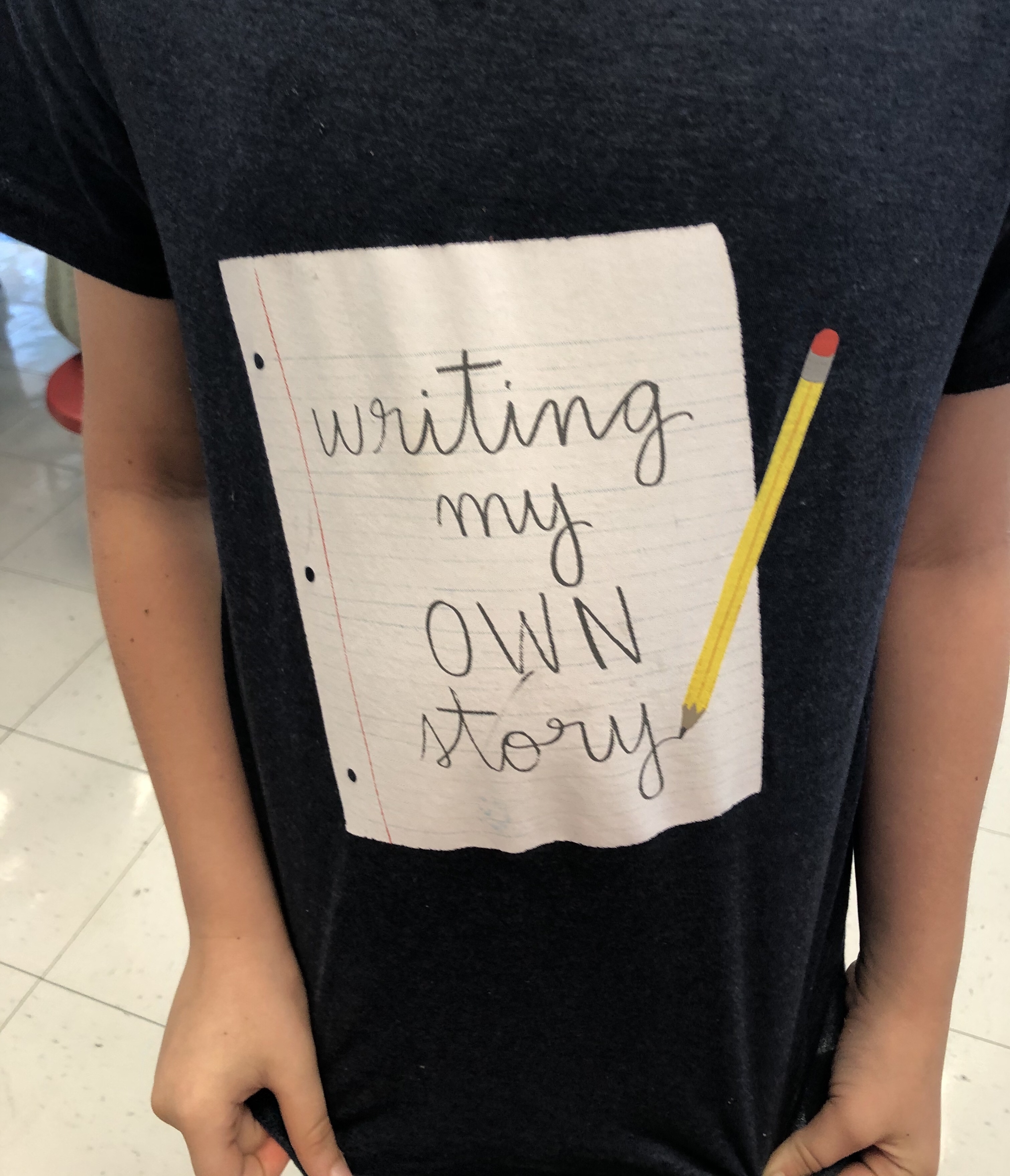
I saw his shirt from across the crowded cafeteria:

Writing my OWN story.

I hadn’t seen him before, didn’t know him, but I had to go over and say: “That’s the most awesome shirt! Do you like to write?”

He smiled and nodded, eyes bright and cheerful: “Yes!”

We had a short conversation about reading and writing. He was new to our school. After this initial encounter he was quick to come ask questions if he wasn’t sure about how we do things here, always greeting me with an earnest face and slightly self-conscious smile.

He wasn’t with us long. On his last days, he asked if he could stay after lunch and clean all of the tables as his grade level headed to recess. He wiped every table meticulously, then straightened all of the cardboard trays in the serving line for the classes to follow.

I understood.

It was something he could control. A positive and productive outlet.

I never got to write with him.

I thought about students over the years and what I learned about their lives from their writing. A girl whose family slept in their car on the journey north to visit relatives for the holidays; how she woke in the morning, shivering, to find frost coating the windows. A teenager whose vivid third-person narrative about a child born in another country, who survives abuse to find a new life and family in America . . . it switches to first person at the end as he rejoices and reveals he was that child. A first-grader who wanted to write about her dog, how the police shot and killed it. Unnerved, I told her teacher, in hopes that this was just a disturbing fabrication. It wasn’t. The child saw it happen.

For all the story-loving writer that I am, I know writing is not a magic cure for the pain and scars of life. It is, however, a real coping mechanism, a positive and productive outlet, a way of seeing and dealing with and finding hope to overcome. Even in the youngest of us, many of whom already know that life doesn’t follow a neat formula, that it seldom follows a clear and sensible series of steps. I often think about what passes for “writing” in schools; it can’t always be a neat response to a text or a prompt. If we are truly to equip children with tools for life, it begins with a real response to their lives in this world. We owe them, for as long as we have them, a place to feel safe, to be loved, a way of having some control in the face of change, to find their own power despite their powerlessness.To write their own lives, even as life is unfolding.

To have hope on the journey as it takes so many twists and turns.

Time is of the essence; we don’t know for how long or short a time they’ll be in our sphere of influence. Good-byes can come without warning.

And so I quickly gathered the best tools I had at my disposal: pencils, notebooks, a couple of favorite books from my shelf. It was my way of saying Godspeed, child. Write your OWN story. Believe. Attend to your heart. Here’s a piece of mine to carry with you.

Edward knew what it was like to say over and over again the names of those you had left behind. He knew what it was like to miss someone. And so he listened. And in his listening, his heart opened wide and then wider still.

You must be filled with expectancy. You must be awash in hope. You must wonder who will love you, whom you will love next.

—excerpts, Kate DiCamillo, The Miraculous Journey of Edward Tulane

Sick Ada

I don’t know where it came from, this idea for a story about a little girl who likes cicadas.

Except that I was a little girl who liked cicadas. I am a grown-up who loves them; I’ve written about this many times.

Anyway . . .

In my idea (that fell into my head when I was actually thinking of other things), a little girl is having a hard time adjusting to her parents’ separation. It’s connected to a change in seasons when she can’t hear cicadas anymore. Perhaps she will find some shed cicada shells and ponder the emptiness where a living thing used to be. Or how one outgrows things. Maybe she’ll even think that her parents have outgrown their love for her. I am not sure yet of all the meanings and connections; I will have to write and let the story grow and breathe on its own.

I do know, however, that the little girl becomes ill. Is it terminal? Not sure yet. She goes to the hospital. It’s winter. As she’s falling asleep, the heater in her room sounds like cicadas rattling high in the summer trees. It’s a happy sound, this buzzing. She will wonder if dying is not so bad, really, if she can just keep hearing cicadas . . . and then she hears voices. Her mother and father are there with her in the room, together if only for a little while, united in their concern for their sick daughter.

Whose name is Ada.

Sick Ada . . . cicada . . .

That’s as far as I’ve gotten, just grasping at these gossamer images, the barest wings of an idea.

But I think it might like to become a real story.

That belongs to children, for they live at the mercy of adults and the world.

And, of course, to cicadas, which are always buzzing somewhere, and which represent many things, mostly good.

Seems I almost owe it to little sick Ada, waiting there in the wings.

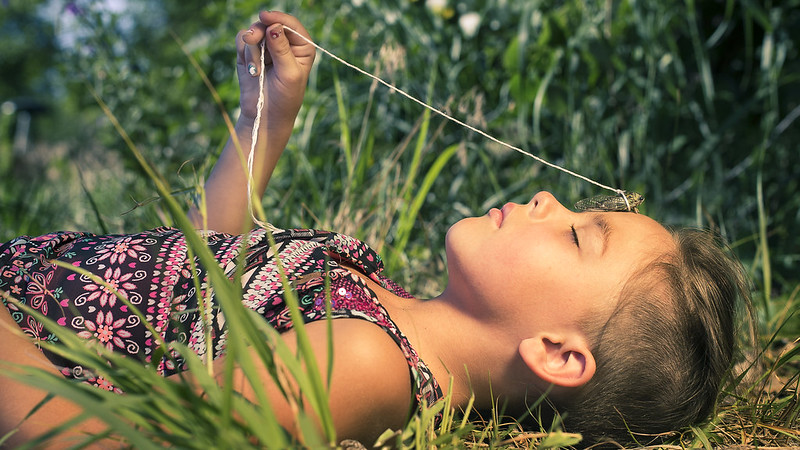
Photo: Girl with cicada bug. Jose Hernandez. CC BY-SA

Waiting

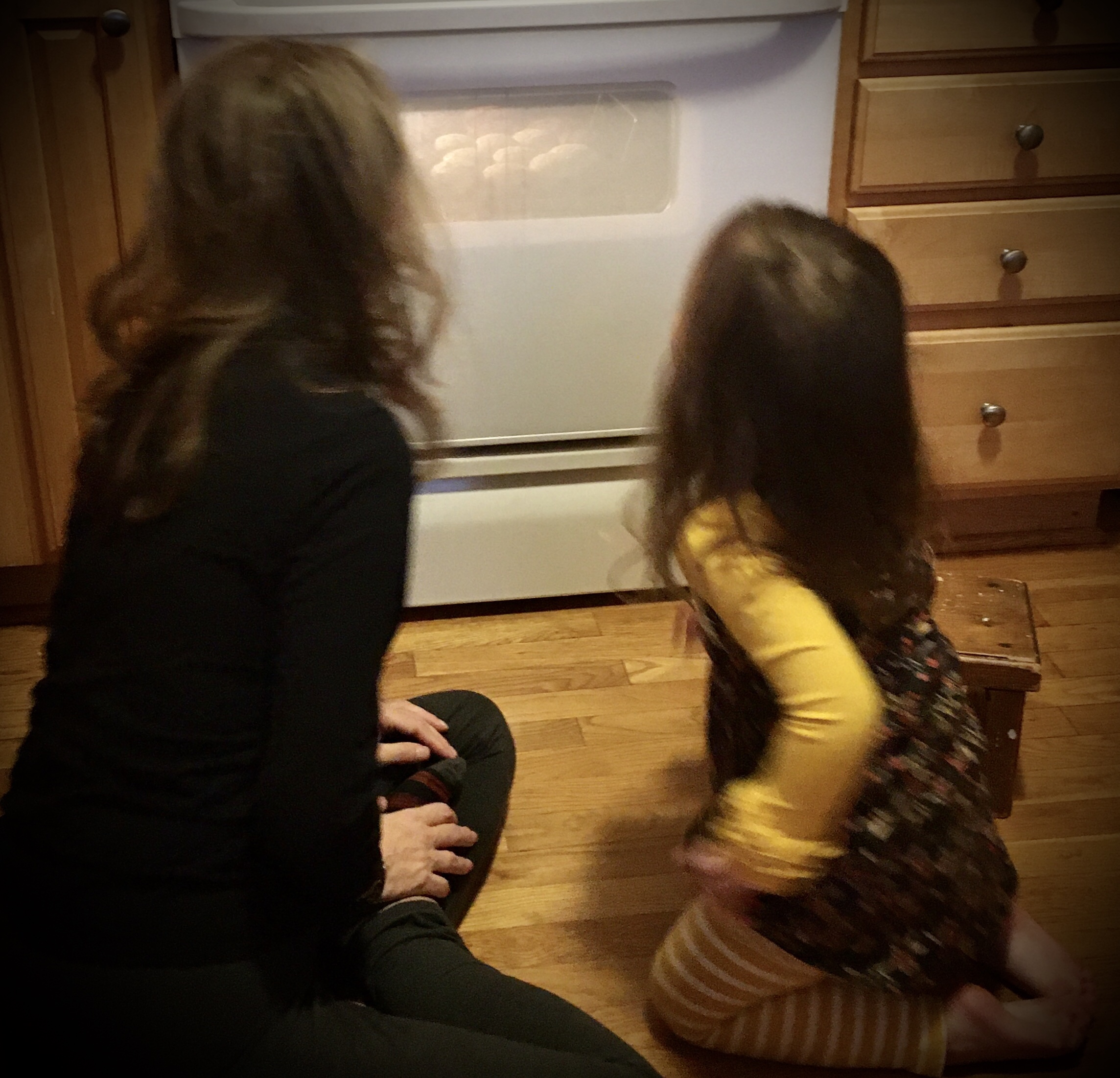
We put the cookies in the oven

and we wait.

Good things take a while.

Don’t they.

Like Christmas and growing up.

Like wedding days

and having children.

Like heart-dreams coming true.

Like you.

It took a long time.

I had to wait.

My little boy had to grow up

and finally find your Mom.

It took a while

didn’t it

for you to get your dad.

Know what he told me?

“Mom, you’re getting a little girl

at last.”

So much of life is waiting, waiting,

it’s true

like my long ago-dream

of you.

So many books to read

and stories to share

and songs to sing

and places to go

and just to be

you and me.

So we put the cookies in the oven

and oh, we can hardly wait.

Revolutionary fiction, revisited

Storming of Redoubt No.10

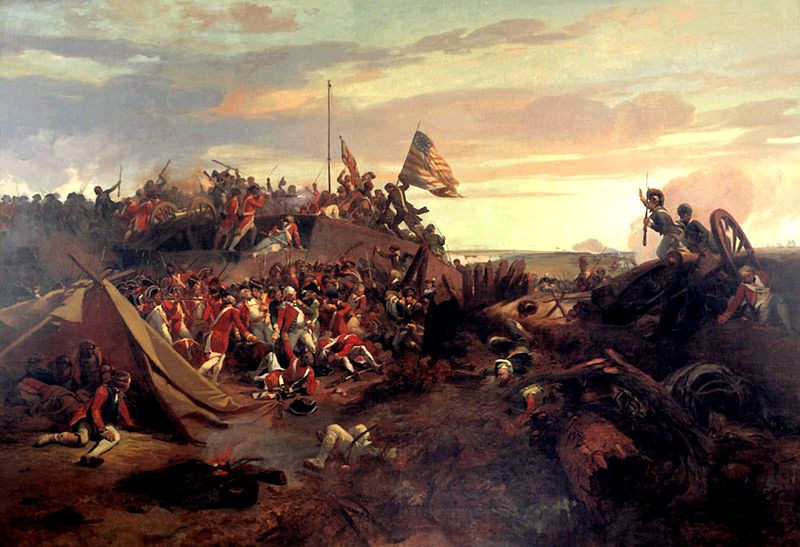
Yorktown, Virginia: Storming of Redoubt No. 10. Eugène Lami. 

I can taste the brine of the river, mingled with gunpowder and wood smoke from the Redcoat campfires . . . I know this shoreline, could walk it in my sleep, but it’s so changed, now, with the batteries, the cannons, the trenches. I can’t carry a lantern for fear of Redcoats seeing me. All I have in my hands is the sack for filling with potatoes. I slide along the ground in the dark, nearing the bank where the cave is set in the earth just below . . . 

The students are gathered on the carpet near my feet, looking at my writing on the screen of an interactive whiteboard, their own papers lying in front of them. They’re considering revisions to the opening scene I wrote while they watched.

To be honest, I am having to review a lot about the last days of the Revolutionary War in order to write this little bit of fiction. I’m tasked with helping the kids write their own story set during the Revolution, as a means of making the history “come alive” for them. As I re-read my writing aloud to the class, I’m already not happy with the reason my main character, Hannah, is going for the evacuated townspeople’s potatoes stored in the cave. Her family is in hiding during the British occupation of Yorktown, they’re nursing three wounded Patriot soldiers, they’re running out of food.

Maybe I should add that Hannah’s mother needs the potatoes to make a poultice for one of those wounded solders. Yeah, that would be even better . . . .

I explain that the next scene I want to write is Hannah getting in the cave, hearing someone come, hiding in the potatoes, overhearing Cornwallis telling his next-in-command that they will escape George Washington’s troops via the river. She will have to figure out how to get word to the Continental Army. Or to the French Army . . .

A boy raises his hand: “I have an idea for your story.”

“Great!” I say. “Let’s hear it!”

“You could have Hannah get back to her family and her friends in hiding and the older boys could disguise themselves as British soldiers to get through their lines.”

“That’s an awesome suggestion, ” I say. “I just might use it! Here’s the thing, everyone: for everything your characters decide to do, there must be a clear, believable reason. It has to make sense in context of the story.”

It is now time to hear their ideas, as they begin to write their own stories.

A few are willing to share with the whole group:

A girl’s brother is supposed to join the Continental Army but he’s afraid and runs away; she decides to dress as a boy and takes his place in battle.

As a Patriot family leaves town, outrunning the British Army, they find a British baby separated from its mother. The mother comes looking for it —”So,” I say, as yet a little unclear on how such a baby (maybe from a Loyalist family?) should be there, lost—”you know they’re on opposite sides, right? Would either take time to politely give a baby back to the enemy?”

—Emphatic nodding of heads; it’s the baby’s mother . . . .

I am picking up on a couple of developing patterns here. One: These fourth-graders are writing from the perspective of main characters who are children. Heroic, rather resourceful children. Well, that’s what I am modeling for them. And, perhaps more importantly: The adults in these stories seem to make remarkably empathetic, kind choices.

Despite a revolution, a war.

Maybe those were more civilized times? When warfare was conducted with etiquette?

Then a girl says that her main characters are a brother and sister whose dad is off fighting under Washington and whose mom is thrown in prison on suspicion of witchcraft. Then the British Army burns their town; the children have to figure out how to stay on the run and survive . . . .

—Never mind about ‘more civilized times.’

As she speaks, I can’t help mulling the true atrocities of war. How Cornwallis’ desperate plan to escape with his troops by river included leaving their injured behind. How deserters told the allied French and American armies that, to preserve food, the British army slaughtered their horses and threw the bodies on the beach.

I shudder at the inhumanity of man, then my mind suddenly reels from the image of dead horses lying on that colonial shoreline to one of greater horror, schoolchildren in America today, lying slain . . . less than 250 years later, THIS is what we’ve become?

“Stop!” I say.

The class freezes. The little writers look at me, quizzically.

“Sorry.” I wonder if they notice the tremor in my voice. “We’re writing fiction, of course, but I just need to know one thing: Are the children are going to be all right?”

—Or what’s a country for?

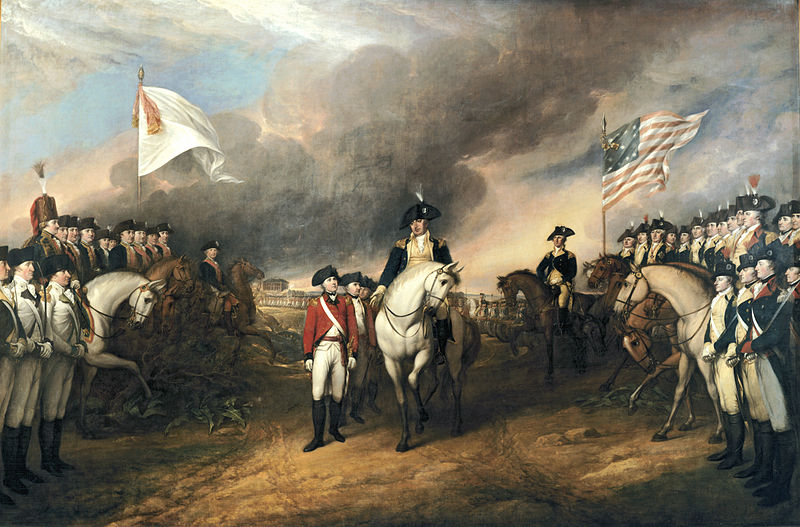
Surrender of Lord Cornwallis

Surrender of Lord Cornwallis. John Trumbull.


The prelude to this post: Revolutionary fiction

Oddball gift

I watch them each afternoon, bringing odds and ends out of their bookbags.

They’re a pretty orderly group, these third, fourth, and fifth grade students seated in the auditorium for carpool dismissal, so I don’t tell them to put the stuff away. Instead, I take note of what they have in their hands.

Some of them are holding books and reading—a delight to my heart.

Some are doing homework—I don’t blame them for getting a head start.

Some are drawing—and I’m astounded by their artistic ability.

Some are writing, occasionally beckoning me to come over and listen as they read it aloud or to ask me a question, and I sigh: All’s right with the world.

Many are playing with slime.

They learned how to make it in science a couple of months back. The kids took the recipe home, altered it, and have taken slime to dazzling new heights. They bring their latest concoctions to school in Ziploc bags, plastic containers, even small glass jars.

First someone came with glow-in-the-dark slime, which, I concurred, is extremely cool.

This progressed to the creation of fluorescent slime. Then glitter slime; one sparkling turquoise batch reminded me of the ocean. Then a shimmery magenta glitter slime containing iridescent beads, which, I am not kidding, was beautiful; it was as supple and stretchy as any other slime. Fascinating.

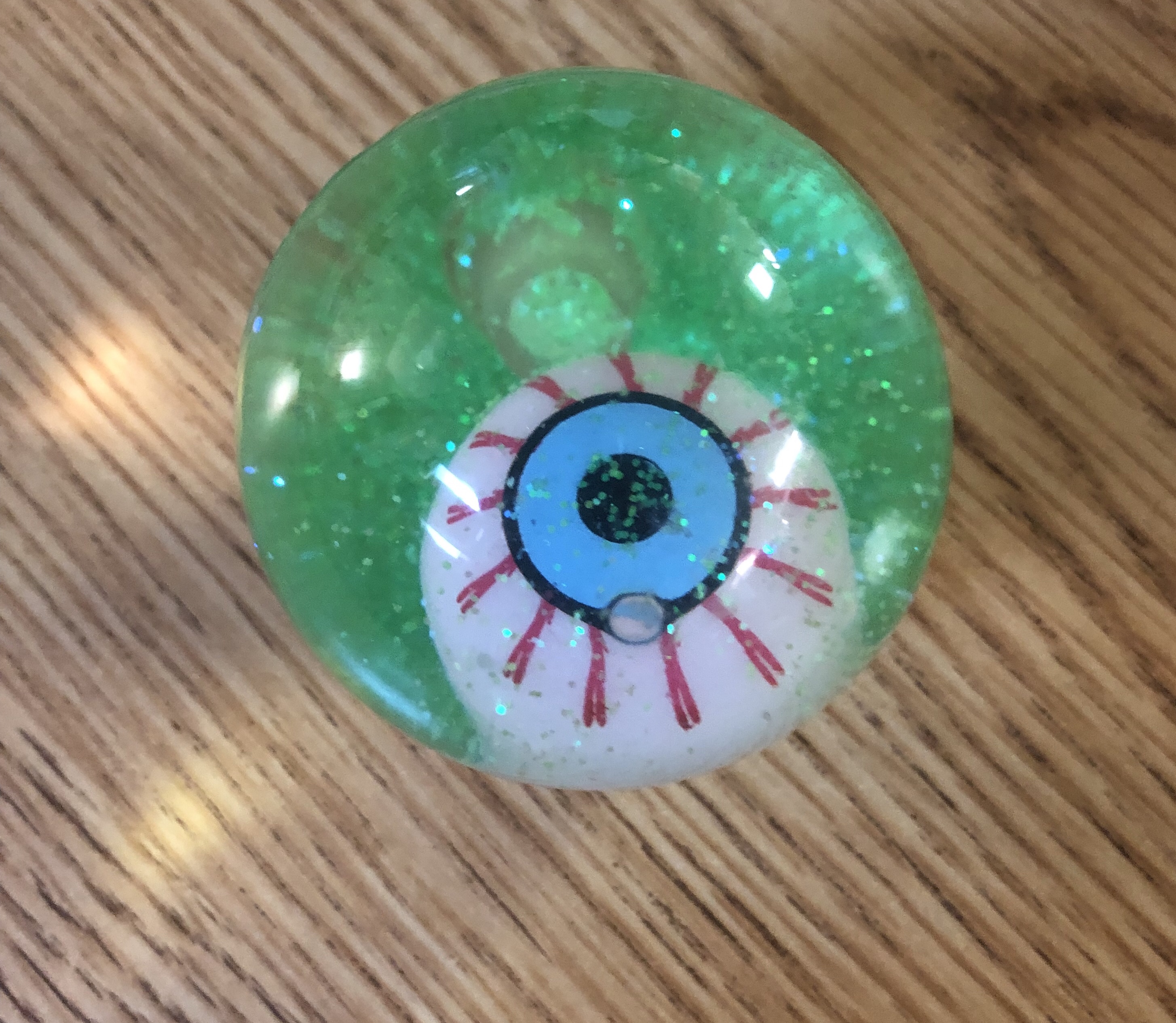
But perhaps the oddest thing of all was non-slime: Some kind of ball being shaken by a girl. I could see green glitter swirling inside and something else floating . . .

I went over for a better look: “Is that . . . an eyeball in there?” I asked.

“Yes,” said the girl, giggling. She handed it to me.

I shook it, because, clearly, that is what one should do with a clear rubber ball filled with fluid, green glitter, and a garish bloodshot eyeball.

“Wild,” I laughed, handing it back.

And the girl said, “No, you can keep it.”

“Ummmm, but, it’s your, er, glittery eyeball . . . thing. Thanks but I would, ah, hate to take it from you.”

She grinned. “It’s okay. I have a whole bunch of them at home.”

I opened my mouth to ask WHY just as her number came up and she left me standing there holding this . . . object. The eyeball floated benignly in the fluid as glitter settled to the bottom. The bright blue iris stared right at me. So odd.

Oddball.

What possible purpose could there be for having ‘a whole bunch’ of these things at home? I wondered. Then, instantaneously: Yeah, there’s a story in that, for sure.

Furthermore, I have learned that when the universe gives you a gift—or when a fifth-grader gives you a glittery eyeball toy—you should just accept it.

And so this gift graces my desk at school, awaiting the moment of its destiny, when an eyeball floating in a sea of green glitter is exactly what is needed.

img_1475


Beautiful child

At a recent meeting of educators, I heard a woman speak of her child’s transition to a new school. The child came home bubbling with excitement on Day One:

“Mom, my teacher looks like me!”

This is the first time her child ever had a teacher of the same race, the woman said. In fact, she went on to say, with quick finger quotes for emphasis, her child was “the only ‘beautiful’ child in the class last year.”

I understood what she meant: Her child was the only one of their race in that classroom.

I’m a mom. I know the protective, fiery love for one’s own, above all else. A proverb comes to mind: “There’s only one beautiful child in the world and every mother has it.” This mom didn’t say there’d been a problem at the previous school but as an educator I know that a sense of belonging and identity are vital to learning. I know that every school and classroom should strive to value, support, empower, and celebrate each child (as well as the adults). For that is how children learn to value, support, empower, and celebrate each other. That’s humanity at its best.

Which is why, as a human being hearing these words from another, a mother and educator, I came away with one heavy, lingering question:

Aren’t ALL children beautiful?