My Patronus

As a headmistress and co-founder of my school’s Harry Potter Club, I was recently admonished to take the Pottermore Patronus quiz, as all other Patronus quizzes are essentially heresy. I approached the task with a bit of trepidation, having heard of people attaining aardvarks and the like.

For the non-Potterite: The Patronus charm produces a silvery animal guardian, usually representative of the individual casting it.

Being a fantasy fan since childhood, and considering my headmistress role, it was necessary: I plunged into the virtual dark forest to seek my symbolic protector. On the site, ghostly words appear in groups of three amongst the trees; the seeker chooses one and is moved onto the next set. At one point in this quest, when I paused too long, the words evaporated with a reprimand: “You are too slow. This game requires quick reflexes.” Silently chiding myself for overthinking simple word choices, certain that this blunder would land me with an armadillo or caterpillar, I picked up my pace. At last, in the ominous forest, a silvery shape materialized.

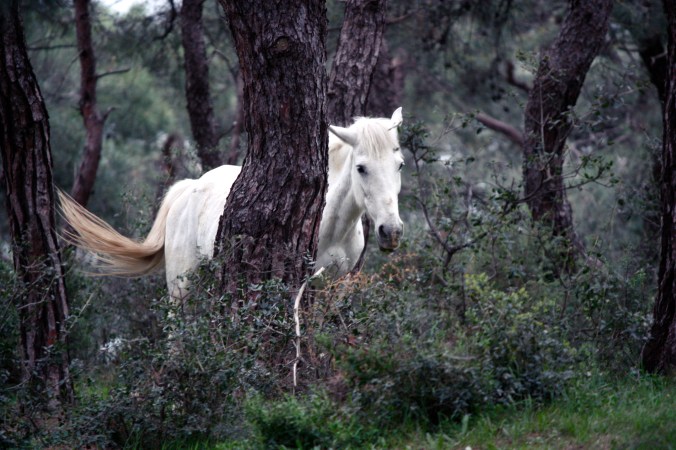
A white mare.

Beautiful and powerful, my white mare galloped through the forest, luminous against the darkness. Enchanting.

My next quest, naturally, was looking up the symbolism.

From various sites, the synthesis is that a white horse represents wisdom, power, loyalty, heroism, nobility, victory – encouraging, yes, but also inversely raising an intrinsic, lofty bar: am I worthy of the white mare? Do I deserve her? Never mind the fact that I gained her by playing a game with an end product based solely on word choices, not short answers or soul-searching responses. The writer in me delves deep into the metaphorical.

I already knew that white horses can symbolize death or the end of the world. They are considered psychopomps, creatures that guide human spirits on their journey from Earth to the afterlife.

As I pondered these connections, my Patronus suddenly conjured up road trips with my father and sister. Three hours is an eternity to young children cooped in a car, so to pass the time, Daddy taught us a game he played as a child:

“When we go by any horses, if they’re on your side of the street, you get a point for each horse. If you have a white horse on your side, it’s worth ten points, because you don’t see many of those.”

My sister and I instantly glued our faces to our respective windows, for we’d been by these random pastures before. We’d often seen horses grazing, strolling, sometimes galloping. I was sure – I just knew – I’d get a white horse. Maybe more than one!

“The thing is,” Daddy continued, “if we pass a graveyard, and it’s on your side of the street, you lose all your horses.”

So we played the game. My sister and I gained horses with glee, then lost them with loud groans, without realizing that one of us would win on the journey to the destination and the other would win on the return trip.

Daddy drove on in peace, smiling to himself.

How many horses I won and lost, I’m not sure, nor do I recall how many were white, only that they were there by the wayside on a long, tiresome journey. Those white horses are obscured by time now, very dim, but still real, ever more priceless, in my misty memory.

Enchanting, indeed, that one should reappear as my guardian after so many years, and that I should have gained it in a game venue that didn’t exist when I was a child.

Daddy, I think, would be pleased. Perhaps he is, from his place on the other side.

Reflect: What creature might symbolize you, and why? I’ve often played a game with students, challenging them to think of an animal that begins with the first letter of their first names (I’ve always chosen fawn in these scenarios – perhaps I should change it to foal?). No two can be the same, so each student ends up with a unique animal and has to think of ways the animal might represent them or their lives. Think – and write. 


Shine

born-to-shine


This is the cover of my mentor text notebook, housing the writing I’ve done with and for children across grade levels.

I believe that every child is a writer, because every child has a story. Every child has feelings and ideas. The writing teacher simply shows how to tap into these feelings and ideas, to give voice to them, to organize them, so that the mind and heart of the writer impacts readers.

Writing is about the human experience: We are all born to shine.

We shine through our fears, our losses.

We shine beyond the choices we make and the choices of others, beyond the things done to us and the things we have done.

We shine no less in our failures than in our successes; in fact, in learning and pressing on, we shine the brighter.

We shine in knowing what to hold onto and what to let go.

We shine when we harness anger before it burns away all that’s of value within us.

We shine by leaving footprints of hope for others to follow, for the human heart runs empty on despair.

We are ALL born to shine. Whether or not we do is up to us.

Reflect:  In the book The Forgotten Beasts of Eld by Patricia A. McKillip, 1974, a mysterious creature had the power to turn people’s eyes around to see inside their minds; they died from what they saw there. Writer, know thyself. Look deep within. You will be surprised by what you discover – the beautiful and the not. Write – and shine.


Born musician

piano-window

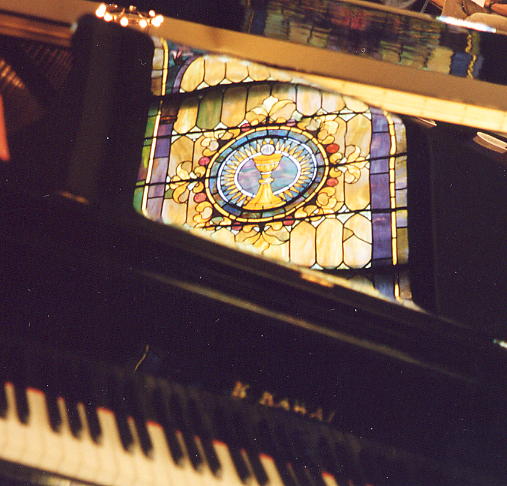
Piano & window. Alan Mayers. CC BY-SA

Years ago, a woman – tired, seven months pregnant – sat in the front row of a church. The morning sun shone through the stained glass windows, casting jewel-tone light on the baby grand piano, a soothing sight to the weary woman whose busy child was churning her insides. The pianist took a seat and began to play the prelude.

The baby stopped moving. He or she didn’t move again until the prelude ended. After the final notes, the child resumed the high activity.

The baby hears the music, thought the mother, marveling. It was the first of many times she would notice the unborn child’s response.

Around age three, the boy frequently hummed a tune to himself. His mother recognized it: “Amazing Grace.” When he was four, the child started playing cassette tapes of gospel music that had belonged to his great-grandfather. After his fifth birthday, his mother stood in the doorway of his bedroom, watching the boy making tally marks with a dry erase marker on a whiteboard easel.

“What are you doing?” she finally asked.

“I’m counting the syllables,” her boy replied, with a serious expression on his little face. He continued his business, listening to the tape, steadily making marks.

It’s the beats, the mother thought. He’s counting the beats.

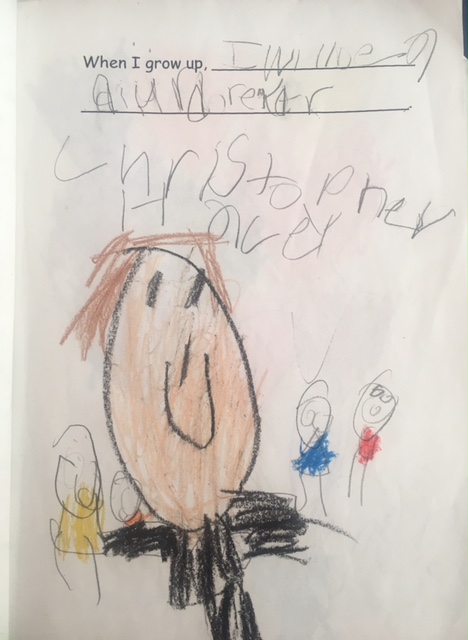
When he brought home his “All About Me” book on finishing kindergarten, his parents smiled at this page:

when-i-grow-up

“When I grow up, I will be a qiur drekctr (choir director).”

When he was seven, watching him tinker occasionally on his great-grandmother’s upright piano in the living room,  his mother said, “You love music so much – why don’t you take piano lessons?”

The boy shrugged, something of a disappointment to his mother, who expected he’d be excited. She took him to lessons anyway.

He wouldn’t practice. The lessons were abandoned before long.

His mother was sad.

In middle school, the boy decided to play alto sax in band. He began tinkering with the piano a little more. Then one day, when he was fourteen, he said, “Hey, Mom, listen to this.” And he played a medley of Christmas songs on the piano – both hands, all the parts – as if he’d been doing so all of his life.

His mother stood marveling, knowing, tears in her eyes.

The boy played the medley on the baby grand piano for the prelude at church on Christmas Day, to the astonishment of the congregation.

He played alto and bari sax for marching band throughout high school; he developed a love for jazz. Few of his friends knew he could play the piano as well. None knew he could sing. One of his teachers did, however. She sought him out when she couldn’t find sheet music for a song she planned to perform at Senior Awards Day.

“This is a version of ‘Perfect’ by Pink – do you think you can play it?” she asked the boy.

“I think so,” replied the boy.

He had two days to prepare.

The result:

One week after graduation, he was hired as the director of music programs at a church, fulfilling his childhood desire of being a choir director.

The rest of the story remains to be written, as it is still unfolding.

I am excited to see where the music takes you throughout your life, Son. Keep learning and reaching.

Much love –

Your infinitely proud mom.

Reflect: Few of us know what we are meant to do so early in life. It’s never too late to find out. What are your dreams, the things that bring you the most fulfillment? Pursue them! What are your gifts? Use them to benefit others. Encourage them to do the same.


Rise

rise

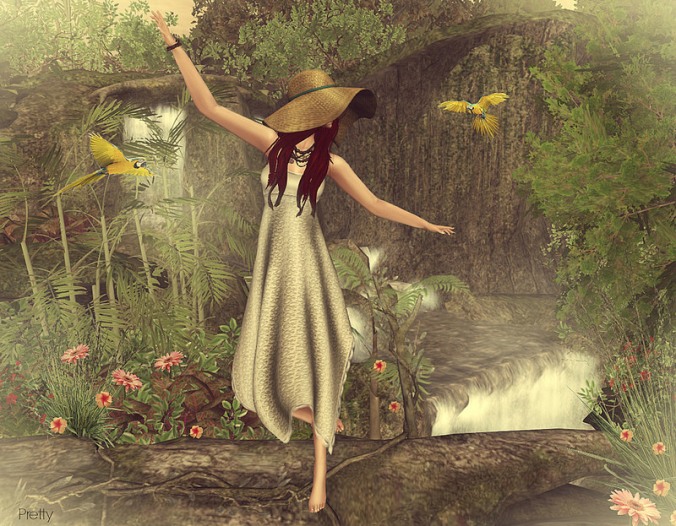
Flight Envy. Pretty ParkinCC BY-SA

Above the negativity, the naysayers, to make room for the wondrous

Above the noise, to a place of productive peace

Above the superficial, the shallow, to the real, the valuable

Above the fleeting, to the lasting

Above constraints, to the creative.

Every day is new. Rise. Reach.

Believe.

Realize.

Repeat: Rise.

Reflect: Rise is a verb. It’s an action, a choice. How might YOU rise and step forward in newness?

Dogged determination

nikolaus

Nikolaus


What comes to mind when you hear the word perseverance? Perhaps it’s The Little Engine That Could. Or Jim Valvano.

I think of Nikolaus.

He’s a dachshund, and if you’ve ever owned one or read E.B. White, you know that the breed tends to be stubborn—as my eastern North Carolinian father would say, “hard-headed.”

Nik came to us when he was three months old. My boys, ages twelve and four, had been begging for a miniature dachshund after they puppy-sat one for friends on vacation. They knew exactly what they wanted: A little chocolate female. So when another friend called to say that her elderly mother had this very creature but could not take care of it, and if we wanted this puppy, we could have it, my boys were elated.

On the much-anticipated day of arrival, we opened the crate door and out strutted Nik. He was tiny, weighing maybe five pounds.

Within sixty seconds, these things developed:

“Mom, she’s not chocolate,” the older son observed. The puppy’s glossy coat was deep red, nearly crimson.

“Mom, she’s peeing on the carpet!” squealed the younger son. A remarkably large puddle, I might add, for a bladder so small.

“And she’s a boy,” I noted, running for the paper towels.

Just sixty seconds to an inkling that This Might Not Be What We Imagined.

Nik looked at us lovingly, wagging his tail.

He was, I decided in the weeks and months that followed, completely untrainable. He could not control his bladder. He wet the carpet, sofa, beds, everything. He would not “go” when we took him outside. Crate training did not work at all; he eliminated in the crate immediately upon entering. Exasperated, I asked the vet: “Why isn’t this working? I read that dogs don’t like to mess up their dens.”

The vet shrugged. “With some dogs, it’s just a behavioral issue.”

Great, I thought. We have a disturbed dog. It did not occur to me until much later that he’d been crated a lot as a puppy because his elderly owner could not keep up with the demands of caring for him. He cried loudly the whole time he was in the crate. Nik, I learned, never wanted to be confined.

The futile attempt to housebreak him reached its zenith a year after we moved into a new house.

“Boys, I don’t know what else to do. I’ve tried everything. I can’t housebreak Nik. He hates his crate, I’m going to work full-time, and he can’t just mess up everything. Maybe it’s time for him to go to a new home.”

The younger son began to sob. “No! We can’t give him away. He’s ours. We’re his family.”

My husband, not Nik’s biggest fan by a long shot, melted: “Shh, don’t cry, son. We won’t give Nik away.”

I glared at him.

“Nik can stay in my room when we’re all out,” offered the older son. “I’ll clean up if he has an accident.”

I thought of the new carpet and sighed. “All right, then. This means everyone is going to have to look after him. EVERYONE.”

The strange thing is that Nik seemed to know about this, because, from that time forward, he was instantly, miraculously housebroken. Whenever he needed to go, he went to the back door and waited to be let out. Just like that. After two years of abject failure.

The boys taught this untrainable dog to “sit pretty” for a treat, which meant that at every meal Nik was by one of our chairs, holding his pose like a groundhog in hopes that we’d give him a bite to eat. I taught him to roll over, so if sitting pretty didn’t work, he’d roll over to get his treat. That’s his entire repertoire: Two tricks.

Nik follows me everywhere in utter devotion, and when he was younger he’d jump into my chair to wedge himself between me and the chair back when I was writing. He is wary of my husband—they are competitors for my attention—but as soon as my husband leaves the room, Nik flies over to curl up in my lap, as if claiming me.

The boys say, “He loves you the best.”

Nik’s intense gaze seems to say the very same thing. He watches my every move.

A couple of years ago, we thought we were about to lose him.

My husband and I heard him fall on the landing of the stairs leading to the upstairs bedroom, dubbed “Nik’s lair,” as Nik was long accustomed to staying there during the day when the family was out. He’d also go up whenever he was tired or ready to go to bed for the night. By this time the older son was grown and gone, and the room belonged to the younger one, who was not home at the moment. On hearing Nik fall, my husband and I rushed to find him crumpled but conscious on the landing.

My husband began to cry.

“Stop it! You, of all people, crying about Nik! Don’t tell me you’re attached to him after all!”

“It’s the boys,” sobbed my husband. “Having to tell them that Nik . . . that he might . . .”

I picked Nik up as carefully as I would a newborn baby. “Let me wrap him in a blanket. You’re driving us to the vet. Stop crying.”

The trouble was two kinked-up vertebrae; the vet pointed them out. He dispensed medication and sent us home.

I made a pallet for Nik in the living room and covered him with the blanket. For two days, Nik didn’t walk. The younger son slept  on the couch to be near him at night. Nik didn’t eat or “go” when we took him outside. He just looked at us with big eyes and never made a sound. When he’s not crated, Nik hardly ever makes any noise.

In the wee hours of the third morning, I woke up and decided to check on Nik. My son was sound asleep on the couch. Nik’s blanket was still tucked on his pallet, but he was nowhere to be seen. He wasn’t on the couch with my son. I started searching, increasingly alarmed as minutes passed with no sign of Nik. He’s crawled off away from us to die. That’s what animals do. He wasn’t in the kitchen, under the chair where he likes to take his treats.

I woke my son: “Where’s Nik?”

“He’s not on his pallet?” asked my groggy teenager.

“No! I can’t find him anywhere!”

I woke my husband: “Nik has disappeared!”

“How is that possible?” He and my son looked again in all the places I’d just looked.

Then I thought, No—surely not—I don’t know how he could . . . 

The upstairs bedroom. That’s where he’d want to be, if . . . .

My heart pounding, dread deepening with every step, I climbed the stairs and opened the bedroom door.

I turned on the light.

No Nik. Normally he’d have jumped on my son’s bed and gone to sleep.

But he couldn’t jump now, not with his back . . . very carefully, I lifted the dust ruffle.

A tail thumped in greeting, and two eyes looked out at me as if to say, I just came up to bed like I always do. 

I cannot envision how he did it, how he dragged himself from his pallet all the way up the stairs to his favorite, safe place. After three days of not being able to walk at all. Knowing he could not jump, he contented himself with sleeping under the bed instead of on top of it.

I do not cry easily, but I did then.

He recuperated, and it happened again a month ago. This time Nik could not walk for a week and a half. The vet—a different one now—called to see how he was faring.

“He’s not any better,” I said into the phone. “No change. He wags his tail at us, but he can’t move.”

“It may be time to think about the quality of life,” the vet said, gently.

We tried to talk about it, the boys, their dad, and I.

“But he knows us still,” I said. “He doesn’t seem to be suffering, except for not being able to walk.”

“Yeah, it’s not like he’s in a coma,” said the younger son.

“If you make that decision, I want to be there,” said the older son, who’d come by on his way home from work. He rubbed Nik’s head.

Nik looked at us lovingly.

Another day passed, and another. He still did not walk.

My younger son and I took turns bringing Nik’s food and water to him. Nik ate and drank. Good signs. I carried him out several times a day; he obediently did what he needed to do, lying in the grass. I carried him back inside, put him in his beloved new dog bed, and covered him with a blanket.

More days passed.

Then one day when I carried him out, I felt his back legs press against my side. When I put him down, he stood. By himself, for a few seconds, on his old white paws, looking at me lovingly from his little white face, before his legs gave out and he flopped down.

Each day after he could stand for a bit longer at a time.

He is fifteen now, turning sixteen in January.  He runs from room to room again like he did when he was a puppy, still begging for treats although he can’t sit pretty anymore or even see his treats as well as he once did, but he gobbles them just like always.

And every night, one of us carries him upstairs to his favorite, safe place to sleep.

Reflect: Who—or what—represents perseverance to you?  Why? What have you learned from this person or situation, and what have you learned about yourself?


The Harry Potter club

harry-potter-club

Every semester a new group of them arrives, fresh-faced, wide-eyed, often clutching owls or wands, quivering with excitement and  ready to be sorted into one of the four houses … no, they’re not at Hogwarts. These are third, fourth, and fifth grade students who signed up to be in the Harry Potter club at our magnet school.

A colleague and I are the founders, the “co-deputy headmistresses” of the club, formed in conjunction with the school’s mission to expand arts and science integrated opportunities for the students. Staff chooses what to offer; students can sign up for anything from cooking classes to a foreign language to astronomy. Since it began, the Harry Potter club has operated at maximum capacity. Once we know students’ names, they receive their own rolled parchment letter of acceptance (as yet not delivered by owl, but we headmistresses are working on that).

My colleague and I expected to have fun – after all, we chose a theme that was fun for us. We expected that the kids would have fun, and they do. From Day One when they are sorted with the help of an online quiz  – we call it the “technological Sorting Hat” and we always end up with an alarming number of Slytherins, prompting discussions about character traits – through sessions of making their own wands, Quidditch pencil brooms, golden snitches, and patronus pictures, the students savor every moment. One of us, a teacher or student volunteer, reads aloud from the books while the club members work on their crafts. As students are sorted, someone reads Harry’s sorting experience to the group; when students make wands, one of us reads the scene where Harry goes to Ollivander’s for his wand. All students chime in right on cue, because they’ve seen the movies and they know: “The wand chooses the wizard.”

What my colleague and I didn’t expect were the far-reaching effects. Parents frequently tell us: “My child is SO excited about being in the Harry Potter club!” We didn’t expect the depth of the discussions students would initiate on their own, regarding various characters and their motivation:

“Professor Snape was really protecting Harry the whole time, not trying to hurt him.”

“That’s because Snape loved Harry’s mother – they knew each other when they were little, before she knew Harry’s father.”

“It was Harry’s mother’s love that protected him – she died to save him, and that’s why Voldemort couldn’t defeat Harry.”

One would have expected students to be drawn most by the magic, the fantastic, or the old good vs. evil theme, but at the ages of eight to ten or eleven, the students talk more about love, the huge, shining thread that winds through the stories and ties them all together.

My colleague and I certainly never anticipated one student’s attending the club from its inception to the day he left for middle school. As the club is in high demand, repeaters are not usually allowed. One of his teachers made the appeal: “He doesn’t like school, but he loves the Harry Potter club. He’s always here on club days. Can he please be in it again?”

His mother said: “It’s all he ever talks about – the Harry Potter club.”

Our young friend turned out to be a jubilant Gryffindor (as is yours truly, for the record). By his third go-round in the club, he was made Head Boy; he coached newcomers on club matters. He occasionally stopped by my room to discuss Potter trivia and other topics of his interest, always smiling. When he graduated from the fifth grade, my colleague and I presented him with a Hogwarts T-shirt. He wore it for the ceremony.

Just before his departure, our veteran member was asked why he loved the club so much. His brow furrowed in thought for a moment before he replied: “It’s this whole story about a boy who loses his parents and everything is hard for him all the time, but he still tries to save everyone. He’s so brave.”

He paused. We listeners wondered, with tears brimming, what sage, profound connection might be coming next. Our Head Boy just shrugged: “And there’s no Star Wars club.”

Ah, perspective.

Reflect: The power of story is limitless. Read a story to someone. Tell yours. It matters.


Why I write 2016

writing

I write because it’s the closest thing there is to magic.

From words spring worlds.

Worlds of understanding, perception, knowledge – of humanity and of myself. I write to explore the world without and within, the real and the fantastic, the important and the insignificant, the extraordinary and most certainly the ordinary. Where there are ideas and images, there are words – lanterns for encircling thoughts, illuminating objects and scenes, mystically shining from one mind to another.

I write because the narrative voice in my head is continuously composing, often drowning out other important things.

The power of story compelled me to write when I was six years old, sitting at the living room coffee table with a pack of wide ruled paper and a fat pencil. A few years later, a teacher said, “What vivid descriptions! Keep writing.” Every year thereafter, a teacher strategically appeared to give a refining bit of feedback: “Wonderful writing. Here’s a way you can make it even better … and keep writing!”

I kept writing, even when my dad grumbled, “Why are you wasting so much notebook paper?”

Today, I write with children. I witness their discovery of their own voices, their courage in putting pieces of their souls on a page. I share in the excitement of their creations, in every little triumph over challenge. I work to empower teachers as writers, for the empowerment of student writers, that all might tap into the magic.

And I keep writing.

I write to wrap a cloak of immortality around everything I have loved – what was, what is, what will be.

I write to scatter the ashes of all my yesterdays, to walk in the light of all my tomorrows.

I write to celebrate having lived.

In honor of National Day on Writing, October 20.

Reflect: Why do you write? What have you wanted to write, but haven’t yet? Carve out a pocket of time today and begin. Tomorrow, repeat.


The secret gates

ditch-gate

Into the ditch. jam343 CC BY

When I was a child, my neighborhood flooded regularly.

I lived on a block where all the backyards joined at a long ditch. When I went to play with a friend, I took a shortcut by running alongside the ditch and jumping over it, taking care not to land in it, for the ditch was lined with thick, black mud; if it did not stink outright, it certainly smelled organic, stagnant. Sometimes fleabane, tiny, hairy daisies, grew along the banks. That’s about it for ditch decor.

Whenever a heavy rain came – and a few times during a moderate rain – the ditch overflowed. Storm drains in the curbs overflowed as well, until water covered the streets and most of the yards. My friends and I had fun wading through it as we walked home from school, sloshing as much as we could.

My father, however, was irate every time.

As soon as he saw the water backing up, he got the city on the phone.

“Listen, I’ve called before,” he’d snap at the City Official on the receiving end. “You ought to have a record of it. This whole neighborhood is flooded AGAIN. Get whoever is paid to do it to open those drainage gates.”

Every time, the City Official pleaded ignorance about said gates.

I watched Daddy’s florid face redden. “You people always act like you don’t know what I’m talking about, but I am telling you, there are flood gates controlled by a switch and somebody up there knows how to use it. There’s NO EXCUSE for a place to flood like this. Open the gates!” He glanced through the picture window in the living room. “A canoe is going down my street right now. So help me, I will get in it, come down there, and find that switch myself.”

A canoe was going down our street, neighbors having dragged out their camping stuff, rowing merrily along. A teenage boy in waders, hip-deep in the water, pulled younger siblings on a raft behind him. To my horror, one young neighbor tossed a puppy from the front steps out into the water to make sure it could swim. It could; that the puppy swam back to its owner amazed me.

Daddy’s voice got louder, his face redder, until he hung the phone up in disgust, but within an hour of his call, the flood began to diminish.

As the water level went down, so did the color in Daddy’s face. In his eyes was a glint of victory, or perhaps vindication. The City Officials had, yet again, scrambled to open the secret gates they kept forgetting about. Good thing they had my dad to remind them.

Did the gates actually exist? Did they lead to the nearby river, or where? I never knew for sure, but the timing between my father’s phone calls and the floodwaters receding is intriguing, suggesting more than a fluke.

Our regular neighborhood floods were mild annoyances in comparison to the devastation experienced by anyone whose home has been lost or whose life has been endangered. The forces of nature are beyond human control, despite the best of foresight and man-made safeguards. On a small scale, my father did what was within his power to change a situation. One voice, persisting. Today I think of the labyrinthine educational system, of American politics, the overwhelming need for change when so much is at stake, and those who are suffering. What are the gates to clearing the way, and where lies the switch? Change is a force within human control. As Anne of Green Gables author Lucy Maud Montgomery penned: “All things great are wound up with all things little.”

Believe, be the voice, reclaim what is of value, before it is lost.

Reflect:  Water is a symbol of life, as well as adaptability, healing, and cleansing. When things become overwhelming, one of these might well be a switch to seek. Which might be yours? How might you help others?


Haunting forevermore

Ah, distinctly I remember it was in … June, 2013.

My older son and I, teachers inspired by a love of The Great Gatsby,  celebrated the arrival of summer vacation by driving from North Carolina to Rockville, Maryland, where we visited the grave of F. Scott Fitzgerald. Having accomplished this mission before nine o’clock in the morning, my son asked: “What do you want to do now?”

“You know,” I grinned, “Baltimore is only forty-five minutes away. Poe is buried there.”

Thus was our Dead Writers Tour born. Off to Baltimore we went.

In contrast to a midnight dreary, the morning sun was blinding at the Westminster Hall and Burying Ground. The old Gothic-Revival church, the gate, the trees, the headstones, all cast the blackest, sharp-edged shadows, as if intentionally evoking the last lines of  “The Raven”:

And the lamp-light o’er him streaming throws his shadow on the floor;

And my soul from out that shadow that lies floating on the floor

Shall be lifted – nevermore!

And there, to the immediate right of the entrance, was the author’s grave under a large, shadowy monument bearing a plaque with his likeness. One wilting yellow rose and a couple of little rocks rested on the base.

Poe is buried with his wife, who was also his cousin, aged thirteen when he married her and twenty-four when she died, and her mother, his aunt.

“This isn’t the original grave,” my son pointed out. “Poe was first buried somewhere behind the church. He was moved here to to the front later.”

“That figures,” I said. “The man was unsettled for most of his life. He couldn’t even be settled in death.”

Just then a black bird flew by to land on another headstone, where it sat watching us from the stark shadows.

“Is that a raven?” I whispered.

Quoth my son, wide-eyed: “Geez, Mom!”

“No, it can’t be,” I assured him. “Ravens are bigger than that … I think. Let’s go find the first grave.”

This cemetery is old, dating from the late 1700s. The pathway from the entrance to the back is narrow,  leading past massive domed slabs somewhat reminiscent of Quonset huts. Years and weather have left black streaks running down the sides of these burial slabs to form odd swirls and patterns. Ghostly patterns, painted by nature’s fingers.

“Check out this stain,” I said, pausing. “Does it look like a skull to you?”

“Oh, wow – it does!”

Rounding the corner of the church, we came upon a marble table with thick legs and a top so sunken in the middle that it seemed impossible for such a heavy substance. A plaque informed us that this “gravity-defying” monument was mentioned in a Ripley’s Believe It or Not! article. A Revolutionary War veteran is buried beneath this oddity.

From there, my son and I could see Poe’s original grave, as the crowned headstone is embossed with a raven. On nearing the cenotaph – the empty tomb – the words arching above the bird become visible: “Quoth the Raven – Nevermore.” The stone informs visitors that Poe rested in this spot from 1849 to 1875.

“Do you remember reading about the mysterious person who showed up every year on Poe’s birthday, wearing a cloak or something, to leave roses at the grave?” I asked my son, a trivia expert extraordinaire.

“Oh, right – the Poe Toaster. He wore a hat and white scarf. He left cognac, too.”

“At this marker or the other?” I wondered.

“This one, I think. He came for decades, until just a couple of years ago. No one ever figured out who the Toaster was.”

“That’s hard to believe, in this day and age.”

“What’s really strange is that just before Poe died, he was found in the streets of Baltimore, out of his mind, wearing someone else’s clothes, and no one ever knew why.”

“It’s haunting, but mostly sad,” I pondered aloud. “Something straight out of his own work.”

We turned to leave, walking past a line of eroding tombs and vaults on the far side of the little cemetery. Some stone vaults had iron closures that appeared damaged. My fanciful imagination took flight: Had someone tampered with the doors, trying to get in – or out?

I shuddered despite the brightness of the day, recalling something my grandmother told me when I was a child afraid of the tiny graveyard across from her house in the country: Never fear the dead. Fear the living.

“I don’t think I’d want to be here at night,” I said to my son.

We simultaneously picked up our pace toward the exit.

“Nor would I.”

Back at Poe’s final resting place by the gate, my thoughts turned to his poetry, the glorious rhythm of “The Raven,” which drew me as a child the first time I heard Vincent Price reading it on TV. The poem wields mesmerizing, unique power. It is meant to be read aloud. Once when I was working to help third graders comprehend a text they were reading, we encountered the word raven.

“What’s a raven?” they wanted to know.

“It’s a bird – a black bird,” I told them. “There’s a famous poem about a raven.”

“Read it to us!” demanded the kids.

After a quick Internet search, I read the opening stanzas.

The children listened, spellbound. When I stopped, one of them sighed:

“Oh, Mrs. Haley – that sounds just like music.”

It does, indeed.

Ever after, the kids greeted me with “Hi, Mrs. Haley! Once upon a midnight dreary, while I pondered, weak and weary!”

Having paid my respects at last to Edgar Allan Poe, I walked back through the gate, just as the church’s bells began striking eleven – as if the word master himself was sending a message:

Keeping time, time, time,

As he knells, knells, knells,

In a happy Runic rhyme,

To the rolling of the the bells —

Of the bells, bells, bells —

To the tolling of the bells,

Of the bells, bells, bells, bells,

Bells, bells, bells–

To the moaning and groaning of the bells.

It couldn’t be coincidence – could it?

Today is the 167th anniversary of Poe’s death.

Reflect: What written works sing in your head, call to you, haunt you? Why?


A poem of friendship

Through clouds of gray will softly shine

a gentle silver tear of mine,

leaving lines to slowly trace

an empty soul, a lonely place.

A golden glow you gave to me

to help me through eternity –

light and warmth with which I try

your own sweet rains to somehow dry.

And we two have learned to see

the me in you, the you in me.

A golden ray through a silver drop

create such colors; they cannot stop.

What blazing brilliance we have sown,

this iridescence of our own!

Combine our souls and we will show

our strength lies in our rainbow.

-Written when I was fourteen. The UK’s National Poetry Day brought this early effort back to mind.

Reflect:  What metaphor captures the beauty and power of your dearest friendship?