Walk with me

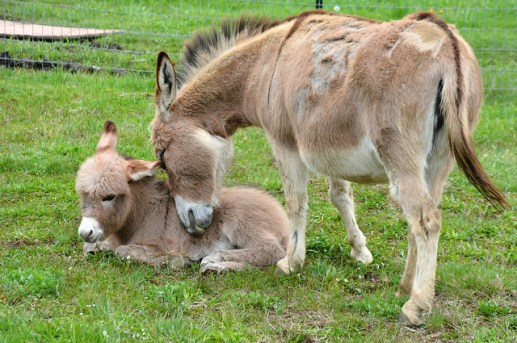
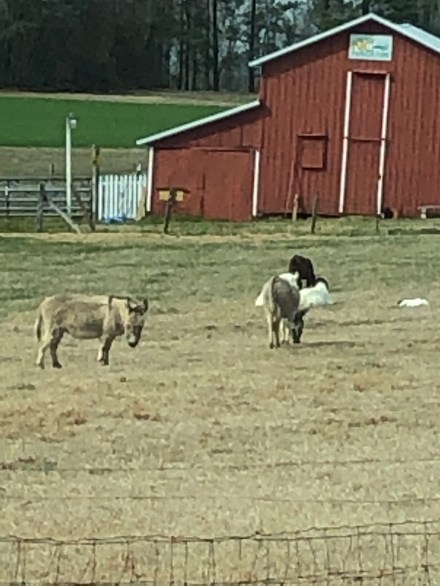
“Jerusalem” donkeys live in a pasture near my home. They are so named for the cross formed by black stripes across their shoulders and down their backs. The donkey is a symbol of peace, for they are peaceable creatures, although farmers know they will protect livestock by driving away coyotes.

The donkey currently plays a significant role around the world with the observance of Palm Sunday and Holy Week. The Gospels of Matthew and John both proclaim the fulfilling of Zechariah’s prophecy that the Messiah would come to Jerusalem humbly, riding the foal, or colt, of a donkey. In Mark and Luke, Jesus directs his disciples to a colt “on which no one has yet sat.” Only Matthew records that the unbroken colt doesn’t come on this mission alone: Its mother walks alongside as it carries Jesus through the shouting crowds in the streets of Jerusalem.

It is the image of the mother walking beside her colt—her child—as a calming presence amid chaos, as a needed coach in fulfilling the sacred duty, that suddenly pierced my heart and inspired today’s post.


Walk with Me

My world is confined

to the home that I know

until strangers come

to lead me away

—please, will you come with me,

walk with me?

I know not the destination

only that it’s far

beyond what I can see

and I can’t go it alone

I need you by me,

to walk with me.

The crowds, the fervor,

what can it all mean

 but that I’m not safe

in this place of screams

don’t leave me now!

Just walk with me.

Such heavy burdens in this

untamed human world

some worthy, some not.

What’s the difference?

—Show me, I am watching you

walk with me.

A step and a step and a step

at a time,

I find I can carry on

as long as you are here

—because you don’t fear

to walk with me.

It is new to me, 

my burden; but it is light

despite the shadows

you are at peace

—and so am I

for you walk with me.

I know, somehow,

you’ll see me home

when this day, these cries,

this purpose, are done

—so walk with me

walk with me

keep me ever close 

and

walk with me.

Jerusalem donkeys

Mother & baby Jerusalem donkeys. Barbara BresnahanCC BY-SA

Inspiration comes on wings and paws

I saw her a couple of times across the convention center lobby. She wasn’t deliberately calling attention to herself. With her flowing blonde hair and elegant bearing, she couldn’t help standing out in a room full of people. 

I smiled at first glimpse of her: A service dog. 

And such a beautiful one.

I suppressed the urge to go over to her, knowing that service dogs are on duty. I briefly wondered if the man she accompanied had impaired vision or special medical needs and whether this throng of humans had the animal on heightened alert.

Instead I focused on my upcoming break-out session. For the second year, my colleague and I were sharing the effects of my school’s Harry Potter club with attendees of the North Carolina Reading Association. It’s a fun and meaningful presentation centering on the sense of identity that develops among diverse learners in third to fifth grades; many students find it such a place of belonging that they ask to be in the club semester after semester, even if we are reading the same stories and making the same crafts.

The best part is how excited teachers are to attend this session at the conference. Never underestimate the power of Potter . . . as my colleague and I set up the slideshow, the room filled quickly with participants and an air of festive expectancy.

Then—in strolled the service dog! Her person took a seat near the front (he wasn’t vision-impaired; he read the welcome slide and made eye contact in conversation with others). The dog immediately lay on the floor alongside his chair, flat on her side, utterly still. Her gleaming dark eyes gazed toward the front of the room.

What a gentle face. I looked back at those sweet eyes for a lingering second, my curiosity thoroughly piqued with regard to her service role, as my own role of presenter began.

—Here’s hoping you like Harry Potter, little canine friend. 

There she lay throughout, even at the conclusion when teachers came to the front of the room to select materials for making a craft like the club kids do: A clear ornament filled with strips cut from pages of an unsalvageable, falling-apart copy of Harry Potter and the Sorcerer’s Stone, a feather pen, a pencil broom, a flying key. 

The dog’s person chose to make a flying key. When I went to check on his progress, he introduced me to his canine companion:

“This is Palmer.”

Her big eyes considered me benignly.

“Hi, Palmer. You’re a beautiful dog!” I desperately wanted to stroke her lustrous yellow-white fur.  

“Want to see what she can do?” asked Palmer’s person.

“Sure!”

She does tricks, then? Do service dogs actually DO tricks?

I had no idea what to expect.

Couldn’t have predicted . . . .

Her person stood. Palmer instantly stood before him.  Her person produced cards with words on them. As he displayed them one by one, Palmer did exactly what the words on the cards said. Sit, lie, stand . . . her trainer—as that’s clearly what he was, now—even shuffled the cards behind his back, held them up again, and Palmer still enacted the word on each card. Accurately.

At this point the entire room was agog: “The dog’s reading the cards!”

Her trainer smiled. “Palmer helps kids at my school learn to read. Especially first graders with sight words.”

I blinked back a sudden welling of tears, envisioning the children with this dog in the classroom, the joy of it. “How wonderful.”

—”Want to take a picture with her?”

I recovered myself: “Oh—absolutely! I’d be honored!”

So Palmer posed beside me at a table, her paws resting on top. Her trainer held out his newly-made winged key: “Hold it, Palmer.” 

And she took it, ever so gently, in her mouth. She held it for all the photos.

Which, to me, holds great significance.

I always think of the winged key as a symbol for unlocking problematic doors in reaching an important goal, as it did in Harry Potter and the Sorcerer’s Stone. I think of it as a metaphor for inspiration, as in flying above and beyond learning obstacles, especially with regard to challenges that some of our Potter club kids have faced.

And here is Palmer, herself a symbol of meeting social-emotional needs, for I have since learned that she goes above and beyond motivating young children who are learning to read. She also helps children at her school attain their behavioral and academic goals. If they need extra encouragement while working on math, or the comfort of a warm, benevolent, stabilizing presence close by, Palmer is there for them. She is a key to overcoming whatever challenges they face. 

—I can think of few things more magical and inspiring. 
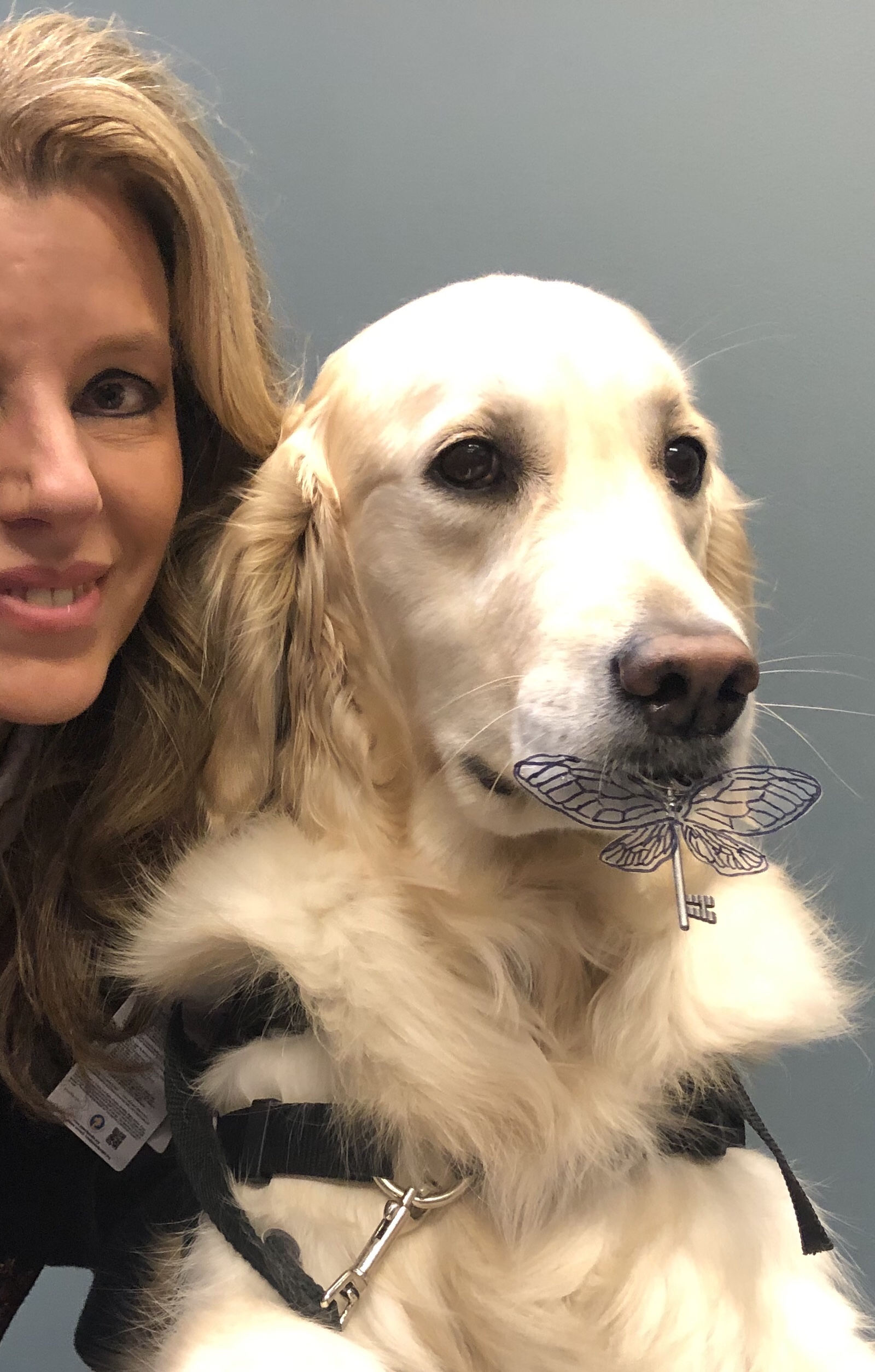
Palmer, Educational Assistance Dog.  April 2, 2019.
 

Trust is a reflex

Trust is a reflex

when eyes can’t see

when a presence passes over

and mouths open

anticipating sustenance.

Trust is a reflex

when others draw near

when in their shadow

minds open

to positive intentions.

Trust is a reflex 

perhaps, more than a choice

that the proximity of others

portends benevolence

not harm.

Trust is a reflex

a silent cry of the heart

believing that somehow

someone is near enough 

to hear.

Holy

It is dark, I cannot see.

—Wait a bit, there will be

light.

I  don’t see You, but I’ll trust.

—I made your eyes, they will adjust;

I gave you sight.

So much I see, that should not be.

Be still and leave this all to Me;

it will be right.

 I fear most to see inside of me.

Fear not. Even there I’ll be

to drive away your night.

No darkness is too great for Me.

This I know. It sets me free.

Toward Your light my soul

takes flight.

Dichotomies

Dichotomy
Dichotomy #3 by Abdulaziz al Loghani. Brett JordanCC BY

Our greatest national resource is the minds of our children.

—Walt Disney

When they are hungry

who would give them rocks

When they cry for a spark

who would spew water

When they strive to see

who would deploy smoke and mirrors

When they would fly

who would clip their wings

When they desire to go further up, further in

who would confine, constrain

When they crave autonomy

who would demand automatons

When their differences resemble a separate peace

who would distill a disparate piece

When the lengths they must travel are not equidistant

who would mistake equality for equity 

When they carry fragile fragments of hope within

who would build a diehard dystopia without

When they begin to perceive diversity as a gift

who would wrap it in sameness

When they aren’t the same

who would construct uniform boxes

When they would breathe

who would affix a lid

When the scraping of the adze and the hammering cease

who will hear the sound of fingernails

from inside

the casket of our dichotomies? 


Note: If you read “they” as children, try reading with “they” as teachers.

*******

Literary allusions: Matthew 7:9-10 and Luke 11:11-12; The Last Battle, C.S. Lewis; A Separate Peace, John Knowles; Animal Farm and Nineteen Eighty-Four, George Orwell; The Giver, Lois Lowry; To Kill a Mockingbird, Harper Lee; As I Lay Dying, William Faulkner.

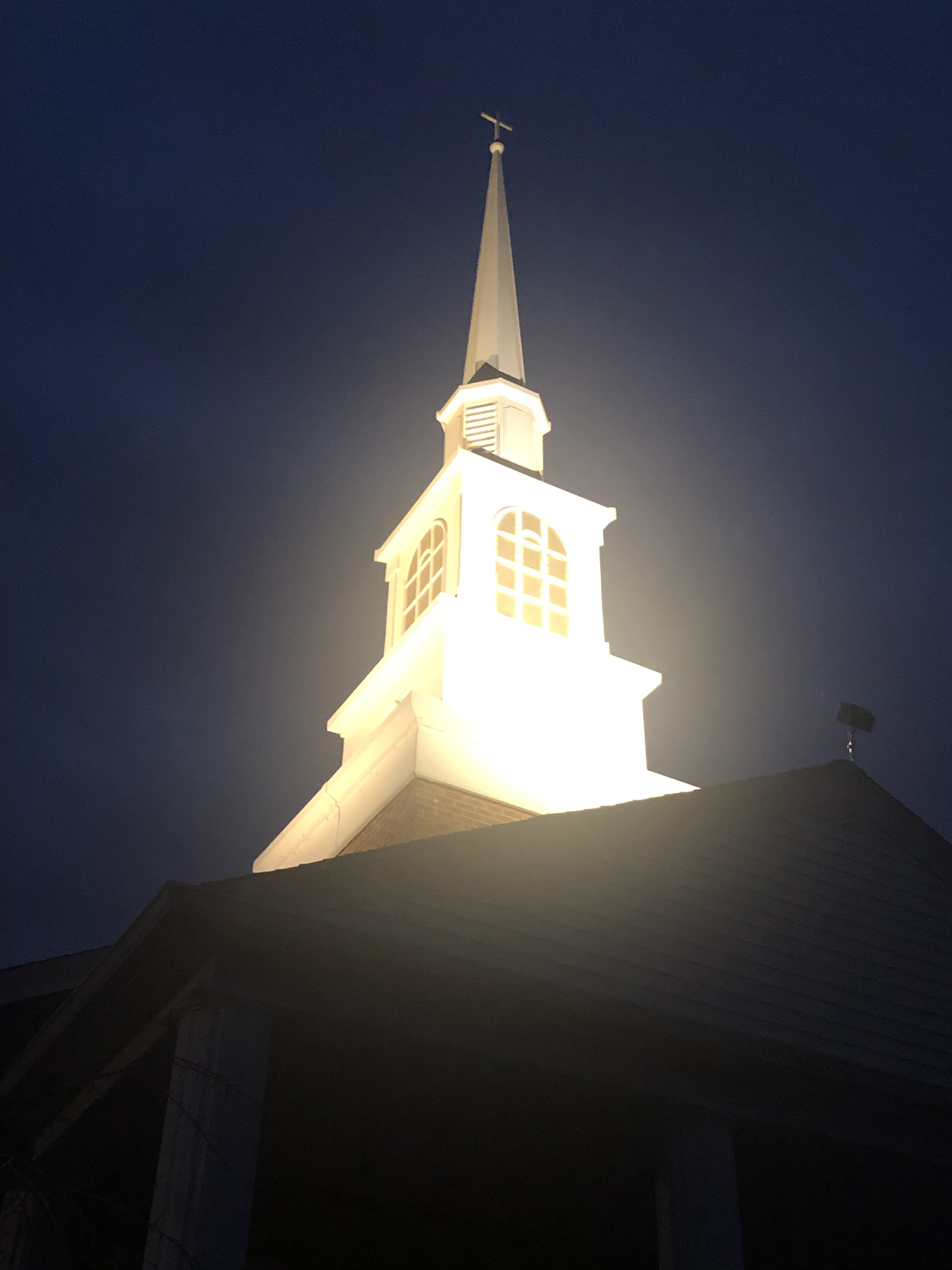
The gazebo

Gazebo at Night. Lori L. StalteriCC-BY

At first he thought he never wanted to see it again, the little gazebo on campus.

How perfect it was when he last saw it.

He couldn’t have orchestrated things better than they’d played out: the June sunlight just beginning to wane after dinner, shining in a deep, golden slant through the magnolias, the fragrance of the last blooms heavy in the air.

And her.

At last, and again, for they’d broken upon once. This time he knew it was meant to be. Side by side they sat, and he gave her the ring.

She started to cry.

“Will you marry me?”

She wiped her tears, laughed, hugged him. “Yes!”

Perfect. That one afternoon, in the whole of his life, was perfect.

In two weeks she was gone.

Not ready, she told him. They were too young.

That’s it then, he told her. Not now, not ever.  

His friends consoled him: “You ARE too young. Just enjoy life before you worry about getting tied down.”

Trouble was, he didn’t know how.

For days, all he wanted to do was sleep. He slept the rest of the summer away. He ate his way through autumn into the winter until he decided (while standing on the scales) that enough was enough.

He started walking, counting his calories. He lost seventy pounds.

He reconnected with old friends.

One asked, “Whatever happened, exactly?”

He told her all of it, just as they were driving past the campus. On the spur of the moment, he said, “I’ll even show you the gazebo where I gave her the ring.”

It was getting dark. He parked the car. They got out, walked the magnolia path. Lights in the lampposts flickered on. It was chilly; he hadn’t thought to wear a coat but he hadn’t planned on strolling to the gazebo tonight, or any night. He shivered as they stepped into the clearing . . .

The gazebo wasn’t there.

For a minute he thought he was dreaming. He looked every which way—yes, this is where it was. This is where it stood.

It’s gone!”

“Gone? How could it be gone?” asked his friend. “Are you sure this is the right place? That you haven’t made a mistake?”

“I made a mistake here, all right, but it wasn’t forgetting where the gazebo is. Was. I even used to ride my bike past it when I was little. Right here.” He scratched his head. “This is like something out of the Twilight Zone.”

His friend laughed. “Well, it’s twilight anyway. And maybe that gazebo didn’t disappear. Maybe it never existed at all, and maybe you never made that mistake because it’s been erased. It just never was.”

To this day, he hasn’t asked anyone who might know what happened to the gazebo, because, as far as he’s concerned, his friend is right.

Although he still occasionally checks, when he happens to think of it, which is less and less often.

It’s not there.

As if it never was.

*******

(True story)

Metaphor

For metaphorMorning glory. Jason BolderoCC BY

Following a poetry unit in fourth grade, the teacher invited me to collaborate on arts-integrated assessments. We set it up by having students choose 1) Poetry concepts they learned and 2) The vehicle for conveying their understanding, one of the multiple intelligences: arts smart, math smart, music smart, body smart, self smart, people smart, word smart, science/nature smart, and one extra that we added, tech smart.

Students could collaborate if they’d selected the same “smart.” They were free to think and design as long as the activity or product defined or represented the selected elements of poetry – imagery, personification, alliteration, simile, etc. Some students chose to make games and puzzles (math smart) with their poetry concepts. Some went straight for Chromebooks. Some preferred sketching and drawing (later in this process one student who struggles with academics will show me how she intentionally incorporated perspective and 3D elements in her art smart visual representation of imagery). A team of body smart students began choreographing a dance to define three concepts. One student wanted to write a song. 

So much excitement, so much brilliance, yet no one picked “metaphor”— the word sat all alone on the chart where students placed their names beside the poetry elements that they wanted to demonstrate.

And no one chose “word smart” as the mode. They had, however, written their own poems during the unit.

I pointed out that word smart is naturally interwoven with music smart in writing a song, and with body smart in the chants accompanying the dance. Words play their part in slideshows, in the puzzles and games, and in all the conversation the kids were having about how to best represent the concepts in these ways.  

As for metaphor . . . the students grinned. With lots of teeth. “You said you’d give us a model.”

Ah. So I did. Is that why no one picked “metaphor” and “word smart”? Was this a conspiracy?  A throwing down the gauntlet?

I smiled inside myself. I would have chosen metaphor anyway (I think). And what better “word smart” way to convey its meaning than through poetry?

When I returned, rough draft poem in hand, I posed a question: “First, I need to make sure you know for yourselves what metaphor is. How would you define it?”

Their responses:

“An image that stands for something else.”

It helps paint a picture in the reader’s mind.”

You can’t say ‘like’ or ‘as’ because that’s simile. You have to say something IS something else.”

A comparison.”

Wordplay.”

Really, guys? And none of you picked metaphor? Seriously?” I asked in mock exasperation.

Giggles. They sit gathered round my chair, on the rug at my feet, these young sages waiting for me to read.

What is metaphor?

Metaphor is the sun behind the clouds

the heavens reaching long, shining fingers

down to the earth of our minds.

Metaphor is the moon on the ocean of knowledge

bits of silver smiles shining on a dark surface

that’s always moving, moving, moving.

When I say that home is the velvety warmth of my dog

and the laughter of my family around the dinner table

that’s metaphor.

What is metaphor for?

Well, meta means beyond.

Metaphor is understanding

in a deeper way.

Without metaphor

imagery is a just a strange skeleton

without flesh and color

something we don’t recognize.

Metaphor is what we know

helping us to see better.

Metaphor is new glasses.

Metaphor is the cloak

thrown over the invisible

to make it appear

and have shape

and make sense.

Without metaphor

poetry would shrivel

and maybe die.

Metaphor waters the poet-tree

and keeps it alive.

That’s meta.

That’s what it’s for.

Metaphor.

In one motion their hands went up to flutter or “sparkle” in silent applause; I had a fleeting sense of being in a beatnik coffee house, minus the sound of finger snaps. Of course these artists, mathematicians, scientists, all, will be chomping to give me specific feedback with the rubric that I helped them create. They’ll do it thoroughly and gleefully, rest assured.

Such a jewel-encrusted, double-edged sword, teaching.

Why I Write 2018

Fossil - Aurora

Pterorhytis conradi fossil murex snail shell, Croatan Formation, Lower Pleistocene. James St. JohnCC BY

It has been said that we are the sum total of our experiences (B.J. Neblett).

Our experiences are our story. Who we are. And why.

We are, therefore, our stories.

I write to tell mine.

I write because stories lie buried within me. I write to dig them out, to examine them, to find their value.

I write because ideas continually deposit themselves on top of one another like fine sediment in my mind. I am always sifting, sifting, finding the bits with meaning, determining how these random pieces connect to one another, for they surely and always do.

I write because my words will remain when I do not, imprints of my time on Earth. In the summers of my childhood, I walked little country roads covered with rejects from a local phosphate mine, gravel of shell and coral skeleton from epochs as old as Time itself. As my shoes crunched over this gravel I sometimes discovered primeval treasures—sharks’ teeth, whale ear bones, vertebrae—remnants of life gone before, lying there in my own shadow.

I write because I also walk upon all the books, all the words I’ve read in my lifetime. Within these layers upon layers of ever-deepening strata, too, lie treasures: phrases, emotions, images—again, remnants of life gone before, stowed away in the depths of my mind like the fossil bits in my childhood pockets. I carry with me always the impressions of other writers, the echo of their voices.

I write because I hear the echo of shoes scurrying in hallways, young voices calling my name: When I stop and turn, the children are there, eyes bright, faces glowing, asking a breathless question: “When are you coming to write with us again?”

I write to help them find their own treasures within, because their voices, their experiences, their stories matter; their existence matters, and they need to know it.

I write to preserve. To leave a record of those I’ve loved who’ve gone before, to celebrate those living and loving now. To share little fragments of hope, of peace, of pressing on, of rising above. My stories are my fossils, with or without value to the few who find them. No matter. They have immense value to me while I live them. They are my writing identity. My human identity.

I write because humans think and remember in story, because humanity is defined and connected by story. The sum total of our shared experience.

I am a storyteller.

And so I write.

*******

Another writing celebration: This is my 200th post published on Lit Bits and Pieces.


September 1st

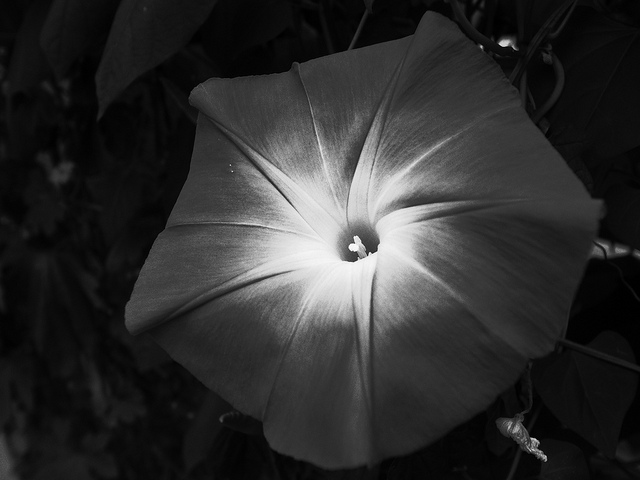
Morning glory

Morning glory. Toshiyuki IMAICC BY-SA

 In the half-light

the barest fog

wisps about the trees

silhouetted against

a colorless sky.

The stars have gone.

Stillness but not silence

just the faintest thrum

of summer symphony

by insects of the night.

The last long encore.

Cool expectant breath

of the dawn

before day is fully awake

like the rooster nearby

with his rusty, lusty cry.

Circadian rhythm. All is well, is well.

I stand

under the haloed half-moon

drinking in the glory

of life

 even in its transitions.

Even in

farewell, farewell, farewell.

A fine mess

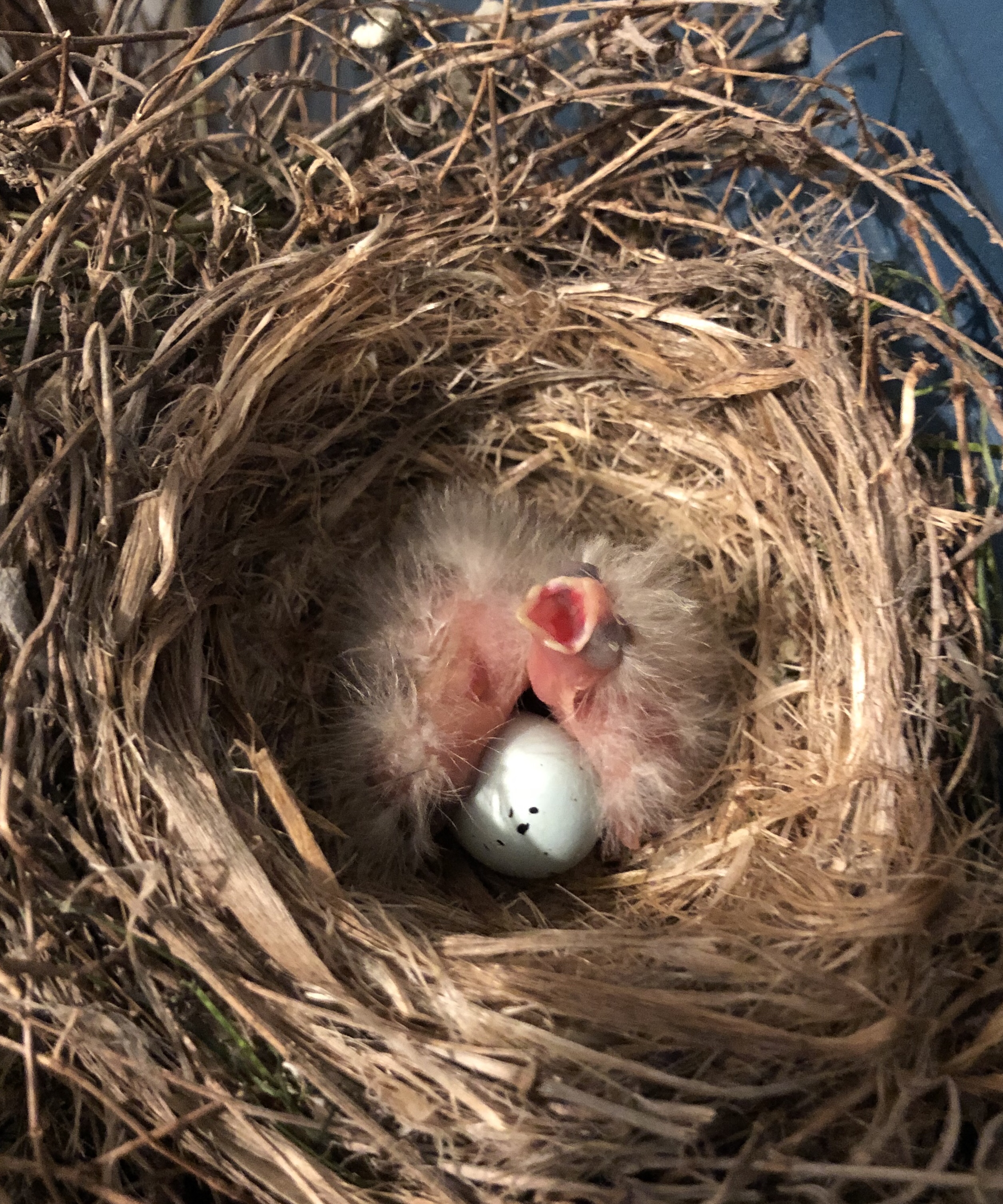
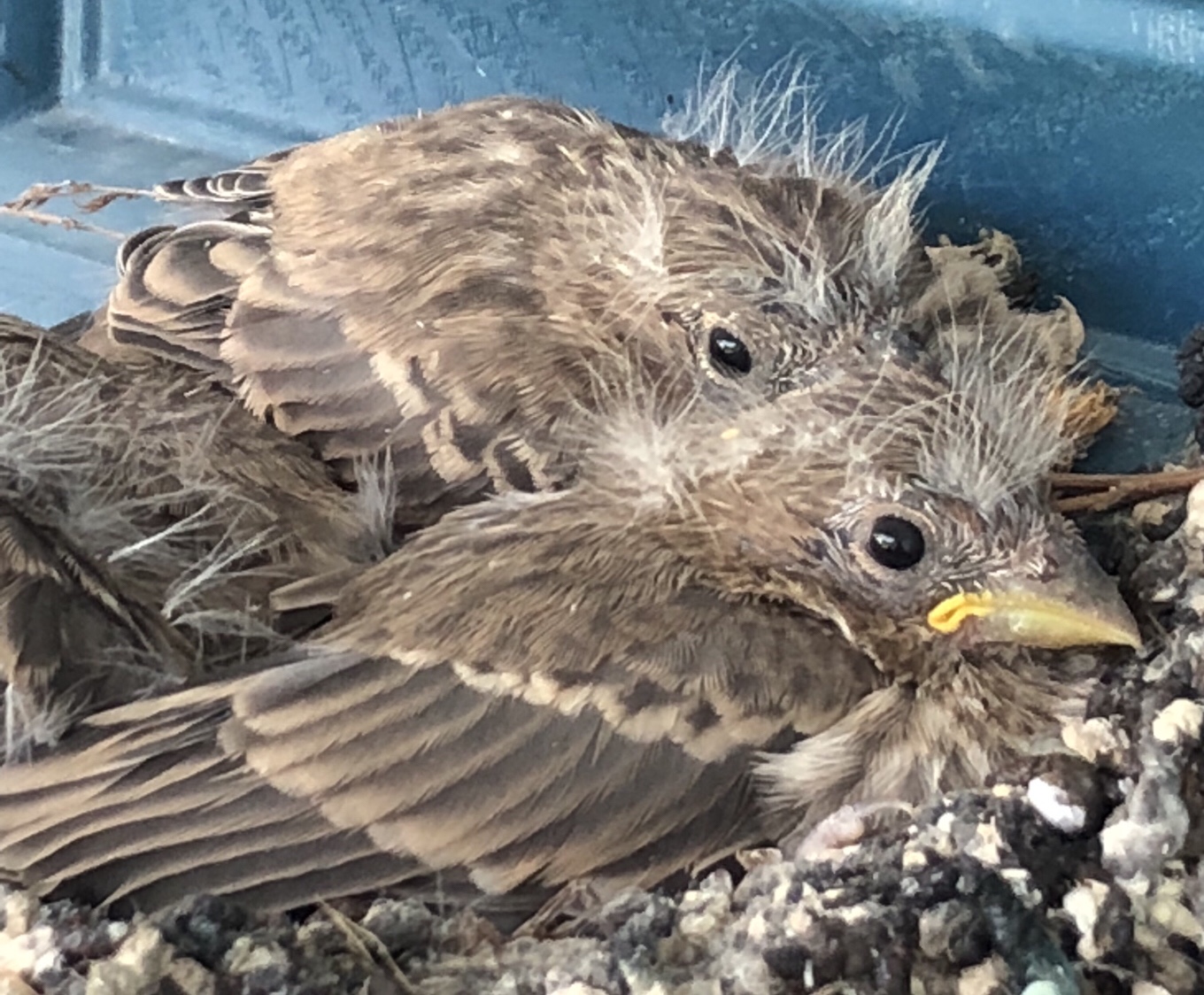
After being away on vacation all last week, my first order of business on returning home was to check on the four baby house finches that hatched in the wreath on my front door. I’d been chronicling their development daily, so I knew many changes would occur in my absence.

Here is what I discovered:

1) The babies are now well-feathered; their skin-head mohawks have become mere wisps upon their downy crowns.

2) Two of the babies can fly. They sailed out of the nest this morning as I approached. The other two stayed put, their bright little eyes regarding me with a mixture of curiosity and apprehension.

3) Their nest is one spectacular conglomeration of droppings.

To be fair, the droppings are only around the rim; the mother collects them there. What a job, building a wall of excrement. Worse than diapers. When I first wrote of the perfect, flower-graced nest, the pale blue eggs, the hatching of the tiny pink nestlings, I concentrated on the beauty and wonder of life. I pointed out that the collective noun for a group of finches is a charm.

And charmed I was.

There is nothing charming about that nest now.

The fledglings themselves, of course, are enchanting. They’ll soon be gone, the circle of life will go on, and all that will remain of these magical moments is a monumental mess.

But that’s the story of life. It’s messy. It can’t be comprised solely of breathtaking beauty and newness; if it were, we could not recognize these moments for what they are. They’d lose their value. Only when contrasted with ugliness, hardships, and pain can we see and cherish the beautiful when it comes. We inevitably deal with messes, some that occur naturally, some created by others, some of our own making. Therein lie all the stories . . .

Which makes me think of writing. This nest is a tangible (although I do not wish to touch it) reminder of these commonalities:

-Life is messy.

-Writing is messy.

-Thinking is messy.

-Teaching is messy.

To do any of these well, we have to be willing to accept and even embrace the messiness. We must certainly persevere through it to arrive at the beautiful. It takes courage, stamina, and a lot of hard work, to write well, to think well, to teach well, to live well.

The strength to do so, I believe, lies in believing that the beautiful will come. It’s all a matter of trust, of faith. And pressing on.

Although I was appalled by the quantity of accumulated—um, bird-doo—around the nest, I was also amazed that two of my four little finches could fly. Last night they couldn’t; today they can. Tomorrow the others might.

This is a message to me about readiness.

Everyone arrives as a writer, a thinker, a teacher, a good practitioner of life, in their own time. Lots of messes will be made along the way. Sorting this out is what grows us. One by one, as children, as adults, as long as we live, we are continually growing the necessary wings to fly beyond where we are. And it’s truly a collective, collaborative growth; we are to nudge each other when needed, but not too hard, too soon. We’re not to hold back, to hold one another back, simply because we cannot see all that lies ahead and for fear of navigating the unknown. Knowledge comes by trying. By experiencing. By taking risks. There’s an implicit difference between throwing caution to the wind and taking a leap of faith, that being potential self-destruction versus healthy maturation. These finches know. As the day wears on, I watch the two fledglings that can fly going back and forth from the eaves to the nest, coaching their other two siblings on how to do it. See see see, I hear them cheeping. A bit at a time, a bit at a time. At any moment, those last two are going to get up on that nasty, messy rim and let go.

In more ways than one . . . .

So you make a mess. So what? So you’re alive and growing.

Tomorrow you stretch your newest feathers and find you can move on.

To where the beautiful awaits.