Artifact

img_5055

Sometimes I think about the writing process more than I do about what to write. Like the origin of ideas, how the barest glimmering can turn into something substantial and take unforeseen shapes altogether during the writing. A breath of a thing becomes a breathing thing—for inspiration means to breathe in, to breathe life into. When I start writing my glimmer or breath of an idea, as it grows, shifts, and takes on a life of its own, it draws other things to it. When people say, “I don’t know how you manage to see these connections and string them together this way,” all I can say in response is, in the end, all things are connected. If you follow the glimmering threads far enough . . . .

Such was the case in my summer writing workshop for teachers. My co-facilitator asked fellow teacher-writers to bring a personal history artifact, something that holds a story about who we are or about a significant time in our lives.

My “default” artifact is a locket that belonged to my grandmother; her uncle gave it to her in 1930 when she was fifteen. She gave it to me when I was fifteen.

But I’ve already written about that: The locket.

I had trouble choosing another artifact. Why should it be so hard? We’re surrounded by pieces of our personal histories in every room in our homes, in our workplaces, even in our cars, sometimes . . . .

A thought hovered: There’s the cross necklace Daddy gave me at Grannie’s funeral. 

Nearly twenty years old, it still glitters like new, and there’s plenty of symbolism and story wrapped around it, for my father didn’t often give gifts, nor was he expressively religious except for a keen interest in eschatology. That he should give the necklace to me on that occasion (Grannie wasn’t his mother but his mother-in-law) is especially poignant.

I ought to write about that . . . yet, I hesitated.

I know! All those pictures I just had developed—if anything’s personal history, that is! Some years ago I’d gathered all my used rolls of camera film, placed them in a giant Ziploc bag, and promptly forgot about them. I’d finally remembered and had the photos developed (do you know how hard it is now to find a local place that will do this with same or next day service?). In these images, many loved ones who are gone smile at me afresh from decades past. Layer upon layer of stories to tell . . . .

Yes, this is an unusual sort of artifact . . . I definitely need to write about this.

The thing—the idea—certainly had a breath, a glimmer.

But it didn’t seem to be quite ready. I got the feeling that it didn’t want to be written about just yet.

I decided to take both, Daddy’s cross necklace and the old newly-printed photos, and as I prepared to leave the house that morning, another image glimmered in my mind. Rather brightly.

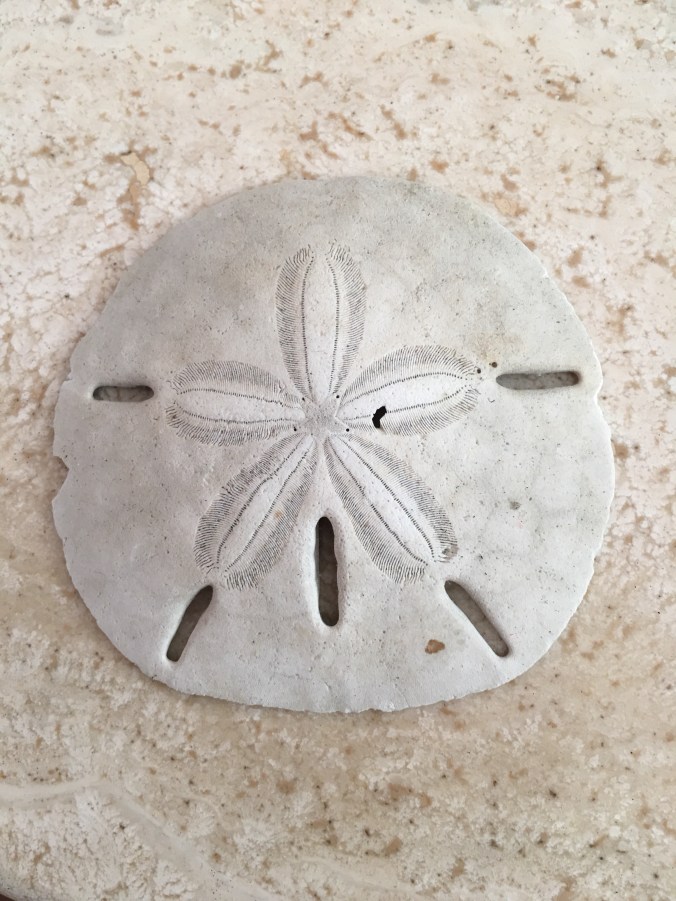
A sand dollar.

I have a few that I found years ago, and while I find them beautiful and compelling, I didn’t really think a sand dollar would be an artifact especially representative of my personal history. But . . . as the glimmering was suddenly there and I’ve learned not to question but to trust . . . I fetched the largest sand dollar, packed it carefully in a box with tissue paper, and took it with me to the workshop.

Guess which artifact I ended up writing about.

Of course.

I found this sand dollar on the beach when walking in the last weeks before my first son was born. There’d been a storm. The sand was still damp, the beach littered with seaweed and shell debris. The sand dollar, however, was whole, which is rare—they’re fragile and I’d never found any here before.

I don’t know why it drew me, just this morning, as a special artifact. It wasn’t something given to me, like Grandma’s locket or Daddy’s cross.

But maybe it was given, from beyond . . . .

I’ve just now recalled that, when I was born, my grandfather gave me twenty silver dollars. He did the same for all of the successive grandchildren. Sand dollar, silver dollar. Wealth of the sea, wealth of the earth. Gifts. Celebration. The coming of children, the next generation, the endowment of hopes and good wishes of those who’ve walked before. Like my younger self on the beach, I am walking the path of generations, I am the bridge between the past and the future. The sand dollar I have in my hand is really a skeleton. It was once a living creature. It’s symbolic of faith and strength despite its fragility and it comes from the ocean, which symbolizes life, continuity . . . .

It occurs to me now that the sand dollar is connected to the other artifacts I considered writing about, Daddy’s cross necklace, given to me unexpectedly at Grannie’s funeral, and the pictures from the old film I just found and had printed. All together they say: These are your life-pieces that endure; you will endure. Oh and I almost forgot that I just had my DNA tested. When I got the results, I marveled at the migratory history of my ancient ancestors, the story of their survival. I hadn’t expected the rush of profound gratitude to all of them for living, that I might be here now. I am here, whole, because they were here. I carry pieces of them within me. 

I found this sand dollar, the skeleton of a living thing, on the beach while walking after a storm, while carrying my firstborn. I walk the path of generations.

We go on.

My co-facilitator’s voice gently broke the hush in the room, we teacher-writers having been immersed in our thoughts, our words, recording on paper:

“Now, how can your artifact drive your teaching of writing?”

I wrote:

My sand dollar can drive my teaching of writing in so many ways. It’s a metaphor for writing:

-Just start walking. Like I did on the beach. Just start writing,

-Until you’re walking, you don’t know what you’ll find.

You’ll have surprises. Rare things will come, if you keep at it.

These gifts are waiting, meant just for you.

I looked at the sand dollar and I know, if it could look back at me, it would have winked.
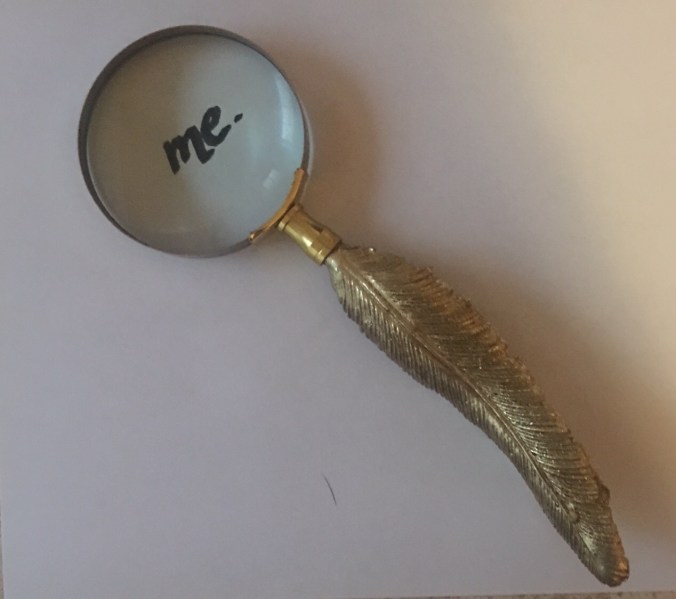
Seeing me

img_4994

Come back to examine this image after you read: In how many ways does it represent the information in this post? 

The big question on Day Three of our Teacher Summer Writing Institute: How do I see myself as a teacher of writing—no matter my grade level or content area? 

The day became a collage of images and symbolism.

Teachers were tasked with using postcards and personal artifacts as metaphors for teaching writing. They used these ideas as springboards into poetry and a means of writing to inform.

Then came the birds.

It began with the fact that 2018 is the Year of the Bird. The National Audubon Society and National Geographic, among other organizations, made this designation to honor the centennial of the Migratory Treaty Act, the most powerful and important bird-protection law ever passed. My co-facilitator posed this question: How do birds inform us? Group answers: They indicate coming changes in the weather, or the quality of the air. Their migration patterns have changed because the climate has changed; the birds are getting confused. That’s a reflection of society and the world, don’t you think? This segued into an activity called “Everyone Has a Bird Story.” For just a couple of minutes, teachers were challenged with a quick write about a bird (everyone really DOES have a bird story of some kind). The teachers gathered in a circle afterward, each reading one line aloud from his or her story, to compose a group bird poem. The effect was funny, strange, and beautiful. The closing question: How might we use this activity to inform student writers?  Answers: It’s a visual way to show students about organization and revision. Students can actually move around so that their poem makes more sense,  or to attain better flow. You can use this activity to physically show students how to group like ideas. It’s an easy way to show students that writing is fun. 

Just as the group broke for lunch, two birds—doves, to be exact—crashed into the windows of our meeting room. Generating both awe and alarm, they hovered, wings flapping, knocking against the glass as if seeking a way inside. A couple of us ran out to guide them away before the birds injured themselves.

Birds, ancient symbols of freedom and perspective, the human soul pursuing higher knowledge, the dove especially representative of peace, love, gentleness, harmony, balance, relationships, appearing at this gathering of teacher-writers as if invoked . . . so much to analyze there, metaphorically . . . .

Following lunch, the group spent time exploring abiding images. These are images that stay with us in our memories (and sometimes in our dreams); they usually have deeper meanings and significance than are obvious at first. One of mine, shared as an example: long, skinny, flesh-colored worms with triangular heads that my grandfather and I encountered when I was a child. He didn’t know what they were (land planarians, I’ve learned), we never saw them again,  and neither of us could have guessed what they have the power to do. They just resurfaced in memory recently; I had to figure out why. Here’s the story of that experience, if you’d like to read it: First do no harm.

Participants were then invited to take virtual journeys in their minds to capture the specific sights, sounds, smells of their favorite places. Others went outdoors to capture the same (see Abiding images for my original experience with this). Whether the journey was real or virtual, everyone encountered something unexpected or fascinating —something so representative of writing itself. The point of collecting abiding images is the intensity of focus, the close examination and capturing of the smallest detail, which might be used later in writing vivid scenes and settings that are necessary in both fiction and nonfiction, as well as for metaphor in poetry. Writers communicate information to readers through images. Teachers must be able to test and try ideas and creative processes—this is called birdwalking—through things like abiding images to inform their teaching and to communicate information to students.

And to write.

At this point teachers could rotate through any or all of three breakouts: Minilessons and content area writing, where they discussed ways to incorporate their new learning to grow student writers, or continuing to work on their own writing with the option of conferring with a facilitator, if desired.

As this vibrant day on writing to inform and “How do I see myself as a teacher of writing?” came to a close, my co-facilitators and I received the most welcome information from our fellow educators who span grades K-12 and all content areas, including ESL and AIG: These have been the most helpful sessions—I have learned so much about writing. There’s so much I want to try with my students! I am excited! How can I find more workshops like this? With most professional development, I am tired before lunch, and the afternoon is a long haul, but with these I go to lunch energized and can’t wait for the afternoon! The breakout sessions, where we choose to work on what we want to, are exactly what we need. Don’t change anything; just keep it coming!

That is like music—or shall I say birdsong?—to our ears.


The hallway

Hallway

Hallway. DSC_003. ColinCC-BY

A large part of my job involves helping teachers and students grow as writers. I often define writing workshop as an artist’s studio, a place with time to fall in love with the craft of writing.

As I consider my own writing experiences, the image of a hallway forms in my mind. I am actually in this hallway. I can see numerous doors, one of which stands partially open, and through it I can see a window, and beyond that, trees, bright in the golden light of afternoon, probably in late spring or early summer. The branches sway in a breeze, making the leaves dance and beckon, but there is no sound, not from this vantage point. I would have to go through the door and open the window, probably, to hear the rustling, the insects, the birds, to feel the sun’s warmth and taste the laziness of a free afternoon – if, in fact, the afternoon is lazy and free, as it seems to be from where I stand.

Other doors are closed, and knowing that I can open any of my choosing sends a compelling shiver through me – each door leads to a different place, experience, and story. They are all mine to explore, at my leisure. I will never know what’s behind the doors unless I go and open them. Some lead to the past – when I walk through, I can see my family, some of whom are gone now but alive and remarkably young in this place.  They don’t seem to mind at all when I come – in fact, they seem to welcome my visit the same as they always did. If I go farther, I see old friends, classmates, even people I didn’t know well but who are somehow connected to an idea, a moment in time when I learned something or realized that something mattered. My childhood dogs bounce up at the makeshift gate between the kitchen and the living room in their typical greeting; I smell cigarette smoke, the old Kirby vacuum cleaner, the old worn rug; fried chicken also lingers in the air. But I do not want to stay and wander like a ghost here in my childhood home. I can come back another time, anytime I like.

Behind other doors are chairs where I rocked my babies. Here I sit with their soft warmth in my arms, their fuzzy heads nestled against my neck. I feel them breathing, slow, easy, contented in their slumber. I can stay here a while and just be, just rocking, holding one boy for a long time and then the other. I can see them when they are a little older, one always chipper and friendly, the other absorbed in his own thoughts, spending hours lining up his Hot Wheels or taking things apart to put them back together. They are safe and well in this place, so I will leave them here, after I kiss their satin-soft cheeks once more and tell them that I will always love them.

Other doors, I suspect, lead to worlds that I can still create, both real and imagined. I can only see so far in the future; only some things are certain and I will alternately face them and embrace them as they come. I could linger far too long in the imagined worlds, just to see what will happen, to discover the secrets and the magic, knowing all is of it is at my command.

I am surprised by the door that opens straight into the natural world. I have discovered this about myself, that the workings of nature have a strong pull for me. Some of the discoveries are breathtaking, like the iridescence of a dragonfly’s body, the precise blue and orange painted pattern down a caterpillar’s back, the powerfully sweet fragrance of a gardenia, of honeysuckle, and the tiny war-plane drone of a hummingbird’s wings. Others discoveries are not nearly as pleasant – a horseshoe crab decaying on the beach, a tobacco worm (a non-native North Carolina neighbor recoils in horror – “Is that a dragon?“) crawling on my porch rail, a scar on the wood trim by the roof where lightning struck the house. Not pleasant, but fascinating all the same. I had no idea until I started writing that nature spoke so much to me – just now, as I capture these words, the sun bursts forth from behind the clouds beyond my bay window, shining on the laptop and my hands as I type, like a validation, an invocation.

Other doors lead to mysterious places like cemeteries, where time is irrelevant. I don’t know these people, but I look at the stones, the names, the dates; I read the poems on the older, eroding ones, and I want to know: Who were you? What were you like? What was your life like, what did you love, and how did you die? What’s your story?

The most curious thing of all about this silent hallway is that whichever door I open, in whatever order, wherever I go and however far or for however long, I find myself there. Myself as I was, as I am, as I will be.

I give myself a nod.

And I write.


Flipover

Error
This video doesn’t exist


This is Kicker, a goldfish given to my soccer coach son by one of his teams.

Kicker is not well, as you can see. In fact, we thought Kicker had kicked the bucket, but then we noticed a little fin and mouth movement.

After watching the tiny creature floating helplessly on its side for a morning, I wondered: Can this be fixed? Can poor Kicker be helped?

An Internet search on “floating goldfish” reveals that goldfish are susceptible to a disease called swim bladder disorder or flipover, frequently caused by overeating. The swim bladder is what gives the fish its buoyancy; it cannot function properly if other organs are swollen and pressing on it. This essentially paralyzes the fish.

Kicker has been flipped like this for three days. My thought now: How much longer can this little fish last?

And, being an educator and a writer, I cannot keep from seeing deeper meanings, metaphors, analogies.

I’ve often said that teachers are becoming paralyzed with regulations – too much, too many, suppressing the natural artistry and creativity that comprise great teaching. Expectations are needed, certainly, but when so many are placed on schools, on teachers – on students – what happens to freedom of movement and growth? How many teachers feel like Kicker, floating helplessly near the surface, unable to do anything about it?

In turn, how many students feel that way?

Is there a remedy?

For Kicker, there may be.

Green peas.

Yes, really. My search tells me that feeding cooked, skinned green peas to a fish affected with swim bladder disorder often alleviates the condition. The experts say not to feed the fish for three days after the onset and then to try the peas.

I gave it a shot. It’s very hard, by the way, to get food in the mouth of a fish that can’t swim. But Kicker fluttered his fins and opened his mouth, clearly trying his best.

Kicker seems to be a little livelier this morning – he’s always greeted us, wagging his whole body just like a dog, whenever we approach the tank. Today he’s twisting a bit more, fluttering his fins and tail excitedly. He even gyrated himself all the way over, a complete 360. He’s still not very mobile or upright yet – but I see better movement, and I am hopeful.

Back to teachers, to students: What’s the remedy to glutted systems?

Certainly not adding more. Green peas won’t cut it here – if only they could! – but perhaps they hold a metaphorical answer. Perhaps the answer lies in boiling away, skinning back, getting to the inside part, the valuable part, the part that matters most. Education is not something to be done to children any more than professional development should be done to teachers; growth and learning come from a place of inspiration, desiring to know more and having authentic opportunities to explore, to ask “How can we make this happen?” or the greatest learning question of all time: “What if …?” It all comes from tapping what’s within, not from exterior layers upon layers, causing figurative flipover.

Goals and standards are necessary. They can be met, exceeded, in fact, with inspiration, creativity, and freedom – these lie at the heart of educational wellness.

Our survival depends on it.


If you’d like to read Part Two of Kicker’s saga: Fintervention

slice-of-life_individual


The coaching tree

Coaching Tree Lg

Early in the school year, my instructional coaching colleagues and I attended district training where participants were tasked with creating an image to explain the coaching process.

My group thought for a moment.

“You know, coaching is an organic thing,” I said. “Or at least it should be. We all know it takes time to develop relationships and trust. It’s about honing practices, sure, but this is a growth process for us as well as for our teachers. We grow together to reach goals.”

A colleague said, “Yes! I’m seeing a tree, branching out . . . .”

In a few minutes we’d sketched the tree. We began to label it, recognizing coaching elements that correlated to parts of the tree. The more we worked, the faster the ideas came.

Relationships are key in coaching, the foundation, but certain things must feed the relationships before the process can begin. These roots are trust, the human connection, listening, collegiality, safety, empathy, and support. Coaches must meet teachers where they are and be willing to plug in with what teachers want to accomplish – it’s not as much about seeing the work as it is seeing a fellow human being. The vision develops from there, and needs to be a shared one.

The trunk of the tree symbolizes this togetherness with inspiration from Shel Silverstein’s The Giving Tree. Near the bottom of our tree, we placed a little heart: Coach + You. The heart of coaching is just that – having a heart for each other.

A solid, thriving coaching relationship branches out into nearly endless possibilities, aspirations, and directions, such as goals, the 4 Cs (communication, creativity, critical thinking, collaboration), encouragement, self-modifying learners, reflection, growth mindset and learner agency.

My coaching colleagues and I stood looking at our work, feeling pretty happy with our Coaching Tree.

“We need to put the sun in,” said a colleague. “The sun is the climate, of course – a warm climate conducive to coaching is necessary for the process to work. That’s where administration comes in.”

We put the sun in.

At this point, something struck me – “Trees bear fruit! What is the ultimate goal of coaching, the payoff? What’s the fruit of our labor?”

We created a basket then, and labeled it The fruit of our combined efforts. It holds apples: Love of learning, data, increased student achievement, teacher fulfillment, students graduating college or career ready. 

As teachers are fulfilled and productive, we desire to branch out into new areas. The growth continues. As students achieve, as they go on with their lives, some will go into the teaching field and the cycle begins anew.

At the close of the training, small groups presented their work to the whole assembly of coaches. The other groups had designed diagrams, cycles, or flow charts, all of which artistically, appropriately encapsulated the continuous reflective coaching cycle of support.

My group was the only one to present the coaching process as a living thing, something organic.

We were startled by the enthusiastic applause from our fellow coaches.

Upon returning to school, my colleagues and I recreated the Coaching Tree in the teachers’ lounge. It stands there to encourage, invite, celebrate, and maybe inspire or spark hope when we all need it, a visual reminder that our work is not in vain, that we’re in this together, to help each other along, and the sky is the limit.

slice-of-life_individualEarly Morning Slicer

Open a book and dance

dance-metaphor

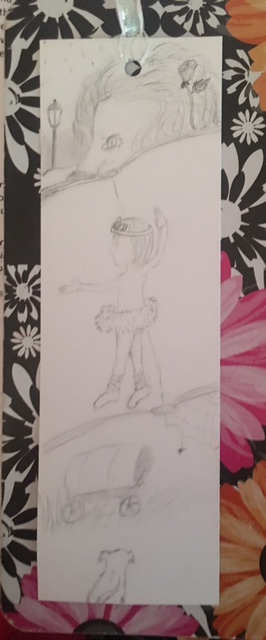
During a recent study of Who’s Doing the Work? How to Say Less So Readers Can Do More (Burkins and Yaris, 2016), the facilitator encouraged participants to jot notes or sketch on blank bookmarks as reflections of our learning.

Throughout the book, the authors use dance lessons as a metaphor for how learning to read works. As aspiring dancers watch proficient ones with a desire to emulate them, to navigating increasingly challenging choreography, so young readers develop skills along with a desire to read for the sake of it. My chapter was “Independent Reading: Learning to Love to Read,” in which independent reading is compared to a dance recital. Students have practiced and the teacher watches from the wings, not interfering when there are missteps, but “noting ways to fine-tune the their next performance.” The line that struck me most: “Most important, teachers let students read, allowing them the glorious luxury of falling in love with books.”

That got me thinking about my early reading life and the hand that teachers played in it.

In fourth grade, my teacher began the year by reading Charlotte’s Web to the class. Naturally we wept at the death of Charlotte (don’t we all, still?). I was so captivated by the story that I bought a copy at the book fair, to reread it to my heart’s content. This teacher knew what she was doing: she ended the year by reading Old Yeller aloud to outright sobbing from the class. I had to read the book again on my own, to grapple further with Travis’s extraordinary courage and the horror of the decision he had to make after that old yellow dog had saved his life. Old Yeller was outdone only by my own discovery of Where the Red Fern Grows in the school library – I cried every day for weeks after that one. I remain eternally grateful to Mrs. Cooley for hooking me with the power of story.

My fifth-grade teacher suggested that I read the Little House series. I loved Laura so much that I sometimes wore my long brown hair in braids and had my mother make sunbonnets for me (to wear at home, not to school). Laura was real. She wasn’t perfect and she knew it; I admired her backbone and the way she faced challenges. I also loved going back in time, reveling in Laura’s descriptions of the natural world and everyday life long ago. There’s such poignancy in the line “Now is now. It can never be a long time ago” (Little House in the Big Woods). As a child I pondered that line, knowing the story took place over a hundred years in the past – then realized that, in the pages of a book, time is preserved, all that happened is still unfolding, those who are gone still live. In the pages of an engrossing book, at least, now is now. How wise my teacher was, guiding me to books that would make reading part of my everyday life.

I was given lots of opportunity to explore books in the sixth grade. That year I was scouring the school library shelves for titles I hadn’t already read when I encountered an especially intriguing one: The Lion, the Witch and the Wardrobe.  “Sounds interesting,” I thought, taking it from the shelf, never suspecting what a defining life moment this would be. When I opened the cover, the magic poured out and pulled me in; I devoured every one of the Narnia Chronicles with an insatiable hunger. I loved them for the beauty of the setting, for their Britishness, for the author’s gift of turning a phrase and his humor, and most of all, for the hope they contain. I was encouraged to reenact scenes from the book for my classmates: I roped a friend into portraying Jadis while I dressed up as Aslan, complete with mane and tail. It’s the old good vs. evil theme, resurfacing many times throughout one’s academic and life experiences.

The influence and insight of my  of my teachers, along with the freedoms they gave me, had much to do with the reader I am, with person I am, today. They provided me the “glorious luxury of falling in love with books” – as you can see in the bookmark above, my tribute to them. I was never much of a real dancer, but metaphorically speaking – as a reader – I dance each day with wild abandon and absolute joy.

Reflect: Who helped you fall in love with reading? Write about this experience – and if these people are still living, write to thank them for their great gift to you. If you teach: How can you better provide “the glorious luxury of falling in love with books” for your students?

The secret gates

ditch-gate

Into the ditch. jam343 CC BY

When I was a child, my neighborhood flooded regularly.

I lived on a block where all the backyards joined at a long ditch. When I went to play with a friend, I took a shortcut by running alongside the ditch and jumping over it, taking care not to land in it, for the ditch was lined with thick, black mud; if it did not stink outright, it certainly smelled organic, stagnant. Sometimes fleabane, tiny, hairy daisies, grew along the banks. That’s about it for ditch decor.

Whenever a heavy rain came – and a few times during a moderate rain – the ditch overflowed. Storm drains in the curbs overflowed as well, until water covered the streets and most of the yards. My friends and I had fun wading through it as we walked home from school, sloshing as much as we could.

My father, however, was irate every time.

As soon as he saw the water backing up, he got the city on the phone.

“Listen, I’ve called before,” he’d snap at the City Official on the receiving end. “You ought to have a record of it. This whole neighborhood is flooded AGAIN. Get whoever is paid to do it to open those drainage gates.”

Every time, the City Official pleaded ignorance about said gates.

I watched Daddy’s florid face redden. “You people always act like you don’t know what I’m talking about, but I am telling you, there are flood gates controlled by a switch and somebody up there knows how to use it. There’s NO EXCUSE for a place to flood like this. Open the gates!” He glanced through the picture window in the living room. “A canoe is going down my street right now. So help me, I will get in it, come down there, and find that switch myself.”

A canoe was going down our street, neighbors having dragged out their camping stuff, rowing merrily along. A teenage boy in waders, hip-deep in the water, pulled younger siblings on a raft behind him. To my horror, one young neighbor tossed a puppy from the front steps out into the water to make sure it could swim. It could; that the puppy swam back to its owner amazed me.

Daddy’s voice got louder, his face redder, until he hung the phone up in disgust, but within an hour of his call, the flood began to diminish.

As the water level went down, so did the color in Daddy’s face. In his eyes was a glint of victory, or perhaps vindication. The City Officials had, yet again, scrambled to open the secret gates they kept forgetting about. Good thing they had my dad to remind them.

Did the gates actually exist? Did they lead to the nearby river, or where? I never knew for sure, but the timing between my father’s phone calls and the floodwaters receding is intriguing, suggesting more than a fluke.

Our regular neighborhood floods were mild annoyances in comparison to the devastation experienced by anyone whose home has been lost or whose life has been endangered. The forces of nature are beyond human control, despite the best of foresight and man-made safeguards. On a small scale, my father did what was within his power to change a situation. One voice, persisting. Today I think of the labyrinthine educational system, of American politics, the overwhelming need for change when so much is at stake, and those who are suffering. What are the gates to clearing the way, and where lies the switch? Change is a force within human control. As Anne of Green Gables author Lucy Maud Montgomery penned: “All things great are wound up with all things little.”

Believe, be the voice, reclaim what is of value, before it is lost.

Reflect:  Water is a symbol of life, as well as adaptability, healing, and cleansing. When things become overwhelming, one of these might well be a switch to seek. Which might be yours? How might you help others?


A poem of friendship

Through clouds of gray will softly shine

a gentle silver tear of mine,

leaving lines to slowly trace

an empty soul, a lonely place.

A golden glow you gave to me

to help me through eternity –

light and warmth with which I try

your own sweet rains to somehow dry.

And we two have learned to see

the me in you, the you in me.

A golden ray through a silver drop

create such colors; they cannot stop.

What blazing brilliance we have sown,

this iridescence of our own!

Combine our souls and we will show

our strength lies in our rainbow.

-Written when I was fourteen. The UK’s National Poetry Day brought this early effort back to mind.

Reflect:  What metaphor captures the beauty and power of your dearest friendship?