Just some fleeting impressions while sweeping my porch …the beauty of the day in such stark contrast to what’s happening in the world …
While sweeping the porch this April day
there’s children at distant play
laughing, falling
voices calling
lawnmowers mowing
cool breeze blowing
flowers quivering
trees shivering
sun shining
life divining.
Joyous birdsong
like nothing’s wrong
as if only rebirth
sweeps the Earth
not humanity hurled
netherworld.
A spring reception
of such deception.
Beautiful day, you’re almost cruel
playing such an April fool.
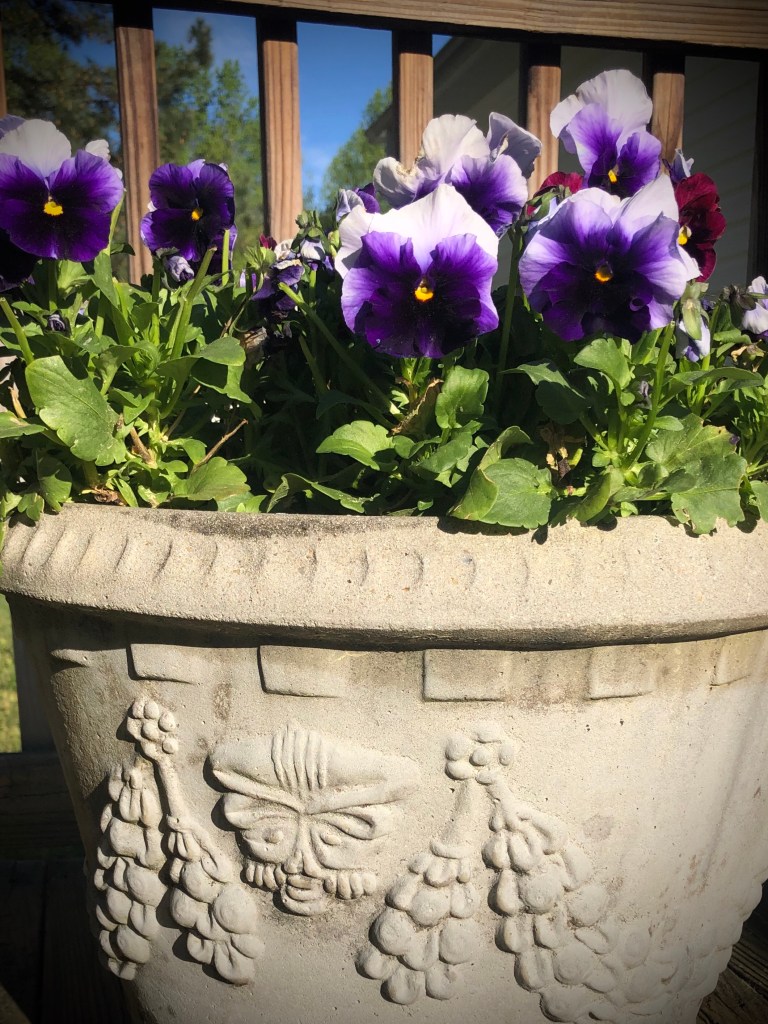
If you were here with me you could see these pansies quivering despite the brightness of the morning. The name of this colorful, dark-eyed flower comes from French penser, “to think.” Pansies symbolize contemplation and remembrance.
Today I write with a group of friends for Spiritual Journey Thursday.
The word restore has been on my mind these days. More or less as a question: When will society, the economy, the country, the health of the globe be restored to pre-COVID-19 conditions? And what will that restoration look like? How changed or different will everything be?
I think on this a lot, as is there is a lot of time to think.
Naturally a well-known line from the Psalms also comes to mind: He restores my soul. It speaks of peace and confidence, of a daily trust. I watch the news, the frenzy of those in the medical profession, pleading on behalf of us all; the government having to count the cost of a shut-down economy as weighed against the life and well-being of its citizens; and everyone worried about having enough resources for coping. They’re all waging a mighty battle against an insatiable, tenacious, invisible pathogen.
While the rest of us watch from a distance, sheltered. Protected. Trusting that the decisions made for us will preserve us, restore us.
We wait in the stillness.
It brings the preceding line of Psalm 23 to mind: He leads me beside still waters.
I could make an analogy of a stormy, violent sea for the government, the medical field, and the stock market, in contrast to the majority of us waiting at home, by the still waters … but a story resurfaced in my memory instead.
Long ago, when I was about seven, I attended a church service where an older girl was baptized. She was perhaps twelve or so, a sweet and affectionate girl well-known and loved by the congregation. It was an exciting morning for the church … except that as this girl entered the baptistry, she was sobbing.
“I can’t do it,” she bawled. ” I can’t …”
Abject terror.
Even as a seven-year-old, I knew she’d chosen to be baptized. She’d walked the aisle some weeks before and professed her faith. I knew the pastor made new members, including children, attend a series of classes to understand the tenets of the faith and the ordnance of baptism. I didn’t understand it all myself, not yet, but I knew this girl, garbed in a white robe, hovering at the steps leading down into the water, crying, wanted to act on her faith. I’d never seen anyone react this way to being baptized: Why’s she so scared?
I look back now and wonder: Was she simply afraid of water? Had she never gone swimming in a pool, as I had?
The water wasn’t deep. It wasn’t cold; it was heated to be comfortably warm. It wasn’t waves crashing on the shore, no dangerous undertow, just clear, still water.
Our pastor, a humble, middle-aged man, a former Navy pilot in WWII and a Bible scholar, stood in his own robe of white at the center of the baptistry. He reached out his hand: “It’s all right, Dear Heart. See, I’m here. It’s safe. You know I’m going to hold onto you.” When she stayed rooted to the steps, clinging to the hidden rail, our pastor waded over, put his arm around her, and led her into the pool.
He held her for a moment. We heard him whisper: “Are you ready?”
Loud sobs, but a nod of her little head.
He raised his hand heavenward:
“I baptize you, little sister, in the name of the Father, the Son, and the Holy Spirit …”
Whoosh.
She went under and just as quickly, he raised her back up.
“I DID IT!” she shouted, hair plastered to her head, wet face shining. “I DID IT!”
If ever there was a vision of radiant joy, that’s it.
The entire congregation wept, even seven-year-old me.
The tears return even now, remembering.
He leads me beside still waters. Sometimes through still waters. When we cannot see the bottom. When we’d really rather not descend into them, when we don’t want to get wet at all, when we fear not so much immersion but submersion: How long will we be under? Can we last?
He restores my soul. It is a matter of trust that, somehow, all will be well, that we will be raised back up, we will be led safely through.
For now, we wait in the stillness like water lilies … which, in the Tamil poetic tradition, happens to symbolize the grief of separation.
On the placid surface
rest the blooms
in waters still.
Their unseen roots
anchor them
to the earth
far below.
And so we float
suspended
separate
waiting
enduring
this strange baptism
yet anchored
to one another
by unseen roots
while time stands still.
Today, in my mind, in my heart, the word restore echoes over and over and over like a prayer.
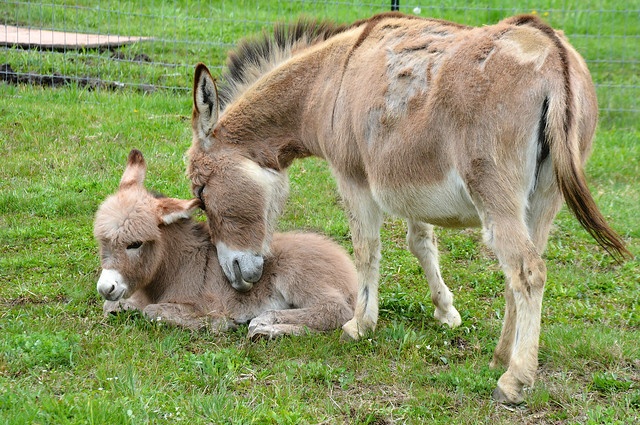
“Jerusalem” donkeys live in a pasture near my home. They are so named for the cross formed by black stripes across their shoulders and down their backs. The donkey is a symbol of peace, for they are peaceable creatures, although farmers know they will protect livestock by driving away coyotes.
The donkey currently plays a significant role around the world with the observance of Palm Sunday and Holy Week. The Gospels of Matthew and John both proclaim the fulfilling of Zechariah’s prophecy that the Messiah would come to Jerusalem humbly, riding the foal, or colt, of a donkey. In Mark and Luke, Jesus directs his disciples to a colt “on which no one has yet sat.” Only Matthew records that the unbroken colt doesn’t come on this mission alone: Its mother walks alongside as it carries Jesus through the shouting crowds in the streets of Jerusalem.
It is the image of the mother walking beside her colt—her child—as a calming presence amid chaos, as a needed coach in fulfilling the sacred duty, that suddenly pierced my heart and inspired today’s post.
Q: What’s a fun way to engage families in English Language Arts activities with their children?
A: Have a Literacy Lunch!
Every year, families look forward to Literacy Lunch at our school. It’s one of our best-attended events.
Our theme this year, “Come SWiRL with Me,” centered on the facets or domains of language: Speak, Write, Read, Listen (we added the “i” to the SWRL acronym to make a real word), as speaking, writing, reading, and listening comprise the ELA standards and language skills needed across all disciplines.
So, grade levels came up with activities that encompassed all elements of SWRL. Some included poetry, in recognition of National Poetry Month.
First graders wrote spring poems with families, to read aloud. Second graders wrote “I wish” poems.
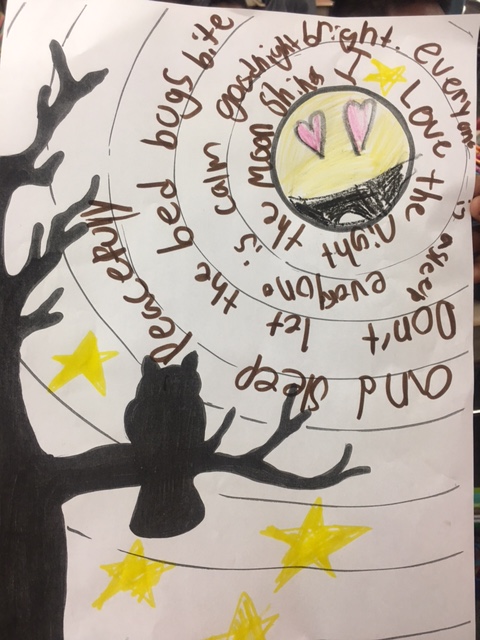
Fourth graders composed “swirl” poems with families.
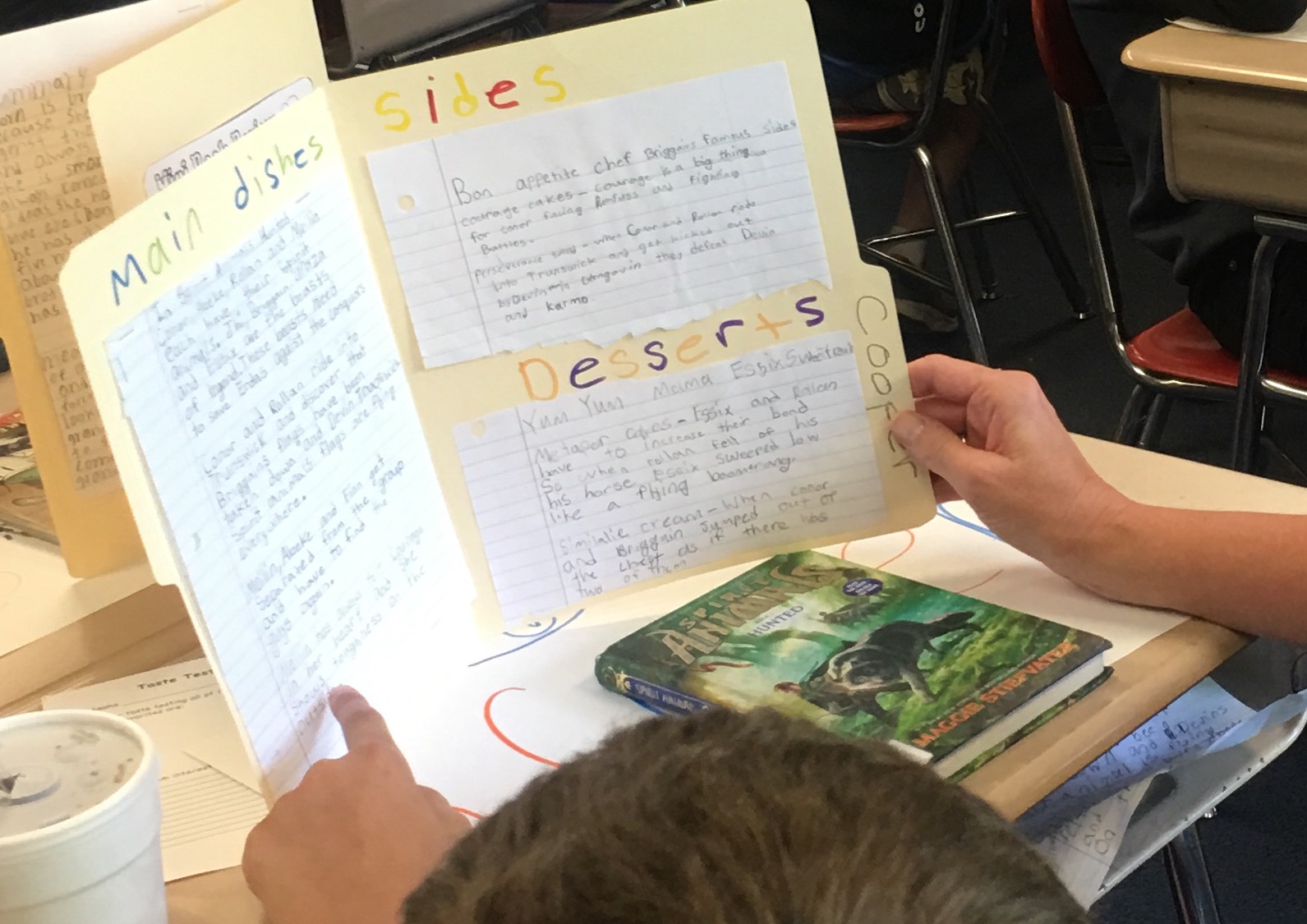
Fifth graders treated parents to a “book tasting.”
Third grade’s wax museum: Meet Woodrow Wilson, Frederick Douglass, and Jackie Robinson. Visitors pressed a “button” to hear the historical figures speak. This was the culmination of a biography writing unit.
After the in-class activity, families went to the cafeteria:
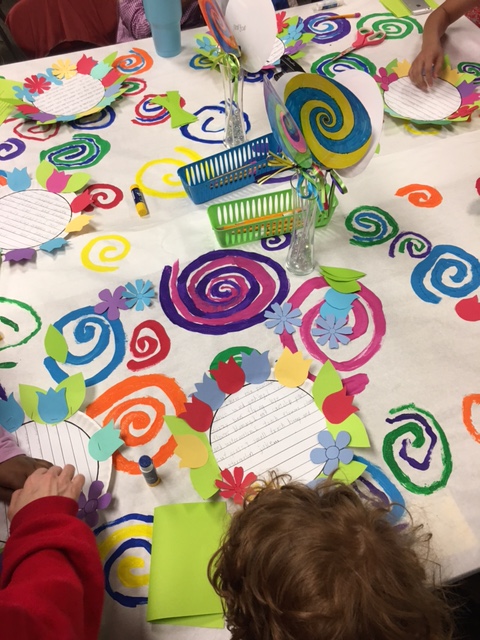
All ready for families to eat together – and to write on the tablecloth.
The children seemed to enjoy writing on the paper tablecloths at lunchtime the most – at the end of each lunch, tablecloths were covered with messages and small sketches. One carefully crayoned note from a first grader: “I love you.” Underneath, the neat printing of a parent: “I love you, too.”
Upon exiting, parents gave feedback: They were in awe of the artwork, fascinated by the children’s ideas and their creative expression. One parent commented: “Public speaking is VERY IMPORTANT!” Another parent, after attending kindergarten’s renditions of reader’s theater, wrote: “I’ve seen so much improvement in my son’s writing and speaking.”
Perhaps most telling is this comment, one frequently echoed throughout our years of Literacy Lunches: “Thank you for this special time with my child.”
Speak, write, read, and listen well, for words are important.
So is time.
Reflect: What message do you need to communicate to someone today? Make time.
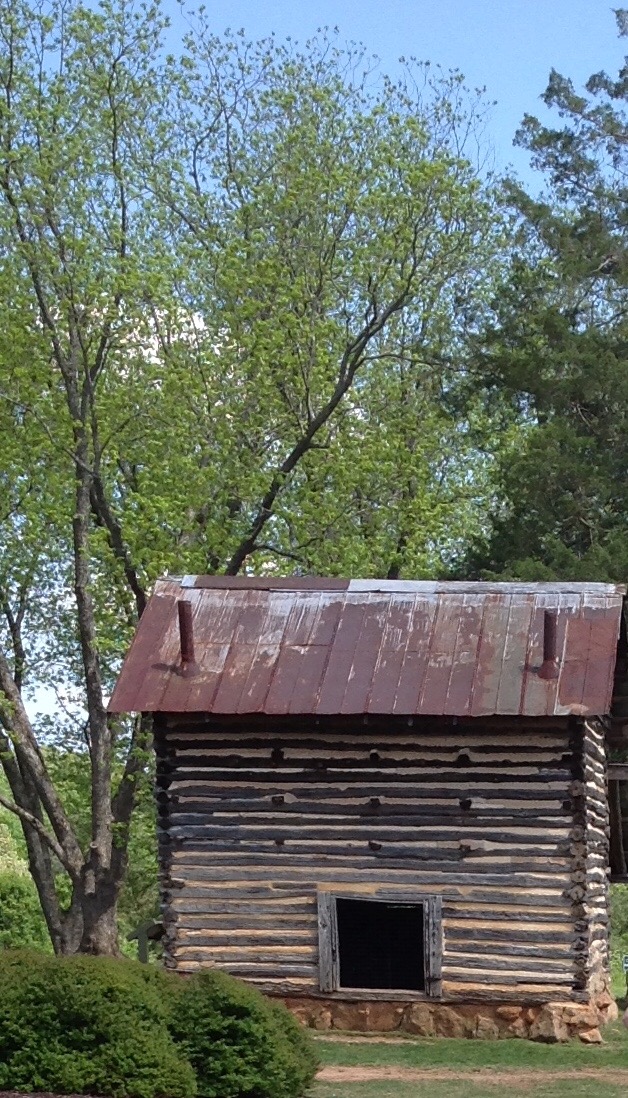
A friend tells the story of a visitor from England who, while riding through our rural North Carolina community, asked: “What are all those quaint, narrow houses in the fields?” My friend chuckled: “Those aren’t houses – they’re tobacco barns.”
I thought: They’re really elegies written all across the countryside.
I love tobacco barns. Within a short radius of my home stands a grand one with a shiny tin roof, another crumbling in a timbered wood, and another housing two mules – seeing this makes me feel as if I’ve stepped back in time. So, with serious apologies to Thomas Gray, I attempt to pay homage to tobacco barns on this last day of National Poetry Month.
Along the winding roads, bereft, they stand
Beyond their use, and most beyond all care,
Just empty shells of creaking wood, unmanned;
Gone gold, within, leaves sweetness in the air.
The fires no longer burn, nor flues convey
The curing smoke, the farmer’s cash-crop dreams;
Those hands and hearts that worked all night and day
Lie spent, burned out, unremembered, it seems
But for the spectral structures standing yet,
Hand-hewn ghosts, whispering to passers-by:
“Press on, work hard before your sun shall set,
Live, love, build well.” – I hear the old barns sigh.
Reflect: What in your landscape, your neck of the woods, speaks to you? What does it say? Why? Listen – and write.
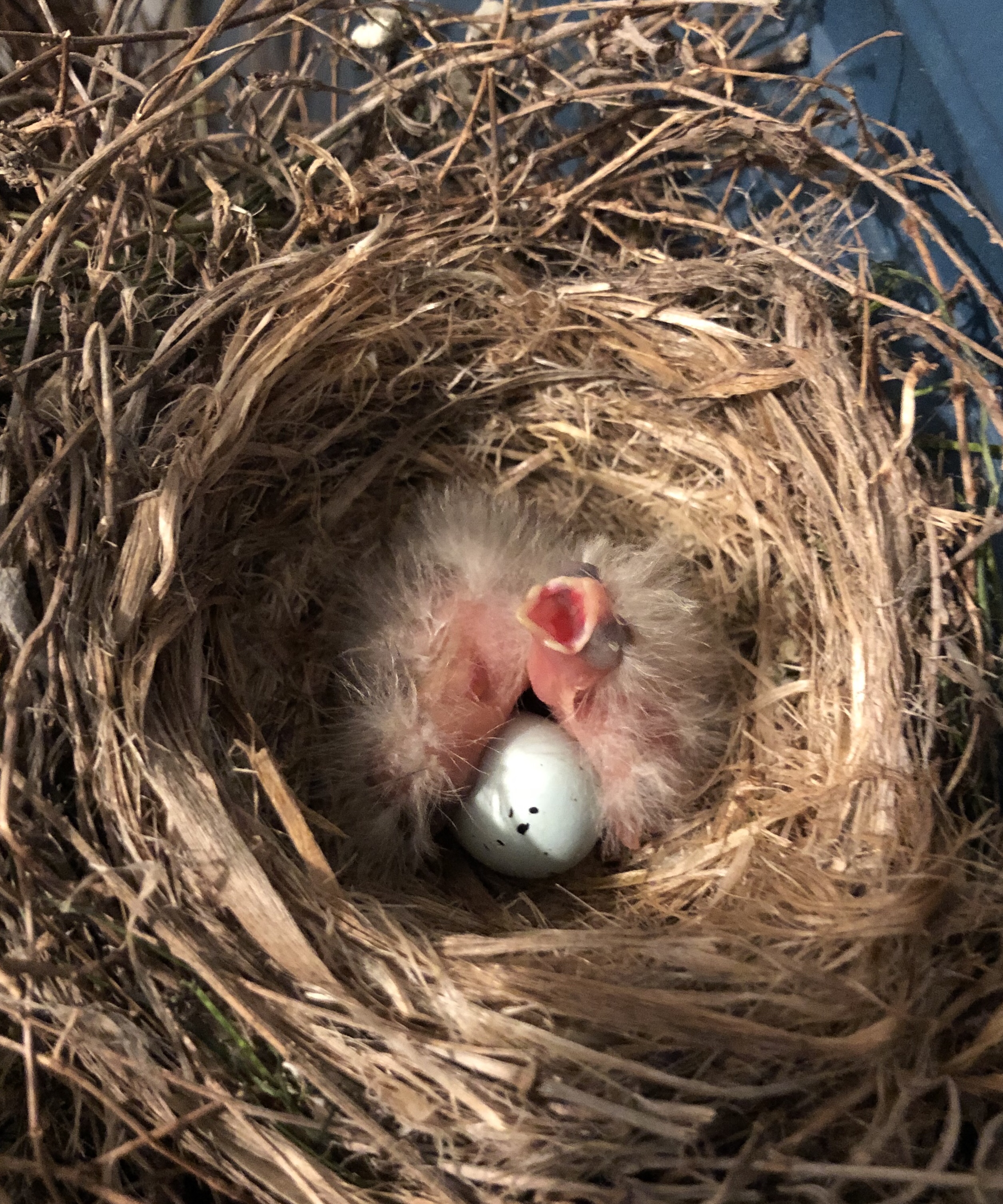
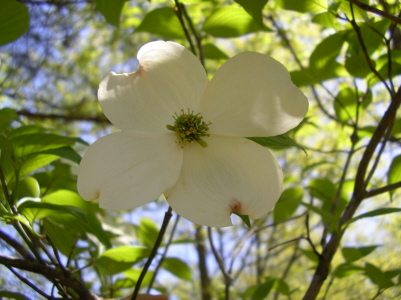
The first day of April – glorious. A sky as blue as it ever gets, hardly a cloud to be seen. Dogwoods and redbuds, bare just days ago, flowering profusely. On the breeze, the scent of blossoms, almost like perfume – winter daphne, I think.
All marking the end of desolation. Nature composes a theme of renewal with color, fragrance, amber light and birdsong.
At the close of the day, I celebrate its beauty. I celebrate the inherent message of hope with the arrival of another spring. Even the news carries a rare inspirational story about a man opening his front door to find his dog, missing for four years, back home on the porch. He sat down and the dog put her head in his lap – what an emotional celebration that must have been.
Today is also the first day of National Poetry month. I have recently discovered a lost booklet of poems that I wrote as a teenager. All things considered, this particular poem struck me as one appropriately celebratory – winter is over, spring has returned; a lost dog has returned home; my lost poems are found.
I wrote it when I was sixteen. Back then, I called it “Yesterdays.”






 lit bits and pieces