Wisteria, part 3

Wisteria arbor

Wisteria arbor (cropped). Jon CallasCC BY

Here’s the next installment of a short story based on a tiny North Carolina farming community at its peak, circa 1880-World War II.  While short stories typically don’t cover a period of years, this one does, as it’s told from the perspective of a wisteria vine that may have lived through the entire period, and may be living still; I will have to visit the area again, just to see . . . 

I grew up on my grandmother’s stories of long ago. Here I am basically just having fun weaving bits of them together, taking liberties, watching the story unfurl with the long tendrils of the wisteria vine. 

Another source of inspiration was an article posing the question, “Do plants have memories?” That’s all I needed for fact and fiction to take root in my mind; the wisteria sprouted then and there, and began to speak.

In the previous two installments (Wisteria and Wisteria, part 2), the vine relates its beginnings on the Griffin farm and its attachment to a little girl named Jennie Jay. Sent to the Griffins to escape diphtheria at her home, Jennie Jay is miserable. Mr. Griffin (Thomas) offers comfort by reminding her of her first encounter with the vine, which vows, whenever it blooms, that its blossoms will be yellow—Jennie Jay’s favorite color. Now we discover that plants, as well as people, harbor secrets . . . 

*******

I couldn’t bloom at all.

The seasons came and went again, one after the other, on and on. I grew thickly over Jennie Jay’s arbor, but I was all leaves, spirals, and shoots, without flower. I made a nice shade, however. In the dead of summer, when nothing but mosquitoes, dragonflies, and snakes desire to move, the Griffin children—six of them—sought refuge under me. I was strong and healthy. Every spring I woke back up to the world, sure my flowering would come. Every autumn when I began ebbing away, it was having failed to flower.

Mrs. Griffin had no such trouble. She budded out yet again.

One black summer night, as lightning flickered and flashed, and thunder shook the earth, Mr. Griffin drove the mule and buggy up the Mixon road. He came back with Miss Aurelia. Bowed against the pounding rain, the wind whipping hard enough to rip away a portion of my leaves, he ushered  her into the house. He set off again, yelling at the mule when it shied at the thunder. After some time, he returned with Doc Martin.

The storm raged all night. As it subsided, and the morning dawned gray, Miss Aurelia left the house. She ran toward her home, holding her skirts up from the muddy road. Within moments, she came back with Jennie Jay.

How she’d grown. Taller than her mother, now.

Holding onto each other to keep from slipping, minding their skirts against the mire, they hurried back to Mr. Griffin’s.

They stayed all day, washing, cleaning, cooking, consoling the sobbing Griffin children. Other neighbor women arrived with more food and husbands for Mr. Griffin’s chores. Jennie Jay’s Papa, Mr. Mixon, took the doctor home and returned with a pine box on the mule cart.

Late in the evening Jennie Jay came outside and rested her head against my frayed leaves. I felt her warmth, her energy; she radiated aliveness. Strong and healthy, like me. Always like me.

Wisteria, she whispered, I wish you could know what’s in my heart.

Tell me, I longed to say.

I’m not a good person.

Oh, but you are.

I wasn’t fond of Miss Rachel. She wasn’t especially kind to me. But I didn’t want her to die. Honest, I didn’t.

It comes to all of us sooner or later, Jennie Jay.

And the baby, that poor baby . . . 

I had no words for that.

Mama says Mr. Thomas wants them buried together. They’ll be together forever and ever.

Jennie Jay fell silent for a while. Then she sighed as deeply as any human ever did, I am certain.

I can’t stop thinking about Mr. Thomas. He’s so good and gentle. I will never forget how he comforted me when Papa nearly died, how he got me to help him build this very arbor. Look at you now, how great and green you are.

Thank you. Look how tall and strong you are yourself.

Why haven’t you ever bloomed, Wisteria?

Alas, Jennie Jay, you cut me to the quick!

Can I tell you something I can never tell anyone, any person, ever?

Yes, of course; I can never divulge your secrets, you know.

I’ve loved him ever since.

Naturally.

I think she—Miss Rachel—knew. It’s part of why she didn’t like me much. Do you know she told Mama once that she wanted to tear this arbor down? She despised it. She’d have gladly destroyed you.

She is dead and gone now. She cannot hurt me. Or you.

—Jennie Jay?

She jumped.

Y-yes, Mr. Thomas?

Please come eat a bite before you and your Mama go home. The children are asleep now. Don’t know how we would’ve gotten along without you today.

Jennie Jay’s long fingers lingered on my leaves, caressing, as she turned to go. I caught her parting whisper: Well, I owed you, didn’t I.

Tell him, Jennie Jay. Tell him every bit of it.

*******

To be continued, in two more installments … here’s Wisteria, part 4.
Wisteria, part 2


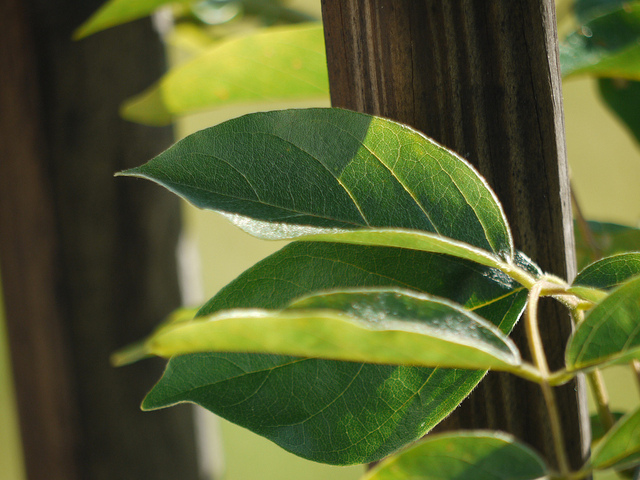
Wisteria leaves

Wisteria leaves. “Leaf edge.” Rebecca SiegelCC BY

I recently posted the first part of a short story about a real wisteria vine that grows in an old, forgotten place. Forgotten people are buried there. An article about plants having memories made me wonder what this hardy old vine may have witnessed in its long lifetime . . . here’s Part One , if you’re interested, in which the vine relates how it mysteriously sprouted, took note of its surroundings, and had its life saved by a little girl, Jennie Jay, and her mother. It was the beginning, shall we say, of a very curious friendship.

Here’s Part Two. The vine has lain dormant during its first winter . . . 

*******

I awoke to a gentle sun and delicious, cool dew. I felt new greenness coming on, so I spread what there was of myself.  I was bigger, definitely bigger. Several days went by before I realized how much time had passed while I slept. A whole season, it seemed. For one thing, the cow had a calf.

For another, Mr. Griffin had a Mrs. Griffin.

Intriguing.

As they planted the garden together, I learned her given name, Rachel, and that she came from Up The Swamp. She must’ve already bloomed, as her fruit was showing right in her middle. I wondered how the fruit would transform into a miniature human like Jennie Jay; did new humans burst forth from pods fully formed like that, or did they just drop off? The fruit kept growing but apparently never ripening. Something taking that long to grow surely could not be healthy.

Finally, near harvest time, Mrs. Griffin shut herself in the house with other female humans. Mr. Griffin scoured his garden for the last of the beans, peered at his pumpkins, sighed, repeated the meaningless motions and hoed, although nary a weed was to be found.

He didn’t see the door when it opened, didn’t see Aurelia Mixon until she called, You’ve a fine son, Thomas! Squalling his very lungs out! Come and see him, Papa.

Mr. Griffin’s face glowed like the risen sun, but I considered myself cheated not to have witnessed the human fruit falling.

****

The seasons cycled and cycled again before Jennie Jay came back to me.

I knew her at once. She’d grown. A lot. I’d grown, too. I no longer needed a cage. Mr. Griffin hadn’t built an arbor for me so I squatted instead of standing upright, but my trunk was decidedly thicker.

By this time there were three little Griffins, one in his Mama’s arms and two hanging from her skirt as she went partway up the Mixon road to meet Jennie Jay, who trudged along wearing a straw hat tied with a wide yellow ribbon. She dragged a curious bag behind her, making a noise like Mr. Griffin’s beagle pup when it got its back leg stuck in the fork of the grapevine.

Mrs. Griffin’s face looked ominous, like storm clouds gathering. Heavens, what a fuss, Jennie Jay. Quit that howling and pick up that valise. You’re getting it filthy. Come on and I’ll fix you a bite to eat.

Ain’t hungry.

Your Mama wouldn’t like that. Say ‘I’m not hungry, thank you.’

Ain’t hungry!

What a stubborn little cuss you are. No matter. You’ll do what you’re told until your Papa gets over this diphtheria and you can go back home.

I want my Mamaaaaa!

She can’t come, she’s tending to your Papa. Besides, you can play with Tommy and Molly; I’m sure you’ll all have a big time together, now won’t you?

They made it to the house but Jennie Jay didn’t stay inside long. Within minutes, the door flew open and she ran as hard as she could toward the garden. She flung herself down so close to me that if a stiff breeze blew, I might bend just enough to touch her. A drop or two of the water flowing from her eyes seeped into the earth, to my underparts. The taste surprised me: humans are remarkably salty.

Mr. Griffin drove up in a cart pulled by one of his more pleasant mules. He saw Jennie Jay, called Whoa, hopped down.

Well, if it isn’t little Jennie Jay.

She paid him no attention. She continued dripping.

He knelt beside her. Tell me what’s the matter.

I want to go hoooommmme!

I know you do. I know your Papa and Mama are missing you as much as you miss them. But your Papa has to get well first. He wouldn’t want you to get sick too, would he?

Jennie Jay sat up and wiped her face, leaving smears of earth.  She shook her head.

It’ll be all right, Jennie. Don’t cry, now. Want to know something?

What?

See that vine there?

Mr. Griffin pointed to me.

The funny bush?

Yes. Know what that is?

Jennie regarded me thoughtfully. She shook her head.

It’s wisteria. Once when you were very small you got away from your Mama and came here to pick every last one of my dandelions. We found you here by this vine. I didn’t even know it had sprung up. I aimed to yank it right out of the ground but your mama said no, let it be, on account of you called it by name and that was your first word.

It was?  A flicker of recollection crossed her face.

It sure was. I witnessed it myself. You didn’t start with something easy, no sirree; you had to go and try to say ‘wisteria.’ It came out something like ‘siria’ or ‘siwia.’

Jennie giggled. The dripping had ceased.

Your mama said I ought to make an arbor here, so this vine could grow and grow. It might even bloom one day, Jennie Jay, with flowers hanging all over.

 Ohhhhh . . . will it?

 It just might. Of course I have to build the arbor first, and see, the trouble is, I ain’t had anyone to help me.

 I’ll help you, Mr. Thomas!

 Well then, let’s get started.

 Mr. Griffin held out his hand and helped Jennie Jay to her feet. She stared up at him with shining periwinkle eyes.

  Mr. Thomas, will them wisteria flowers be yellow?

  Probably not. Usually they’re purple.

  Oh.

  Reckon that will be all right, Jennie Jay?

  I reckon.

Mr. Griffin unhitched his mule and off the three of them went toward the barns, Jennie Jay skipping, Mr. Griffin smiling, the mule laying its ears back, looking altogether like Mrs. Griffin at the doorway.

As for me, I vowed that, whenever I finally bloomed, my blossoms would be yellow.

*******

To be continued . . . here’s Wisteria, part 3


Divine appointment

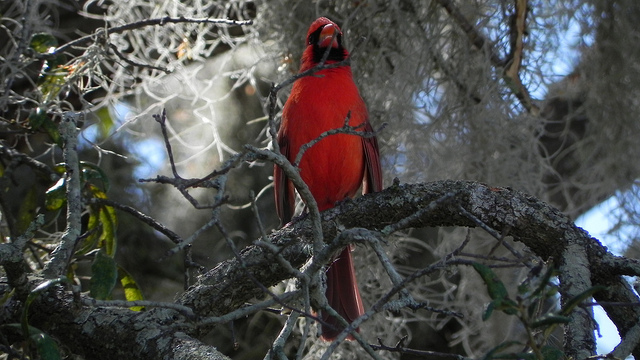
Cardinal

Cardinal Singing Along. Don and Janet BeasleyCC BY-SA

Broom in hand, I descend the brick steps where moss has newly sprung. The sidewalk needs sweeping and I’ve only a minute. Must get to school early, to prepare for the day; the minutiae of all that has to be done circles round and round my mind. 

But I have to do this first. Oddly. Sweeping the sidewalk is not part of my morning routine. 

Hurry. Hurry.

All is still but for the light chatter of a few birds, waking. The sound of early spring. The sound of April. Of a new day. I pause, listening. How cheerful, how happy their bird voices are, even if to them it’s just regular conversation. My spirit eases, just hearing them. I note that the light is unusual. Against random trees and shrubs, the dawn gleams amber in patches. Everything else is a backdrop in half light. There’s an edge to it all, a starkness. The sky is moody. Altocumulus clouds, dark in their middles, gleaming around their rims, are gathered in bands or waves; this is what scientists call a mackerel sky, I think. Strange light.

—Time. Be aware.

Right, I must hurry.

Just as I put broom to concrete, I see it.

Over in the neighbor’s yard, in the shadows under the bushy, unpruned crape myrtle. 

The brightest spot of color I’ve ever seen. Red. Rosy, electric red, brighter than any neon light, as vivid as fire, glowing, but not burning. Just being. I blink. How does such a color even exist in nature? It has to be a cardinal but I can’t see the rest of him, just his plump breast. A half-memory from childhood stirs in my mind, of pretending I had a pet cardinal and spraying pine-scented air freshener throughout the house to create his forest, where he could fly freely— but for all my attraction to the male cardinal’s plumage, I’ve never seen it to the intensity and brilliance as right now in this capricious light.

I want to see him better but I dare not move. 

I think I’ve quit breathing.

Could I, maybe, get a picture? If I’m stealthy, can I make it into the house and back with my phone? 

I have to try. I have to capture this image.

I watch him as I ease toward the house. He moves a little, hopping in the dappled grass.

As soon as I reach the steps, out of his field of vision, I race through the front door to the kitchen, grab my phone, turn, shoot back through the door, take the steps without making a sound, stop, and creep to where I can see the crape myrtle.

He’s still there! I can’t believe it!

An astounding spot of color, radiating an otherworldly light.

Holy.

I aim my phone and zoom in . . . 

On the screen I see the thin myrtle branches up close. The grass, the shadows, the sunlit patches. —Where’s my bird?

I look away from the phone back to the scene, to get my bearings . . . don’t know how I could have missed, I aimed right where he was standing . . . .

Gone.

He is gone.

In the second between my sighting him and my lifting the phone, he vanished. Without a sound or any perceptible movement. He was and then he was not. Just like that.

Nowhere to be seen at all.

I stand frozen, phone in hands, an inexplicable feeling sweeping through me. 

The moment passed and nothing remains of it. Stunning, that spot of fiery color like no other, in the shadows under that tree. One glimpse of glory. He was so beautiful and I never even saw all of him. Even if I do see him again—and I’ll try, at this same time tomorrow, and the next day, and the day after—it will never happen again, not just like this. The clouds will not be the same. The position of the sun will be slightly different. It can never be again exactly as it was. 

I so wanted to capture his image, the holiness of it, to keep it forever, and I could not.

But I hold it in my mind. I cling to every breathtaking detail. 

I write it before it leaves me, wondering at the tears burning behind my eyes over this one bird, this one moment, why it should be so significant, to make me feel so much.

I was just there, unexpectedly, and so was he.

For one shining moment, we just were.

Wisteria

In recent years, I’ve written lots of short stories, beyond those as models for students or posted here on the blog.  Some of my stories are realistic, usually centering on a character making a self-discovery or a difficult decision. Other stories are more ethereal, with a slightly supernatural element.  

“Wisteria” is one of the latter.

April in North Carolina brings life to the heavy vines snaking through the woods. One day the woods are dark, gray, forlorn, and the next, it seems, they’re bursting with color. Along the highways and back roads, cascades of soft purple blooms reminiscent of grape clusters swathe the trees. The wisteria is beautiful. Its perfume laces the fresh spring air. To me it speaks of old things, old ways, long ago, things we cannot see and did not know, but are with us still, even so.

Regular visitors to this blog will know that I frequently write of my grandparents’ country home in eastern North Carolina, where I spent many childhood summers. It is a tiny, old, remote place. Utterly foreign and mysterious to a little city girl. The images abide with me to this day for myriad reasons: I was happy there. To be with my grandparents was to be in a stronghold of love and safety. Absolute sanctuary. Not until I was grown did I realize how much the environment, the setting, nature itself wove its way into my very being much like wisteria stealthily weaves its way through a forest, grabbing hold of anything it can. Like it did in the thick woods looming eternally dark and secretive around my grandparent’s home. Suddenly, in the spring, these tall, ominous trees were laden with wisteria blooms. They made my grandmother sneeze; they made me stand still and dream. 

Grandma told stories of long ago, before these woods existed. When a whole community thrived along this old dirt road. When the people in the cemetery in the tiny clearing  across from her house were alive. As a child, listening, these people lived and breathed once more, just briefly, in my my mind. Like ghosts temporarily made corporeal before dissolving again. I stood by their aging white stones, some eroding or so weather-streaked or moss-covered that names and snippets of verse were hard to read, seeing my own moving shadow cast over the grass of their graves, as a soft breeze picked up. Leaves and pine needles rustled; birds chattered with wild abandon; frogs plopped into the tiny canal at the cemetery’s edge; crickets chorused from the recesses of the woods because it’s always night there. 

The cemetery vibrated with life. 

I looked up and saw the wisteria nodding, high in the trees.

I tried growing it myself, once.  

A few years ago, a friend of mine, knowing my affinity for the vine, brought me a potted wisteria. I planted it by the back deck with great glee. Another friend built a trellis for me on the deck, so that as the vine grew—which is alarmingly fast—I could tease its tendrils through the lattice. Soon I’d have a glorious arbor of soft purple bliss.

That is not what happened.

Those tendrils, so tender and unassuming, grew daily; they began reminding me of something out of science fiction. Like thin green antennae, they grew out and up from the woody trunk. They held themselves aloft in the air, swaying, twisting—I could actually see these movements. Some tendrils eventually reached the deck and coiled around its posts. Still others stretched, as if consciously, toward the lattice; I guided these green strands to spots where they could weave through in their ever-onward and upward way. 

The first small blooms appeared.

-Joy.

And then one day as I walked across the deck I realized that the lattice was bending, was already quite convex. The wisteria, pulling and pulling, continually gaining strength and momentum (as best I can describe it) was destroying the trellis, was literally drawing it into itself. 

I gazed in fascinated horror. How did this happen so fast?

I noted that one sweet little tendril had reached the gutter of the house, so benignly . . . 

It had to go. 

I cut down the vine. Hacked it to bits.

And mourned.

Not long afterward, I read a science article that posed the question: “Do plants have memories?”

Oh. Oh. Oh . . . .

That wisteria in the woods by my grandparents’ home surely must. . . it’s been there for how long? A century? More?

What, exactly, would it remember?

And that is how my story “Wisteria” was born.

My friends enjoy it. Contest judges and magazine publishers apparently do not.

For whatever it’s worth, I’ve decided to share a bit of the story here, maybe tinkering with it as I go, just because it’s April and the wisteria blooms are once again hanging in the trees, nodding high above whenever I pass by.

*******

She was the first child I ever saw.

I did not recognize her as human. Tiny, clad all in white, she was rather daisy-like, with her upper petals drawn toward her capitulum. I have since learned that this curiosity is a bonnet, for shielding the female’s face from the sun.

I have never understood this.

I came up craving the full sun over my entire being, excepting my under parts that forbid any relocation, that stretch incrementally downward and outward, darkly drawing moisture. This flower possessed the astonishing power of locomotion. She tottered along the dusty road and into Mr. Griffin’s yard where the pecan tree shadowed the patchy grass. Apparently she attracted dandelions; wherever a fuzzy yellow head dotted the ground, she paused and somehow drew it right to her.

Nearer and nearer she came. To her own fate, I suspected, should she enter Mr. Griffin’s garden. Vigilant about his cultivation, he allowed no weed or creature of any kind to interfere with it. I’d poked my way aboveground to discover him plowing painstakingly straight rows, followed by weeks of planting, fertilizing, constructing poles for his beans, staking his tomatoes, scanning the sky wistfully for rain. The black earth bubbled up into greenness, a ceaseless unfurling, blooming, enlarging. The garden was, I must confess, a magnificent human endeavor. If this mobile daisy dared invade, Mr. Griffin might well appear with his shotgun, as he frequently did with four-footed fauna. I preferred not to witness the annihilation of the only known walking-flora specimen.

I shuddered when the vibration came.

Not the crack of the shotgun; a human cry, a scream:

JENNNNNIEEEE! JENNNNIEEEEE JAAAAAYYYYYYYYY!

A harrowing sound.

I know about harrows.

Mr. Griffin heard it from the cow barn. He came running, pitchfork in hand, looking every which way. He couldn’t see the daisy; she had fallen flat behind a sprawling squash vine. A movement at the road caught his eye: A woman, running hard, clutching her long skirt.

JENNNNNIEEEE!

By this time the daisy had righted herself. She proceeded on through the furrows, right in my direction.

They saw her. Just as her warm shadow fell upon me, the woman was there, Mr. Griffin immediately behind her.

Up into the woman’s arms went the daisy.

Oh, Jennie Jay, you frightened Mama to death. You could have fallen in the creek and drowned.

No harm done, Miss Aurelia. Looks like she was just hunting dandelions. Got a whole bouquet of ’em clutched there in her hands, don’t she.

She loves anything yellow. She’s strong-minded, to be such a little thing. Lord-a-mercy! Sound asleep on the quilt under the oaks one minute and gone the next, when I stepped in to stir the soup!

She didn’t get far.

Thank heaven. Your garden’s a wonder, Thomas. What made you decide to start a wisteria?

Ma’am?

Miss Aurelia pointed to me.

Your little wisteria, there.

To tell the truth, that ain’t my doing. Ain’t even noticed it.  Here, I’ll pull it right out . . . 

Oh, no, Thomas—don’t. Let it be. You could build an arbor for it, train it up. That wisteria would make the place real pretty for a bride, now wouldn’t it?

Mr. Griffin’s sun-browned face burned as red as the kerchief in his bibbed overalls. Miss Aurelia grinned and turned away. A little face peeped over her shoulder, and that’s when I perceived that the white-petaled thing was no walking flower but a miniature human, as capitula do not have two great blue eyes.

Siwia, she said.

My land! Did you hear that, Thomas? Jennie Jay just said her first word! Say it again, Jennie.

Siwia. Siwia.

What on earth?

Sounds to me like she’s trying to say ‘wisteria’, Miss Aurelia.

Well, I never. Not ‘Mama’. Not ‘Papa’. Wisteria! That does beat all. I reckon you have to leave that vine now, Thomas, to mark this occasion for Jennie Jay.

From the moment she spoke my name, I was enchanted. As her mama carried her away, Jennie Jay’s eyes stayed fixed on me.

Thus our kinship germinated.

We were both so new.

That evening, Mr. Griffin cut some chicken wire and made a cage around me.

Just you stay out of my garden, he muttered, the first and last time he ever addressed me directly.

I vowed to try.

Some weeks later he brought mulch—oh, so rich and warm!  Before I knew it, I slipped into a deep sleep.

*******

To be continued . . . see Wisteria, part 2.

Wisteria in yard 2

Wisteria and spring blooming. Ryan BasilioCC BY

Abiding images

Last week I spent several days on Ocracoke Island, North Carolina, studying writing with teaching colleagues from across the state.  This extraordinary opportunity was provided to us by the North Carolina Center for the Advancement of Teaching – heartfelt thanks to you, NCCAT, for your support of teachers, and for inspiration at a time when it is needed more than ever.

Ocracoke is, in the words of our faculty advisor, who’s native to the island, “a windy, sandy, watery place.” It’s also tiny and breathtakingly beautiful. One of our assignments was to capture abiding images from this idyllic locale in our writer’s notebooks.

Abiding images are symbols with deep personal meaning to us, often recurring, according to dream analysts. Abiding images are part of us, shaping our lives the way the wind and the water continuously shape this island. To poets and writers, abiding images come from a wellspring inside us – stories, dreams, conscious and unconscious memories – each as unique to us as our own fingerprints.

Our task was to walk in this brine-tinged breeze, under the moody sky, without speaking to one another. We were to walk alone, searching for the images that speak to us.

I prefer to think of it as being called by the images that wish to speak to us.

The long beach grass rippled like hair against the ground; the sea, shimmering and calm on the Pamlico Sound side, flowed ceaselessly from left to right like words across a page. Come, was the inherent, compelling invitation. Come. Listen to me. I have stories to tell.

I filled seven pages with abiding images and took pictures of a few.

There were the pink wildflowers, startlingly bright against the beach grass. Marsh pinks, they’re called. Sabatia stellaris. Our advisor said for anything to survive on the island, it must be hardy, yet here were these delicate flowers with perfect yellow stars in the center, as if painstakingly hand-painted by an artist. Incongruous. Surprising. Hopeful, somehow, for these flowers carry the mark of the heavens in their upturned faces.

I came across some shells by a small hole in the sand, out of which grew a thin, solitary blade of grass. No other grass stood anywhere near this one long, lonely strand, this one hair from this one follicle. There are secrets in the sand, the advisor told us. So much more goes on in it and below it than we really know. 

This curious wisp of grass shivers, nods.

I walk farther and discover the ivory-yellow skeleton of . . . something. I don’t have a frame of reference for it, other than knowing it’s a bone, something once alive. It worries me. I want to know what creature it was and why it’s here in such pristine condition, with no other marks in the sand near it in this isolated spot. How long has it been dead?

I learn later that it’s the skull – just the skull, although it’s the size of a chicken – of a red drum. North Carolina’s state fish.

I still don’t know why it was lying there all by itself.

The last of my abiding images is at the marina in front of the NCCAT building, which used to be the old U.S. Coast Guard lifesaving station. As I turn to go back inside, I encounter a rusted handle quite suddenly in the sand near the marina’s edge. It’s sticking upright, clearly attached to something buried there, and it’s obviously been around a long time. What’s THIS secret hidden in the sand? I don’t tug on the handle, although I want to; I imagine pulling it and a door coming forth from the sand to reveal an opening with stairs leading down to . . . anywhere. A bunker, a secret gathering place, another world, another time. Oh, the stories this strange handle evokes!

Perhaps I will write one of them yet.

For now, the images abide in my notebook and in my mind; they shape me, even as I shape my thoughts about them. I carry them with me while I leave a piece of my heart, perhaps a piece of my soul, behind with them.

We belong to one another. That’s what I think as the sun goes down over the Sound, as I hear boats over in the marina rocking as if they are waking from a long sleep, coming back to life.

We abide.


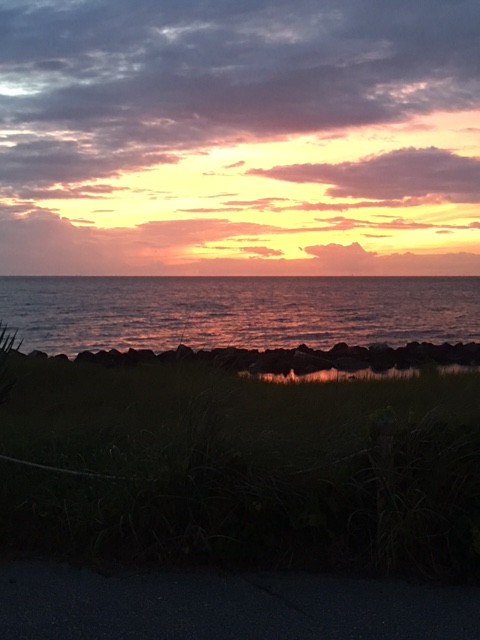
Sunset Pamlico Sound

Sunset on the Pamlico Sound.

In reading and in writing, our instructors told us, “Setting is everything. It drives the story, drives the characters’ actions.” 

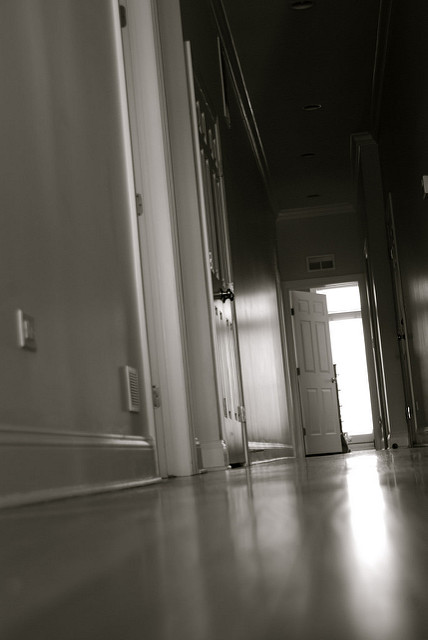
The hallway

Hallway

Hallway. DSC_003. ColinCC-BY

A large part of my job involves helping teachers and students grow as writers. I often define writing workshop as an artist’s studio, a place with time to fall in love with the craft of writing.

As I consider my own writing experiences, the image of a hallway forms in my mind. I am actually in this hallway. I can see numerous doors, one of which stands partially open, and through it I can see a window, and beyond that, trees, bright in the golden light of afternoon, probably in late spring or early summer. The branches sway in a breeze, making the leaves dance and beckon, but there is no sound, not from this vantage point. I would have to go through the door and open the window, probably, to hear the rustling, the insects, the birds, to feel the sun’s warmth and taste the laziness of a free afternoon – if, in fact, the afternoon is lazy and free, as it seems to be from where I stand.

Other doors are closed, and knowing that I can open any of my choosing sends a compelling shiver through me – each door leads to a different place, experience, and story. They are all mine to explore, at my leisure. I will never know what’s behind the doors unless I go and open them. Some lead to the past – when I walk through, I can see my family, some of whom are gone now but alive and remarkably young in this place.  They don’t seem to mind at all when I come – in fact, they seem to welcome my visit the same as they always did. If I go farther, I see old friends, classmates, even people I didn’t know well but who are somehow connected to an idea, a moment in time when I learned something or realized that something mattered. My childhood dogs bounce up at the makeshift gate between the kitchen and the living room in their typical greeting; I smell cigarette smoke, the old Kirby vacuum cleaner, the old worn rug; fried chicken also lingers in the air. But I do not want to stay and wander like a ghost here in my childhood home. I can come back another time, anytime I like.

Behind other doors are chairs where I rocked my babies. Here I sit with their soft warmth in my arms, their fuzzy heads nestled against my neck. I feel them breathing, slow, easy, contented in their slumber. I can stay here a while and just be, just rocking, holding one boy for a long time and then the other. I can see them when they are a little older, one always chipper and friendly, the other absorbed in his own thoughts, spending hours lining up his Hot Wheels or taking things apart to put them back together. They are safe and well in this place, so I will leave them here, after I kiss their satin-soft cheeks once more and tell them that I will always love them.

Other doors, I suspect, lead to worlds that I can still create, both real and imagined. I can only see so far in the future; only some things are certain and I will alternately face them and embrace them as they come. I could linger far too long in the imagined worlds, just to see what will happen, to discover the secrets and the magic, knowing all is of it is at my command.

I am surprised by the door that opens straight into the natural world. I have discovered this about myself, that the workings of nature have a strong pull for me. Some of the discoveries are breathtaking, like the iridescence of a dragonfly’s body, the precise blue and orange painted pattern down a caterpillar’s back, the powerfully sweet fragrance of a gardenia, of honeysuckle, and the tiny war-plane drone of a hummingbird’s wings. Others discoveries are not nearly as pleasant – a horseshoe crab decaying on the beach, a tobacco worm (a non-native North Carolina neighbor recoils in horror – “Is that a dragon?“) crawling on my porch rail, a scar on the wood trim by the roof where lightning struck the house. Not pleasant, but fascinating all the same. I had no idea until I started writing that nature spoke so much to me – just now, as I capture these words, the sun bursts forth from behind the clouds beyond my bay window, shining on the laptop and my hands as I type, like a validation, an invocation.

Other doors lead to mysterious places like cemeteries, where time is irrelevant. I don’t know these people, but I look at the stones, the names, the dates; I read the poems on the older, eroding ones, and I want to know: Who were you? What were you like? What was your life like, what did you love, and how did you die? What’s your story?

The most curious thing of all about this silent hallway is that whichever door I open, in whatever order, wherever I go and however far or for however long, I find myself there. Myself as I was, as I am, as I will be.

I give myself a nod.

And I write.


The secret gates

ditch-gate

Into the ditch. jam343 CC BY

When I was a child, my neighborhood flooded regularly.

I lived on a block where all the backyards joined at a long ditch. When I went to play with a friend, I took a shortcut by running alongside the ditch and jumping over it, taking care not to land in it, for the ditch was lined with thick, black mud; if it did not stink outright, it certainly smelled organic, stagnant. Sometimes fleabane, tiny, hairy daisies, grew along the banks. That’s about it for ditch decor.

Whenever a heavy rain came – and a few times during a moderate rain – the ditch overflowed. Storm drains in the curbs overflowed as well, until water covered the streets and most of the yards. My friends and I had fun wading through it as we walked home from school, sloshing as much as we could.

My father, however, was irate every time.

As soon as he saw the water backing up, he got the city on the phone.

“Listen, I’ve called before,” he’d snap at the City Official on the receiving end. “You ought to have a record of it. This whole neighborhood is flooded AGAIN. Get whoever is paid to do it to open those drainage gates.”

Every time, the City Official pleaded ignorance about said gates.

I watched Daddy’s florid face redden. “You people always act like you don’t know what I’m talking about, but I am telling you, there are flood gates controlled by a switch and somebody up there knows how to use it. There’s NO EXCUSE for a place to flood like this. Open the gates!” He glanced through the picture window in the living room. “A canoe is going down my street right now. So help me, I will get in it, come down there, and find that switch myself.”

A canoe was going down our street, neighbors having dragged out their camping stuff, rowing merrily along. A teenage boy in waders, hip-deep in the water, pulled younger siblings on a raft behind him. To my horror, one young neighbor tossed a puppy from the front steps out into the water to make sure it could swim. It could; that the puppy swam back to its owner amazed me.

Daddy’s voice got louder, his face redder, until he hung the phone up in disgust, but within an hour of his call, the flood began to diminish.

As the water level went down, so did the color in Daddy’s face. In his eyes was a glint of victory, or perhaps vindication. The City Officials had, yet again, scrambled to open the secret gates they kept forgetting about. Good thing they had my dad to remind them.

Did the gates actually exist? Did they lead to the nearby river, or where? I never knew for sure, but the timing between my father’s phone calls and the floodwaters receding is intriguing, suggesting more than a fluke.

Our regular neighborhood floods were mild annoyances in comparison to the devastation experienced by anyone whose home has been lost or whose life has been endangered. The forces of nature are beyond human control, despite the best of foresight and man-made safeguards. On a small scale, my father did what was within his power to change a situation. One voice, persisting. Today I think of the labyrinthine educational system, of American politics, the overwhelming need for change when so much is at stake, and those who are suffering. What are the gates to clearing the way, and where lies the switch? Change is a force within human control. As Anne of Green Gables author Lucy Maud Montgomery penned: “All things great are wound up with all things little.”

Believe, be the voice, reclaim what is of value, before it is lost.

Reflect:  Water is a symbol of life, as well as adaptability, healing, and cleansing. When things become overwhelming, one of these might well be a switch to seek. Which might be yours? How might you help others?


What lies within


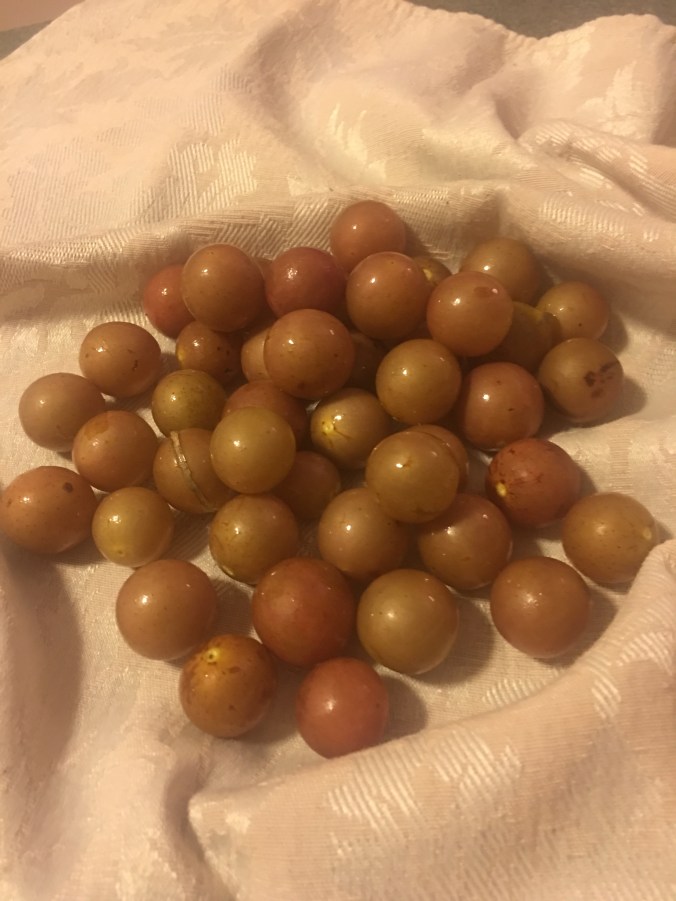
scuppernongs

They aren’t beautiful, scuppernong grapes. Their unassuming greenish-bronze skins are flecked as if with age spots. Hardly inviting.

If you have never tasted one, you have not fully lived.

Yes, the seeds are a nuisance, difficult to manage in polite company, as one must spit them somewhere.

But put one in your mouth, gently split its remarkably thick skin open with your teeth … oh! The burst of richness is almost breathtaking. Embryonic wine, a touch of dying summer, a whisper of sweet things to come, something of all Christmases and bit of Heaven is encased in that homely little orb. No other taste on Earth compares. When I first studied mythology, I wondered if ambrosia, the food of the gods, was actually scuppernongs.

I first encountered scuppernongs as a young child. I can see the vines towering over my head, the flickering sunshine and shadow of wide leaves, the poles my grandfather erected, his straw hat, the plaid pattern of his sleeve as his big wrinkled hand reached up to pick the grapes for me. No words; just richness. Just joy.

A lot of things are like scuppernongs – unappealing on the outside, messy and more work than seems necessary. Teaching is like that. Writing is like that. Living is like that. Get beyond that first impression; it’s misleading. Press on to the heart of it. What you find there will take your breath away.

Reflect: When has the appearance of a thing, an experience, deceived you? What surprise was waiting for you within?


Breakfast Island

island

Image:  studio tdes CC BY

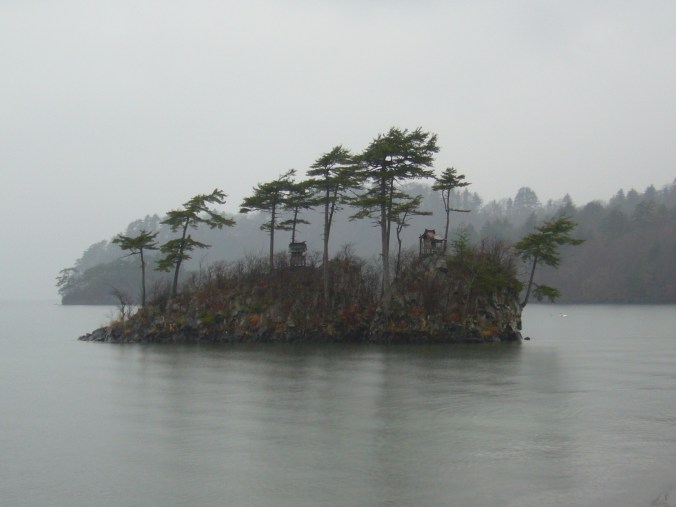
Somewhere in Maryland’s scenic Severn River is a tiny island that belongs to me.

Not that I have a deed to it, or that the island was even the giver’s to give, but those are minor details.

The transaction came about when I was around seven years old, during a family gathering. My aunt and uncle, avid boaters, decided to treat everyone to breakfast on the beach. In the chilly gray dawn, a bunch of us piled into my uncle’s motorboat and sped across the Severn. Unbeknownst to me at the time, this majestic river connects with the Chesapeake Bay; the U.S. Naval Academy stands at the convergence. I only knew I was cold and hungry. I shivered in the breeze, thinking that going to the beach for breakfast was just about the most exciting thing ever.

The beach turned out to be an island right in the middle of the river. If Huck Finn had seen it, he would have called it a towhead, a mere islet with a thicket of brush in the middle. As the grown-ups busied themselves with building a small fire, I walked the whole sandy circumference in a couple of minutes, marveling at the island’s diminutive size.

“What is this place?” I asked my uncle, who was crouching by the fire with a skillet full of sausage links.

“Just an island where people sometimes stop off,” my uncle answered, as the sausages began to sizzle.

The sun was bright now, the Severn very blue against the island’s golden sand. A few white sails appeared in the distance.

“What’s the island’s name?” I wondered aloud.

“It doesn’t have one,” replied my uncle.

“Why not?”

“I guess it’s too small for a name.”

How disturbing, that such a pretty place did not have a name.

“Why don’t the owners want it to have a name?”

“Nobody really owns this island,” my uncle said, carefully turning the sausages. Thin blue smoke drifted up from the skillet.

“What! How come nobody owns it? ”

“It’s just here, hon. It isn’t like the big islands, where people live. That’s a good thing, because anyone who wants to can stop and visit, like we’re doing now.”

An inexplicable sorrow welled up in me. It wasn’t fair that no one cared enough about this little island to want it or give it a name. It hurt my heart.

My uncle squinted at me. “What’s the matter?”

“It should belong to somebody.”

“Ok, then, why not you?”

“WHAT?!”

“It now belongs to you.”

“For real?”

“You’re the owner of this island. Congratulations.”

Pride surged through me – I owned this island, the prettiest place in the world! I loved it. Somehow I felt it was mutual, that the island loved me back, was happy that I was there, that we were meant to be. Then a fleeting fear struck me:

“Do I need to pay for it?”

My uncle howled with laughter. “Goodness! Well, since there is no other owner, it’s free.”

The sausages were done; someone filled another skillet with apples and cinnamon. I never knew apples could be fried. Their aroma filled the air like incense from an altar, sweet, pleasing, mouth-watering. For the rest of that morning I basked in the glory of possessing my own island,  soaking up the sun and asking for more apples, until they were gone. I never wanted to leave.

I have never returned. I do not know if the island still exists, or if time and weather have dissolved it, the way that relationships eventually dissolved. What I know is that for that one halcyon morning, I was the richest person on Earth; I owned an island, and it was free.

Reflect: In what ways can you take a child beyond the realm of “the usual” to experience something rich and unusual? How can you creatively instill a sense of ownership?