Halfway between work and home I noticed the field. How could I not, such vibrant green popping against the panorama of brown grass and tired trees giving way to winter.
I needed this shot of unexpected freshness after these first days back to full-time work with my husband at home in the middle of a slow recovery from spinal surgery.
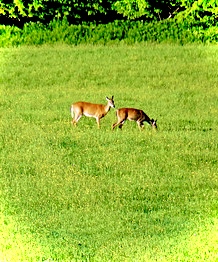
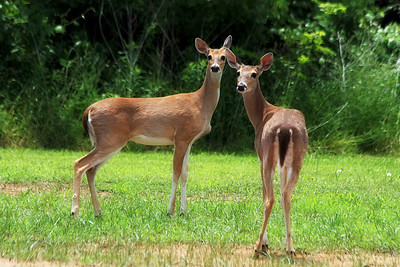
The waning afternoon light slants gold across the green and there, there, clear as day, two deer graze, gilt-edged and peaceful and perfect
as if it isn’t hunting season as if carcasses of their kindred aren’t lying mangled by the roadside within their view as if the long in-betweenness of hours and days and seasons and breaths is no consequence
For today’s Open Write on Ethical ELA, participants are invited to write poems about “places we call home”.
Nothing pulls on the heart like home… I can almost hear the Beatles’ song “In My Life” playing in the background: “There are places I remember all my life, though some have changed…” The memory of these places, and the spirit of them, really are the theme song of our lives.
Of all the places I remember and could write about…have written about…I choose my home now. I have lived here the longest. I became a grandmother here. I have learned a lot more about savoring here. Usually I try to make my poem title do more work, but today, no other will do.
Home
In the first moments of pale-pink light the big brown rabbit comes from the woods to nibble away at the clover
in the ever-thickening branches of the crape myrtle my husband and planted years ago I can spot hummingbirds hiding among the leaves always alone never together
they dart, one by one to the kitchen-window feeder
silvery-green females perfect, pure ethereal as fairies
a male, ruby fire at his throat (brighter than the cardinal-flame landing over on the fence) impossible greens and turquoise shimmering on his back
unaware of his utter tininess he sometimes perches atop the feeder as if to say I am King of this Water-Mountain
a pair of doves feeds on the ground by the tree line then takes flight on pearly wings vanishing in the pines and sweetgums where their nest is secreted
robins, robins everywhere just last week a speckled fledgling on the back deck both parents in the grass chirping ground-control instructions
the mockingbird in the driveway strutting and stretching his banded wings as if he knows how legendary he is
a trill of finch-song from a nearby tree so plaintive I fear my heart may burst
and the bluebirds oh the bluebirds
if only I spoke green language I would explain that I removed their house from the back deck because it is about to be torn down
that I waited until their unexpected second brood flew out into the world
never imagining these parents would return to the empty rail corner a day or two later clearly so puzzled to find their house gone…
if I were the hermit wizard-woman of this semi-enchanted nook (as I sometimes pretend to be) I would have known what to do
but my unmagical self did my best: placing the birdhouse atop the old wooden arbor built by my oldest when he was a boy
well away from the impending deck destruction
and to my astonishment the bluebirds have followed their home
I do not yet know if more eggs have been laid in the house relocated to the arbor
but as evening draws and the pine-shadows fall across the arbor and the crape myrtle and the big brown rabbit back in the clover and the old dog’s grave and the old deck about to be made new
I ponder my length of time on this Earth and the continuous carving-out of home how it goes on and on
a path forever unfolding before me that I must follow
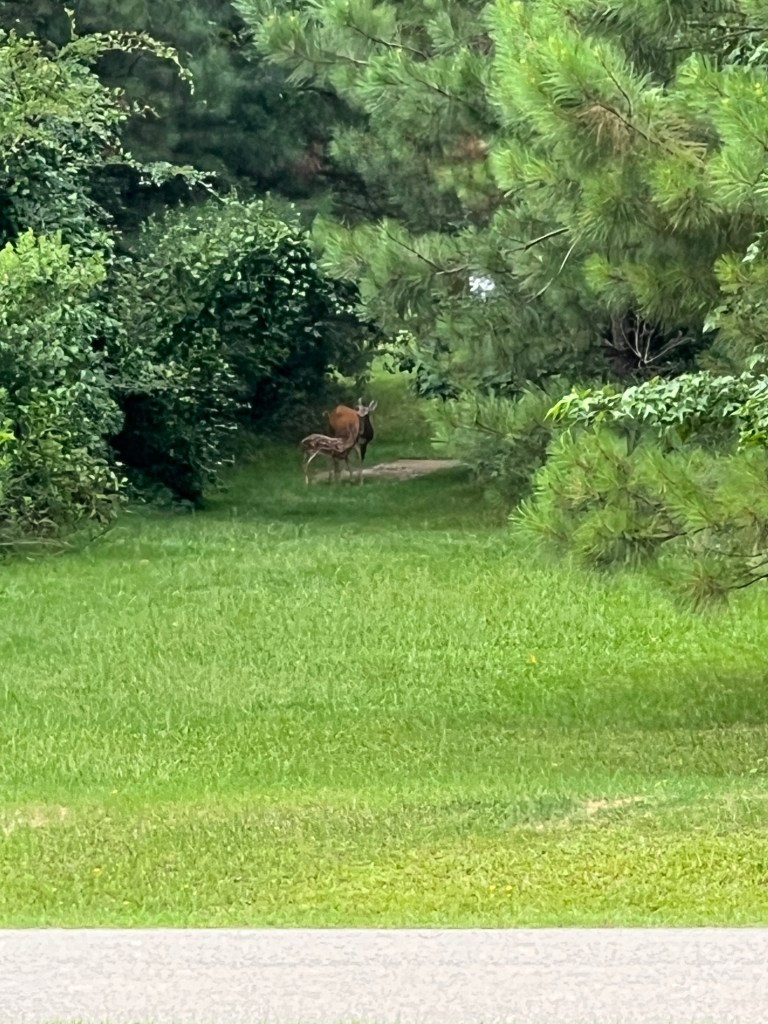
like the doe in the little clearing across the road pausing for one long moment with her two fawns before disappearing in the leafy green
One fawn has already been ushered across
*******
with thanks to Ethical ELA and Two Writing Teachers for the inviolable, invaluable writing spaces and the inspiration
This spring, a pair of Eastern bluebirds raised a brood in a birdhouse on the back deck. From the windows I watched the whole process. I learned much from my avian teachers.
Bluebirds are curious; they want to know everything, including what humans are doing. When the finch nestlings died a couple months back, necessitating that I dispose of the nest, Mama and Papa Bluebird sat side-by-side on the fence, solemnly watching my every move. Bluebirds are all about family. Their fledglings stick around. When this first brood left the next, the parents became fiercely territorial. They attacked the kitchen bay window and cars in the driveway. No matter how far down the driveway my husband parks, they still take over his car; I even saw the father bluebird killing a worm on top of it one morning, like a mighty hunter on some holy mountain. I wondered if that worm was a meal for his children; the parents continue to feed them for a while after departing the nest.
Lesson One of Bluebirdology: protect your young at all costs.
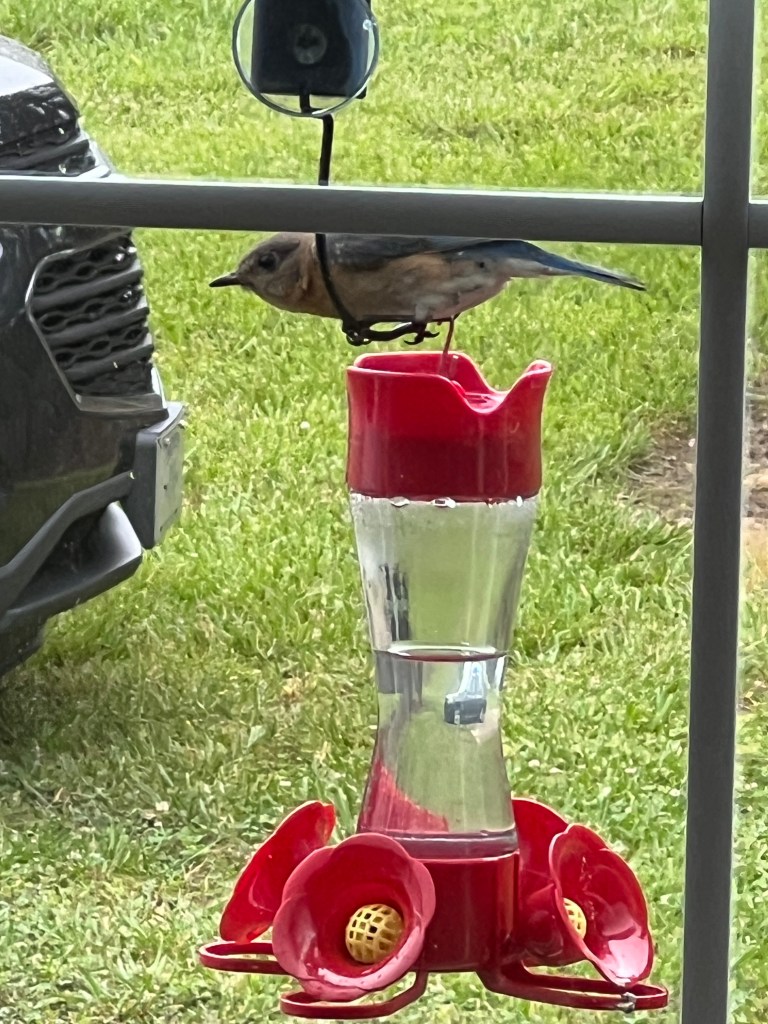
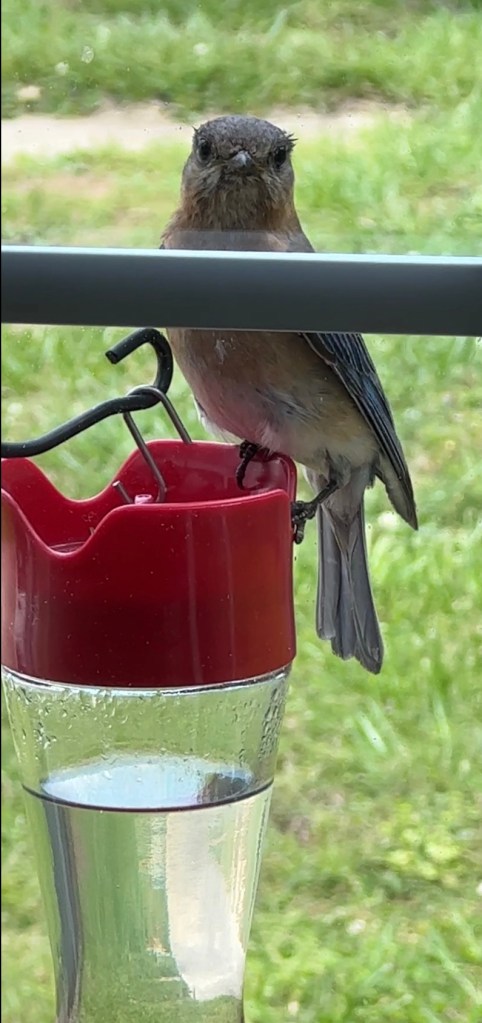
Mama Bluebird takes over the hummingbird feeder, frequently looking in the kitchen window: What are those humans up to?
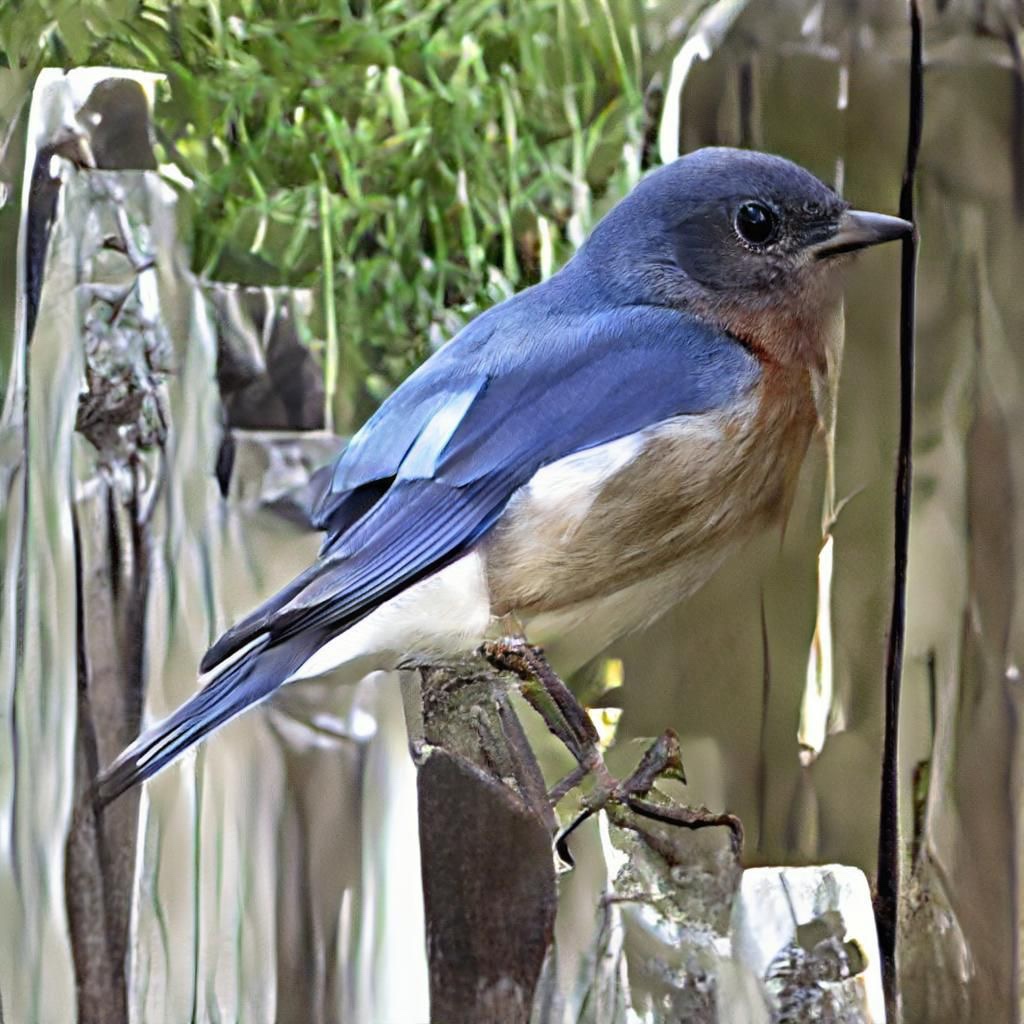
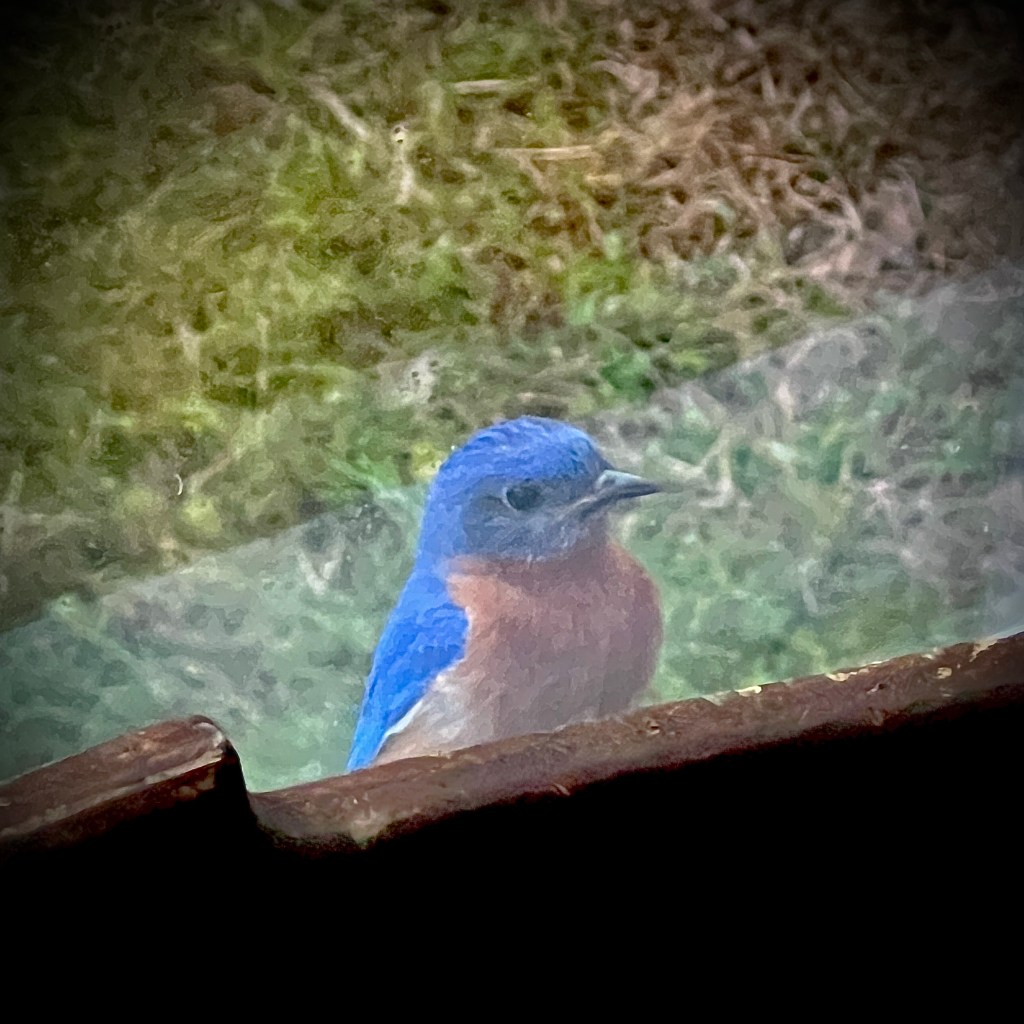
Papa Bluebird in all his blue glory, patrolling the fence.
The baby bluebirds are juveniles now, and over the last few weeks I’ve seen three or four them at any given time in the grass or lined up on the fence.
Lesson Two of Bluebirdology: Persevere.
One of the juveniles getting its own breakfast worm: Ta-daa!
What I find most remarkable is how the juveniles help to prepare for the next brood. I watched Papa Bluebird carry new nesting material into the birdhouse; in a moment, here came one of his children with a bit of straw.
Lesson Three of Bluebirdology: Teach your children well; survival is a community effort.
This weekend my seven-year-old granddaughter and I watched Mama Bird sitting on the fence watching us through the window, when out of the blue came Papa Bluebird. He landed beside his mate and fed her an insect in his beak. “They look like they’re kissing!” exclaimed my granddaughter.
They did. It was a sign, for sure…
I suspected, with the recent activity around the birdhouse, that new eggs were on the way. Here’s the thing: That birdhouse has only one little opening where the birds enter and exit. No way to peek in and verify anything or even to clean out a used nest.This is where the plot really thickens: My husband and I are about to embark on much-needed deck repairs. I needed to know: What’s in that birdhouse? If it is an active nest, by law we cannot disturb it. And if there are eggs… well, to me that makes it a sacred place. Not to be desecrated.
And so I bought a little endoscope and ran the wire camera into the birdhouse.
There are four bright blue eggs in a bed of pine straw.
I am not sure when they were laid. It could be a week or two from now before they hatch. Then it will be about three weeks before this next brood fledges and begins to fend for itself (I am imagining a whole army of bluebirds on the offense at that point, with Brood One still in the wings).
The deck repair will have to wait a bit, alas… not sure how I am going to explain this to my husband or our builder but I will take my chances with them over the bluebirds. In honor of life.
Heeding Lesson Four of Bluebirdology: There’s no place like home.
One of the juveniles still hanging around its natal home.
*******
with thanks to Two Writing Teachers for the Tuesday Slice of Life Story Challenge
Was there a childhood birthday when you woke up excited beyond description for what you hoped that day would bring? It was like that when I turned six. I couldn’t wait for my father to take me to the store where I’d pick out my first pet: a parakeet. I’d begged and begged for one. I was enchanted by birds then, and I am exponentially enchanted now, which is why I woke up so excited last Saturday.
It was to be a day filled with birds…more than I could even count, although I had to try.
World Migratory Bird Day, to be more precise, a global celebration occurring on the second Saturdays of May and October. As defined on the WMBD website: World Migratory Bird Day is an annual awareness-raising campaign highlighting the need for the conservation of migratory birds and their habitats. It has a global outreach and is an effective tool to help raise global awareness of the threats faced by migratory birds, their ecological importance, and the need for international cooperation to conserve them.
In the common interest of science, conservation, and celebration, the Cornell Lab of Ornithology invites bird lovers around the world to count all birds seen or heard on Global Big Day and to enter this data in official checklists.
And so I joined Team eBird with my friend and fellow blogger-poet, Kim Johnson. She’s in Georgia, I’m in North Carolina, but we are birds of the same feather in countless ways, equally excited for this bird-counting day.
It began when I woke up to birdsong early Saturday morning. Lately it’s been a mockingbird, which, I’ve learned, is usually a male singing while the female incubates eggs.
This day, however, the dawn singer was a robin.
I threw on my robe and went outside to start my count as the earth swelled with bird chorus.
Here’s what Merlin Sound ID (a Cornell Lab app on my phone) told me I was hearing out front and on my back deck:
There are also some regular bird friends whose voices aren’t in this mix. Back in the house, a fluttering at the window…
My male ruby-throated hummingbird visits periodically throughout the day, and this day was no different; he arrived early and was off in a flash. I added him to my list.
Then there are my eastern bluebirds.
They’re a mated pair which nested in a birdhouse on the deck before Easter, attempting to be as furtive as possible, until the first week of May when they went stark raving territorial. The female flew and flew at the kitchen bay window. Both of them became obsessed with cars in the driveway; one morning I watched the male killing a worm on top of my son’s car. I am still not sure what prompted the sudden change in behavior, but I suspect their babies fledged and flew, resulting in fierce protectiveness of the habitat. All I can say with certainty is that these two birds believe they reign over the kingdom of my yard.
Because they do.
His Majesty
Her Royal Highness, taking over the hummingbird feeder
Never fear, Bluebirds Dear; I added you both to the list. And you don’t know it yet but I bought a “snake” camera to check your nest in the birdhouse, to see what exactly is in there. More on that later…
Other birds awaited on this Global Big Day. Off to the lake I went, in hopes of seeing eagles.
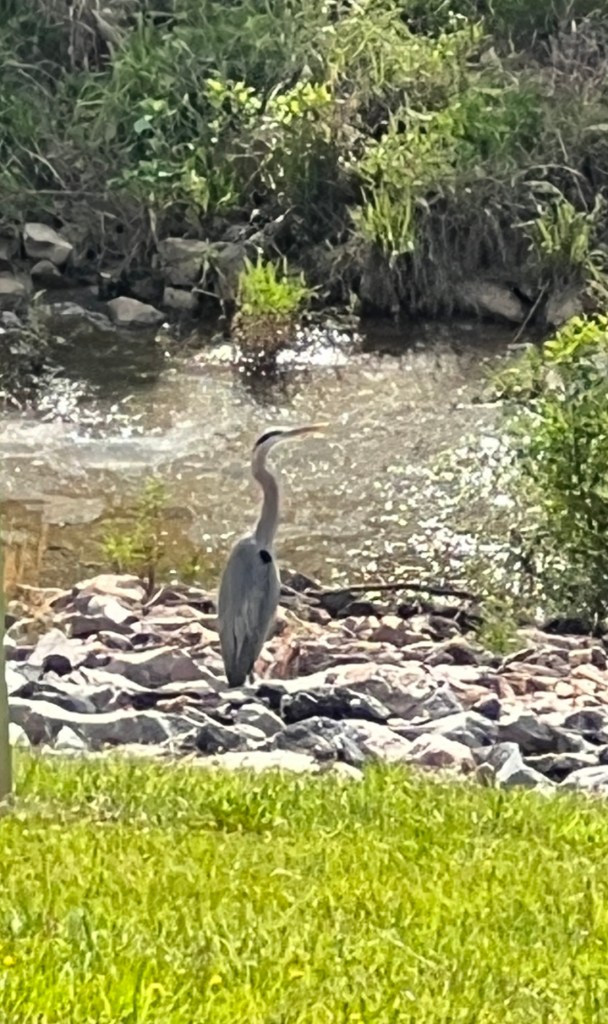
I didn’t see any. But I did see two great blue herons, separately, standing still as statues, as elegiac as poetry, in all their strange and ancient beauty.
They remind me that birds are the last living dinosaurs.
One of the two great blue herons
Over at the dam, a giant nest is protected by government fencing and two fake owls, which don’t seem to bother the two nesting ospreys at all.
One of the two ospreys
After duly noting the ospreys, I made a note to self: Get a good digital camera ASAP. The zoom on the phone can only do so much.
The trip to the lake yielded over thirty species of birds. In addition to those I noted at home, Merlin Sound ID picked up scarlet and summer tanagers, pine warblers, a Swainson’s thrush, Eastern phoebes, brown-headed cowbirds, white-breasted nuthatches, Eastern wood pee-wees, red-bellied woodpeckers and downy woodpeckers, Eastern towhees, chimney swifts, ovenbirds, and the American goldfinch.
Then a huge bird fell straight down from the sky and landed in the brush few feet in front of me.
A red-shouldered hawk. With its beak it grabbed a little snake I’d have never seen otherwise. And then the hawk ran—yes, ran!—into the woods.
I added the hawk to my list as I headed back to the car, exhausted but elated with my bird inventory. I was pretty much done.
But the hawk wasn’t done with me yet.
A little farther down the wooded path, a sudden loud “screaming” of birds— an unmistakable warning of danger, as the hawk sailed by to land on a low pine branch.
I stood as still as I could, videoing that bird for over two minutes while he cocked his head, observing me (does he have a checklist, too?). Smaller birds clamored all around the whole time; some were quite near the hawk, almost like groupies. I couldn’t take my eyes off the hawk long enough to see exactly what the other birds were; Merlin later told me “robins.” Really? I have read that robins are the birds whose warnings make all others take cover but I have never heard them so loud, in such stereo sound. I’d already counted robins, fortunately…then just like that, the hawk took off and the wild screams followed right after him…Elvis has left the building.
Wild.
The red-shouldered hawk, celebrity of the day
Back at home in the evening my family gathered ’round to celebrate my birthday… even more bird-wonder in this day!
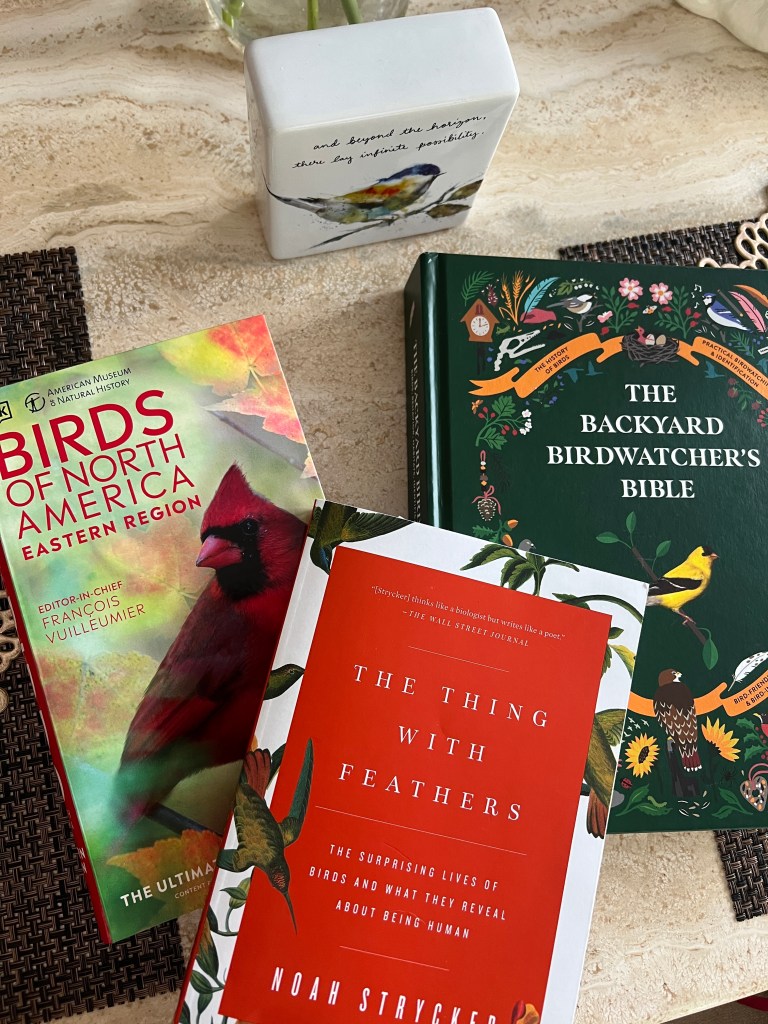
Books on birds and birding
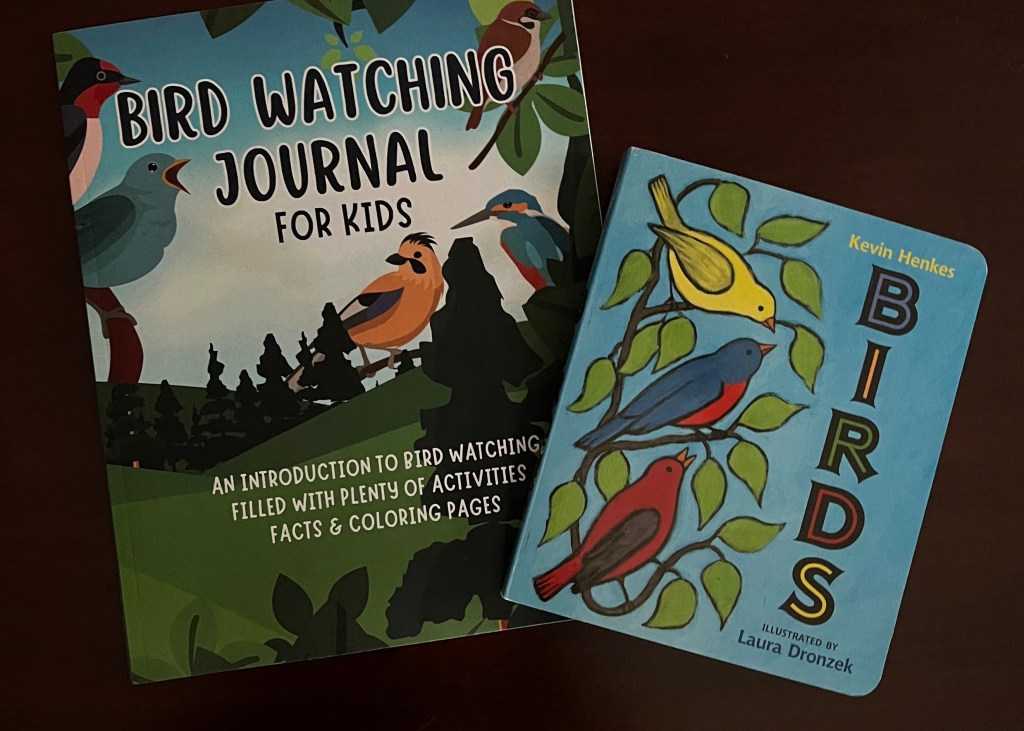
Books to share with my granddaughters, ages seven and eighteen months
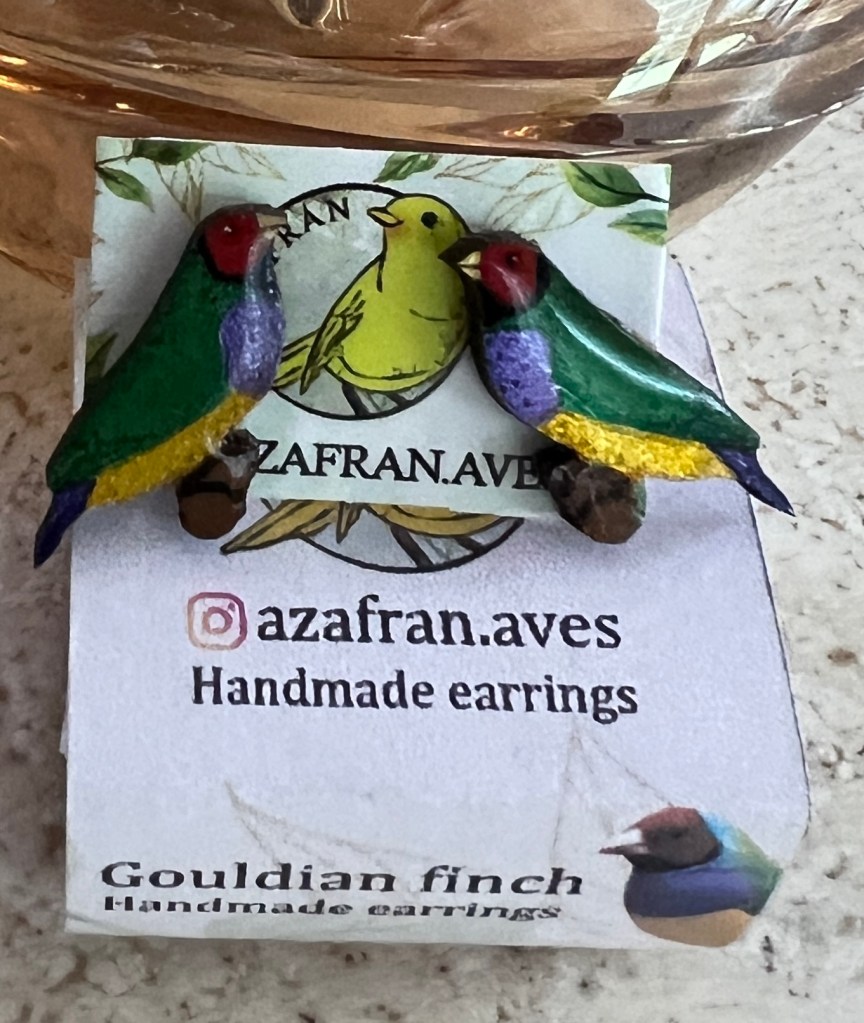
Finch earrings from my son
I settled down to bed that evening, counting my years, counting my birds, counting the many blessings and love in my life….all in all, the happiest of birddays.
I opened one of the new books, The Thing with Feathers: The Surprising Lives of Birds and What They Reveal About Being Human, to read the opening sentence:
Imagine what might happen if birds studied us.
Imagine? There’s no need to imagine...
I know without question that they do.
His Majesty, looking in the window
*******
with thanks to Two Writing Teachers for the weekly Slice of Life story writing challenge to Kim Johnson, for always inspiring me to the Cornell Lab of Ornithology for its amazing mission to all who help protect birds
and to birds, for all the awe and the lessons we need to learn about tending our Earth
For Monday’s VerseLove on Ethical ELA, host Brittany Saulnier extended this invitation: “Today, write a poem inspired by science and perhaps, whimsy…The challenge is to ensure the reader can simultaneously glimpse the scientific concept you were inspired by and a universal truth.”
As always, my thoughts turn to nature. It is always teaching; are we heeding its lessons? Nature’s messages don’t come on words but from its own rhythms and coding. I write much of birds. It is said that they are they last living dinosaurs. Maybe even now they are the impetus, in their always-inspirational way, for my digging deep to see what I might find…
Existential Dance
sea and earth earth and sea complicated choreography
streams of movement building higher freeform deposits wetter, drier
life rising, falling layer on layer it’s all timing, timing, the dragon-slayer
everything alive to remain, must eat until nothing remains but remains under feet
strata with volumes lined on a shelf stories kept secret unto itself
sea and earth earth and sea consolidated choreography
streams of movement releasing the store freeform deposits washing ashore
when miners come millennia later scratching their heads no translator
for what they’re seeing drawn from the earth looking for phosphate to be stunned by girth
of ancient teeth from a creature long gone scientific name:
Megalodon
(meaning “big tooth”) —what great irony this turns out to be last laugh of earth and sea
monster-shark teeth unearthed in a way with a side effect: workers’ tooth decay
everything alive to remain, must eat until nothing remains but remnants…of teeth
sea and earth earth and sea conspiratorial choreography
Carcharocles Megalodon Tooth. 5.4 inches long, 4.4 inches wide. Excavated from Lee Creek Mine, Aurora, North Carolina, USA. Public domain.
My grandparents lived on the outskirts of tiny Aurora, North Carolina, home to the largest phosphate mining and chemical plant in the world (miningtechnology.com archive). In the 1970s, prior to the establishment of the Aurora Fossil Museum, “rejects” or unwanted gravel material from mines were scattered on the many dirt roads around the area. As a child I walked in these rejects along the old dirt road by my grandparents’ home, finding bits of coral skeleton, shark’s teeth, possibly some Megalodon teeth, and fossilized eardrums and vertebrae of log-extinct creatures. Now visitors can dig through this material in the fossil pits at the Museum, which will host its annual Fossil Festival May 26-29.
The April 2023 edition of Our State Magazine contains an article by Katie Schanze about Aurora and its fossils: the area “produces the most prolific fossil record of Miocene (2.3 million to 5.3 million years ago) and Pliocene (5.3 million to 2.6 million years ago) marine life on the Atlantic coast.”
It was by chance that I stumbled across references elsewhere stating that one of the detrimental effects of phosphate mining is tooth decay from prolonged exposure to fumes of chemicals used in the process. What irony, I thought, tooth decay caused by mining something used as fertilizer to grow food, while simultaneously finding preserved teeth of one of the mightiest sea predators ever to have lived…which likely went extinct due to loss of food.
*******
with thanks to Brittany Saulnier for the poetic inspiration on Ethical ELA and to Two Writing Teachers for the Tuesday Slice of Life Story Challenge and Our State: Celebrating North Carolina, Vol. 90, No. 11
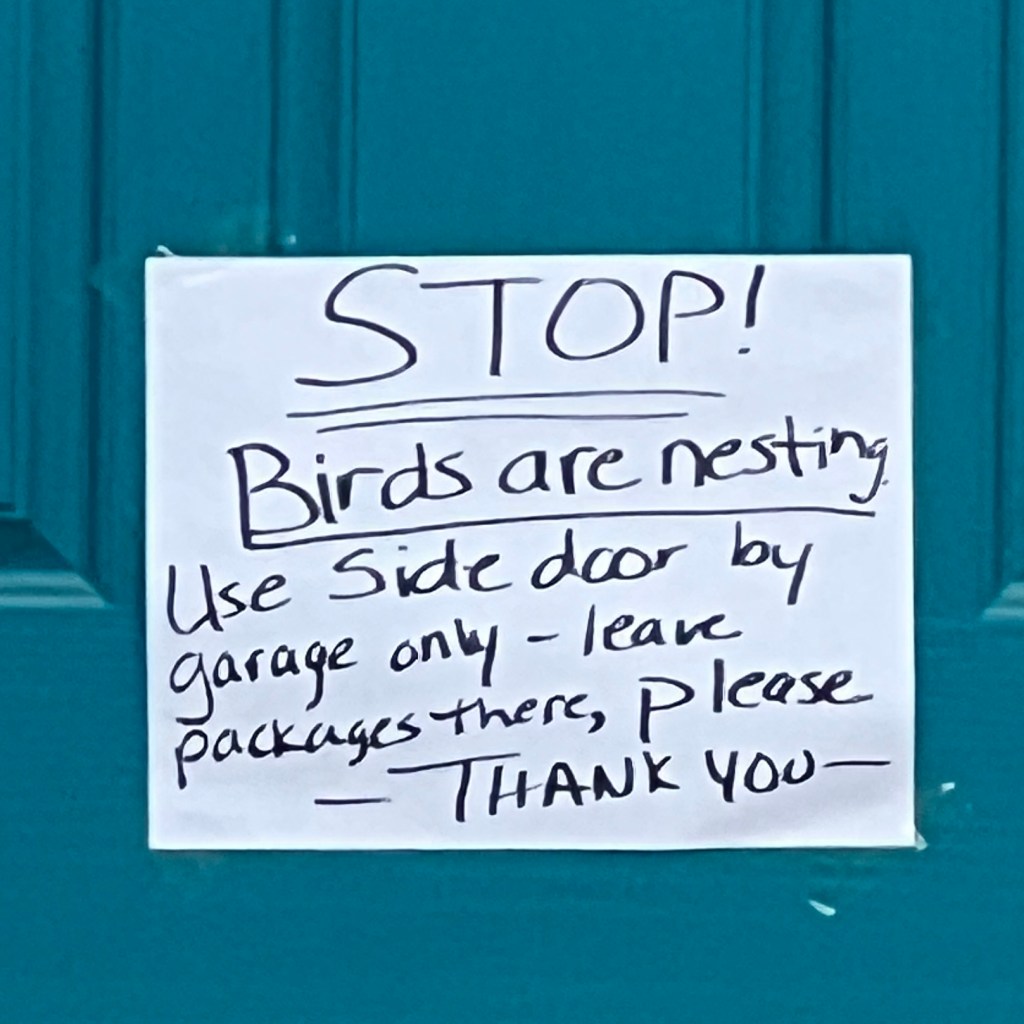
Thank you for respecting my taped-up signs that say stay away from the front porch it’s a bird sanctuary again the house finches nested early on the door wreath I left for them Mama laid four tiny eggs in blue cold mohawked nestlings hatched in a snowfall by mid-March I thought the fledglings had all flown, for there was no more happy chatter-song at the door and when I checked I found two perfectly beautiful fledglings dead in the nest
how why what happened here
I placed them together in a deep pile of dry leaves at wood’s edge because birds do not bury their dead they are creatures of the air
I tore down the death-nest and my taped-up signs
and read online that birds grieve the death of their young
the next day blades of green grass appeared on the wreath where the nest had been
the day after that, more grass and flowered strands
scientists say that only the mother finch builds the nest but I am here to tell you that the father worked just as hard
in tandem they flew with string and fluff in their beaks chattering their architectural plans
in five days, recreating what was lost
and now in the most exquisitely-lined nest I’ve ever seen
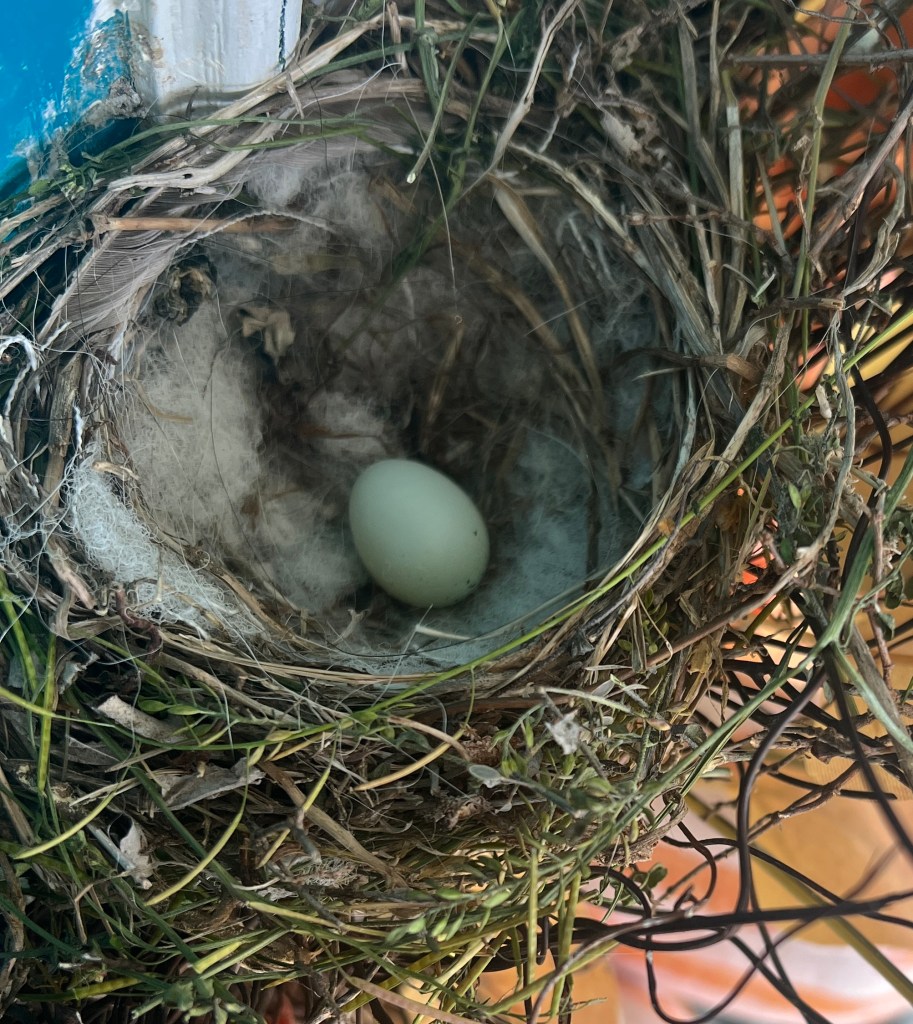
there are new blue eggs
exactly two
so thank you, Delivery People for reading my freshly-taped signs
this is a sacred little space where miracles of nature take place
******* with thanks to b.c. randall for today’s VerseLove invitation on Ethical ELA:
“Write today’s poem for someone else: the boy who bags your groceries, the neighbor who walks by your front window every day, that colleague or friend who has been on your mind. Craft the poem to be left for another to unwrap (a gift that we all need).”
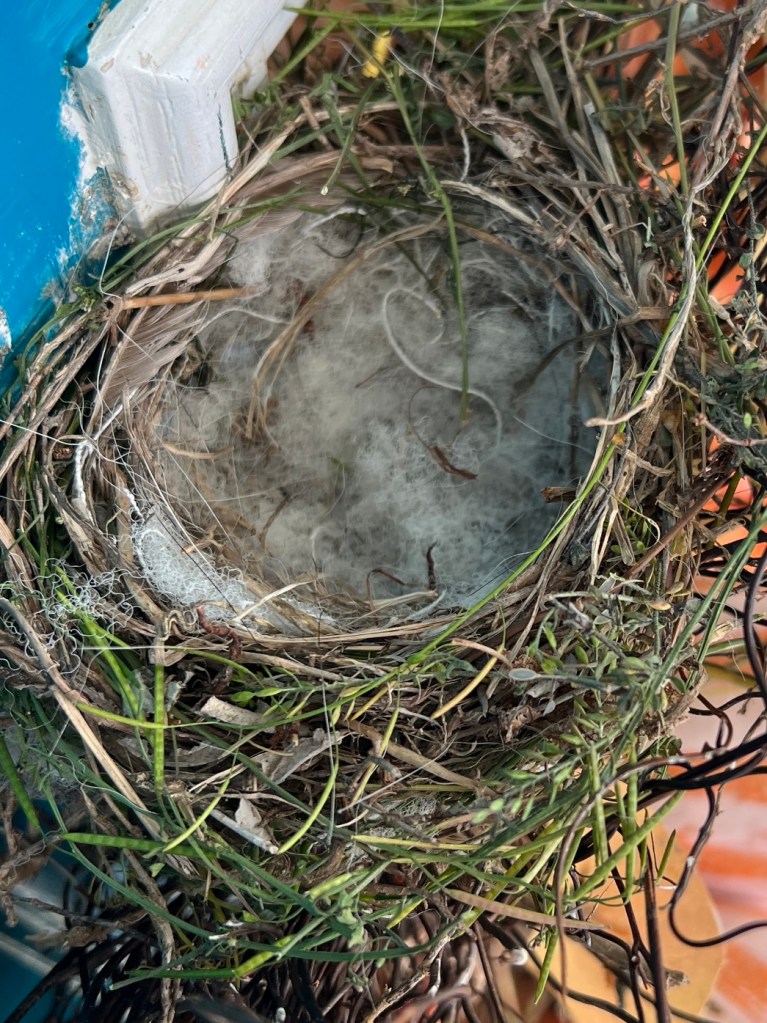
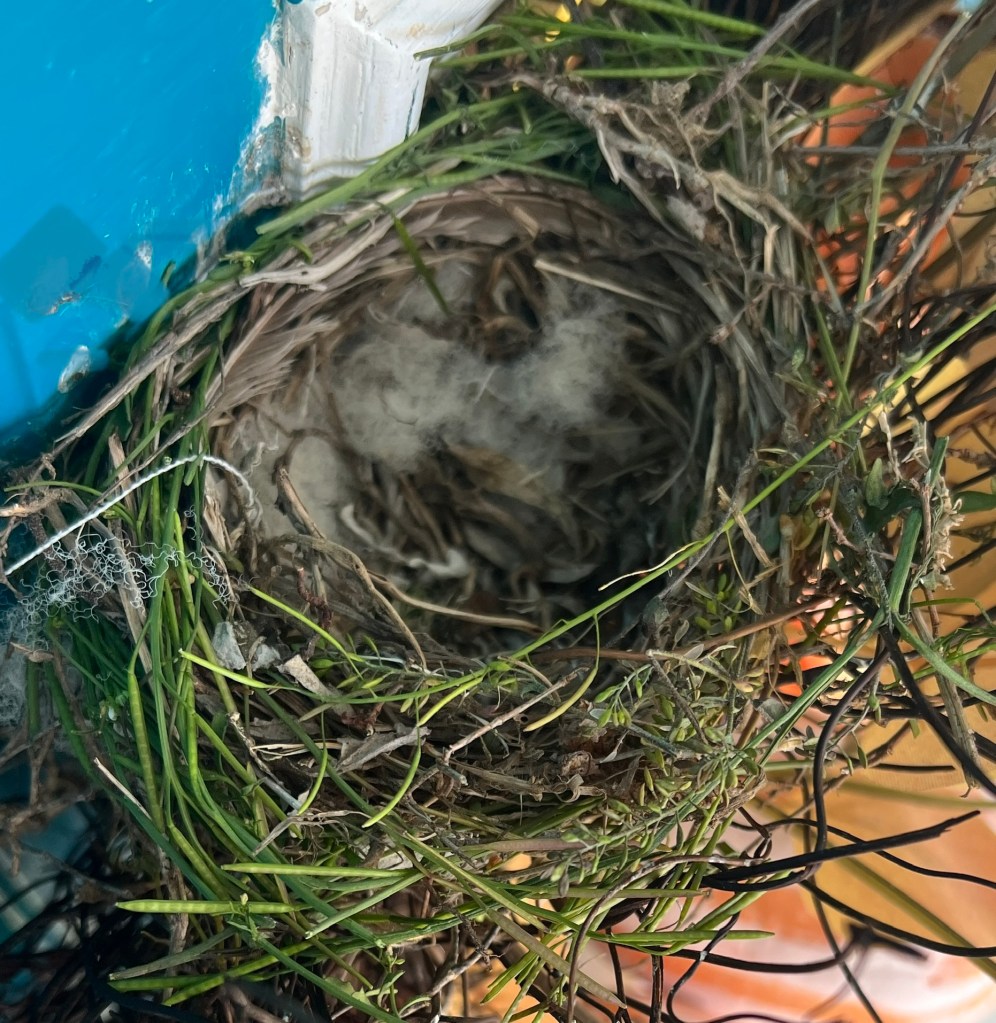
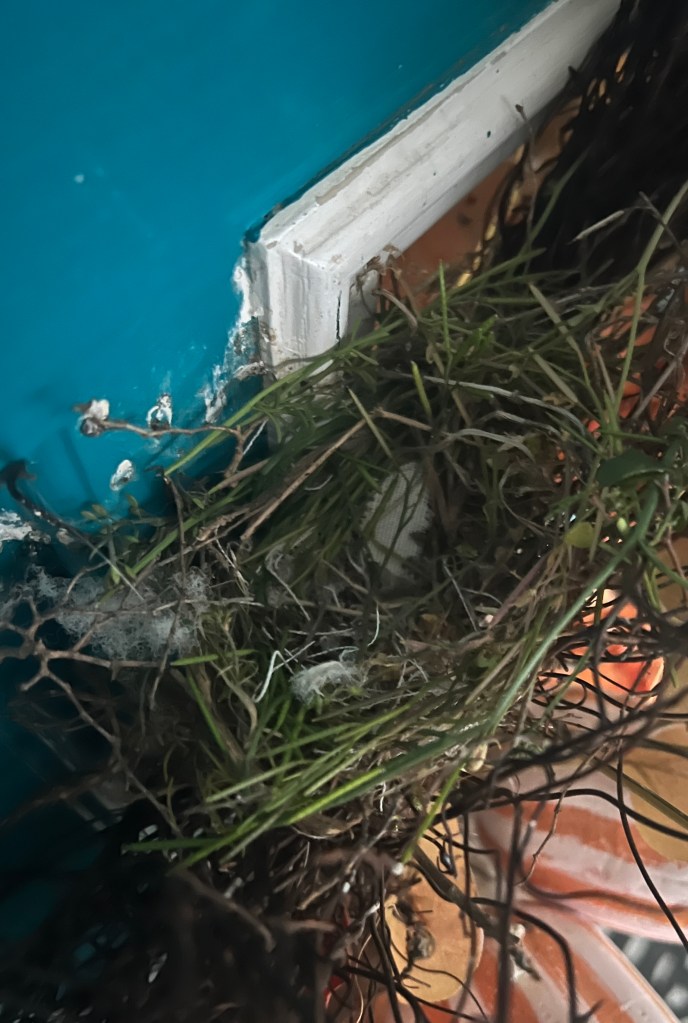
On the fourth day of rebuilding after tragedy, here’s what the new house finch nest looks like:
In all the years of finches raising broods in my front door wreath, I have never seen a nest lined with such deep layers of fluff and feathers. The little blue eggs to come any morning now (prediction: the first one on Sunday) will be so well-cradled, so tenderly sheltered.
This week I read that birds mourn the loss of their young.
I believe it.
I also believe, looking at this nest, that my house finches are determined not to lose any more.
*******
Backstory/timeline:
March 1: Auspices – discovery of an unusually early nest and eggs laid in February (with photo)
March 5: Eavesdropping – audio of the parent finches’ joyous chatter
March 14: Nestlings – likely hatched during a snowfall (with photo)
a favor or gift bestowed by God, thereby bringing happiness.
—Dictionary.com
*******
I could hardly wait to get home yesterday to check the progress of the new finch nest on my door wreath.
On Day Two, it now has the characteristic cup shape. It’s lined with white fuzz, a soft cushion for the precious eggs to come.
It is comprised almost exclusively of fresh green grass. The color of newness and life.
House finches are said to represent new beginnings.
Their nests always fill me with awe, and never more than now, watching the parents working together to rebuild immediately after two of their babies died in the previous nest, which I tore down. Confession: I wasn’t sure I was doing the right thing. Nature is mighty, ever-resilient, wise; it is imbued with regenerative power. Yet there are so many delicate balances within it. I didn’t want to upset any of these. I am a mere student of these birds. They are the experts.
So to see this nest being built in the exact spot as the ill-fated former one is a gift. It sends my spirits soaring, exponentially.
House finches are considered symbols of joy. If you ever hear one singing, you understand why.
In some parts of the world, they’re called the blessing bird.
They chose my door years ago as the place to bring new life into the world. I now share the wonder of it with my seven-year-old granddaughter, our “nurture scientist.” Together we have witnessed the miracle of tiny life coming into existence and eventually taking flight. In a couple more seasons, her baby sister will be able to enjoy it, too.
After I took this photo of the new nest, rejoicing and wondering when the first egg will appear, I went into the house to find a mysterious package my husband had retrieved from the mailbox.
Neither of us had ordered anything.
Curious.
I opened it…
A gift from a friend I met through writing, who reads about my finches each spring, who knows of the recent loss.
I am awed again.
A writing community is like a nest: a safe place especially created for growth, where we nurture one another and encourage each other to stretch our wings and fly.
It is here that we learn the true power of story and how it knits our hearts together. In the beginning, in the end, we are story.
To live it, write it, build it together, is a gift.
And the time for doing it is now. Today.
My love for the finches, like my love for writing, is inextricably woven through and through with gratitude for the blessings in my life. It’s all a song in my heart, greater than words.
Each day brings its own gifts. It’s up to us to see them, accept them, celebrate them.
And to give in return.
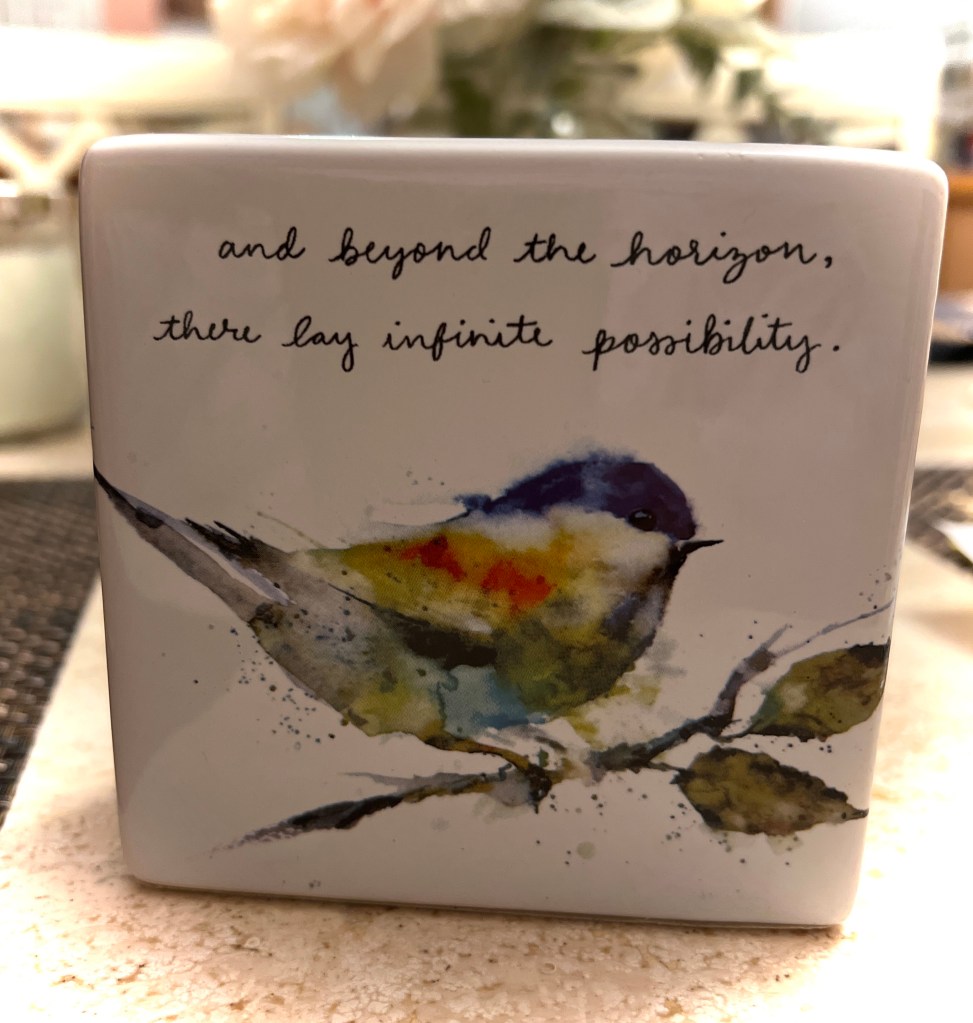
Beyond the horizon Lies infinite possibility Eyes cannot see. Sky meeting sea Sea meeting sky… I fly ever onward Nested and rested in the Giver of every good and perfect gift.
Today, there might be an egg.
******** with thanks to Two Writing Teachers for the monthlong Slice of Life Story Challenge
On Monday afternoon I came home to check the nest on my front door wreath, expecting that finch fledglings had flown. They are the earliest brood I’ve ever known: four tiny blue eggs laid during the last week of February and hatching by the second week of March; I discovered a pile of fuzzy gray, mohawked nestlings after a snowfall.
By Monday, as the temperatures finally warmed, I hadn’t heard their happy chatter at my door in a day or so. I assumed the babies had left home; it was just over two weeks after hatching, which is normal.
But that afternoon I found two perfectly beautiful fledglings dead in the nest.
First time this has happened in all the years of house finches adopting my porch as their sanctuary. No real clue as to why. Inexperienced parents? Doubtful, as nesting in my wreath is an established pattern and the finches are quite prolific. Disease? Maybe; but where were the other two babies? Sustained freezing temperatures? Possible. Survival of the fittest? Probable.
No sign of the parents. Had something happened to them? Had they abandoned these little ones? If so, why?
I stood before the nest, icy shock quickly melting into grief.
It had to be dealt with…
Armed with paper towels and cloths, I extricated the tiny lifeless babies. I carried them to the edge of the woods out back and covered them, together, in a deep bed of dry leaves. I couldn’t just throw them away; they had been living things. They had been growing. I couldn’t bury them; birds don’t bury their dead and furthermore, they’re creatures of the air.
They never got to fly.
I bid the babies goodbye and told them I was sorry that this was the best I knew to do for them, to let nature reabsorb them.
Then, the nest.
Finches sometimes reuse them.
If I were a mother bird, however, I wouldn’t want to reuse a nest where two of my precious babies had died.
I decided the nest—every one a unique masterpiece, this one threaded with tiny dried flowers and padded with white hair from some mammal—had to go. In case there were mites or germs or traces of decay…
It should be burned, I thought, as I pulled it away from the wreath.
Instead I wrapped it, bagged it, and threw it in the trash.
I almost threw the whole wreath in the trash, too, but just as I took it down, I remembered how, all winter long, two little birds slept in this wreath together at night, keeping each other warm, sometimes startling me by flying out when I opened the door.
No doubt it was the finch parents, staking their claim until nesting season.
I couldn’t throw the wreath away.
I guess…I know… well, just hoping…
I shook out the wreath and hung it back up.
Monday evening, I was forlorn. I read everything I could find online about bird babies dying in nests. I read that bird parents grieve for their lost ones. I peeked out of the front blinds; I am sure I saw a little shadowy figure on the porch railing, just as it saw me and darted away, without a sound.
I didn’t sleep well.
Tuesday morning, as I got dressed for work, the silence was depressing. This is the time I’d hear them most, the parents with their song-chatter, the chorusing baby voices…
So I went outside with my Merlin Bird Sound ID app. It picked up robins, a mockingbird, a Carolina wren, a chipping sparrow, a mourning dove…no house finches.
I drove to work heavy-hearted, knowing that there are countless other birds for the savoring and that in the human world incomparable horrors are steadily unfolding…yet that’s why the finches matter. One bit of joy that softens the edges of the blade. A little song of light against a devouring darkness. A tiny comfort on the wing, a fleeting moment of transcendence…
Tuesday afternoon I came home and checked the wreath.
I don’t know what I expected. I don’t even know if this is wise or healthy (when is a thing officially an obsession?).
It didn’t look any different. I thought I saw one shred of green grass hung in the grapevine where the nest used to be…probably a remnant.
I tried Merlin Bird Sound ID again. —Crows! You are SO. LOUD. Chickadee, cardinal, dark-eyed junco…blue-gray gnatcatcher? Chipping sparrow, osprey. —Osprey! Several of them, impossibly high overhead, calling in their wild, echoing sea-song bursts.
But even in my awe…no finches.
As I turned to leave the driveway a bird sailed right past my head to land in the crape myrtle.
I couldn’t believe it: Papa Finch! Speckled brown, gorgeous red head…I’d know him anywhere.
Then another swoop over the fence to the backyard, not so far from where I laid the babies to rest…is that Mama Finch? Am I making this up? The power of suggestion, or wishful thinking? Writer’s imagination?
I came back into the house to watch a while through the beveled glass of the front door… clandestine operations…
It wasn’t long before he appeared on the garage roof top.
Papa Finch.
With something trailing from his beak.
‘THEY ARE REBUILDING!” I cried aloud to no one, before I remembered to be clandestine.
Sure enough, Mama Finch soon joined him… appears they have a personal stash of building materials on top of my garage, for they took turns swooping to the front door.
Making a new nest, in a big hurry.
If you have time, watch the short video; it is the first footage I’ve ever obtained of the house finch parents. I’ve never even been able to get a photo. But here’s Papa holding wisps of nesting material while Mama sets hers in place; she returns, and he goes to add his layer.
In the exact same spot as the nest I removed the day before, with the lost babies.
This is what they accomplished in one afternoon:
Look at those soft white pieces procured by Papa.
They’re not done, of course, but are working feverishly in tandem; I suspect Mama is ready to lay more eggs…
If I know my finches, they’ll start hatching right around Easter.
And he that sat upon the throne said, Behold, I make all things new —Revelation 21:5.
For the first time, I rejoice at tearing the old nest down. I marvel at the fortitude of these little birds, prevailing today over yesterday’s loss, pressing on with urgency. They have a contribution to make to the world. This is not the first time, nor surely the last, that I am awed by the resilience and regenerative power of nature. It’s all doing exactly what it is meant to do…with hope and healing for the taking.
Courage, dear hearts.
*******
with thanks to Two Writing Teachers for the Slice of Life Story Challenge







 lit bits and pieces