It all started last month when I saw one hummingbird in the backyard, out by the pines.
She appeared from nowhere, hovering stock-still in the air across the yard, directly facing my son and me as if to consider what manner of beings we are before she darted away—poof. Perhaps it’s just my overactive imagination, but I felt like some sort of message was in this magical appearing. Something the bird wanted…
I bought a feeder.
In a day or so, I had a bird. Or two.
Then there seemed to be three. All females.
Eventually a male showed up with his gorgeous fiery throat. From a distance he looked like a flying ember. He preferred coming early in the morning or around suppertime. It’s almost like His Tiny Royal Highness was letting his Royal Nectar-Tasters go before him to be sure the stuff wasn’t tainted. I cannot say, however, that he was any match for the females in regard to which was most vicious in the dive-bomber approach of driving all others away from the sugar water.
Hummingbirds are contentious creatures. Terribly territorial.
I’ve learned there’s a scientific reason for this: Their metabolism requires them to feed almost constantly. Hummingbird hearts have been recorded, I read, at 1200 beats per minute.
I bought another feeder.
As of mid-August, there’s a squadron of hummers at my feeders, so much so that the original feeder hanging on the kitchen window has to be refilled daily; I had to buy more sugar. I know that ruby-throats (the only kind of hummingbird that breeds in the eastern U.S.) are supposed to start migrating to central Mexico. The males go first, in early August, which explains their current scarcity, I think. Females wait a while longer. I’ve also read that some hummingbirds stay in residence all year. We shall see… I have learned to recognize some individual females by their different markings: one with black speckles all down her pale breast and belly, one with a pure ivory belly and a brighter, iridescent green back, one with a darker head, one with a lighter head and pale stripe on top, and one with a precious, tiny dot of red at her throat, like a lady bedecked in a ruby pendant. When I opened the blinds one morning last week, there was Little Ruby, hovering in the gray dawn; we were so startled by each other that we both froze for a split second in mutual awe (wonder on my part, likely fear on hers) before she zipped away.
At this point I must mention my grandmother. Hummingbirds and cardinals were her favorite birds, perfect symbolism for a woman named Ruby. I saw my first hummingbird by the spirea bushes in her yard one summer. The loud buzz of the beating wings alarmed me—was this a big bug coming after me?—but Grandma Ruby’s childlike delight quickly allayed my fear. And then there was nothing but enchantment for this tiny, dazzling fairy of a creature, glittering like an emerald, my own birthstone, in the sun.
Perhaps that is why I took my six-year-old granddaughter out with refilled feeders yesterday:
The hummingbirds hide in the crape myrtle and cheep at me whenever I take their feeders down.
They do? Why, Franna?
They just want their nectar. They are saying ‘What are you doing with my food!‘
I haven’t ever heard them cheeping.
Today you will.
And so, for just a moment, I held the favored window feeder out at arm’s length as my granddaughter stood by, very still. Two hummers appeared instantaneously, cheeping competitively before hovering, suspended in the air, eyeing me, uncertain, their whirring wings as loud as electric propeller fans. Each took a tentative drink before whizzing off to the pines out back.
I hung the feeder and my granddaughter said, Quick, let’s go in before all those wings come back!
I chuckled, remembering my first experience with the intimidating sound when I was about her age. We darted for the door. As we entered the house, she said: I heard them cheeping!
And then, before I could reply: Franna, look!
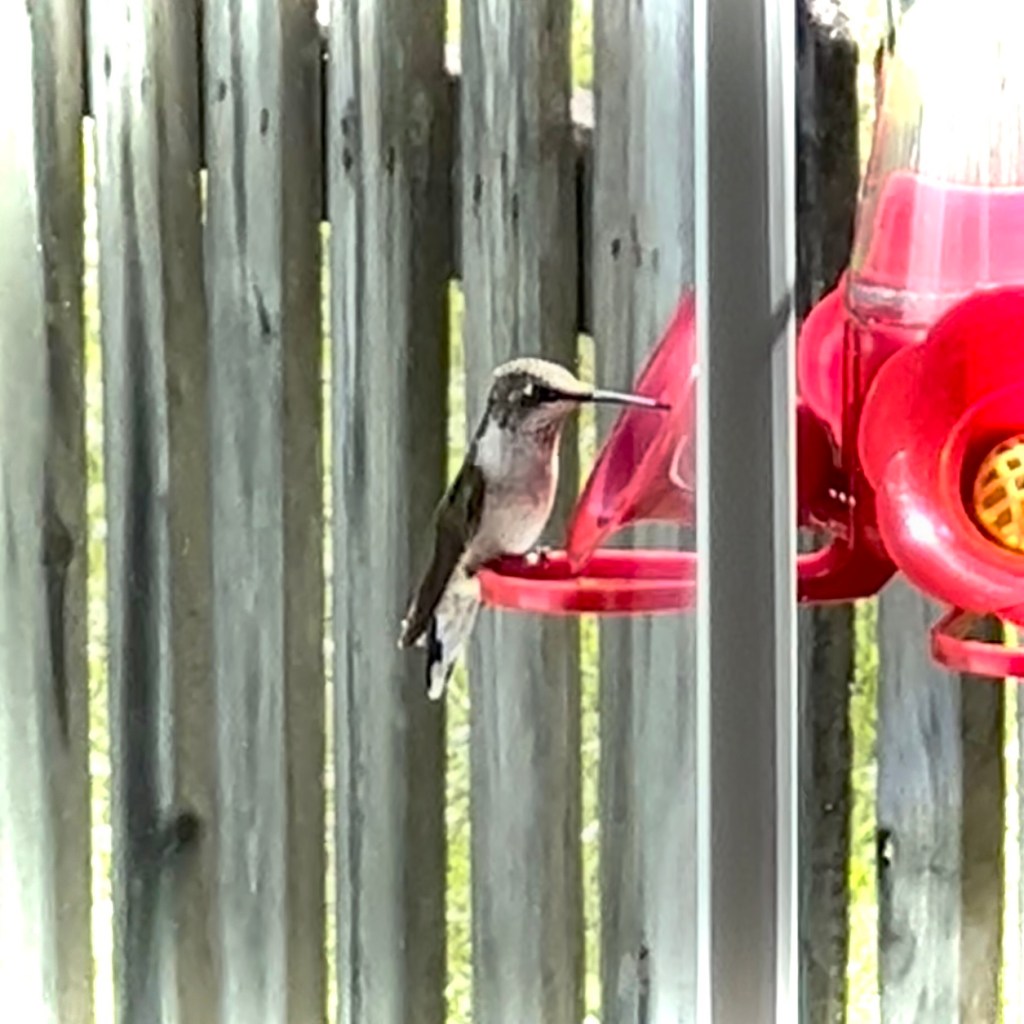
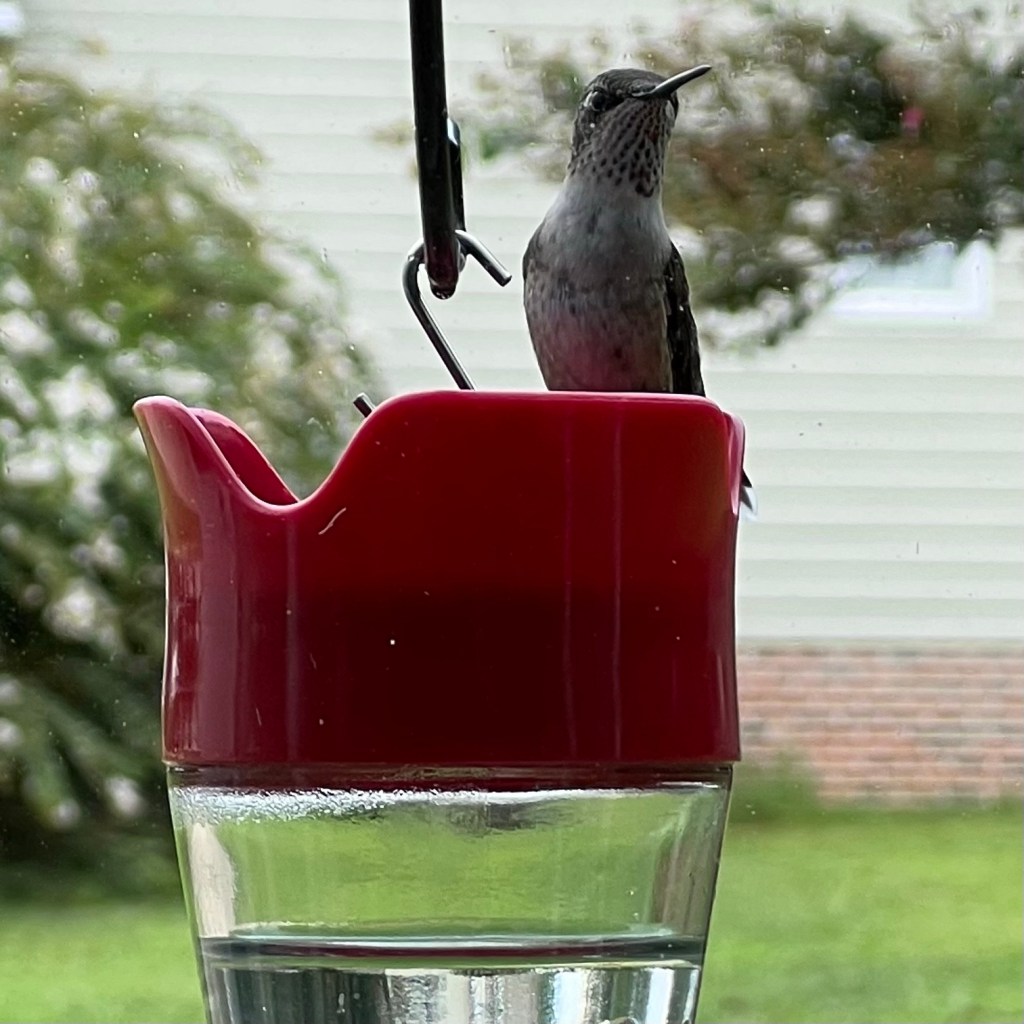
She pointed to the window, where a hummer was perched on the very top of the feeder.
Well, that is something new, I said. I haven’t seen any of them sitting up there before.
My husband, sitting at the kitchen table preparing a sermon, said: That bird was perched on the feeder hanger the whole time you were fixing the sugar water.
I am sure she was one of the two who dared to take a drink when I was holding the feeder.
For the rest of the day, this little bird perched, fed, flew off in skirmishes with other tiny feathered Amazons, and returned. Whenever I looked at the window, she was there, looking in, occasionally fluffing her feathers. I am not sure if she’s nominated herself Queen of This Feeder or if she’s simply curious—hummingbirds are known to be extremely so—and is watching me as I play with my granddaughters and cook supper.
I suppose the ultimate question is who’s observing whom.
And what we are learning about each other in the process.
Didn’t realize, until I reviewed the day’s photos, that I happened to catch her with her tongue extruded. Every minute with hummingbirds filled with absolute wonder. I have christened her Lilibet, the nickname of Queen Elizabeth (since she seems to be reigning over the feeder) and also in honor of my great-aunt Elizabeth, Grandma Ruby’s sister. I wrote about Aunt Elizabeth’s hummingbirds a couple of weeks ago: Solitary existence.
Next goals: 1) Get a good photo of Little Ruby and 2) Invest in hummingbird feeder rings for my granddaughter and me to wear…can we stand still enough for them to come drink from our hands? Will they actually do it?
*******
with thanks to Two Writing Teachers for the weekly Slice of Life Story Challenge



 lit bits and pieces