Twilight’s gleaming

Twilight Zone

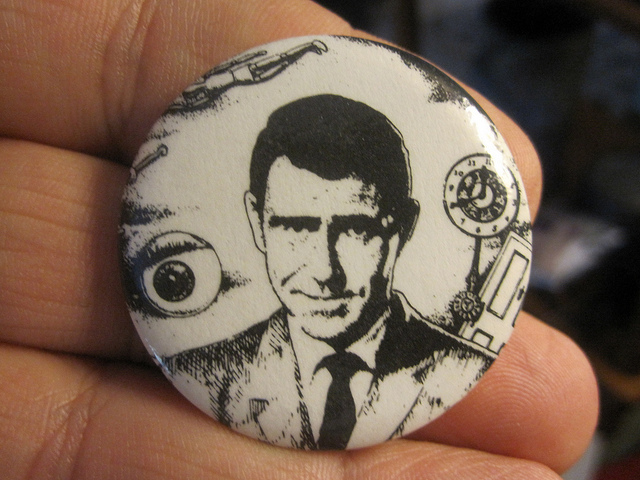
Rod Serling – Twilight Zone Button. Tony AlterCC BY

“It is a dimension as vast as space and as timeless as infinity. It is the middle ground between light and shadow, between science and superstition, and it lies between the pit of man’s fears and the summit of his knowledge. This is the dimension of imagination. It is an area which we call the Twilight Zone.” 

– Season One opening narration, The Twilight Zone television series (1959-1964)

What’s your Fourth of July tradition, fellow Americans?

For my family, it’s watching The Twilight Zone marathon on Syfy.

I have to ask myself: Why do I love this series? Why is it so addictive? After all, special effects have advanced light-years since these shows were filmed; some of the outer space/alien/futuristic costumes and settings are primitive, even laughable. Rod Serling, garbed in dress jacket and skinny tie, strolls out of inconspicuous places – other rooms in houses, offices, or even the woods – to comment on the rising action and the characters,  occasionally smoking a cigarette in true ’60s vogue.

Part of the fun is seeing famous people when they were heartrendingly young, when their stars were still on the rise: Carol Burnett, Telly Savalas, Elizabeth Montgomery, William Shatner (THE Captain Kirk, before the inception of Star Trek). There’s Burgess Meredith, the best of the best character actors, Mickey Rooney beautifully playing an angry drunk. The furniture and props in many episodes, some fashionably chic, some commonplace, are now vintage, nostalgic slices of a bygone era. Something must also be said for the show’s camera work, the strategic zooms, the compelling close-ups. In truth, between some captivating characterizations and the cinematography, there’s a great bit of artistry in The Twlight Zone.

But all that’s just part of it. What really draws the viewer, ultimately, is the story.

The Twilight Zone breaks the dimensions of time and space, to be sure – it takes us away from Earth, brings us to an Earth we don’t recognize, allows us to step into the past and sometimes into a future that isn’t future anymore (I just saw a calendar on the wall of a restaurant in  one futuristic episode: 1974. Geez.). Statues come to life;  a warm, vibrant grandmother is really a custom robot; dolls talk, wreaking havoc and destruction. People down on their luck find good fortune; people lose fortunes; people are at the mercy of forces greater than themselves; people possess supernatural powers that are often abused or taken advantage of by others.

The most haunting thing about The Twilight Zone isn’t the supernatural, however. It’s the journey within, the recognition of the worst parts of ourselves. Selfishness and greed are common themes, with catastrophic consequences – not that the Zone is didactic. In the spirit of the best short stories, with O. Henry-esque twists at the end, The Twilight Zone follows the dark convolutions of the human psyche. Endings are intriguing, but not always happy.

My favorite episode is “A Stop at Willoughby.” A man is locked into a job he hates by a demanding, socialite wife; a hardcore boss berates him for his ineptitude and lack of drive. He’s miserable; he can’t please anyone, least of all himself. On the train commute between home and work, he falls asleep and dreams of a stop that isn’t on the line – a back-in-time place, where women carry parasols and children go fishing and men ride penny-farthing bicycles (the ones with the huge front wheel). The vision of this place, Willoughby, is so real and inviting that the man thinks about getting off there in his dream.  He wakes to the ongoing pressures of his life, but yearns more and more for the slower, contented pace of Willoughby. His wife mocks him for wanting to be Huckleberry Finn, then turns her back on him just as he caves from the pressures at work. On the train, he dreams of Willoughby once more, and this time he gets off, where the townspeople greet him cheerfully by name, as if they’ve always known him, as if he belongs there.

The story doesn’t quite end here; there’s a final scene with a big final twist, but I would be the ultimate spoiler if I told it here. The episode – all the episodes – are meant to be experiences for the viewer. Here’s part of the closing narration: “Willoughby? Whatever it is, it comes with sunlight and serenity and is part of The Twilight Zone.”

Perhaps that’s the pull of the Zone – that beyond the darkness, horror, oppression, bad choices, fears, the worst of humanity, there lies something better, that’s worth the pain of overcoming. Where morbid fascinations, bystander mentalities, selfish desires and regrets melt away. A place of healing, of peace, of freedom – where the best of humanity thrives, has a voice that’s heard. It’s not a place to be merely maintained, but is always being actively created.

What does that sound like to you? What would a Magic 8-Ball say?

Utopia? Very doubtful.

America? Most likely.

The Twilight Zone? Yes definitely.

So celebrate.

Cherish. Savor. Digest. Mull.

Not just food, but your tradition, your story. Yours as well as others’.

And see beyond.
 

In-between places

Gloomy forest

Gloomy forest. gorchakov.artemCC BY

I read the final page and close the cover. The idea of being separated from someone you love intensely, whether by distance, time, or circumstances, comes with a stab so sharp that it almost isn’t bearable.

Never mind that The Time Traveler’s Wife is fiction. The frequent separation of Claire and Henry, especially their final one, is crafted with this piercing truth, the longing for the “in-between” period to be over so that the characters can be together again. Sometimes the interim lasted for years.

While Claire and Henry usually had the advantage of knowing the duration of their separations thanks to his time traveling, the rest of us don’t get such clear glimpses of the future. We have to endure the various in-between stages of our lives, not knowing how long they’ll last, not being able to speed up time, not knowing the outcome, often having little or no control.  These in-between places are often laced with deep aching, a sadness and desperation at being apart from someone we  love. Existence is as flat and barren as a desert. The emptiness is huge, frightening; we want to rid ourselves of it before it consumes us. The scope of this in-between-ness is too much for us. The loss cannot be dealt with as a whole but only lived through in chunks  – a day, maybe just an hour, at a time.

There are in-between places other than those of relationships. The loss of a job, long illnesses, hardships, disasters – all can be dark places that sap our strength, sometimes with no foreseeable guarantees that all will end well. Living in these situations is like navigating a dark, unfamiliar forest. Not knowing which way is the shortest or best way out, we often go in pointless circles without realizing it.

I recall an in-between place that’s quite different. It’s remained in my mind since I was a child, on my first reading of The Magician’s Nephew.

It’s called The Wood Between the Worlds.

In the attempt to move from our current world to another by wearing magic rings, two children land in a sort of “connector” place. Here’s how C.S. Lewis describes it:

It was the quietest wood you could possibly imagine. There were no birds, no insects, no animals and no wind. You could almost feel the trees growing . . . a pool every few yards as far as his eyes could reach. You could almost feel the trees drinking the water up with their roots. This wood was very much alive. When he tried to describe it afterwards Digory always said, “It was a rich place: as rich as plum-cake.” 

Digory discovers that he’s not frightened, excited, or curious. He’s forgetting why he’s there and what he knew of his own life, even his mother, who’s dying.

If anyone had asked him: “Where did you come from?” he would probably have said “I’ve always been here.” That was what it felt like – as if one had always been in that place and never been bored although nothing had ever happened. As he said long afterwards, “It’s not the sort of place where things happen. The trees go on growing, that’s all.”

Not the sort of place where things happen, but things go on growing around us while we are numb, sleepy. Who among us hasn’t experienced this?

Digory has an epiphany nevertheless – he tells his companion, Polly:

That’s why it’s so quiet and sleepy here. Nothing ever happens here. Like at home. It’s in the houses that people talk , and do things, and have meals. Nothing goes on in the in-between places, behind the walls and above the ceilings and under the floor, or in our own tunnel. But when you come out of our tunnel you may find yourself in any house. I think we can get out of this place into jolly well Anywhere!

Digory is right. The rest of the book deals with the results of his and Polly’s choices, both wise and foolish, but suffice it to say that they get out of The Wood Between the Worlds to witness the birth of a brand-new world.

Narnia.

Here’s another illustration, not out of fantasy.

My family once decided to travel from Raleigh, North Carolina to Boston by train. There was a problem with the train at the first segment of the trip – it had to be made by bus. Arriving at a different station, we boarded the train at last.

What we didn’t realize is that the train would stop at every major station on the East Coast even when no one was getting off or boarding. Long into the night we rode, stopping in deserted stations, sometimes for an hour or more. Bleary, exhausted, regretting our choice of transportation, we wondered how long this train would sit in this place where nothing was happening, and why.

I fell asleep.

The first light of dawn woke me. I looked through the train window at gray nothingness to see a shoreline slowly materializing. After having come through the unsightly backsides of major cities for most of the trip, this was unexpected. The sky turned pink, the sea rose-gold and sparkling, with the rising of the sun.

It was breathtaking, one of the most glorious sights I’ve ever seen.

After nineteen (eternal) hours on the train, we arrived in Boston.

The trip home was longer, as another train’s battery died and our train had to deliver a new one to them.

The point is that while the in-between places are static, and we often arrive in them for indeterminate stretches of time, they do serve a purpose. We can rage at the nothingness there, fervently railing at the passing of time, or sink into numb paralysis for the duration. Or we can see the in-between places as connectors, the temporary segue from one phase of our lives to another. Away from the energy, the hustle and bustle of life in this world, the in-between place may be one of needed rest, one of learning, reevaluating, recharging, restoring, until the path becomes clear and we can move on with living where the action is.

The next destination may not look like what we imagined.

It could, in fact, be far more glorious than we ever dared to hope.

Reflect: What in-between places have you experienced in life? What stories can you tell about enduring and getting through to the other side? If you are in an in-between place now – strength to you. It is temporary.  Reorient yourself; think, and begin preparing for what is waiting for you just ahead – be ready to meet it.

And write!

Mastering the monster

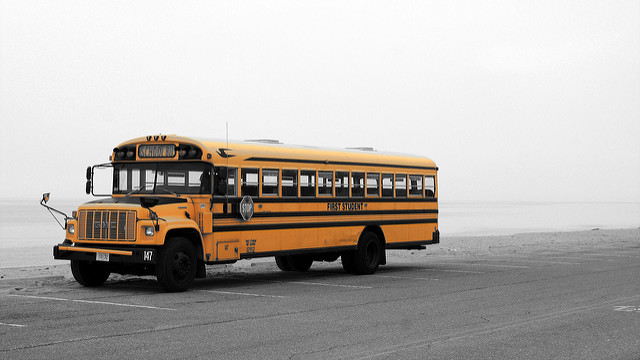
School bus

Bus #147. SebamirumCC BY

Life takes many unexpected twists and turns – a friend of mine says, “Life is one wild ride.” The mysterious is frequently interwoven with the breathtaking, the brightest moments often collide with the darkest, and the greatest desires of our hearts almost always involve epic challenges.

It took me the better part of two decades to finish college, for example.

I married at twenty, quitting college with a year and a half of coursework in general studies and theater arts. My boys were born. My husband completed two degrees needed for his work. I took a variety of jobs, all the while wanting to return to college myself, taking a class or two whenever and wherever I could. Sometimes I dusted off the old textbooks and plays, reread portions, dreamed of going on with my education.

When my younger son started kindergarten, I took a part-time reading remediation position that became full-time, until the program was cut after a couple of years.

“I’d like to keep you on, if you’re willing to take a teaching assistant job in first grade,” my principal told me. “Furthermore, there’s a distance education cohort beginning for paraprofessionals to get teaching degrees. You should pursue this – you’d be an excellent teacher.”

I pondered the prospect. A teacher. At the elementary level? I don’t know. High school English, maybe, but . . .

“It’s a consortium,” the principal went on. “If you’re a full-time teaching assistant, our county qualifies you to attend with financial aid. The books are even covered.”

Here it was, the long-awaited chance to finish school, only it didn’t look exactly like what I imagined.

The principal noted my hesitation. “It’s a perfect opportunity. What are you waiting for?”

Turns out that the program had K-12 reading certification built in.

That was the tipping point.

I love roller coasters. They climb and climb, gaining momentum, then – wooooosh. Hold on tight, as you don’t know what’s coming next – a pretty good metaphor for the wild ride of life. I applied to the program, got in. I loved my classes, my advisor, my instructors, my classmates. Returning to college was exhilarating.

Until.

“Of course, as a full-time teaching assistant in our county,” my principal said, “you’re required to get bus driver licensure.”

WHAT? 

I’m not overly fond of driving in the first place. The idea of maneuvering something as big as a bus, loaded with kids, being the only adult responsible . . .

“I’m not sure I can do it,” I said, going cold and clammy. My stomach lurched like it does after a sudden twist on a coaster, only worse.

The principal smiled. “Yes, you can. Look at it as something that gets you where you want to go.”

That’s what it came down to. If I wanted to finish school, to teach – which I now wanted to do more than anything, the ultimate situational irony – then I would have to face the big yellow monster.

My dad had driven a school bus when he was in high school. So had his sister. Back in their day, students were drivers. Daddy told stories about students tampering with the governor so the buses would go faster – I could envision the buses bumping down the country dirt roads, whipping around the bends in thick clouds of dust, kids bouncing wildly. He told the tales with glee; I listened in horror. While I darkly imagined Daddy’s great amusement on learning that I’d be driving a bus, if he’d lived to see it, this connection to him helped, if only the tiniest bit.

Look at it as something that gets you where you need to go.

I couldn’t let a bus stop me from finishing school or embarking on a whole new career that stretched out before me, glimmering and beckoning like the sea.

I signed up for the training.

The trainer started off with lots of stories, such as a driver once tipping a bus over by trying to avoid a squirrel, which is why we should never swerve if an animal runs in front of the bus.

I put my head down on the desk.

Then there was the first exam: Memorizing all the parts of the bus, how these parts are connected, what these parts do and why, what every light means. This was conducted by walking with the instructor, pointing everything out and giving an oral explanation. A written exam was also given.

I briefly considered failing these exams but my pride wouldn’t let me.

The training culminated in behind-the-wheel practice with the instructor, who asked: “Ever driven a Mercedes before?”

“No sir,” I answered.

He chuckled. “You’re about to now.”

I thought he was joking.

He wasn’t.

The bus I learned to drive on was made by Mercedes-Benz – who knew? It almost drove itself.

I managed to get this monstrous thing, this almost-airplane, through the narrow tree-lined streets of the nearby little old southern town without doing harm to anything until the instructor said: “All right, make a stop. Let these imaginary kids off the bus.”

I made the stop, opened the bus door. The flashing lights came on, the stop sign came out. I even counted imaginary heads.

For the first time, I thought: I’ve got this. It’s not so bad.

Then, as I closed the door to move on, the instructor said, “STOP!”

“What?!” I jumped a little in my seat. I stood on the brake.

“You just ran over a child,” said the instructor.

“I – what? How? I counted all the imaginary heads!”

“You didn’t check your mirrors. Kids can hide close to the bus and you’ll never see them if you don’t check all those mirrors. That’s why they’re there. Kids have been killed that way.”

I returned to work that afternoon in the deepest funk. A teacher assistant colleague greeted me: “Hey, how’d the training go?”

I sighed. “Not great. I ran over an imaginary child.”

My colleague grinned. “How did the imaginary parents take it?”

I laughed in spite of myself.

Still, I put myself on the prayer list at church. Seriously. The youth minister consoled me: “Look, when the time comes, God will give you driving grace.”

He was right.

The first time I had to drive, on my own, with real kids, it wasn’t a magnificent Mercedes bus but an old “cheese box,” as the kids say. I boarded with driving grace in my head and rosary beads in my pocket, given to me by a friend – and I’m not even Catholic.

I – and more importantly, the kids – lived to tell about it.

In fact, my driving the first-graders on their field trip to the movies (a trip of about three miles, consisting of three turns, one of which I took too close with a back wheel going over the curb, causing the bus to sway and the kids to scream), made their writing journals. When the teacher asked them to write about their favorite part of the trip, our entire class wrote various versions of this, with various spellings: “My favorite part of the field trip was when Mrs. Haley drove the bus.” On all the pages I was depicted at the wheel of the big yellow monster, my hair flying in the breeze for some reason, and smiling.

In the eyes of the kids, apparently, I was a great success.

I consider my mastery of the yellow monster my most dubious achievement, closely followed by my passing a college course on golf. No animals ever ran in front of me, all the kids got home, and other than the door handle rolling off one day and causing me to drive back to school with the stop sign out and all the lights flashing so that every car on both sides of the road pulled over, I am happy to report that I only had to drive a handful of times without incident until I finished the teaching degree and moved on, when I no longer had to drive a bus.

It did, indeed, get me where I needed to go.

Those obstacles that stand in the way of what we want, where we want to go – there’s no shortcut, no way over or around them. The only way is through, even when it doesn’t seem feasible, beneficial, or possible.

Whatever it is, whether it looms in front of you, in your past, or inside you, face your monster. Look it in the eye.

Then make up your mind to master it.

Grace be with you.

Making adjustments

Poor Banjo

Poor Banjo!

Banjo is my family’s 18-month-old yellow Lab. If he can be summed up in one word, it’s exuberant. If two words – wildly exuberant. He is a force to be reckoned with, ninety-one pounds of raw energy barreling toward us at top speed in hopes of 1) eating something or 2) having us throw a ball or stick for him to retrieve. Endlessly. Banjo goes into a frenzy if he thinks we’re about to stop throwing said ball or stick, the bodily equivalent of shouting NONONONONOPLEASEPLEASEPLEASEPLEASE!!!! His beautiful gold-green eyes (sky-blue when he was a baby) go pink around the rims; he often leaves us humans coated in a layer of frothy slobber, prompting us to quote Bill Murray’s line to Dan Aykroyd in Ghostbusters: “He slimed me.”

During attempted walks on the leash (key word: attempted – these walks are more like trying to restrain a steam locomotive), Banjo’s mouth foams to the point of looking rabid, unnerving to anyone who might recall a certain story about a big yellow dog exposed to hydrophobia. I mentally push this horrible connection away the instant it comes to mind. Managing Banjo has become something of a Herculean challenge, to say the least. Twice he’s escaped from us, running, barking and foaming, through our neighborhood, causing one woman to run into her house and giving young men chase. I corralled him once myself and got him safely to our fenced backyard. The other time my older son chased him for forty-five minutes, while Banjo had the time of his life ripping through neighbor’s yards and swimming in the pond across the street from our house. In disgust, my son gave up and stormed home, at which point Banjo, sopping with pond water, bounded back up the driveway.

Banjo escaped from the backyard recently, having dislodged two slats of the wooden fence by repeatedly jumping against them with his considerable weight. Looking at the slats, presently secured with bungee cords until we can nail them back properly, my husband said, “If we can’t contain him, we’re not going to be able to keep him.”

My turn to say NONONONONOPLEASEPLEASEPLEASEPLEASE!!!! 

Despite all, I love this wildly exuberant dog. He’s been with us since he was seven weeks old, a ball of yellow fuzz that slept in my lap or on my feet. Banjo’s presence represents hope and survival, his own as well as my husband’s during a dark time;  I wrote about it in The unplanned baby. How can I just give him up? Yes, he’s one giant mess. Sure, he sheds copiously, enough hair to make a whole other dog. Yes, he dug up the pipe leading from the propane tank by the back deck until the stench of gas frightened us all, giving us visions of the whole place blowing at any moment, until we buried the pipe again and built a small wall of cinder blocks around it. Banjo barked at these blocks nonstop, all day, every day, for about a month.

But when he goes into his crate at night, he looks at me with those golden-green eyes and waits patiently for me to reach through and rub him for a minute. When I do, he leans his head against my hand, closes his eyes, and savors every second – the sweetest, most loving of creatures.

If only he would stay this calm more often . . . .

It was inevitable, of course, and past time, really. It had to be done.

We took Banjo to be neutered.

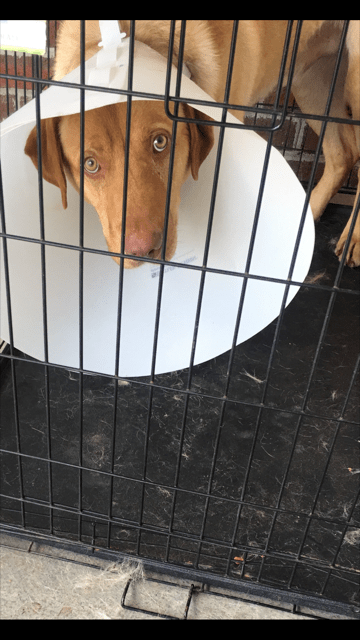
We did not know until we picked him up that he’d be wearing a cone to keep him from interfering with his surgery site until it healed – for seven days.

“There’s no way,” I said, watching Banjo writhing, twisting, and jumping, trying to rid himself of this horrid thing around his head. But after a few minutes, he sat still, with his head hanging down. Subjugated, submissive, maybe even dejected, Banjo seemed to be contemplating this new, unfortunate turn of events.

In the subsequent days, he simply made the necessary adjustments.

He learned that he had to put the entire cone opening over his food and water bowl to eat and drink. I laughed at the sight. He looked like something straight out of science fiction, a vacuum-headed suction creature from another planet. He ran through the backyard, as exuberant as ever, with his cone pointed toward the sky like a morning-glory flower. He wanted to play so badly that, despite the cone, he managed to drag a five-foot pine limb thicker than my arm to me in hopes that I’d throw it for him.

He still waited for me to rub his head when he went into his crate to sleep.

“I am so sorry about all of this, Banjo,” I said, working my hand through the bars and past the cone.

He shifted his head to help me reach him, leaned against my hand, and closed his eyes. So accepting and forgiving.

I rubbed him an extra-long time, tears stinging my own eyes.

My husband and I took the cone off after four days. We couldn’t stand it anymore.

Banjo is healed now, running unfettered again in the backyard each day of this glorious, sunny spring. He never fails to lift my spirits, this big, beautiful, messy boy. He reminds me that setbacks are temporary, that whatever pain and hardships come, there’s something good waiting just on the other side. Accept, make the necessary adjustments, carry on – cheerfully.

Just another of life’s lessons from an exuberant yellow dog that will hopefully be calmer now.

Regardless, here’s the truth about Banjo: He doesn’t belong to me. I belong to him.

Always.

Reflection: What are the necessary adjustments must you make in your own life, currently? Think acceptance, forgiveness, healing, moving beyond. What’s the something better that might be waiting on the other side of the struggle, the pain? Write your truths.


Committing assumicide

Through the window

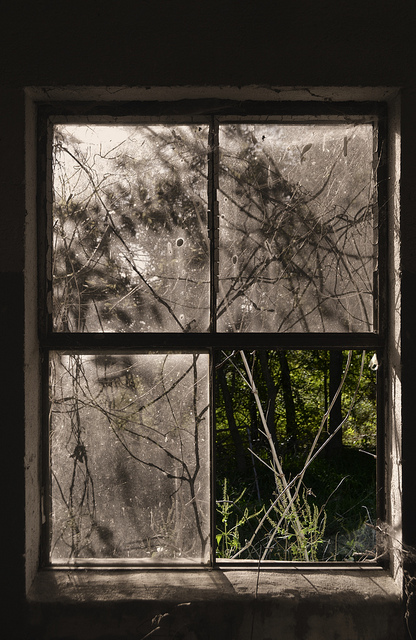
Through the window sepia. Jo NaylorCC BY

Your assumptions are your windows on the world. Scrub them off every once in a while, or the light won’t come in.
Isaac Asimov

This quote brings a little girl to mind.

She shows up in my classroom early for her reading intervention group. I am hunkered over my laptop fighting with a SMART Board activity I’ve created on word families.

“Hello,” I say, without looking up, frowning at my screen and the uncooperative technology. “Come have a seat. The others will be here in a few minutes.”

She sits right next to me, a small warmth at my elbow. “What are you doing?”

I sigh. “Trying to fix this activity for your group to play – it will be fun. Something’s not right, though. I’m trying to figure it out.”

She watches while I attempt to cut a word from one side to paste on the other. Unsuccessfully.

Even as I fight the program, I wonder what she is thinking.

She struggles terribly in all academic areas, an ESL student with processing issues beyond the language barrier. She is soon to be tested for disabilities.

“What is that line in the middle?” she asks.

“It’s a dual screen – two screens instead of one.”

“Oh. You are trying to move this word to here?” She points from one side of the screen to the other.

“Yes. I don’t know what I’m doing wrong,” I say in exasperation. I glance at the clock – I should have caught this problem sooner! “I’m going to have to quit now – I’m out of time. Your group will have to do something else instead.”

Without removing her eyes from the laptop, my student reaches over, clicks on the obstinate word, then drags and drops it on the other side.

“There,” she says, matter-of-factly.

I stare at her. “How did you know that? Have you seen a SMART Notebook before?”

She shrugs, laughing at my expression. “No. Just a try.”

The group was able to play the interactive word game. That day my little girl was a much more willing participant, with considerably more confidence.

The outcome could have been quite different. In my frustration, it would have been easy to answer her questions with Oh, never mind. It’s too hard. I could have thought, There’s not much need of my explaining. You won’t understand.

Had I done so, I would never have known that she had this ability, that she could “see” what to do with the new software when I couldn’t.

I would have committed assumicide.

It happens every day.

Teachers assume that students who struggle in academic areas struggle in all things – and thereby limit the students further. Although the thought may never be verbalized, it lurks in the mind: They can’t do that . . . so surely they can’t do this . . . .

A friend of my family was born with cerebral palsy. His father was an avid golfer who decided early on that he would treat his son as if he didn’t have the disability. As soon as the boy was big enough, his father started teaching him the game.

I have often wondered how many eyebrows were raised at the time: What is that man doing? His child can barely walk or dress himself – why in the world would he teach him something requiring as much precision as golf? That boy will never be able to hit the ball! I wondered if some people may have been angry over the injustice.

If so, they eventually learned that they’d committed egregious assumicide.

The boy grew up living and breathing golf. He remains a local expert on the game with a room full of trophies won in multiple tournaments, long after his father had passed away.

Yes, that’s right – a room full of trophies in a precise game like golf, when the two halves of his body don’t work together for him to climb stairs and his hands shake when holding a cup so that it can only be partially filled, lest he spill the contents.

When I needed a fast P.E. credit one summer to complete my teaching degree, the only thing available, to my great chagrin, was golf – and this extraordinary man coached me through it. I have page after page of his painstakingly handwritten notes and drawings on “the fundamentals of golf.”

When I was growing up, my parents had the In the Wind album with Peter, Paul and Mary singing Bob Dylan’s “Blowin’ in the Wind.” As a child, I loved the three-part harmony and haunting lyrics:

How many times can a man turn his head

And pretend that he just doesn’t see? 

Maybe it’s not always a matter of not seeing, but seeing wrongly – seeing the deficits, not the potential.

For the teacher, what isn’t working too often overshadows what might. Sometimes we see but don’t act because we don’t know what to do, or because we believe our efforts won’t matter. We assume we are defeated before we begin. Sometimes our focus just isn’t where it needs to be when worry, exhaustion, fear, discomfort, directives, even the need for self-preservation and validation, occlude our vision. Sometimes it’s hard, in the throes of teaching – and of living – to stop and breathe, to listen, to see, to let go when we’re so focused on whatever it is we are trying to make happen. Accordingly, we close more doors than we open – for ourselves as well as for others.

We assume, and something dies.

I decided at the end of eleventh grade that I wanted to go to college. Higher education wasn’t talked about at my home, wasn’t encouraged. The general expectation is that I would keep taking courses like business typing (which I bombed, miserably) to become a secretary.

I needed to take several college prep courses in twelfth grade even to apply for college, and the college prep English teacher wouldn’t let me in his class.

He had the reputation for being the hardest teacher in the school. He reluctantly met with me, frowning over my transcripts. “You haven’t taken the prerequisites for this class or demonstrated that you can handle this caliber of work,” he commented, handing the transcripts back.

“Y-yes, sir, I know,” I answered, trembling. “I hadn’t planned to go to college until now.”

He eyed me over the rim of his glasses. Piercing blue, absolutely no-nonsense eyes.

“Tell me why I should let you into my class.”

“I’ll work hard. I can do it,” I said.

He sort of snorted. “A lot of students before you thought they could do it, too, and transferred out of my class, even when they had prepared for it.”

“Please.” It was all I knew to say.

He shook his head. “I am doing this against my better judgment,” he grumbled, and signed my special permission form.

That year I encountered the great poets, studied sonnets, wrote so much about the spider in Robert Frost’s “Design” that my teacher noted at the end of my interpretation: Exhaustive analysis! I memorized and recited – in Middle English – the first thirty-four lines of Chaucer’s Prologue to the Canterbury Tales. I hung on my teacher’s every word about London during the time of the Black Death; his descriptions were so vivid that the images remain clear in my mind to this day. For my final paper I wrote about the function of King Claudius in Hamlet – and when our teacher announced that four students tied for the highest score on the paper, I was one of the four.

He returned my paper on the last day with this comment: “For someone who had to have a special conference to get in this class, you have done remarkably well. You have surpassed expectations.”

All of which leads me to believe that the First Commandment of teaching should be Thou shalt not commit assumicide.

Perhaps it may even need to be the First Commandment of humanity.

slice-of-life_individual

Courage (part two)

The surgery took longer than expected, but the surgeon came to the waiting room at last.

“It went well,” he said. “Your husband’s eye is removed and the implant is in place, covered by membrane and attached to the muscles as it should be, if he were to get a prosthesis.”

He paused.

If it went well, why is he pausing? Something’s not right.

He continued: “I had to remove a lot of extra tissue, as it was dark and there’s no way for me to tell if it’s just natural pigment, or bruising, or melanoma.”

I was shaking. “What does this mean?”

“I took all of the dark tissue but he may never be able to wear a prosthesis, as there may not be enough support for it,” said the surgeon, gently.

I nodded. How are we going to tell him?

“Pathology will send the eye to Wills Institute in Philadelphia – they’re the best. They’ll analyze the tumor, whether or not any cells have spread . . . .”

 I closed my eyes as he spoke, not having considered this possibility.

I recalled the oncologist’s words when we consulted him: By the time it’s found, it’s usually metastasized. Radiation and chemotherapy are ineffective. It’s nasty.

That doctor had treated five patients with ocular melanoma in the last two decades.

All five had died.

Please, God. Please let those cells not have spread.

And then I went to recovery to hold my husband’s hand.

He squeezed mine, hard.

Half his head was bandaged. When an eye is surgically removed (enucleated), that side of a person’s face bruises badly. A conformer, a clear plastic piece like a huge contact lens, is put under the eyelid to hold its shape during healing so a prosthesis will fit.

The pain is intense for the first few days.

When the bandage had to be removed the first time for the application of antibacterial ointment, my husband said, “Get me a mirror.”

I handed it to him.

“Dear God,” he said, looking at his reflection.

It was the only time he cried.

After that, he never complained, not once – all of his energy went into healing.

The first night back home, when he went to bed, my husband said, “I see a light.”

“There isn’t a light,” I said. “I just turned it off.”

“I see it with my . . . what used to be my eye,” he said. “A bright light at the floor. Then it sort of swept up to the ceiling.”

I thought about amputees who still feel rings on fingers that are gone, or sensations in legs that are not there anymore. Phantom pain.

“I think it’s a phantom light,” I told my husband.

 He saw it for a few nights, this ghost light, the optic nerve trying to adapt to not seeing anymore. And then it stopped.

The bruising absorbed in a week or so and the eye – what do you call an eye that’s not an eye? A non-eye? – didn’t look as alarming as one would imagine. Just a pale orb, sort of like sclera without an iris. Not frightening at all, nothing like a hallowgast from Miss Peregrine.  Just different.

And every day we wondered about that pathology report.

Three long weeks went by before the surgeon called:

“No rogue cells in the tissue around the eye! The timing couldn’t have been better – the tumor was in the early stages.”

We threw our arms around each other; we could get on with living.

It wasn’t all that easy.

At first my husband wore a black eye patch to shield the removed eye. Everywhere we went, little kids called out, “Look, a pirate!” My husband just laughed and waved at them. An eye patch, however, is quite convex. It bumped against the lens of his glasses, which he had to wear all the time now for his remaining eye, as it was becoming strained.

He tried adhesive bandages designed for eyes next. Our grown sons said, “Dad, the eye patch looks better than those Band-Aids. A lot better.”

My husband sighed. He decided to try wearing a contact lens in the real eye, doing away with glasses so he could go back to the eye patch, which worried all his doctors:

“You only have one eye now – you can’t afford an abscess or corneal infection,” they told him.

He tried it anyway – and learned that in order to put a contact in, you really need two eyes to see what you’re doing.

At last he resorted to tinted lenses and gave up on coverings altogether.

He had trouble with depth perception, driving after dark, merging onto the highway. He was startled by people approaching him on his left side, because he couldn’t see them coming.

He bumped into things, hard enough to leave bruises.

He had trouble reading, which worried him more than anything else – he’s a minister, and reading is the foundation of his life’s work. He got a magnifying glass to be able to study his Bible.

He became restless, quiet.

At an appointment for his strained eye, the neurological ophthalmologist asked: “Why haven’t you gotten a prosthesis?”

“The surgeon said with all the tissue he removed, there may not be enough support for it,” answered my husband.

“Hmmm,” said the ophthalmologist. “How long has it been since your surgery?”

“A year.”

“I think you should investigate it. Here’s the name of the ocularist. He’s only about an hour away.”

We called, and learned that the ocularist sets appointments in the morning. If the patient is a candidate for a prosthesis, he makes it in his office that day and the patient leaves wearing it.

My husband hung up the phone, his face alight with hope.

“What if . . . ” I struggled, “what if you’re not a candidate?”

“Then I tried, and that’s all I can do.”

I worried the whole trip about how the idea buoyed his spirits, fearing that we’d be sent away, and how would that affect him?

Our younger son drove us. The three of us sat in the office together as the ocularist examined my husband.

“Oh, that was a lovely surgery,” he said. “Lovely. Great movement of the implant. Let’s get to work.”

“Do you mean,” I hardly dared to confirm, “that he will be able to wear a prosthesis, after all?”

“Sure – not a problem.”

I sat there watching as the mold was made of my husband’s non-eye, then as the resin was poured into it to create the prosthesis, thinking, This is like a cross between a medieval apothecary and Lemony Snicket. It might have been downright gothic, except that the room was sunny and cozy, being part of a house converted to an office.

The last step of the process was painting the prosthesis. We watched this man, this artist extraordinaire, open his set of paints and create his little masterpiece. He held the prosthesis up to my husband’s eye for comparison: “You have a lot of ocher in your iris. I have to add more.”

Back to dabbing paint he went.

As long as I live, I do not expect to see anything like it again – it was nothing short of a miracle when the ocularist placed the prosthesis over the implant, and my husband looked at me with two big, beautiful brown eyes.

My mouth fell open.

So did my husband’s, when the ocularist handed him the mirror.

We arrived at 8:00 that morning.

We left at 3:00 that afternoon, with the new eye.

On the porch of the office as we were leaving, in the bright the afternoon sun, my husband said, “Tell me how it looks.”

A perfect match – one would not know which was the real eye.

“It’s unbelievable,” I said. “Amazing.”

“It looks great, Dad,” said our son.

“I feel like myself again,” said my husband. A grin spread across his face.

“I just wonder how long it will be before someone asks if I can see out of it,” and he dissolved with laughter.

That was just three weeks ago.

He hasn’t stopped smiling since.

*******

(Note:  Just before the surgery, when we didn’t know what would happen next, we made the seemingly insane decision to adopt a seven-week-old Lab puppy who needed a home. If you are interested in the puppy’s story in relation to this experience, here’s a previous post: The unplanned baby.

slice-of-life_individualEarly Morning Slicer

Follow the light

Hermit crab

Hermit crab. Jessica DiamondCC BY-SA

Daddy has a story to tell this morning:

“Last night, a sound woke me up.  I got out of bed and listened.  A steady clinking was coming from the bathroom. I thought: What in the devil could be making that noise in the bathroom? I went and looked around – didn’t see anything. I bent down to look at the pipe under the sink. Nothing. The noise was much closer, though, almost right in my ear . . . I turned my head and there on the sink leg was that hermit crab, crawling up. His shell was hitting against the metal leg – that was the clinking.”

I look in the glass bowl where my pet crab Shermie lives. He’s completely inside his black-and-white shell now, obviously sleeping off his late-night adventure. 

“He got out of his bowl and went that far? Why would he do that, Daddy?”

 “I guess he was following the light.”

The bowl is in the living room. I look at the hallway. The bathroom is at the end, around the corner on the right. That’s an awfully long way for a little crab. I imagine him crawling along the hardwood floor past the bedrooms in the dark. It’s a good thing none of us got up and stepped on him. 

Shermie’s stalk eyes peek out of his shell and I wish I could ask him: Why were you trying so hard to get to the light?

Maybe it wasn’t the light. A quick skim of the Internet reveals that hermit crabs are nocturnal creatures which often climb out of cages at night, when they would normally be in search of food and water; in the wild, they do this in droves, traveling for miles. When a pet hermit crab escapes – apparently quite a few do – the experts say to check the bathroom, as the crab might be seeking the humidity of its natural habitat.

In the days before the Internet, however, we didn’t know all of this.

For years I thought of that tiny creature and the Herculean task of climbing out of a wide, smooth glass bowl – how, I do not know to this day – to make his way, alone, through the dark toward the only light in the house.

And I would think: If Shermie could figure out where the light is, then so can I. There’s a light to follow out of this darkness, somewhere. I’ll find it. I’ll climb out.

slice-of-life_individual Early Morning Slicer


Shine

born-to-shine


This is the cover of my mentor text notebook, housing the writing I’ve done with and for children across grade levels.

I believe that every child is a writer, because every child has a story. Every child has feelings and ideas. The writing teacher simply shows how to tap into these feelings and ideas, to give voice to them, to organize them, so that the mind and heart of the writer impacts readers.

Writing is about the human experience: We are all born to shine.

We shine through our fears, our losses.

We shine beyond the choices we make and the choices of others, beyond the things done to us and the things we have done.

We shine no less in our failures than in our successes; in fact, in learning and pressing on, we shine the brighter.

We shine in knowing what to hold onto and what to let go.

We shine when we harness anger before it burns away all that’s of value within us.

We shine by leaving footprints of hope for others to follow, for the human heart runs empty on despair.

We are ALL born to shine. Whether or not we do is up to us.

Reflect:  In the book The Forgotten Beasts of Eld by Patricia A. McKillip, 1974, a mysterious creature had the power to turn people’s eyes around to see inside their minds; they died from what they saw there. Writer, know thyself. Look deep within. You will be surprised by what you discover – the beautiful and the not. Write – and shine.


Rise

rise

Flight Envy. Pretty ParkinCC BY-SA

Above the negativity, the naysayers, to make room for the wondrous

Above the noise, to a place of productive peace

Above the superficial, the shallow, to the real, the valuable

Above the fleeting, to the lasting

Above constraints, to the creative.

Every day is new. Rise. Reach.

Believe.

Realize.

Repeat: Rise.

Reflect: Rise is a verb. It’s an action, a choice. How might YOU rise and step forward in newness?

What lies within


scuppernongs

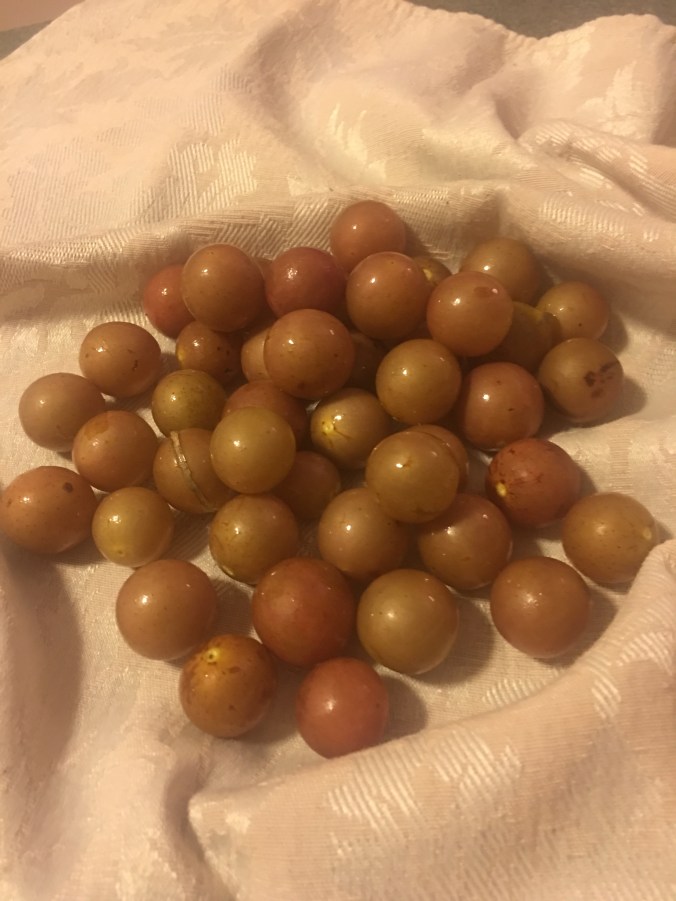
They aren’t beautiful, scuppernong grapes. Their unassuming greenish-bronze skins are flecked as if with age spots. Hardly inviting.

If you have never tasted one, you have not fully lived.

Yes, the seeds are a nuisance, difficult to manage in polite company, as one must spit them somewhere.

But put one in your mouth, gently split its remarkably thick skin open with your teeth … oh! The burst of richness is almost breathtaking. Embryonic wine, a touch of dying summer, a whisper of sweet things to come, something of all Christmases and bit of Heaven is encased in that homely little orb. No other taste on Earth compares. When I first studied mythology, I wondered if ambrosia, the food of the gods, was actually scuppernongs.

I first encountered scuppernongs as a young child. I can see the vines towering over my head, the flickering sunshine and shadow of wide leaves, the poles my grandfather erected, his straw hat, the plaid pattern of his sleeve as his big wrinkled hand reached up to pick the grapes for me. No words; just richness. Just joy.

A lot of things are like scuppernongs – unappealing on the outside, messy and more work than seems necessary. Teaching is like that. Writing is like that. Living is like that. Get beyond that first impression; it’s misleading. Press on to the heart of it. What you find there will take your breath away.

Reflect: When has the appearance of a thing, an experience, deceived you? What surprise was waiting for you within?