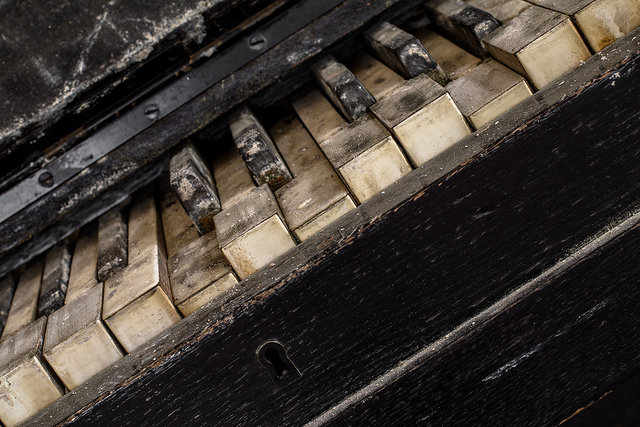
Forgotten

Forgotten

Forgotten Sounds Pt.II. Marco NurnbergerCC BY

Memory makes us. If we couldn’t recall the who, what, where, and when of our everyday lives, we wouldn’t be able to function. – “Memory Basics,” Psychology Today

This week, I remembered a poem I wrote as a teenager.

Some of the lines returned to me, complete and clear.

I couldn’t recall other lines at all.

I wrote the poem after a dream. In this dream, I was with a group of young people around my own age in a deserted beachy area with trees. We had reunited there on a hazy afternoon when the light is most golden, just as the sun begins to set, and with great joy, we began singing.

Except that I really did not know these people, this place, this song. In the dream I knew I was supposed to know all of these things, and I didn’t. I was meant to belong, to be a part, and I couldn’t. The sense of mounting sadness over the desperate attempt to remember the significance of these people and the words to the beautiful song so that I could join in was overwhelming.

The dream haunted me so that when I woke, I wrote the poem.

Remembering my poem for the first time in years, I wanted to reread it, to recapture the lines that were missing in my memory. I could envision the little stapled booklet I made, could actually recall other poems I wrote in it, word for word.

I couldn’t find it.

I searched everywhere I thought the booklet ought to be – I could not remember where I put it.

Things like this become compulsions for me. The more I searched without success, the more determined I became to find the missing poems.

At some point I realized the many layers of irony folded into this situation: I wrote a poem about forgetting something I could not remember in the first place, because I wanted to remember the experience; not remembering all the lines compelled me to read it again, and I forgot where I put it.

I began to think about what dementia patients must feel like.

But I kept looking, and yesterday, in a box of old notebooks, in a planner under some loose papers, I found it:

Forgotten Remembrance

My mind, it plays a melody

That it hasn’t ever heard

A voice sings in my memory

But remembers not a word

Faces I don’t recognize

Are singing this with me

Sadness streaming from my eyes

Such a haunting harmony

I hear the music chiming there

And then again it’s gone

Hidden in my mind somewhere

Chiming off and on

I ought to know this tune

These words I’ve sung before

I’ll try to learn them very soon

So I can sing them more

I can’t remember this refrain

I’ve forgotten it this far

My mind cries out to know this strain

And what the lyrics are

But all I know is sorrow

A deep and dark despair

I’ll cry and cry tomorrow

For what was never there.

At last. My mind can rest now.

I certainly can’t end on such a dark note, so today I pay tribute to the vital, mysterious power of memory, how it makes us who we are; to writing, which preserves who we are at various points in our lives and sets us free from whatever haunts or hurts us; and to the foresight of my young, rather gothic self for having grasped it.


 

slice-of-life_individual


All that you hold dear

Fawn in hands

A new idea is fragile, fleeting

capture it as soon as you can.

Find the meaning

what it makes you think

how it makes you feel.

Nurture it

as you nurture the artist within you

so the idea and the artist will grow.

Play with the words

the images will come.

Play with the images

the words will come.

Trust your inner writer

to find a way

of conveying that idea, that image

so that others think and see

and feel.

There’s power in that fledgling thought

in every feeling connected to

 all that you hold dear.

More power in sharing it

than in holding it tight, unspoken.

Let it breathe

let it live.

It wants to.

It is precious.

Even

priceless.

Inspired by my writing workshop with teachers yesterday on “creating the magic”  – first as a writer, then for your writers.

slice-of-life_individualEarly Morning Slicer

Haunting forevermore

Ah, distinctly I remember it was in … June, 2013.

My older son and I, teachers inspired by a love of The Great Gatsby,  celebrated the arrival of summer vacation by driving from North Carolina to Rockville, Maryland, where we visited the grave of F. Scott Fitzgerald. Having accomplished this mission before nine o’clock in the morning, my son asked: “What do you want to do now?”

“You know,” I grinned, “Baltimore is only forty-five minutes away. Poe is buried there.”

Thus was our Dead Writers Tour born. Off to Baltimore we went.

In contrast to a midnight dreary, the morning sun was blinding at the Westminster Hall and Burying Ground. The old Gothic-Revival church, the gate, the trees, the headstones, all cast the blackest, sharp-edged shadows, as if intentionally evoking the last lines of  “The Raven”:

And the lamp-light o’er him streaming throws his shadow on the floor;

And my soul from out that shadow that lies floating on the floor

Shall be lifted – nevermore!

And there, to the immediate right of the entrance, was the author’s grave under a large, shadowy monument bearing a plaque with his likeness. One wilting yellow rose and a couple of little rocks rested on the base.

Poe is buried with his wife, who was also his cousin, aged thirteen when he married her and twenty-four when she died, and her mother, his aunt.

“This isn’t the original grave,” my son pointed out. “Poe was first buried somewhere behind the church. He was moved here to to the front later.”

“That figures,” I said. “The man was unsettled for most of his life. He couldn’t even be settled in death.”

Just then a black bird flew by to land on another headstone, where it sat watching us from the stark shadows.

“Is that a raven?” I whispered.

Quoth my son, wide-eyed: “Geez, Mom!”

“No, it can’t be,” I assured him. “Ravens are bigger than that … I think. Let’s go find the first grave.”

This cemetery is old, dating from the late 1700s. The pathway from the entrance to the back is narrow,  leading past massive domed slabs somewhat reminiscent of Quonset huts. Years and weather have left black streaks running down the sides of these burial slabs to form odd swirls and patterns. Ghostly patterns, painted by nature’s fingers.

“Check out this stain,” I said, pausing. “Does it look like a skull to you?”

“Oh, wow – it does!”

Rounding the corner of the church, we came upon a marble table with thick legs and a top so sunken in the middle that it seemed impossible for such a heavy substance. A plaque informed us that this “gravity-defying” monument was mentioned in a Ripley’s Believe It or Not! article. A Revolutionary War veteran is buried beneath this oddity.

From there, my son and I could see Poe’s original grave, as the crowned headstone is embossed with a raven. On nearing the cenotaph – the empty tomb – the words arching above the bird become visible: “Quoth the Raven – Nevermore.” The stone informs visitors that Poe rested in this spot from 1849 to 1875.

“Do you remember reading about the mysterious person who showed up every year on Poe’s birthday, wearing a cloak or something, to leave roses at the grave?” I asked my son, a trivia expert extraordinaire.

“Oh, right – the Poe Toaster. He wore a hat and white scarf. He left cognac, too.”

“At this marker or the other?” I wondered.

“This one, I think. He came for decades, until just a couple of years ago. No one ever figured out who the Toaster was.”

“That’s hard to believe, in this day and age.”

“What’s really strange is that just before Poe died, he was found in the streets of Baltimore, out of his mind, wearing someone else’s clothes, and no one ever knew why.”

“It’s haunting, but mostly sad,” I pondered aloud. “Something straight out of his own work.”

We turned to leave, walking past a line of eroding tombs and vaults on the far side of the little cemetery. Some stone vaults had iron closures that appeared damaged. My fanciful imagination took flight: Had someone tampered with the doors, trying to get in – or out?

I shuddered despite the brightness of the day, recalling something my grandmother told me when I was a child afraid of the tiny graveyard across from her house in the country: Never fear the dead. Fear the living.

“I don’t think I’d want to be here at night,” I said to my son.

We simultaneously picked up our pace toward the exit.

“Nor would I.”

Back at Poe’s final resting place by the gate, my thoughts turned to his poetry, the glorious rhythm of “The Raven,” which drew me as a child the first time I heard Vincent Price reading it on TV. The poem wields mesmerizing, unique power. It is meant to be read aloud. Once when I was working to help third graders comprehend a text they were reading, we encountered the word raven.

“What’s a raven?” they wanted to know.

“It’s a bird – a black bird,” I told them. “There’s a famous poem about a raven.”

“Read it to us!” demanded the kids.

After a quick Internet search, I read the opening stanzas.

The children listened, spellbound. When I stopped, one of them sighed:

“Oh, Mrs. Haley – that sounds just like music.”

It does, indeed.

Ever after, the kids greeted me with “Hi, Mrs. Haley! Once upon a midnight dreary, while I pondered, weak and weary!”

Having paid my respects at last to Edgar Allan Poe, I walked back through the gate, just as the church’s bells began striking eleven – as if the word master himself was sending a message:

Keeping time, time, time,

As he knells, knells, knells,

In a happy Runic rhyme,

To the rolling of the the bells —

Of the bells, bells, bells —

To the tolling of the bells,

Of the bells, bells, bells, bells,

Bells, bells, bells–

To the moaning and groaning of the bells.

It couldn’t be coincidence – could it?

Today is the 167th anniversary of Poe’s death.

Reflect: What written works sing in your head, call to you, haunt you? Why?


A poem of friendship

Through clouds of gray will softly shine

a gentle silver tear of mine,

leaving lines to slowly trace

an empty soul, a lonely place.

A golden glow you gave to me

to help me through eternity –

light and warmth with which I try

your own sweet rains to somehow dry.

And we two have learned to see

the me in you, the you in me.

A golden ray through a silver drop

create such colors; they cannot stop.

What blazing brilliance we have sown,

this iridescence of our own!

Combine our souls and we will show

our strength lies in our rainbow.

-Written when I was fourteen. The UK’s National Poetry Day brought this early effort back to mind.

Reflect:  What metaphor captures the beauty and power of your dearest friendship?