Chanticleer

He comes a-strolling with dignity and purpose, bobbing majestically, robed in royal red, as fiery as embers in the grate on a winter’s night. He’s huge, he’s beautiful, and he knows it, the neighborhood rooster leading his ladies on a foraging expedition though all the front yards.
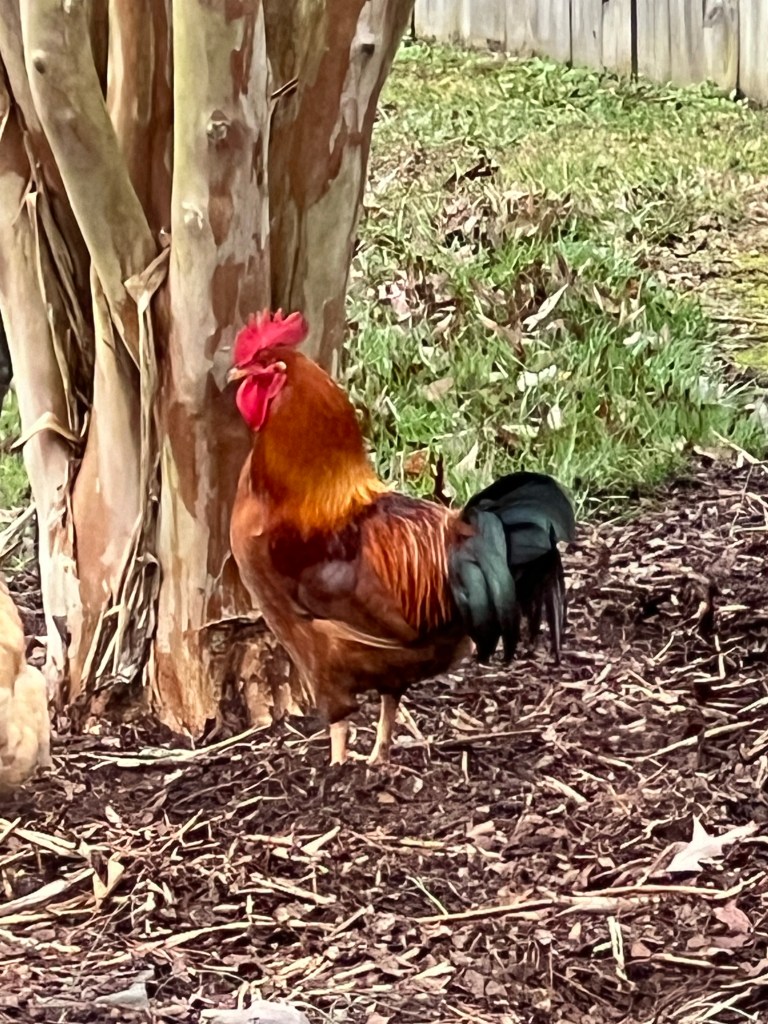
Sometimes he brings three ladies. Today, it’s four.

He doesn’t partake of the ground-feast himself. He leads the way, strutting to and fro, keeping watch while the hens scratch and peck.

Naturalist Sy Montgomery writes in Birdology:

Most roosters are very solicitous of their hens. When he’s not patrolling for predators, he’s often searching for food his flock might enjoy. When he finds it, uttering his food call…he stands aside while his women enjoy the treat, and only after they’ve had their fill will he sample the snack. The Talmud praises the rooster, and its writers advise the Jews to learn from him courtesy toward their mates.

I watch from the kitchen window as the chickens work their way over to my yard. The rooster crows. Montgomery calls it “the soundtrack of rural life.” In my mind, it’s the quintessence of rustic. And something more. The rooster’s crow calls to something deep in the human spirit (long before and long after the Apostle Peter wept in contrition).

Montgomery, again:

In the sacred book, the Hadith, the prophet Muhammad tells us why roosters crow: they do so because they have seen an angel. The moment a cock crows, the holy man advises, is a good time to ask for God’s blessing.

I remember the story-name given to roosters in fables: Chanticleer. From Old French, meaning “clear song.”

I slip outside through the garage to see if I can record it.

The chickens are under the crape myrtle at the old dog’s grave, scritching about in the mulch, flinging it every which way. The rooster is immediately aware of my presence. He turns to face homeward, in case.

Here’s my recording…wait for it…

At the end of a required re-interview for a job I’ve had for years (another story in itself, involving all staff) I was asked if I had anything else to add. I said yes. “I’ve learned a lot by watching birds. There’s nothing random in their actions.”

I likely left the interviewers scratching their heads, but I held my position.

Chanticleer crows. God, please bless me, my family, the work of my hands, my heart. Give me strength.

In the words of Montgomery: At the end of my prayers…birds teach me how to listen.

*******

Composed for Day 24 of the Slice of Life Story Challenge with Two Writing Teachers

Tongue of hummingbird

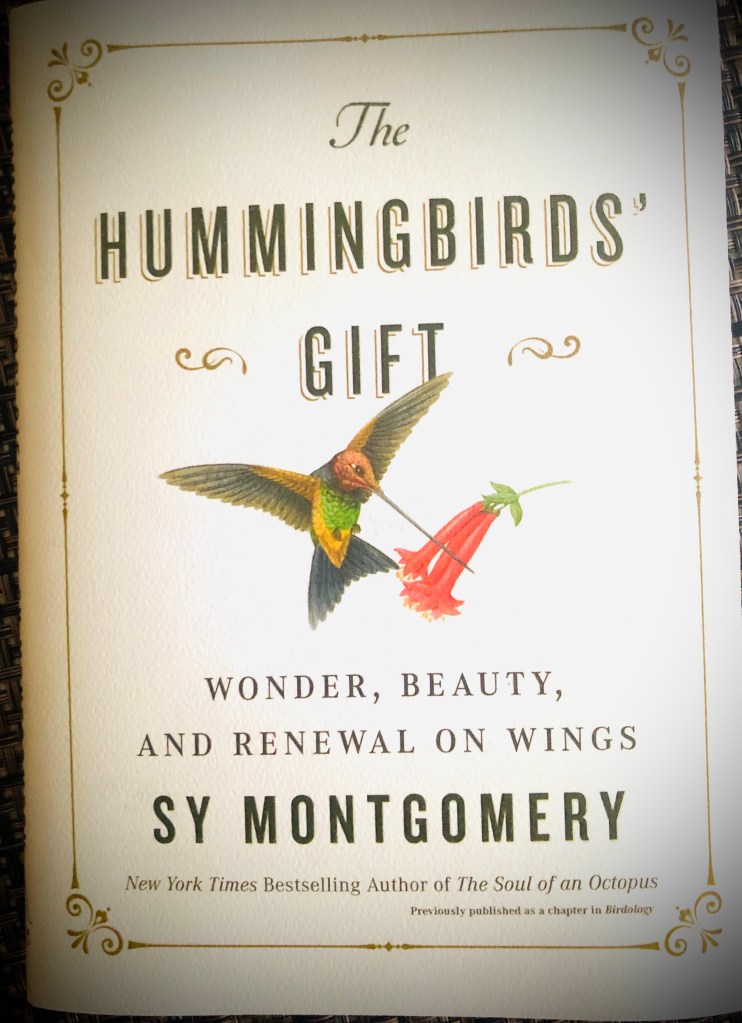
“At a feeder, a hummingbird extrudes and withdraws its tongue thirteen times a second. Hummingbirds do not sip nectar; they lap it. The tongue is forked, like a snake’s, with absorbent fringes along the edge of each fork…The tongue is so long that, when retracted, it extends back to the rear of the skull and then curls around to lie on top of the skull.”

—Sy Montgomery, The Hummingbirds’ Gift: Wonder, Beauty, and Renewal on Wings

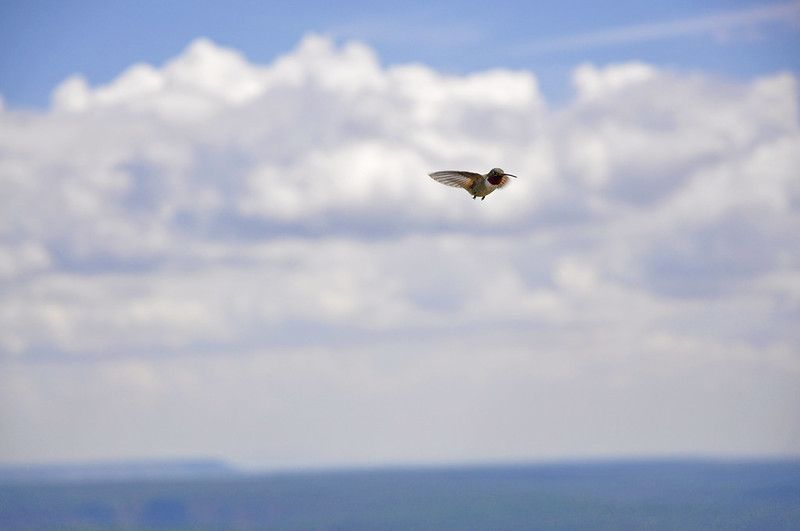
Tongue of hummingbird outside my window.

The only way I can get such a photo is by videoing and going back, frame by frame, to select a still shot.

Utterly mesmerizing, these tiny creatures and the way they are designed. They have the largest brain and heart of any bird in relation to its size, plus a skullful of tongue.

—Wild.

Rescue

Just a snippet of my current reading, if your weary heart needs a lift today:

“One autumn, a ruby-throat, on its lonely, five-hundred-mile migration—a journey across the gulf of Mexico, which can demand twenty-one hours of nonstops flight—landed, spent, on a drilling platform on the Mississippi coast. The oil company dispatched a helicopter to fly it to shore. The hummingbird spent the winter in a gardener’s greenhouse, then left, fat and healthy, on its spring migration.”

—Sy Montgomery, The Hummingbirds’ Gift: Wonder, Beauty, and Renewal on Wings

Cannot help thinking that sometimes we are the hummingbird at the end of our strength; sometimes we are the oil company with mighty means of helping another living creature…if we but see.


Hummingbird. U.S. Forest Service. CC BY-SA

Osprey acrostic

Overlords of sea and sky
Sunward soaring, unafraid
Precise piscivore pair
Riding the winds with
Easy grace
You see and seize the moment

Osprey pair. Photo by my friend E. Johnson.
“Fierce beauty,” as Sy Montgomery would say.

Picture book poem

On the last day of the February Open Write at Ethical ELA, Britt Decker invites participants to write a poem based on a picture book, taking inspiration from beautiful lines, illustrations, or theme.

My little acrostic is inspired by Inky’s Amazing Escape: How a Very Smart Octopus Found His Way Home, by Sy Montgomery (a true story).

*******

The Long-Reaching Tentacle of Adaptability

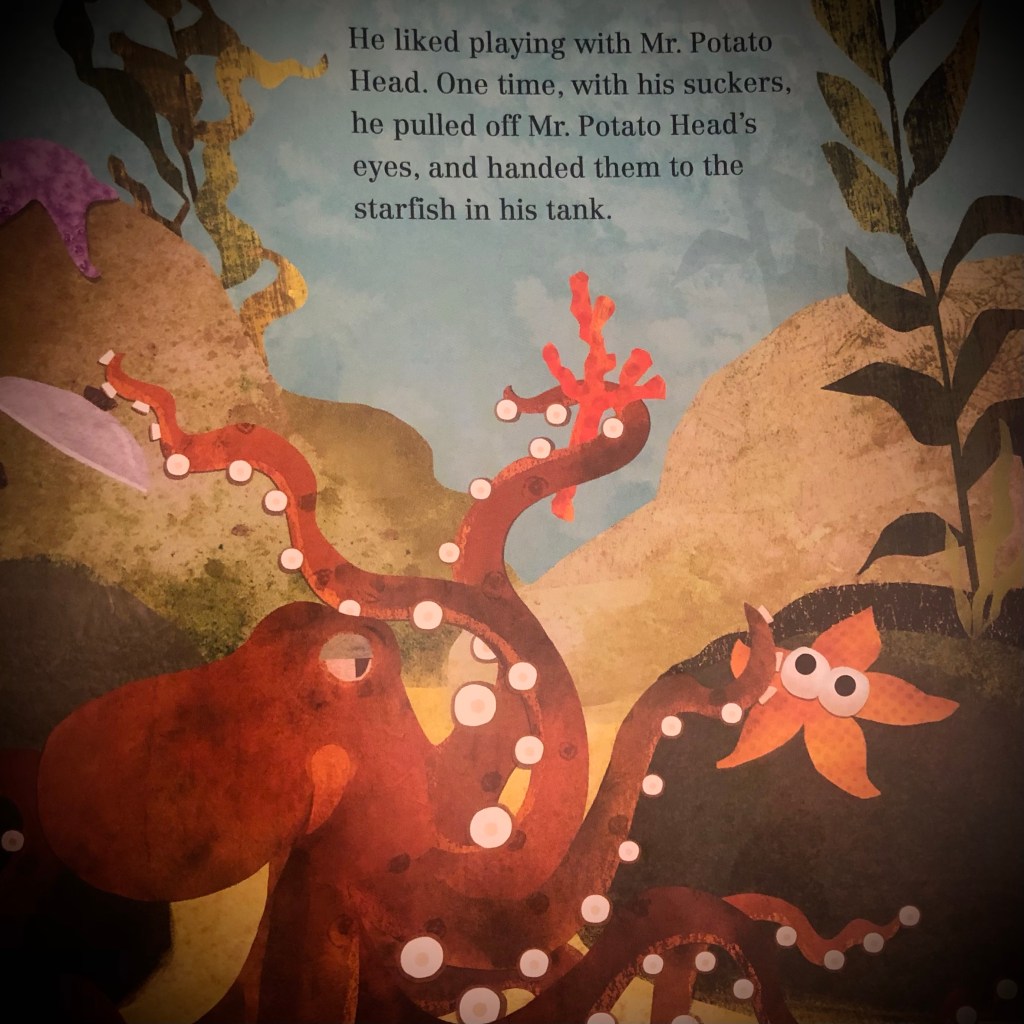
Sometimes the keeper gave Inky toys. Inky liked to take apart LEGO blocks, and put them back together. He liked playing with Mr. Potato Head. One time, with his suckers, he pulled off Mr. Potato Head’s eyes and handed them to the starfish in his tank.”

 
Once upon a time, a 
Child yearned
To understand why
Others seem such a 
Puzzle
Until she learned
She didn’t have to solve them.

From Inky’s Amazing Escape: How a Very Smart Octopus Found His Way Home, written by Sy Montgomery, illustrated by Amy Schimler-Safford. Simon & Schuster Books for Young Readers, New York, 2018.

I am in awe of octopuses. Inky’s story is etched on my heart. There’s something so poignant to me in his giving Mr. Potato Head’s eyes to the starfish.