Turning the page

February is nearly gone.

I flip the page in my daily planner to find this image on the March tab:
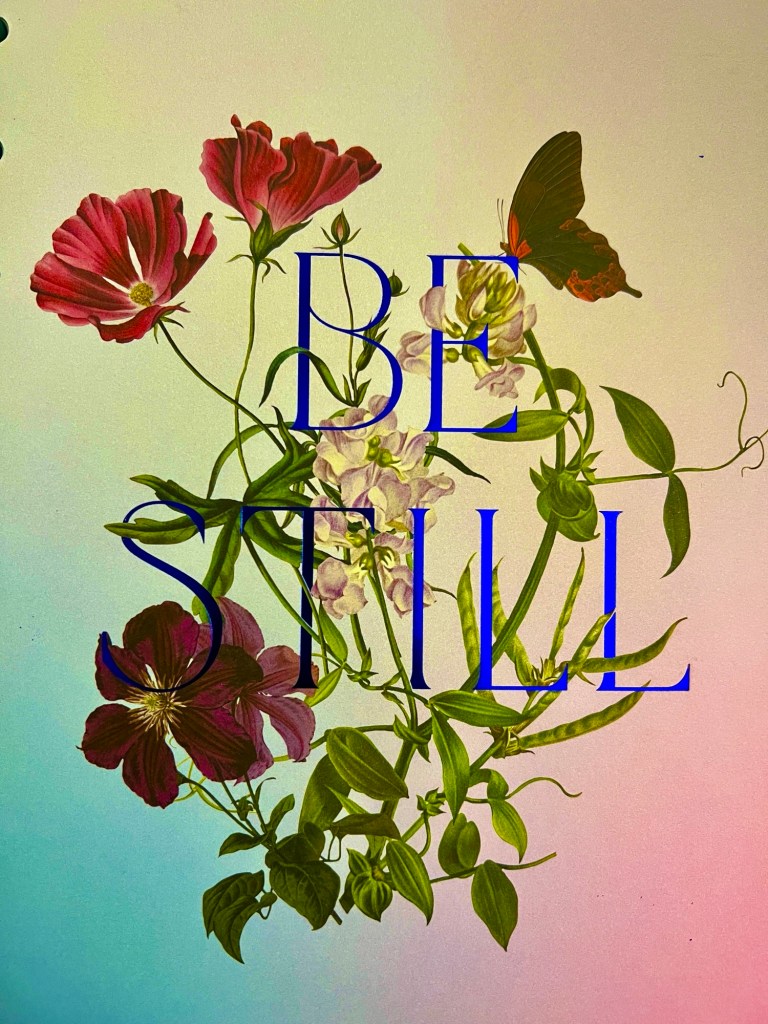
I am still, in contemplation of the message.

First thought: The Bible verse that has repeatedly reverberated throughout my life, ever since a youth minister gave me a plaque that hung on my bedroom wall during my teenage years: Psalm 46:10, Be still and know that I am God. The rest of which reads: I will be exalted among the nations, I will be exalted in the earth.

A reminder that I can see so little of the big picture of events, why they unfold the way they do, and that I must trust even as life’s story takes dark and twisting turns. Even so, there’s awe to be found. Always. I am not the author of life, not even my own. Someday it will end, as it does for us all. In the meantime…living well means finding this stillness every day. Tapping into the underlying currents of perspective and meaning…here’s where writing becomes an invaluable gift. Sometimes you can’t know what you think or feel until you begin to write.

Within that stillness eventually comes gratitude for the gift of life itself, imperfect as it is. To what or whom is this gratitude directed? For me: God. Whatever sadness, mourning, grief, anger, irritation, guilt, worry that gnaws at my soul, it is stilled to submission, releases its hold, even evaporates like smoke in the wind, in my awe of God. Another verse: Luke 1:37, Nothing is impossible with God.

I know it to be true. When I was a teenager, I could never have envisioned my life now. I was an unlikely candidate for a minister’s wife. Today, my sons serve as pastor and church musician.

Awe. Awe. Awe.

I contemplate the illustration on my planner page. Living things are woven into the words Be still. The upper flowers appear to be cosmos, the Greek meaning orderly, harmonious; the opposite of chaos. These flowers attract pollinators which perpetuate life (note the butterfly). The garden cosmos is often symbolic of knowledge, beauty, and happiness. Be still and know…

The bottom bloom might be Italian leather flower, a form of clematis. A plant app tells me it was the first climbing vine introduced into the garden of Queen Elizabeth I. It has come to represent wisdom, royalty, high aspirations. I look at this bloom, with its leathery-strong petals, and think of resilience. Pereverance. Endurance. Faithfulness. Reliance.

The flower in the center, the least noticeable, seems to be sweet pea. It stands for goodbyes. And thank yous.

This journey called Life is inevitably strewn with pain, with loss, with goodbyes; yet along the path, if we will remember to stop and be still, we can find the sprouts of gratitude. The good is blossoming despite all. In the stillness, maybe only in the stillness, we can breathe that fragrance deep, and be strengthened.

Just the reminder I needed.

*******

with thanks to Two Writing Teachers for the Tuesday Slice of Life Story Challenge
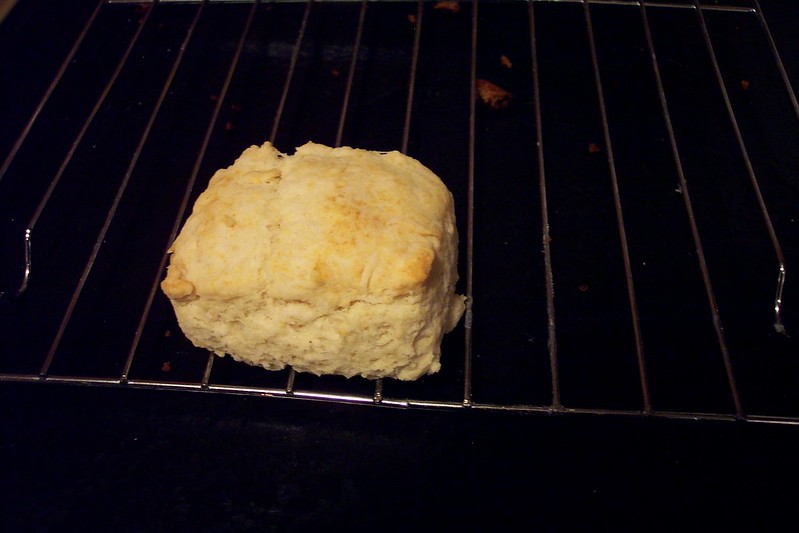
And a little child shall lead

This is a story of two brothers not in the Bible, not Cain who was angry with Abel over his offering and slew him, not Esau who might have done the same to Jacob save for their mother’s intervention (after her part in the division), but of two little boys in the current millenia, carrying school breakfast trays, as the older begins shouting at the younger and a teacher steps in.

What’s the matter? Why are you shouting at him? The rest of us do not appreciate hearing those kinds of words, says the teacher.

The smaller boy stops in front of the teacher. His bright face is utterly untroubled. It’s okay. You see, I am his brother.

The teacher pauses. You are used to this.

The bigger brother turns back, face like a thundercloud, voice blasting: And I dropped my freakin’ biscuit!

You can get another one, begins the teacher, when the younger boy takes off running, calling his brother’s name. The teacher follows in case intercession is needed.

Here, says the little one. You can have my biscuit.

The teacher blinks back tears. You don’t want your biscuit?

The little boy shakes his head. He places the proffered bread on his brother’s tray.

The older brother’s face eases. Anger abates; tentative calm settles in.

Thank you, he says, his voice low.

You owe your brother an apology, says the teacher, after the way you have just been shouting at him.

I’m sorry, he says. He turns away, but not before the teacher sees deep sadness in his eyes.

Wait! calls his little brother. You can have my jelly, too. You like jelly on your biscuit.

The teacher bends down to whisper in his ear: That is a beautiful thing you just did.

The brothers go off together in peace. The teacher watches, awed and humbled. The morning is still new, the day has only just begun, an unholy moment has been transfomed by a child’s purehearted act of sacrifical love, in his offering of bread and grape jelly.

The teacher thinks: If the world ended right now, I’d die having witnessed one of life’s greatest acts. Oh, to be so selfless, to learn the unforced rhythms of grace, to follow that child’s lead!

The bell rings.

Work awaits

Biscuit. Joshua Heyer. CC BY-SA

*******

with thanks to Two Writing Teachers for the Tuesday Slice of Life Challenge

Descent of doves

Every evening around suppertime, they come.

The doves.

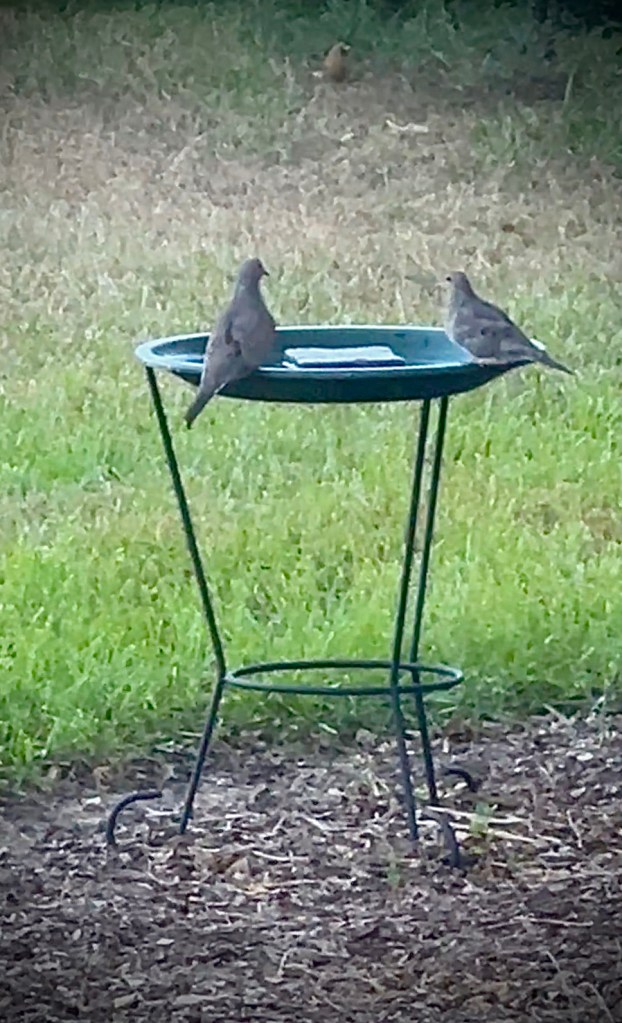
They adore my birdbath. Sometimes three of them cram in together. I think of the ancient Roman Baths, a place to gather and socialize, to share the events of the day while washing the grime away.

One dove tends to linger longer than the others, immersed in the water, fluffed to the size of a chicken.

As if staking claim to her personal pool.

Other birds do not know what to think about it. Occasionally another will land, say, a female cardinal. She sits cautiously, eyeing the dove. After a furtive sip she flits away.

The dove stays put. Doesn’t move a feather. Rather regal.

What I find most compelling is the effect of seeing the doves, of knowing they will come.

They represent peace, of course. Even if I didn’t know this, I think they’d impart it to me. They don’t fuss. They are gentle. Peaceable. Beautiful, in their impeccably smooth, pale-sand plumage. Restful, there in the still waters.

Most often I see two together, surely a mated pair, and the carol plays in my head: On the second day of Christmas my true love gave to me two turtledoves and a partridge in a pear tree.

Infinite symbolism, really. Spiritual, biblical…a sign of covenant. Of blessing.

In these days leading up to another heart surgery for my husband, when life is hitting the pause button yet again, the daily descent of doves in the evening imparts a calm I cannot fully articulate. I watch for them and they come. I refill the water for them and they savor it.

They do not know they’re between hunting seasons. It resumes here in early November.

I can’t bear to think of it, my sweet and precious birds. I didn’t even know until today that one of your collective nouns is a piteousness. To me it’s an unspeakable pity to kill such lovely and harmless creatures. So much in this world is a shattering, scattering pity.

Like the doves, none of us can know what lies ahead of us, all around us, in wait for us.

That thought was behind the closing stanza of a poem I wrote yesterday:

Yet again I cope with life on pause
redirecting my energy, because
no one can know what tomorrow will bring
only certainty that birds still sing, still sing
Come evening, a settling of doves
upon my birdbath. Oh, my loves, my loves—

Life is passing by

How I need this daily descent of doves. Their stillness, their peace.

My weary spirit rests with them in these moments and is refreshed.

See you at the baths tonight, my dears.

If you look closely you can see the female cardinal in the background, wondering if she might gather at the water, too.

*******

with thanks to Two Writing Teachers for the Tuesday Slice of Life Story Challenge
A tail to tell

I happened to catch sight of it through my kitchen window.

A big brown creature in the yard, over by the birdbath.

First thought: Neighbor’s cat.

But in the milliseconds it takes to process thought, I knew the creature was too big, too low to the ground, too oddly-shaped, too uniformly brown to be the cat.

Oh! A groundhog.

They’re pretty common around here, usually sighted standing up by the roadside like little totems.

The groundhog sniffed the air like a dog…what does it smell?

I grabbed my phone for a photo. Better yet, a video…the granddaughters will want to see this…

The groundhog bunched itself up. Humpbacked, it made an about-face and trotted away alongside the fence toward the woods.

That’s when I saw its tail.

A very long, very ratlike tail.

You are not a groundhog.

Their tails are furry. Wider, flatter.

Clearly not a beaver, although, come to think of it, how does one tell a beaver from a groundhog unless one actually sees the tail?

What ARE you, strange creature?

A muskrat.

I showed the video of the muskrat to my husband.

“It’s HUGE!” he said. “I thought muskrats were a lot smaller.”

“It has that rat tail,” said I.

I showed the video to friends at church.

“It’s not a muskrat,” said one, an avid outdoorsman. “It’s a nutria.”

My husband and I have lived in these parts for over thirty years and have never seen a nutria before (to our knowledge; maybe a former “groundhog” or two may have been this creature instead?).

We had never even heard that nutria live ’round here.

My daughter-in-law, a Louisiana native, knew it right away: “Oh, a nutria rat!”

I looked them up.

Nutria have frothy white whiskers and giant, terrifying orange teeth. They live in marshlands. This one was headed back through the woods toward a field; marshes are nearby, but in all the recent rains, everything out here is marshy. Nutria also detroy wetland ecosystems (I learned on Wikipedia that Louisiana loses wetland acreage the size of a football field every hour). Needless to say, the creature is a rodent. Invasive. A nutria can weigh upwards of twenty pounds. They carry diseases that can be transmitted to humans.

I stopped reading these fun facts and switched to symbolism instead.

In various cultures, nutria stand for good luck. Balance. Humility. Resourcefulness. Strength. Resilience. Prosperity. The interconnectedness of all things.

I’ll be honest: It had a rather friendly face (I couldn’t see the teeth).

Its rather inocuous name means “mouse-beaver.”

In Brazil, however, nutria are called ratão-do-banhado: big swamp rat.

I gotta say the Brazilians hit the tail—er, nail—on the head.

*******

with thanks to Two Writing Teachers for the Tuesday Slice of Life Story Challenge
Litany

Did you cry, people asked me.

I didn’t.

I am not sure it will make sense: I rested.

In the deep, wordless way of culmination.

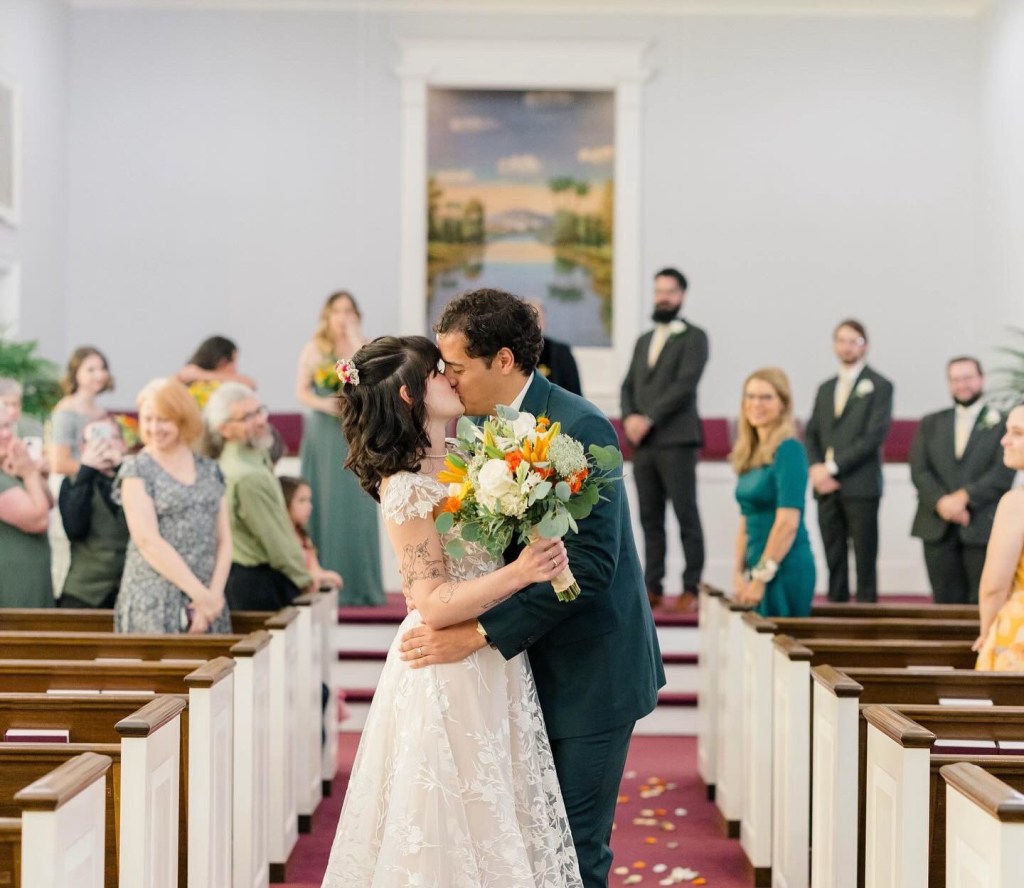
My boy walked me down the aisle and seated me at the second pew, in the same spot where I sit each Sunday while his father preaches. In the same spot where I sat while I was expecting him and felt him stop moving whenever the piano was played, where I knew he was listening to the music before he was ever born. In the same spot where I sat with him in my arms for the first time during worship, when he was four days old.

I rested in the remembering.

I rested in the preparations being complete, and the long-awaited moment at hand.

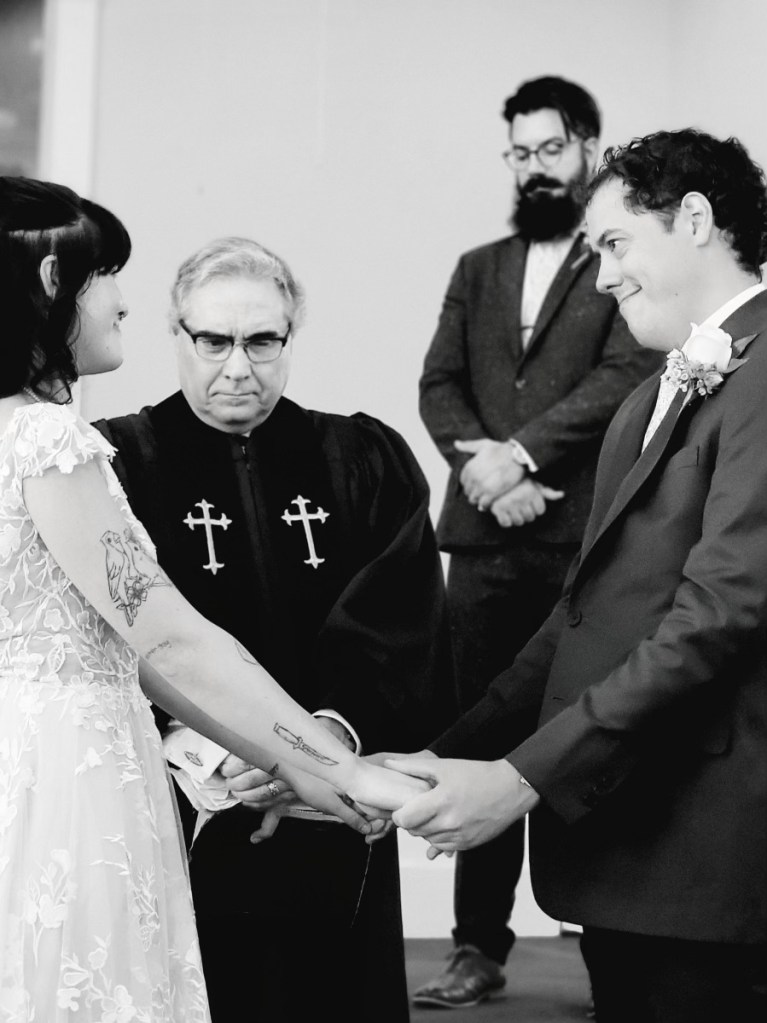
I rested in the expression on my boy’s face, making his vows to his bride. I have never seen a groom with so tender a countenance. I marveled, and rested.

I rested, and rejoiced, that his father lived to officiate after suffering such serious health setbacks in recent years.

His father began to cry during the ceremony.

I rested in that love. In the overcoming. In the triumph.

I rested in the presence of my husband’s sister, that she traveled to be here, that she reminded my boy of his grandmother who loved him so. Ma-Ma is here, you know, she told my boy just before the wedding. She cried, too, over how much he looks like her mother.

I rested in the knowledge that my sister-in-law remembers her mother every time she sees a cardinal, her mother’s favorite bird. A symbolic bird, representing Christ. I remembered that my sister-in-law and my boy were holding Ma-Ma’s hands when she died. I rested in the serendipity of my boy’s bride choosing her wedding gown before she knew it was named “The Cardinal.” It happens to be her own grandmother’s favorite bird.

I rested in the significance of my boy’s precious bride wearing her grandmother’s pearls and my earrings, the third bride in the family to do so, after my first daughter-in-law and my youngest niece, who came with her new baby to see her cousin married. I recalled buying those earring for my twenty-fifth wedding anniversary.

I rested in that.

I rested in the timing, in late September marking the births of my grandfather and my husband as well as the loss of my father, and that it now marks new joy.

I rested in the day, in the glorious cusp-of-autumn sunshine, in this season of scuppernongs and piercing calls of red-shouldered hawks. I rested in the symbolism of wildflowers that my new daughter-in-law loves so well; although delicate and fragile, they are incredibly adaptable and resilient. They represent delight of the soul. She carried wildflowers; they were the pattern of my boy’s tie. Her dress and their wedding rings also bear vines—a symbol of deep spiritual significance.

I rested in the Scripture my husband read, from the second chapter of the Song of Solomon, the first time he’s ever used it in a wedding:

My beloved spake, and said unto me, Rise up, my love, my fair one, and come away.
For, lo, the winter is past, the rain is over and gone.
The flowers appear on the earth; the time of the singing of birds is come, and the voice of the turtle is heard in our land;
The fig tree putteth forth her green figs, and the vines with the tender grape give a good smell.
Arise, my love, my fair one, and come away.

I rest in the fact that my boy and his bride reside just four minutes away from me.

And I rest in the vows that they wrote and spoke to each other, and in the invisible thread that pulled them together, drawn by the hand of God.

Yes.

I rest in the litany of it all.

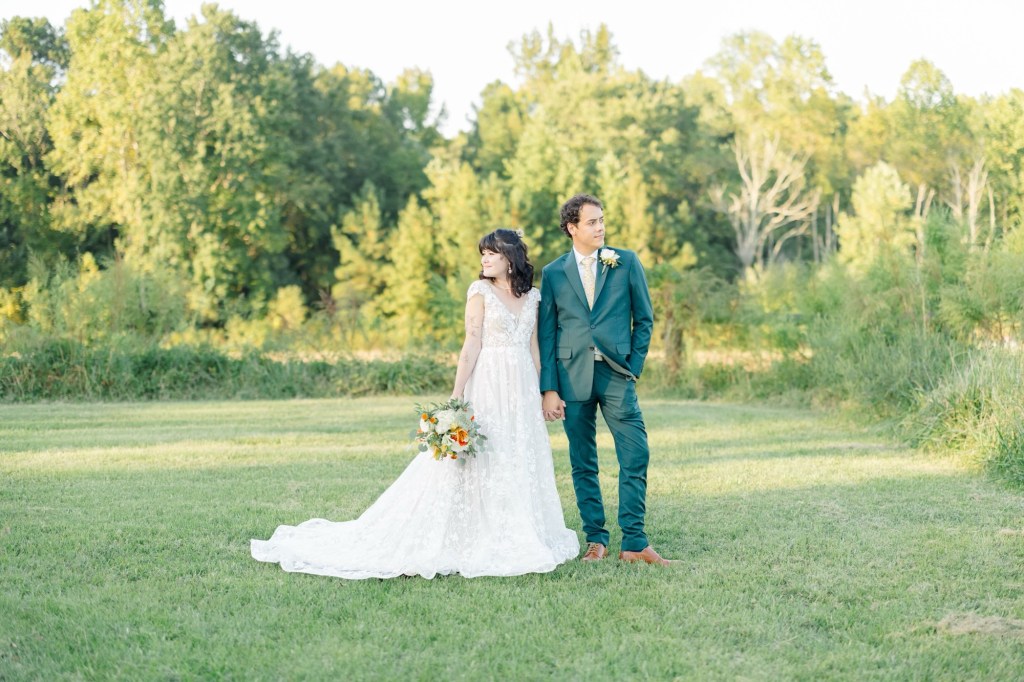
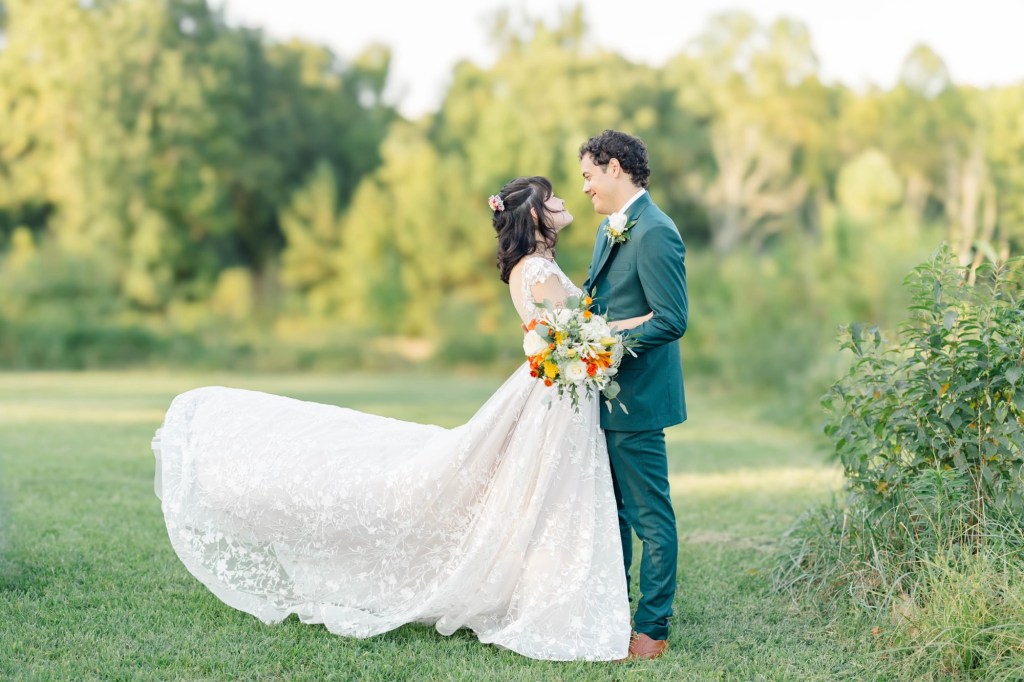
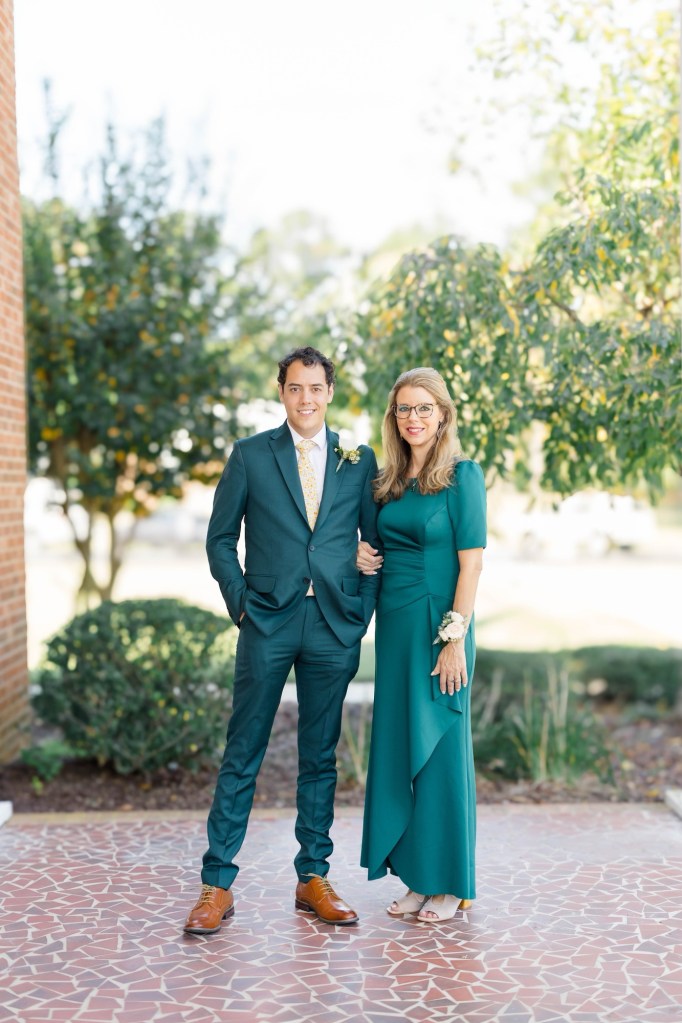
My boy and me in front of the church after the ceremony.
Behind us is the parsonage where we lived when he was born.

Photos by Kailey B. Photograhy

*******

with thanks to Two Writing Teachers for the wonderful sharing-place
known as the Tuesday Slice of Life Story Challenge
My last hummingbird

She’s still here.

As of yesterday evening, anyway, after I went out in the rain to refill the almost-empty hummingbird feeder.

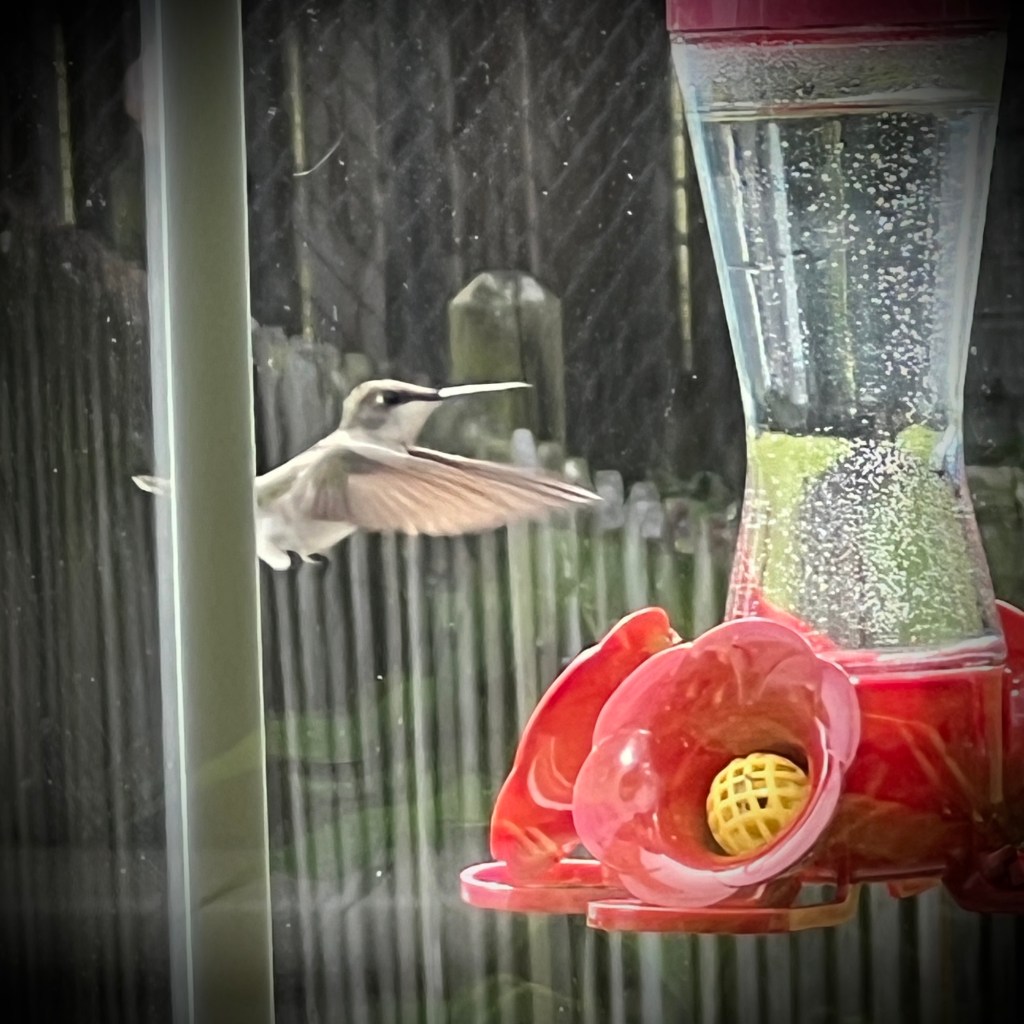
One little female, silvery-cream, with the faintest dark speckling on her breast.

Upon my return to the house, I stand a few feet back from the window in the unlit kitchen, and —zip! —she appears like a fairy out of nowhere. She perches on the feeder (attached to my window with a suction cup hanger), gripping the thin red rim with unspeakably tiny feet. Her back appears gray in the dusk but I know how it shimmers in the sunlight: gold-dusted, olive-green, smooth as glass. Ethereal. I marvel at the exotic lining around her eye. For a moment, I forget to breathe.

For several days prior, she and another hummingbird were fighting like mad for possession of the feeder. Clearly a high-stakes frenzy. Remarkably loud squeaking. Palpable urgency. Throughout the summer, four or more of them kept vying for a turn. They do not share. They drive each other away. Each bird has her own unique markings, but the astonishing speed of movement sometimes makes individual identification impossible. Except for the one female with a rare dot of red at her throat. Fancy.

Ornithologists say that male ruby-throats return first each spring, but my first hummingbird sighting this year, at the outset of April, was a female. I pushed up the kitchen blinds one chilly morning and there she was, right before my eyes, hovering for a split second before darting away. I caught the implied question: Ummm…where’s my nectar?!

I like to think it was this same female. The first to arrive. The last to leave.

I wonder why she lingers.

It’s mid-September. The males left at the end of August. Punctually. I saw the last one on the last day of the month: A male perched on the feeder, his black ascot turning to crimson-fire whenever he lifted his head. I watched him take his fill of sugar-water. I noted the date. By Labor Day, I knew that was it. He’d gone, as if in keeping with the calendar page flipping or an inner alarm clock going off: Ding! Male hummingbirds vanish all at once. Now you see them, now you don’t. Poof.

Females remain for a few more weeks. I’ve sensed that mine have been leaving, one by one, in the last few days. Off to Mexico or Central America or wherever they winter. I am curious about where my birds go. I am certain each goes to its own exact spot; there’s no shadow of turning with hummingbirds.

I’ve read of their long, lonely, exhausting migration, but I can’t imagine hummingbirds ever feeling sorry for themselves. Prosaic writers have described them as “made of air” and “tricks of light” — I love the lyricality.  I also know that the hummingbird’s fragile appearance belies a tenacity and ferocity unrivaled by any other bird around, even the huge red-shouldered hawk that sits so majestically on our power lines and poles, scrutinizing the landscape for prey.

Last week I heard the cries of a hawk. I went out on my porch to listen and was rewarded with the sight of two red-shouldered hawks flying, one after the other, in the patch of tall pine woods across my street. I suspect there’s a nest nearby. While I stood gazing in awe, there came a sudden vibration: vvvvRRRR! A female hummingbird materialized to hover three feet away from my face, her wings beating like tiny fan blades on high.

I said, Oh it’s you.

I feel sure she was saying the same thing.

We seem to be equally curious about each other.

Maybe she was the one that still lingers, my last hummingbird.

She won’t stay much longer.

In the predawn hours, with a rainstorm raging and my electricity out, it’s too dark to see anything beyond my window except for the feeder. It still holds. Freshly replenished. I will ensure that it remains so for as long as my hummingbird should have need of it.

When she’s gone, I’ll experience a little autumnal pang of loss, the expected but unwanted shedding, the indefinable ache of transition, the instinctive pulling-inward preparation against the coming cold and dark. For a time. A season.

Until the morning I push up my blinds and we meet face-to-face once more.

 Godspeed, precious spark.

*******

With thanks to Two Writing Teachers for the Tuesday Slice of Life Story Challenge
and to the hummingbird that remains
even now, in the wind and rain
while I write

The greening

The Greening

On Christmas, my firstborn son
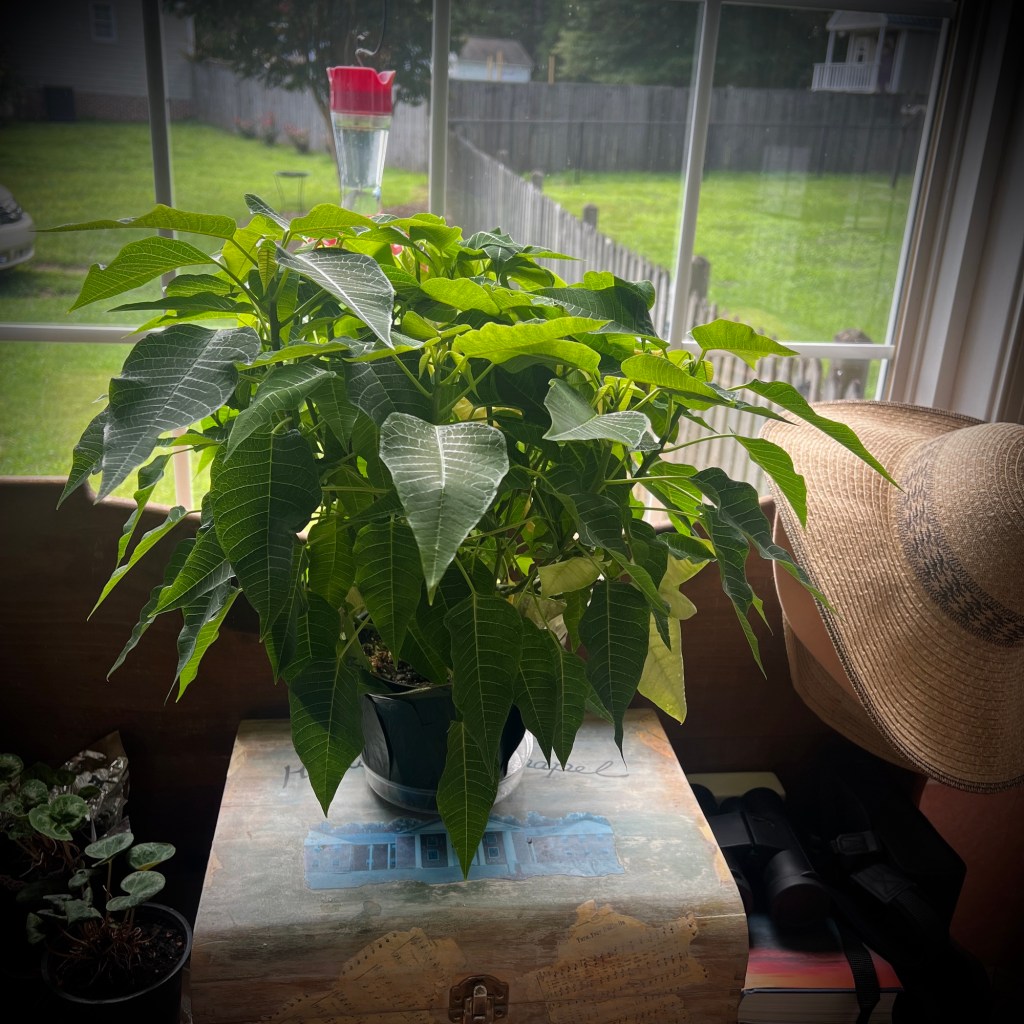
brought me a white poinsettia
from the altar of his church

I set it by the window
in the kitchen, facing east
expecting it would die soon

but it lives on, lush and green
from the abundance of light
and my increased watering

For reblooming, it must go
in the dark, thirsty and dry
but I can’t, I can’t do it

It’s the only poinsettia
I haven’t managed to kill
and my boy gave it to me

Let it stay pure emerald
drinking all the light it can
in its summer of content

growing a little bigger
every day, like my spirit
while my leaves begin to fall

*******

with thanks to Denise Krebs for the inspiration and septercet poem form in today’s Open Write at Ethical ELA

Green comfort

Written 7/9/2024

Today I type my thoughts while sitting by the green-gray Atlantic. Ancient undulations roll on and on like Time itself, cascading into new foam as brief and bright as this new morning.

The older I become (this is the last year of my fifties) the more I contemplate the brevity of things. Suddenly—it seems—the kids are grown with lives of their own. The granddaughters are older and smarter every day. Micah, age two-and-three-quarters, carries on a conversation like an adult. She knows what “be brave” means. She will need that attribute in life more than she can know.

I have.

My husband walks out into the waters for a moment. He’s not much of a beachgoer anymore, after all his medical crises in recent years. He’s here because I want to be. Because I need a little salt, a little sun, probably a lot of Vitamin D, and the comfort of this vast continuum. We loved the beach when we were young. Almost thirty-nine years into the marriage, the ocean is personal metaphor, a living promise, ceaseless.

Ever how grounded I may be in my faith, I am not immune to lapses. Today, as I logged on to write this post, WordPress offered a prompt:

What strategies do you use to increase comfort in your daily life?

And in my email inbox, a devotion from Our Daily Verse on increasing perseverance.

For me, the key to increasing comfort and perseverance in daily life begins with remembering that God is still God. No matter what. Not merely the limb on which I perch when I’m tired and despairing, but the whole of existence. The true eternal. Generations of our whole human history rise and fall like the ocean waves, and God holds it all.

The sun grows hot. My husband can’t take it for long, and, truth be told, neither can I. Our morning by the sea is brief. We must seek a respite. Somewhere shadowy and green.

I can’t help thinking of forgiveness as a green thing…well-watered with tears, surely, but under its lush canopy, comfort. Rest. Freedom. Peace. As we prepare to leave the shore, my husband and I watch parasailors. How peaceful it must be, so high above it all. I wonder what they hear up there. Here on the ground I hear the ocean’s roar, a strain of cicadas in the scrubby brush, and a baby laughing nearby, playing in the sand.

Some of my favorite sounds on Earth.

Along with the house finch singing as soon as we arrived at the beach this morning. I heard it as soon as I opened the car door. Instantly recognizable. It’s the beautiful song I hear on my front porch every spring and summer. In itself, the sound of perseverance. Of home. It seems to follow me everywhere I go. “Hello, Finch,” I called back to him, perched there in his crape myrtle tree, his little head and breast as red as sunset.

At a recent gathering, my neighbor joked that we’ve reached the time of life in which we just want to watch birds.

There’s comfort in it.

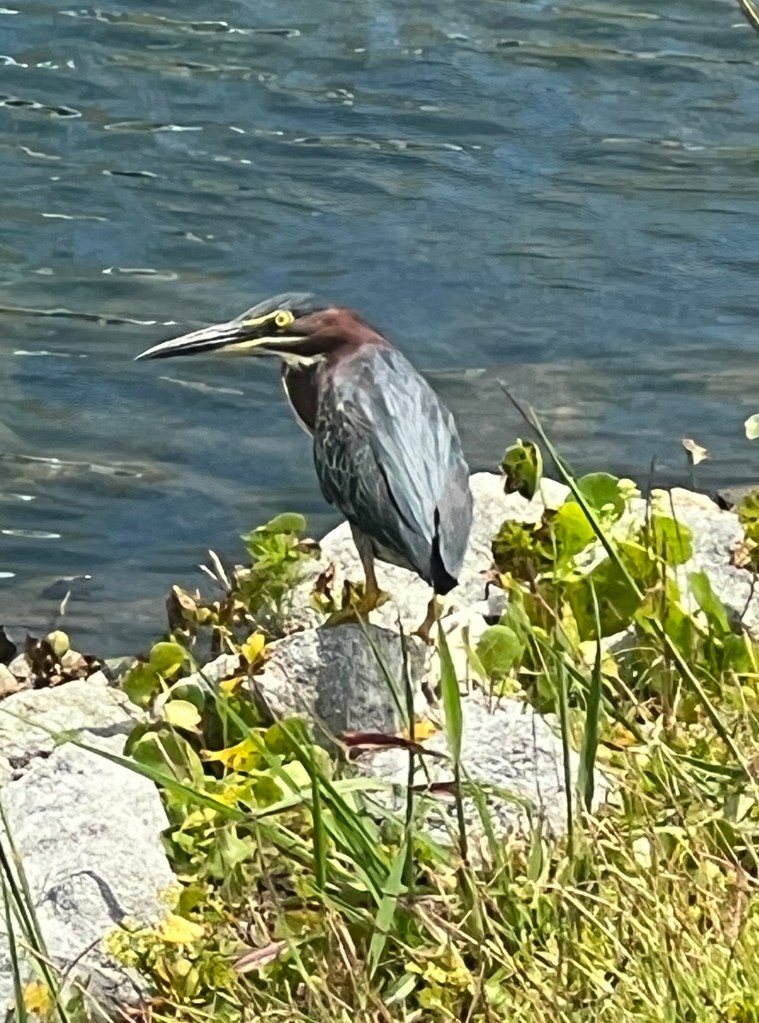
Yesterday while walking through the beach community I saw a green heron. I don’t recall ever having seen one before. A week ago I responded to a fellow blogger, wishing I could have seen the green heron she wrote of, so lyrically.

And one came to me.

The heron and I watched each other for a long awed moment, before she (?) flew to the other side of the pond and I walked on, to let her be.

I contemplate the symbolism of the green heron.

From a biblical perspective, my first go-to, it’s not great. Herons are “unclean” per the Law, i.e., not suitable for consumption, although one resource states that “The very poor of our western and southeastern coast states eat them”(in 1915, that is to say, per the ISB Encyclopedia, written just before the birds were protected by the Migratory Bird Treaty Act). I wasn’t expecting this, the act or the desperation. It’s been illegal to hunt and kill herons for over a hundred years. Furthermore, the green heron is known to be an irritable, angry bird.

Sounds like some people l know. I don’t want to be one of them.

There are a number of other spiritual meanings associated with the green heron, among them humility, patience, adaptability, wisdom, the ability to focus intently (heaven knows I need this; I used to be better at it than I am now)… and perseverance.

What it really comes down to, however, is how I felt when I encountered this bird. I’d desired to see it, and it came. We were maybe ten feet apart. The heron fixed its bright golden eye intently on me and I was awed. Encouraged. Curious.

It didn’t say anything but I imagine if we spoke the same language, it might have said Be watchful. Be brave. You will persevere. What you need will be provided.

All this in a space of a held breath, in a flutter of green wings, beside the still waters…

I believe. I walk lighter, a wordless green song in my heart.

My green heron

*******

with thanks to Two Writing Teachers for the Tuesday Slice of Life Story Challenge
Red, white, and blue reflections

The words are in my head when I wake.

Memorial Day.

I should write about it, I think.

But my brain is restless.

For one thing, the weather.

I rise with the sun and patter, barefoot, to the kitchen. Pink light is spilling through the blinds before I open them. Thunder rolls in the distance. The forecast is severe. I stand in the bay window’s rosy glow as a soft rainshower begins. No birds in sight. The usual morning chorus of robins, house finches, cardinals, Carolina wrens is paused. Silence, but for the occasional caw of a crow near the woods. My neighbors’ freshly-planted roses are blinding red against the green grass, the weathered-wood fence. Stark white curtains hanging from their gazebo flutter like ghosts, like prelude…what’s past is prologue, as states the murderous Antonio in The Tempest.

That’s the second thing. Ghosts.

The imagery distracts me.

I ordered a ghost from a catalog, once. When I was a child. True story.

It was disappointing.

That was before I knew that ghosts have many manifestations. And to be careful what you wish for.

There’s always a cost. Ghosts aren’t free.

Why I’m thinking this just now, as the sun fades away into gray, as the lights in the house blink, as the skies crack open, releasing the predicted deluge, as my little dachshund curls into a ball on the kitchen rug, shivering uncontrollably…I do not know, exactly.

On the table I have a small arrangement of red, white, and blue flowers, in honor of the day and my country’s fallen soldiers. I recall learning that my first real home was once an Army hospital morgue.

It’s dim, but I can remember living in that shadowy house at age three, until my family was forced out. I wonder which WWII soldiers were brought there before their burial, before my time.

I light a candle by the flowers, against the encroaching darkness. At the window, a tiny ember-red flash. Male ruby-thoated hummingbird, undeterred by the tempest, coming for a drink of sugar-water at my feeder. Over by the wooden fence,in front of the gazebo’s billowing white veils, a fluttering of blue wings… bluebirds seeking to feed their young. Despite all. Above all.

Sustenance.

New thought: That’s what this day is about.

Sacrifice, prayer, and peace, too…in fact, the word prayer is mentioned four times in the legal language for the holiday (read it for yourself: 36 U.S. Code § 116 – Memorial Day). Peace appears twice. Contextually, in a call to pray for permanent peace, according to each individual’s faith.

That’s in the law of our land.

As the storm descends, I pick up my trembling dachshund. There’s no way to tell him it’s only temporary. I can only hold him ’til it’s over. Sustenance. The lesson of the birds. The whole purpose of prayer. Of faith.

Memory. It’s for teaching. If what’s past is prologue…it cannot be changed; but the present, the future, can. If we remember. If we do not remember the past, as the saying goes, we are condemned to repeat it.

That’s the lesson of the ghosts.

*******

with thanks to Two Writing Teachers for the Tuesday Slice of Life Story Challenge
-sharing your writing is a true act of courage.


True or False poem

My friend Denise Krebs hosts VerseLove over on Ethical ELA today with a profound “true/false” list poem based on the work of Dean Young. By all means, read her poem and the prompt.

Here’s what I have, so far…

True or False?

  1. I am much older than I appear.
  2. Green is the color of ordinary time.
  3. Angels can sing.
  4. Stars can sing.
  5. Trees can sing.
  6. Just because it’s myth doesn’t mean it isn’t true.
  7. There’s a reason I use seven asterisks for section breaks.
  8. A seahorse holds the reins of your memory and emotions.
  9. Salt water heals all.
  10. Blood is thicker than water.
  11. Blood cries.
  12. I will live to see another solar eclipse.

*******

Bonus points will be awarded for citing evidence in support your answer for #10.

Tip: Double check #3 before submission.

*******

MDavis.D, CC BY-SA 4.0 https://creativecommons.org/licenses/by-sa/4.0, via Wikimedia Commons

*******

with thanks to Two Writing Teachers for the Tuesday Slice of Life Story sharing