What is literacy?

Museum of the Navy

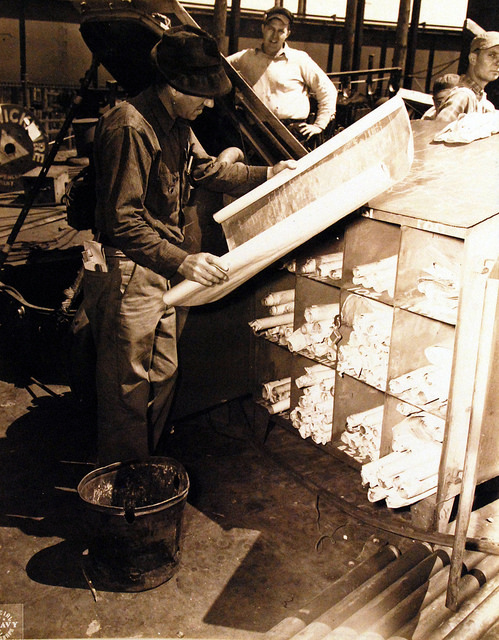
Quarterman shipfitter looks at blueprints, 1943. Museum of the U.S. Navy

“Literacy is the ability to identify, understand, interpret, create, compute, and communicate using visual, audible, and digital materials across disciplines and in any context.

The ability to read, write, and communicate connects people to one another and empowers them to achieve things they never thought possible. Communication and connection are the basis of who we are and how we live together and interact with the world.” 

International Literacy Association, 2018

On the eve of the New School Year, I contemplate my role in the scheme of things. In the face of changes in staff, in curriculum, in differing perspectives on literacy instruction.

I am defined by literacy. I’ve loved reading and writing all my life. My professional work is literacy: As a coach, I collaborate with teacher colleagues across grade levels on how to best teach English Language Arts in ways that meet the needs of all students.

When it comes to defining literacy, I rely on the International Literacy Association, for no two dictionaries, and hardly any two people, seem to have the same idea of it. Some believe it’s just reading and writing. But it’s so much more . . . .

In the ILA definition several things jump out at me, beginning with

the ability to interpret

in any context

I think of my grandfather.

Over a hundred years ago, my grandfather left school to work on his family’s little North Carolina farm. He married during the Great Depression. When tenant farming, sharecropping, and other odd jobs like painting houses weren’t enough for him to “make a go of it,” Granddaddy rode with men from his hometown to Newport News, Virginia, in hopes of landing steady work at the shipyard.

Granddaddy became a shipwright, responsible for helping build the keels of ships, less than a year before Pearl Harbor. When America entered World War II, production continued around the clock with the invention of a new thing: aircraft carriers.

He made his living; he took care of his own. He retired from the shipyard when I was five. He and Grandma moved back home and there I spent my childhood summers.

In the evenings he sat in his recliner while Grandma and I sat on the living room floor. She spread the newspaper out on the carpet, handed me the “funnies” section, and then she read the rest of the paper in a loud, clear voice to Granddaddy—his years around industrial equipment in the Yard had made him hard of hearing.

I eventually asked:

Why do you read the paper to Granddaddy? Why doesn’t he just read it?

He can’t, Dear. 

Why? Is something wrong with his eyes?

No, no. He just never learned to read, not much, really. He quit school in the fourth grade to help on his family’s farm, you see . . . .

I was stunned. This was the first time I’d known of anyone who couldn’t read.

It hurt my heart for him.

But I later learned that he could read intricate blueprints and build to those precise measurements. That’s what he did at the shipyard all those years.

It’s something I can’t do.

 the ability to identify, understand, interpret

using visual

materials across disciplines

and in any context

My grandfather was always a farmer first; he read the days, the seasons, the weather.

He read nature. When he and I came across strange worms gliding over his front sidewalk, he couldn’t identify them but instinctively knew to leave them alone. Decades later I researched them (land planarians) and learned that if he’d tried to crush or chop them up, every piece would have replicated and they would have destroyed the good earthworms that kept his garden so abundant and healthy.

Signs, symbols, meanings, he understood. Not in or from books, but from life. He possessed visual-spatial acuity. Keen intuition. He read the times in which he lived, comprehended that the way of life he and the generations before him had known was passing forever. He reached for better things. He worked hard. He collaborated with a lot of different people. The shipyard management eventually asked him to be a supervisor, and that’s where his courage ran out. It required regular paperwork. He declined the position.

My heart ached again, deeply, on learning that.

The ability to read, write, and communicate connects people to one another

and empowers them to achieve things

they never thought possible.

That belief is behind everything I do with teachers and students.

The greatest man I’ve ever known indirectly taught me, years ago, that reading and writing are the keys to opening doors of possibility and opportunity. He also taught me that literacy is so much more, long before this digital age.

We have to be able to read words and ascertain their meaning, but our survival depends on more. We must be able to read the times, read people, read what we see, what we are creating. And make sense of it. We must interpret. That’s the entire, inherent value of reading and writing in the first place.

We must communicate well with one another, recognizing that each of us possesses different strengths, all of which are valuable to helping each other. Communication is the keel on which all good relationships are built. We must speak, but we must listen more, absorb more, understand more.

Communication and connection are the basis of who we are

and how we live together

and interact with the world.

My grandfather survived—his family survived—because of his clarity of vision and sense of purpose.  He knew he lived through unique times. In his last years he preserved his life experiences for future generations not by penning a memoir but by recording his stories on a set of audiotapes. I don’t think he ever knew just how unique, how extraordinary, he was. In my mind I see him now—thick white hair, plaid shirt, gray pants with a black belt, black shoes, his big, wrinkled, work-worn hands folded in his lap, leaning back in his recliner listening to my grandmother reading. In addition to the nightly newspaper, she read the Bible through to him each year.

And so, on the eve of the New School Year, I contemplate my role in the scheme of things. I think of the constant adaptation of teachers to the times and the changing tides of literacy instruction; of students, each of whom has strengths and gifts that may not be obvious at first. I think of their futures and know that clarity of vision and a sense of purpose are vital to their learning and well-being. To all of our well-being. I think of my grandfather reading complex blueprints and going forth to build something previously unknown in a vastly changing world. I think about life literacy as well as literacy for life. How we live together and interact with the world.

For, in truth, we are building the world.

*******

Here’s the story of Granddaddy and me encountering those unknown worms long ago: First do no harm.

A fine mess

After being away on vacation all last week, my first order of business on returning home was to check on the four baby house finches that hatched in the wreath on my front door. I’d been chronicling their development daily, so I knew many changes would occur in my absence.

Here is what I discovered:

1) The babies are now well-feathered; their skin-head mohawks have become mere wisps upon their downy crowns.

2) Two of the babies can fly. They sailed out of the nest this morning as I approached. The other two stayed put, their bright little eyes regarding me with a mixture of curiosity and apprehension.

3) Their nest is one spectacular conglomeration of droppings.

To be fair, the droppings are only around the rim; the mother collects them there. What a job, building a wall of excrement. Worse than diapers. When I first wrote of the perfect, flower-graced nest, the pale blue eggs, the hatching of the tiny pink nestlings, I concentrated on the beauty and wonder of life. I pointed out that the collective noun for a group of finches is a charm.

And charmed I was.

There is nothing charming about that nest now.

The fledglings themselves, of course, are enchanting. They’ll soon be gone, the circle of life will go on, and all that will remain of these magical moments is a monumental mess.

But that’s the story of life. It’s messy. It can’t be comprised solely of breathtaking beauty and newness; if it were, we could not recognize these moments for what they are. They’d lose their value. Only when contrasted with ugliness, hardships, and pain can we see and cherish the beautiful when it comes. We inevitably deal with messes, some that occur naturally, some created by others, some of our own making. Therein lie all the stories . . .

Which makes me think of writing. This nest is a tangible (although I do not wish to touch it) reminder of these commonalities:

-Life is messy.

-Writing is messy.

-Thinking is messy.

-Teaching is messy.

To do any of these well, we have to be willing to accept and even embrace the messiness. We must certainly persevere through it to arrive at the beautiful. It takes courage, stamina, and a lot of hard work, to write well, to think well, to teach well, to live well.

The strength to do so, I believe, lies in believing that the beautiful will come. It’s all a matter of trust, of faith. And pressing on.

Although I was appalled by the quantity of accumulated—um, bird-doo—around the nest, I was also amazed that two of my four little finches could fly. Last night they couldn’t; today they can. Tomorrow the others might.

This is a message to me about readiness.

Everyone arrives as a writer, a thinker, a teacher, a good practitioner of life, in their own time. Lots of messes will be made along the way. Sorting this out is what grows us. One by one, as children, as adults, as long as we live, we are continually growing the necessary wings to fly beyond where we are. And it’s truly a collective, collaborative growth; we are to nudge each other when needed, but not too hard, too soon. We’re not to hold back, to hold one another back, simply because we cannot see all that lies ahead and for fear of navigating the unknown. Knowledge comes by trying. By experiencing. By taking risks. There’s an implicit difference between throwing caution to the wind and taking a leap of faith, that being potential self-destruction versus healthy maturation. These finches know. As the day wears on, I watch the two fledglings that can fly going back and forth from the eaves to the nest, coaching their other two siblings on how to do it. See see see, I hear them cheeping. A bit at a time, a bit at a time. At any moment, those last two are going to get up on that nasty, messy rim and let go.

In more ways than one . . . .

So you make a mess. So what? So you’re alive and growing.

Tomorrow you stretch your newest feathers and find you can move on.

To where the beautiful awaits.

That kid

Legos

Legos. qrevolutionCC BY

I woke up thinking of him today.

Don’t know why.

Maybe it’s because another school year just ended and memories are flowing thick and deep, like they always do.

Maybe something subconsciously reminded me of the collective sigh of relief when he finished elementary school and moved on a few years ago.

I am not sure.

But here he is again, so clear in my mind.

He arrived every morning long before the school doors were open, jumping, running on the sidewalks, talking to himself, singing. Staff spent the first few hours of each day trying to calm him down.

My first real encounter with him came in third grade when I, as the literacy coach, worked out of the room across from his classroom. In better moments, he’d appear without warning in my room: “What do you do in here?”

“I plan reading and writing lessons. Sometimes I have reading groups in here. Want to read with me?”

“Naw,” he said, wide-eyed, shaking his head emphatically, bouncing back to his room just as the teacher realized he’d left.

In the worst moments, the teacher came to enlist my help.

“I need a breather,” she said once, gray-faced. “I can’t do anything with him today. Can you please just stay in the room for a few minutes?”

So I stepped in. Everyone was seated, working on something, except . . . that kid. He was standing by a classmate’s desk. Taking things off of it.

“Stop it!” she kept saying.

“What’s going on?” I asked her.

“He’s taking all my supplies that I’m trying to use for this project,” said the exasperated girl.

Leaning down to his eye level, I addressed that kid: “Did you ask her permission to borrow her supplies?”

He snorted and flounced away from me. He kept grabbing pens and markers.

Firmly accentuating every word, I said: “Leave her things alone. If they aren’t yours, do not touch them without permission.”

At this moment, I realized the whole class had stopped working to watch.

He didn’t return the items. Instead, he marched to his desk, took out a wrinkled piece of notebook paper, wrote a word on it, and waved it around in the air:

Bitch

I took odd satisfaction in his spelling the word correctly.

Just then his teacher returned from her “breather.” In fractions of a second, she absorbed the scene. She was livid. The rest is a blur, her ushering that kid out of the room while the others bent quietly back to their work.

He wrote me a note of apology while doing his time in the assistant principal’s office. Delivered it to me himself, later that day.

He’d drawn flowers all over it.

That was the beginning of my being his “safe place.” When he couldn’t function in the classroom setting, his teacher sent him over to me for a few minutes, until he was able to return. One day was especially bad; I cannot remember the details of his actions. His teacher, red-faced and teary-eyed, escorted him over and immediately returned to the rest of her class.

Pacing back and forth like a caged animal, his eyes suddenly landed on the Legos on a table in the wet area of the room. Without a word, he sat at the table, and, block after block, immersed himself in building.

Presently his teacher came back, and on seeing this, turned to me. Turned on me, actually:

“Why are you rewarding his behavior like this? Why should he disrupt the class completely and get to come over here and play?” This teacher, usually so mild-mannered and nurturing, was angry to the point of visibly shaking.

Caught off guard, I took a step back. “I didn’t think of it as a reward, or even playing. He’s decompressing—this seems to be exactly what he needs.”

She stared at me for a long minute. Then she turned to that kid and said, “Are you ready to come back to class?”

He got up without a word and followed her.

Many more times that year he came, played with the Legos for a little while, and went calmly back to class.

I learned, talking to him, listening to him, that his mind functioned in overdrive. Warp speed. Hyper-curious. He asked questions other students didn’t think to, without reservation. He noticed minute details that others, adults included, frequently did not.

Such as, seeing me walking toward him in the hallway: “Hey, Mrs. Haley! Where are you going? What’s wrong with your hip?”

“What?”

“Your hip. One’s higher than the other.”

I looked at his earnest face, stunned. He was right; a touch of scoliosis left one hip slightly higher than the other, which plagues me every time I have to buy pants or jeans, making sure the one side is long enough.

He was also a math whiz. Scored high on his tests. Reading, not so much. He did decide to read with me a time or two. I later watched him work hard on his reading test, but there were too many things vying for his fractured attention; too many choices, too many strategies to remember.

But he tried.

And then he went on to middle school.

One day, at the end of another school year, I was walking through the parking lot with boxes to place in my car when I heard, “HEY, MRS. HALEY!”

—That voice!

A human projectile came from nowhere and threw its arms around me, tight.

That kid.

“Hey!” I said. “It’s you! How are you?”

“Good!” he said. “How’s that hip?”

That kid.

That rare kid, with rare insight and gifts that many may never see.

Woke up thinking of him today.

God, please let him make it.

Most meaningful moments in school: A student’s perspective

Jumping for joy

Jumping for joy. kilgarronCC BY

“So,” I ask the student, “what are some of your favorite memories from all your time in elementary school?”

She’s working on her fifth grade graduation speech. Making this farewell address to the school is part of her official role as Student Council President. She’s struggling with framing her thoughts, which is why I’m here.

She looks off in the distance, past the walls of the room where we’re sitting, scrolling back over the chapters of her young life. I wonder what she’s remembering. Maybe a time she accomplished something she thought she couldn’t? Winning a class competition? A book that a teacher read aloud? A moment in a lesson when she learned something powerful that will remain with her for the rest of her life? I hope that’s it because I want to know it. And tap into it.

Finally she smiles. “There was this one time my first grade teacher just started tossing candy around the room.”

I blink. “Um, okay . . . why did she do that?”

The student shrugs, still smiling. “I don’t know. I don’t think there was a reason. I just remember she had a lot of candy and she started tossing it around for us and the other classes.”

Six years of elementary school and this is her favorite memory.

Having nothing to do with learning, achieving, growing, or rationale . . . but everything to do with spontaneous joy.

“All right then,” I say as I jot notes. “You can put this in your speech. Maybe call it the time you remember it ‘raining candy’ and explain what your teacher did.”

“That’s good,” she nods.

“Can you think of any other special or meaningful moments from all your time here?”

I wait as she scrunches her face a bit, thinking hard. Then another big grin:

“Yeah, the time the fourth grade teachers got together and sang to our classes.”

They sang? I never knew they did this. I’m curious. “Why did the teachers sing to you?”

“Just for fun, I think.”

Her eyes are so bright.

We finish fleshing out the draft of her speech. She is pleased. As she heads back to her classroom, I walk the hallways, replaying the conversation, mulling the moments that hold significance for such an accomplished student.

Just simple, unscripted, uninhibited moments when teachers were having fun.

How few and far between are they?

But how priceless to students, in the long educational scheme of things.

I walk on, carrying both the lightness and the weight of it.

Get words

Imagine what is over there

Imagine what is over there. Kenneth BarkerCC BY

Last night I met with a small group of teacher-writer-colleagues from my district.

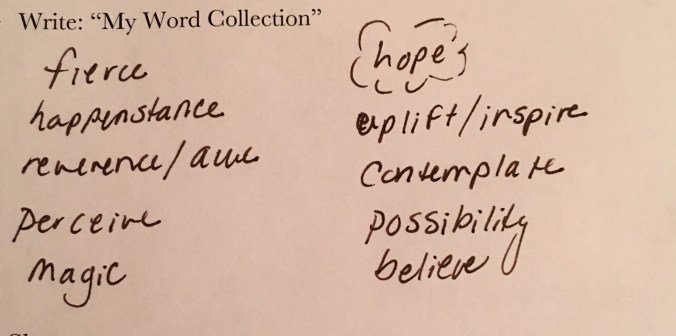
We started our discussion by writing words that resonate with us.

-Quickly.

Mine are:

fierce    happenstance   reverence   awe   perceive  magic  hope   uplift   inspire               contemplate   possibility   believe

I don’t know why this was hard or why some of these words came to me (happenstance? Go figure. Must just be the sound of it. What other reason could there be?).

Then we had to pick the word that was most significant to us.

Mine is

      hope

for in every aspect of my life, I am hopeful. If I could impart one thing to others, it would be hope.

Hope is vital to the human spirit.

My colleagues and I talked about our work with students, other teachers, and our own writing. Where we’ve been, where we are now, where we want to go.

       uplift

               inspire

Going home, the lively discussion and energy circles round my mind. Something in there is trying to find a landing place.

                         contemplate

The “something” is tied somehow to student reactions . . . the ooooohhhh moment that’s such music to a teacher’s ears . . . like when a student connects a thing he/she loves to a book, or to writing . . . this week in fourth grade, it was me asking Why is opinion writing important? with a student responding You write about what you feel deep in your heart and another student saying Like music. I can write about why I love music. I want to write songs and me saying, Well, maybe you need to write your opinion piece AS a song.

—beat—

OOOOHHHH

       reverence

                             awe

And then I think, fierce is an odd word for me to pick yet it was the first one that came to mind. Why is that?

Fierce love like mother for child, fierce dedication to excellence, fierce desire for learning.  Maybe that’s why.

The something circling in my mind is materializing. I think it’s another word . . .

                                                    perceive

Not that word.

The word is—well, awfully simple:

Get.

Get?

Yes, get.

Get what?

Get them reading

Get them writing

Get them talking

Then get out of the way.

Oh, I get it.

My colleagues and I talked about that.

And

Get out of the box.

Because that’s where all the

          magic

happens.

We don’t make it happen.

They do

but only after we tear down the walls

of windowless boxes

so that they can see the glimmering horizon beckoning

and be free to

imagine

what is over there.

                       possibility

And that they can

get excited

get through

get there

if they only

      believe

And that comes only from the stirring the ocean within

Not by sea-spray on the wind without

never never by

                           happenstance

Snow day GIF documentary

If you work in education—in central North Carolina, anyway— you know that the merest rumor of snowflakes sends people into a frenzy. Mostly because 1) We must go buy bread and water in vast quantities, or at least the necessary ingredients to make big pots of chili; and 2) We want to be home quickly, because we really don’t know how to drive in this stuff.

Just to be safe, systems dismiss early, sometimes before any flakes fall.

Such was the case yesterday. The masses went home to stay glued to weather reports and social media, all the while asking: When will the snow start? How much will we get?

And the question of all questions: WILL SCHOOL BE CANCELED TOMORROW?

So, as a few flakes dropped in various areas, but not in others, as the evening wore on, the waiting intensified.

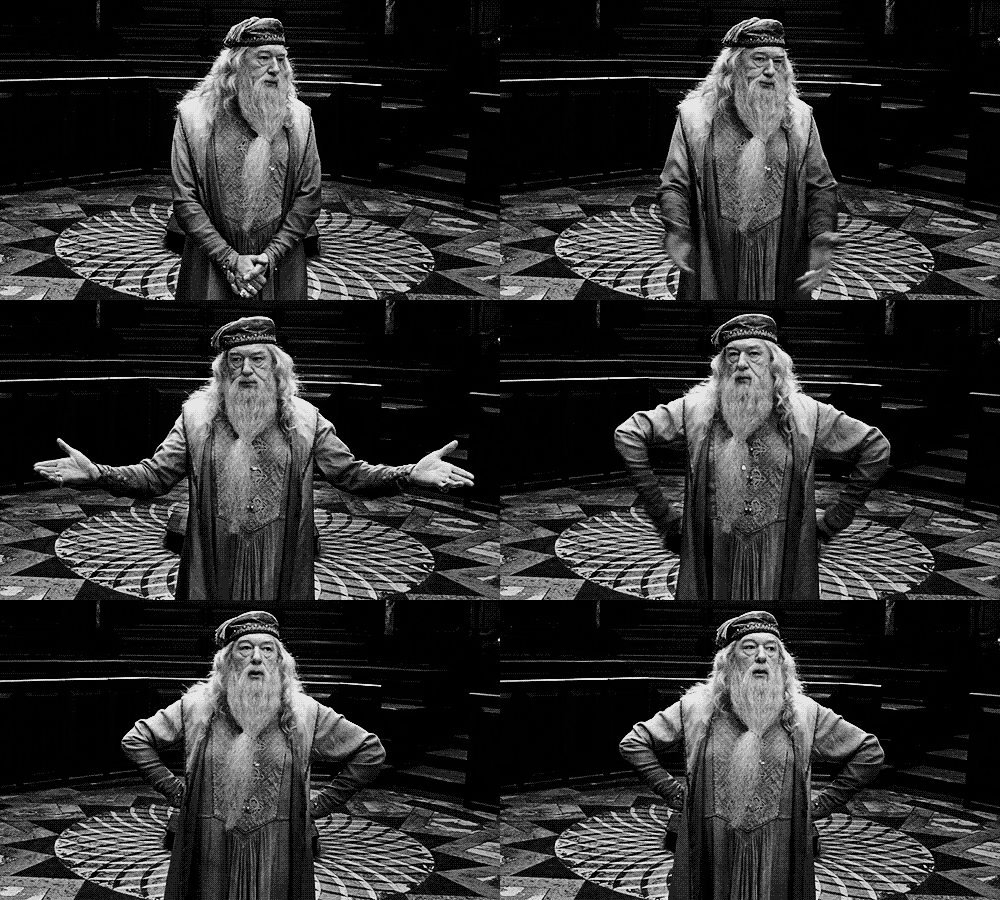
I amused myself by reading tweets to the school district about when a decision would be made about school closings. Many had GIFS such as these:

Dumbledore.gif

tenor.gif

Those, by the way, were sent by staff. Not students!

Then the announcement came: There were, in fact, enough snowflakes to cancel school today!

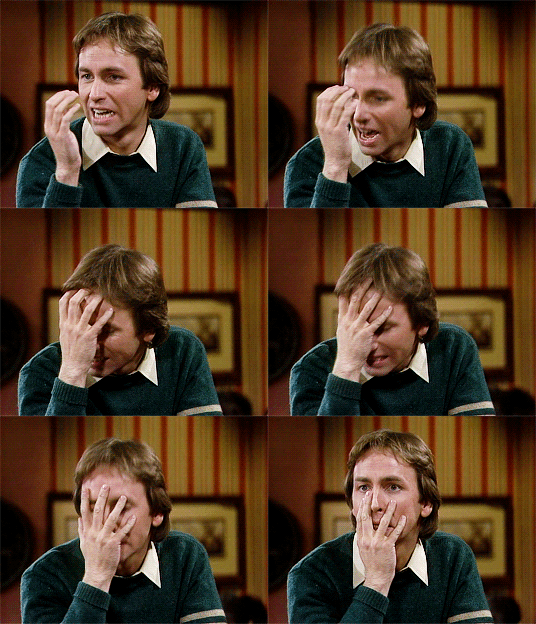
Someone tweeted this as the parent reaction across the district:

John Ritter.gif

Poor parents! And poor John Ritter, for that matter . . . is anyone else out there astonished that this will make fifteen years since he died?

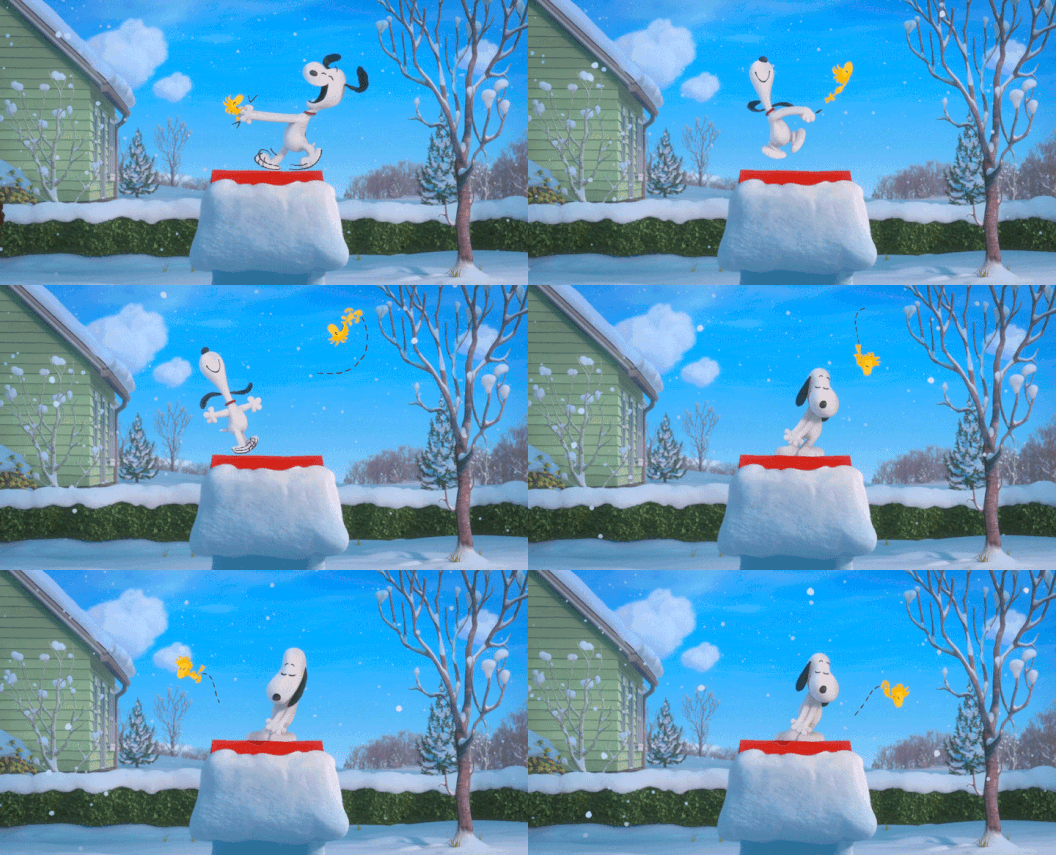
By and large, however, there were hundreds of celebratory tweets from students with variations of GIFs such as this:

Peanuts

Many of those tweets said something like: “THANK YOU! You saved me and my grades!”

Okay . . . that really begs more investigation as to exactly how one snow day can save a GPA . . . and why grades are the whole emphasis of education . . .

Then there was this cheery admonishment from the school system: “Everyone stay safe! Kids, don’t forget to read!”

Truly warms the cockles of your heart, doesn’t it?

Except for a long thread of student responses like this:

“Don’t expect us to read, though.”

Reading that sentiment was, to me, like being impaled by a jagged icicle. My reaction:

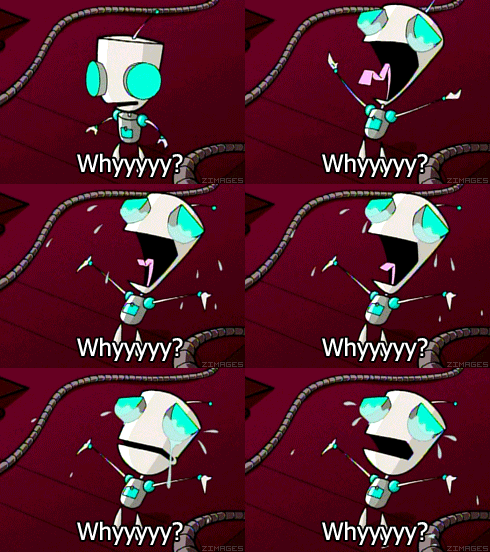
Why.gif

Why do the kids hate reading so much? When they say “reading,” what do they actually mean? After all, they text constantly, they’re a huge presence in social media, and their choices of graphics to communicate feelings are both entertaining and dead-on. Today’s average student is quite literate, digitally.

I think—I shiver as I say this—that the aversion is to reading books. Whether it’s actual books or those on a screen is a moot point. My question is: How have we, educators, failed on such an epic scale to promote a love of reading, to the point that our students, especially those who NEED to read more, view it as such a hateful chore? As long as they feel this way, when will our students ever, hopefully, pick up a book that they simply want to read?

The year is young; there’s no time like the present. Snow days are ideal for thinking of ways to revamp instruction to help the kids get excited about books and develop a love—or at least a very strong like—of reading. Will they all? Truthfully, probably not. But that’s no excuse for not striving for something far better on their behalf:

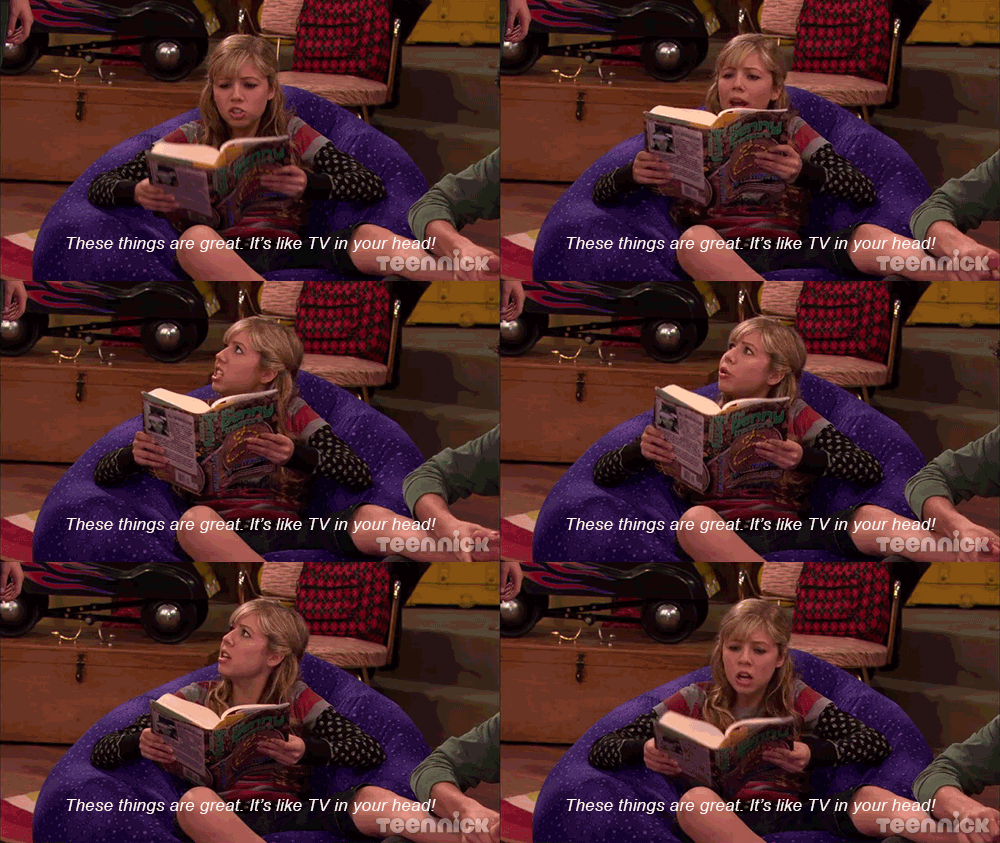
Books are great.gif

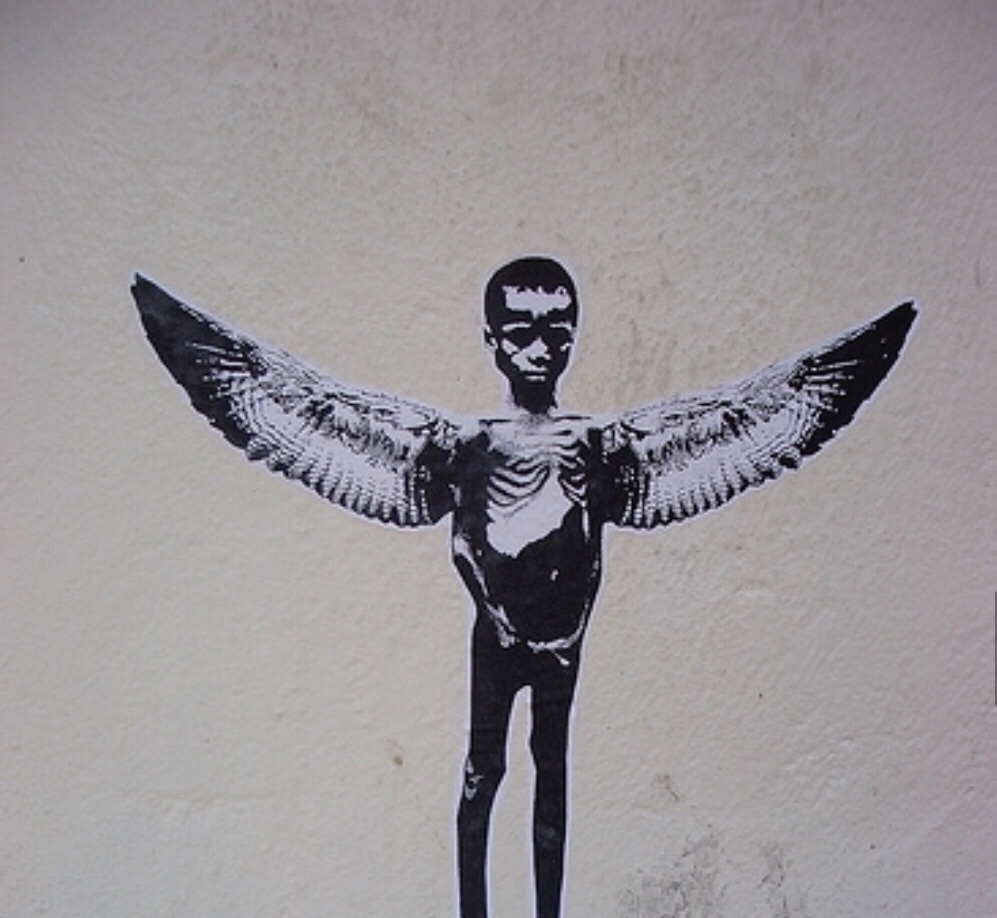
What child is this

African Angel Boy. bixentroCC BY 

What child is this, who, laid to rest . . . .

Snow is falling. Huge flakes like white feathers shaken from the sky, a rare thing in the North Carolina Piedmont at the beginning of December.

Another rare thing: Today a former student is buried.

He was eleven years old.

I stand at the kitchen window, watching the snowflakes fall. Eleven years. That is all he had.

An only child. A latched seat belt—I can envision his mother reminding him—wasn’t enough.

I begin wondering about enough.

Did we do enough?

Nearly the whole of his short life was spent at elementary school. How much of our focus was data and test scores? Did he feel successful?

College and career ready doesn’t matter at all when you die at eleven.

Should it matter so much when you don’t die at eleven?

Were we enough? Did he enjoy coming to school, or did he endure it? 

I can hardly endure the heaviness of that thought.

The bleakness of the gray December day, but for the snow, matches the bleakness in my soul. On the television in the living room, Christmas music softly plays:

What child is this . . . .

He is Everychild now. Mine, yours, ours, all children, coming to school, day after day.

Do they have the chance to get out of the box, before they’re put in a box?

Do they have the opportunity to develop a hunger for knowledge? Do their teachers create dynamic experiences that empower the children to own their own learning? Or are the children starved for authenticity, their minds and days numbed by worksheets, by sameness, by constant assessment, by irrelevance, by teachers in survival mode, by hierarchical machinery?

Underneath all those wheels in motion lies the child. Motionless. Powerless.

Haunting that such a beautiful snow should pour on such an ugly day, for snow can mean many things beyond ice crystals. It represents death, yes, but also wisdom, purity, innocence, blessing.

Wisdom, blessing, and strength to you, Everyteacher, for Everychild in your hands. Strive for more than enough. For joy, for awe, for love-of-learning-for-life ready. There’s no way of knowing whether this child will live a hundred years, or just eleven.

What child is this, who, laid to rest . . . whom angels greet, with anthems sweet . . . .

Every minute matters.

To the children

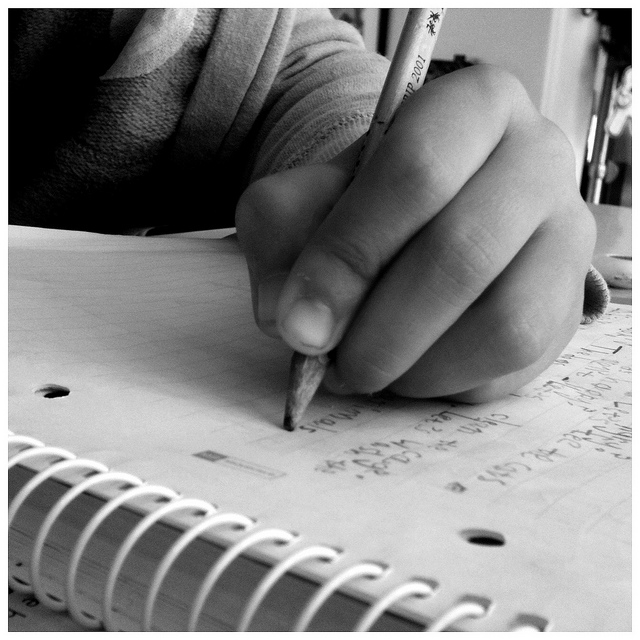
writing in notebook

Writing. VassilisCC BY-SA

Dear Children,

I am thankful for you.

For your uniqueness, for your existence, for the lens through which only you can see the world.

I am thankful for your courage, your stories.

That you feel free enough to write about what you know, what you’ve lived, endured, and overcome in your young lives.

That you have the strength to share your early taste of loss—of pets, of parents, of siblings, of homes.

That you escaped abusive homes for ones where you could thrive.

That you left another country for mine—for ours.

That you learned from watching the failures and mistakes of others close to you.

That you learned to forgive others and even yourself.

That you learned to persevere, that you accomplished what you set your mind to because you kept trying.

That you faced your fears and came safely through.

I am thankful for what you teach me each day about listening, seeing, discerning, wondering.

I am thankful for the reminder that curiosity and questioning are natural, that creating something from whatever happens to be lying nearby is a hallmark of the human soul.

I am thankful for the beauty you bring to the world.

I thank you for daring to pour your hearts onto the page, for laboring at it, and for your truth.

I thank you for the unparalleled honor of reading your words, for the moments of laughing with you, crying with you, and standing in awe of you. For the privilege of helping you capture your ideas and communicate them clearly, of seeing you realize the power of your own voices. Of simply being on the receiving end of the important messages you have within you.

If I have inspired any of you, know that I am inspired a hundredfold in return.

Keep writing, Children, and I will do the same, for we owe it to ourselves and to each other—we need to read our stories as much as we need to write them.

I carry you and your stories, your abiding images, with me always.

Always believe in yourself, for I believe in you. In who you are now, in who you will become.

With love and profound gratitude,

your writing teacher

*******

Inspired by students I’ve taught and others whose work I’ve read.

Thanksgiving challenge: To whom are you deeply grateful, and why? Write this person a letter expressing your gratitude. If  your person is still living, read your letter aloud to them face to face or by phone. If your person is no longer living, read it aloud in a place that’s meaningful to you. Celebrate what this person has added to your life. Celebrate the power of writing and the transformative power of gratitude. 

slice-of-life_individual

Reformation

SONY DSC

Martin-Luther. Awaya LegendsCC BY-SA

On this day, 500 years ago, Martin Luther hung his list of protests against corrupt practices on the door of the Wittenburg Castle church, igniting the Reformation that would change the course of human history.

Reform. The idea is like a diamond glittering in the dirt. Not change for the sake of change, but for the sake of those who are suffering, oppressed, under excessive pressure.

I can’t help but think of public education today – the pressure on teachers, on students. The need for large-scale reform is too widely known to be a point of dispute. The trouble with attacking any huge, knotty problem is figuring out where to begin, then where to go next, without re-tangling what’s just been untangled.

What are the oppressive practices that need to go for true education reformation? It varies, depending on who’s asked and what personal or professional interests are at stake. Luther wrote ninety-five theses; I’ll spare readers and list my top five, although they’re not anything new:

  1. Standardized testing. Everyone knows – don’t they? – that scores do not accurately reflect a person or that person’s potential. It’s a data point at a fixed moment in time, not for all time. How many students come through the system believing they are failures because they didn’t measure up? How many teachers and schools work hard, only to be considered the same? In a country historically admired the world over for creativity and innovation, giving and living the test is the best we can do?
  2. Teaching reading and writing as separate entities – often sacrificing writing for the sake of reading. It’s a dichotomy that sends the subliminal, counterproductive message that understanding others is more important than understanding self, which is what authentic writing does for people. If we want the world to be a better place, it begins with understanding why we think and feel the way we do. Empathy and compassion are born from this. Write.
  3. Cutting the arts. The test alone proves that people are diverse learners, and the great emphasis on improving reading scores already limits student self-expression. Students who have trouble focusing are often extraordinary actors and dancers; they bring powerful interpretations to scenes, can read and create brilliant choreography. Some students, considered struggling learners, are constantly composing songs in their heads and can sing with startling expression, emphasizing all the right phrases. My son, who showed an affinity for music early in life, asks: “Why aren’t kids given a chance to experiment and explore in ways they really enjoy? Why aren’t their talents or their strengths maximized?” He endured his education. Today he has a job in the music field.
  4. Teacher education and professional development as we know it. Sigh. That’s what we typically do, isn’t it? Better, deeper preparation for the diverse learners and the demands of the field is critical. Ongoing professional learning needs to be practical, designed specifically for the needs of the children AND the teachers. If we speak of deficits and gaps – how about creativity deficits and vision gaps? If the hallmark of a great teacher is getting students to love learning, shouldn’t we first love ours? How about some inspiration? It’s a pretty big motivator (wouldn’t you say, Martin Luther?).
  5. Whatever the expectations, the requirements, the new layers of things that come along as purported magic bullets that will save everything, hold these two things utterly sacred every single day: The read-aloud and time for students to generate writing that means something to them. These are proven to lift the level of thinking – authentically, organically – which will never come through compliance alone.

What are your theses for true education reform? Today, in the spirit of Martin Luther, be bold. Speak your mind through the power of the written word.

And if you teach, teach on.


Trust

Child jumping

Едно, две, триии…(One, two, three…). Vladimir Petkov. CC BY-SA

I am eleven years old, standing at the end of a pier beside my uncle. He’s holding both of my toddler cousin’s hands as she jumps from the pier’s edge toward the murky green depths of the Piankatank River. She squeals with delight. Just as she dips, her father swings her back. She lands safely on the wooden slats, laughing. Over and over she jumps. Her feet never touch the water. 

I know the water is over her head. The biggest jellyfish I’ve ever seen are floating all around. We can’t even go swimming because of these ghostly orbs, larger than my head and so heavy that when I catch one in the crab net, it fills the net and I can barely lift it from the water. Hunks of the jellyfish ooze through the net, too, plopping back into the water.

I shudder.

I’ve composed a song in my head:

The Piankatank River 

Ain’t the place to swim

Because it’s full of jellyfish

And other things within.

I don’t even know what other things are within but I sense that they’re utterly treacherous. My toddler cousin’s reflection zooms out again over the shimmering, placid surface. Back she swings to safety.

“Why isn’t she scared?” I ask my uncle.

He smiles, holding tight to his daughter’s small hands. “She knows I won’t let her fall. She has no fear because she trusts me completely.”

My little cousin jumps once more, with wild abandon. Her face turns toward the sky as she swings backward, dangling from her father’s hands.

Her expression is one of absolute joy.

That image, that moment, has never left me.

He was enjoying her joy. Allowing her freedom to dare, to be a risk-taker, yet keeping her safe at the same time. Had he been less attentive, less vigilant . . . she might have gotten wet, or worse. I knew what dangers awaited, the harm that could come, and also that my uncle wouldn’t be doing this if he weren’t confident in his own strength. I marveled at his easy assurance and peace of mind. He wasn’t afraid, either.

Of myriad connections I can make out of this moment, the one that rises to the surface of my mind first is teaching. Creating the conditions for good learning to occur means letting children explore, dare, make choices, take risks, all stemming from a foundation of safety, an environment of trust. Children have to know they can take leaps and that their teachers will not let them fall, that they have nothing to fear.

For that to occur, we as teachers must  recognize our own strength and continuously strive on behalf of those entrusted to us. Teachers must be risk-takers, too. We must believe that we can get students safely from where they are to where they need to be, even beyond. Not just for now, this quarter, this year, this test – but by inspiring students to actively pursue learning for the rest of their lives.

It’s no small feat, when our own piers stand in the murkiest of depths. But we’re standing in the singular position that affects outcomes. What lies within us is greater than external forces. By far. We make the leap when we move from belief to action, from self-esteem to self-efficacy. Trusting others, trusting self, trusting in the safety of shared trust, strengthening one another, propelling each other forward. Professional trust isn’t holding on loosely; it’s everyone holding on tight, not letting go. When done with confidence, responsibility, and mindfulness, we develop a dynamic of grace, a synergy of poetry in motion – swinging out over the depths with our faces turned skyward.

The safe environment of will not let you fall. 

A paradox, really, that it takes a collective grasping of hands to experience the freedom, the joy.

slice-of-life_individual