Revolutionary fiction

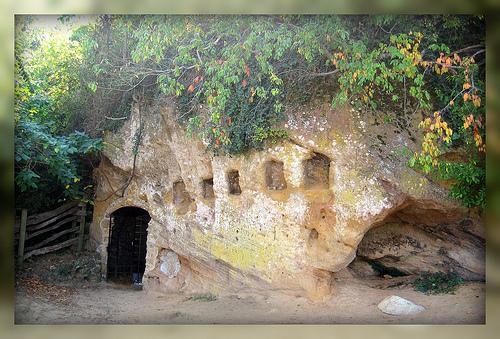
Cornwallis' Cave

Cornwallis’ Cave, Yorktown, VA

The class had been studying the American Revolution.

Their teacher wanted them to have a sense of being there. What better way than writing historical fiction?

—Would I come model for them, help them get started?

—Are you KIDDING?

Let the revolutionary zeitgeist begin!

I set the fourth-graders to researching daily life, clothing, furniture, chores during colonial times. The story cannot come to life without some period details.

Then we worked on understanding that big ideas of the historical event don’t change, although we can make up some characters who live through it.

—A hand, waving in the air: “Like the Titanic sinking was a real historical event. The captain and crew were real people. Jack and Rose in the movie were not.”

—Other child, aghast: “They weren’t real? I thought they were!”

—Me: “Um, no, they’re fictional. Made-up characters.”

Ahem. 

Back to the Revolution.

We move on to plot . . . who’s this story about, what does this character want to accomplish, and what’s getting in the way or putting the character in danger?

Then setting . . .

I did my own background research and decided to let the class choose which of two stories for me to write as a model.

“Okay, I’ve given this some thought, ” I tell them as they gather on the carpet at my feet. “A town right here in North Carolina was one of the first in the colonies to oppose the Stamp Act.  The British burned the town and it was never rebuilt. What if my main character was a child who had to leave quickly with the family? What if they saw their home destroyed?”

“Ooooo,” murmur the children, wide-eyed. A couple of them nod their heads. “That’s a good story. It’s sad. It could have happened.”

“Yes, and as a writer that’s part of your job, to make the readers feel like they are there, experiencing everything the characters do. This story probably will be sad. And frightening. Or, here’s your other choice. I actually grew up near Yorktown, Virginia, where Lord Cornwallis surrendered to George Washington, ending the war. I visited Cornwallis’ cave countless times. Legend says Cornwallis hid from Washington’s troops in the cave but that’s not likely. What is true is that the cave was used to store potatoes! So, what if I have a character, a colonial child, who, for some reason, has to go into that cave for the potatoes when Lord Cornwallis comes to have a quick, private conversation with his next-in-command? What if the child hides, hears Cornwallis’ escape plan, waits until Cornwallis leaves, and somehow gets the message to General Washington—which is how the British get captured, and which forces the surrender?”

“Yes! Yes!” All the kids are nodding, bouncing on the floor. “The cave story! Write the cave story! The boy will be a the hero of the Revolution!”

—”Why can’t it be a girl?” asks a girl.

All faces turn her way.

In silence.

Well, women helped in the war effort . . . some were even spies . . . why CAN’T it be a girl?

“What if,” I say slowly, my gray matter spinning hard, “what if a boy was sent for those potatoes . . . by someone, we can figure that out later . . . and he just can’t do it, he’s too frightened? Or sick—or injured? What if he has a friend, a girl, who has to help him by doing it in his place, who hides in the cave, overhears Cornwallis’ secret escape plan, and she gets the message to George Washington?”

Heads are tilted, fingers cupping chins, eyes shining. They all look like future history professors.

Except for the girl who made the suggestion. She glows like Victory herself.

—Revolutionary, indeed.

*******

A couple of other scenarios the class discussed for their own writing:

What if colonists were hunting in the forest and found a wounded British soldier? What would they do?

What if British soldiers were marching through a field or by the shore when they find an colonial baby, all alone? What would they do?

—”Wait a second,” interrupts a boy. “How would they KNOW this is a colonist’s baby?”

“That is a great question,” I smile. “You are the writer. That is for you to figure out.”
Life imitates art

img_0527

“Life imitates Art far more than Art imitates Life.” -Oscar Wilde

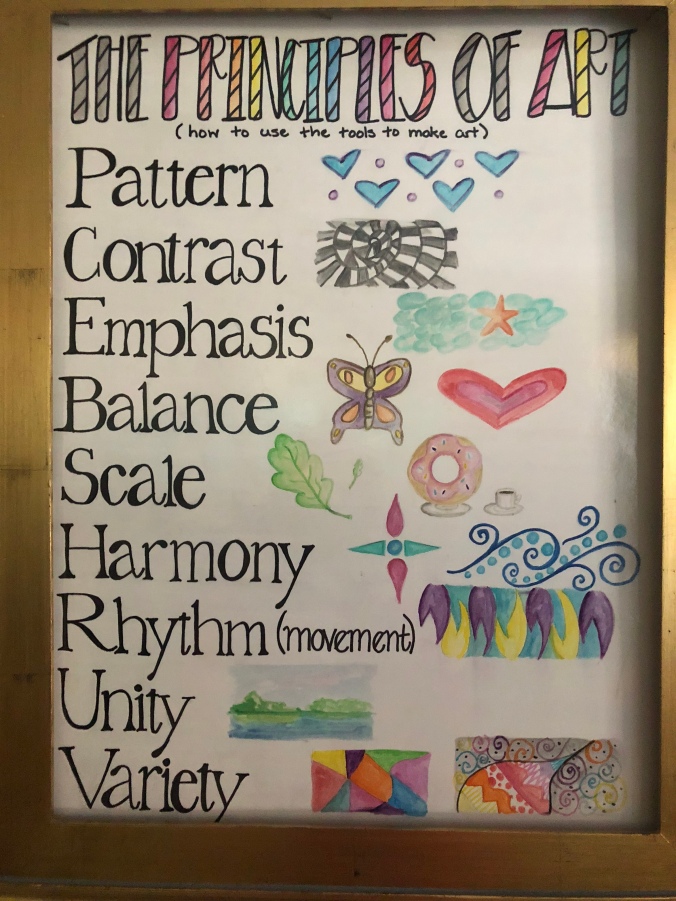
When I saw my colleague’s handmade “Principles of Art” on the wall of the art classroom, I thought: Wait – couldn’t these be principles of life, too?

Inspiration struck; in fact, it dared me to try . . . so, here goes . . . .

How to Use Tools in Life

Pattern

Let us step away from repetition; save it for rhythm. Think instead of a template laid before us, with diagrams and guidelines, a model to be examined before cutting to fit who we are and are becoming, always making the necessary alterations as we go. 

Contrast

—isn’t easy, might be painful, but is necessary, for it makes elements that need to be seen stand out: the good, the bad, the ugly. It also makes better and best possible, for it is in differences that we find beauty, that we reach beyond realms that we know into those we don’t; this is how we grow. 

Emphasis

Find your focus. What’s WORTH emphasizing? Everything cannot have the same intensity or there’s no big picture, no real vision, and meaning is lost. 

Balance

—means stability. Not attempting too much or too little. Too much and we become oppressed, paralyzed, ineffective. Too little, and we become bored, listless, unproductive. Balance is achieved by planning for it, knowing that the work and the break from the work are essential, equivalent, and correlated gifts. 

Scale

—is about relationships. And perspective. It takes courage to see these as they are. Healthy relationships are in proportion. Unhealthy ones are not. A whole must relate to another whole, not to parts. The only person you can adjust is you. Use your power wisely.

Harmony

Finding common ground, honoring inherent sameness, coming to a pleasing agreement or resolution, is finding our place of belonging, one to another.

Rhythm (movement)

—begins with the beating of our hearts. Humanity is meant to to make music, sing, to dance, to run; rhythm is exciting, reminds us we are alive. It is not random. It is structured. It is anticipated. It is a recognizable, repeated pattern necessary for order and flow. It’s all about the right timing.  

Unity

—is about overall clarity and completeness. It occurs only when all individuals, all pieces, are in harmony with one another. Clutter and confusion are gone.

Variety

Ah, the spice of life . . . intricacies, complexities, diversity, the delight of the unexpected . . . all that transforms existence from an interesting experience to one breathtaking adventure. 

Double challenge: Re-read as 1) Tools for writing and again as 2) Tools for teaching.


Keep it alive

It is the place

where ideas are born

some as ghosts

some fully formed

It is the place

where voices echo, echo

real or imagined

they ebb and they flow

It is a place of seeing

yet layered in veils

lift them one by one

as mystery entails

It is a place of sensing

both self and Other

alive within, without

—feel the shiver, the shudder

It was striving to be

long before we had words

for we are knitted of story

given voice, to be heard

So nurture it well

let it breathe, let it grow

keep the magic alive, for

you’re meant to write it,

you know.

Salt and the stagecoach

Stagecoach

Western Stagecoach 08. Robin HallCC BY

The third graders were having a hard time.

“We’re writing pourquoi tales in this unit,” explained their teacher, “which have to be based on the students’ research of frogs. We practiced writing one together and now they have to write their own, but they keep coming up with stuff that doesn’t quite work. I’ll end up with twenty stories about ‘Why Frogs Have Eyes’ or something.”

She sighed.

So, as extra practice,  I agreed to come help the children write pourquoi stories on topics of their choosing. I modeled writing one of my own composition, “Why People Wear Shoes,” incorporating their artistic contributions along the way (my main character meets a talking owl and the kids said it needed to be huge so that my character could ride on its back, which greatly enhanced the story).

Then we brainstormed ideas that they might write about:

Why there are stars

Why there are oceans

Why the ocean is salty

Why zebras have stripes

Why there are colors (challenging!)

Or anything else in the universe that might make a sensible pourquoi.

“Remember,” I told them, as they settled on their ideas and started to write, “you can have fun with this. You can make animals can talk, you can make mysterious things happen, but your stories have to clearly explain why or how something is the way it is.”

When I returned the next day, the teacher said, “You’ve got to hear this!” She asked a boy to read his draft to the class. A quiet boy who hadn’t seemed especially interested in writing.

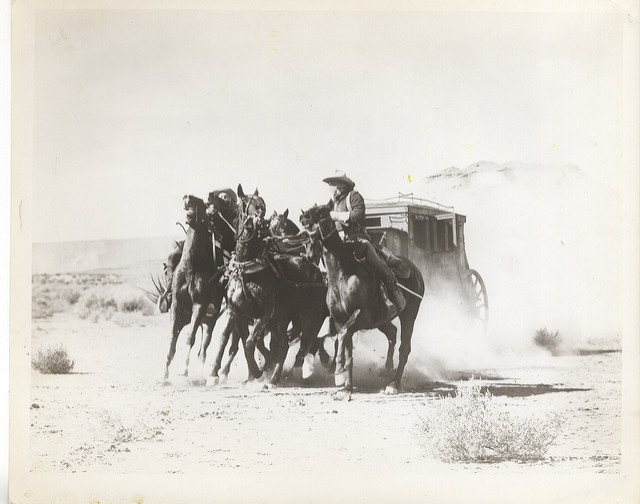
I sat down and listened. He’d chosen “Why the Ocean Water is Salty.” A man working in the mountains delivered salt to people in a stagecoach. Thieves threw a stick of dynamite into it, which frightened the horses. They drove over a cliff into the sea, where the dynamite went off, dispersing “billions of salt” throughout the water.

Oh, and the driver survives, retires, and decides he’ll just fish and hunt for the rest of his life.

He finished reading. His classmates applauded enthusiastically.

Must have been a full minute before I thought to close my gaping mouth.

“Amazing!” I finally managed to say. “What made you think of a stagecoach?”

“Well, first I wrote that the man was breaking up rocks on the mountain and hit one accidentally with his foot. It rolled down a cliff and knocked other rocks in, but then I thought, that doesn’t make sense. Rocks won’t make the ocean salty. So I thought about a stagecoach with salt in it. Then I needed something to explode in the water . . .”

—Makes perfect sense to me.

The moral of the story:

We can show them the stagecoach

but if we never let them load it as they please, 

they’ll drive only so far.

Set the wheels in motion,

hand over the reins,

jump out of the way.

See what astonishing routes they take.

Getting to the heart of writing workshop

I wasn’t sure how the day would go.

There were a lot of strikes against it before it even started.

Normally when I facilitate writing workshop training for teachers they’ve specifically signed up for it. They want to be there. This year, due to an oversight somewhere at the district level, the workshops weren’t scheduled. At the last minute, this workshop training was added as Day Two of Balanced Literacy (as Day One focused only on reading).

Meaning that teachers who signed up learned that they had two whole-day sessions to attend instead of one.

How would they feel about that?

Normally the overview of writing workshop alone is spread across three afternoons. Now I had to condense it all into one day.

Nothing like prioritizing content . . .

And, with the adoption of a new curriculum, writing workshop—and balanced literacy—won’t be offered to K-5 teachers any more. Just to K-2.

I felt I’d landed in no man’s land on some dismal shore, ineffectively beating back the waves of despair crashing all about me.

But I chose to keep my footing on a solid foundation, to hang onto all that I value about writing and teaching writing. The lifeline. Not just for me, but for the children, for their teachers.

This has to be worth their while, I sighed to myself.

And I got to work revising the training.

The day of reckoning comes. I start with who we are and why we’re here, rolling right into the what of writing workshop: Create the conditions for good writing to occur (credit Donald Graves). Understanding that writing workshop is not a program, is not about a product, but is a time set aside to fall in love with the craft (my definition) and to learn the real writing process.

Then we go deeper, into the why of writing. It’s at the very core of being human.

I read aloud to my participants:

Five-year-old Paul writes. Children want to write before they want to read. They are more fascinated by their own marks than by the marks of others. Young children leave their messages on refrigerators, wallpaper, moist windowpanes, sidewalks, and even on paper. 

Six-year-old Paul doesn’t write. He has gone to school to learn to read. Now that he is in school, the message is, “Read and listen; writing and expression can wait.” Paul may wait a lifetime. The odds are that he will never be truly encouraged to express himself in writing.

Paul will wait and wait to write because a higher premium is placed on his ability to receive messages than on his ability to send them. Individual expression, particularly personal messages in writing, will not be valued as highly as the accurate repetition pf the ideas of others, expressed in their writing. Since Paul will write so little, by the time he graduates from high school he will think of himself as a poor writer and will have a lowered sense of self-esteem as a learner. He will have lost an important means of thinking and will not have developed his ability to read critically.

-Donald Graves, Children Want to Write

I notice, as I read this, how heads begin to nod in acknowledgment . . .

Next we read portions of two articles with quotes from people in the business world. How young would-be employees have a hard time organizing their thoughts and articulating them, and that, when possible, employers should hire the better writer, because writers understand how people work, have better interpersonal skills . . .

We read these even though the participants of this training are K-2 teachers. 

Because this is where all the writing begins. 

Here, with them.

Then I read a bit from Colleen Cruz in The Unstoppable Writing Teacher, how a boy, Robert, discovers what his personal essay is really about. This is in a chapter entitled “I’m Finding Some Student Writing Repetitive and Boring.” Cruz writes: “Kids, and some adult writers, have a subconscious need to write about particular topics, but they don’t understand why.” Robert had chosen the topic ‘Christmas is my favorite holiday.’ His reasons are food, presents, and videos. While conferring with Cruz, Robert finally says that watching videos is the most important  thing about the holiday because his family had recorded every Christmas; he goes deeper and deeper into the meaning, until: “Since my dad died, Christmas is the only time I get to see him. My mom can’t stand to watch all the videos at any other time. But on Christmas she lets us watch them, and it’s like we’re all together again.”

The why of teaching writing: We owe it to the children to find their stories, to tell them.

It begins with our finding and telling our own.

Here’s where I carve out time to write in this workshop training. We lift lines from our writing to create an interactive poem; we brainstorm for more writing with heart maps (credit Georgia Heard).

At this point, I have to gently ask the teachers to stop writing.

For we’ve reached the how of writing workshop, beginning with minilessons. The vehicle for teaching standards and process, for modeling, for creating that atmosphere, those conditions, for good writing to occur. Opening the windows for student ideas to flow. Choice, voice. Meaning and mattering.

And it’s time for lunch. I tell the teachers that when they return, we’ll spend the rest of the afternoon on the backbone of writing workshop: Conferring. It merits its own what, why, and how. Academic feedback in the effort to reach a goal, growth versus grades, meeting each child, each writer, individually . . . .

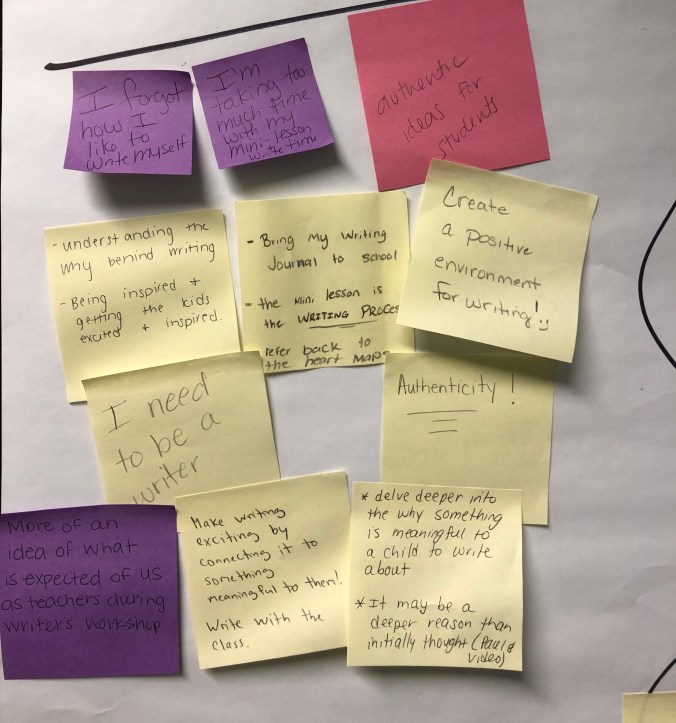
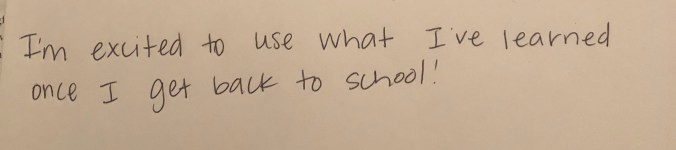
As they exit, the teachers seem happy. They leave sticky notes with their “gots” and “wants” on a chart. Personally I celebrate that the “gots,” pictured at the top of this post, far outnumber the “wants.”

Their notes revive my spirits. I’ve a sense of standing on a shore just as the sun breaks through the clouds. I feel the warmth of it. I can almost hear distant gulls, or something, calling and calling, wild and free; I can taste promise like salt in the breeze.

We’re not even done; we’ve only just begun.

I believe it’s gonna be a great day, after all.

*******

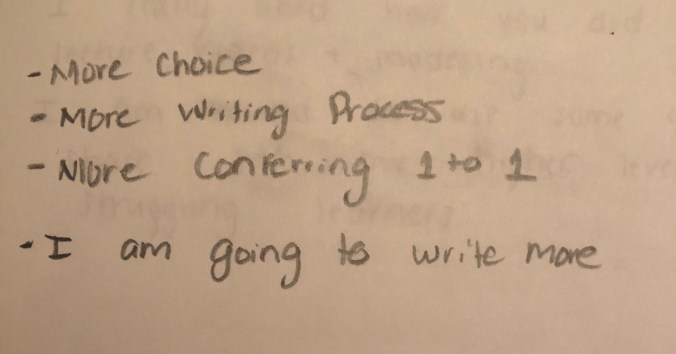
-Bits of the teachers’ final reflections at the end of the day.

Something to say

All you have to do is open

All you have to do is open . . . Mike HartnettCC BY

If you want to absorb rich dialogue, hang out at a hair salon. I keep thinking that a lively full-length play could be derived from the banter and candidness between a stylist and clients, with minimal staging needed. Conversations are not constrained; there are no boundaries, no topic is taboo.

I confess that I cannot help listening with writer’s ears every time I visit my salon. Not that I eavesdrop. Nobody whispers. It’s all just out there.

So it was, while waiting for my turn at a recent appointment and helping myself to the coffee bar, that I heard a woman with her head in the nearby shampoo bowl mention the word writing to her stylist (visualize how I froze, ears perked, coffee stirrer held aloft):

“My son never liked writing. He didn’t do well at all with it until he went to college. When I saw his first college paper, I actually said: ‘What? YOU wrote this? You didn’t get somebody to write it for you?’ But he’d really written it himself. I couldn’t believe it!”

They laughed together as the stylist lathered up the client’s hair.

I stirred half-and-half into my coffee, thinking: The boy finally had something to say.

I don’t know who he is, this college student. I don’t know where he attended school or anything about him other than those few sentences. But as I sipped my hot cinnamon dolce, I wondered about those statements.

My son never liked writing. 

What made that change? What drove him to pour the words onto the page and to hammer them into shape? Was this the first time he felt passionate about his topic, whatever it was? Had he ever been able to choose his own topic before, one that mattered to him? Did he have any authentic writing experiences in elementary or secondary school, or was it all formulaic, step-by-step, assigned for a grade? Surely this college paper was assigned, too, but apparently something new—within the writer—had given it life.

He didn’t do well at all with it until he went to college.

What was his process, or was it just real for the first time? Did someone in college give him feedback on his strengths, validate his ideas? Did he visit the campus writing lab for help with this paper? Or was there a professor who inspired him, stirred his interests, made him realize he had a voice and something to say, at last?

I caught myself sighing between swigs of cinnamon dolce. Why, why, why did it take him all the way to college to “do well” as a writer?

Maybe it’s simply freedom. His not being confined by what’s all too often considered “writing” in school, but being able to articulate what he really thinks, what he feels in the depths of his heart, and having a safe, supportive venue for communicating his perspective to a real audience, even to the world. Maybe he got a professor who loves to write, who showed the students how and why to write. All I know for sure is that SOMETHING was the game changer for this young man; even his mother was amazed. Could it be that someone finally believed in him? That’s where the true business of education begins—in throwing doors wide open, not in closing them. Learning and understanding are like coming from a stuffy closet into a living room, or from a comfortable living room into the whole vibrant outdoors.

Or the hair salon, where you can speak what’s on your mind, where someone listens and responds, where voices are not constrained, where there are no boundaries, and no topic is taboo.

Writing teacher rhapsody

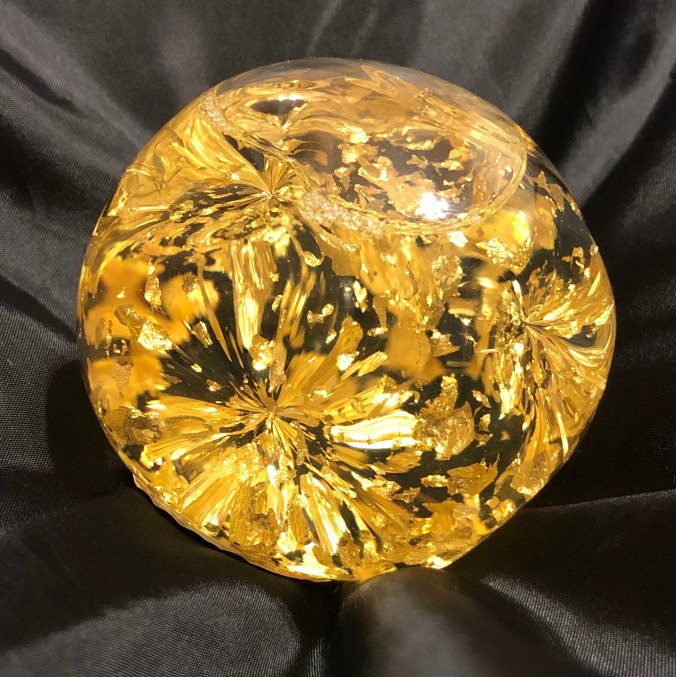
Globe with gold suspended in water

Writing time.

Expectancy painted on their faces.

They know something’s coming,

just not what, yet.

But something.

Ideas.

Their own.

In this moment

I’m just the crossing guard

from the unit 

to the universe.

Ever expanding.

They do not know, yet,

that they’re made 

of the same stuff as the stars.

That the stuff without

is always calling

to the stuff within.

They are children

but not too young to discover

they’re oceans

containing more than simply

water 

and salt.

But I know 

there’s millions of pounds of gold

infinitesimally dispersed

throughout the oceans.

Here is where

those priceless grains 

rise to the surface

take shape

become substance.

Now is when they start spilling

onto the page

to shine

with a light of their own.

The whole of my task

is to stir

release

and be swept away.

A word for 2019

A friend gave me a treasure box of gifts for Christmas.

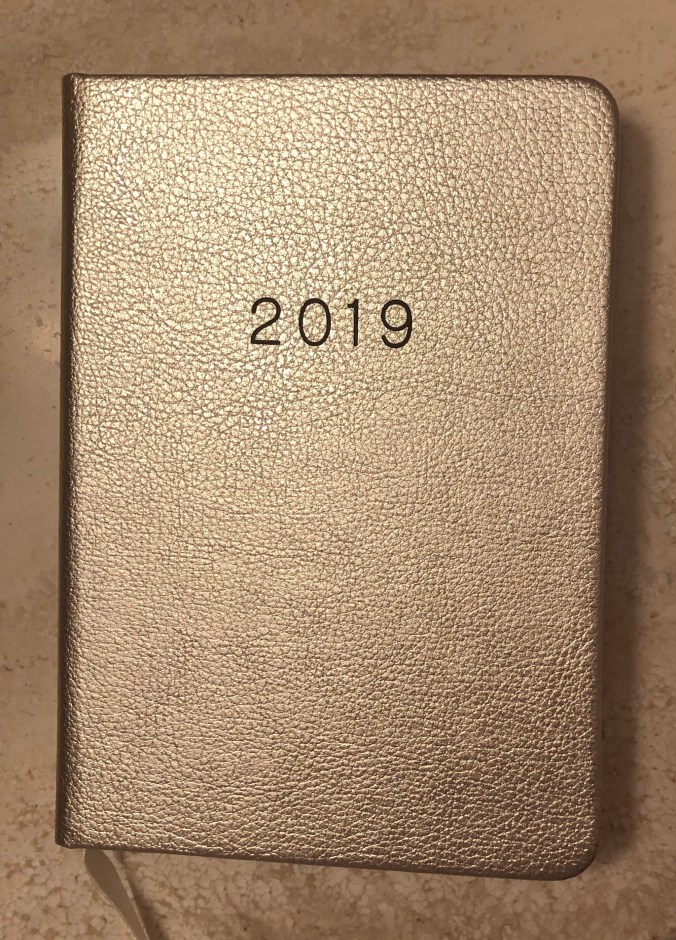
One of the items in it was this gilded 2019 planner.

I already have a (rather large) daily planner for mapping out my workdays—I write in pencil because, as I accommodate the teachers I support, the course of each day shifts constantly, and I make lots of notes. Part of living the coachly life. I’ve learned to embrace it.

So I look at this beautiful planner and think: How shall I use it?

I could give it away, except that don’t want to, it was given to me with love, and I have come to understand that things come to us for a reason. There’s a purpose for this little planner.

I look at it, shimmery and new, just like the year itself, lying before me.

Beckoning, almost.

I will use it for something personal, then.

Maybe for my writing. To map out a timeline, to hold myself accountable for completing things. Or perhaps as a bit of a notebook, recording new thoughts and ideas before they get away, before I have the chance to play with them and flesh them out. I could capture images until I have time to explore why they struck me and what they mean. I frequently use the notes app in my phone for this but the planner has more “space” for movement, for expression. Not to mention sketching. I could carry it with me, keep it by my bedside.

Or I might even be able to use the planner as a sort of manuscript style sheet. For I’ve lots of things that need to be written, rewritten, or simply finished.

However I slice it, then, the planner invites me to plan.

And to write.

And there’s my word for 2019.

It’s something I already do, that already defines me, so it seems superfluous, but it’s the word, the action, that calls to me most. With the greatest sense of urgency, tinged with excitement.

—WRITE.

Here’s to your own unique adventure as the golden cover of 2019 opens.

Take it, live it, to the next level.

Treasures await.

And one of them is your story.

Today


Bubble in reeds

Today … a bubble in the reeds. Claudia DeaCC BY

Today held some rare things.

A teacher said, “Come sit with me while I do my reading groups. I don’t learn by watching but by doing.  Just be there with me and jump in when you see a way I can make them better.”

A third-grader read me his rough draft about experiencing an eclipse, relating his understanding of the science behind it, yet conveying real fear at watching the sun go dark. I sat, listening, in awe of his inspiration, his words.

Another third-grader read her narrative draft to me. How she helps her grandmother to dress and brush her teeth, but not wanting to, wanting instead to go outside and play or watch TV . . . . I sat blinking back tears as she spoke her truths recorded there on the page. She has no idea how powerful this is. How powerful she is. And she’s eight.

I walked down an empty hallway and suddenly heard song—a student coming up the stairs, walking back to class, singing to herself in a vibrato that almost sounded trained. I turned around to see her moving her arms and hands in time with the words. Sign language. I didn’t know she could sing. Or sign.

Had I somehow fallen into a parallel universe, a facet of paradise, maybe, where beauty is multiplied exponentially? Somewhere over the rainbow?

But no, these were only moments in a regular day. Wondrous bubbles against the usual backdrop. Shining, ethereal, iridescent.

And all I really did was show up and listen.

Craftsmanship

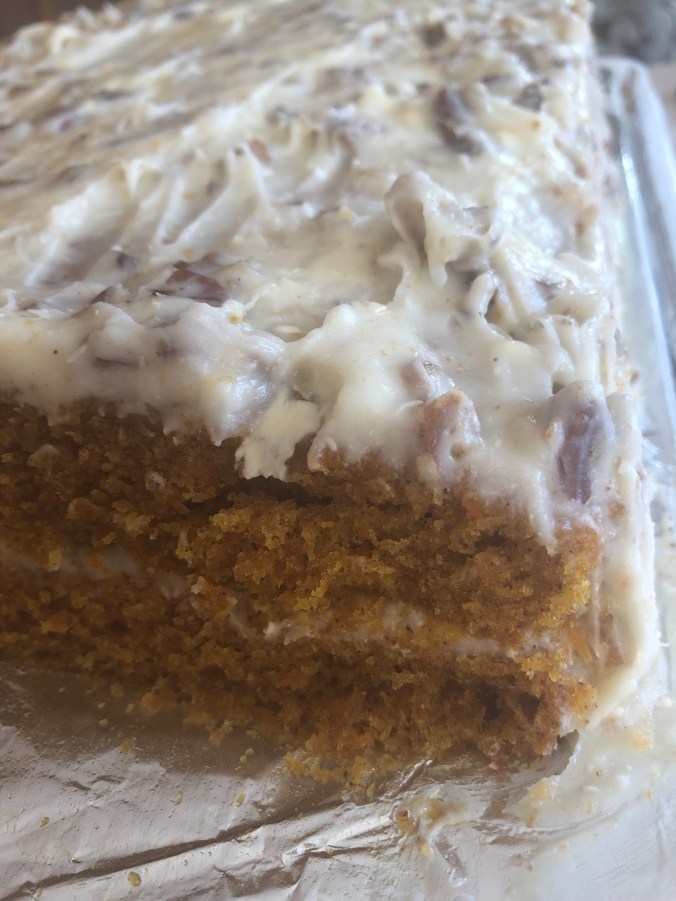
When I was growing up, the dessert everyone wanted at holiday gatherings was my mother’s carrot cake.

I used to sit at the table watching her make it, hoping for scrapings of the batter bowl or to sneak a fingerful of icing. The process took forever. Finally the two layer pans went into the oven, and as the cake baked, the fragrance of cinnamon filled the house—an indescribably delicious smell.

Now I make the cake. Over time I’ve come to think mine is almost—almost—as good as hers.

But as much as I love the cake and want to make it, and as much as it stirs the ghost of my childhood self on holidays past, I find myself sighing and almost reluctant as I prepare for it.

Making this cake is a lot of work.

I make it the way my mother did. Peeling the carrots, grating them on the finest side of the grater so that they become a smooth orange pulp, for no carrot bits should be discernible in the cake batter. I know people who use processors or even baby food carrots, and that may work for them . . . but this is where I appreciate the craftsmanship of my mother’s cake.

That word has been in my mind since a recent meeting when facilitators asked fellow educators a guiding question: “What makes high-quality work?” The answers were plentiful: originality or authenticity, clarity of expression or thought, meeting or exceeding a standard or learning goal . . . and craftsmanship.

It takes time to produce something high-quality. There aren’t shortcuts. I think about writing (because I always think about writing). As with making mother’s carrot cake, writing well is a lot of work, hard work. Refining, refining, grating those danged carrots to a pulp so that they’re not even evident in the outcome, yet they’re the foundation of it. Words worked and reworked and restrung until they finally blend into a seamless, cohesive whole. Without hunks of stuff that trips up readers. To become skilled at anything is to work and work and keep working, all the while knowing how these parts and pieces should come together and that in the end, the effort pays off. Craftsmanship means a serious investment of time, effort, and patience.

There’s an aesthetic feature to craftsmanship. The artist labors long for the effect and beauty of the work. The aesthetics of my mother’s carrot cake are its exceptional flavors and textures, the sensory experience of eating it, for on the surface it looks pretty humble. In middle school I had a French teacher native to Greece (another story for another day, trust me) who told the class that Greek desserts look very plain but are incredibly rich and sweet; when she first came to America and saw our wedding cakes, she couldn’t even imagine what such gorgeous things would taste like. “Then I tried one,” she said, wrinkling her nose. “Bah! Like cardboard!” Aesthetics can be somewhat subjective, then, allowing for personal preference, but I can say this after having read hundreds of student papers across grade levels: When I find one of high quality, from the first sentence all the way through, it “sings.” It stands out. Not perfect, but flowing, clear, and beautiful. I know time and effort have gone into it, and that the author cared about the work.

And this, I believe, lies at the heart of craftsmanship. Caring. With every carrot I grate, I think about how my family will enjoy this cake, the same way I always have. Their enjoyment, more than my own, keeps me at the task. I even make the frosting like my mother did, blending cream cheese, Blue Bonnet margarine, and powdered sugar. That’s tedious, too. Like with writing, I get tired of it all long before I’m through. But I keep at it, not just to be done, but to do as well as I can, because it’s not only for me. It’s something deeply meaningful to me that I am sharing; I need for it to be as good as I can make it. The only concession I allow myself with the cake is buying chopped pecans for the frosting. When I was a child, I helped my mother crack, shell, and chop the pecans. They came from Granddaddy’s pecan tree.

But that tree is gone, as are so many people I loved long ago. The holidays come round and round again with their particular darkness—less and less daylight, the shadows of memory—but there’s a strength gained in expending strength on behalf of others. Caring means giving. Love means sacrifice. There’s a holiness in such work, a healing . . .

My son walks through the kitchen, puts his empty plate in the sink. He sighs. “That is the best cake.”

—Every carrot worth it.