The loves of my life:
granddaughters, books, libraries
stories yet to come

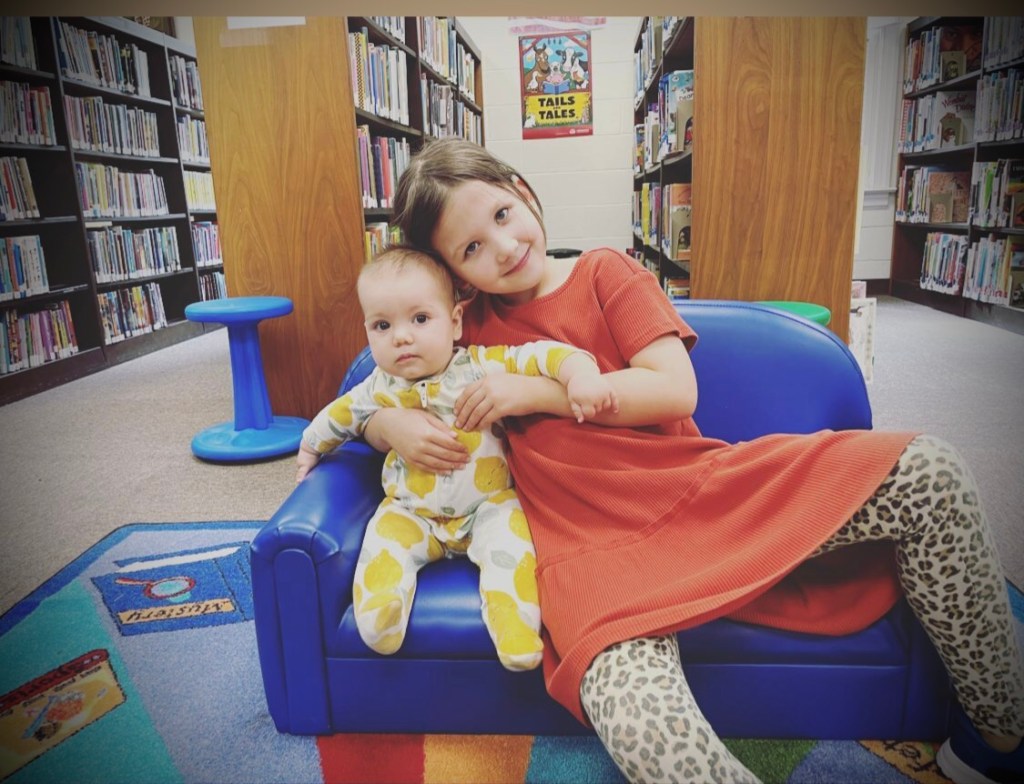
Ages six months and six years. A sisterhood of book love.
The loves of my life:
granddaughters, books, libraries
stories yet to come

Ages six months and six years. A sisterhood of book love.
On the last day of National Poetry Month, Sarah J. Donovan, creator of Ethical ELA, invites teacher-poets to celebrate thirty days of writing for VerseLove. In studying a collection of poems dealing with struggle and celebration about what we are told and believe about ourselves, Sarah says: “I thought a lot about how our bodies hold and shape so much of who we are.” Today we write to own that we are writers and poets, considering figurative body language, other voices that have influenced us, and our own song.
For me, writing calls from sacred places, inherently requiring, as an act of creation, sacred spaces.
As such, writing, poetry in particular, takes on a life of its own. It starts as one thing and becomes another. This may be more than one poem. I am just letting it be.
Polyhymnia at the Core
And there was I as smooth and soft as a peeled switch and smaller than I had been.
—C.S. Lewis, “How the Adventure Ended,” The Voyage of the Dawn Treader
The ghost
of my father
and grandfather
are here
in the shape
of my face
something of them
about my cheekbones
my mouth
a certain turning
My grandmother
is in my bones
those are her arms
in the mirror
fixing my hair
no denying
my mother’s eyes
the Spirit sighs
I imagine Polyhymnia
nearby
(if I can choose
my Muse)
in long cloak and veil
finger to her lips
bright eyes glimmering
silken rustlings
as she leans
whispering,
always whispering
it is with great love
that she raises
the lion’s claw
piercing every knobby layer
of my being
peeling away
until all that remains
at my tender core
is wordless song
singing there
all along
you are alive
alive alive alive
in the listening
in the remembering
in the faces
in the sacred spaces
where you have been brought
to learn
the unforced rhythms
of grace
now find your words
and be

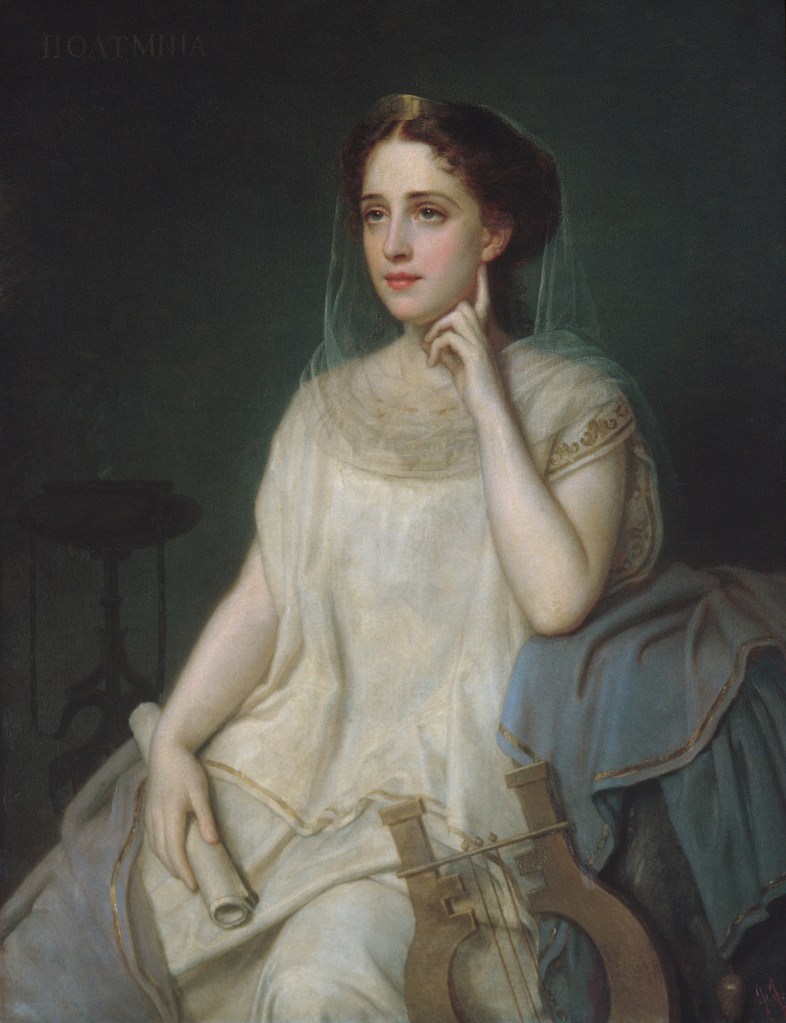
Polyhymnia. Joseph Fagnani, 1869.
Polyhymnia’s name means “many praises.” She is the Muse of sacred poetry, hymns, and meditation.
The lion’s claw in my poem is an allusion to the referenced chapter in The Voyage of the Dawn Treader, where Aslan peels away the enchanted dragon skin from Eustace, restoring him to his true—and transformed—self.
“Learn the unforced rhythms of grace” is from the paraphrase of Matthew 11:28-30 in The Message.
On Ethical ELA today Glenda Funk takes inspiration from what can a poem do? by Darius V. Daughtry. Her invitation to teacher-poets: “Compose a poem in which you celebrate what a poem can do and imagine the possibilities for more poetry specific to an issue or concern.”
In the Non-Rhyming Scheme of Things
A poem cannot
erase the past or
bring back people I’ve loved
and lost
A poem cannot
still the storm or
turn back tides
of war
A poem cannot
repair the whole world or
remake the human heart
but it’s a start

Today on Ethical ELA Jessica Wiley invites teacher-poets to compose in a form invented by her ten-year-old daughter, entitled “By Myself.” The challenge: Keep the first and last stanzas from the model and write eight rhyming lines in the middle, beginning with “I am.”
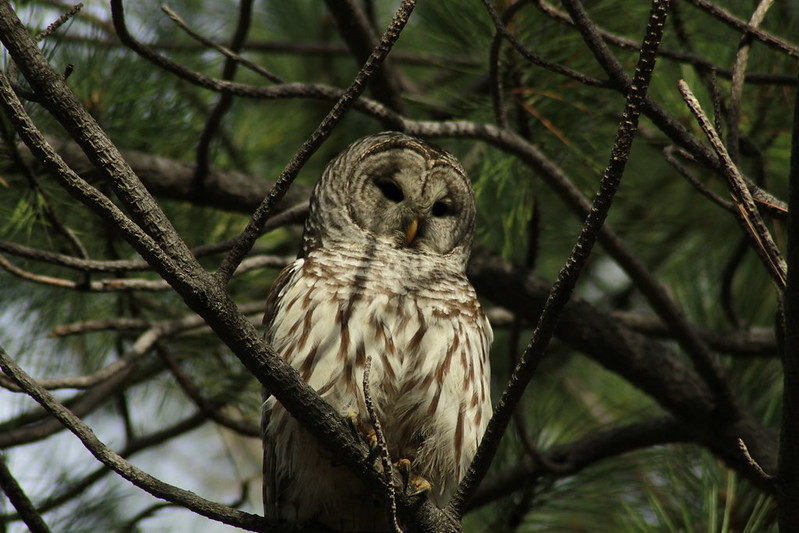
As I began to write this morning, quite by myself (so I thought), I heard a sound outside… I had to stop, open my back door, and listen. Naturally it had to become part of the poem, as it’s part of me, now…
Lines Composed Before a Late-April Dawn as Birds Begin Singing and a Barred Owl Is Calling
When I’m by myself
And I close my eyes
I’m flickering candleglow
I’m a rainstreaked window
I’m sky-scouring birds
I’m the wings of words
I’m snowflakes, driven
I’m mistakes, forgiven
I’m an ivy-covered portal
I’m the voice of the owl, immortal
I’m whatever I want to be
An anything I care to be
And when I open my eyes
What I care to be
Is me
A recording of my owl out back in the pre-dawn darkness this morning.
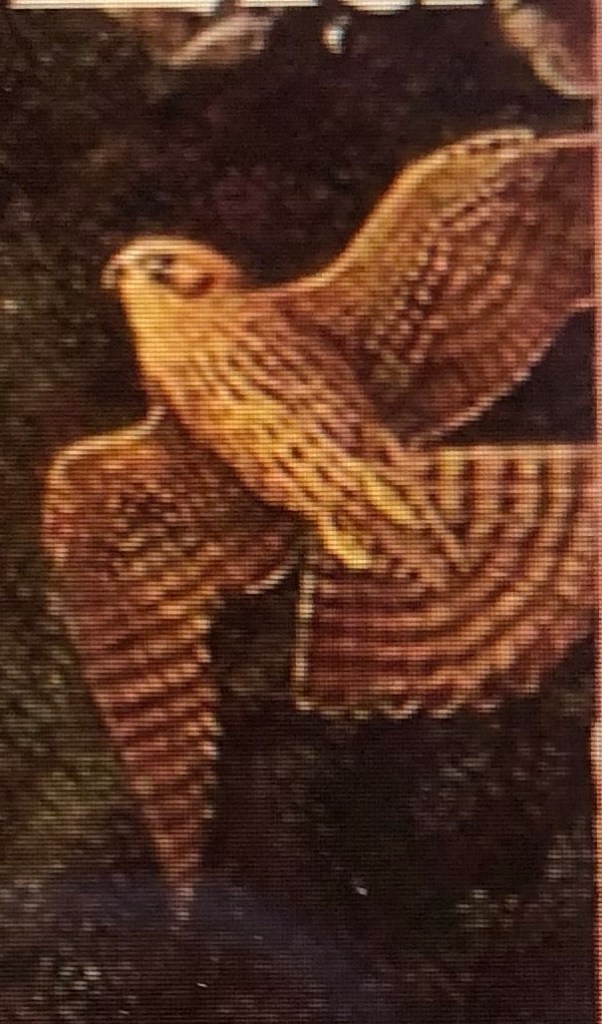
One of the many symbolic meanings of the barred owl is sacred space… which is always calling to me.
It’s also known as a hoot owl.
I have stories and an old song about that, for another day.

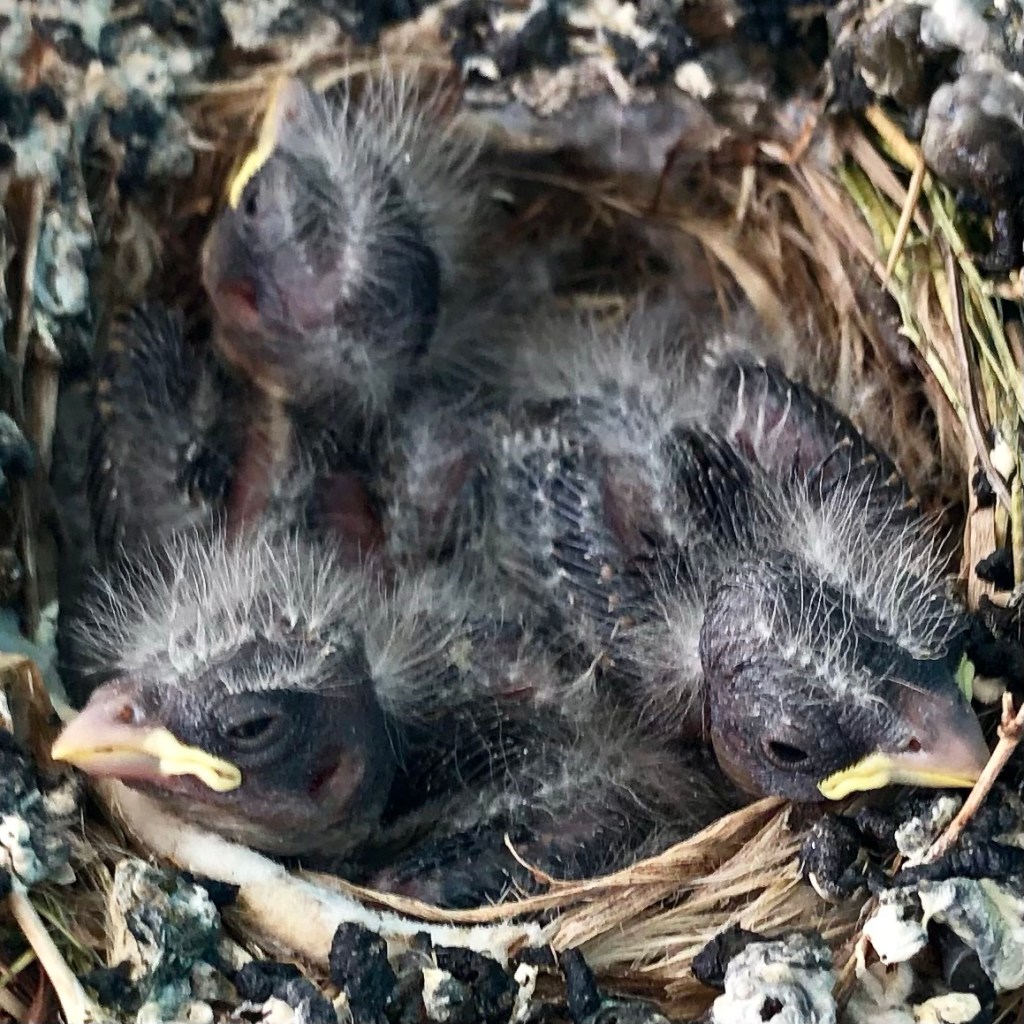
One-week-old finches
sport mohawks with drowsy pride
in their tiny nest

There are actually four baby finches in the nest on my front door wreath,
one of whom was Little Blue Egg.
This photo was taken a week after they hatched on Easter.
On Ethical ELA’s VerseLove today, Amy Vetter invites teacher-writers to compose found poems: “A found poem is like a collage…find a text (e.g. a novel) or series of texts (e.g., novel, poem, article) and pull out words, phrases, sentences that stick out to you. Play around with the words. Rearrange them until a thought or theme jumps out at you. Continue until you’ve created a cohesive text.”
My found poem comes from Natalie Babbitt’s The Search for Delicious, Amanda Gorman’s poem “Arborescent I” from Call Us What We Carry, and A Field Guide to Lies: Critical Thinking in the Information Age, Daniel J. Levitin.
Stories We Tell Ourselves
I read a story
about people who
built towns
crowned a king
and enjoyed
a great many
quarrels and troubles
all of which
they created quite
by themselves
for our brains are built
to make stories as
they take in the vastness
of the world
we forget
looking at a city
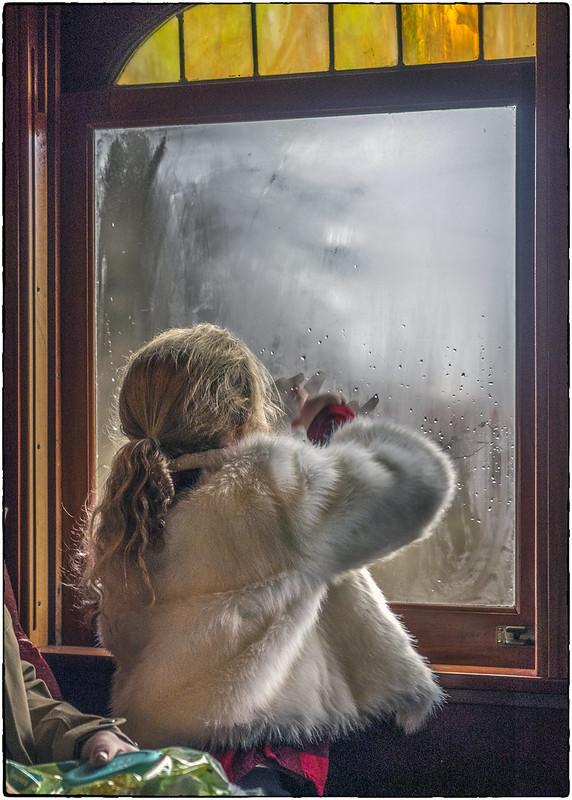
through the window
of a train
that we’re only seeing
the part
with the train tracks
running through it
not the whole
blow the whistle
open the door
but it is shut
and locked
the brain
makes up its mind
-it is a very powerful
self-justifying machine
and so
for selective windowing
we would again
give up our world

For Day 25 of VerseLove on Ethical ELA, Linda Mitchell inspires teacher-poets with the scientific method. Linda says: “The scientific process reminds me of poetry. For me, poetry is about observing, questioning and predicting–which are vital, although not the total, of the scientific process.” She challenges poets to incorporate part of the scientific method in a poem: Make an observation; ask a question; form a hypothesis or testable explanation; make a prediction based on the hypothesis; test the prediction; and iterate: use the results to make new hypotheses or predictions.
My poem is dedicated to students, with a question I find myself asking too often. I left the area of referral out on purpose; could be behavior, academics…
Graphic Failure
Dear Student, I see you’ve been referred.
Why have you been referred?
Maybe it’s because your teacher
is afraid.
Not of you. Not really.
You see, in the scheme of things,
you should be the tip of
a hypothetical pyramid,
with all the systemic structures
supporting you—in other words,
your needs should drive
everything else
your teacher, see,
is the next closest layer
to you
and when this pyramid is
upside down
with the ponderous weight
of systems all at the top,
by the time it reaches
your teacher,
the pressure
is immense
(research tells me this used to be
a form of execution in ancient times,
crushing, i.e., the adding of more
and more stones)
which means that if
this colossal pyramid
is inverted
there you are
the tip at the bottom
the whole system’s
supposed
raison d’etre
bearing it all
like Atlas
no wonder
you have been referred
it is all too much

Today on Ethical ELA Jessica Shernburg invites teacher-poets to find 1-3 short texts to read and annotate or texts that we’ve previously annotated (“examples you have modeled for your students, your responses to student work, books you have marked up, etc.”). The idea is to use your own annotations in creating a found poem.
This is the kind of thing that could keep me busy for days, weeks, infinity…
My annotations come from an eclectic mix of professional development, research, an old but much-loved novel, and the Bible: Culturally Responsive Teaching and the Brain: Promoting Engagement and Rigor Among Culturally and Linguistically Diverse Students (Zaretta Hammond), The Power of Moments (Chip and Dan Heath), The Forgotten Beasts of Eld (Patricia A. McKillip), and John 16.
Might I violate the expectation
of an experience
with the right amount of tension
keeping the rubber band taut
bearing in mind that
there must be trust enough
for productive struggle
risking vulnerability
even as a disciple unprepared
for the terribleness
of what is to come
imagine tapping inner power
to call creatures with ancient magic
unto myself
while tasting
the freewheeling thoughts
of birds

Today on Ethical ELA Stefani Boutelier invites teacher-poets to roll Metaphor Dice, originally created by Taylor Mali for composing poems with students.
I’ve written a few poems based on Metaphor Dice:
Your Ego is a Feckless Maelstrom
Here’s where today’s roll landed me…
Wearer Beware
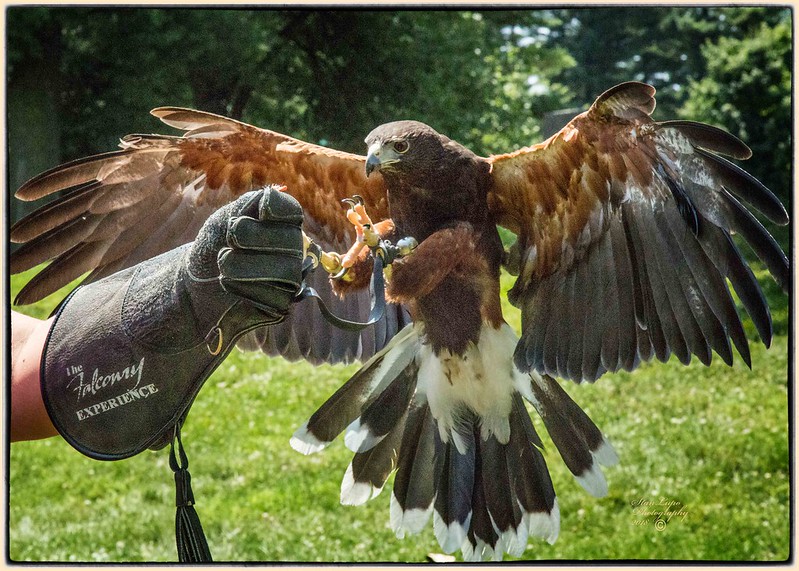
seel (as defined by Dictionary.com):
1. Falconry. to sew shut (the eyes of a falcon) during parts of its training.
2. Archaic.
Bias is a capricious gauntlet
a gloved hand
infinitely unwieldy
but nevertheless employed
in stitching closed the eyes
in beckoning talons
begging the question
of rapture in the raptor
of rupture in the captor
over eviscerating prey
which is to say
once worn with intent
to destroy
the capricious gauntlet of bias
may turn, of its own accord,
to reach instead
for one’s own throat
beware the taking up
and the throwing down

with thanks to Tammi Belko, who encouraged teacher-poets to write on the topic of cheese today at Ethical ELA: “Poets have been mysteriously silent on the subject of cheese” (G.K. Chesterton).
an extended haiku, of sorts
For Love of Grilled Cheese
Mama and Grannie
decide they want Chinese food
I don’t like the smell
they’re frowning at me
holding my nose in Kam Ling’s
ordering grilled cheese
—not on the menu
I’m confusing the waiter
Just take bread, I say,
two pieces, and put
a slice of cheese in between
and butter outside
fry it in a pan…
a loooong time later, it comes
miraculously
(was someone dispatched
to a nearby grocery
in great vexation?)
Not long afterward
Mama has a surgery
Grannie comes to stay
Daddy is working
and doesn’t cook, anyway
I ask for grilled cheese
Grannie makes the thing
in the toaster… No, I say,
that’s not how Grandma Ruby
makes my grilled cheeses
Grannie’s face goes Mr. Hyde
like on Bugs Bunny
she shouts—the house shakes—
I’M. NOT. YOUR. GRANDMA. RUBY!
Heaven help me please
I may not get grown
if grown-ups demolish me
for love of grilled cheese

Grilled Cheese Sandwich @ Thunder Bay Regional Hospital. istargazer. CC BY-NC-ND 2.0.
Note: I love Chinese food now.
And my Grannie. Mutual forgiveness and gratitude, for so many things.