Mystical morning

Ocracoke surprise

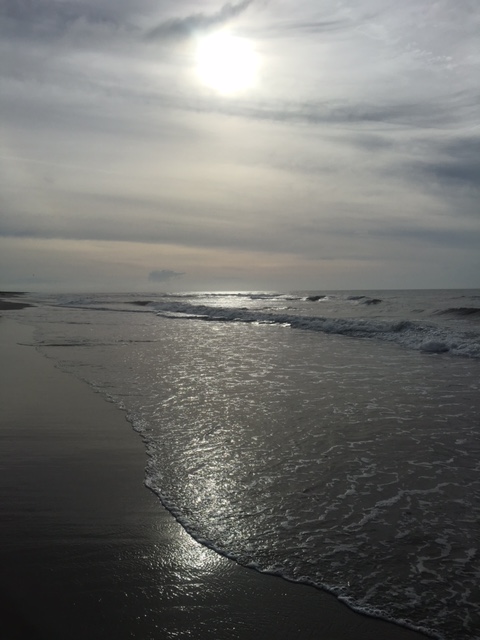
The island dawn is one of nebulous grayness, the sun an oblique white disc shrouded in veils of clouds. Painted from a palette of pearl, silver, and slate, the sand, the sea, the sky are starkly monochromatic, like an old black-and-white-movie. The temperature is indeterminate, neither hot nor cold. The morning is not uninviting nor inviting; it simply is.

As I make my way past softly rolling dunes of long grass shivering and undulating in the wind, I think only of the ocean, the opportunity to savor its splendor in relative isolation, away from commercialism. I expect to see a die-hard beachcomber or two; surely this a shell-collector’s paradise.

I do not expect the tree.

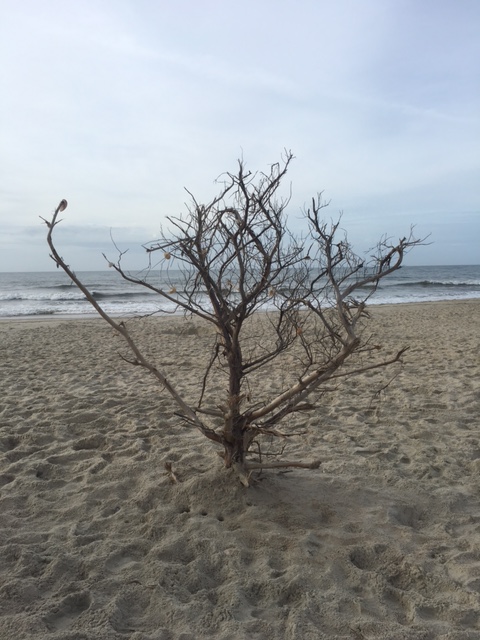
There it is, up ahead in the sand, directly in front of the path where dunes give way to the shore, with the shimmering, empty Atlantic for a backdrop.

How curious. I’ve not seen a tree smack in the middle of a beach before.

Are there others? I scan the shoreline, as far as I can see, on the left and the right.

No.

This is the only tree.

Did it grow here, somehow? I investigate. I suspect not, as the sand is built up around the tree’s base, although I can’t discern human handprints. Or footprints. I don’t even know what kind of tree this is, although I saw numerous others like it lying in the Pamlico Sound on the Hatteras side of the ferry ride to Ocracoke. I should have asked the crew what kind of trees these are and why they lie so far out in the water. 

Driftwood, then. 

It stands here on the vacant beach with its thin, snaky branches twisting skyward. Shells dangle from some of the vine-like tips, reminiscent of castanets on fingers. Or earrings.

I am enchanted. I’ve a sense of standing in no-man’s land, except that someone has clearly been here. Maybe someones, plural. Mystery people were inspired to plant this bit of driftwood and to decorate it with what was near at hand. 

The tree is dead. Shells, for all their intricate beauty, are but skeletons. I marvel at the human heart, its great desire for creativity and play. At the ability of the inner artist to see that random pieces of things no longer living, broken things, can come together in such an unexpected way. Whimsy in the wind. The beach tree stands as a mystical reminder that all is not lost, that all has value, that there’s beauty beyond the brokenness if we are willing to rearrange the pieces. The extraordinary lies not beyond the ordinary, but within it. Not beyond us, but within us, within our very grasp, if we just reach.

The ocean sparkles despite the obscured sun, like the twinkling of an eye when someone’s just about to smile.

Ocracoke morning

Note: The title is a deliberate play on that of a previous post about my son’s trip to Iceland – both attempts at capturing the essence of place: Mythical morn.

slice-of-life_individual

The last stop


Nursing Home

The Last Station Nursing Home. Ulrich JohoCC BY-SA

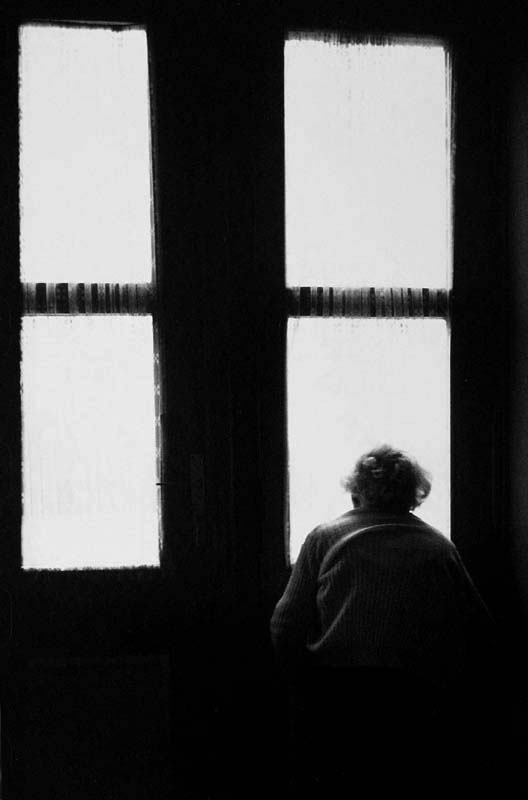
I push the wheelchair down the hallway. We pass an old man in a wheelchair; he lifts his hand in greeting, although he’s never seen us before. In the lounge, a tiny, gray-haired woman is holding a doll in her arms, rocking it while she watches TV. She takes a spoon from the tray in front of her, scoops up something orange – maybe jello, maybe mashed peaches – and tries to feed it to her doll. My throat constricts. With every step, I feel like the world is converging, that I am being squeezed into a narrowing tube.

I come to the room. 

“Here we are, Grandma. This is your room. It’s really nice.”

In the wheelchair, Grandma covers her face with her hands. She begins to cry.

I kneel, nearly panicked, feeling akin to Judas Iscariot. “Stop! Please don’t cry. You will make me, cry, too. Is that what you want?”

Instantly her hands drop. She lifts her wet face, squares her thin shoulders. “No, no. I don’t want you to cry.”

She looks at me with those watery blue eyes that I know so well. She places her bony hand over mine on the arm of the wheelchair. “If I have to come to this place, then I am glad you are the one who came with me.”

For a long while we just sit in the waning afternoon light, holding each other’s hands. There are no words.

Because there are no words.

I feared the day would come when she didn’t know me. She forgot many things – what era we currently lived in, that many family members were long dead. I debated whether or not to tell her when she mentioned her brothers or her son – my father – that they were gone. How many times can a person stand to lose someone they love? She watered her artificial poinsettia at Christmastime and, still in possession of her physical strength, managed to get out of the building through a window (if I recall that detail correctly).

She eventually lapsed into a docile silence, looking at every visitor with a sort of curiosity, but no longer struggling. She’d stopped speaking. At this point, she wasn’t feeding herself any more, so I would feed her whenever I was there.

Taking the plastic spoon in my hand, I say – I don’t know why, maybe because of tradition, habit, courtesy, or simple spontaneity – “Grandma, do you want to say the blessing?”

I know she hasn’t spoken in weeks. I guess I expect to say grace for her now.

But she bows her head, clasps her hands . . . and recites, perfectly, word for word, the Lord’s Prayer.

I sit, awestruck. This isn’t the family blessing, my grandfather’s prayer, that we always say when we give thanks. But she knows it is a prayer; it remains intact in her mind.

I thought of all the nursing homes I’d visited through the years, usually during the holidays to sing Christmas carols. The Alzheimer’s wards are especially haunting, with their heavy doors and alarm systems. The people sit, physically present, enduring their days, but mentally elsewhere, often unresponsive unless one of two things occurs. When a child comes in, the faces of the elderly suddenly light up. It’s an eager expression. They lean toward the child, smiling. Some even hold their hands out to the child. Whether it’s the newness of life or the memory of  what once was, the presence of  a child is magic here.

As is music.

Carolers walk the halls, singing, and residents wheel themselves to the doors of their rooms. Some smile and wave, others nod in time to the song, until we sing “Silent Night.”

Some of them were just sitting at dinner, one leaning to the other, saying, “I don’t know where I am. What is this place?” The other responded, “I don’t know either. And who are you?”

They may have been playing Scrabble earlier that afternoon, although the words won’t come and the tiles are too hard to see anymore.

But when “Silent Night” begins, the light comes back on in their faces. They sing every single word with us – even a woman, rocking her doll. 

This is my grandmother’s favorite hymn – she taught me to play it on her chord organ long before I started school, placing my little fingers on the keys over and over until I got it right. 

She was born the day after Christmas and died three days before Christmas, almost on her ninety-first birthday. We sang “Silent Night” at her funeral.

These thoughts and images swirled in my mind yesterday as my son played the keyboard at his grandmother’s convalescent center. I noted the absence of one resident who followed me nimbly to the exit the last time I visited – I saw the eagerness on her face, the light of it – just as the alarms went off and the nurses gently escorted her away from the door.

She died last week.

My son plays hymn after hymn; the residents clap after every lively rendition. Someone sings in a clear, soft soprano, every single word of every stanza, in perfect time with the music.

This is my story, this is my song . . . .

Even at the last stop, when time seems to be no more, when the days and nights and years and epochs melt together, when the stories lie dormant, music sweeps in like a breeze, stirring  fallen leaves into the air again. The words rise to the surface, for they are there, always there, in the deepest, darkest places. No matter how long they lie, the old, familiar melodies bubble back with the first strains. Released.

They sing, and I marvel. At the power of it, at the gift of it, at the peace of it.

Shadows are gathering, deathbeds are coming. Silent nights are coming. But until then, their hearts go on singing.

I stand amazed.


Soul-ache

Only time for a quick hug

Only Have Time for a Quick Hug. JackieCC BY

I recently learned of the UK’s Empathy Museum, which began in 2015. Their mission: To help us look at the world through other people’s eyes. To walk in their shoes.

Literally.

Part of the exhibit, “A Mile in My Shoes,” is an actual collection of shoes worn by a Syrian refugee, a war veteran, a neurosurgeon, and many others. A person can don the shoes and walk in them while listening to a recording of the original shoe-owner’s story.

Another project of the Museum is the Human Library – instead of checking out a book, you can borrow a human for a conversation. “A Living Book,” says the site.

The keys to empathy are story and dialogue. Experiencing what others have experienced.

The Museum was founded by – can you guess? – a writer.

A thousand things flood my mind as I read about the Museum. Although I know it well, the power of story to impact and transform the mind and the heart is driven home again, anew. To live for a moment inside of others, to see through their eyes, to feel the stab of their pain, their fear, their sorrow, their longing, their joy (for joy, too, is a stab; read C.S. Lewis and William Wordsworth) is to bleed away part of ourselves on their behalf. Empathy is a simultaneous forgetting and remembering of our own soul-aches, while standing in someone else’s shoes.

Shoes remain, as stories remain. People do not. I have long been haunted by the image of shoes lying around the wrecked stern of Titanic when it was discovered. Author Charles Pellegrino writes that it took months for scientists to realize that these pairs of shoes, still intact after seventy-three years on the ocean floor, were uniformly spaced about eighteen inches apart, with shoelaces still tied. There’s no other trace of the people at all – not even teeth. Only the shoes remain to mark where the bodies came to rest. Scientists are at a loss to explain exactly how leather and shoelaces endure when no other clothing or skeletal remains are to be found, yet the shoes are there, the final witnesses, the last word in the story of their wearers. (And one more secret of the utterly mysterious ocean).

It is also worth noting how the hardcore scientists, successful in their famous mission to find her, wept over the Titanic.

Empathy.

Soul-ache.

For the suffering of others.

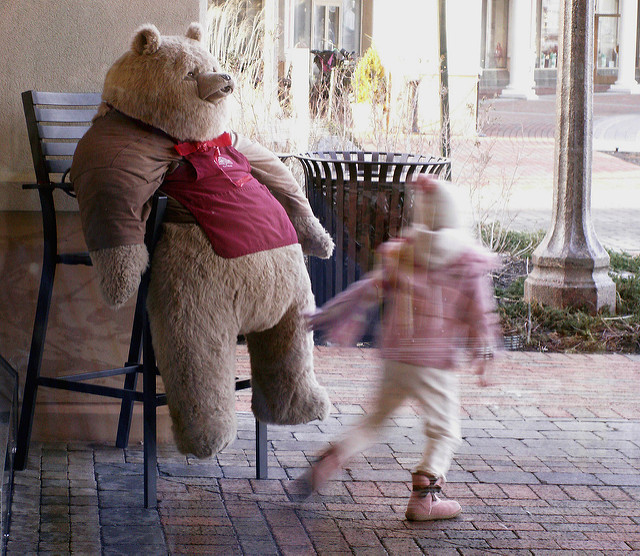
It’s also important to note that the word origin of empathy is rooted in passion as well as in suffering, hence the photo at the top of this post. The little girl runs to hug the stuffed bear in a burst of feeling, then runs away too quickly for the camera. Her image is blurred, ghost-like; a reminder that life is fleeting. She will not be a child for long. She may or may not ever be in this place again to see this bear, but in this moment, she is spurred to action.

That’s what empathy does – the short walk in someone else’s shoes strikes our souls so that we come away changed, wanting to make changes. We are all islands in a common sea, wrote Anne Morrow Lindbergh, twenty years after the kidnapping and murder of her baby boy. The common sea – the human experience, with all of its sufferings, its horrors, its joys, its beauty. See – really see – the people around you. Hear them. Feel their soul-aches, even as you feel your own. That’s empathy. Read it, write it, speak it – and by all means, teach it. A little soul-ache goes a long way in making the world more livable.

For all of us.

Note: The idea of soul-ache came to me while reading Mary Oliver’s poem “Wild Geese.”


Mythical morn

Iceland beach

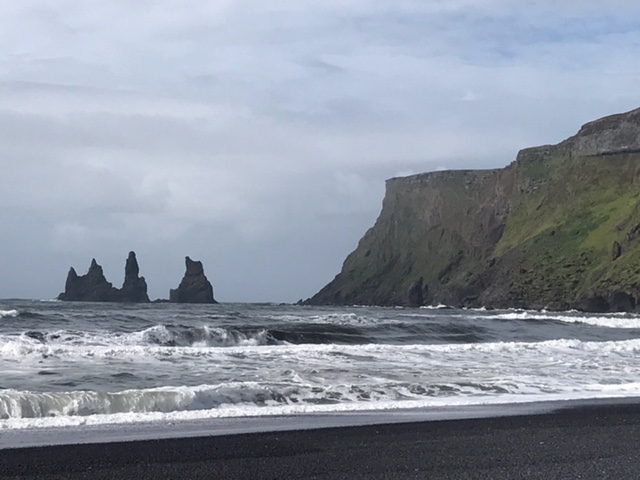
Sea stacks (Reynisdrangar) and black sand beach,  Vík í Mýrdal, Iceland

The breaking of the wave cannot explain the whole sea. – Vladimir Nabokov

My older son toured Iceland this week, capturing his own abiding images of the exotic landscape.

We struggled to find adequate words for encapsulating the stunning scenery.

Desolate. Windswept. Wistful. These drifted in and out of my thoughts when viewing the photos, although they were a shade off, a tad too dark, didn’t have the exact right feel, weren’t sufficient. Uncaptured words, like elusive, shadowy birds, circled round my mind, never quite touching down.

It’s like being on another planet, my son texted.

Ethereal, I texted back, almost happy with that word, as it’s one I love and it almost fit.

It’s mythical. 

My son nailed it.

He was, after all, the one there taking it all in.

Land of legend and lore, glaciers and volcanoes, sharp contrasts and starkness, sparse, picturesque villages, moody skies and morning mists, Iceland is mythical. Not in the sense of Avalon and Atlantis, for one can actually stand at the volcano’s edge or scoop up handfuls of the black sand at the beach, really tiny pebbles of basalt. The whipping wind, the rocky coast, the crashing waves – the Vikings would recognize these still.

It looks like something out of Tolkien or the Chronicles of Narnia, said my son.

Experiencing Iceland vicariously, I did what I always do when I wonder about things – I looked them up (until this moment, I hadn’t thought that looking things up might count as a hobby; I am saying it’s mine, the next time I’m asked). There in the Internet’s vast sea of words, the facts have as magnetic a pull as the legends.

On the southern tip of Iceland, where my son stood on the black sand looking out at the craggy basalt sea stacks, the ocean is unimpeded all the way to Antarctica – there is no land mass in between. Hence the Atlantic rollers – long, powerful waves – can attack this shore with ferocity. I envision the sea drawing itself back as far as it wants, like a pitcher winding up for a fastball. Treacherous, even deadly (local legend features sea trolls and shipwrecks), there’s yet something lyrical, spiritual, about the wild freedom of the ocean at this point on the globe.

The Earth is mostly water; we are mostly water. 71% of Earth is covered by water; there’s 73% water in the human brain and heart. The ocean’s inspirational pull on us may be that simple – like recognizing like. We see the beauty and the power of the sea and something stirs deep within us – humans have waxed poetic about the ocean from time immemorial.

The thing that draws me most about this particular spot, the fascinating black beach at the village of Vik on the southernmost tip of Iceland, is knowing the ocean is unhindered here, from the shore at the uppermost part of the world to the lowest. The vast freedom, the power. The creative force. It draws me as a writer, as a teacher, as a human. That we are capable of great destruction is an understatement – but that’s not where I am going. From our entry into the world to our exit, there’s not a time we aren’t hindered by obstacles, both physical or metaphysical, taking their tolls on our bodies, minds, hearts, spirits. It’s astonishing how we are inspired to carry on, unfathomable how the smallest of things can be the source of willing ourselves onward – we flow over, around, through what would hold us back, finding peace despite what looms, ever how great, in our paths. As with the ocean, humankind has waxed pretty eloquently, deeply, about trouble, trials and pain. It’s a shared experience; none of us is unmarked. The difference is how we make our way, individually.

To be truly unleashed and still live seems an impossibility, so I ponder the power of unhindered inspiration – the indomitable force that would be. What heights, what depths, what creativity. Ultimate constructive power, unlimited possibility.

If such energy were harnessable . . . well, that’s the stuff superheroes and sagas are made of.

I tap into it as much as I am able, and let it flow on – one grateful conduit of ideas, images, and meaning, in my little part of the boundless, surging sea.

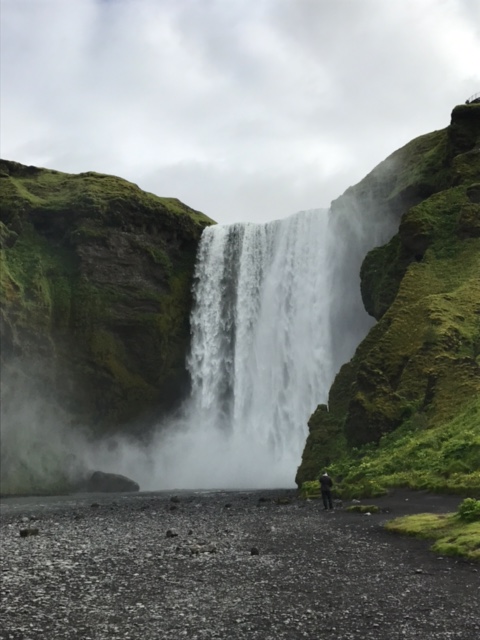
Iceland waterfall

Skógafoss, a waterfall in southern Iceland at the former coastline.

Note: Prior to writing this post, I had been toying with a piece about an enchanting encounter on a beach much closer to home. The titles of these posts are deliberate plays on one another, attempts at capturing the essence of place: Mystical morning.

Rare perspective

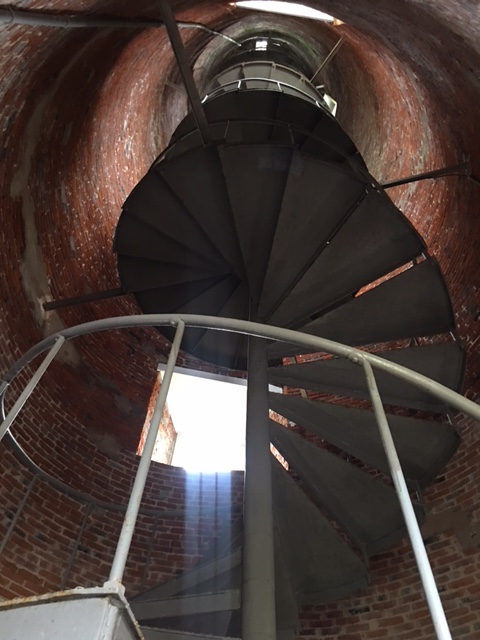
Ocracoke lighthouse inside

On my recent trip to Ocracoke Island for professional development, courtesy of the North Carolina Center for the Advancement of Teaching (NCCAT), my colleagues and I were treated to something unexpected and rare: A visit inside the Ocracoke lighthouse, which is closed to the general public.

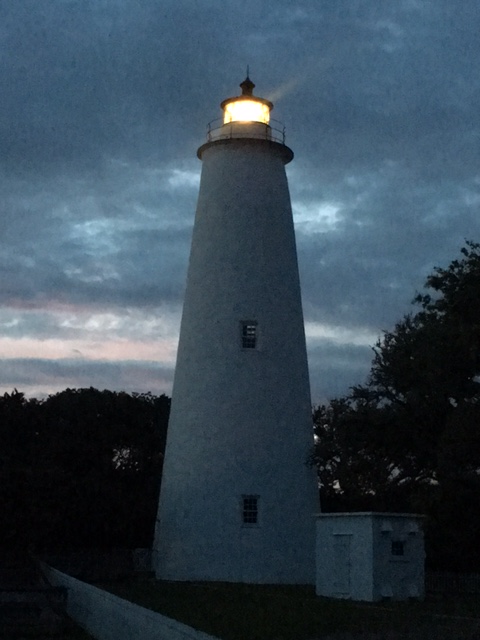
The Ocracoke Light, as it is called, is the oldest and smallest of the Outer Banks lighthouses. So tiny, in fact, that the only person allowed up the spiral stairs is the bulb-changer. There’s just enough room for this maneuver at the top. The bulb is about the size of an average man’s pinky finger. It’s not the bulb, of course, that shines a steady light fourteen miles out into the Atlantic and the Pamlico Sound; the fourth-order Fresnel lens, historic in itself, magnifies the light.

The history is compelling, how the land was purchased for so little (two acres for $50 in 1822), and how this diminutive lighthouse originally operated by burning whale oil. Tiny yet powerful, standing on high ground, this lighthouse still guides ships safely through the inlet to other inner ports. I was also drawn by the graves nearby, almost obscured by a white picket fence and sheltering live oaks, just a stone’s throw from the lighthouse door. I wonder how many people ever notice this.

“Who were they?” I asked the NCCAT facilitator, an island native who had the key to let us inside the lighthouse. Imagine walking around with such a key in your pocket! “The people buried here – were they the original landowners?”

“Some,” was his answer, which set my mind surging so that it was hard to pay attention to the presentation. Who gets to be buried in such a captivating place, on a remote little rise overlooking the sea, at the foot of a lighthouse? What an incredible resting place.

It got me thinking about the human connection to place, to each other.

The original light could only shine about five miles out to sea – not always enough to save some of the ships. With the new lenses, really multifaceted prisms, the light shines almost three times farther. That it is a steady light seems significant to me – it does not blink or rotate at intervals, as other lighthouses do.

Perhaps because I am an educator, I connect this to teamwork, to the light we can shine individually only going so far, and how the strategically focused, combined efforts of colleagues goes so much farther in what we can do for students. There’s power in collaboration, in steadily striving for a common goal, in strengthening one another for the sake of those we are trying to help.

This doesn’t apply only to education. It applies to any organization – in fact, to humanity as a whole.

Which leads me to contemplate the rare perspective of being inside the Ocracoke Light – there’s a tiny bulb at the top with a mighty lens to magnify its illumination during the night, but I am here in the day, and I see natural light spilling in a tiny window.

That, to me, is inspiration. The natural light that shines through whatever little window into the human soul. Such light may leave periodically with the temporary darkness, while the light from the top of the lighthouse shines far for the benefit of others, but it always returns again, driving the darkness away.

We have only limited glimpses into the hearts and minds of others; we can hardly recognize our own, sometimes. There’s no real correlation between the light shining through a window to the inside of a lighthouse and its ability to shine a light at night – but for a human, there is.

Inspire. Be inspired. Appreciate your own rare perspective, and you’ll better see that of others.

A little light goes a long way – longer still, if we magnify that inside each other.

Ocracoke lighthouse


Abiding images

Last week I spent several days on Ocracoke Island, North Carolina, studying writing with teaching colleagues from across the state.  This extraordinary opportunity was provided to us by the North Carolina Center for the Advancement of Teaching – heartfelt thanks to you, NCCAT, for your support of teachers, and for inspiration at a time when it is needed more than ever.

Ocracoke is, in the words of our faculty advisor, who’s native to the island, “a windy, sandy, watery place.” It’s also tiny and breathtakingly beautiful. One of our assignments was to capture abiding images from this idyllic locale in our writer’s notebooks.

Abiding images are symbols with deep personal meaning to us, often recurring, according to dream analysts. Abiding images are part of us, shaping our lives the way the wind and the water continuously shape this island. To poets and writers, abiding images come from a wellspring inside us – stories, dreams, conscious and unconscious memories – each as unique to us as our own fingerprints.

Our task was to walk in this brine-tinged breeze, under the moody sky, without speaking to one another. We were to walk alone, searching for the images that speak to us.

I prefer to think of it as being called by the images that wish to speak to us.

The long beach grass rippled like hair against the ground; the sea, shimmering and calm on the Pamlico Sound side, flowed ceaselessly from left to right like words across a page. Come, was the inherent, compelling invitation. Come. Listen to me. I have stories to tell.

I filled seven pages with abiding images and took pictures of a few.

There were the pink wildflowers, startlingly bright against the beach grass. Marsh pinks, they’re called. Sabatia stellaris. Our advisor said for anything to survive on the island, it must be hardy, yet here were these delicate flowers with perfect yellow stars in the center, as if painstakingly hand-painted by an artist. Incongruous. Surprising. Hopeful, somehow, for these flowers carry the mark of the heavens in their upturned faces.

I came across some shells by a small hole in the sand, out of which grew a thin, solitary blade of grass. No other grass stood anywhere near this one long, lonely strand, this one hair from this one follicle. There are secrets in the sand, the advisor told us. So much more goes on in it and below it than we really know. 

This curious wisp of grass shivers, nods.

I walk farther and discover the ivory-yellow skeleton of . . . something. I don’t have a frame of reference for it, other than knowing it’s a bone, something once alive. It worries me. I want to know what creature it was and why it’s here in such pristine condition, with no other marks in the sand near it in this isolated spot. How long has it been dead?

I learn later that it’s the skull – just the skull, although it’s the size of a chicken – of a red drum. North Carolina’s state fish.

I still don’t know why it was lying there all by itself.

The last of my abiding images is at the marina in front of the NCCAT building, which used to be the old U.S. Coast Guard lifesaving station. As I turn to go back inside, I encounter a rusted handle quite suddenly in the sand near the marina’s edge. It’s sticking upright, clearly attached to something buried there, and it’s obviously been around a long time. What’s THIS secret hidden in the sand? I don’t tug on the handle, although I want to; I imagine pulling it and a door coming forth from the sand to reveal an opening with stairs leading down to . . . anywhere. A bunker, a secret gathering place, another world, another time. Oh, the stories this strange handle evokes!

Perhaps I will write one of them yet.

For now, the images abide in my notebook and in my mind; they shape me, even as I shape my thoughts about them. I carry them with me while I leave a piece of my heart, perhaps a piece of my soul, behind with them.

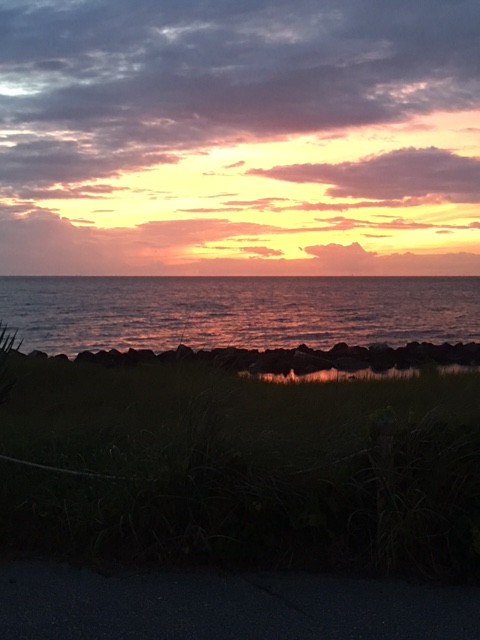
We belong to one another. That’s what I think as the sun goes down over the Sound, as I hear boats over in the marina rocking as if they are waking from a long sleep, coming back to life.

We abide.


Sunset Pamlico Sound

Sunset on the Pamlico Sound.

In reading and in writing, our instructors told us, “Setting is everything. It drives the story, drives the characters’ actions.” 

The hallway

Hallway

Hallway. DSC_003. ColinCC-BY

A large part of my job involves helping teachers and students grow as writers. I often define writing workshop as an artist’s studio, a place with time to fall in love with the craft of writing.

As I consider my own writing experiences, the image of a hallway forms in my mind. I am actually in this hallway. I can see numerous doors, one of which stands partially open, and through it I can see a window, and beyond that, trees, bright in the golden light of afternoon, probably in late spring or early summer. The branches sway in a breeze, making the leaves dance and beckon, but there is no sound, not from this vantage point. I would have to go through the door and open the window, probably, to hear the rustling, the insects, the birds, to feel the sun’s warmth and taste the laziness of a free afternoon – if, in fact, the afternoon is lazy and free, as it seems to be from where I stand.

Other doors are closed, and knowing that I can open any of my choosing sends a compelling shiver through me – each door leads to a different place, experience, and story. They are all mine to explore, at my leisure. I will never know what’s behind the doors unless I go and open them. Some lead to the past – when I walk through, I can see my family, some of whom are gone now but alive and remarkably young in this place.  They don’t seem to mind at all when I come – in fact, they seem to welcome my visit the same as they always did. If I go farther, I see old friends, classmates, even people I didn’t know well but who are somehow connected to an idea, a moment in time when I learned something or realized that something mattered. My childhood dogs bounce up at the makeshift gate between the kitchen and the living room in their typical greeting; I smell cigarette smoke, the old Kirby vacuum cleaner, the old worn rug; fried chicken also lingers in the air. But I do not want to stay and wander like a ghost here in my childhood home. I can come back another time, anytime I like.

Behind other doors are chairs where I rocked my babies. Here I sit with their soft warmth in my arms, their fuzzy heads nestled against my neck. I feel them breathing, slow, easy, contented in their slumber. I can stay here a while and just be, just rocking, holding one boy for a long time and then the other. I can see them when they are a little older, one always chipper and friendly, the other absorbed in his own thoughts, spending hours lining up his Hot Wheels or taking things apart to put them back together. They are safe and well in this place, so I will leave them here, after I kiss their satin-soft cheeks once more and tell them that I will always love them.

Other doors, I suspect, lead to worlds that I can still create, both real and imagined. I can only see so far in the future; only some things are certain and I will alternately face them and embrace them as they come. I could linger far too long in the imagined worlds, just to see what will happen, to discover the secrets and the magic, knowing all is of it is at my command.

I am surprised by the door that opens straight into the natural world. I have discovered this about myself, that the workings of nature have a strong pull for me. Some of the discoveries are breathtaking, like the iridescence of a dragonfly’s body, the precise blue and orange painted pattern down a caterpillar’s back, the powerfully sweet fragrance of a gardenia, of honeysuckle, and the tiny war-plane drone of a hummingbird’s wings. Others discoveries are not nearly as pleasant – a horseshoe crab decaying on the beach, a tobacco worm (a non-native North Carolina neighbor recoils in horror – “Is that a dragon?“) crawling on my porch rail, a scar on the wood trim by the roof where lightning struck the house. Not pleasant, but fascinating all the same. I had no idea until I started writing that nature spoke so much to me – just now, as I capture these words, the sun bursts forth from behind the clouds beyond my bay window, shining on the laptop and my hands as I type, like a validation, an invocation.

Other doors lead to mysterious places like cemeteries, where time is irrelevant. I don’t know these people, but I look at the stones, the names, the dates; I read the poems on the older, eroding ones, and I want to know: Who were you? What were you like? What was your life like, what did you love, and how did you die? What’s your story?

The most curious thing of all about this silent hallway is that whichever door I open, in whatever order, wherever I go and however far or for however long, I find myself there. Myself as I was, as I am, as I will be.

I give myself a nod.

And I write.


Flipover

Error
This video doesn’t exist


This is Kicker, a goldfish given to my soccer coach son by one of his teams.

Kicker is not well, as you can see. In fact, we thought Kicker had kicked the bucket, but then we noticed a little fin and mouth movement.

After watching the tiny creature floating helplessly on its side for a morning, I wondered: Can this be fixed? Can poor Kicker be helped?

An Internet search on “floating goldfish” reveals that goldfish are susceptible to a disease called swim bladder disorder or flipover, frequently caused by overeating. The swim bladder is what gives the fish its buoyancy; it cannot function properly if other organs are swollen and pressing on it. This essentially paralyzes the fish.

Kicker has been flipped like this for three days. My thought now: How much longer can this little fish last?

And, being an educator and a writer, I cannot keep from seeing deeper meanings, metaphors, analogies.

I’ve often said that teachers are becoming paralyzed with regulations – too much, too many, suppressing the natural artistry and creativity that comprise great teaching. Expectations are needed, certainly, but when so many are placed on schools, on teachers – on students – what happens to freedom of movement and growth? How many teachers feel like Kicker, floating helplessly near the surface, unable to do anything about it?

In turn, how many students feel that way?

Is there a remedy?

For Kicker, there may be.

Green peas.

Yes, really. My search tells me that feeding cooked, skinned green peas to a fish affected with swim bladder disorder often alleviates the condition. The experts say not to feed the fish for three days after the onset and then to try the peas.

I gave it a shot. It’s very hard, by the way, to get food in the mouth of a fish that can’t swim. But Kicker fluttered his fins and opened his mouth, clearly trying his best.

Kicker seems to be a little livelier this morning – he’s always greeted us, wagging his whole body just like a dog, whenever we approach the tank. Today he’s twisting a bit more, fluttering his fins and tail excitedly. He even gyrated himself all the way over, a complete 360. He’s still not very mobile or upright yet – but I see better movement, and I am hopeful.

Back to teachers, to students: What’s the remedy to glutted systems?

Certainly not adding more. Green peas won’t cut it here – if only they could! – but perhaps they hold a metaphorical answer. Perhaps the answer lies in boiling away, skinning back, getting to the inside part, the valuable part, the part that matters most. Education is not something to be done to children any more than professional development should be done to teachers; growth and learning come from a place of inspiration, desiring to know more and having authentic opportunities to explore, to ask “How can we make this happen?” or the greatest learning question of all time: “What if …?” It all comes from tapping what’s within, not from exterior layers upon layers, causing figurative flipover.

Goals and standards are necessary. They can be met, exceeded, in fact, with inspiration, creativity, and freedom – these lie at the heart of educational wellness.

Our survival depends on it.


If you’d like to read Part Two of Kicker’s saga: Fintervention

slice-of-life_individual


Mastering the monster

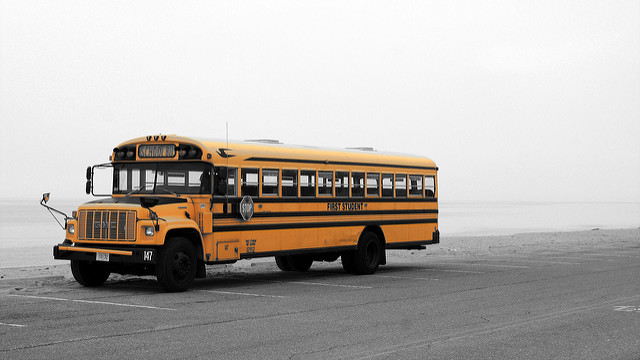
School bus

Bus #147. SebamirumCC BY

Life takes many unexpected twists and turns – a friend of mine says, “Life is one wild ride.” The mysterious is frequently interwoven with the breathtaking, the brightest moments often collide with the darkest, and the greatest desires of our hearts almost always involve epic challenges.

It took me the better part of two decades to finish college, for example.

I married at twenty, quitting college with a year and a half of coursework in general studies and theater arts. My boys were born. My husband completed two degrees needed for his work. I took a variety of jobs, all the while wanting to return to college myself, taking a class or two whenever and wherever I could. Sometimes I dusted off the old textbooks and plays, reread portions, dreamed of going on with my education.

When my younger son started kindergarten, I took a part-time reading remediation position that became full-time, until the program was cut after a couple of years.

“I’d like to keep you on, if you’re willing to take a teaching assistant job in first grade,” my principal told me. “Furthermore, there’s a distance education cohort beginning for paraprofessionals to get teaching degrees. You should pursue this – you’d be an excellent teacher.”

I pondered the prospect. A teacher. At the elementary level? I don’t know. High school English, maybe, but . . .

“It’s a consortium,” the principal went on. “If you’re a full-time teaching assistant, our county qualifies you to attend with financial aid. The books are even covered.”

Here it was, the long-awaited chance to finish school, only it didn’t look exactly like what I imagined.

The principal noted my hesitation. “It’s a perfect opportunity. What are you waiting for?”

Turns out that the program had K-12 reading certification built in.

That was the tipping point.

I love roller coasters. They climb and climb, gaining momentum, then – wooooosh. Hold on tight, as you don’t know what’s coming next – a pretty good metaphor for the wild ride of life. I applied to the program, got in. I loved my classes, my advisor, my instructors, my classmates. Returning to college was exhilarating.

Until.

“Of course, as a full-time teaching assistant in our county,” my principal said, “you’re required to get bus driver licensure.”

WHAT? 

I’m not overly fond of driving in the first place. The idea of maneuvering something as big as a bus, loaded with kids, being the only adult responsible . . .

“I’m not sure I can do it,” I said, going cold and clammy. My stomach lurched like it does after a sudden twist on a coaster, only worse.

The principal smiled. “Yes, you can. Look at it as something that gets you where you want to go.”

That’s what it came down to. If I wanted to finish school, to teach – which I now wanted to do more than anything, the ultimate situational irony – then I would have to face the big yellow monster.

My dad had driven a school bus when he was in high school. So had his sister. Back in their day, students were drivers. Daddy told stories about students tampering with the governor so the buses would go faster – I could envision the buses bumping down the country dirt roads, whipping around the bends in thick clouds of dust, kids bouncing wildly. He told the tales with glee; I listened in horror. While I darkly imagined Daddy’s great amusement on learning that I’d be driving a bus, if he’d lived to see it, this connection to him helped, if only the tiniest bit.

Look at it as something that gets you where you need to go.

I couldn’t let a bus stop me from finishing school or embarking on a whole new career that stretched out before me, glimmering and beckoning like the sea.

I signed up for the training.

The trainer started off with lots of stories, such as a driver once tipping a bus over by trying to avoid a squirrel, which is why we should never swerve if an animal runs in front of the bus.

I put my head down on the desk.

Then there was the first exam: Memorizing all the parts of the bus, how these parts are connected, what these parts do and why, what every light means. This was conducted by walking with the instructor, pointing everything out and giving an oral explanation. A written exam was also given.

I briefly considered failing these exams but my pride wouldn’t let me.

The training culminated in behind-the-wheel practice with the instructor, who asked: “Ever driven a Mercedes before?”

“No sir,” I answered.

He chuckled. “You’re about to now.”

I thought he was joking.

He wasn’t.

The bus I learned to drive on was made by Mercedes-Benz – who knew? It almost drove itself.

I managed to get this monstrous thing, this almost-airplane, through the narrow tree-lined streets of the nearby little old southern town without doing harm to anything until the instructor said: “All right, make a stop. Let these imaginary kids off the bus.”

I made the stop, opened the bus door. The flashing lights came on, the stop sign came out. I even counted imaginary heads.

For the first time, I thought: I’ve got this. It’s not so bad.

Then, as I closed the door to move on, the instructor said, “STOP!”

“What?!” I jumped a little in my seat. I stood on the brake.

“You just ran over a child,” said the instructor.

“I – what? How? I counted all the imaginary heads!”

“You didn’t check your mirrors. Kids can hide close to the bus and you’ll never see them if you don’t check all those mirrors. That’s why they’re there. Kids have been killed that way.”

I returned to work that afternoon in the deepest funk. A teacher assistant colleague greeted me: “Hey, how’d the training go?”

I sighed. “Not great. I ran over an imaginary child.”

My colleague grinned. “How did the imaginary parents take it?”

I laughed in spite of myself.

Still, I put myself on the prayer list at church. Seriously. The youth minister consoled me: “Look, when the time comes, God will give you driving grace.”

He was right.

The first time I had to drive, on my own, with real kids, it wasn’t a magnificent Mercedes bus but an old “cheese box,” as the kids say. I boarded with driving grace in my head and rosary beads in my pocket, given to me by a friend – and I’m not even Catholic.

I – and more importantly, the kids – lived to tell about it.

In fact, my driving the first-graders on their field trip to the movies (a trip of about three miles, consisting of three turns, one of which I took too close with a back wheel going over the curb, causing the bus to sway and the kids to scream), made their writing journals. When the teacher asked them to write about their favorite part of the trip, our entire class wrote various versions of this, with various spellings: “My favorite part of the field trip was when Mrs. Haley drove the bus.” On all the pages I was depicted at the wheel of the big yellow monster, my hair flying in the breeze for some reason, and smiling.

In the eyes of the kids, apparently, I was a great success.

I consider my mastery of the yellow monster my most dubious achievement, closely followed by my passing a college course on golf. No animals ever ran in front of me, all the kids got home, and other than the door handle rolling off one day and causing me to drive back to school with the stop sign out and all the lights flashing so that every car on both sides of the road pulled over, I am happy to report that I only had to drive a handful of times without incident until I finished the teaching degree and moved on, when I no longer had to drive a bus.

It did, indeed, get me where I needed to go.

Those obstacles that stand in the way of what we want, where we want to go – there’s no shortcut, no way over or around them. The only way is through, even when it doesn’t seem feasible, beneficial, or possible.

Whatever it is, whether it looms in front of you, in your past, or inside you, face your monster. Look it in the eye.

Then make up your mind to master it.

Grace be with you.
Making adjustments

Poor Banjo

Poor Banjo!

Banjo is my family’s 18-month-old yellow Lab. If he can be summed up in one word, it’s exuberant. If two words – wildly exuberant. He is a force to be reckoned with, ninety-one pounds of raw energy barreling toward us at top speed in hopes of 1) eating something or 2) having us throw a ball or stick for him to retrieve. Endlessly. Banjo goes into a frenzy if he thinks we’re about to stop throwing said ball or stick, the bodily equivalent of shouting NONONONONOPLEASEPLEASEPLEASEPLEASE!!!! His beautiful gold-green eyes (sky-blue when he was a baby) go pink around the rims; he often leaves us humans coated in a layer of frothy slobber, prompting us to quote Bill Murray’s line to Dan Aykroyd in Ghostbusters: “He slimed me.”

During attempted walks on the leash (key word: attempted – these walks are more like trying to restrain a steam locomotive), Banjo’s mouth foams to the point of looking rabid, unnerving to anyone who might recall a certain story about a big yellow dog exposed to hydrophobia. I mentally push this horrible connection away the instant it comes to mind. Managing Banjo has become something of a Herculean challenge, to say the least. Twice he’s escaped from us, running, barking and foaming, through our neighborhood, causing one woman to run into her house and giving young men chase. I corralled him once myself and got him safely to our fenced backyard. The other time my older son chased him for forty-five minutes, while Banjo had the time of his life ripping through neighbor’s yards and swimming in the pond across the street from our house. In disgust, my son gave up and stormed home, at which point Banjo, sopping with pond water, bounded back up the driveway.

Banjo escaped from the backyard recently, having dislodged two slats of the wooden fence by repeatedly jumping against them with his considerable weight. Looking at the slats, presently secured with bungee cords until we can nail them back properly, my husband said, “If we can’t contain him, we’re not going to be able to keep him.”

My turn to say NONONONONOPLEASEPLEASEPLEASEPLEASE!!!! 

Despite all, I love this wildly exuberant dog. He’s been with us since he was seven weeks old, a ball of yellow fuzz that slept in my lap or on my feet. Banjo’s presence represents hope and survival, his own as well as my husband’s during a dark time;  I wrote about it in The unplanned baby. How can I just give him up? Yes, he’s one giant mess. Sure, he sheds copiously, enough hair to make a whole other dog. Yes, he dug up the pipe leading from the propane tank by the back deck until the stench of gas frightened us all, giving us visions of the whole place blowing at any moment, until we buried the pipe again and built a small wall of cinder blocks around it. Banjo barked at these blocks nonstop, all day, every day, for about a month.

But when he goes into his crate at night, he looks at me with those golden-green eyes and waits patiently for me to reach through and rub him for a minute. When I do, he leans his head against my hand, closes his eyes, and savors every second – the sweetest, most loving of creatures.

If only he would stay this calm more often . . . .

It was inevitable, of course, and past time, really. It had to be done.

We took Banjo to be neutered.

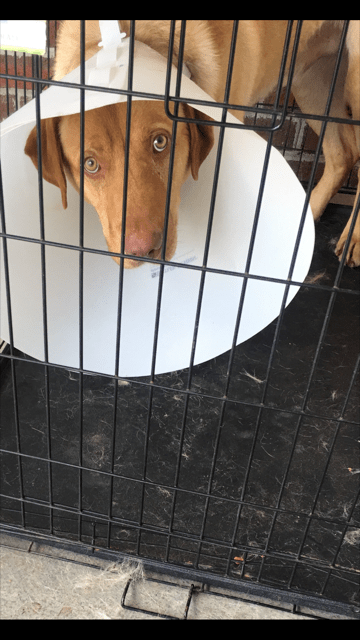
We did not know until we picked him up that he’d be wearing a cone to keep him from interfering with his surgery site until it healed – for seven days.

“There’s no way,” I said, watching Banjo writhing, twisting, and jumping, trying to rid himself of this horrid thing around his head. But after a few minutes, he sat still, with his head hanging down. Subjugated, submissive, maybe even dejected, Banjo seemed to be contemplating this new, unfortunate turn of events.

In the subsequent days, he simply made the necessary adjustments.

He learned that he had to put the entire cone opening over his food and water bowl to eat and drink. I laughed at the sight. He looked like something straight out of science fiction, a vacuum-headed suction creature from another planet. He ran through the backyard, as exuberant as ever, with his cone pointed toward the sky like a morning-glory flower. He wanted to play so badly that, despite the cone, he managed to drag a five-foot pine limb thicker than my arm to me in hopes that I’d throw it for him.

He still waited for me to rub his head when he went into his crate to sleep.

“I am so sorry about all of this, Banjo,” I said, working my hand through the bars and past the cone.

He shifted his head to help me reach him, leaned against my hand, and closed his eyes. So accepting and forgiving.

I rubbed him an extra-long time, tears stinging my own eyes.

My husband and I took the cone off after four days. We couldn’t stand it anymore.

Banjo is healed now, running unfettered again in the backyard each day of this glorious, sunny spring. He never fails to lift my spirits, this big, beautiful, messy boy. He reminds me that setbacks are temporary, that whatever pain and hardships come, there’s something good waiting just on the other side. Accept, make the necessary adjustments, carry on – cheerfully.

Just another of life’s lessons from an exuberant yellow dog that will hopefully be calmer now.

Regardless, here’s the truth about Banjo: He doesn’t belong to me. I belong to him.

Always.

Reflection: What are the necessary adjustments must you make in your own life, currently? Think acceptance, forgiveness, healing, moving beyond. What’s the something better that might be waiting on the other side of the struggle, the pain? Write your truths.