On Day 7 of National Poetry month, for VerseLove at Ethical ELA, Chris Goering invites teacher-poets to compose around song structures by borrowing syllables, meter, rhyme scheme, etc.
My youngest son came immediately to mind.
Before he was born, he would get very still when the piano was played in church; he would become active again when it stopped. I was sure he was listening to the music. At five he said he wanted to be a choir director when he grew up… he now has a degree in worship ministry.
Here’s a scene from long ago, about his first favorite song.
Amazing Grace, Age Three
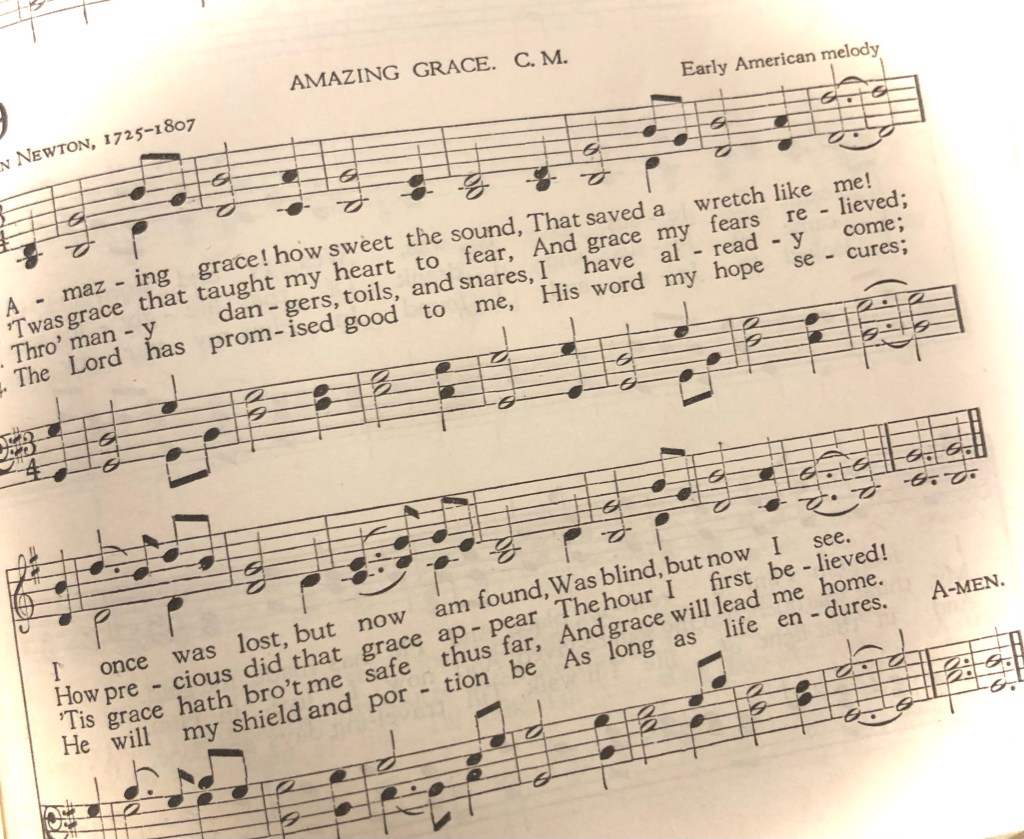
My boy hummed the song before he knew What it meant to weep for grace What could he know of a shattered soul In spite of his solemn face?
At the whiteboard he stood, making marks Counting every beat he heard: “Adders deedle-dee, adders, adders…” -For at three, grace needs no words
with thanks to Katie at #verselove on Ethical ELA yesterday. She inspired poets to look around the room for an object of great personal significance, followed by a brainstorming process for finding the object’s own voice and characteristics: “Now that you have stilled this object in order to distill it in a piece of art, it’s time to bring it to life. Listen to it, and once you are ready, consider: If it were a character…and say something back.”
when the harmonies rang and people sang songs by shape note
now more of a reliquary
with touch-memory of her hands on your beloved keys
they don’t forget
somewhere in that high-backed mahogany cracked prized-possession frame
amid your hammers and strings and octavian dreams
surely you must hold her dust alongside mine skin cells of the child I was
relics of bygone days side by side just as we used to be on your bench, of a summer night in pale lamplight
singing of the sweet by and by when we shall meet on that beautiful shore
in the meantime despite your need for tuning and your wonky key
her great-grandson stirs the slumbering chords again the dust the strings the house the blood in our veins pounding out the glory of the old, old story
blood does not forget
she’d be overjoyed with my boy
as you must surely be
as you whisper to me
in high-backed mahogany cracked corners where silence aches
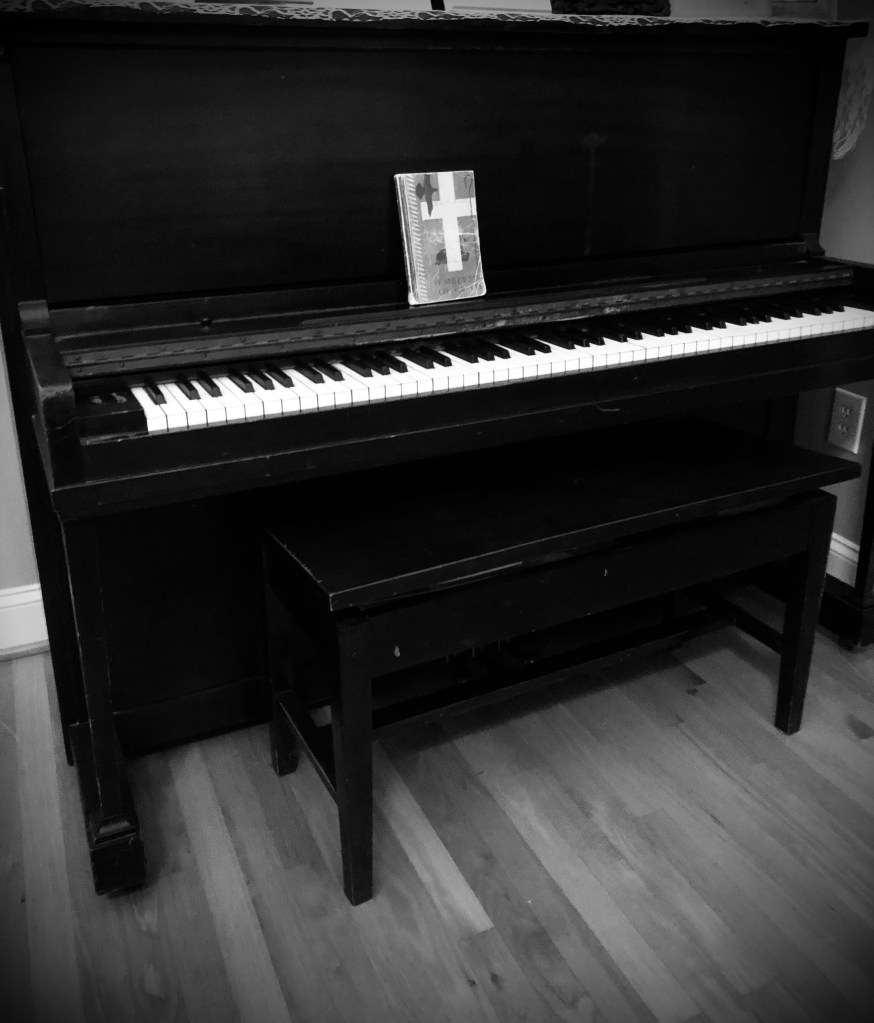
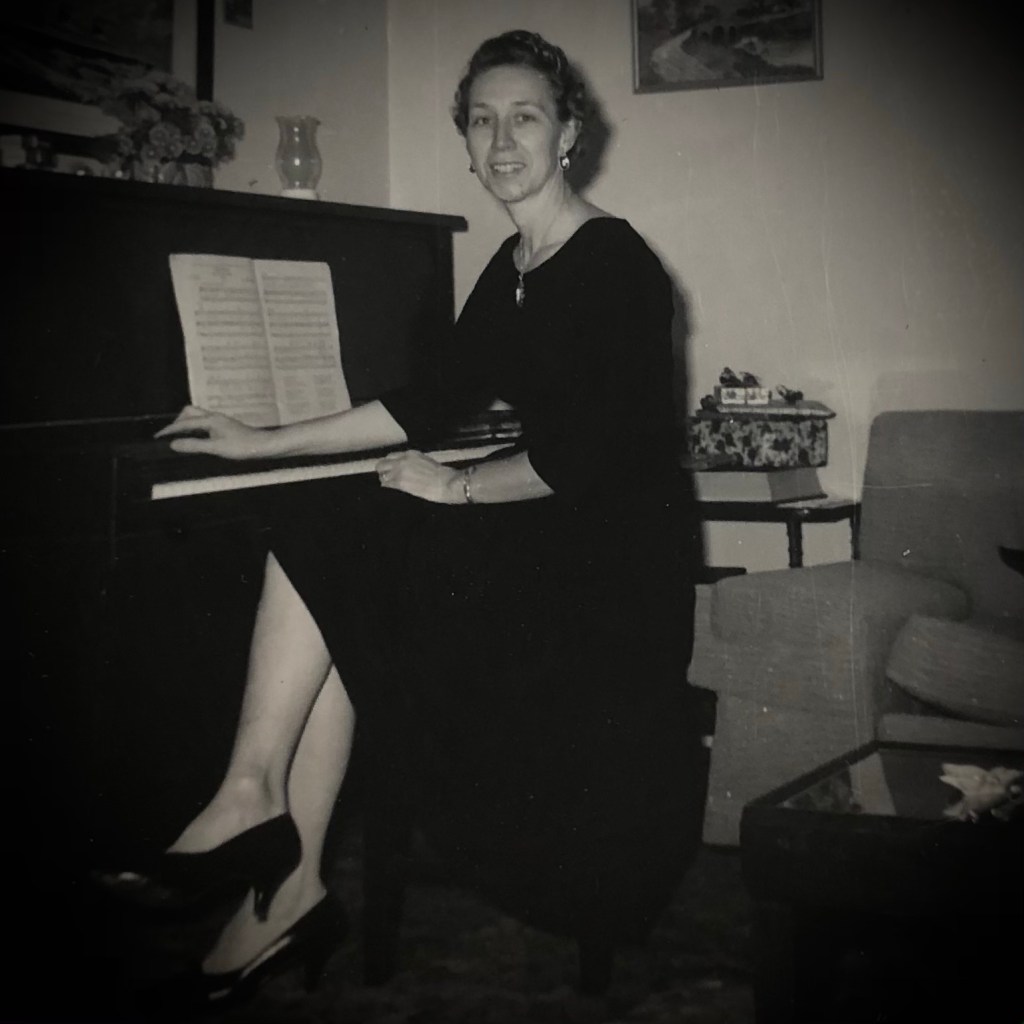
The piano dates to pre-WWII days, possibly the 1920s. My grandfather bought it secondhand for my grandmother. I spent many hours beside her on the bench as she played and sang alto to my soprano. In her last years she moved in with my aunt and finally the nursing home. She gave the piano to me: “It’s my most-prized possession, you know.” I never learned how to play but my my youngest son grew up loving old gospel songs. He’s a magnificent pianist who graduated from college with a music ministry degree; not a day passes that I don’t think of how elated she’d beto know this.
My boyish husband and I have come to eat with my parents. There’s a lot on my mind as I carry dishes from the kitchen to the dining room table. My father’s voice drifts from the adjoining living room, mingling with the Macy’s parade-babble on TV. He’s conversing with my husband, who’s planning to enter the ministry. Beyond the old lace drapes of the picture window where I sat so often as a child, the November day is like a sepia print. Browns of dead grass and leaves, oyster sky, skeletal trees bathed in pale, unassuming sunlight.
Then…another voice.
Singing.
Coming from the television.
I turn to face it, spellbound. I cannot move. I stand stone-still, between portals, as everything else fades away…there’s only that voice. Almost too pure to bear. It wrenches something inside of me, twists and pierces so that tears spring to my eyes… a man singing “God on high, hear my prayer, in my need, you have always been there…”
He sings of protection for a young man in troubled times, afraid, resting nearby. Of summers dying, one by one. He is willing to die for the young man— “he is only a boy”— if God will let him live and “bring him home.”
I stand, tears flowing, aching to the core of my soul, not wanting it to stop, knowing that I am somehow irrevocably changed.
******
The singer was Colm Wilkinson, portraying Jean Valjean from the Broadway musical Les Misérables. The song “Bring Him Home” is a prayer for young Marius, who’s fallen in love with Valjean’s adopted daughter, Cosette. Valjean watches over the sleeping Marius at a barricade during the June Rebellion, or the 1830 Paris Uprising. Broad view: On top of harsh economic times, crop failures, and food shortages, a cholera epidemic killed over 100,000 across France. The poor, especially in the city of Paris, were devastated; they blamed the government and retaliated.
I learned much later that the song was especially written for Wilkinson’s tenor voice—a profound marriage of artistry. And revision. Lyricist Herbert Kretzmer struggled with the English translation. He completed it seventeen days before the show opened. Upon hearing its first rehearsal, the cast was blown away. One member, playing the Bishop, said:“You told us at the beginning that you couldn’t keep God out of the show. But you didn’t say you’d booked God to sing this song.”
My husband eventually took me to see (to hear?) Les Misérables on Broadway. My awe has never diminished; so many songs are hauntingly beautiful, meant to pull on the soul with deep themes of loss, love, faith, sacrifice, death…and, above all, redemption.
I’ve been thinking of Thanksgiving in the time of COVID, how life and gatherings— and parades—are changed in ways we couldn’t have imagined. We are not allowed to sing at school, for fear of spreading the virus.
But some things never change. We never really know what is to come in a day, a week, a year…or the next moment.
Like Valjean, I grow older, with my heart turned toward the next generation in prayer for preservation. For their peace and joy. My own boys, now grown… the firstborn followed his father into the pastorate. The youngest is a worship leader. A musician and singer. Yes, how soon the summers fly, on and on…the boys weren’t even born yet on that long-ago Thanksgiving when I stood before the TV screen in my childhood home, transfixed by a cloaked Irish tenor in the streets of New York City, as snow began to fly…
God on high, hear my prayer In my need, you have always been there…
It remains my Thanksgiving song, every day.
Always.
God on high, hear my prayer In my need, you have always been there He is young, he’s afraid Let him rest, heaven-blessed Bring him home Bring him home Bring him home He’s like the son I might have known If God had granted me a son The summers die, one by one How soon they fly, on and on And I am old and will be gone Bring him peace, bring him joy He is young, he is only a boy You can take, you can give Let him be, let him live If I die, let me die Let him live Bring him home Bring him home Bring him home
The road is long With many a winding turn That leads us to who knows where Who knows where …
—”He Ain’t Heavy, He’s My Brother,” B. Scott/B. Russell
Dear Son,
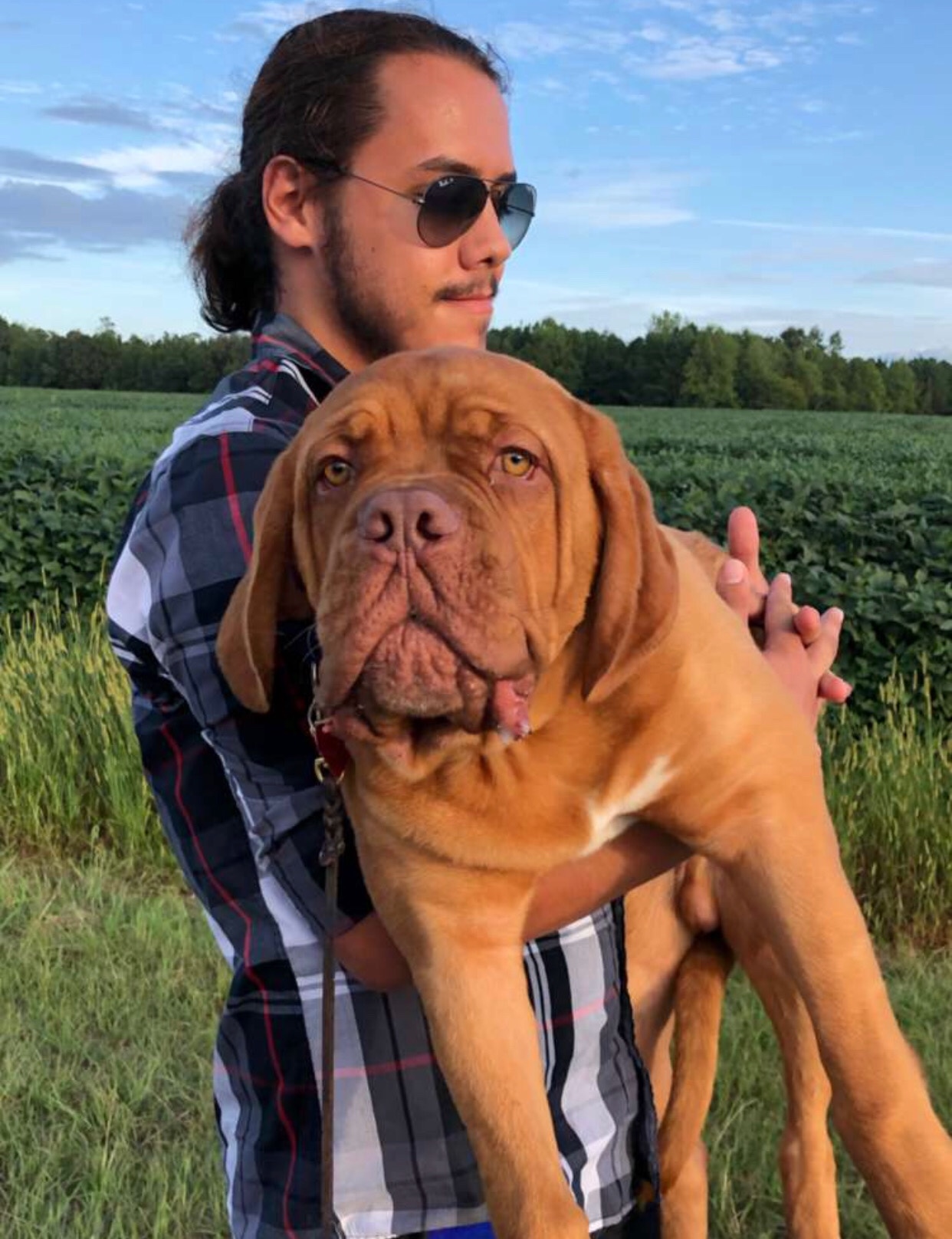
I think this may be my favorite picture of you. For several reasons. I like to see you in such a peaceful setting, walking that country path beside lush green fields, under the blue summer sky. You were walking with a friend, so you weren’t alone. You told me that her puppy followed you—I still can’t believe that’s just a puppy; he’s massive!—and he got tired, so you picked him up and carried him the rest of the way.
That is why I love the photo so much. It captures the essence of who you are.
Quietly bearing your burdens, no matter how heavy. There have been many in these past few years. Ever how burdened you were, ever how twisted and dark the pathbecame, you kept on walking.
No one knows better than I what a long, long road it’s been, from the day you started college to now. Graduation being canceled, just when the end is in sight, feels like a coup de grâce.
It all started off on such a high note, didn’t it? Getting that phone call two weeks after you finished high school, a church looking for a music director. Your childhood dream. I still have your kindergarten “All About Me” book with the prompt ‘When I grow up, I want to be’ … where you drew yourself as a choir director in crayon.You attained it at seventeen, before your formal training even began.
That summer was glorious and brief.
That fall you started college and almost instantly the shadows came.
Your father‘s diagnosis of ocular melanoma, the loss of his eye, the weeks waiting for pathology to reveal no cancer cells had spread.Despite your new job and your courseload, you stepped up to help him readjust.
On the heels of his healing came Ma-Ma’s stroke, the beginning of her slow decline over the rest of that year. She knew how much you loved her. She treasured every minute with you; she savored every long phone call you made from the time you were little. She couldn’t keep from crying whenever you played the piano and sang—remember how she organized for you to come play at her nursing home, near the last?I will never forget her wet, shining face. She was inordinately proud of you. She loved you fiercely.
How grateful I am that you and your dad were there, holding her hands, when she died.
And so you bore her loss on top of an unexpected one.
I know you’re marking the date. Three years ago today, the accident that took your friend. Your little childhood playmate who sang with you in preschool choir, your high school band mate, the organizer of the Sunday-nights-at-Bojangles gatherings. As I write, I hear her pure, high voice echoing in the church to your harmony and piano accompaniment. Her going left all of us reeling—a swift, severe, deep cut to the heart, a knotty scar we’ll bear forever. And yet you play on. You still sing. You stand by her family in their remembrances, your presence the only comfort that’s in your power to give. She would be graduating, too, this spring … but no one is graduating this spring …
It’s one of the hardest things in life, losing people, and not only to death. People will come and go because they choose to, no matter how much we wish they’d stay. You endured this, too, with uncommon grace, never lashing out, just walking on with your invisible pain. I knew it was there. I could feel the weight of it.
Seems we were due a respite, and if there was one, it was those few weeks of vacation last summer before your dad’s heart attack. You and I had just come home from walking when the officer arrived in the driveway to say your dad’s truck had run off the road and hit a tree, it might have been a medical event, maybe a seizure, no, he wasn’t sure what condition your father was in, EMS was working on him when he left, and did we have a way to get to the hospital? With your big brother too distraught to drive, you did it. Calmly, carefully, you drove us to the emergency room where the nurse met us at the door. You were beside me when she ushered us to the little room where the doctor met us to say your father had been resuscitated and was being prepped for heart surgery.
You were there with me that first night of sleeping on the waiting room chairs, not knowing what tomorrow would bring. You were there with me throughout that long week of his hospitalization, until your dad came home, battered, bruised, trying to recover his memory. You got his prescriptions so that I wouldn’t have to leave him … and when I took him back to the ER with chest pains a couple of weeks later, you met us there. Another hospital stay. Another heart surgery. Two more weeks of sleeping in the hospital. Do you remember the surreality of it all? How we felt like it would never end, like we were caught in the web of the wrong story, a movie with a terrible plot twist we didn’t see coming? How could this be?
Somehow you managed to keep your studies up, only leaving for your classes and your church services, making the music and leading the worship for others.
So here we are, at last. Your dad, recovered and restored … able to drive me back and forth to work with my broken foot … until this tiny pathogen bent on world domination closed the schools. Here you are, completing your final weeks of college online, being denied the walk to receive the reward of all your labors …it is unthinkable.
I think about the whole of your young adult life. How your road has been so long, with many a winding turn, through many a dark shadow. I watched how you went around, through, or over every obstacle on this arduous journey. You’ve endured what might have caused others to quit college, others who might have actually enjoyed their studies; I know you never loved the “game” of school and that for you it’s been a test of endurance, in itself. But the end is in sight—despite a pandemic. A plague. Who’d have ever believed, in our time …
You have come this far, bearing every heavy load. You’ve carried on. Often you, the baby of the family, carried the rest of us. You’ve fought internal battles for your own wellness more than anyone else knows; in this spiritual war, you’ve earned a Medal of Honor for exceptional valor. I know it and God knows it, Son. I stand in awe of your heart, full of love and mercy, so self-sacrificial, so willing to lighten others’ burdens as your own grew heavier. Like carrying a giant puppy during a long walk on a hot summer’s day, because it got tired.
That is why I love this picture. It is your story.
There are no words for how much I love you.
Keep walking, Son. Carry on.You are strong.
I am stronger because of you. Soon my foot will be well enough to walk with you again.
When we come through this present ominous shadow, college will be over, we’ll find ourselves in a whole new chapter in our lives, and we’ll celebrate all of it. Just a little farther along … I know that in your quiet way, you’ve already made your peace with it. I can almost hear you singing:
Here comes the sun, here comes the sun And I say it’s all right...
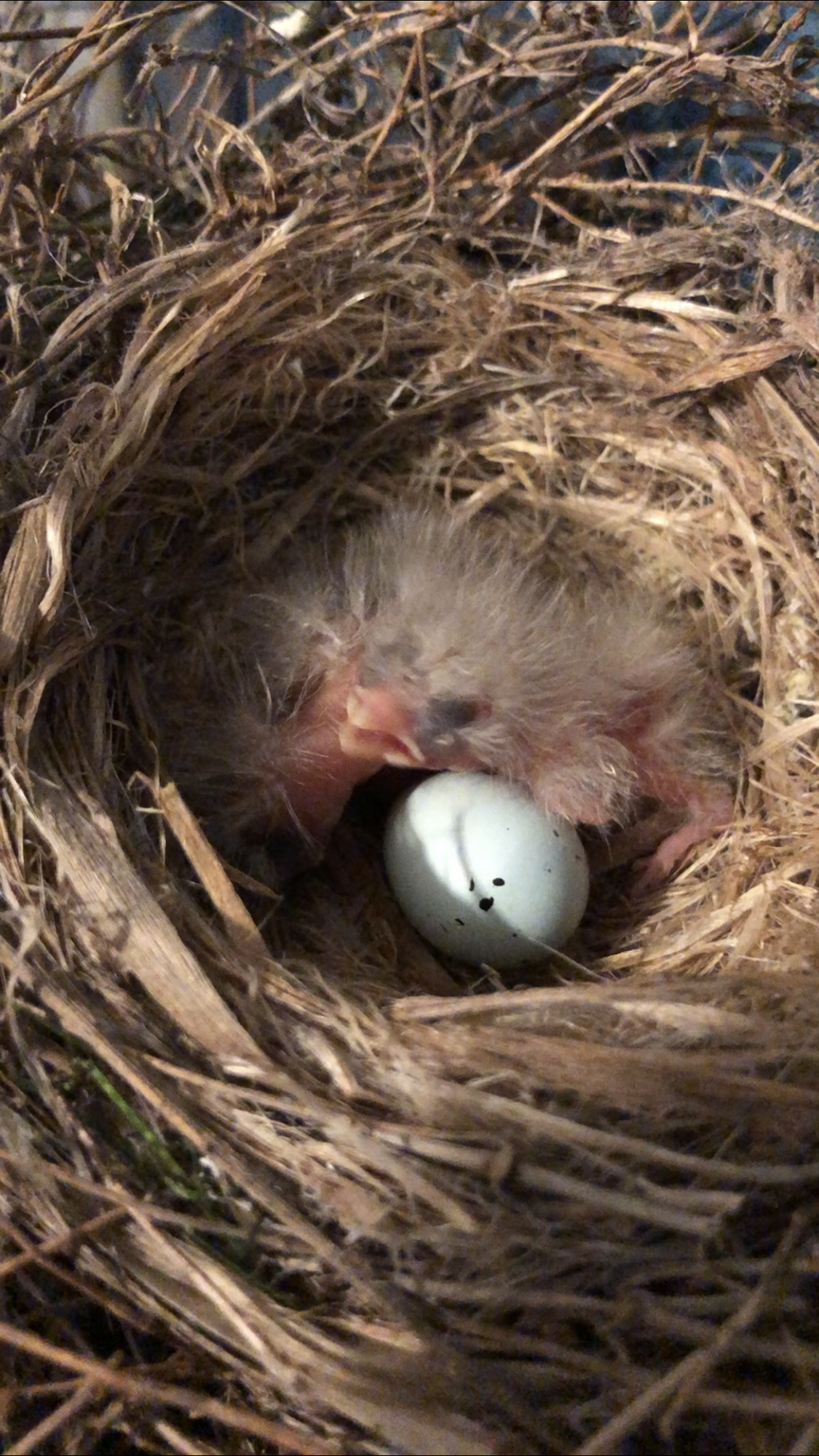
I was expecting to find a hatched baby finch on Sunday.
Instead, I found two!
—I think.
I can really only tell it’s two because one egg of three is still there. Although I can kind of discern two different necks, one baby lying over the other.
I knew the eggs were due to hatch around Sunday, and all last week I wondered what the mother bird was experiencing. To begin with, she built—rebuilt, actually—her nest on top of the wreath on my front door, which means that any time we walk down the hallway or open any other doors in the house, she feels those vibrations. Is that a good thing, somehow? Is that a reason why finches like to build so close to humans, to feel those larger rhythms of life, perhaps trusting them to be benevolent and protective forces?
And I wondered—being a mom—if she could feel stirrings inside the eggs beneath her as she diligently kept them warm on these still-frosty nights and mornings. Eggshells are only so thick . . . Can she feel those tiny hearts beating under her, long before her chicks begin pecking their way out into the world?
So many good vibrations . . . .
Reminds me of the story behind the famous song. When he was young, Brian Wilson’s mother told him that dogs will bark at people who give off “bad vibrations.”
Inspired, Brian eventually composed the Beach Boys iconic masterpiece Good Vibrations.
Which leads me back to the naming of these three babies (in a previous post: Tiny trio). Finches are singers, and my son is a Beach Boys aficionado, so . . . .
Ladies and Gentlemen, please welcome Brian and Dennis (the latter of which was apparently revved up and decided to hatch early—how fitting).
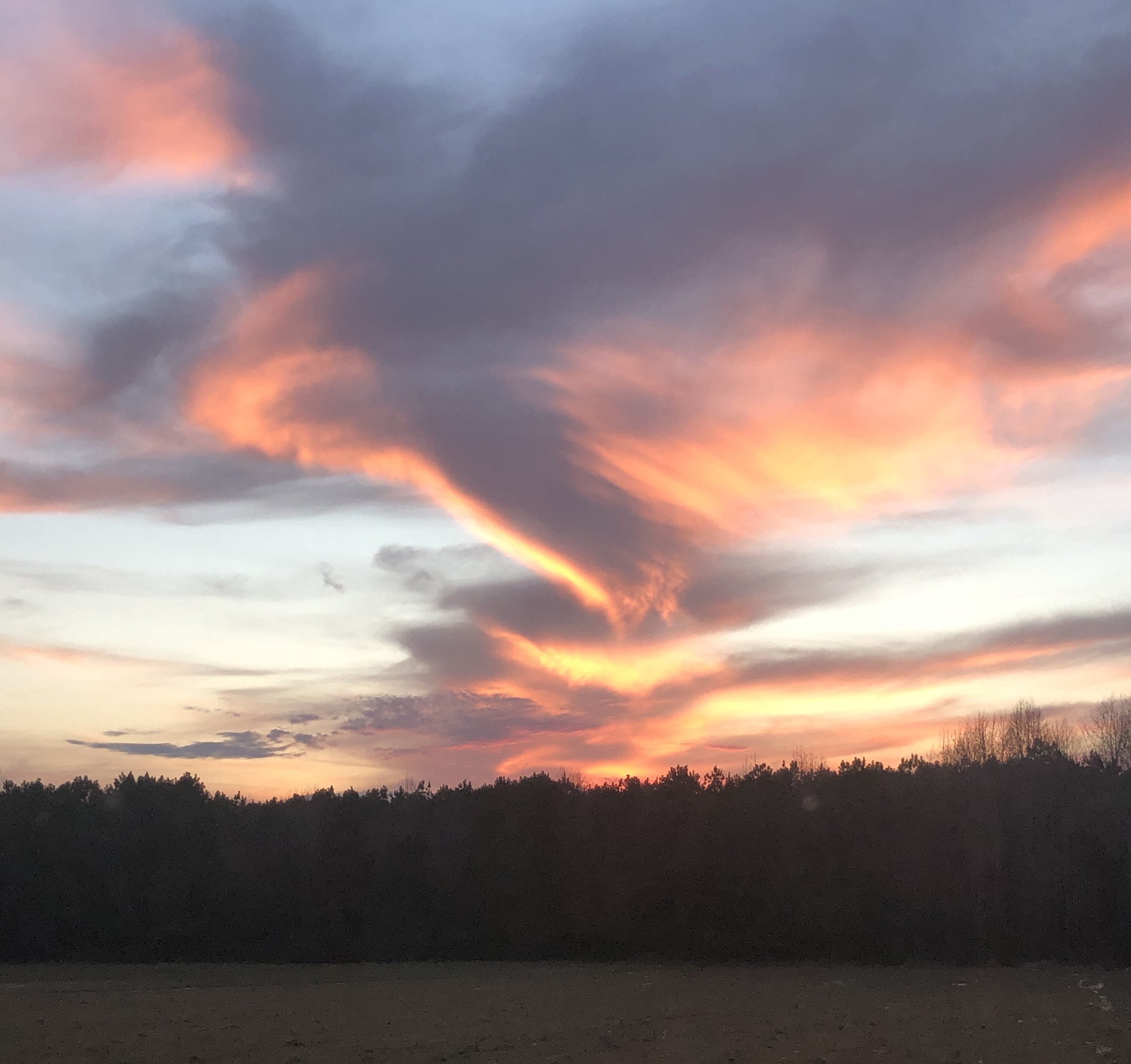
Spring arrives amid a flurry of wings, bird voices rising with the morning sun, daylight hours stretching perceptibly longer, the first warm breath of promise to come.
On such a day, two years ago, my youngest son’s lifelong friend died in an accident.
She was eighteen.
She was one of the prettiest children I’ve ever seen. Big, brown, doe-like eyes in a round cherub face. Musical, like my son. They grew up in children’s choirs at church, were in band together throughout high school. She played the flute. My son occasionally accompanied her and their other childhood friend on the piano during worship services. All three of them sang:
I’ve had many tears and sorrows
I’ve had questions for tomorrow
There’ve been times I didn’t know right from wrong
But in every situation
God gave blessed consolation
That my trials come to only make me strong.
Through it all,
Through it all . . .
Their voices blended beautifully. Hers was high, clear, pure, almost ethereal.
I wrote to her, told her so. Said that she needed to sing more often.
Perhaps that note was in her things, still, when her mother began going through them after her death. I do not know.
But an essay she’d written in high school was there.
Its title: My Favorite Childhood Memory.
Her mother copied it, sent it to my son and their other friend—for she wrote of them.
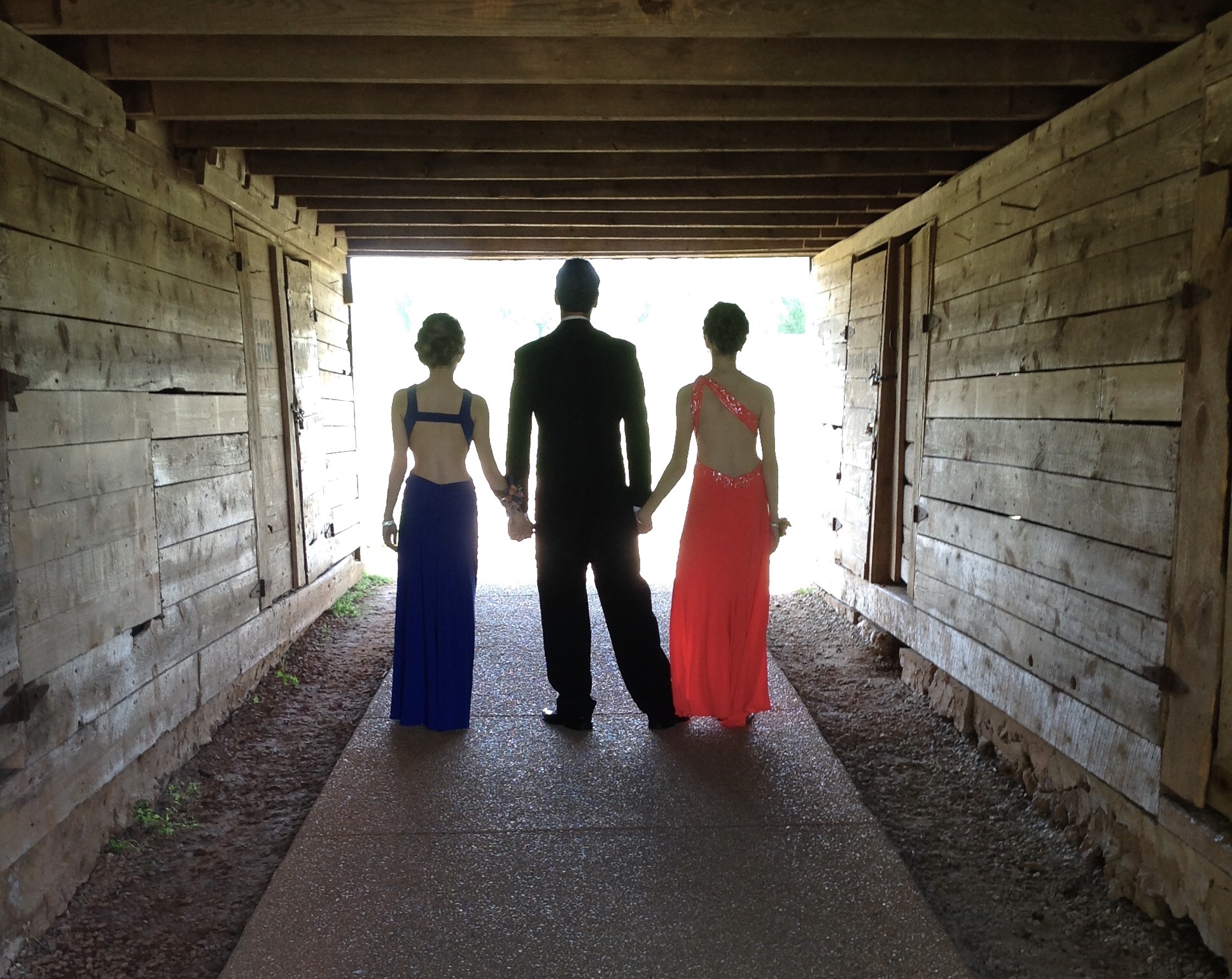
I wondered, when I first learned of this essay, what the memory was. Maybe a birthday celebration, as they were all born in August of three successive years. Maybe working Vacation Bible School or Bible Sports Camp together as youth. Maybe it was the time they went shopping and bought two betta fish that my son named after gospel bass singers, or one of the summer beach trips they took, growing up. The three of them even went to the prom together, once.
My son let me read her essay.
She wrote of Sunday nights when the three of them would go with her family to BoJangles for supper, how they told hysterically funny stories, how she laughed and laughed. She said these were the best times of her childhood, that she would always remember them . . . .
She is gone. Her words, her love for her friends, remain:
You were my favorite childhood memory.
It seems almost like a thank-you letter, now.
My son says once in a while, when he’s out walking laps around the church, exercising his body, easing his mind and his soul—he can hear her singing.
It’s two years today, a Sunday. Tonight her family and friends will gather at BoJangles in her memory.





 lit bits and pieces