Found story-poem

On Ethical ELA this week, host Dave Wooley invited VerseLove participants to compose blackout poems: “Find a piece of writing that you want to use as a source, grab a black sharpie and start redacting. The words that are left will be your poem.”

Basically, a blackout is a found poem, with chosen words and phrases remaining in original order. Examples can be found here: How-To Blackout Poetry.

Great! I thought. This will be easy.

It was not.

The problem: First thing that came to mind was a new poem that completely awes me…

Amy Nemecek, The Language of the Birds, 2022.

I started blacking out lines and stopped, because a thing happened.

I just couldn’t reduce this stunning poem. It felt like…desecration.

Instead, I lifted a few words out that especially sang to me. They brought with them their own images, forming something new and other.

Thus was my “found-story haiku” born (not sure if that’s even a thing… I guess it is now):

History of Ideas

from firelight, a spark
illumination flaring
then dying in dust

from the river, song
improvisational joy
free and beckoning

from the silhouette
of trees against starlit sky
infinite longing

from the heart crying
against its impermanence
a reliquary

from calloused fingers
a hieroglyph on a wall
before papyrus

from the weightless bones
a shell of structure is formed
the embryo stirs

out of the static
spark, song, longing are harnessed
the fragile thing lives

For the record: I finished blacking to reveal the words I pulled, although this in itself is not a blackout poem.

It is my seed-bed of ideas.

Science poem: Existential Dance

For Monday’s VerseLove on Ethical ELA, host Brittany Saulnier extended this invitation: “Today, write a poem inspired by science and perhaps, whimsy…The challenge is to ensure the reader can simultaneously glimpse the scientific concept you were inspired by and a universal truth.”

As always, my thoughts turn to nature. It is always teaching; are we heeding its lessons? Nature’s messages don’t come on words but from its own rhythms and coding. I write much of birds. It is said that they are they last living dinosaurs. Maybe even now they are the impetus, in their always-inspirational way, for my digging deep to see what I might find…

Existential Dance

sea and earth
earth and sea
complicated
choreography

streams of movement
building higher
freeform deposits
wetter, drier

life rising, falling
layer on layer
it’s all timing, timing,
the dragon-slayer

everything alive
to remain, must eat
until nothing remains
but remains under feet 

strata with volumes 
lined on a shelf
stories kept secret
unto itself

sea and earth
earth and sea
consolidated
choreography

streams of movement
releasing the store
freeform deposits
washing ashore

when miners come
millennia later
scratching their heads
no translator

for what they’re seeing
drawn from the earth
looking for phosphate
to be stunned by girth

of ancient teeth
from a creature long gone
scientific name:

Megalodon

(meaning “big tooth”)
—what great irony
this turns out to be
last laugh of earth and sea

monster-shark teeth
unearthed in a way
with a side effect:
workers’ tooth decay

everything alive
to remain, must eat
until nothing remains
but remnants…of teeth

sea and earth
earth and sea
conspiratorial
choreography

Carcharocles Megalodon Tooth. 5.4 inches long, 4.4 inches wide.
Excavated from Lee Creek Mine, Aurora, North Carolina, USA.
Public domain.

My grandparents lived on the outskirts of tiny Aurora, North Carolina, home to the largest phosphate mining and chemical plant in the world (miningtechnology.com archive). In the 1970s, prior to the establishment of the Aurora Fossil Museum, “rejects” or unwanted gravel material from mines were scattered on the many dirt roads around the area. As a child I walked in these rejects along the old dirt road by my grandparents’ home, finding bits of coral skeleton, shark’s teeth, possibly some Megalodon teeth, and fossilized eardrums and vertebrae of log-extinct creatures. Now visitors can dig through this material in the fossil pits at the Museum, which will host its annual Fossil Festival May 26-29.

The April 2023 edition of Our State Magazine contains an article by Katie Schanze about Aurora and its fossils: the area “produces the most prolific fossil record of Miocene (2.3 million to 5.3 million years ago) and Pliocene (5.3 million to 2.6 million years ago) marine life on the Atlantic coast.”

It was by chance that I stumbled across references elsewhere stating that one of the detrimental effects of phosphate mining is tooth decay from prolonged exposure to fumes of chemicals used in the process. What irony, I thought, tooth decay caused by mining something used as fertilizer to grow food, while simultaneously finding preserved teeth of one of the mightiest sea predators ever to have lived…which likely went extinct due to loss of food.

*******

with thanks to Brittany Saulnier for the poetic inspiration on Ethical ELA
and to Two Writing Teachers for the Tuesday Slice of Life Story Challenge
and Our State: Celebrating North Carolina, Vol. 90, No. 11

For my finch followers: returning thanks

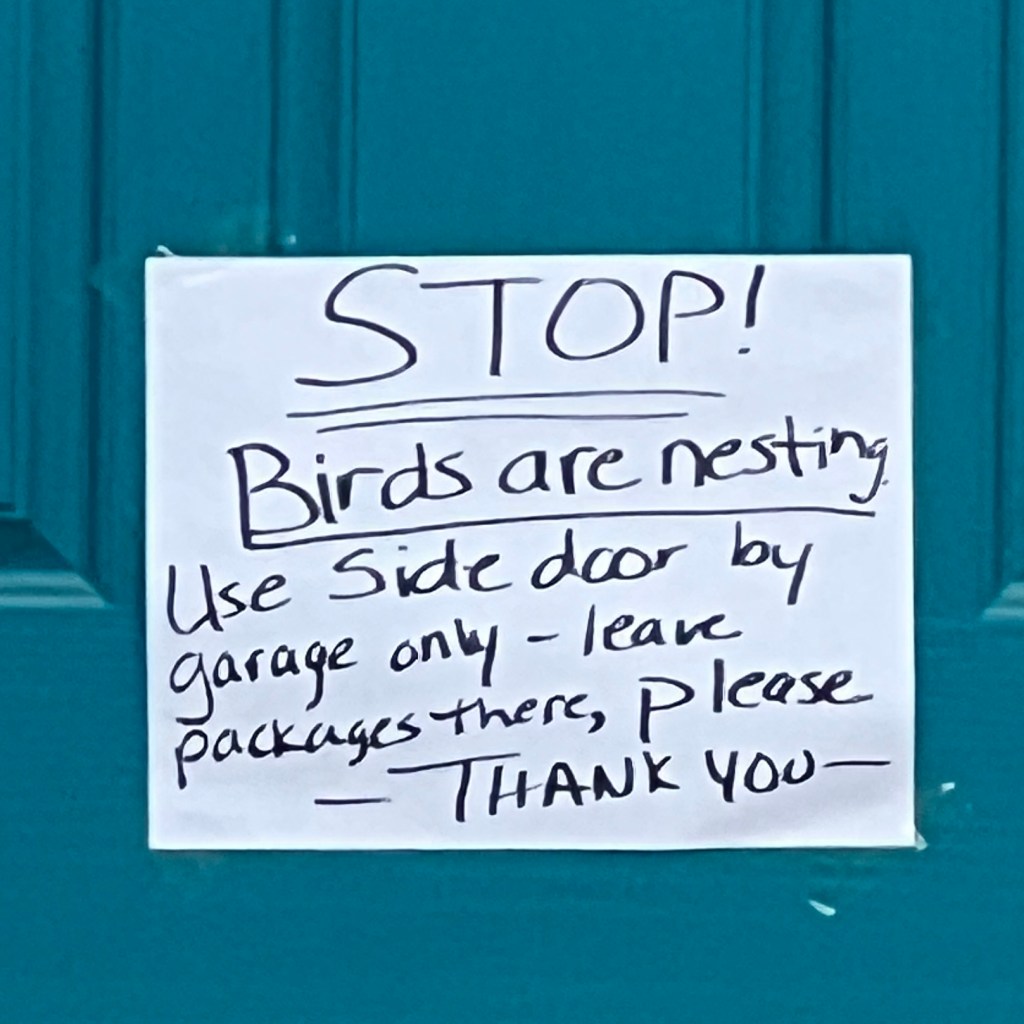
Dear Delivery People:

Thank you
for respecting
my taped-up signs
that say stay away 
from the front porch
it’s a bird sanctuary again
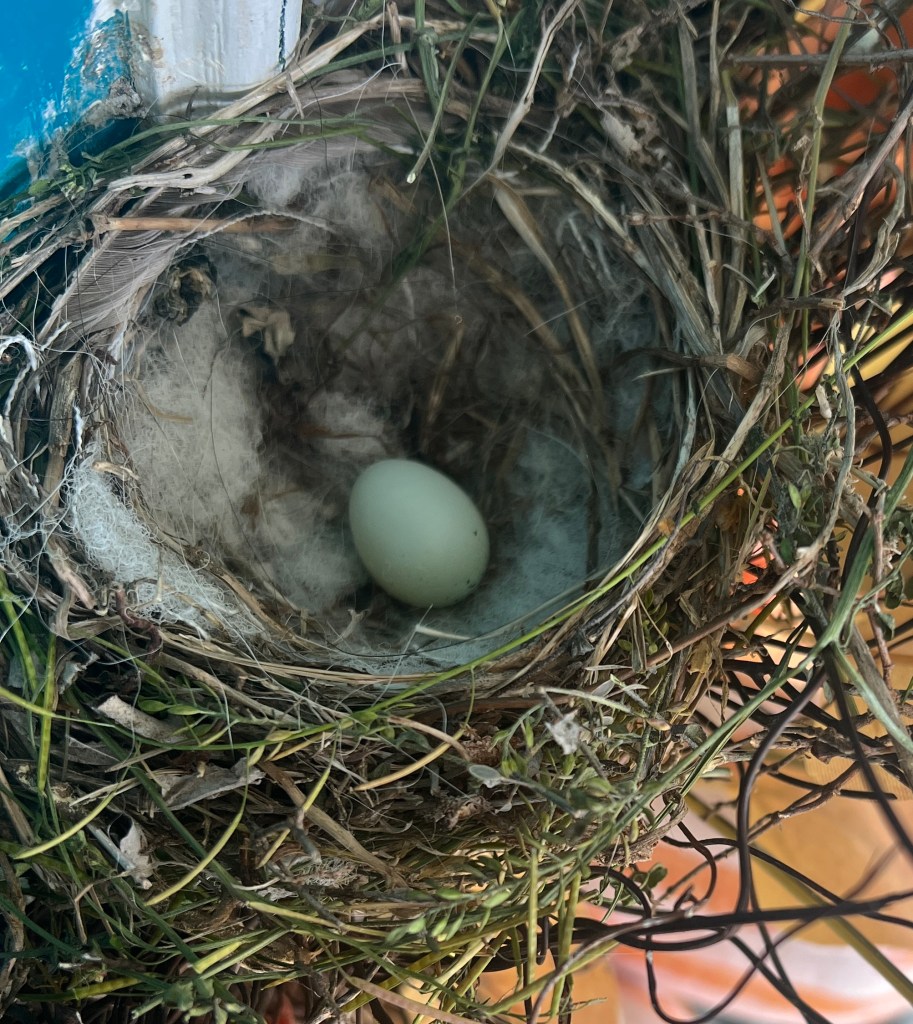
the house finches nested early
on the door wreath I left for them
Mama laid four tiny eggs in blue cold
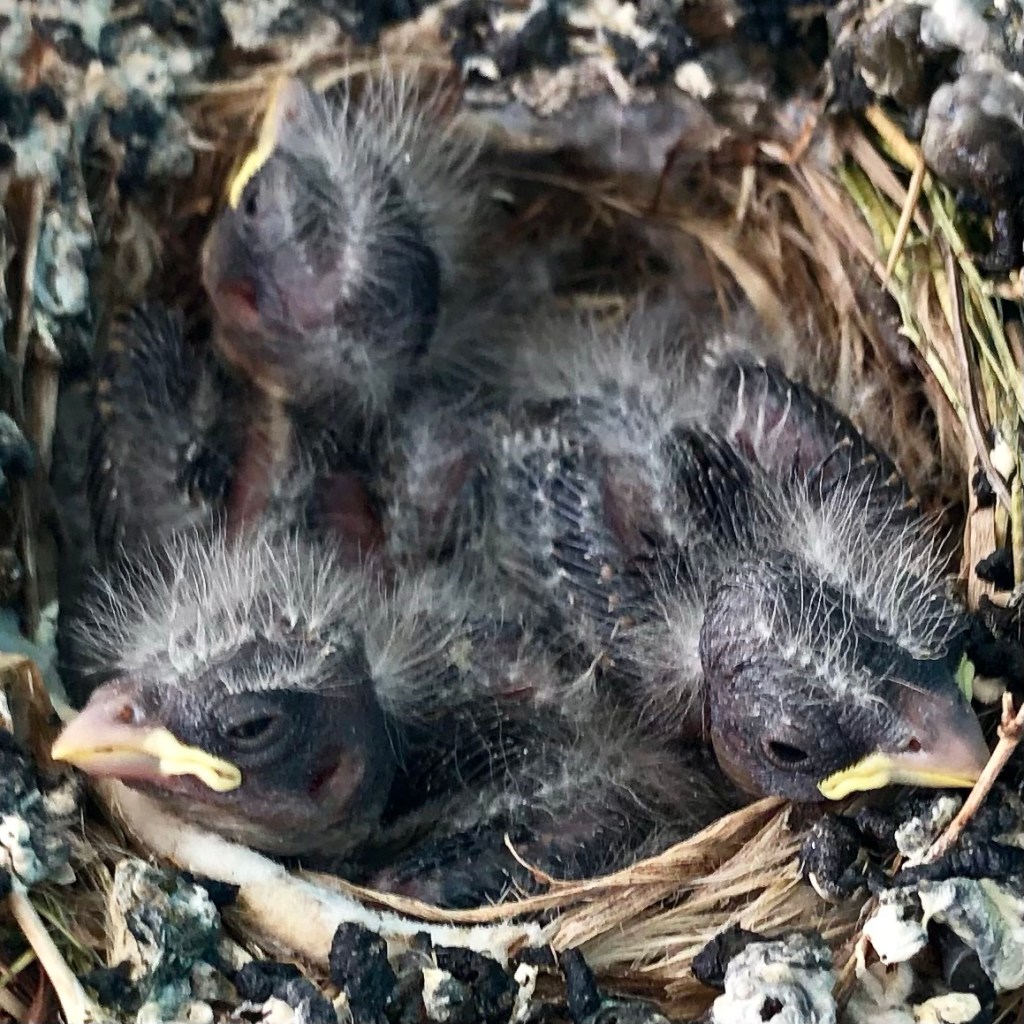
mohawked nestlings hatched in a snowfall
by mid-March I thought the fledglings
had all flown, for there was no more
happy chatter-song at the door 
and when I checked I found
two perfectly beautiful
fledglings dead
in the nest

how 
why
what
happened
here

I placed them together 
in a deep pile of dry leaves 
at wood’s edge because birds
do not bury their dead
they are creatures
of the air

I tore down
the death-nest
and my taped-up signs

and read online
that birds grieve
the death of
their young

the next day
blades of green grass
appeared on the wreath
where the nest had been

the day after that, more
grass and flowered strands

scientists say that only
the mother finch builds
the nest but I am here
to tell you that the father
worked just as hard

in tandem they flew
with string and fluff
in their beaks
chattering their
architectural plans

in five days,
recreating 
what was lost

and now
in the most
exquisitely-lined nest
I’ve ever seen

there are new blue eggs

exactly
two

so thank you,
Delivery People
for reading my
freshly-taped signs

this
is a sacred
little space
where miracles
of nature
take place

*******
with thanks to b.c. randall for today’s VerseLove invitation on Ethical ELA:

“Write today’s  poem for someone else: the boy who bags your groceries, the neighbor who walks by your front window every day, that colleague or friend who has been on your mind. Craft the poem  to be left for another to unwrap (a gift that we all need).”

For my finch followers: New beginning

The nest is finished
for new life to begin there
this bright Sunday morn

*******

Backstory/timeline:

March 1: Auspices – discovery of an unusually early nest and eggs laid in February (with photo)

March 5: Eavesdropping – audio of the parent finches’ joyous chatter

March 14: Nestlings – likely hatched during a snowfall (with photo)

March 27: Finch elegy – sad discovery

March 28: Finch fortitude – beginning anew, so quickly (with video of the parents)

March 29: Blessing – the gift of carrying on (with photo)

March 31: For my finch followers – Day 4 of nest rebuilding, softly and tenderly (with photo)

Haibun poem: Breath

On the first day of National Poetry Month, Glenda Funk kicks off VerseLove at Ethical ELA with haibun poetry writing:

“Haibun originated in Japan and combines prose and haiku. Haibun can feature many genre forms, including narrative, biography, diary, essay, prose poem, travel journal, etc. The prose section comes first and is followed by the haiku, which an article on Poets.org describes as ‘a whispery and insightful postscript’

Compose a poem juxtaposing ideas about rest with the haibun form…I’ve noticed the economy of words in the haibun and believe this is achieved by omitting as many being verbs (and dare I say adjectives) as possible.”

I have never written haibun before.

I do not know why the image of the child struggling to breathe in the night came to mind, but she did.

More on that after the verse…

Breath

Night takes the stage like a magician bent on harm, draping the child in her bed with a velvet cape intended to suffocate. Ghost-hands press theme music from her lungs, just pipes and whistles, an accordion straining, straining to get enough air in and out. Carnival music distortion, chorusing with the machine at the bedside rattling and spewing steam. It doesn’t help. The child craves release. Air. Sleep. PleasePlease…she wriggles against the ghost-hands, piling her pillows, drawing her knees to her chest underneath her, not knowing this is how she slept as a baby. Not knowing she’s a victim of in-betweenness, planted in a time before widespread use of inhalers and eras beyond physicians prescribing the remedy (for adults, anyway) of smoking jimsonweed. Nightshade. The magician’s sleight of hand, again. In the fog-filled room, moisture trickling down the walls, she’s akin to the bald cypress in the bog, relying on knees to —stabilize? —to breathe? She does not know that even trees rest at night (measure the droop of their branches; see it restored at morning). Like trees repatriating nutrients before winter, turning their fragile leaves loose, she knows she has one hope for staving off ruination. Her knees. In this pocket, the ghost-hands lose their grip; the magician is undone. The velvet cape slips away. 

Sleep repairs the brain
but there would be no breathing
at all, without trees

#Repost @_sunkissed_gal_ ・・・
The trees are our lungs, the rivers our circulation, the air our breath, and the earth our body. — Deepak Chopra.
Sterling College. CC BY 2.0.

—I was the child, suffering with asthma.

A poem of body and song

On the last day of National Poetry Month, Sarah J. Donovan, creator of Ethical ELA, invites teacher-poets to celebrate thirty days of writing for VerseLove. In studying a collection of poems dealing with struggle and celebration about what we are told and believe about ourselves, Sarah says: “I thought a lot about how our bodies hold and shape so much of who we are.” Today we write to own that we are writers and poets, considering figurative body language, other voices that have influenced us, and our own song.

For me, writing calls from sacred places, inherently requiring, as an act of creation, sacred spaces.

As such, writing, poetry in particular, takes on a life of its own. It starts as one thing and becomes another. This may be more than one poem. I am just letting it be.

Polyhymnia at the Core

And there was I as smooth and soft as a peeled switch and smaller than I had been.
—C.S. Lewis, “How the Adventure Ended,” The Voyage of the Dawn Treader
 
The ghost
of my father
and grandfather
are here 
in the shape
of my face
something of them
about my cheekbones
my mouth
a certain turning

My grandmother
is in my bones
those are her arms
in the mirror
fixing my hair

no denying
my mother’s eyes

the Spirit sighs

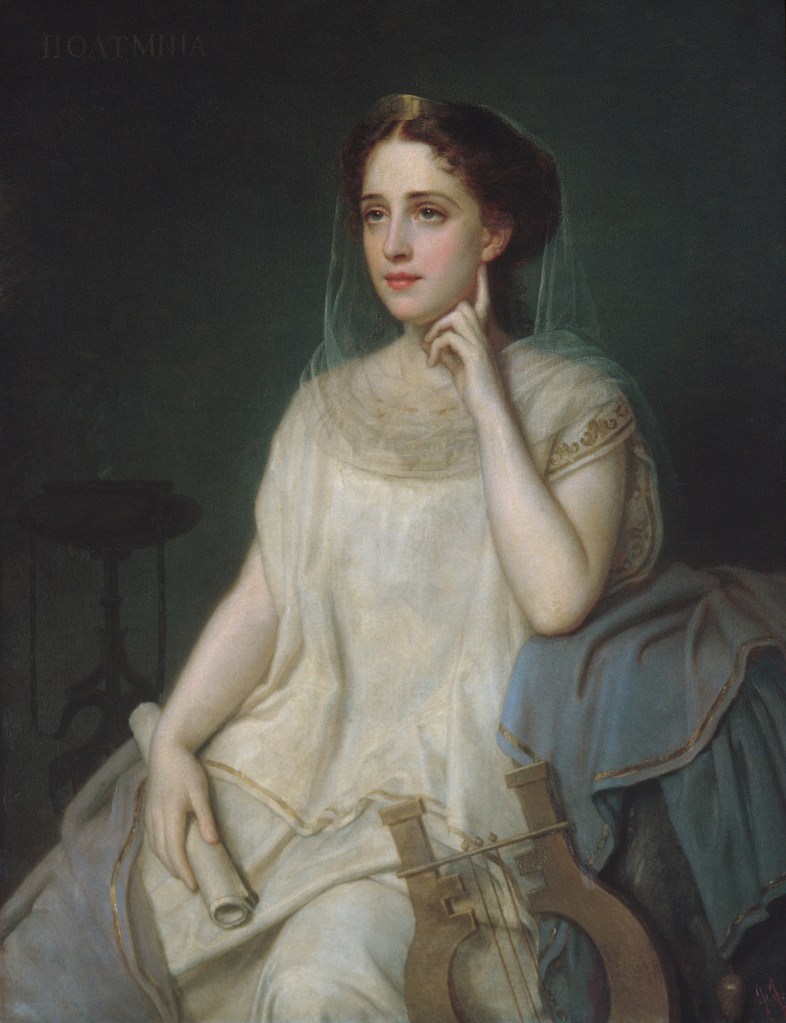
I imagine Polyhymnia
nearby
(if I can choose
my Muse)
in long cloak and veil
finger to her lips
bright eyes glimmering
silken rustlings
as she leans
whispering, 
always whispering

it is with great love
that she raises
the lion’s claw
piercing every knobby layer
of my being
peeling away
until all that remains
at my tender core
is wordless song
singing there
all along

you are alive
alive alive alive
in the listening
in the remembering
in the faces
in the sacred spaces
where you have been brought
to learn
the unforced rhythms
of grace

now find your words
and be

Polyhymnia. Joseph Fagnani, 1869.

Polyhymnia’s name means “many praises.” She is the Muse of sacred poetry, hymns, and meditation.

The lion’s claw in my poem is an allusion to the referenced chapter in The Voyage of the Dawn Treader, where Aslan peels away the enchanted dragon skin from Eustace, restoring him to his true—and transformed—self.

“Learn the unforced rhythms of grace” is from the paraphrase of Matthew 11:28-30 in The Message.

What a poem can/cannot do poem

On Ethical ELA today Glenda Funk takes inspiration from what can a poem do? by Darius V. Daughtry. Her invitation to teacher-poets: “Compose a poem in which you celebrate what a poem can do and imagine the possibilities for more poetry specific to an issue or concern.”

In the Non-Rhyming Scheme of Things

A poem cannot
erase the past or
bring back people I’ve loved
            and lost
A poem cannot 
still the storm or
turn back tides
            of war
A poem cannot 
repair the whole world or
remake the human heart
            but it’s a start

When I’m by myself poem

Today on Ethical ELA Jessica Wiley invites teacher-poets to compose in a form invented by her ten-year-old daughter, entitled “By Myself.” The challenge: Keep the first and last stanzas from the model and write eight rhyming lines in the middle, beginning with “I am.”

As I began to write this morning, quite by myself (so I thought), I heard a sound outside… I had to stop, open my back door, and listen. Naturally it had to become part of the poem, as it’s part of me, now…

Lines Composed Before a Late-April Dawn as Birds Begin Singing and a Barred Owl Is Calling

When I’m by myself
And I close my eyes

I’m flickering candleglow
I’m a rainstreaked window
I’m sky-scouring birds
I’m the wings of words
I’m snowflakes, driven
I’m mistakes, forgiven
I’m an ivy-covered portal
I’m the voice of the owl, immortal

I’m whatever I want to be
An anything I care to be
And when I open my eyes
What I care to be
Is me

A recording of my owl out back in the pre-dawn darkness this morning.

One of the many symbolic meanings of the barred owl is sacred space… which is always calling to me.
It’s also known as a hoot owl.
I have stories and an old song about that, for another day.

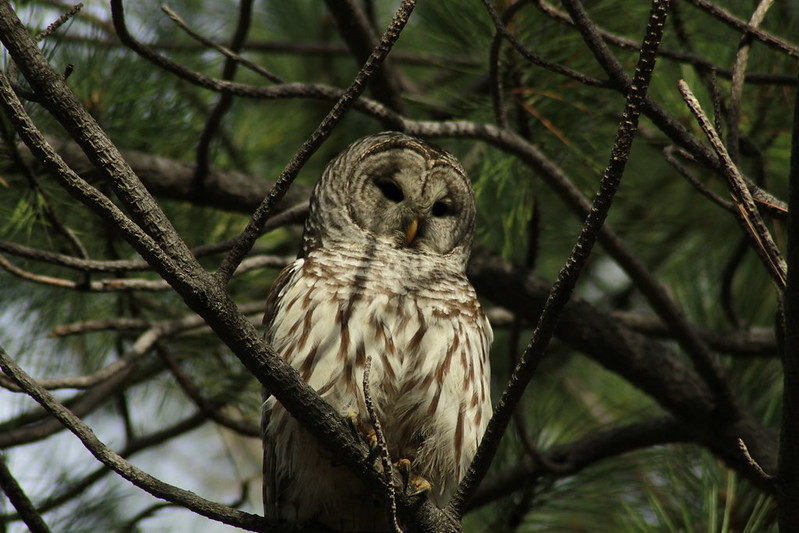
Barred owl. Jon David NelsonCC BY-NC-SA 2.0.

Found poem: stories we tell ourselves

On Ethical ELA’s VerseLove today, Amy Vetter invites teacher-writers to compose found poems: “A found poem is like a collage…find a text (e.g. a novel) or series of texts (e.g., novel, poem, article) and pull out words, phrases, sentences that stick out to you. Play around with the words. Rearrange them until a thought or theme jumps out at you. Continue until you’ve created a cohesive text.”

My found poem comes from Natalie Babbitt’s The Search for Delicious, Amanda Gorman’s poem “Arborescent I” from Call Us What We Carry, and A Field Guide to Lies: Critical Thinking in the Information Age, Daniel J. Levitin.

Stories We Tell Ourselves

I read a story
about people who 
built towns
crowned a king
and enjoyed 
a great many 
quarrels and troubles 
all of which 
they created quite 
by themselves

for our brains are built
to make stories as 
they take in the vastness
of the world

we forget
looking at a city
through the window 
of a train
that we’re only seeing
the part
with the train tracks
running through it
not the whole

blow the whistle
open the door
but it is shut
and locked

the brain
makes up its mind
-it is a very powerful
self-justifying machine

and so 
for selective windowing
we would again
give up our world

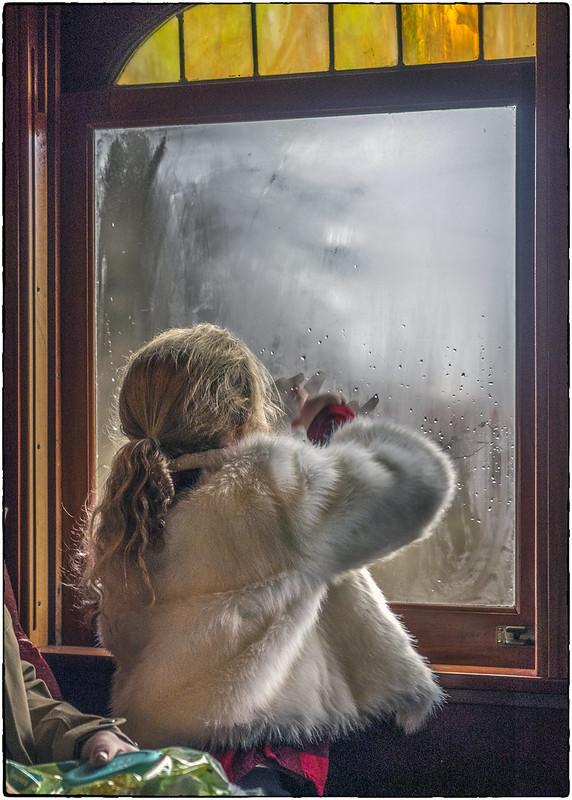
Train WindowNoJuanCC BY-NC-SA 2.0.