My own St. Patrick

In 1906, Theodore Roosevelt was president, Upton Sinclair published The Jungle, and the San Franciso earthquake killed around three thousand people. The Panama Canal was under construction and Cuba had its first president. Susan B. Anthony died that year. Lou Costello, Estée Lauder, and Anne Morrow Lindbergh were born.

In the far reaches of eastern North Carolina, a farm woman named Claudia Amanda Victoria delivered another of her ten children. A boy. She would have only two girls; one would die of diphtheria at age four.

But this baby boy would be hardy. He would outlive them all.

She named him Columbus St. Patrick.

Some folks called him Columbus. Those who knew him best called him Lump.

I called him Granddaddy.

As I grew up listening to the old stories, I tried to imagine living in his era. Seeing an early Ford Model T. Mail-ordering live chickens, delivered in wire cages by horse and buggy. Raising ducks that wandered off to the swamp on a regular basis, only to be herded back home again to eat bugs in the garden and to provide eggs for breakfast. Learning to plant and to harvest, to be in tune with the rhythms of the earth, following the steps of that ancient choreography, the seasons.

He was five when the Titanic sank, seven when World War I began. His older brother, Jimmy, served in the Great War and returned; I would know him and his wife Janie in their old age. They lived in a little tin-roofed house along one of the many dirt roads of my childhood summers. Jimmy and Columbus had a brother who drowned long before my time. Job Enoch. One brother accidentally shot and killed another on the porch of the family home. I knew their sister Amanda, who had a high-back pump organ adorned with brown-speckled mirrors in her house. The organ sounded and smelled of ages and ages past…but she could play it, and she could sing.

Columbus didn’t sing, but he loved country gospel songs and bluegrass to the end of his days.

And Columbus St. Patrick loved Sunday School. He had perfect attendance for years, garnering long strings of pins awarded to him. He did not enjoy regular school. He quit in the fourth grade to work on the farm. Later in life he had some regrets about this. But his father walked out on the family and Columbus rose to the role of provider.

He participated in community hog-killings, with the farm wives taking the backbone to flavor collard greens. The pork was preserved in barrels with salt brine. Some of the folks enjoyed scrambling hog brains into their breakfast eggs.

Columbus St. Patrick worked hard. He plowed fields with mules. He took part in the making of molasses, which required several people. Mules walked in a circle, harnessed to poles attached to large grinder where sugarcane was fed to extract the juice. The juice would be collected and heated in trays over a fire, skimmed numerous times until it became rich, blackstrap molasses. At the end of a meal, he sopped his biscuits in molasses, and poured his hot coffee in the saucer to cool it.

He competed with a scrappy little woman named Lula for the honor of being the community’s top cotton-picker. She often beat him.

Lula would be widowed when her husband Francis hung himself in the woods. One of their daughters would find his body.

Columbus St. Patrick’s youngest brother married another of those daughters.

Columbus made some time to hang out with the young people, attending taffy-making parties in their homes and driving groups of friends to the movies in town…all the while noticing Lula’s daughter with the wavy blonde hair and straight posture. There was a certain spark about her.

She considered him her mother’s friend. The “older” set. She was nine years younger and she had her eye on the preacher’s son, who would surely follow in his father’s footsteps: How wonderful, to be a preacher’s wife!

It didn’t happen. Desires of the heart sometimes come to unexpected fruition: I would be a preacher’s wife, a half-century later.

This daughter of Lula’s ended up marrying a farmer: Columbus St. Patrick. They planned to wed in September but he had the mumps. And so it came to pass in mid-December instead.

My grandparents.

Here’s a photo taken sometime early in their marriage:
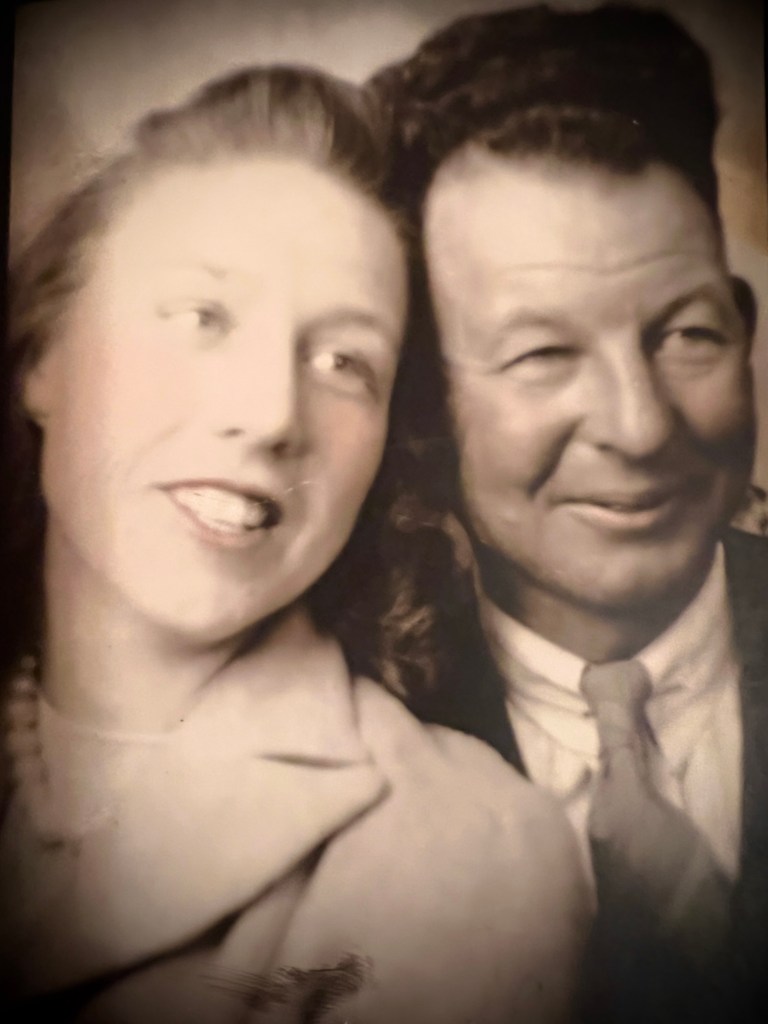
Ruby Frances and Columbus St. Patrick, circa 19371938.
She would have been around 23. He would have been 31 or 32.
If this photo was taken prior to October 1937, my father was not yet born.

They would endure the Great Depression and the second World War with a small child. My father. When Columbus St. Patrick couldn’t make a go of tenant farming and sharecropping, he traveled to the shipyard nearly 200 miles away with a group of men from down home. He was working there, building cradles for ships, when Pearl Harbor was attacked. Suddenly U.S. ship production went into overdrive; the Yard turned out ships in three months versus the usual year.

He would try, after the war, to make a living farming, painting, and doing other handyman jobs. By that time there were three children to care for. Columbus opted to go back to the shipyard, staying in a boarding house during the workweek and coming home to see his wife and children on the weekends.

For ten years.

His son (my dad) became senior class president and entered the United States Air Force after graduation. The oldest daughter was a high school basketball star; Columbus St. Patrick nailed peach crates to posts out in the yard for her to practice. By the time his youngest daughter was ready for high school, he’d had enough of separations. He moved the family to an apartment near the shipyard.

Hilton Village, built between 1918 and 1921, is the first federal wartime housing project in the U.S. It was created for shipyard workers. These quaint, English-style rowhouses would be the setting of my first memories. I would awaken in the dim gray morning at my grandparents’ upstairs apartment and my grandmother soothed me back to sleep while my grandfather, having risen at four, made his own breakfast before going to work. On Sundays, his day off, he took me to the playgound behind the Methodist church.

I felt as safe as I ever have in life, walking hand-in-hand with him.

He retired after I started school and lived another twenty-nine years. He saw my children. He survived the removal of his bladder after a cancer diagnosis. My grandmother would empty the urostomy bag and dress his stoma (surgical opening) every day until his death.

They would lose their middle child, their basketball star, to multiple sclerosis in her fifties. She died on Good Friday; they buried her on Easter Sunday. Their son (my dad) was just recovering from bypass surgery after his first heart attack. He would not survive the second, but Columbus would not be here to suffer the loss of his son.

Granddaddy died of lung cancer under hospice care, at home his own bed, as he wanted, on a fine spring day. He refused morphine in favor of keeping his mind clear. And it was, to the very end.

St. Patrick’s Day rolls ’round again and stirs all the memories. They spring to life, as rich and sweet as molasses that Granddaddy and I sopped with our biscuits. He was always embarrassed by the oddity of his middle name. I am proud of it. I have loved it all my life, just as I’ve loved him. Fiercely. I have learned many a valuable lesson from Columbus St. Patrick: Treat people well. Help those in need. Money doesn’t buy happiness (back in the old days, he said, nobody had any money but everybody was happier). Love your family. Love your neighbor. Get a dog to love. Work hard. Persevere. There’s always a way. Tend the earth. Do your duty. Spend time with children, for they are precious. Go to church. Trust in the Lord. Return thanks.

One day, he said, we will meet again in a better place. I am looking forward to it.

Me, too, Columbus St. Patrick.

Me, too.
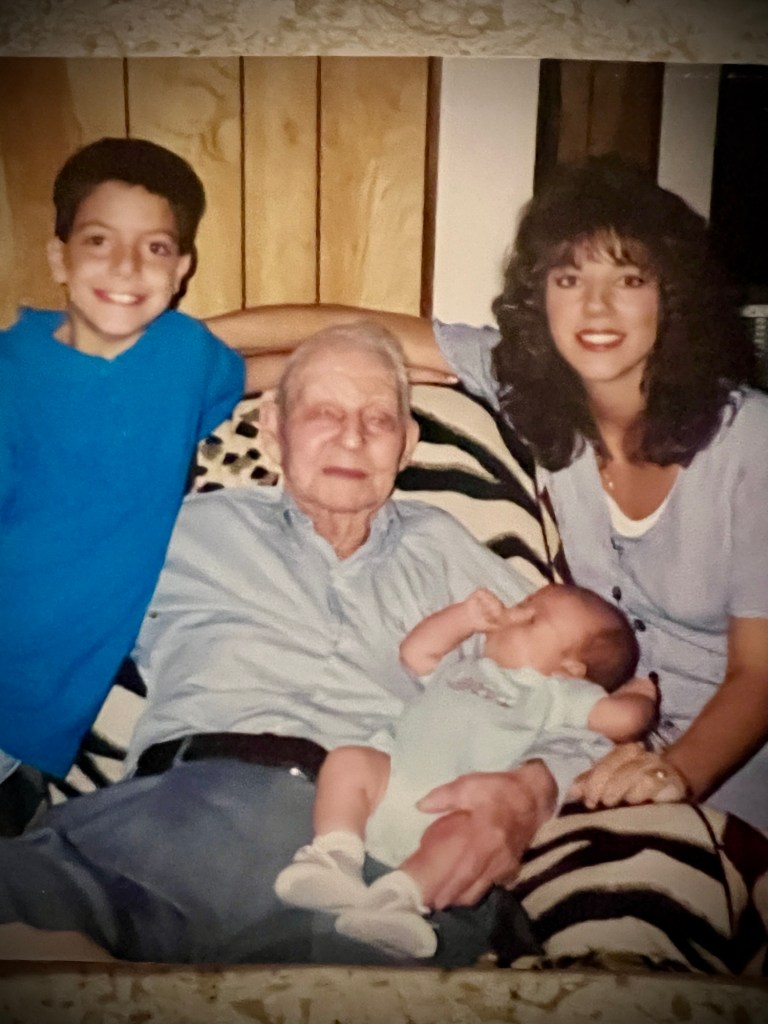
My boys and I visiting Granddaddy for his 91st birthday, 1997.
My youngest was six weeks old.

*******

with thanks to Two Writing Teachers for the March Slice of Life Story Challenge
Jewels

On March 17th I typically write a post contemplating my obscure Irish roots while celebrating the novelty of my grandfather’s middle name: St. Patrick. Yes. For real. No one knows why, my down-east North Carolina Methodist Granddaddy hated it, and by my lifetime he’d legally changed it to the initial S.

I love the uniqueness of it. I cannot let the day pass without saying that Columbus St. Patrick Brantley’s name remains a treasure to me, a jewel in my family’s living memory, a perpetual mystery in our supposed non-Catholic history.

Here is where I diverge from my norm to chase, not a name, but a word: jewels. In keeping with the day, of course. The first jewel I’m after is brilliant language, and the Irish are rich in that. It glimmers in every bit of their wit, storytelling, poetry, and song.

In 1996, Frank McCourt’s memoir Angela’s Ashes burst upon the world and won the Pulitzer Prize. As soon as I learned of the book, I had to have it. Reviewers raved about McCourt’s narrative voice: Stunning. Lyrical. Dazzling.

So I got my own copy. From page one…spellbinding. My concepts of writing and memoir were forever changed; McCourt’s Irish voice has never left my head.

Of his many glorious phrases, one that returns to me most often comes from the scene where young Frank is in the hospital recovering from typhoid fever. In the room next door is a girl recovering from diphtheria. They can’t see each other, but she calls out to him. She says she has a book about the history of England with her, if he’d like to read it. He does. Books are treasures to him; his impoverished family doesn’t own any. The girl sends the book to him via the nurse, Seamus, who delivers it most reluctantly, complaining because it’s about England “after all they did to us” and that there “isn’t a history of Ireland to be had in this hospital.”

McCourt writes:

The book has the first bit of Shakespeare I ever read:

I do believe, induced by potent circumstances
That thou art mine enemy
.

...I don’t know what it means and I don’t care because it’s Shakespeare and it’s like jewels in my mouth when I say the words.

Jewels in my mouth…

I knew exactly what he means. I loved Shakespeare from my own first encounter. The last line of Sonnet 73 is the heartbeat of most everything I do in life, certainly of the things I write: To love that well, which thou must leave ere long. Jewels in my mouth, in my heart…the bequest of beautiful language.

McCourt eventually left Ireland for America where he became a high school English teacher. He’d regale his classes with stories of his childhood, and they’d say Hey Mr. McCourt, you should write a book.

So he did.

Angela’s Ashes.

And so the world is changed.

That is the power of story.

That is the second jewel from McCourt: Story. Specifically, writing of your own life.

In his final memoir, Teacher Man, he’s become a creative writing teacher. He’s trying to inspire students to write about their lives when they think there’s nothing interesting to say. He tells them: Every moment of your life, you are writing. Even in your dreams, you’re writing…Dreaming, wishing, planning: it’s all writing, but the difference between you and the man on the street is that you are looking for it…realizing the significance of the insignificant, getting it on paper. You might be in the throes of love or grief but you are ruthless in observation. You are your material. You are writers and one thing is certain: no matter what happens, you’ll never be bored again. Never…nothing human is alien to you.

Jewels. Your words, your story, your every moment. All priceless.

I met Frank McCourt in the winter of 2000 when he visited North Carolina State University. I went despite a falling snow. I took my oldest son with me and we listened to McCourt speak of his books and devastating childhood in Ireland. We listened, and marveled. We listened, and wondered about the story of our own origins on The Emerald Isle.

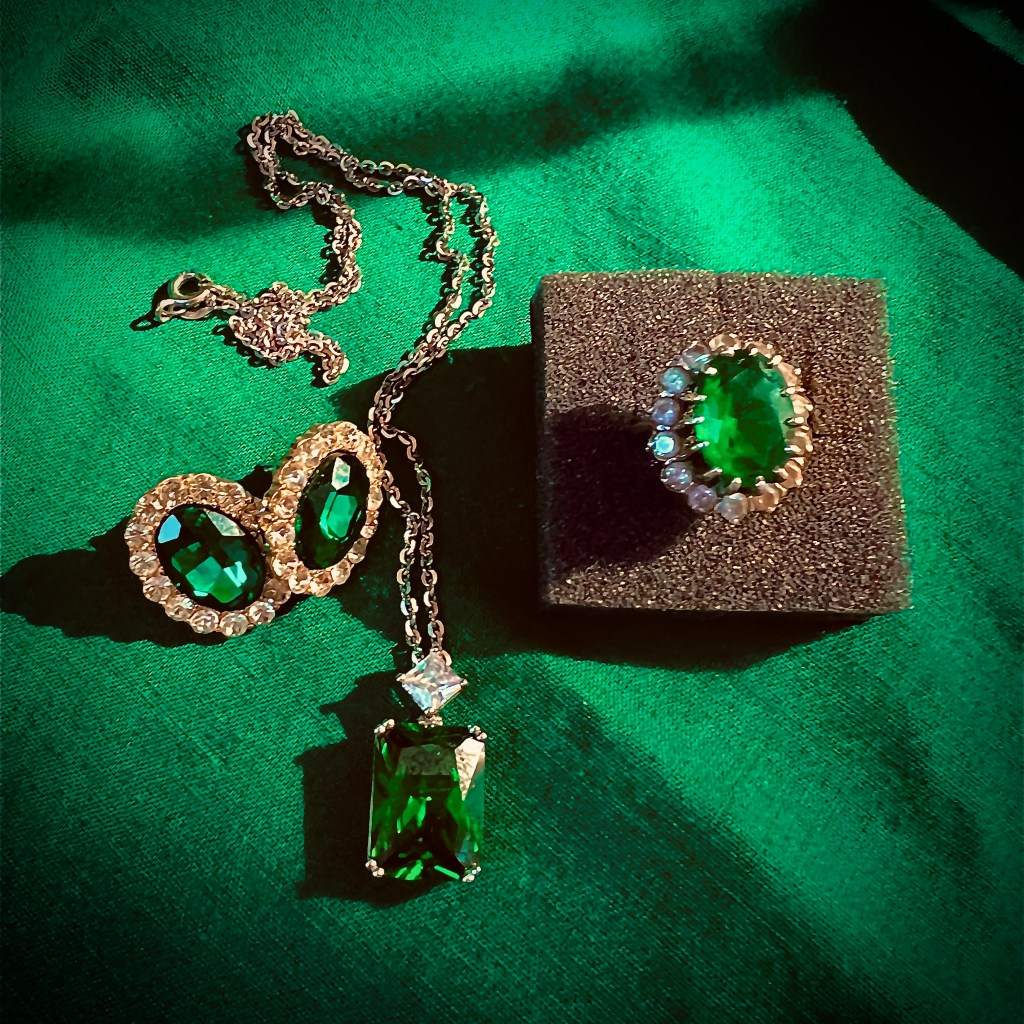
Which brings me to my final set of jewels for today: Christmas before last, my husband gave me a necklace and ring. His sister, without knowing or discussing it with him, gave me earrings. The jewelry, all bearing my birthstone, emerald, are a startling match. My sister-in-law chose the jewelry for me because she loves the color. My husband said, These are to remind you that one day, I’ll take you Ireland.

Where, I imagine, the voices of my distant ancestors still whisper in the wind…perhaps when I go, if I am very still, I might hear them…learn from them…

Until then, and always, I shall be about the excavation of my own story-jewels, with McCourt’s words echoing in my brain and my curious link to St. Patrick forever pulling at my heart.

As for today… here’s to proudly wearin’ o’ the green.

*******

Composed for Day 17 of the Slice of Life Story Challenge with Two Writing Teachers

*******

Works cited:

McCourt, Frank. Angela’s Ashes: A Memoir. New York, Scribner, 1996. (Pages 195-196)

McCourt, Frank. Teacher Man: A Memoir. New, York, Scribner, 2005. (Pages 244-246)

Until we meet again

Today I write in memory of my grandfather.

His name was Columbus St. Patrick Brantley.

He was born in 1906 “up the swamp” in coastal North Carolina. Farming was in his blood. He married my grandmother during the Depression and worked as a sharecropper. My father was born in a tenant house. Just before WWII, Granddaddy went to Virginia to work as shipwright. He tried farming and house painting after the war but “couldn’t make a go of it,” so he went back to the shipyard, where he was still working when I came along. For the record: the whole family said I looked exactly like him when I was born.

He didn’t work on Sundays; that became our day together when I was small.

He retired when I was six. He and my grandmother moved back home and thus began my many journeys to the little white house nestled in the bend of an old dirt road, where the woods had grown up all around, taking back house after house where people lived no more.

In his later years Granddaddy recorded stories of his life on audiocassette to give to his family. He could remember seeing his first Model T at age three or four. He said that mail was delivered by horse and buggy; farmers ordered chickens that were delivered in cages. He had a whole string of pins awarded him for perfect Sunday School attendance at the little Methodist church. He loved listening to the Grand Ole Opry on the radio. He spoke of his nine siblings, including a sister, Peaney (Penelope), who died of diphtheria at age four. He outlived them all. He lived to see both of my children. He could remember an ancestor speaking of Dublin.

Near the end of his life, I gave him a framed print of an Irish blessing. It hangs by my front door now:

The last time I saw him, he was dying of lung cancer at ninety-two. It was springtime. He’d grown weak but was fully dressed, sitting in his recliner by the door; he tried to coax my two-year-old to sit in his lap, like I did when I was little. I sat by his chair on a stool and held his old, wrinkled, work-worn hand.

Do you remember how we used to go to the park on Sundays?

I do, Granddaddy. We took bread to feed the ducks.

And the old locomotive?

I can just remember climbing in it together…

He was tired, always a man of few words. We sat for a long time together, not speaking at all.

When it was time to go, I kissed him on his forehead.

I love you, Granddaddy. God’s got you safe in His hands.

That’s the best place to be. And I love you.

He held tight to my hand.

It’s been twenty-three years. You can’t imagine all I have to tell you, Granddaddy. There’s been another pandemic. Wars and rumors of wars. Your great-grandsons are grown. The little two-year-old you tried to coax into sitting with you at that last visit plays piano and guitar; he loves singing the old-time songs that you loved. His brother’s a pastor with a baby girl; he tells me almost daily that something about your great-great-granddaughter reminds him of you. God remains faithful from one generation to the next. It’s almost springtime again, the fields are so green…

Until we meet again, Columbus St. Patrick.

I love you.

*******

with thanks to Two Writing Teachers for the Slice of Life Story Challenge every day in the month of March.


In the name of St. Patrick

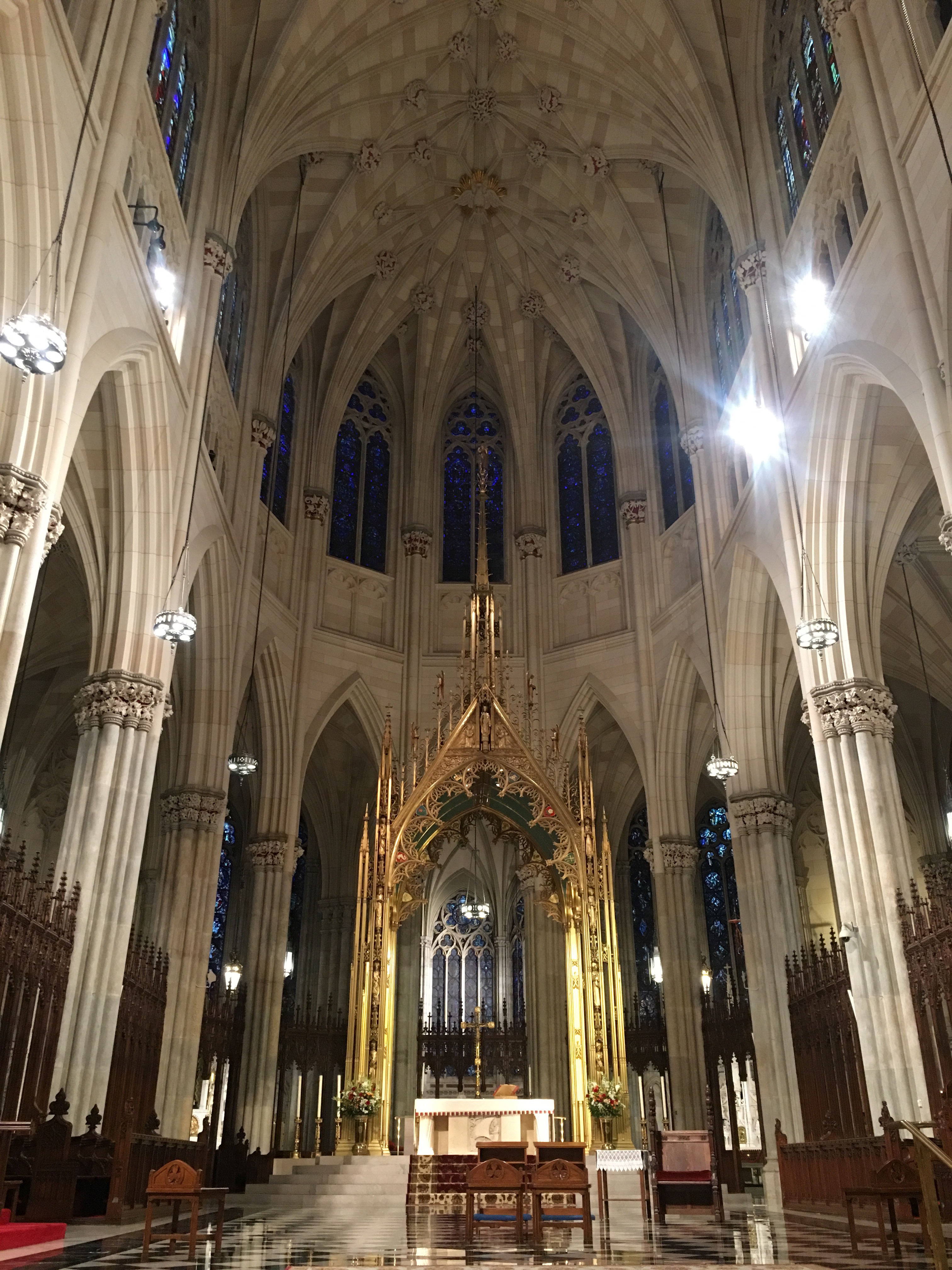
St. Patrick’s Cathedral, New York City, on my most recent visit in 2016

I was sixteen years old the first time I went to New York City—that’s the same age, according to his own writing, that St. Patrick was kidnapped in Britain and carried to slavery in Ireland.

I didn’t know this fact at the time. I arrived in the city that long-ago day with my high school drama club, excited that his cathedral was one of our designated destinations.

Raised in the Baptist church, I had only a rudimentary understanding of the canonization of saints. A shadowy working knowledge in which St. Patrick loomed very large, for a personal reason:

My grandfather, born in rural North Carolina in 1906, was named Columbus St. Patrick.

Why remains a mystery to this day.

Of course there were stories of Irish heritage. Granddaddy maintained that his paternal grandfather came to America from Ireland with his brothers, but the timeline is knotty, the facts obscure, the story too piecemeal to be reconstructed. He dimly remembered his grandfather talking about carving a dugout, a small boat made from a hollow log, in Dublin.

That’s the only tiny jewel of Irish family lore I have, besides my grandfather’s middle name.

Oh, and the surname of my other grandfather, whom I barely knew: Riley.

Just this year, my family took the DNA ancestry plunge. I learned that a good bit of my blood really does run green.

I like to think it was calling to me when I first entered the cathedral, tears inexplicably welling in my eyes. It had to be more than the curiosity of Granddaddy’s name being St. Patrick, although I was mindful of it at the moment.

Maybe my emotion rose in response to the breathtaking splendor, the deep hush, the sense of pure awe . . . and something utterly unnameable. I would later learn that this profound monument to God, named for His missionary saint, was built in part by contributions of poor Irish immigrants, thousands of them. Wealthy citizens donated, too. The cathedral website states:  “St. Patrick’s Cathedral proves the maxim that no generation builds a cathedral. It is, rather, a kind of ongoing conversation linking generations past, present and future.”

—An ongoing conversation linking generations past, present, and future.

A conversation of love. Of extreme sacrifice. Of perseverance. Of devotion. Of faith.

Of blessing. Now and for all time.

The pillars of my life, built on foundations laid by my grandfather.

Until we meet again, Columbus St. Patrick, may God hold you in the palm of His hand.

*******


Previous posts about my grandfather:

Red rubber boots

A long time ago, in a Galaxie far, far away

My grandfather, St. Patrick with my favorite photo of him, circa 1924-25

First do no harm – on nature and wisdom

What is literacy – for reading isn’t always about words

Happy place

A slice of long ago – 1937 and plowing with mules

Happy St. Patrick’s

Happy St Pat's

Happy St. Patrick’s Day. Hailey E. HerreraCC BY

Last year on this day, I wrote about being St. Patrick’s granddaughter.

My grandfather, born in 1906 in the far reaches of Beaufort County, North Carolina, was named Columbus St. Patrick. (Read the post if you like).

You’d think our family would be Catholic, celebrating this day with the best of them, but we aren’t and we don’t. What a mystery, his having that name. Legend has it that his grandfather came to America from Ireland, but records are sketchy. One of these days I’ll have my DNA tested by Ancestry.com to prove how green my blood really is (it’s metaphorical, Mr. Spock. Although being related to you would be . . . fascinating).

I love Irish things. My wedding band bears a Claddagh. Hearing an Irish tenor takes my breath, stirs my soul, fills me with an ache, a longing. Whenever I visit New York City, I have to stop by St. Patrick’s Cathedral; I could stay inside indefinitely, savoring the profound beauty, the grandeur, the reverent hush. It’s one of my all-time favorite places. I adored Frank McCourt and met him years ago when he came to speak at North Carolina State University—it was snowing that night. Magical. I have a shamrock growing in a pot on my kitchen table and I even had an Irish Setter once. His name was Dublin. I grew up eating Irish potatoes grown by my grandfather or from the potato sheds of his farming community; Granddaddy’s pronunciation was ishe (for years I thought he was saying ice) potatoes. I’d love to visit Ireland.

I thought, to commemorate this day, that I’d post a lovely quote from St. Patrick and reflect upon it, maybe in verse.

This, however, is the quote I found, and for the life of me (remember the Irish keen sense of humor), I can’t find another one to top it at present.

So, Happy St. Patrick’s Day, one and all—with a special nod to Harry Potter fans:

Do you suppose it’s true, that St. Patrick was a Parselmouth, and his Muggle friends never knew?

~David J. Beard (1947–2016), tweet, 2012 March 17th

saintpatrick