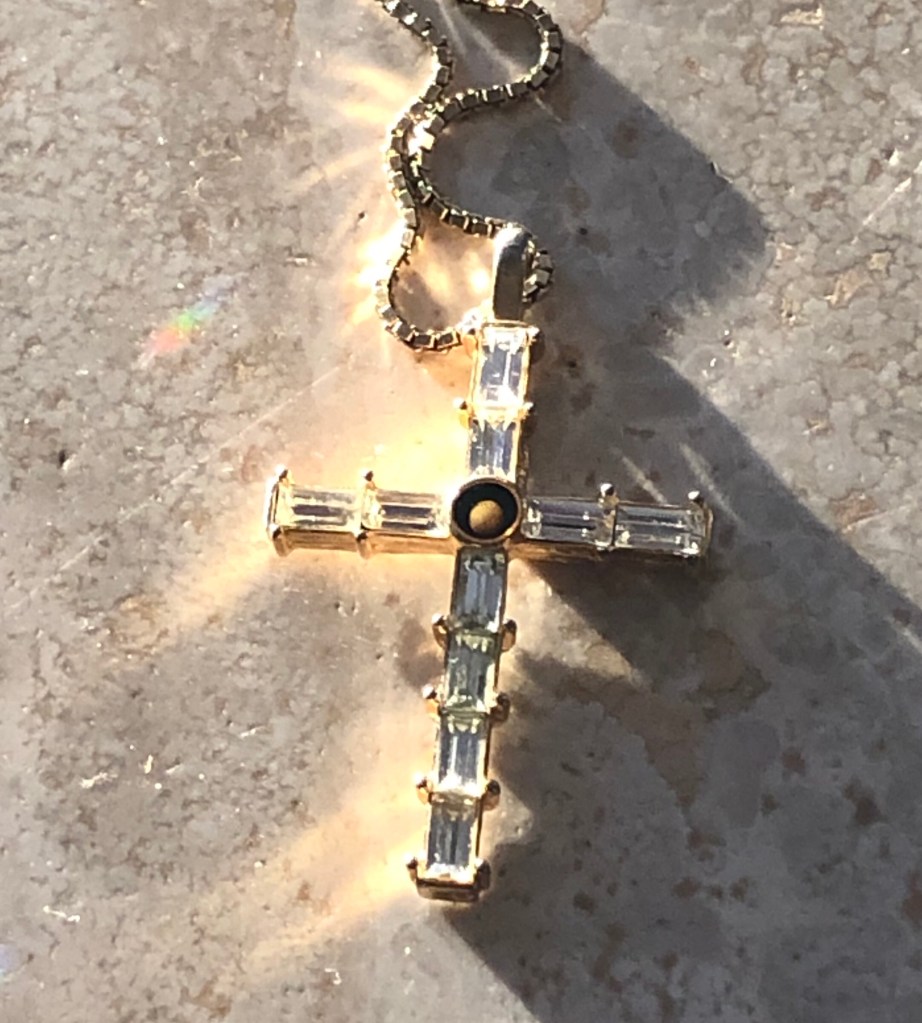
Do you know it’s been twenty years since you handed me that necklace at Grannie’s funeral? “Saw it at the drugstore counter,” you said. “I thought it was pretty and that you’d like it.”
Do you know how it moved me because you weren’t one for giving gifts very often. I was surprised. And you were so pleased when I put it on.
Do you know that I still have it.
Do you know that I wear it to funerals and it brings me comfort.
Do you know that I wore it to yours and you seemed very near.
Do you know that I wear it to church on special occasions like Easter.
Do you know that there isn’t any church gathering this Easter.
Do you know what’s happening here on Earth.
Do you know that on the back of the pendant etched in tiny letters is a word:
F A I T H
Do you know when people comment on how beautiful it is, I say Thank you. It was a gift from my father.
Do you know that in all these years the drugstore cross you bought for me hasn’t tarnished at all.
This is my second attempt at writing a blitz poem. The first didn’t go so well. I think I am getting the hang of it. Will keep practicing to see what comes … of course my thoughts are colored by COVID-19.
Signs of Sun
Read a book Read the signs Signs of spring Signs of the times Times of trouble Times of plenty Plenty to eat Plenty enough Enough to go around Enough for now Now is the best time Now who among you You who are [not] gathered here You are loved Loved best of all Loved more than words can say Say it again Say it like you mean it It matters It is your word Word of the Lord Word of encouragement Encouragement is needed Encouragement makes the world go round Round and round we go Round off Off the wall Off the chain Chain letters Chain unbroken Unbroken horse Unbroken spirit Spirit of the moment Spirit set free Free from all harm Free as a bird Bird of paradise Bird chatter beyond my window Window of time Window closing Closing the day Closing the book Book of Life Book it out of here Here is where we are Here comes the sun Sun directly overhead Sun in my eyes Eyes Overhead
When I was a child, I looked forward to seeing the dentist.
His name was Dr. Job. Like Job in the Bible, long o, not as in “teaching is a hard job.” I could not understand this when I saw his name on the office door: Why do we say ‘Jobe?’ It says Job! J-o-b. That’s not right.It should have an ‘e’ on the end. J-o-b-e …
It irritated my father: That’s how his name is pronounced. He knows how to spell it. Now stop.
Dr. Job had white hair and a white coat and to be honest I wasn’t happy to see him.
No.
I wanted his rings.
After each visit—usually for a filling—Dr. Job reached into some magical cabinet and brought out a box. With a big smile, he opened it before me like a hawker on the city streets selling watches out of a car trunk.
The box was full of rings, set in foam rubber, as if on display at a fine jewelry counter.
“Which one would you like, hmmm? You’ve been a good little patient!”
Of course I was good … there were rings for the taking! How they glittered. All different colors, sizes, shapes. It didn’t matter which one I chose as they were adjustable; their metal bands were split to be widened or narrowed to fit.
One day I looked and looked it—had to be the best ring—until Dr. Job finally cleared his throat: “Ahem. You need to pick one, all right?”
I settled on a ring with a pale purple stone cut in facets like a diamond. I put it on the ring finger of my right hand (not my left, that was for getting married someday). Feeling like a princess, I said: “This is alexandrite, right?” (so … as a child I was fascinated by birthstones and pored over them in mail-order catalogs. My own is emerald. To me, at the time, this pale purple was prettier. June’s birthstone. Point to ponder: How many kids today know about birthstones? ).
Dr. Job looked at me and blinked. He closed the case and returned me to my father.
The main reason I remember that ring is because of a scene in a different office. Plagued by allergies, I had to get weekly injections in both arms. Sometimes I had reactions, rashes or big knots that burned. While I sat waiting, waiting, waiting at the doctor’s office, before and after the shots, I read all the children’s books and magazines—I loved Highlights. Then I read the grown-up stuff, like Reader’s Digest. One afternoon I was too tired to read. I sat sideways in the waiting room chair, leaning against the wall in the late-afternoon shadows. I reached up to rub my sore left arm when waning light from the window caught my “alexandrite” ring. A dozen tiny rainbows appeared on the wall beside me. Mesmerized, I move my hand this way and that, watching the rainbow-spots dance, vanish, and reappear. I forgot the time, forgot my swollen arm; I was too busy scattering the light.
This whole story returned to me as I was continuing my containment cleaning and sunlight caught my ring (diamond, on my married finger) just right.
Scattered light. Tiny rainbows. On a day, incidentally, when Highlights became a destiny…
Ethereal moments call for an etheree, don’t you think.
Just some fleeting impressions while sweeping my porch …the beauty of the day in such stark contrast to what’s happening in the world …
While sweeping the porch this April day
there’s children at distant play
laughing, falling
voices calling
lawnmowers mowing
cool breeze blowing
flowers quivering
trees shivering
sun shining
life divining.
Joyous birdsong
like nothing’s wrong
as if only rebirth
sweeps the Earth
not humanity hurled
netherworld.
A spring reception
of such deception.
Beautiful day, you’re almost cruel
playing such an April fool.
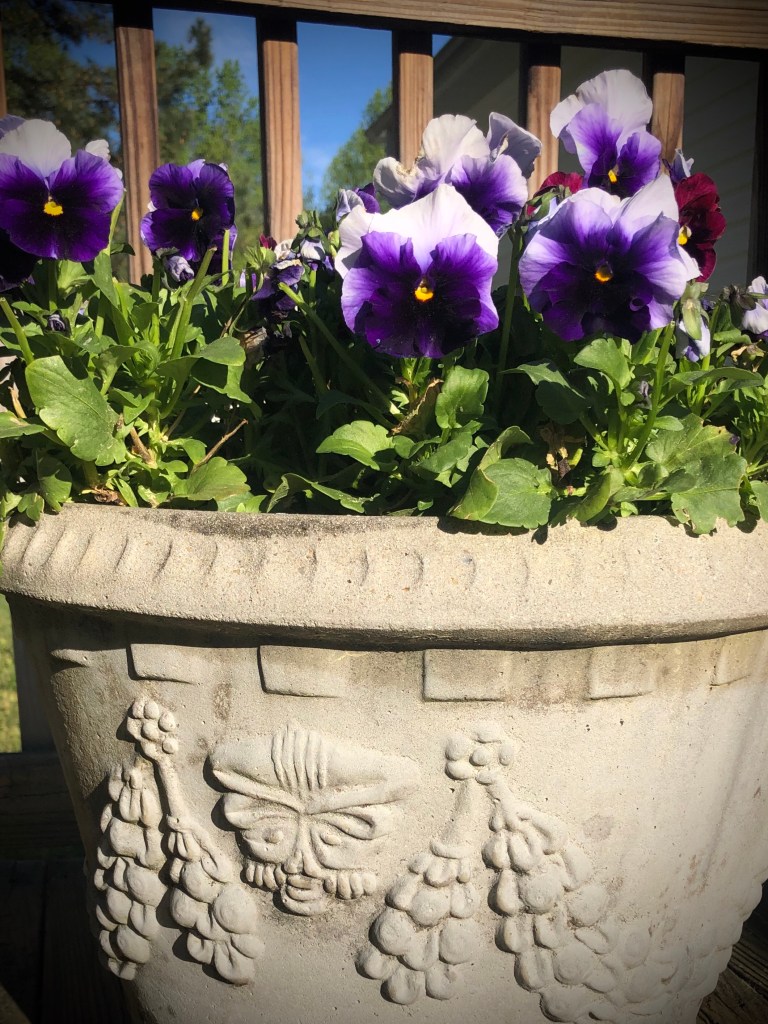
If you were here with me you could see these pansies quivering despite the brightness of the morning. The name of this colorful, dark-eyed flower comes from French penser, “to think.” Pansies symbolize contemplation and remembrance.
Today I write with a group of friends for Spiritual Journey Thursday.
The word restore has been on my mind these days. More or less as a question: When will society, the economy, the country, the health of the globe be restored to pre-COVID-19 conditions? And what will that restoration look like? How changed or different will everything be?
I think on this a lot, as is there is a lot of time to think.
Naturally a well-known line from the Psalms also comes to mind: He restores my soul. It speaks of peace and confidence, of a daily trust. I watch the news, the frenzy of those in the medical profession, pleading on behalf of us all; the government having to count the cost of a shut-down economy as weighed against the life and well-being of its citizens; and everyone worried about having enough resources for coping. They’re all waging a mighty battle against an insatiable, tenacious, invisible pathogen.
While the rest of us watch from a distance, sheltered. Protected. Trusting that the decisions made for us will preserve us, restore us.
We wait in the stillness.
It brings the preceding line of Psalm 23 to mind: He leads me beside still waters.
I could make an analogy of a stormy, violent sea for the government, the medical field, and the stock market, in contrast to the majority of us waiting at home, by the still waters … but a story resurfaced in my memory instead.
Long ago, when I was about seven, I attended a church service where an older girl was baptized. She was perhaps twelve or so, a sweet and affectionate girl well-known and loved by the congregation. It was an exciting morning for the church … except that as this girl entered the baptistry, she was sobbing.
“I can’t do it,” she bawled. ” I can’t …”
Abject terror.
Even as a seven-year-old, I knew she’d chosen to be baptized. She’d walked the aisle some weeks before and professed her faith. I knew the pastor made new members, including children, attend a series of classes to understand the tenets of the faith and the ordnance of baptism. I didn’t understand it all myself, not yet, but I knew this girl, garbed in a white robe, hovering at the steps leading down into the water, crying, wanted to act on her faith. I’d never seen anyone react this way to being baptized: Why’s she so scared?
I look back now and wonder: Was she simply afraid of water? Had she never gone swimming in a pool, as I had?
The water wasn’t deep. It wasn’t cold; it was heated to be comfortably warm. It wasn’t waves crashing on the shore, no dangerous undertow, just clear, still water.
Our pastor, a humble, middle-aged man, a former Navy pilot in WWII and a Bible scholar, stood in his own robe of white at the center of the baptistry. He reached out his hand: “It’s all right, Dear Heart. See, I’m here. It’s safe. You know I’m going to hold onto you.” When she stayed rooted to the steps, clinging to the hidden rail, our pastor waded over, put his arm around her, and led her into the pool.
He held her for a moment. We heard him whisper: “Are you ready?”
Loud sobs, but a nod of her little head.
He raised his hand heavenward:
“I baptize you, little sister, in the name of the Father, the Son, and the Holy Spirit …”
Whoosh.
She went under and just as quickly, he raised her back up.
“I DID IT!” she shouted, hair plastered to her head, wet face shining. “I DID IT!”
If ever there was a vision of radiant joy, that’s it.
The entire congregation wept, even seven-year-old me.
The tears return even now, remembering.
He leads me beside still waters. Sometimes through still waters. When we cannot see the bottom. When we’d really rather not descend into them, when we don’t want to get wet at all, when we fear not so much immersion but submersion: How long will we be under? Can we last?
He restores my soul. It is a matter of trust that, somehow, all will be well, that we will be raised back up, we will be led safely through.
For now, we wait in the stillness like water lilies … which, in the Tamil poetic tradition, happens to symbolize the grief of separation.
On the placid surface
rest the blooms
in waters still.
Their unseen roots
anchor them
to the earth
far below.
And so we float
suspended
separate
waiting
enduring
this strange baptism
yet anchored
to one another
by unseen roots
while time stands still.
Today, in my mind, in my heart, the word restore echoes over and over and over like a prayer.
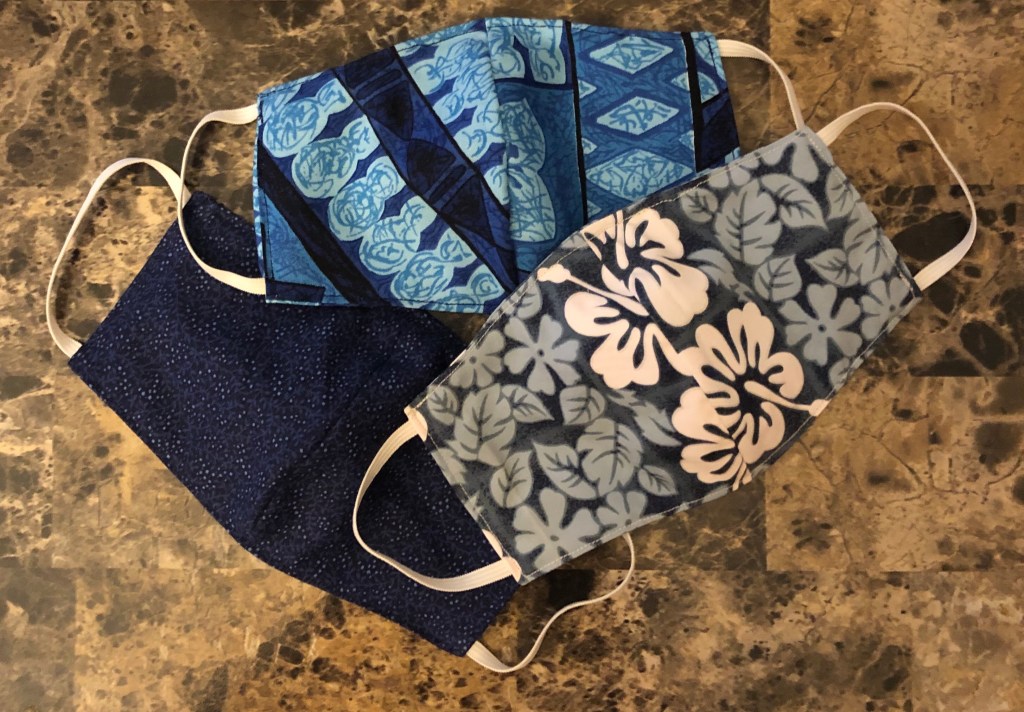
A friend wanted to know if my family would like some face masks.
She is making them.
She sent us pictures of the fabric—she has bolts of it—for us to choose the prints.
Yesterday she and her husband pulled up in our driveway to drop off the masks. My husband and I went out to meet our friends, offering our thanks only in words, no hand-grasps or hugs … a time to embrace, and a time to refrain from embracing … a few weeks back, we were all sitting around the dining room table here in the house, laughing and telling stories after a lasagna dinner. It seems long ago.
When will we be able to do so comfortably, again?
When I look at these masks, I see all that they represent. Shields in time of trouble. A friend channeling inertia into something productive, a practical means of battling an unseen enemy. Self-care spreading out like a blanket to cover others. Homemade love. Colorful patterns against the dark backdrop of our days.
These masks are artifacts of our times. Symbols of our story as we live it. And nothing connects humanity as much as story.
As I walked out to the driveway to receive these gifts, my grandmother’s voice echoed from across the years:
You won’t believe it, but where these woods are now used to be houses and farms, up and down this little road … when the Spanish flu came, it hit all but a couple of them … twelve people died in one week … Mama made pots of soup and Papa would carry it to their doors. He wouldn’t go in, of course …
Grandma wouldn’t have had living memory of this. When the influenza pandemic began in January 1918, she was only two. But she knew the stories. If my own memory serves me correctly, as I walked the tiny country cemeteries surrounding her homeplace, listening to her narratives of the people resting there—for she knew all their stories, and how they were connected— there was an unexpected commonality.
A death year. 1917.
That was before the Spanish flu.
Grandma nodded. There was a sickness before: They called it hemorrhagic fever. People would bruise and bleed from their noses and ears and eyes … a lot of people who tried to take care of the sick caught it and died, too …
She was hardly more than a baby then, a girl born and raised in a hard place in hard times, but here she stood, by the weather-worn stones under a cloudless blue sky, telling the stories seven decades later.
Because of story, these events are lodged in my memory a hundred years after they happened.
My father was Grandma’s first child, born during the Great Depression. Flour companies made their sacks with patterns and bright colors so people could make clothes out of them … look at my handmade face masks and tell me they aren’t reminiscent. A second child, my aunt, arrived with the war. Granddaddy moved the family from North Carolina to Virginia; he found work in the shipyard, where production increased to the point of cranking out ships in less than a third of the time it normally took. How can one not compare that to the scramble for mass production of ventilators today …
Grandma said: It was so hot that summer. I was miserable, being pregnant. I’d sit by the upstairs window and watch the iceman delivering blocks of ice to grocers … companies stopped making refrigerators … everything went into the war effort. I just cried. I’d have given anything for some of that ice … then we had ration cards and could only get certain things at certain times … once my sister Jack and her husband pooled their gas ration cards with ours and we all went on a trip to Massachusetts … it was so beautiful and so cool there …
I look at these masks and that is what I see.
The story of overcoming. Of determination. Of resourcefulness in time of scarcity. Of finding a means to be a good neighbor, a good friend, a real and present help in time of need, even if from a safe distance. Sharing so that everyone has enough. Acts of service, gifts of love. Sacrifice.
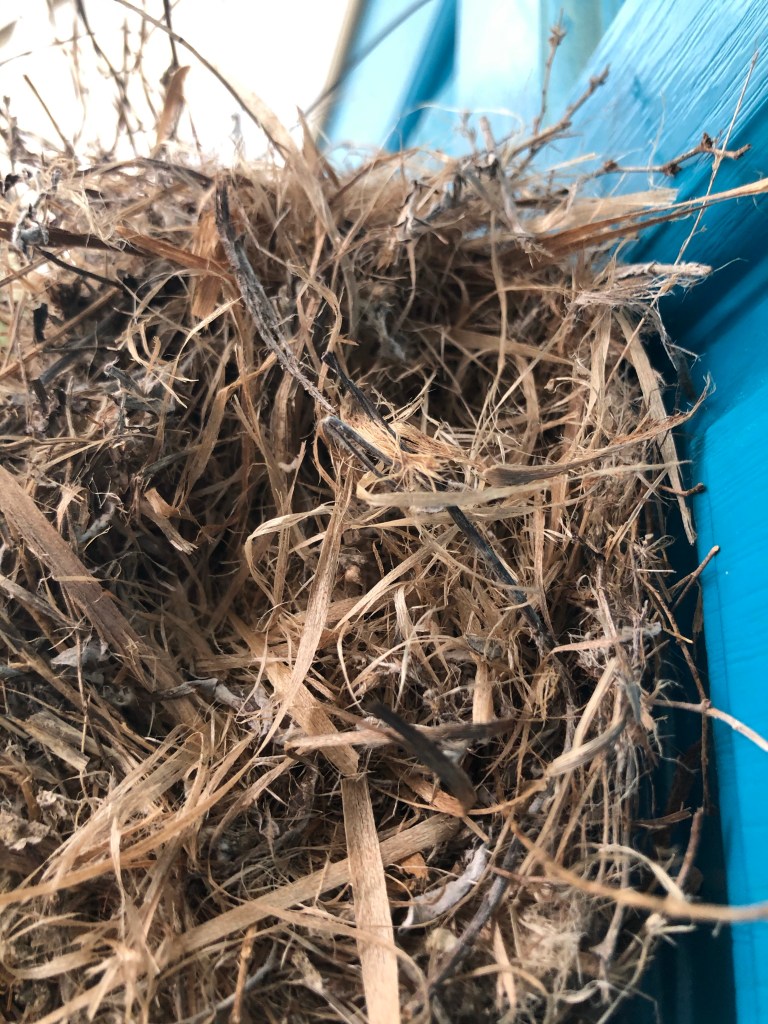
Mourning doves are said to symbolize providence, grace, peace, safety, renewal, and moving forward. Their low-pitched song sounds sad or comforting, depending on the listener. I dedicate this lament to the dove outside my kitchen window, whose plaintive murmur I hear in the dark, just before sunrise.




 lit bits and pieces